

General purpose technologies ‘Engines of growth’?
Open accessThe DOI matches its Crossref record; 39 of the 45 references it cites were found in a registry or an index.
Abstract
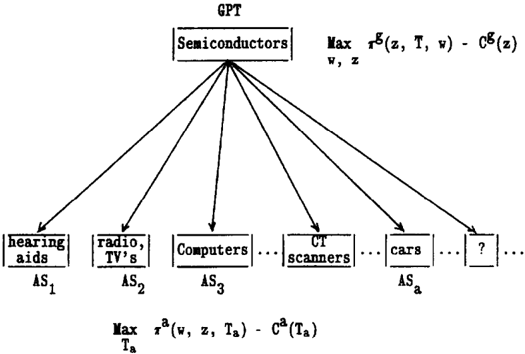
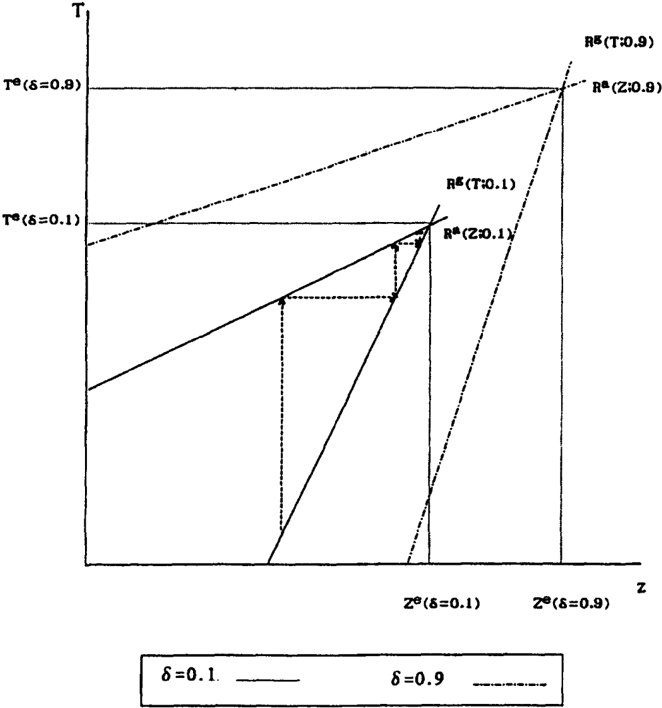
Whole eras of technical progress and growth appear to be driven by a few ‘General Purpose Technologies’ (GPT's), such as the steam engine, the electric motor, and semiconductors. GPT's are characterized by pervasiveness, inherent potential for technical improvements, and ‘innovational complementarities’, giving rise to increasing returns-to-scale. However, a decentralized economy will have difficulty in fully exploiting the growth opportunities of GPT's: arms-length market transactions between the GPT and its users may result in ‘too little, too late’ innovation. Likewise, difficulties in forecasting the technological developments of the other side can lower the rate of technical advance of all sectors.
Overview
The claims and statistics of this paper haven’t been checked yet.
Free: it reads the open-access text and checks the first 5 claims that cite a source we can check. Create a free account to check every claim.
Integrity signals
Registry
Cites
Statistics
Figures
Verification
Claims the paper makes
The claims and statistics of this paper haven’t been checked yet.
Free: it reads the open-access text and checks the first 5 claims that cite a source we can check. Create a free account to check every claim.
Claims other papers make about this one
Each is checked against this paper’s own text: does it say what the citing paper says it does?
The source backs part of the claim, not all of it — or backs it for a different population, condition or comparison.
In the citing paper
“The impacts of GPT are pivotal explanatory factors of long-term economic growth: 'One of the most important aspects of GPT is that they rejuvenate the growth process by creating spillovers that go far beyond the concept of measurable externalities' [80] (p. 100).”
From Digitalization and the Decoupling Debate: Can ICT Help to Reduce Environmental Impacts While the Economy Keeps Growing? (2020) · cites this paper as [80]
Experimental — accuracy not yet measuredThe source backs part of the claim, not all of it — or backs it for a different population, condition or comparison.
In the citing paper
“We conclude that LLMs such as GPTs exhibit traits of general-purpose technologies”
From GPTs are GPTs: An Early Look at the Labor Market Impact Potential of Large Language Models (2023) · cites this paper as Bresnahan and Trajtenberg, 1995
Experimental — accuracy not yet measuredThe source backs part of the claim, not all of it — or backs it for a different population, condition or comparison.
In the citing paper
“General purpose technologies (GPTs) such as AI enable and require significant complementary investments, including co-invention of new processes, products, business models and human capital.”
From The Productivity J-Curve: How Intangibles Complement General Purpose Technologies (2021) · cites this paper as Bresnahan and Trajtenberg 1995
Experimental — accuracy not yet measuredIn the citing paper
“AI, and in particular the subfield of AI called machine learning, is pervasive, improves over time, and spawns complementary innovation, thereby meeting Bresnahan and Trajtenberg's (1995) three canonical GPT criteria.”
From The Productivity J-Curve: How Intangibles Complement General Purpose Technologies (2021) · cites this paper as Bresnahan and Trajtenberg's (1995)
In the citing paper
“Specifically, they are pervasive, improve over time, and lead to complementary innovation (Bresnahan and Trajtenberg 1995).”
From The Productivity J-Curve: How Intangibles Complement General Purpose Technologies (2021) · cites this paper as Bresnahan and Trajtenberg 1995
Self-check
Percentages, sums and reported differences re-computed from the paper’s own numbers.
The self-check needs the paper’s full text.
Citations
Cites
Increasing returns and long-run growth
Romer, P. M. (1986) · Journal of Political Economy · doi:10.1086/261420 · Cited by 20,149
Technical Change and the Aggregate Production Function
Solow, R. M. (1957) · The Review of Economics and Statistics · doi:10.2307/1926047 · Cited by 12,259
The Theory of Industrial Organization
Jean Tirole, Z. (1988) · MIT Press Books · Cited by 8,651
Economic Welfare and the Allocation of Resources for Invention
Arrow, K. J. (1962) · The Rate and Direction of Inventive Activity · doi:10.1515/9781400879762-024 · Cited by 8,635
The Strategy of Economic Development
Linder, S. B., & Hirschman, A. O. (1959) · Ekonomisk Tidskrift · doi:10.2307/3438684 · Cited by 6,249
Innovation and Growth in the Global Economy.
Taylor, M. S., Grossman, G. M., & Helpman, E. (1993) · Economica · doi:10.2307/2554862 · Cited by 6,231
Theory of Industrial Organization.
Rubinstein, A., & Tirole, J. (1989) · Economica · doi:10.2307/2554286 · Cited by 5,142
Holmstrom, B. (1982) · The Bell Journal of Economics · doi:10.2307/3003457 · Cited by 4,903
Innovation and growth in the global economy
Broadberry, S. (1992) · International Journal of Industrial Organization · doi:10.1016/0167-7187(92)90023-r · Cited by 3,930
Hybrid Corn: An Exploration in the Economics of Technological Change
Griliches, Z. (1957) · Econometrica · doi:10.2307/1905380 · Cited by 3,330
Research works printed but not linked: 4
- Fisher, F.M., J.E. Greenwood, and J.J. McGowan, 1983, Folded, spindled, and mutilated: Economic analysis of U.S. vs. IBM (MIT Press, Cambridge, MA).
- Landes, D., 1969, The unbound Prometheus (Cambridge University Press, Cambridge).
- Mokyr, J., 1990, The lever of riches (Oxford University Press, New York, NY).
- Pakes, A. and P. McGuire, 1992, Computation of Markov perfect Nash equilibrium: Numerical implications of a dynamic differentiated product model, NBER technical discussion paper.
Cited by
Items 401–500 of 1,010
Technology adoption and upskilling in the wake of Industry 4.0
Pedota, M., Grilli, L., & Piscitello, L. (2022) · Technological Forecasting and Social Change · doi:10.1016/j.techfore.2022.122085 · Cited by 98
The Rise of Generative Artificial Intelligence and Its Impact on Education: The Promises and Perils
Murugesan, S., & Cherukuri, A. K. (2023) · Computer · doi:10.1109/mc.2023.3253292 · Cited by 92
Schweikl, S., & Obermaier, R. (2019) · Management Review Quarterly · doi:10.1007/s11301-019-00173-6 · Cited by 93
Müller, J. M., & Voigt, K. (2018) · IFAC-PapersOnLine · doi:10.1016/j.ifacol.2018.08.245 · Cited by 90
Ultra-fast broadband investment and adoption: A survey
Abrardi, L., & Cambini, C. (2019) · Telecommunications Policy · doi:10.1016/j.telpol.2019.02.005 · Cited by 90
Broadband adoption and firm productivity: evaluating the benefits of general purpose technology
Majumdar, S. K., Carare, O., & Chang, H. (2009) · Industrial and Corporate Change · doi:10.1093/icc/dtp042 · Cited by 91
From Growth Theory to Technology Policy - Coordination Problems in Theory and Practice
Klette, T. J., & Møen, J. (1998) · RePEc: Research Papers in Economics · Cited by 90
Organizing for innovation: A contingency view on innovative team configuration
Vakili, K., & Kaplan, S. (2021) · Strategic Management Journal · doi:10.1002/smj.3264 · Cited by 89
ICT, trade openness and economic growth in Tunisia: what is going wrong?
Dahmani, M., Mabrouki, M., & Youssef, A. B. (2022) · Economic Change and Restructuring · doi:10.1007/s10644-022-09388-2 · Cited by 89
Technology growth in the digital age: Evidence from China
Jin, C., Xu, A., Zhu, Y., & Li, J. (2022) · Technological Forecasting and Social Change · doi:10.1016/j.techfore.2022.122221 · Cited by 90
An empirical test for general purpose technology: an examination of the Cohen-Boyer rDNA technology
Feldman, M. P., & Yoon, J. W. (2011) · Industrial and Corporate Change · doi:10.1093/icc/dtr040 · Cited by 90
Innovation and productivity in services and manufacturing: the role of ICT
Aboal, D., & Tacsir, E. (2017) · Industrial and Corporate Change · doi:10.1093/icc/dtx030 · Cited by 89
The cyclical advancement of drastic technologiesPreprint
Vaal, A. D., Yetkiner, H., & van Zon, A. (2002) · RePEc: Research Papers in Economics · Cited by 89
The Consequences of Financial Innovation: A Counterfactual Research Agenda
Lerner, J., & Tufano, P. (2011) · National Bureau of Economic Research · doi:10.3386/w16780 · Cited by 95
Broadband and economic growth: a reassessment
Mayer, W. J., Madden, G. G., & Wu, C. (2019) · Information Technology for Development · doi:10.1080/02681102.2019.1586631 · Cited by 88
Regulation and innovation in 5G markets
Bauer, J. M., & Bohlin, E. (2021) · Telecommunications Policy · doi:10.1016/j.telpol.2021.102260 · Cited by 88
Delegation in Multi‐Establishment Firms: Evidence from I.T. Purchasing
McElheran, K. (2014) · Journal of Economics & Management Strategy · doi:10.1111/jems.12054 · Cited by 73
Ict, Innovation and Business Performance in Services: Evidence for Germany and the NetherlandsPreprint
Hempell, T., van Leeuwen, G., & van der Wiel, H. (2004) · SSRN Electronic Journal · doi:10.2139/ssrn.545183 · Cited by 93
L'ECONOMIA DELLA CONOSCENZAPreprint
Geuna, A. (2010) · RePEc: Research Papers in Economics · Cited by 87
Some Simple Economics of the BlockchainPreprint
Catalini, C., & Gans, J. S. (2016) · RePEc: Research Papers in Economics · Cited by 89
Broadband and knowledge intensive firm clusters: Essential link or auxiliary connection?
Mack, E. A. (2014) · Papers of the Regional Science Association · doi:10.1111/j.1435-5957.2012.00461.x · Cited by 86
Service Provision for the Global Economy: The Evolving Indian Experience
Dossani, R. K., & Kenney, M. F. (2009) · Review of Policy Research · doi:10.1111/j.1541-1338.2008.00370.x · Cited by 86
Strategic timing of adoption of new technologies under uncertainty
Stenbacka, R., & Tombak, M. M. (1994) · International Journal of Industrial Organization · doi:10.1016/0167-7187(94)90040-x · Cited by 86
Pandža, K., Wilkins, T., & Alfoldi, E. A. (2011) · Technovation · doi:10.1016/j.technovation.2011.05.003 · Cited by 89
Automation technologies: Long-term effects for Spanish industrial firms
Camiña, E., Díaz-Chao, Á., & Torrent‐Sellens, J. (2019) · Technological Forecasting and Social Change · doi:10.1016/j.techfore.2019.119828 · Cited by 84
ICT growth effects at the industry level: A comparison between the US and the EU
Dimelis, S. P., & Papaioannou, S. (2010) · Information Economics and Policy · doi:10.1016/j.infoecopol.2010.03.004 · Cited by 87
Tylecote, A. (2018) · Research Policy · doi:10.1016/j.respol.2018.10.001 · Cited by 85
Value Creation and Capture From Technology Innovation in the 6G Era
Yrjölä, S., Ahokangas, P., & Matinmikko‐Blue, M. (2022) · IEEE Access · doi:10.1109/access.2022.3149590 · Cited by 84
Hempell, T. (2005) · Economics of Innovation and New Technology · doi:10.1080/1043859042000269106 · Cited by 83
Shinn, T. (2005) · Social Science Information · doi:10.1177/0539018405058218 · Cited by 83
Basu, S., Fernald, J. G., Oulton, N., & Srinivasan, S. (2003) · National Bureau of Economic Research · doi:10.3386/w10010 · Cited by 84
Growth Through Inter-sectoral Knowledge Linkages
Cai, J., & Li, N. (2018) · The Review of Economic Studies · doi:10.1093/restud/rdy062 · Cited by 82
Putting the watering can away –Towards a targeted (problem-oriented) cluster policy framework
Grashof, N. (2021) · Research Policy · doi:10.1016/j.respol.2021.104335 · Cited by 83
Inventer les nouveaux lieux de la ville créative : les espaces de coworking
Moriset, B. (2017) · Territoire en mouvement · doi:10.4000/tem.3868 · Cited by 82
IMPORTED SKILL-BIASED TECHNOLOGICAL CHANGE IN DEVELOPING COUNTRIES
Conte, A., & Vivarelli, M. (2011) · The Developing Economies · doi:10.1111/j.1746-1049.2010.00121.x · Cited by 83
The effect of soft ICT capital on innovation performance of Greek firms
Arvanitis, S., Loukis, E., & Diamantopoulou, V. (2013) · Journal of Enterprise Information Management · doi:10.1108/jeim-07-2013-0048 · Cited by 82
Induced technical change and the cost of climate policy
Wing, I. S. (2003) · ATE Central (National Science Foundation) · Cited by 82
Skill-Biased Technological Change: Evidence from a Firm-Level Survey
Siegel, D. S. (1999) · Upjohn Research (W.E. Upjohn Institute for Employment Research) · doi:10.17848/9780585341651 · Cited by 84
Knowledge Complementarity and Fungeability: Implications for Regional Strategy
Antonelli, C. (2003) · Regional Studies · doi:10.1080/0034340032000108705 · Cited by 81
The who and how of commercializing emerging technologies: A technology-focused review
Haessler, P., Giones, F., & Brem, A. (2022) · Technovation · doi:10.1016/j.technovation.2022.102637 · Cited by 84
Freedom and Innovation: A Country and State Level Analysis
Lehmann, E. E., & Seitz, N. (2016) · The Journal of Technology Transfer · doi:10.1007/s10961-016-9478-3 · Cited by 83
The `New Economy': Background, Historical Perspective, Questions, and Speculations
DeLong, J. B., & Summers, L. H. (2001) · RePEc: Research Papers in Economics · Cited by 81
Raiteri, E. (2018) · Research Policy · doi:10.1016/j.respol.2018.02.017 · Cited by 81
Absorptive and transformative capacities in nanotechnology innovation systems
Pandža, K., & Holt, R. (2007) · Journal of Engineering and Technology Management · doi:10.1016/j.jengtecman.2007.09.007 · Cited by 80
Nylund, P. A., Brem, A., & Agarwal, N. (2021) · Technovation · doi:10.1016/j.technovation.2021.102271 · Cited by 80
Gorton, G., & Ordoñez, G. L. (2016) · National Bureau of Economic Research · doi:10.3386/w22008 · Cited by 80
Forecasting AI progress: A research agenda
Gruetzemacher, R., Dorner, F. E., Bernaola, N., Giattino, C., & Manheim, D. (2021) · Technological Forecasting and Social Change · doi:10.1016/j.techfore.2021.120909 · Cited by 81
The impact of organization capital on firm innovation
Francis, B. B., Mani, S. B., Sharma, Z., & Wu, Q. (2020) · Journal of Financial Stability · doi:10.1016/j.jfs.2020.100829 · Cited by 81
Muñiz, A. S. G., & Vicente, M. R. (2014) · Telecommunications Policy · doi:10.1016/j.telpol.2013.12.003 · Cited by 79
Psychological models of digital competence in Russian adolescents and parents
Солдатова, Г., & Рассказова, Е. (2014) · National Psychological Journal · doi:10.11621/npj.2014.0204 · Cited by 79
The economic fundamentals of smart specialisation
de Lausanne, E. P. F., & Foray, D. (2013) · Ekonomiaz Revista Vasca de Economía · doi:10.69810/ekz.1175 · Cited by 79
Labour-saving technologies and employment levels: Are robots really making workers redundant?
Squicciarini, M., & Staccioli, J. (2022) · OECD science, technology and industry policy papers · doi:10.1787/9ce86ca5-en · Cited by 80
Vona, F., Marin, G., Consoli, D., & Popp, D. C. (2015) · National Bureau of Economic Research · doi:10.3386/w21116 · Cited by 81
From Tools to Agents: Meta-Analytic Insights into Human Acceptance of AI
Li, B., Lai, E. Y., & Wang, X. (. (2025) · Journal of Marketing · doi:10.1177/00222429251355266 · Cited by 79
Innovation diffusion, general purpose technologies and economic growth
Andergassen, R., Nardini, F., & Ricottilli, M. (2016) · Structural Change and Economic Dynamics · doi:10.1016/j.strueco.2016.12.003 · Cited by 82
Understanding successive industrial revolutions: A “development block” approach
Nuvolari, A. (2018) · Environmental Innovation and Societal Transitions · doi:10.1016/j.eist.2018.11.002 · Cited by 82
David, P. A., & Wright, G. (1999) · RePEc: Research Papers in Economics · Cited by 78
Roy, R., Lampert, C. M., & Stoyneva, I. (2018) · Strategic Entrepreneurship Journal · doi:10.1002/sej.1278 · Cited by 79
The emergence of artificial intelligence in European regions: the role of a local ICT base
Xiao, J., & Boschma, R. A. (2022) · The Annals of Regional Science · doi:10.1007/s00168-022-01181-3 · Cited by 77
Patenting in 4IR technologies and firm performance
Benassi, M., Grinza, E., Rentocchini, F., & Rondi, L. (2021) · Industrial and Corporate Change · doi:10.1093/icc/dtab041 · Cited by 77
Bakry, W., Nghiem, X., Farouk, S., & Vo, X. V. (2023) · Economic Analysis and Policy · doi:10.1016/j.eap.2023.03.026 · Cited by 77
Dual Use Deception: How Technology Shapes Cooperation in International Relations
Vaynman, J., & Volpe, T. A. (2023) · International Organization · doi:10.1017/s0020818323000140 · Cited by 77
Gallego, J. M., Gutiérrez, L. H., & Lee, S. H. (2014) · Industrial and Corporate Change · doi:10.1093/icc/dtu009 · Cited by 76
Economic Growth and the Diffusion of Clean Technologies: Explaining Environmental Kuznets Curves
Smulders, S. A., Bretschger, L., & Egli, H. (2010) · Environmental and Resource Economics · doi:10.1007/s10640-010-9425-y · Cited by 78
A failure trichotomy in knowledge exploration and exploitation
Gustafsson, R., & Autio, E. (2011) · Research Policy · doi:10.1016/j.respol.2011.03.007 · Cited by 79
The Economic Fundamentals of Smart Specialization Strategies
Foray, D. (2017) · Elsevier eBooks · doi:10.1016/b978-0-12-804137-6.00002-4 · Cited by 77
Explaining Environmental Kuznets Curves: How Pollution Induces Policy and New TechnologyPreprint
Smulders, S. A., & Bretschger, L. (2000) · SSRN Electronic Journal · doi:10.2139/ssrn.249023 · Cited by 77
Girón, A. (2016) · Problemas del Desarrollo Revista Latinoamericana de Economía · doi:10.1016/j.rpd.2016.08.001 · Cited by 76
Highly innovative small technology firms, industrial clusters and firm internationalization
Libaers, D. P., & Meyer, M. S. (2011) · Research Policy · doi:10.1016/j.respol.2011.06.005 · Cited by 77
Broadband adoption, jobs and wages in the US telecommunications industry
Majumdar, S. K. (2008) · Telecommunications Policy · doi:10.1016/j.telpol.2008.07.003 · Cited by 78
Technological Breakthroughs and Productivity Growth
Edquist, H. O., & Henrekson, M. (2006) · Research in economic history · doi:10.1016/s0363-3268(06)24001-1 · Cited by 76
Ngwenyama, O. K., Guergachi, A., & McLaren, T. S. (2006) · International Journal of Production Economics · doi:10.1016/j.ijpe.2006.02.013 · Cited by 75
The Emerging Generative Artificial Intelligence Divide in the United States
Daepp, M. I. G., & Counts, S. (2025) · Proceedings of the International AAAI Conference on Web and Social Media · doi:10.1609/icwsm.v19i1.35825 · Cited by 75
ICT and resilience in times of crisis: evidence from cross-country micro moments data
Bertschek, I., Polder, M., & Schulte, P. (2019) · Economics of Innovation and New Technology · doi:10.1080/10438599.2018.1557417 · Cited by 73
Disruptive innovation and spatial inequality
Kemeny, T., Petralia, S., & Storper, M. (2022) · Regional Studies · doi:10.1080/00343404.2022.2076824 · Cited by 77
Hybrid digital manufacturing: Capturing the value of digitalization
Stark, A., Ferm, K., Hanson, R., Johansson, M. I., Khajavi, S. H., Medbo, L., Öhman, M., & Holmström, J. (2022) · Journal of Operations Management · doi:10.1002/joom.1231 · Cited by 73
The commercialisation decisions of research-based spin-off: Targeting the market for technologies
Conceiç�ão, O., Fontes, M., & Calapez, T. (2011) · Technovation · doi:10.1016/j.technovation.2011.07.009 · Cited by 73
The determinants of investment in information and communication technologies
Guerrieri, P., Luciani, M., & Meliciani, V. (2011) · Economics of Innovation and New Technology · doi:10.1080/10438599.2010.526313 · Cited by 73
Regional Innovation Systems in Small and Medium-Sized Regions
Andersson, M., & Karlsson, C. (2006) · Springer eBooks · doi:10.1007/3-540-34488-8_4 · Cited by 77
Specialisation in key enabling technologies and regional growth in Europe
Evangelista, R., Meliciani, V., & Vezzani, A. (2017) · Economics of Innovation and New Technology · doi:10.1080/10438599.2017.1338392 · Cited by 74
Clark, G. (2013) · Elsevier eBooks · doi:10.1016/b978-0-444-53538-2.00005-8 · Cited by 76
The Division of Inventive Labor and the Extent of the MarketPreprint
Bresnahan, T. F., & Gambardella, A. (1998) · RePEc: Research Papers in Economics · Cited by 74
Self-citationThe Diffusion of the Internet and the Geography of the Digital Divide in the United States
Greenstein, S. M., & Prince, J. T. (2006) · National Bureau of Economic Research · doi:10.3386/w12182 · Cited by 73
Misuraca, G. C., Codagnone, C., & Rossel, P. (2012) · Government Information Quarterly · doi:10.1016/j.giq.2012.07.011 · Cited by 74
Creating advantage in peripheral regions: The role of publicly funded R&D centres
Hewitt‐Dundas, N., & Roper, S. (2011) · Research Policy · doi:10.1016/j.respol.2011.03.005 · Cited by 72
WHY HAVE AGGREGATE SKILLED HOURS BECOME SO CYCLICAL SINCE THE MID‐1980s?*
Castro, R., & Coen‐Pirani, D. (2008) · International Economic Review · doi:10.1111/j.1468-2354.2008.00476.x · Cited by 72
Cooperation strategies among SMEs for implementing industry 4.0
Müller, J. M., Maier, L., Veile, J. W., & Voigt, K. (2017) · Econstor (Econstor) · doi:10.15480/882.1462 · Cited by 44
Galliano, D., & Roux, P. (2007) · The Annals of Regional Science · doi:10.1007/s00168-007-0157-z · Cited by 74
Evolution and structure of technological systems - An innovation output network
Taalbi, J. (2020) · Research Policy · doi:10.1016/j.respol.2020.104010 · Cited by 72
Cantwell, J., & Zaman, S. (2024) · Journal of Economic Geography · doi:10.1093/jeg/lbae013 · Cited by 71
Is artificial intelligence leading to a new technological paradigm?
Damioli, G., Roy, V. V., Vértesy, D., & Vivarelli, M. (2024) · Structural Change and Economic Dynamics · doi:10.1016/j.strueco.2024.12.006 · Cited by 73
Dynamic Capabilities: Foundational Concepts
Teece, D. J. (2025) · Cambridge University Press eBooks · doi:10.1017/9781009562713 · Cited by 72
Schmidt, T. S., Battke, B., Grosspietsch, D., & Hoffmann, V. H. (2016) · Research Policy · doi:10.1016/j.respol.2016.07.001 · Cited by 74
Beyond local search: Bridging platforms and inter-sectoral technological integration
Corradini, C., & Propris, L. D. (2016) · Research Policy · doi:10.1016/j.respol.2016.09.017 · Cited by 71
The IT Revolution and the Globalization of R&D
Branstetter, L., Glennon, B. M., & Jensen, J. B. (2018) · Innovation Policy and the Economy · doi:10.1086/699931 · Cited by 70
Motivations, Barriers and Risk-Taking When Investing in Cryptocurrencies
Smutný, Z., Šulc, Z., & Lánský, J. (2021) · Mathematics · doi:10.3390/math9141655 · Cited by 70
A Framework for Economic Growth with Capital-Embodied Technical Change
Jones, B. F., & Liu, X. (2024) · American Economic Review · doi:10.1257/aer.20221180 · Cited by 70
Cristofaro, M., & Giardino, P. L. (2025) · Journal of Management History · doi:10.1108/jmh-01-2025-0002 · Cited by 75
Wolff, E. N. (2006) · Economic Systems Research · doi:10.1080/09535310600844193 · Cited by 71
Il lavoro 4.0: La Quarta Rivoluzione industriale e le trasformazioni delle attività lavorative
Edited by: Alberto Cipriani, A. G., Mari, G., Gramolati, A., & Cipriani, A. (2018) · Studi e saggi · doi:10.36253/978-88-6453-649-1 · Cited by 71
Metadata
- Authors
- Bresnahan, T. F., & Trajtenberg, M.
- Affiliations
- National Bureau of Economic Research (US)
- Corresponding author
- Bresnahan, Timothy F.
- Venue
- Journal of Econometrics
- Publisher
- Elsevier BV
- Published
- 1995-01
- Volume
- 65
- Issue
- 1
- Pages
- 83-108
- ISSN
- 0304-4076 (ISSN-L)
- OpenAlex
- W2033912020
- Cited by
- 2,879
- References
- 45
- Citations by year
- 2026: 331 · 2025: 227 · 2024: 174 · 2023: 140 · 2022: 146 · 2021: 144 · 2020: 124 · 2019: 124 · 2018: 105 · 2017: 130 · 2016: 91 · 2015: 86 · 2014: 79 · 2013: 79 · 2012: 96
- FWCI
- 29.27
- Type
- journal article
- Language
- en
- Open access
- hybrid
- doi.org
- Licence
- cc-by-nc-nd
- www.elsevier.com/tdm/userlicense/1.0/ (tdm)
- www.elsevier.com/legal/tdmrep-license (tdm)
- creativecommons.org/licenses/by-nc-nd/4.0/ (vor, 2287 d)
- Locations
- Journal of Econometrics (publishedVersion, cc-by-nc-nd)
- RePEc: Research Papers in Economics (submittedVersion)
- Topics
- Social Sciences › Economics, Econometrics and Finance › Economics and Econometrics › Economic Growth and Productivity
- Social Sciences › Economics, Econometrics and Finance › General Economics, Econometrics and Finance › Economic Development and Digital Transformation
- Social Sciences › Decision Sciences › Management Science and Operations Research › Innovation Diffusion and Forecasting
- Keywords
- general purpose technologies, technological progress, economic growth, innovation complementarity, increasing returns to scale, decentralized economy, technology forecasting, semiconductors, electric motors, steam engines
About these checks
Registry, retraction, Cites and statistics results are computed, not judged, with one exception: a printed reference that no index lists is read once by a model before it counts as a citation error. Claims are extracted by a model and kept only when their quote appears verbatim in the text; each cited source is then checked, with a model’s help, for whether it says what the claim relies on. Those verdicts can be wrong — read the claim’s quote and the cited source before relying on one.
Statistics and arithmetic are recomputed, not judged.
Confidence bands are shown only for fields calibrated on our annotated test set. None is calibrated yet, so no band is shown.
What counts as a claim ›How we measure confidence ›How we check this ›
Are you an author, or do you see a problem with this page? Request a review
Data sources
Bibliographic data: Semantic Scholar, OpenAlex, Crossref.
Contains information from the Semantic Scholar Academic Graph Datasets, made available under the ODC Attribution License (ODC-BY 1.0).
Semantic Scholar’s data is described in: Kinney, R., et al. (2023). The Semantic Scholar Open Data Platform. arXiv:2301.10140.
