

The DOI matches its Crossref record; 60 of the 60 references it cites were found in a registry or an index.
Fusobacterium nucleatum and adverse pregnancy outcomes: Epidemiological and mechanistic evidence
Open accessAbstract
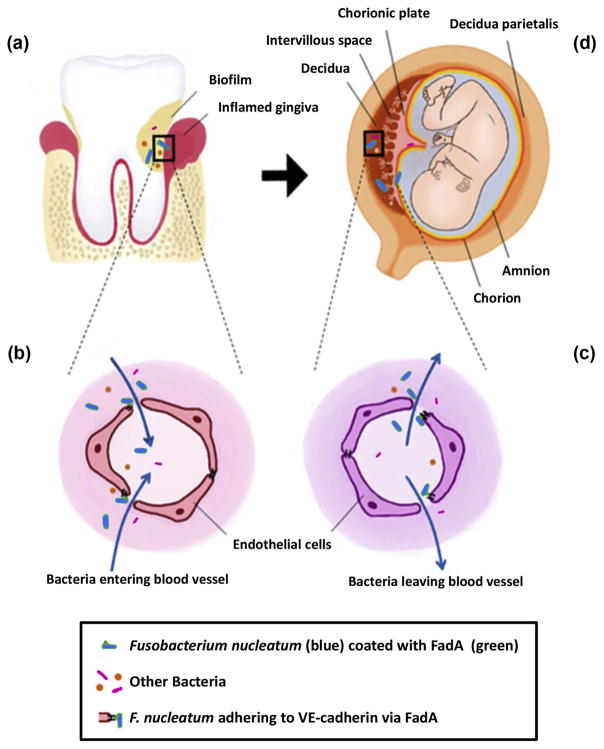
Fusobacterium nucleatum is a Gram-negative anaerobic oral commensal associated with periodontal disease. F. nucleatum has been implicated in a wide spectrum of systemic diseases, including oral, gastro-intestinal, rheumatologic, and vascular pathologies. As pregnancy risk has been linked to periodontal disease, there has also been significant research into the effects of periodontal disease on adverse pregnancy outcomes. This article reviews the epidemiological and mechanistic evidence of the role of F. nucleatum in adverse pregnancy outcomes.
Overview
The claims and statistics of this paper haven’t been checked yet.
Run the check — free, no account needed. It reads the open-access text and checks the sources it cites.
Integrity signals
Registry
Cites
Statistics
Figures
Verification
Claims the paper makes
The claims and statistics of this paper haven’t been checked yet.
Run the check — free, no account needed. It reads the open-access text and checks the sources it cites.
Claims other papers make about this one
Each is checked against this paper’s own text: does it say what the citing paper says it does?
In the citing paper
“Studies investigating the placental microbiome to understand its role in preterm pregnancies have identified bacteria associated with periodontal disease, suggesting a relationship between the oral and placental microbiomes.113, 114, 115, 116”
From The oral microbiome: Role of key organisms and complex networks in oral health and disease (2021) · cites this paper as [115]
In the citing paper
“Pathogenic bacteria from the oral cavity found at various sites within the uterus are associated with adverse pregnancy outcomes, such as preterm delivery and preeclampsia.113, 114, 115”
From The oral microbiome: Role of key organisms and complex networks in oral health and disease (2021) · cites this paper as [115]
In the citing paper
“Similarly, bacteria of oral origin, namely Fusobacterium nucleatum, were identified in samples of amniotic fluid and cord blood from women with pregnancy complications, suggesting oral translocation via hematogenous mechanisms.115”
From The oral microbiome: Role of key organisms and complex networks in oral health and disease (2021) · cites this paper as [115]
Self-check
Percentages, sums and reported differences re-computed from the paper’s own numbers.
The self-check needs the paper’s full text.
Citations
Cites
Intrauterine infection and preterm delivery
Goldenberg, R. L., Hauth, J. C., & Andrews, W. W. (2000) · New England Journal of Medicine · doi:10.1056/nejm200005183422007 · Cited by 2,548 · cited 1×
“Currently, there are two major pathways by which bacteria and other pathogens may trigger an inflammatory response leading to pregnancy complications [1,6].”
BackgroundThe Placenta Harbors a Unique Microbiome
Aagaard, K., Ma, J., Antony, K. M., Ganu, R., Petrosino, J., & Versalovic, J. (2014) · Science Translational Medicine · doi:10.1126/scitranslmed.3008599 · Cited by 2,494 · cited 1×
“Although the presence of a placental microbiome in healthy term pregnancies has been debated [21], recent research suggests that the placental microbiome most closely resembles the human oral microbiome [22].”
BackgroundRubinstein, M. R., Wang, X., Liu, W., Hao, Y., Cai, G., & Han, Y. W. (2013) · Cell Host & Microbe · doi:10.1016/j.chom.2013.07.012 · Cited by 2,476
Self-citationThe bacteria of periodontal diseases
Moore, W. E., & Moore, L. V. H. (1994) · Periodontology 2000 · doi:10.1111/j.1600-0757.1994.tb00019.x · Cited by 1,077 · cited 1×
“One such oral species of interest is Fusobacterium nucleatum, a Gram-negative anaerobe commonly found within the oral cavity and implicated in various forms of periodontal diseases [27,28].”
BackgroundGriffen, A. L., Beall, C. J., Campbell, J. H., Firestone, N. D., Kumar, P., Yang, Z. K., Podar, M., & Leys, E. J. (2011) · The ISME Journal · doi:10.1038/ismej.2011.191 · Cited by 1,006 · cited 1×
“One such oral species of interest is Fusobacterium nucleatum, a Gram-negative anaerobe commonly found within the oral cavity and implicated in various forms of periodontal diseases [27,28].”
BackgroundFusobacterium nucleatum: a commensal-turned pathogen
Han, Y. W. (2015) · Current Opinion in Microbiology · doi:10.1016/j.mib.2014.11.013 · Cited by 869 · cited 2×
“nucleatum has also been implicated in a wide variety of systemic diseases, including GI disorders, atherosclerosis, rheumatoid arthritis and respiratory tract infections [29,30], which is well summarized in a prior review [31].”
BackgroundSelf-citationStrauss, J., Kaplan, G. G., Beck, P. L., Rioux, K. P., Panaccione, R., DeVinney, R., Lynch, T., & Allen‐Vercoe, E. (2011) · Inflammatory Bowel Diseases · doi:10.1002/ibd.21606 · Cited by 578 · cited 1×
“nucleatum has also been implicated in a wide variety of systemic diseases, including GI disorders, atherosclerosis, rheumatoid arthritis and respiratory tract infections [29,30], which is well summarized in a prior review [31].”
BackgroundLauder, A. P., Roche, A. M., Sherrill-Mix, S., Bailey, A., Laughlin, A. L., Bittinger, K., Leite, R., Elovitz, M. A., Parry, S., & Bushman, F. D. (2016) · Microbiome · doi:10.1186/s40168-016-0172-3 · Cited by 539
Han, Y. W., & Wang, X. (2013) · Journal of Dental Research · doi:10.1177/0022034513487559 · Cited by 489
Self-citationPeriodontal infection and preterm birth
JEFFCOAT, M. K., GEURS, N. C., REDDY, M. S., CLIVER, S. P., GOLDENBERG, R. L., & HAUTH, J. C. (2001) · The Journal of the American Dental Association · doi:10.14219/jada.archive.2001.0299 · Cited by 476
Cited by
Sorted by citations
Items 101–166 of 166
RETRACTED: Toll-like receptor 2/4 inhibitors can reduce preterm birth in mice
Xu, J., Chen, M., Yun, L. Q., Qin, H. S., Rui, L., Li, J., & Mei, M. (2020) · Journal of International Medical Research · doi:10.1177/0300060520933795 · Cited by 3
“A previous study suggested that Fusobacterium nucleatum, a Gram-negative bacterium, was associated with PTB and premature rupture of membranes in women.(22) CXR-526 did not suppress bacterial colonization of the placenta.”
ResultRetractedPeriodontitis as a potential risk factor for premature delivery
Turcu, A., Dumitriu, A. S., Păunica, S., Gică, C., Botezatu, R., Gică, N., Peltecu, G. C., & Panaitescu, A. M. (2021) · Journal of Mind and Medical Sciences · doi:10.22543/7674.81.p2733 · Cited by 3
“30 trophoblasts, decidual cells, amniotic epithelial cells and vascular cells, having the potential to induce preterm birth as noted by Katz [40] and Fusobacterium nucleatum which has been identified in placental and fetal tissues, including amniotic fluid, cord blood, fetal membranes and neonatal gastric aspirates, w…”
BackgroundKuppusami, B., Santhadevy, A., Nagaraja, V., Giri, U., Santhanam, V., & Sivaramakrishan, M. (2025) · Journal of Oral and Maxillofacial Pathology · doi:10.4103/jomfp.jomfp_125_24 · Cited by 2
Fusobacterim nucleatum, periodontal diseases, and preterm birth: a literature review
Петровна, Б. Е., Barantsevich, N. E., Orekhova, L. Y., Shiyanova, A., Tulgaa, K., & Tapalski, D. V. (2026) · Parodontologiya · doi:10.33925/1683-3759-2025-1167 · Cited by 3
Mandell, J., Wang, T., Mathad, J. S., Shafiq, M., Naik, S., Alexander, M., Kulkarni, V., Deshpande, P., Humphrys, M. S., Ma, B., et al. (2026) · Nature Communications · doi:10.1038/s41467-026-69912-0 · Cited by 2
“Most research has linked Fusobacterium during pregnancy in the oral, vaginal, and placental microbiome with preterm birth 25 ; however, a small number of studies in populations without HIV havealsofoundhigherabundanceofgut Fusobacterium inwomenmay potentiallybelinkedtopretermbirth 26,27 .”
Microbial regulation of immune tolerance during embryonic implantation and pregnancy
Kanannejad, Z., Taylor, W. R. J., Ghatee, M. A., & Mohkam, M. (2026) · Journal of Reproductive Immunology · doi:10.1016/j.jri.2026.104898 · Cited by 2
Ragunagam, G. S., Anbarasu, A., & Muthukaliannan, G. K. (2026) · Gut Microbes · doi:10.1080/19490976.2026.2694819 · Cited by 3
Structural insight into the role of thiolase from Fusobacterium nucleatum
He, S., Bai, X., & Xu, Y. (2023) · Biochemical and Biophysical Research Communications · doi:10.1016/j.bbrc.2023.149151 · Cited by 2
Perspective Chapter: Oral Condition and Lifetime Hormonal Fluctuations
Rafiei, M. (2025) · IntechOpen eBooks · doi:10.5772/intechopen.1008444 · Cited by 2
THE BACTERIUM Fusobacterium sp. MAY INTERFERE WITH CONCEPTION
Saleh, T. (2020) · IRAQI JOURNAL OF AGRICULTURAL SCIENCES · doi:10.36103/ijas.v51i3.1045 · Cited by 2
Ovalle, A., & Figueroa, J. (2021) · Revista chilena de obstetricia y ginecología · doi:10.24875/rechog.m21000030 · Cited by 2
C, D. J. F. I., Vidal, M. S., Cruz, F. S. E. D., Tantengco, O. A. G., & Menon, R. (2026) · American Journal of Reproductive Immunology · doi:10.1111/aji.70246 · Cited by 1
Metal Alloys Used in Dental Prosthetics and Their Impact on the Oral Microbiome: Narrative Review
Ordyniec-Kwaśnica, I., Kudra, A., Lampkowski, M., & Muszyński, D. (2026) · Dentistry Journal · doi:10.3390/dj14080506 · Cited by 1
“This bacterium is often found alongside Actinomyces and is responsible for severe periodontitis [29].”
The microbiome and pregnancy complications
Fuhler, G. M. (2020) · Elsevier eBooks · doi:10.1016/b978-0-12-818097-6.00002-x · Cited by 1
Placenta, Abnormal Conception, and Prematurity
Sergi, C. M. (2020) · Springer eBooks · doi:10.1007/978-3-662-59169-7_18 · Cited by 1
Evaluation of Fusobacterium nucleatum in Amniotic Fluid of Women with Preterm Labour
Nwaokorie, F. O., Okunade, K. S., Edet, U. O., Obisanya, O. I., & Ekun, A. O. (2023) · Babcock University Medical Journal · doi:10.38029/babcockuniv.med.j..v6i2.219 · Cited by 1
“Fusobacterium species have been detected in the placenta tissues of women who had severe chorioamnionitis (27, 28, 29).”
BackgroundMethodInfluentialSporadic Fusobacterium Bacteremia as an Atypical Cause of Acute Hepatitis in a Young Caucasian Woman
Ahmed, N., Bahrin, M. H. K., Agha, A., & Deshmukh, A. (2020) · Cureus · doi:10.7759/cureus.10590 · Cited by 1
“It has been reported that Fusobacterium nucleatum is widely present in pregnancy complications, including premature birth and stillbirth [5], as well as intrauterine infections, including neonatal sepsis [6].”
BackgroundMicroorganisms in persistent apical periodontitis: A review
Castañeda, Z. C. G., Garza, H. V., Alanis, H. F. M., Reyes, A. L., Huitrón, P. L., Sánchez-Najéra, R. I., & Solís-Soto, J. M. (2021) · International Journal of Applied Dental Sciences · doi:10.22271/oral.2021.v7.i3f.1323 · Cited by 1
“1 Characteristics It is a gram-negative anaerobic oral commensal ([21]).”
BackgroundRISING STARS: Bumps and bacteria: influence of the maternal microbiota on pregnancy outcomes
Willmott, T., & Cottrell, E. C. (2024) · Journal of Endocrinology · doi:10.1530/joe-23-0360
Periodontal Medicine: Impact of Periodontal Status on Pregnancy Outcomes and Carcinogenesis
Caracostea, G. V., Bucur, A., Micu, I. C., Șoancă, A., Ciurea, A., Objelean, A., Delean, A. G., Ionescu, C. V., Chisnoiu, R. M., Negucioiu, M., et al. (2021) · Dentistry · doi:10.5772/intechopen.96147
Heller, D. S. (2021) · Springer eBooks · doi:10.1007/978-3-030-84725-8_25
Periodontitis and pregnancy outcomes
Mehta, A., Mittal, I., & kaur, M. (2022) · IP International Journal of Periodontology and Implantology · doi:10.18231/j.ijpi.2022.012
Feng, Q., Wang, Y., Wang, L., Sun, T., Shen, S., Li, Z., Ma, X., Gu, X., Zhang, X., Peng, A. F., et al. (2022) · Research Square · doi:10.21203/rs.3.rs-1901387/v1
Impact of SARS-CoV-2 on the microbiota of pregnant women and their infantsPreprint
Leftwich, H. K., Vargas-Robles, D., Rojas-Correa, M., Yap, Y. R., Bhattarai, S. K., Ward, D. V., Fujimori, G., Forconi, C. S., Yeboah, T., Carter, A., et al. (2022) · medRxiv · doi:10.1101/2022.11.01.22281810
“nucleatum, decreased in pregnant women with SARS-CoV-2 infection in our study, is one of the most prevalent species and by far the most prevalent oral species implicated in adverse pregnancy outcomes (51, 52).”
BackgroundO’Callaghan, J. L. (2023) · Queensland University of Technology · doi:10.5204/thesis.eprints.244719
Tangled genetic relationships within the Fusobacterium genusPreprint
Molteni, C., Forni, D., Cagliani, R., & Sironi, M. (2024) · bioRxiv (Cold Spring Harbor Laboratory) · doi:10.1101/2024.03.27.587012
“Finally, F. nucleatum can colonize the placenta and cause preterm birth, intra-amniotic infection, stillbirth, neonatal sepsis, and hypertensive disorders of pregnancy 1,40,41 .”
BackgroundAdditional file 1 of The microbiota of pregnant women with SARS-CoV-2 and their infants
Leftwich, H. K., Vargas-Robles, D., Rojas-Correa, M., Yap, Y. R., Bhattarai, S. K., Ward, D. V., Fujimori, G., Forconi, C. S., Yeboah, T., Carter, A., et al. (2023) · Figshare · doi:10.6084/m9.figshare.23583550
Bacteroides , Porphyromonas , Prevotella , Fusobacterium , and Other Anaerobic Gram‐Negative Rods
Conrads, G., Nagy, E., & Könönen, E. (2023) · ClinMicroNow · doi:10.1002/9781683674849.mcm0057
Bacteroides , Porphyromonas , Prevotella , Fusobacterium , and Other Anaerobic Gram‐Negative Rods
Conrads, G., Nagy, E., & Könönen, E. (2023) · ClinMicroNow · doi:10.1002/9781683670438.mcm0057
Saputri, D., Alibasyah, Z. M., Ismi, S. N., & Arfirosa, A. (2024) · Reports of Biochemistry and Molecular Biology · doi:10.61186/rbmb.13.3.310
Ghosh, D., & Kumar, A. (2025) · Neuroglia · doi:10.3390/neuroglia6030030
Zhurabekova, G., Balmagambetova, A., Oralkhan, Z., Sarsenova, M., Toichiyeva, G., Altynbay, N. P., Malik, A., Tastambek, K. T., & Бердалинова, А. К. (2025) · Europe PMC (PubMed Central) · doi:10.30476/ijms.2025.102996.3613
THE ASSOCIATION BETWEEN PERIODONTAL DISEASES AND MISCARRIAGE: A REVIEW OF MODERN STUDIES
Sulima, A. N., Gazhva, S. I., Игоревич, Ж. С., Кучер, В. А., & Kashin, Y. (2025) · Таврический медико-биологический вестник · doi:10.29039/2070-8092-2025-28-1-79-87
dos Anjos Borges, L. G., Pastuschek, J., Heimann, Y., Dawczynski, K., Schleußner, E., Dietmar, P., & Zöllkau, J. (2024) · Figshare · doi:10.6084/m9.figshare.26574691
dos Anjos Borges, L. G., Pastuschek, J., Heimann, Y., Dawczynski, K., Schleußner, E., Dietmar, P., & Zöllkau, J. (2024) · Figshare · doi:10.6084/m9.figshare.26574679
dos Anjos Borges, L. G., Pastuschek, J., Heimann, Y., Dawczynski, K., Schleußner, E., Pieper, D. H., & Zöllkau, J. (2024) · Figshare · doi:10.6084/m9.figshare.26574712
dos Anjos Borges, L. G., Pastuschek, J., Heimann, Y., Dawczynski, K., Schleußner, E., Pieper, D. H., & Zöllkau, J. (2024) · Figshare · doi:10.6084/m9.figshare.26574682
dos Anjos Borges, L. G., Pastuschek, J., Heimann, Y., Dawczynski, K., Schleußner, E., Pieper, D. H., & Zöllkau, J. (2024) · Figshare · doi:10.6084/m9.figshare.26574670
dos Anjos Borges, L. G., Pastuschek, J., Heimann, Y., Dawczynski, K., Schleußner, E., Pieper, D. H., & Zöllkau, J. (2024) · Figshare · doi:10.6084/m9.figshare.26574664
dos Anjos Borges, L. G., Pastuschek, J., Heimann, Y., Dawczynski, K., Schleußner, E., Pieper, D. H., & Zöllkau, J. (2024) · Figshare · doi:10.6084/m9.figshare.26574673
dos Anjos Borges, L. G., Pastuschek, J., Heimann, Y., Dawczynski, K., Schleußner, E., Pieper, D. H., & Zöllkau, J. (2024) · Figshare · doi:10.6084/m9.figshare.26574667
dos Anjos Borges, L. G., Pastuschek, J., Heimann, Y., Dawczynski, K., Schleußner, E., Pieper, D. H., & Zöllkau, J. (2024) · Figshare · doi:10.6084/m9.figshare.26574715
dos Anjos Borges, L. G., Pastuschek, J., Heimann, Y., Dawczynski, K., Schleußner, E., Pieper, D. H., & Zöllkau, J. (2024) · Figshare · doi:10.6084/m9.figshare.26574700
dos Anjos Borges, L. G., Pastuschek, J., Heimann, Y., Dawczynski, K., Schleußner, E., Pieper, D. H., & Zöllkau, J. (2024) · Figshare · doi:10.6084/m9.figshare.26574658
dos Anjos Borges, L. G., Pastuschek, J., Heimann, Y., Dawczynski, K., Schleußner, E., Pieper, D. H., & Zöllkau, J. (2024) · Figshare · doi:10.6084/m9.figshare.26574661
dos Anjos Borges, L. G., Pastuschek, J., Heimann, Y., Dawczynski, K., Schleußner, E., Pieper, D. H., & Zöllkau, J. (2024) · Figshare · doi:10.6084/m9.figshare.26574709
dos Anjos Borges, L. G., Pastuschek, J., Heimann, Y., Dawczynski, K., Schleußner, E., Pieper, D. H., & Zöllkau, J. (2024) · Figshare · doi:10.6084/m9.figshare.26574688
dos Anjos Borges, L. G., Pastuschek, J., Heimann, Y., Dawczynski, K., Schleußner, E., Dietmar, P., & Zöllkau, J. (2024) · Figshare · doi:10.6084/m9.figshare.26574706
dos Anjos Borges, L. G., Pastuschek, J., Heimann, Y., Dawczynski, K., Schleußner, E., Pieper, D. H., & Zöllkau, J. (2024) · Figshare · doi:10.6084/m9.figshare.26574676
dos Anjos Borges, L. G., Pastuschek, J., Heimann, Y., Dawczynski, K., Schleußner, E., Pieper, D. H., & Zöllkau, J. (2024) · Figshare · doi:10.6084/m9.figshare.26574685
11 Periodontal Microbiome and Systemic Crosstalk: Unraveling the Oral-Systemic Axis
Hashim, N. T., Babiker, R., Chaitanya, N. C., & Rahman, A. M. M. (2025) · De Gruyter eBooks · doi:10.1515/9783112219904-001
172 Periodontitis and Systemic Diseases
Hashim, N. T., Babiker, R., & Mohammed, A. R. (2025) · De Gruyter eBooks · doi:10.1515/9783112219904-002
Remmani, N. B., Harous, Z. S., Alzaidy, R. Q., Ahmednour, S. A., Egusa, H., & Soliman, S. S. M. (2026) · Anaerobe · doi:10.1016/j.anaerobe.2026.103030
Infecciones por bacterias anaerobias
Vázquez, S. M. D. L. R., Gamarro, B. G., & Muñoz, M. C. P. (2026) · Medicine - Programa de Formación Médica Continuada Acreditado · doi:10.1016/j.med.2026.03.002
Ma, L., Du, X. M., Pang, C., Han, X., Zhang, G., Guo, X., & Pu, K. (2026) · Frontiers in Cellular and Infection Microbiology · doi:10.3389/fcimb.2026.1719385
Li, T., Kuang, H., Zhang, J., Meng, Y., Feng, X., Mao, X., Pan, Z., & Sun, M. (2026) · Current Microbiology · doi:10.1007/s00284-026-04918-x
“According to Vander Haar et al., Fusobacterium is capable of traveling via the bloodstream from the oral cavity to the placenta, which can cause intrauterine inflam - mation and may contribute to the advancement of EMs [59].”
Placental Pathogens Associated With Adverse Maternal and Neonatal Outcomes
Liu, A., Little, C., Dubowitz, T., Schaeffer, M., Skvarca, L. B., Rick, A.-M., Hooven, T. A., Morowitz, M. J., Hillier, S. L., Wiesenfeld, H. C., et al. (2026) · Open Forum Infectious Diseases · doi:10.1093/ofid/ofag229
Nycz, K., & Sztajura, J. (2026) · International Journal of Innovative Technologies in Social Science · doi:10.31435/ijitss.2(50).2026.5114
The microbiology of amniotic fluid sludge: a systematic review and meta-analysis
Shipitsyna, E. V., Pachuliia, O. V., Khalenko, V. V., Вадимовна, К. Е., Sazonova, A. P., Zhestkova, N. V., & Bespalova, O. N. (2026) · Archives of Gynecology and Obstetrics · doi:10.1007/s00404-026-08492-2
“Furthermore, there is a substantial body of evidence indicating involvement of F. nucleatum in adverse pregnancy outcomes, such as chorioamnionitis, PTB, stillbirth, neonatal sepsis, and preeclampsia [31].”
Oral Microbiome Dysbiosis: Periodontitis Links to Systemic Diseases
Sathyakumar, N. M., Surya Sreevatsa, C. M., Pranita, H., & Manojkumar, S. (2026) · World Journal of Dentistry · doi:10.5005/jp-journals-10015-2821
Mechanisms of the Oral–Gut Microbiota Axis in Adverse Pregnancy Outcomes
Wang, Y., & Liu, Y. F. (2026) · Microorganisms · doi:10.3390/microorganisms14071453
“…studies have detected or isolated periodontal pathogens such as P. gingivalis and Fusobacterium nucleatum ( F. nucleatum ) in placental or pregnancy-related samples from cases of chorioamnionitis or preterm birth, supporting an association between these pathogens and APO-related tissues [43,44].”
Kito, S., Goto, S., Goto, T., Ogasawara, S., Yoshihara, H., Kitaori, T., Banno, C., Ogawa, S., Kojima, R., Matsumoto, Y., et al. (2026) · Journal of Reproductive Immunology · doi:10.1016/j.jri.2026.104950
Chen, L. (2026) · Journal of Obstetrics and Gynaecology · doi:10.1080/01443615.2026.2681762
Cannon, M. L., Peldyak, J., Reynolds, P. R., & Ferrer, G. (2026) · Microorganisms · doi:10.3390/microorganisms14091913
Aptamer-CRISPR/Cas as a tool in point-of-care testing of infectious diseases
Lau, C., Huang, Y., Ch’ng, E. S., Tang, T., Zhu, H., & Citartan, M. (2026) · Talanta · doi:10.1016/j.talanta.2026.130767
Invasive guests: the role of non-oral bacteria in oral dysbiosis and systemic health
Ari, M. M., Al‐Ahmad, A., Cieplik, F., & Scholz, K. J. (2026) · Journal of Oral Microbiology · doi:10.1080/20002297.2026.2745592
“Persistent colonization may also sustain low ‑ grade inflammation, damaging local tissues and exacerbating systemic conditions such as cardiovascular disease and diabetes [199].”
Metadata
- Authors
- Vander Haar, E. L., So, J., Gyamfi-Bannerman, C., & Han, Y. W.
- Affiliations
- Columbia University Irving Medical Center (US)
- Corresponding author
- Han, Yiping W.
- ORCID
- Han, Yiping W.
- Venue
- Anaerobe
- Publisher
- Elsevier BV
- Published
- 2018-04
- Volume
- 50
- Pages
- 55-59
- ISSN
- 1075-9964 (ISSN-L)
- PMC
- PMC6750227
- OpenAlex
- W2791709251
- Cited by
- 155
- References
- 60
- Citations by year
- 2026: 23 · 2025: 23 · 2024: 21 · 2023: 28 · 2022: 20 · 2021: 20 · 2020: 13 · 2019: 4 · 2018: 1
- FWCI
- 1.39
- Type
- journal article
- Language
- en
- Open access
- hybrid
- doi.org
- Licence
- Locations
- Anaerobe (publishedVersion, cc-by-nc-nd)
- PubMed (publishedVersion)
- PubMed Central (acceptedVersion, cc-by-nc-nd)
- Funders
- NIH (DE014924, DE023332, CA192111)
- Topics
- Health Sciences › Dentistry › Periodontics › Oral microbiology and periodontitis research
- Health Sciences › Medicine › Obstetrics and Gynecology › Preterm Birth and Chorioamnionitis
- Health Sciences › Medicine › Obstetrics and Gynecology › Pregnancy and preeclampsia studies
- Keywords
- Fusobacterium nucleatum, adverse pregnancy outcomes, periodontal disease, oral commensals, oral microbiota, systemic inflammation, pregnancy complications, periodontitis
- MeSH terms
- Animals, Female, Fusobacterium Infections, Humans, Mouth Mucosa, Periodontal Diseases, Pregnancy, Pregnancy Complications, Pregnancy Complications, Infectious, Pregnancy Outcome, Virulence, Fusobacterium nucleatum
About these checks
Registry, retraction, Cites and statistics results are computed, not judged, with one exception: a printed reference that no index lists is read once by a model before it counts as a citation error. Claims are extracted by a model and kept only when their quote appears verbatim in the text; each cited source is then checked, with a model’s help, for whether it says what the claim relies on. Those verdicts can be wrong — read the claim’s quote and the cited source before relying on one.
Statistics and arithmetic are recomputed, not judged.
Confidence bands are shown only for fields calibrated on our annotated test set. None is calibrated yet, so no band is shown.
What counts as a claim ›How we measure confidence ›How we check this ›
Are you an author, or do you see a problem with this page? Request a review
