

Psychiatric Symptom Dimensions Are Associated With Dissociable Shifts in Metacognition but Not Task Performance
Open accessThe DOI matches its Crossref record; 71 of the 71 references it cites were found in a registry or an index; 7 of the 68 sources its claims cite were checked for support.
Abstract
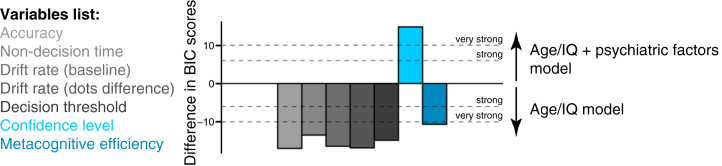
BACKGROUND: Distortions in metacognition-the ability to reflect on and control other cognitive processes-are thought to be characteristic of poor mental health. However, it remains unknown whether such shifts in self-evaluation are due to specific alterations in metacognition and/or a downstream consequence of changes in decision-making processes. METHODS: Using perceptual decision making as a model system, we employed a computational psychiatry approach to relate parameters governing both decision formation and metacognitive evaluation to self-reported transdiagnostic symptom dimensions in a large general population sample (N = 995). RESULTS: Variability in psychopathology was unrelated to either speed or accuracy of decision formation. In contrast, leveraging a dimensional approach, we revealed independent relationships between psychopathology and metacognition: a symptom dimension related to anxiety and depression was associated with lower confidence and heightened metacognitive efficiency, whereas a dimension characterizing compulsive behavior and intrusive thoughts was associated with higher confidence and lower metacognitive efficiency. Furthermore, we obtained a robust double dissociation-whereas psychiatric symptoms predicted changes in metacognition but not decision performance, age predicted changes in decision performance but not metacognition. CONCLUSIONS: Our findings indicate a specific and pervasive link between metacognition and mental health. Our study bridges a gap between an emerging neuroscience of decision making and an understanding of metacognitive alterations in psychopathology.
Overview
CoChat Summary
TL;DR
In two large online perceptual decision-making experiments (total N = 995), self-reported psychiatric symptom dimensions were associated with dissociable shifts in confidence and metacognitive efficiency but not with decision speed or accuracy. An anxious-depression dimension related to lower confidence and higher metacognitive efficiency, whereas a compulsive behavior/intrusive thought dimension related to higher confidence and lower metacognitive efficiency.
Key findings
- Psychiatric symptoms were unrelated to decision formation: in experiment 1, symptoms were not associated with decision accuracy or drift-diffusion model parameters; experiment 2 replicated no association between psychiatric factors and accuracy/decision formation parameters.
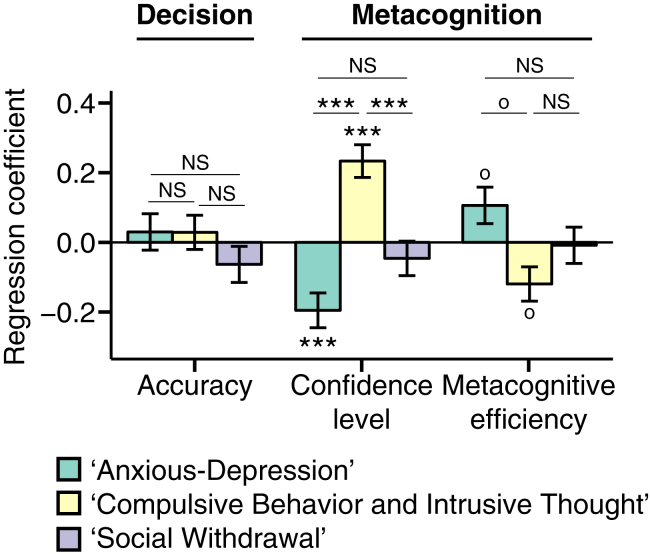
- In experiment 2, the anxious-depression (AD) factor was associated with lower confidence level (β = −.20, p < .001) and higher metacognitive efficiency (β = .11, p_uncorrected = .04), while the compulsive behavior and intrusive thought (CIT) factor was associated with higher confidence level (β = .23, p < .001) and lower metacognitive efficiency (β = −.12, p_uncorrected = .02); the metacognitive efficiency findings did not survive correction for multiple comparisons.
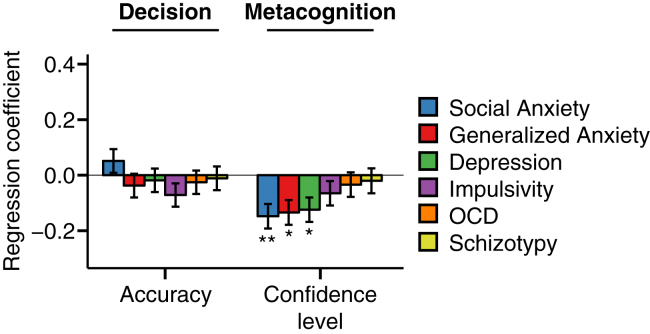
- In experiment 1, depression, social anxiety, and generalized anxiety were associated with lower confidence (all β < −.12, all p < .05), whereas impulsivity, OCD, and schizotypy showed no association with confidence (all p > .05).
- A double dissociation was observed: psychiatric symptoms predicted changes in metacognition but not decision performance, whereas age predicted changes in decision performance but not metacognition; older age was associated with slower, less accurate decisions, and neither age nor IQ was related to confidence.
Methods
- Data were collected online via Amazon’s Mechanical Turk in two experiments (experiment 1: 663 participants; experiment 2: 637 participants); after exclusions, 498 participants remained in experiment 1 and 497 in experiment 2 (total N = 995).
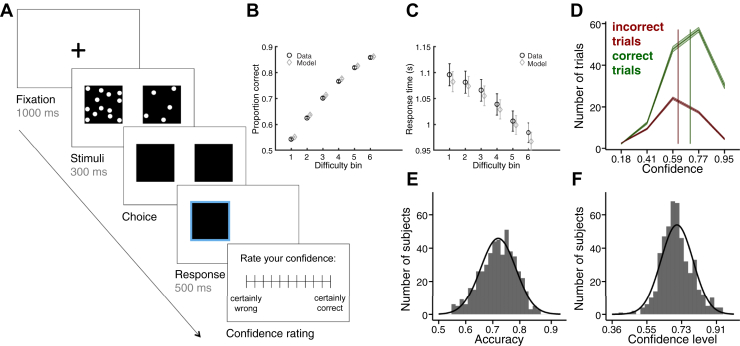
- Participants performed a perceptual decision-making task judging which of two boxes contained more dots and rated confidence on each judgment; across both experiments there were 210 trials in five blocks, and experiment 2 added a calibration/staircase procedure to equate performance and allow computation of metacognitive efficiency (meta-d′/d′).
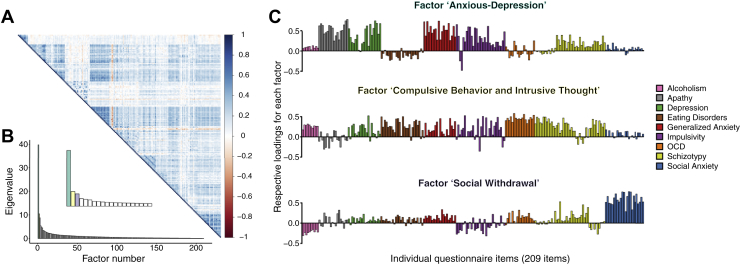
- Self-report questionnaires assessed depression, generalized anxiety, schizotypy, impulsivity, OCD, social anxiety, and IQ; experiment 2 added eating disorders, apathy, and alcoholism questionnaires. Experiment 2 used factor analysis on 209 items across nine questionnaires, identifying three factors (AD, CIT, social withdrawal), and analyses used drift-diffusion modeling, signal detection theory, linear regressions controlling for age, IQ, and gender, and Bayesian information criterion model comparison.
Limitations
- The paper states that no structured clinical interviews were used and no information about psychiatric diagnosis or medication was recorded; the sample was a general population sample with continuous self-reported symptoms, limiting inferences about patients with psychiatric diagnoses.
- The paper states that the metacognitive efficiency findings did not survive correction for multiple comparisons and should be interpreted with caution, and that the factor analysis sample (n = 497) had a relatively low subject-to-variable ratio, though the solution was compared with prior results from Gillan et al. (N = 1413).
- The paper states that perceptual decision making was used as a model system and it remains to be explored how findings extend to other decision types or cognitive domains; evident from the design, the study is cross-sectional and correlational, so it cannot establish causal direction.
Model-written summary. Check it against the paper before relying on it.
Integrity signals
Registry
Cites
Statistics
Figures
Verification
Claims the paper makes
4 Valid · 0 Not valid · 43 Not checked · 59 Own results and interpretations
The cited sources support only part of this claim — read each source’s verdict below.
In the paper
“Notably, the level of confidence is a relatively stable feature of individuals’ judgments that generalizes across different tasks 10, 11, 12”
§ Psychiatric Symptom Dimensions Are Associated With Dissociable Shifts in Metacognition but Not Task Performance > Abstract > Conclusions
What the sources say
- Supportedcites [10] Ais J. Zylberberg A. Barttfeld P. Sigman M. Individual consistency in the accuracy and distribution of confidence judgments Cognition 146 2016 377 386 26513356 source
Section 3.3 ('Confidence bias within and across tasks') reports very strong within-task correlations of the mean of the confidence distribution and significantly positive correlations for every pair of different experiments, stating explicitly that 'an individual's confidence bias is consistent across tasks'. The Discussion point (4) adds that despite large across-task changes in distribution shape, the mean was highly indicative of a subject's identity and every single correlation of average confidence across sessions (different days and different tasks) was positive; the Abstract (5) makes the same point. This matches the claim's 'confidence level ... relatively stable ... generalizes across different tasks', with the caveat that the paper's evidence comes from 23 subjects in four perceptual/cognitive tasks — and separately, its measure of confidence *accuracy* (AUC) was only modestly correlated across tasks (§3.1, Abstract 2), which the claim does not attribute. (LLM, conf=0.85)
- Not checked — no full text of the sourcecites [11] Stankov L. Crawford J.D. Self-confidence and performance on tests of cognitive abilities Intelligence 25 1997 93 109 source
- Partly supportedcites [12] Rahnev D. Koizumi A. McCurdy L.Y. D’Esposito M. Lau H. Confidence leak in perceptual decision making Psychol Sci 26 2015 1664 1680 26408037 PMC4636919 sourceExperimental — accuracy not yet measured
Our copy supports only the cross-task half of the claim: the Introduction (p.1) states 'We demonstrate robust inter-task dependence in metacognitive judgments of confidence even when the two different tasks involve distinct visual features', and Results (Experiment 1, p.2; Experiment 2, p.3) report positive trial-by-trial inter-task confidence correlations (Fisher z = .23 and .26). That is a trial-level coupling of confidence ratings between tasks, not evidence that confidence level is a relatively stable, trait-like feature of individuals' judgments; indeed Results (Experiment 1) uses scaled correlation to show the effect does not depend on slow changes in observers' overall state, and the individual-difference analyses (Experiments 3-4) concern the amount of leak, not a person's characteristic confidence. Moreover, the generic 'task-independent'/'common currency' framing that would license 'generalizes across different tasks' is explicitly credited in the Discussion to de Gardelle & Mamassian (2014), not established here. (LLM, conf=0.72)
plain- Asserted: passes — The authors put it forward as true.
- Checkable: passes — It can be checked against evidence.
- Load-bearing: passes — The paper’s conclusions depend on it.
- Based: passes — The paper gives a reason why it holds.
- Supported
The sources with a verdict support this claim; the rest weren’t checked yet, have no full text we could read, or their verdicts aren’t rated yet.
In the paper
“A relationship between lower confidence level and an AD symptom dimension is consistent with depression’s being characterized by pervasive negative shifts in self-evaluation 5, 47, 48.”
§ Psychiatric Symptom Dimensions Are Associated With Dissociable Shifts in Metacognition but Not Task Performance > Discussion
What the sources say
- Not checked yetcites [5] Elliott R. Sahakian B.J. McKay A.P. Herrod J.J. Robbins T.W. Paykel E.S. Neuropsychological impairments in unipolar depression: The influence of perceived failure on subsequent performance Psychol Med 26 1996 975 989 8878330 source
Checked before — its earlier verdict is held back until a new check runs.
- Supportedcites [47] Silverstone P.H. Salsali M. Low self-esteem and psychiatric patients: Part I—the relationship between low self-esteem and psychiatric diagnosis Ann Gen Hosp Psychiatry 2 2003 2 12620127 PMC151271 source
The Discussion section 'Self-Esteem and Depressive Disorders' states that low self-esteem arises during major depression and depressive subtypes (seasonal affective disorder, dysthymia), that the lowering is cumulative with comorbid depressive disorders, and that self-esteem shifts with depressive state — decreasing after onset and increasing as mood improves — which is what the citing sentence attributes (depression characterized by negative shifts in self-evaluation). The Abstract/Results (Rosenberg scores) reinforce this, with self-esteem lowest in major depressive disorder and significantly lower than in anxiety or adjustment disorders. The only caveat is that the paper stresses the relationship is not uniquely specific to depression (lowered self-esteem occurs across the psychiatric spectrum) and that trait vs. state remains unresolved, but the hedged 'is consistent with' framing of the claim matches this level of confidence. (LLM, conf=0.85)
- Not checked yetcites [48] Orth U. Robins R.W. Understanding the link between low self-esteem and depression Curr Dir Psychol Sci 22 2013 455 460 source
Checked before — its earlier verdict is held back until a new check runs.
plainstates an association- Asserted: passes — The authors put it forward as true.
- Checkable: passes — It can be checked against evidence.
- Load-bearing: passes — The paper’s conclusions depend on it.
- Based: passes — The paper gives a reason why it holds.
- Not checked yet
Every source the paper cites for this claim was checked and supports it.
In the paper
“Our findings speak to computational models of confidence (15): while previous work has focused on modeling trial-level determinants of decision confidence 60, 61, the between-subjects variance typically captured by one or more free parameters in such models could reflect systematic trait-level differences among individuals.”
§ Psychiatric Symptom Dimensions Are Associated With Dissociable Shifts in Metacognition but Not Task Performance > Discussion
What the sources say
- Supportedcites [15] Pouget A. Drugowitsch J. Kepecs A. Confidence and certainty: Distinct probabilistic quantities for different goals Nat Neurosci 19 2016 366 374 26906503 PMC5378479 source
The citation (ref. 15) is attached to the noun phrase 'computational models of confidence'; the trial-level-modelling clause carries refs 60,61 and the between-subjects/trait-level inference is the citing authors' own conclusion, so only the identification of computational models of confidence is attributed to this source. Our copy plainly establishes that topic: the Introduction (p. 1) states the authors' goal is 'to offer a computational and neural coding perspective on confidence', and 'Looking for confidence in neural codes' describes 'developing a computational model of this task' so that 'a subject's estimate of being correct can be inferred without an explicit report of this probability'. The 'Confidence: definition and computations' section likewise formalizes confidence as the probability of the current choice being correct, including its extension to continuous estimates and its role in learning rules (Box 2). (LLM, conf=0.85)
- Supportedcites [60] Sanders J.I. Hangya B. Kepecs A. Signatures of a statistical computation in the human sense of confidence Neuron 90 2016 499 506 27151640 PMC5350614 source
Sanders et al. (2016) is squarely an instance of the thing the citing sentence cites it for: a computational model of human confidence in which a free parameter is fit per subject and varies across subjects — Results 'Quantitative prediction of human confidence reports' states 'we introduced one free parameter (α), confidence reporting efficacy' and 'The optimal parameter for human confidence reporting efficacy ranged from α = 0.49 to 0.72 with an average of 0.57', and Experimental Procedures 'Model fitting' confirms α is a single subject-level free parameter (with per-subject noise σ also estimated). The Introduction/Discussion (pp. 1, Discussion) likewise characterizes prior computational confidence models as trial-level/algorithmic accounts whose predictions depend on 'parameter choices'. The further inference that this between-subjects variance 'could reflect systematic trait-level differences' is the citing authors' own conclusion, not something the sentence attributes to Sanders, so nothing in the attributed content is unsupported. (LLM, conf=0.82)
- Supportedcites [61] Kiani R. Corthell L. Shadlen M.N. Choice certainty is informed by both evidence and decision time Neuron 84 2014 1329 1342 25521381 PMC4271191 source
The citation (15) is attached to 'computational models of confidence', and our copy of Kiani et al. (2014) is exactly that: a bounded-accumulation model that yields explicit predictions of choice certainty from decision variable and decision time (Introduction; Results, 'The model provides explicit predictions for the relationship between DV, decision time, and certainty'; Discussion, 'it provides a novel account of decision confidence'). The Methods section ('Bounded accumulation model') also confirms the characterization the sentence relies on — 'the model has six free parameters: k, r, Bl, Bu, T0, and σT0²... fit the model to each subject's RT distribution' — i.e., between-subjects variance handled by per-subject free parameters. The remaining clause (that this variance could reflect trait-level differences) is the citing authors' own inference, and the 'trial-level determinants' point is credited to references 60, 61, not to this source. (LLM, conf=0.85)
hedgedstates an association- Asserted: passes — The authors put it forward as true.
- Checkable: passes — It can be checked against evidence.
- Load-bearing: passes — The paper’s conclusions depend on it.
- Based: passes — The paper gives a reason why it holds.
- Supported
Every source the paper cites for this claim was checked and supports it.
In the paper
“our findings of disrupted metacognition in high-CIT individuals is consistent with recent findings of lowered metacognitive efficiency in high versus low compulsive participants who were matched for depression and anxiety symptoms (55).”
§ Psychiatric Symptom Dimensions Are Associated With Dissociable Shifts in Metacognition but Not Task Performance > Discussion
What the sources say
- Supportedcites [55] Hauser T.U. Allen M. Rees G. Dolan R.J. Bullmore E.T. Goodyer I. Metacognitive impairments extend perceptual decision making weaknesses in compulsivity Sci Rep 7 2017 6614 28747627 PMC5529539 source
The Results (Metacognitive impairments in high compulsive participants, pp. corresponding to passages 3–4) state that group metacognitive efficiency (M-ratio) was significantly lower in high compulsive participants (0.512 vs 0.814 in low compulsives, p = 0.017), independent of perceptual performance (d'). The Methods (Participants, passage 7) and Introduction/Discussion (passages 5, 8) confirm the two groups were selected from a population-based cohort and matched on other psychiatric dimensions, specifically depression (MFQ) and anxiety (RCMAS). Both parts of the attributed claim — lowered metacognitive efficiency in high versus low compulsive participants, and the depression/anxiety matching — are stated in our copy. (LLM, conf=0.92)
plainstates an association- Asserted: passes — The authors put it forward as true.
- Checkable: passes — It can be checked against evidence.
- Load-bearing: unclear — It is unclear whether the paper’s conclusions depend on it.
- Based: passes — The paper gives a reason why it holds.
- Supported
A result the paper reports from its own data — it cites no other source for it, so there is none to check. The quote shows it is in the paper.
In the paper
“the AD factor was significantly associated with lower confidence level (β = −.20, p < .001)”
- Also stated in: § Results · plain
“a symptom dimension related to anxiety and depression was associated with lower confidence and heightened metacognitive efficiency”
§ Psychiatric Symptom Dimensions Are Associated With Dissociable Shifts in Metacognition but Not Task Performance > Results
plainstates an association- Asserted: passes — The authors put it forward as true.
- Checkable: passes — It can be checked against evidence.
- Load-bearing: passes — The paper’s conclusions depend on it.
- Based: passes — The paper gives a reason why it holds.
- Also stated in: § Results · plain
45 more claims
Create a free account to see all 106 claims and to verify the 59 references still open.
- It may state two separate claims as one. 25
- Probably not a substantial claim. 42
- The quote only partly states this claim. 1
Claims other papers make about this one
Each is checked against this paper’s own text: does it say what the citing paper says it does?
The cited source says what the claim attributes to it.
In the citing paper
“We replicated previous findings showing that heightened anxiety symptoms are associated with lower average local confidence (metacognitive bias; Exp 1—GAD-7: χ² = 9.76, p = 0.002, β = −0.03, CI = [−0.05 −0.01]; Exp 2—Anxious-Depression axis: χ² = 29.63, p < 0.001, β = −0.35, CI = [−0.47 −0.22])2”
From Distorted learning from local metacognition supports transdiagnostic underconfidence (2025) · cites this paper as [2]
In the citing paper
“Individuals experiencing symptoms of anxiety and depression have been shown to exhibit persistent underconfidence.”
From Distorted learning from local metacognition supports transdiagnostic underconfidence (2025) · cites this paper as [2]
In the citing paper
“These relationships are observed in both local confidence judgments on individual trials2–5 and global confidence as measured through long-run self-performance estimates6”
From Distorted learning from local metacognition supports transdiagnostic underconfidence (2025) · cites this paper as [2]
In the citing paper
“Individuals high in subclinical anxious-depression symptoms tend to be chronically underconfident in their abilities both when evaluating their confidence on a particular task instance2–5 and when providing global self-performance estimates (SPEs)6.”
From Distorted learning from local metacognition supports transdiagnostic underconfidence (2025) · cites this paper as [2]
In the citing paper
“Our model-based approach to estimating the influence of feedback on confidence can also be used to simulate an expected change in metacognition under different feedback schedules for different individuals—highlighting a potential for developing personalised interventions to ameliorate systematic biases in over- and under-confidence2,5,32,40,41.”
From Distorted learning from local metacognition supports transdiagnostic underconfidence (2025) · cites this paper as [2]
2 more claims about this paper
Create a free account to see every claim other papers make about this one.
Citations
Cites
Self-efficacy: Toward a unifying theory of behavioral change
Bandura, A. (1977) · Psychological Review · doi:10.1037/0033-295x.84.2.191 · Cited by 43,925
A Brief Measure for Assessing Generalized Anxiety Disorder: The GAD-7
Spitzer, R. L., Kroenke, K., Williams, J. B. W., & Löwe, B. (2006) · Archives of Internal Medicine · doi:10.1001/archinte.166.10.1092 · Cited by 31,765
Diagnostic and Statistical Manual of Mental Disorders, 5th ed.
Carter, M. J. (2014) · Therapeutic Recreation Journal · Cited by 15,169
The Scree Test For The Number Of Factors
Cattell, R. B. (1966) · Multivariate Behavioral Research · doi:10.1207/s15327906mbr0102_10 · Cited by 13,554 · cited 1×
“We selected the number of factors based on Cattell’s criterion (44), in which a sharp elbow indicates the point at which there is little benefit to retaining additional factors.”
MethodSelf-efficacy: Toward a unifying theory of behavioral change
Bandura, A. (1978) · Advances in Behaviour Research and Therapy · doi:10.1016/0146-6402(78)90002-4 · Cited by 10,586
A self-rating depression scale
ZUNG, W. W. K. (1965) · Archives of General Psychiatry · doi:10.1001/archpsyc.1965.01720310065008 · Cited by 9,813
Insel, T., Cuthbert, B., Garvey, M., Heinssen, R., Pine, D. S., Quinn, K., Sanislow, C., & Wang, P. (2010) · American Journal of Psychiatry · doi:10.1176/appi.ajp.2010.09091379 · Cited by 7,067 · cited 1×
“As such, this approach provides a powerful new pathway toward testing the merits of a dimensional view of psychiatry (25), consistent with the broader goals of the burgeoning computational psychiatry movement (26,27).”
Instructional manipulation checks: Detecting satisficing to increase statistical power
Oppenheimer, D. M., Meyvis, T., & Davidenko, N. (2009) · Journal of Experimental Social Psychology · doi:10.1016/j.jesp.2009.03.009 · Cited by 3,493
The Obsessive-Compulsive Inventory: Development and validation of a short version.
Foa, E. B., Huppert, J. D., Leiberg, S., Langner, R., Kichic, R., Hajcak, G., & Salkovskis, P. M. (2002) · Psychological Assessment · doi:10.1037/1040-3590.14.4.485 · Cited by 2,959 · cited 1×
“After the task, subjects completed standard self-report questionnaires assessing a range of psychiatric symptoms (Supplemental Figure S1), including depression (Zung Self-Rating Depression Scale) (35), generalized anxiety (Generalized Anxiety Disorder 7-item scale) (36), schizotypy (Short Scales for Measuring Schizoty…”
BackgroundLiebowitz, M. R. (2015) · Modern Trends in Pharmacopsychiatry · doi:10.1159/000414022 · Cited by 2,266
Cited by
Items 301–394 of 394
Exploring Your Past to Strengthen Your Best-Loved Self
Divoll, K., & Ribeiro, A. R. (2022) · Palgrave studies on leadership and learning in teacher education · doi:10.1007/978-3-031-11902-6_9
Prieto, F., Lorca-Vyhmeister, A. A., CALCAGNI, S. C., Silva, J. R., Goupil, L., & Reyes, G. (2023) · PsyArXiv (OSF Preprints) · doi:10.31234/osf.io/r3zm4
Fox, C. A., Lee, C. T., Hanlon, A. K., Seow, T. X. F., Lynch, K., Harty, S., Richards, D., Palacios, J. E., O’Keane, V., Stephan, K. E., et al. (2023) · eLife · doi:10.7554/elife.87193.1.sa0
Self-citationSocial perspective-taking influences on metacognitionPreprint
Battich, L., Pacherie, É., & Grèzes, J. (2024) · PsyArXiv (OSF Preprints) · doi:10.31234/osf.io/hzgs3
Boldt, A., Fox, C. A., Gillan, C. M., et al. (2024) · eLife · doi:10.7554/elife.98114.1.sa1
Boldt, A., Fox, C. A., Gillan, C. M., et al. (2024) · eLife · doi:10.7554/elife.98114.1.sa0
Tiberi, L., Delvaux, V., Saloppé, X., Vicenzutto, A., & Pham, T. H. (2024) · Journal of Forensic Psychiatry and Psychology · doi:10.1080/14789949.2024.2415911
Disentangling the effects of Anxious, Autistic and Schizotypal Traits on Perceptual InferencePreprint
Bévalot, C., Mallevays, M., de Noyer, E. B., Berkovitch, L., & Meyniel, F. (2024) · bioRxiv (Cold Spring Harbor Laboratory) · doi:10.1101/2024.10.14.618266
Metacognition and Addiction: A New Look Inside
Bradberry, C. W. (2024) · Biological Psychiatry Cognitive Neuroscience and Neuroimaging · doi:10.1016/j.bpsc.2024.09.004
Meta-Neuropsy Salud mental y metacognición: análisis desde una perspectiva transdiagnóstica
del Desarrollo, U., Pablo, J. M. D., & Gana, S. (2024) · doi:10.52611/11447/9507
Reinforcement learning is positively associated with anhedonia symptomsPreprint
Liang, S., & Wimmer, G. E. (2024) · PsyArXiv (OSF Preprints) · doi:10.31234/osf.io/jftrp
Boldt, A., Fox, C. A., Gillan, C. M., & Gilbert, S. J. (2025) · eLife · doi:10.7554/elife.98114.2.sa0
Self-citationDrevet, J. (2022) · theses.fr (ABES) · doi:10.70675/072159bdz23bdz4a13z91c8za1621e3bd7ef
Computational Psychiatry and the Bayesian Brain
Friston, K. J., & Gu, X. (2025) · Oxford University Press eBooks · doi:10.1093/med/9780197640654.003.0071
Towards a latent space cartography of subjective experience in mental health
Manuel, S., Gagnon, J., Gosselin, F., & Taschereau‐Dumouchel, V. (2025) · Psychiatry and Clinical Neurosciences · doi:10.1111/pcn.13798
Boldt, A., Fox, C. A., Gillan, C. M., & Gilbert, S. J. (2025) · eLife · doi:10.7554/elife.98114.3
Self-citationCommon psychiatric treatments alter affective dynamicsPreprint
Dercon, Q., Huys, Q. J. M., Rutledge, R. B., & Nord, C. L. (2025) · PsyArXiv (OSF Preprints) · doi:10.31234/osf.io/q8r2b_v1
Boldt, A., Fox, C. A., Gillan, C. M., & Gilbert, S. J. (2025) · PsyArXiv (OSF Preprints) · doi:10.31234/osf.io/gf7mr_v3
Self-citationThe effects dopamine related genes on decision dynamics and psychiatric dimensionsPreprint
Kaçar, A. Ş., Tosun, T., Üner, B. S., & Balcı, F. (2025) · Research Square · doi:10.21203/rs.3.rs-6524080/v1
Biased and Inattentive Responding Drive Apparent Metacognitive Biases in Mental HealthPreprint
Sarna, N., Dar, R., & Mazor, M. (2025) · PsyArXiv (OSF Preprints) · doi:10.31234/osf.io/fzwu8_v2
Can I Trust You?—Handling Unreliable Human Action Advice in Interactive Reinforcement Learning
Kempf, L., Maurer, C., Turan, C., & Koert, D. (2025) · ACM Transactions on Human-Robot Interaction · doi:10.1145/3736424
Lu, X. (2025) · PsyArXiv (OSF Preprints) · doi:10.31234/osf.io/sfdcr_v2
Common psychiatric treatments alter affective dynamicsPreprint
Dercon, Q., Huys, Q. J. M., Rutledge, R. B., & Nord, C. L. (2025) · eLife · doi:10.7554/elife.107269
Neurocomputational evidence of sustained Self-Other mergence after psychedelicsPreprint
Mallaroni, P., Mason, N. L., Preller, K. H., Razi, A., Ereira, S., & Ramaekers, J. G. (2025) · medRxiv · doi:10.1101/2025.10.07.25337510
The effects of dopamine-related genes on decision dynamics and psychiatric dimensions: A pilot studyPreprint
Kaçar, A. Ş., Tosun, T., Üner, B. S., & Balcı, F. (2025) · Research Square · doi:10.21203/rs.3.rs-7413020/v1
Toyama, A., Kunisato, Y., Yamashita, Y., & Suzuki, S. (2025) · PsyArXiv (OSF Preprints) · doi:10.31234/osf.io/xhvyw_v1
Tu, S., He, J., Liu, J., Zhao, H., Turel, O., & He, Q. (2025) · Brain Structure and Function · doi:10.1007/s00429-025-03038-9
Inflammatory profiles of transdiagnostic symptom dimensions in healthy females
Smith, A., Kigar, S. L., Dercon, Q., Lynall, M.-E., Ioannidis, K., Kaşer, M., Hitchcock, C., Dalgleish, T., & Nord, C. L. (2025) · Brain Behavior & Immunity - Health · doi:10.1101/2025.11.13.688353
Large-scale experimental investigation of the reliability of confidence measures
Bouleau, C., Lebreton, M. P., & Jacquemet, N. (2025) · Communications Psychology · doi:10.1038/s44271-025-00330-6
Exploring Social Metacognition
Jaquiery, M. (2021) · doi:10.5281/zenodo.5554892
Lee, C. T., Palacios, J. E., Richards, D., Hanlon, A. K., Lynch, K., Harty, S., Claus, N., Swords, L., O’Keane, V., Stephan, K. E., et al. (2023) · Figshare · doi:10.6084/m9.figshare.22612702
Self-citationExploring too much? The role of exploration in impulsivity [Registered Report Stage 1 Protocol]
Dubois, M., & Hauser, T. U. (2021) · Figshare · doi:10.6084/m9.figshare.14346506
Furthering the multi-route model of alexithymia: a constructionist perspective
Lee, K. S. (2024) · Oxford University Research Archive (ORA) (University of Oxford) · doi:10.5287/ora-obono0bjq-2
Lee, C. T., Palacios, J. E., Richards, D., Hanlon, A. K., Lynch, K., Harty, S., Claus, N., Swords, L., O’Keane, V., Stephan, K. E., et al. (2023) · Figshare · doi:10.6084/m9.figshare.22612705
Self-citationPerceptual multistability: a window for a multi-facet understanding of psychiatric disordersPreprint
Safavi, S., Rolland, D., Sterzer, P., Jardri, R., & Leptourgos, P. (2025) · arXiv (Cornell University) · doi:10.48550/arxiv.2506.18176
Confidence and information seeking in medical decision making
Aiyer, S. (2025) · Oxford University Research Archive (ORA) (University of Oxford) · doi:10.5287/ora-r8robxmvx
Kelley, S. W. (2023) · Trinity's Access to Research Output (TARA) (Trinity College Dublin)
Implicit Learning and Metacognition: A Computational, Behavioral, And Neural Analysis
Schorn, J. M. (2023) · eScholarship (California Digital Library)
Ting, C.-C. (2021) · UvA-DARE (University of Amsterdam)
Manuel, S. (2024) · Papyrus : Institutional Repository (Université de Montréal) · doi:10.71781/30253
Ceja, V. (2025) · eScholarship (California Digital Library)
Constructing the Self in Adolescence: Learning What We Like and What We're Like
Moses-Payne, M. E. (2024) · UCL Discovery (University College London)
Who does iCBT work for and why: predicting and understanding treatment outcomes in depression
Lee, C. T. (2024) · Trinity's Access to Research Output (TARA) (Trinity College Dublin)
Bouleau, C., Jacquemet, N., & Lebreton, M. P. (2025) · HAL
Khattak, S. (2023) · Nature-Nurture Journal of Psychology · doi:10.53107/nnjp.v3i2.36
Perceptual decision making, and the construction of confidence
Calder-Travis, J. (2020) · Oxford University Research Archive (ORA) (University of Oxford) · doi:10.5287/ora-vjk8edkmg
Exploring social metacognition
Jaquiery, M. (2021) · Oxford University Research Archive (ORA) (University of Oxford) · doi:10.5287/ora-8rdbvjx0g
How local and global metacognition relate to overt and covert narcissism in adolescentsPreprint
Liu, C., Shi, J., Luo, T., & Hu, X. (2025) · Research Square · doi:10.21203/rs.3.rs-8214411/v1
Order matters : the effect of sequential presentation on economic decision making
Hu, C. (2019) · theses.fr (ABES) · doi:10.70675/c9a41438z9143z4fa3z83ffz28b6952f6851
Degutis, J. M., Ng, E., Megwa, O. F., Agnoli, S., Fortier, C. B., Milberg, W., & Esterman, M. S. (2026) · Journal of the International Neuropsychological Society · doi:10.1017/s1355617726101945
Accounting for perceptual uncertainty : characterizing heterogeneity
Bévalot, C. (2024) · theses.fr (ABES) · doi:10.70675/28f5c667zcdfbz4f22z9a49zd9d71debcce5
Sanchez, R. (2023) · theses.fr (ABES) · doi:10.70675/5502e145z7be0z4855za34bz425051aad5cb
Ding, J., Chiu, J. C., Moon, S., Ren, Y., Turner, D., Shoval, G., Niv, Y., & Berwian, I. M. (2026) · Frontiers in Psychiatry · doi:10.3389/fpsyt.2026.1774560
Kas see tundub õige? Afektiivne vaade metakognitiivsele otsustuskindlusele
Voodla, A. (2026) · DSpace repository (University of Tartu)
How local and global metacognition relate to overt and covert narcissism in adolescentsPreprint
Luo, T., Shi, J., Hu, X., & Liu, C. (2026) · SSRN Electronic Journal · doi:10.2139/ssrn.6864640
Yasukawa, K. (n.d.) · PhilPapers (PhilPapers Foundation)
Mapping abstraction and metacognition onto distinct transdiagnostic symptom profilesPreprint
Oka, T., Kunisato, Y., Koizumi, K., Murakami, M., Six, H., Taylor, J. E., & Cortese, A. (2026) · eLife · doi:10.7554/elife.112401
Mapping abstraction and metacognition onto distinct transdiagnostic symptom profilesPreprint
Oka, T., Kunisato, Y., Koizumi, K., Murakami, M., Six, H., Taylor, J. E., & Cortese, A. (2026) · medRxiv · doi:10.64898/2026.06.17.26354096
Kadri, K. (2024) · PEARL (University of Plymouth) · doi:10.24382/4zqw-vb47
Building worlds of your own: the functional role of metacognitive bias in metacognition
Romanazzi, D., Pasini, A., Tarasi, L., & Romei, V. (2026) · Frontiers in Psychology · doi:10.3389/fpsyg.2026.1792782
Decision processes underlying effort avoidance and their relationship with metacognition
Yoshida, K., Saito, R., Hayashi, R., Watanabe, S., & Okada, H. (2026) · Imaging Neuroscience · doi:10.1162/imag.a.1332
Kurtev, S. (2026) · SSRN Electronic Journal · doi:10.2139/ssrn.7166767
Effects of SSRI’s on Catastrophising and Resilience Aspects of Clinical Anxiety
Foxglove, M. G. (2026) · Otago University Research Archive (University of Otago) · doi:10.82348/our-archive.00304
Phon-Amnuaisuk, P., Teckentrup, V., Fittipaldi, S., Crossen, R. J., Fox, C. A., Hanlon, A. K., Katyal, S., Fleming, S. M., & Gillan, C. M. (2026) · eLife · doi:10.7554/elife.112173
Self-citationPhon-Amnuaisuk, P., Teckentrup, V., Fittipaldi, S., Crossen, R. J., Fox, C. A., Hanlon, A. K., Katyal, S., Fleming, S. M., & Gillan, C. M. (2026) · eLife · doi:10.7554/elife.112173.1.sa0
Self-citationPhon-Amnuaisuk, P., Teckentrup, V., Fittipaldi, S., Crossen, R. J., Fox, C. A., Hanlon, A. K., Katyal, S., Fleming, S. M., & Gillan, C. M. (2026) · eLife · doi:10.7554/elife.112173.1
Self-citationDynamic Modulation of Confidence Based on the Metacognitive Skills of CollaboratorsPreprint
Corlazzoli, G., Knogler, S., Friedemann, M., Desender, K., & Hermans, F. (2026) · OSF Preprints (OSF Preprints)
Drops in confidence precede symptoms of obsessive-compulsive disorder
Marzuki, A. A., Kosina, L., Dome, L., Hewitt, S., & Hauser, T. U. (2026) · Nature Communications · doi:10.1038/s41467-026-76671-5
Loneliness is linked to reduced calibration of confidence to uncertainty in social decision-making
Misiak, B. (2026) · Cognitive Affective & Behavioral Neuroscience · doi:10.3758/s13415-026-01488-0
Stern, Y., Sussan, D., Nelson, B., Hertz, U., Goldsmith, M., Bergmann, E., Nashashibi, L., Salomon, R., & Koren, D. (2026) · bioRxiv (Cold Spring Harbor Laboratory) · doi:10.64898/2026.08.09.743764
The Effects of SSRI Treatment for Anxiety on Breathing-Related Interoceptive Learning
Morris, S. A. R. (2026) · Otago University Research Archive (University of Otago) · doi:10.82348/our-archive.00318
Modelling Metacognition: A Joint Prediction-Confidence Model for Predictive Inference Task DataPreprint
Félez, E., Waade, P. T., Heinzle, J., & Hess, A. J. (2026) · bioRxiv (Cold Spring Harbor Laboratory) · doi:10.64898/2026.08.14.744790
Cheng, J., Cheng, X., Zhou, J., Deng, J., Feng, S., Sun, Y., Gong, K., Liu, K., Liu, C., Lei, W., et al. (2026) · Cognitive Development · doi:10.1016/j.cogdev.2026.101763
Search-period EEG signatures of confidence in naturalistic visual searchPreprint
Zhou, N., Catchpoole, D. R., Lin, C.-T., Guo, T., & Wang, Y. (2026) · Research Square · doi:10.21203/rs.3.rs-10907191/v1
A dimensional link between gain–loss economic preferences and psychopathologyPreprint
Feng, Y.-Y., & Monosov, I. E. (2026) · bioRxiv (Cold Spring Harbor Laboratory) · doi:10.64898/2026.09.09.750300
Fatiga y disfunción cognitiva en condición post COVID
Oliver‐Mas, S. (2026) · Docta Complutense (Universidad Complutense de Madrid)
Kolar, A. (2025) · University of Maribor digital library (University of Maribor)
Beyond Cortical Signatures: Measurement Gaps Across Theories of Consciousness
Svet, M., & Arachchige, A. S. P. M. (2026) · Brain Sciences · doi:10.3390/brainsci16101087
The Effects of Selective Serotonin Reuptake Inhibitors on Emotion Recognition in Anxiety
Gans, J. (2025) · Otago University Research Archive (University of Otago)
McLeod-Edwards, E. (2024) · Otago University Research Archive (University of Otago)
Sohail, A., Magda, A., Said, M., Phillips, L., Lu, Y., Reynolds, G., Comer-Fenn, A., Russell, J., Lü, H., Sims, T., et al. (2026) · Psychological Medicine · doi:10.1017/s0033291726106217
Did I do that? Efficacy estimation distinguishes rumination and anhedonia symptomatology
Migó, M., Brown, V. M., Cooper, J. A., Ryan, J., Hitchcock, P., & Treadway, M. T. (2026) · Biological Psychiatry Cognitive Neuroscience and Neuroimaging · doi:10.1016/j.bpsc.2026.10.010
Otomo, Y., & Kawachi, Y. (2026) · Frontiers in Psychology · doi:10.3389/fpsyg.2026.1900905
Li, X., Chen, Y., Su, R., & Yang, T. (2026) · bioRxiv (Cold Spring Harbor Laboratory) · doi:10.64898/2026.11.01.759033
Six Challenges for a Mechanistic Science of Human Interoception
Avidan, G., Allen, M., Khalsa, S. S., Nord, C. L., Petzschner, F. H., & Rozenkrantz, L. (2026) · Journal of Neuroscience · doi:10.1523/jneurosci.1178-26.2026
Scholl, J., Trier, H. A., Rushworth, M. F. S., & Kolling, N. (2022) · doi:10.1371/journal.pbio.3001566.r009
Metadata
- Authors
- Rouault, M., Seow, T., Gillan, C. M., & Fleming, S. M.
- Affiliations
- Wellcome Centre for Human Neuroimaging (GB)
- Trinity College Dublin (IE)
- Corresponding author
- Rouault, Marion
- Fleming, Stephen M.
- Venue
- Biological Psychiatry
- Publisher
- Elsevier BV
- Published
- 2018-09
- Volume
- 84
- Issue
- 6
- Pages
- 443-451
- ISSN
- 0006-3223 (ISSN-L)
- PMC
- PMC6117452
- OpenAlex
- W2783564726
- Cited by
- 393
- References
- 71
- Citations by year
- 2026: 58 · 2025: 62 · 2024: 63 · 2023: 63 · 2022: 37 · 2021: 51 · 2020: 33 · 2019: 19 · 2018: 7
- FWCI
- 13.73
- Type
- journal article
- Language
- en
- Open access
- hybrid
- doi.org
- Licence
- cc-by
- www.elsevier.com/tdm/userlicense/1.0/ (tdm)
- www.elsevier.com/legal/tdmrep-license (tdm)
- creativecommons.org/licenses/by/4.0/ (vor)
- Locations
- Biological Psychiatry (publishedVersion, cc-by)
- Europe PMC (PubMed Central) (publishedVersion, cc-by)
- PubMed (publishedVersion)
- PubMed Central (publishedVersion, cc-by)
- HAL (submittedVersion, cc-by)
- UCL Discovery (University College London) (submittedVersion)
- MPG.PuRe (Max Planck Society) (submittedVersion)
- Funders
- Wellcome Trust (203147/Z/16/Z)
- Topics
- Life Sciences › Neuroscience › Cognitive Neuroscience › Neural and Behavioral Psychology Studies
- Social Sciences › Psychology › Experimental and Cognitive Psychology › Anxiety, Depression, Psychometrics, Treatment, Cognitive Processes
- Social Sciences › Arts and Humanities › Philosophy › Mental Health and Psychiatry
- Keywords
- metacognition, perceptual decision making, metacognitive confidence, metacognitive efficiency, anxiety, depression, compulsive behavior, intrusive thoughts, computational psychiatry, transdiagnostic symptoms, decision performance, age effects
- MeSH terms
- Metacognition, Adolescent, Adult, Aged, Compulsive Behavior, Decision Making, Female, Humans, Male, Middle Aged, Models, Theoretical, Psychomotor Performance, Task Performance and Analysis, Linear Models, Young Adult, Self Report
About these checks
Registry, retraction, Cites and statistics results are computed, not judged, with one exception: a printed reference that no index lists is read once by a model before it counts as a citation error. Claims are extracted by a model and kept only when their quote appears verbatim in the text; each cited source is then checked, with a model’s help, for whether it says what the claim relies on. Those verdicts can be wrong — read the claim’s quote and the cited source before relying on one.
The claim verdicts this report counts are experimental: their accuracy is not yet measured.
A language model drew the claims from the paper on 2026-11-18, under version 3 of the claim definition (model deepseek-v4.1-flash, prompt extract-v3).
A second model labelled each claim on 2026-11-18 (model jev-1.13-20260917, definition revision gold-guideline-v0.2).
Cited sources are checked with a language model’s help (qwen3.8-omni-flash).
Statistics and arithmetic are recomputed, not judged.
Confidence bands are shown only for fields calibrated on our annotated test set. None is calibrated yet, so no band is shown.
What counts as a claim ›How we measure confidence ›How we check this ›
Are you an author, or do you see a problem with this page? Request a review
Data sources
Bibliographic data: Semantic Scholar, OpenAlex, Crossref.
Contains information from the Semantic Scholar Academic Graph Datasets, made available under the ODC Attribution License (ODC-BY 1.0).
Semantic Scholar’s data is described in: Kinney, R., et al. (2023). The Semantic Scholar Open Data Platform. arXiv:2301.10140.
