

Psychiatric Symptom Dimensions Are Associated With Dissociable Shifts in Metacognition but Not Task Performance
Open accessThe DOI matches its Crossref record; 71 of the 71 references it cites were found in a registry or an index; 7 of the 68 sources its claims cite were checked for support.
Abstract
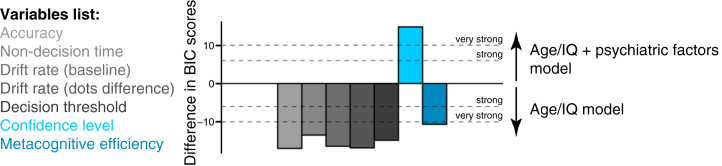
BACKGROUND: Distortions in metacognition-the ability to reflect on and control other cognitive processes-are thought to be characteristic of poor mental health. However, it remains unknown whether such shifts in self-evaluation are due to specific alterations in metacognition and/or a downstream consequence of changes in decision-making processes. METHODS: Using perceptual decision making as a model system, we employed a computational psychiatry approach to relate parameters governing both decision formation and metacognitive evaluation to self-reported transdiagnostic symptom dimensions in a large general population sample (N = 995). RESULTS: Variability in psychopathology was unrelated to either speed or accuracy of decision formation. In contrast, leveraging a dimensional approach, we revealed independent relationships between psychopathology and metacognition: a symptom dimension related to anxiety and depression was associated with lower confidence and heightened metacognitive efficiency, whereas a dimension characterizing compulsive behavior and intrusive thoughts was associated with higher confidence and lower metacognitive efficiency. Furthermore, we obtained a robust double dissociation-whereas psychiatric symptoms predicted changes in metacognition but not decision performance, age predicted changes in decision performance but not metacognition. CONCLUSIONS: Our findings indicate a specific and pervasive link between metacognition and mental health. Our study bridges a gap between an emerging neuroscience of decision making and an understanding of metacognitive alterations in psychopathology.
Overview
CoChat Summary
TL;DR
In two large online perceptual decision-making experiments (total N = 995), self-reported psychiatric symptom dimensions were associated with dissociable shifts in confidence and metacognitive efficiency but not with decision speed or accuracy. An anxious-depression dimension related to lower confidence and higher metacognitive efficiency, whereas a compulsive behavior/intrusive thought dimension related to higher confidence and lower metacognitive efficiency.
Key findings
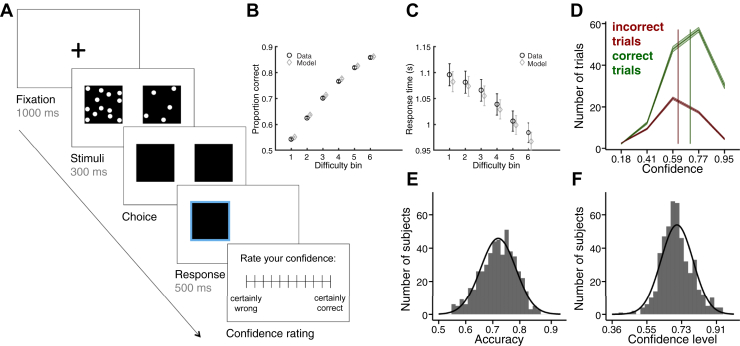
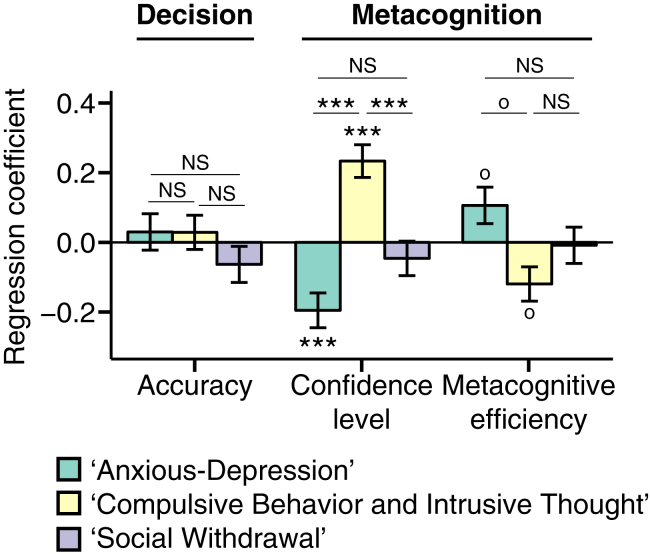
- Psychiatric symptoms were unrelated to decision formation: in experiment 1, symptoms were not associated with decision accuracy or drift-diffusion model parameters; experiment 2 replicated no association between psychiatric factors and accuracy/decision formation parameters.
- In experiment 2, the anxious-depression (AD) factor was associated with lower confidence level (β = −.20, p < .001) and higher metacognitive efficiency (β = .11, p_uncorrected = .04), while the compulsive behavior and intrusive thought (CIT) factor was associated with higher confidence level (β = .23, p < .001) and lower metacognitive efficiency (β = −.12, p_uncorrected = .02); the metacognitive efficiency findings did not survive correction for multiple comparisons.
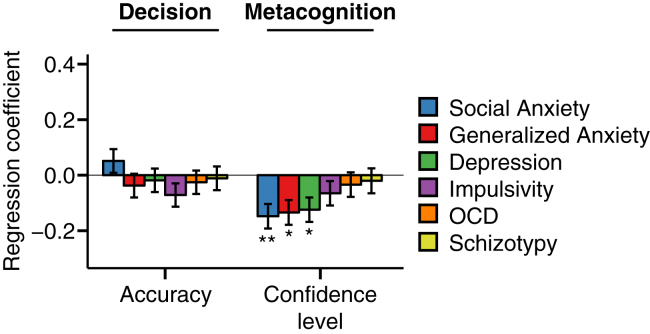
- In experiment 1, depression, social anxiety, and generalized anxiety were associated with lower confidence (all β < −.12, all p < .05), whereas impulsivity, OCD, and schizotypy showed no association with confidence (all p > .05).
- A double dissociation was observed: psychiatric symptoms predicted changes in metacognition but not decision performance, whereas age predicted changes in decision performance but not metacognition; older age was associated with slower, less accurate decisions, and neither age nor IQ was related to confidence.
Methods
- Data were collected online via Amazon’s Mechanical Turk in two experiments (experiment 1: 663 participants; experiment 2: 637 participants); after exclusions, 498 participants remained in experiment 1 and 497 in experiment 2 (total N = 995).
- Participants performed a perceptual decision-making task judging which of two boxes contained more dots and rated confidence on each judgment; across both experiments there were 210 trials in five blocks, and experiment 2 added a calibration/staircase procedure to equate performance and allow computation of metacognitive efficiency (meta-d′/d′).
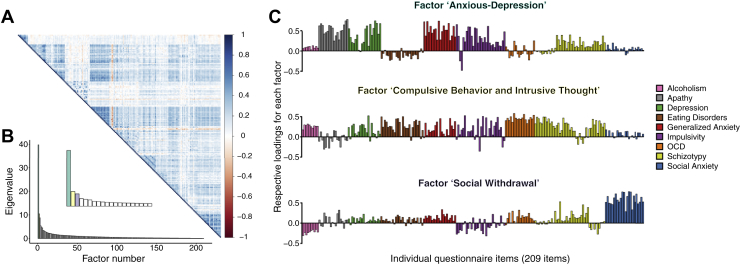
- Self-report questionnaires assessed depression, generalized anxiety, schizotypy, impulsivity, OCD, social anxiety, and IQ; experiment 2 added eating disorders, apathy, and alcoholism questionnaires. Experiment 2 used factor analysis on 209 items across nine questionnaires, identifying three factors (AD, CIT, social withdrawal), and analyses used drift-diffusion modeling, signal detection theory, linear regressions controlling for age, IQ, and gender, and Bayesian information criterion model comparison.
Limitations
- The paper states that no structured clinical interviews were used and no information about psychiatric diagnosis or medication was recorded; the sample was a general population sample with continuous self-reported symptoms, limiting inferences about patients with psychiatric diagnoses.
- The paper states that the metacognitive efficiency findings did not survive correction for multiple comparisons and should be interpreted with caution, and that the factor analysis sample (n = 497) had a relatively low subject-to-variable ratio, though the solution was compared with prior results from Gillan et al. (N = 1413).
- The paper states that perceptual decision making was used as a model system and it remains to be explored how findings extend to other decision types or cognitive domains; evident from the design, the study is cross-sectional and correlational, so it cannot establish causal direction.
Model-written summary. Check it against the paper before relying on it.
Integrity signals
Registry
Cites
Statistics
Figures
Verification
Claims the paper makes
4 Valid · 0 Not valid · 43 Not checked · 59 Own results and interpretations
The cited sources support only part of this claim — read each source’s verdict below.
In the paper
“Notably, the level of confidence is a relatively stable feature of individuals’ judgments that generalizes across different tasks 10, 11, 12”
§ Psychiatric Symptom Dimensions Are Associated With Dissociable Shifts in Metacognition but Not Task Performance > Abstract > Conclusions
What the sources say
- Supportedcites [10] Ais J. Zylberberg A. Barttfeld P. Sigman M. Individual consistency in the accuracy and distribution of confidence judgments Cognition 146 2016 377 386 26513356 source
Section 3.3 ('Confidence bias within and across tasks') reports very strong within-task correlations of the mean of the confidence distribution and significantly positive correlations for every pair of different experiments, stating explicitly that 'an individual's confidence bias is consistent across tasks'. The Discussion point (4) adds that despite large across-task changes in distribution shape, the mean was highly indicative of a subject's identity and every single correlation of average confidence across sessions (different days and different tasks) was positive; the Abstract (5) makes the same point. This matches the claim's 'confidence level ... relatively stable ... generalizes across different tasks', with the caveat that the paper's evidence comes from 23 subjects in four perceptual/cognitive tasks — and separately, its measure of confidence *accuracy* (AUC) was only modestly correlated across tasks (§3.1, Abstract 2), which the claim does not attribute. (LLM, conf=0.85)
- Not checked — no full text of the sourcecites [11] Stankov L. Crawford J.D. Self-confidence and performance on tests of cognitive abilities Intelligence 25 1997 93 109 source
- Partly supportedcites [12] Rahnev D. Koizumi A. McCurdy L.Y. D’Esposito M. Lau H. Confidence leak in perceptual decision making Psychol Sci 26 2015 1664 1680 26408037 PMC4636919 sourceExperimental — accuracy not yet measured
Our copy supports only the cross-task half of the claim: the Introduction (p.1) states 'We demonstrate robust inter-task dependence in metacognitive judgments of confidence even when the two different tasks involve distinct visual features', and Results (Experiment 1, p.2; Experiment 2, p.3) report positive trial-by-trial inter-task confidence correlations (Fisher z = .23 and .26). That is a trial-level coupling of confidence ratings between tasks, not evidence that confidence level is a relatively stable, trait-like feature of individuals' judgments; indeed Results (Experiment 1) uses scaled correlation to show the effect does not depend on slow changes in observers' overall state, and the individual-difference analyses (Experiments 3-4) concern the amount of leak, not a person's characteristic confidence. Moreover, the generic 'task-independent'/'common currency' framing that would license 'generalizes across different tasks' is explicitly credited in the Discussion to de Gardelle & Mamassian (2014), not established here. (LLM, conf=0.72)
plain- Asserted: passes — The authors put it forward as true.
- Checkable: passes — It can be checked against evidence.
- Load-bearing: passes — The paper’s conclusions depend on it.
- Based: passes — The paper gives a reason why it holds.
- Supported
The sources with a verdict support this claim; the rest weren’t checked yet, have no full text we could read, or their verdicts aren’t rated yet.
In the paper
“A relationship between lower confidence level and an AD symptom dimension is consistent with depression’s being characterized by pervasive negative shifts in self-evaluation 5, 47, 48.”
§ Psychiatric Symptom Dimensions Are Associated With Dissociable Shifts in Metacognition but Not Task Performance > Discussion
What the sources say
- Not checked yetcites [5] Elliott R. Sahakian B.J. McKay A.P. Herrod J.J. Robbins T.W. Paykel E.S. Neuropsychological impairments in unipolar depression: The influence of perceived failure on subsequent performance Psychol Med 26 1996 975 989 8878330 source
Checked before — its earlier verdict is held back until a new check runs.
- Supportedcites [47] Silverstone P.H. Salsali M. Low self-esteem and psychiatric patients: Part I—the relationship between low self-esteem and psychiatric diagnosis Ann Gen Hosp Psychiatry 2 2003 2 12620127 PMC151271 source
The Discussion section 'Self-Esteem and Depressive Disorders' states that low self-esteem arises during major depression and depressive subtypes (seasonal affective disorder, dysthymia), that the lowering is cumulative with comorbid depressive disorders, and that self-esteem shifts with depressive state — decreasing after onset and increasing as mood improves — which is what the citing sentence attributes (depression characterized by negative shifts in self-evaluation). The Abstract/Results (Rosenberg scores) reinforce this, with self-esteem lowest in major depressive disorder and significantly lower than in anxiety or adjustment disorders. The only caveat is that the paper stresses the relationship is not uniquely specific to depression (lowered self-esteem occurs across the psychiatric spectrum) and that trait vs. state remains unresolved, but the hedged 'is consistent with' framing of the claim matches this level of confidence. (LLM, conf=0.85)
- Not checked yetcites [48] Orth U. Robins R.W. Understanding the link between low self-esteem and depression Curr Dir Psychol Sci 22 2013 455 460 source
Checked before — its earlier verdict is held back until a new check runs.
plainstates an association- Asserted: passes — The authors put it forward as true.
- Checkable: passes — It can be checked against evidence.
- Load-bearing: passes — The paper’s conclusions depend on it.
- Based: passes — The paper gives a reason why it holds.
- Not checked yet
Every source the paper cites for this claim was checked and supports it.
In the paper
“Our findings speak to computational models of confidence (15): while previous work has focused on modeling trial-level determinants of decision confidence 60, 61, the between-subjects variance typically captured by one or more free parameters in such models could reflect systematic trait-level differences among individuals.”
§ Psychiatric Symptom Dimensions Are Associated With Dissociable Shifts in Metacognition but Not Task Performance > Discussion
What the sources say
- Supportedcites [15] Pouget A. Drugowitsch J. Kepecs A. Confidence and certainty: Distinct probabilistic quantities for different goals Nat Neurosci 19 2016 366 374 26906503 PMC5378479 source
The citation (ref. 15) is attached to the noun phrase 'computational models of confidence'; the trial-level-modelling clause carries refs 60,61 and the between-subjects/trait-level inference is the citing authors' own conclusion, so only the identification of computational models of confidence is attributed to this source. Our copy plainly establishes that topic: the Introduction (p. 1) states the authors' goal is 'to offer a computational and neural coding perspective on confidence', and 'Looking for confidence in neural codes' describes 'developing a computational model of this task' so that 'a subject's estimate of being correct can be inferred without an explicit report of this probability'. The 'Confidence: definition and computations' section likewise formalizes confidence as the probability of the current choice being correct, including its extension to continuous estimates and its role in learning rules (Box 2). (LLM, conf=0.85)
- Supportedcites [60] Sanders J.I. Hangya B. Kepecs A. Signatures of a statistical computation in the human sense of confidence Neuron 90 2016 499 506 27151640 PMC5350614 source
Sanders et al. (2016) is squarely an instance of the thing the citing sentence cites it for: a computational model of human confidence in which a free parameter is fit per subject and varies across subjects — Results 'Quantitative prediction of human confidence reports' states 'we introduced one free parameter (α), confidence reporting efficacy' and 'The optimal parameter for human confidence reporting efficacy ranged from α = 0.49 to 0.72 with an average of 0.57', and Experimental Procedures 'Model fitting' confirms α is a single subject-level free parameter (with per-subject noise σ also estimated). The Introduction/Discussion (pp. 1, Discussion) likewise characterizes prior computational confidence models as trial-level/algorithmic accounts whose predictions depend on 'parameter choices'. The further inference that this between-subjects variance 'could reflect systematic trait-level differences' is the citing authors' own conclusion, not something the sentence attributes to Sanders, so nothing in the attributed content is unsupported. (LLM, conf=0.82)
- Supportedcites [61] Kiani R. Corthell L. Shadlen M.N. Choice certainty is informed by both evidence and decision time Neuron 84 2014 1329 1342 25521381 PMC4271191 source
The citation (15) is attached to 'computational models of confidence', and our copy of Kiani et al. (2014) is exactly that: a bounded-accumulation model that yields explicit predictions of choice certainty from decision variable and decision time (Introduction; Results, 'The model provides explicit predictions for the relationship between DV, decision time, and certainty'; Discussion, 'it provides a novel account of decision confidence'). The Methods section ('Bounded accumulation model') also confirms the characterization the sentence relies on — 'the model has six free parameters: k, r, Bl, Bu, T0, and σT0²... fit the model to each subject's RT distribution' — i.e., between-subjects variance handled by per-subject free parameters. The remaining clause (that this variance could reflect trait-level differences) is the citing authors' own inference, and the 'trial-level determinants' point is credited to references 60, 61, not to this source. (LLM, conf=0.85)
hedgedstates an association- Asserted: passes — The authors put it forward as true.
- Checkable: passes — It can be checked against evidence.
- Load-bearing: passes — The paper’s conclusions depend on it.
- Based: passes — The paper gives a reason why it holds.
- Supported
Every source the paper cites for this claim was checked and supports it.
In the paper
“our findings of disrupted metacognition in high-CIT individuals is consistent with recent findings of lowered metacognitive efficiency in high versus low compulsive participants who were matched for depression and anxiety symptoms (55).”
§ Psychiatric Symptom Dimensions Are Associated With Dissociable Shifts in Metacognition but Not Task Performance > Discussion
What the sources say
- Supportedcites [55] Hauser T.U. Allen M. Rees G. Dolan R.J. Bullmore E.T. Goodyer I. Metacognitive impairments extend perceptual decision making weaknesses in compulsivity Sci Rep 7 2017 6614 28747627 PMC5529539 source
The Results (Metacognitive impairments in high compulsive participants, pp. corresponding to passages 3–4) state that group metacognitive efficiency (M-ratio) was significantly lower in high compulsive participants (0.512 vs 0.814 in low compulsives, p = 0.017), independent of perceptual performance (d'). The Methods (Participants, passage 7) and Introduction/Discussion (passages 5, 8) confirm the two groups were selected from a population-based cohort and matched on other psychiatric dimensions, specifically depression (MFQ) and anxiety (RCMAS). Both parts of the attributed claim — lowered metacognitive efficiency in high versus low compulsive participants, and the depression/anxiety matching — are stated in our copy. (LLM, conf=0.92)
plainstates an association- Asserted: passes — The authors put it forward as true.
- Checkable: passes — It can be checked against evidence.
- Load-bearing: unclear — It is unclear whether the paper’s conclusions depend on it.
- Based: passes — The paper gives a reason why it holds.
- Supported
A result the paper reports from its own data — it cites no other source for it, so there is none to check. The quote shows it is in the paper.
In the paper
“the AD factor was significantly associated with lower confidence level (β = −.20, p < .001)”
- Also stated in: § Results · plain
“a symptom dimension related to anxiety and depression was associated with lower confidence and heightened metacognitive efficiency”
§ Psychiatric Symptom Dimensions Are Associated With Dissociable Shifts in Metacognition but Not Task Performance > Results
plainstates an association- Asserted: passes — The authors put it forward as true.
- Checkable: passes — It can be checked against evidence.
- Load-bearing: passes — The paper’s conclusions depend on it.
- Based: passes — The paper gives a reason why it holds.
- Also stated in: § Results · plain
45 more claims
Create a free account to see all 106 claims and to verify the 59 references still open.
- It may state two separate claims as one. 25
- Probably not a substantial claim. 42
- The quote only partly states this claim. 1
Claims other papers make about this one
Each is checked against this paper’s own text: does it say what the citing paper says it does?
The cited source says what the claim attributes to it.
In the citing paper
“We replicated previous findings showing that heightened anxiety symptoms are associated with lower average local confidence (metacognitive bias; Exp 1—GAD-7: χ² = 9.76, p = 0.002, β = −0.03, CI = [−0.05 −0.01]; Exp 2—Anxious-Depression axis: χ² = 29.63, p < 0.001, β = −0.35, CI = [−0.47 −0.22])2”
From Distorted learning from local metacognition supports transdiagnostic underconfidence (2025) · cites this paper as [2]
In the citing paper
“Individuals experiencing symptoms of anxiety and depression have been shown to exhibit persistent underconfidence.”
From Distorted learning from local metacognition supports transdiagnostic underconfidence (2025) · cites this paper as [2]
In the citing paper
“These relationships are observed in both local confidence judgments on individual trials2–5 and global confidence as measured through long-run self-performance estimates6”
From Distorted learning from local metacognition supports transdiagnostic underconfidence (2025) · cites this paper as [2]
In the citing paper
“Individuals high in subclinical anxious-depression symptoms tend to be chronically underconfident in their abilities both when evaluating their confidence on a particular task instance2–5 and when providing global self-performance estimates (SPEs)6.”
From Distorted learning from local metacognition supports transdiagnostic underconfidence (2025) · cites this paper as [2]
In the citing paper
“Our model-based approach to estimating the influence of feedback on confidence can also be used to simulate an expected change in metacognition under different feedback schedules for different individuals—highlighting a potential for developing personalised interventions to ameliorate systematic biases in over- and under-confidence2,5,32,40,41.”
From Distorted learning from local metacognition supports transdiagnostic underconfidence (2025) · cites this paper as [2]
2 more claims about this paper
Create a free account to see every claim other papers make about this one.
Citations
Cites
Self-efficacy: Toward a unifying theory of behavioral change
Bandura, A. (1977) · Psychological Review · doi:10.1037/0033-295x.84.2.191 · Cited by 43,925
A Brief Measure for Assessing Generalized Anxiety Disorder: The GAD-7
Spitzer, R. L., Kroenke, K., Williams, J. B. W., & Löwe, B. (2006) · Archives of Internal Medicine · doi:10.1001/archinte.166.10.1092 · Cited by 31,765
Diagnostic and Statistical Manual of Mental Disorders, 5th ed.
Carter, M. J. (2014) · Therapeutic Recreation Journal · Cited by 15,169
The Scree Test For The Number Of Factors
Cattell, R. B. (1966) · Multivariate Behavioral Research · doi:10.1207/s15327906mbr0102_10 · Cited by 13,554 · cited 1×
“We selected the number of factors based on Cattell’s criterion (44), in which a sharp elbow indicates the point at which there is little benefit to retaining additional factors.”
MethodSelf-efficacy: Toward a unifying theory of behavioral change
Bandura, A. (1978) · Advances in Behaviour Research and Therapy · doi:10.1016/0146-6402(78)90002-4 · Cited by 10,586
A self-rating depression scale
ZUNG, W. W. K. (1965) · Archives of General Psychiatry · doi:10.1001/archpsyc.1965.01720310065008 · Cited by 9,813
Insel, T., Cuthbert, B., Garvey, M., Heinssen, R., Pine, D. S., Quinn, K., Sanislow, C., & Wang, P. (2010) · American Journal of Psychiatry · doi:10.1176/appi.ajp.2010.09091379 · Cited by 7,067 · cited 1×
“As such, this approach provides a powerful new pathway toward testing the merits of a dimensional view of psychiatry (25), consistent with the broader goals of the burgeoning computational psychiatry movement (26,27).”
Instructional manipulation checks: Detecting satisficing to increase statistical power
Oppenheimer, D. M., Meyvis, T., & Davidenko, N. (2009) · Journal of Experimental Social Psychology · doi:10.1016/j.jesp.2009.03.009 · Cited by 3,493
The Obsessive-Compulsive Inventory: Development and validation of a short version.
Foa, E. B., Huppert, J. D., Leiberg, S., Langner, R., Kichic, R., Hajcak, G., & Salkovskis, P. M. (2002) · Psychological Assessment · doi:10.1037/1040-3590.14.4.485 · Cited by 2,959 · cited 1×
“After the task, subjects completed standard self-report questionnaires assessing a range of psychiatric symptoms (Supplemental Figure S1), including depression (Zung Self-Rating Depression Scale) (35), generalized anxiety (Generalized Anxiety Disorder 7-item scale) (36), schizotypy (Short Scales for Measuring Schizoty…”
BackgroundLiebowitz, M. R. (2015) · Modern Trends in Pharmacopsychiatry · doi:10.1159/000414022 · Cited by 2,266
Cited by
Metacognition and Confidence: A Review and Synthesis
Fleming, S. M. (2024) · Annual Review of Psychology · doi:10.1146/annurev-psych-022423-032425 · Cited by 256
“…(measured as the noise in metacognitive judgments, relative to performance) covaries across perceptual and cognitive tasks, suggesting the existence of a global resource that is leveraged to monitor self-performance (Rouault et al., 2018b, Mazancieux et al., 2020, Boundy-Singer et al., 2023).”
InfluentialSelf-citationKnowing Ourselves Together: The Cultural Origins of Metacognition
Heyes, C., Bang, D., Shea, N., Frith, C. D., & Fleming, S. M. (2020) · Trends in Cognitive Sciences · doi:10.1016/j.tics.2020.02.007 · Cited by 232
“It improves learning in schools [86–89,127]; regulates anxiety, depression, and compulsion [107]; promotes effective leadership [128,129]; and encourages moderation in political and religious debate [22].”
BackgroundSelf-citationMachine learning and big data in psychiatry: toward clinical applications
Rutledge, R. B., Chekroud, A. M., & Huys, Q. J. (2019) · Current Opinion in Neurobiology · doi:10.1016/j.conb.2019.02.006 · Cited by 196
“The same trans-diagnostic factor was associated with high confidence but low self-evaluation ability while the anxiety/depression factor was associated with low confidence but high self-evaluation ability [40].”
BackgroundMetacognitive Failure as a Feature of Those Holding Radical Beliefs
Rollwage, M., Dolan, R. J., & Fleming, S. M. (2018) · Current Biology · doi:10.1016/j.cub.2018.10.053 · Cited by 193
“4014 Current Biology 28, 4014–4021, December 17, 2018 a 2018 Th This is an open access article under the CC BY license (http://creative (changes in an overall belief about performance, which may be affected by optimism [8] and mood [9]) from changes in metacognitive sensitivity (an ability to distinguish accurate from…”
BackgroundSelf-citationConfidence drives a neural confirmation bias
Rollwage, M., Loosen, A., Hauser, T. U., Moran, R., Dolan, R. J., & Fleming, S. M. (2020) · Nature Communications · doi:10.1038/s41467-020-16278-6 · Cited by 183
Self-citationMetacognition: ideas and insights from neuro- and educational sciences
Fleur, D. S., Bredeweg, B., & van den Bos, W. (2021) · npj Science of Learning · doi:10.1038/s41539-021-00089-5 · Cited by 180
Advances in the computational understanding of mental illness
Huys, Q. J. M., Browning, M., Paulus, M. P., & Frank, M. J. (2021) · Neuropsychopharmacology · doi:10.1038/s41386-020-0746-4 · Cited by 179
Human Metacognition Across Domains: Insights from Individual Differences and Neuroimaging
Rouault, M., McWilliams, A., Allen, M. G., & Fleming, S. M. (2018) · Personality Neuroscience · doi:10.1017/pen.2018.16 · Cited by 176
“Approaches to tackling this question are synergistic with transdiagnostic perspectives of psychopathology emerging in neuroscience (Barch, 2017; Rouault et al., 2018).”
BackgroundSelf-citationAbnormalities of confidence in psychiatry: an overview and future perspectives
Hoven, M., Lebreton, M., Engelmann, J. B., Denys, D., Luigjes, J., & van Holst, R. J. (2019) · Translational Psychiatry · doi:10.1038/s41398-019-0602-7 · Cited by 171
Interoception of breathing and its relationship with anxiety
Harrison, O. K., Köchli, L., Marino, S., Luechinger, R., Hennel, F., Brand, K., Hess, A. J., Frässle, S., Iglesias, S., Vinckier, F., et al. (2021) · Neuron · doi:10.1016/j.neuron.2021.09.045 · Cited by 163
Computational Psychiatry Needs Time and Context
Hitchcock, P. F., Fried, E. I., & Frank, M. J. (2022) · Annual Review of Psychology · doi:10.1146/annurev-psych-021621-124910 · Cited by 131
How Local and Global Metacognition Shape Mental Health
Seow, T. X. F., Rouault, M., Gillan, C. M., & Fleming, S. M. (2021) · Biological Psychiatry · doi:10.1016/j.biopsych.2021.05.013 · Cited by 159
“With self-reported symptoms in nine psychiatric questionnaires (105), we characterized large online general population samples along three symptom dimensions [anxious-depression, compulsive behavior and intrusive thought (henceforth compulsivity), and social withdrawal; replicated from a previous study (106)].”
BackgroundSelf-citationIndividual differences in information-seeking
Kelly, C., & Sharot, T. (2021) · Nature Communications · doi:10.1038/s41467-021-27046-5 · Cited by 149
The nature of metacognitive inefficiency in perceptual decision making.
Shekhar, M., & Rahnev, D. (2021) · Psychological Review · doi:10.1037/rev0000249 · Cited by 111
Wise, T., & Dolan, R. J. (2020) · Nature Communications · doi:10.1038/s41467-020-17977-w · Cited by 119
Forming global estimates of self-performance from local confidence
Rouault, M., Dayan, P., & Fleming, S. M. (2019) · Nature Communications · doi:10.1038/s41467-019-09075-3 · Cited by 134
Self-citationMazancieux, A., Fleming, S. M., Souchay, C., & Moulin, C. J. A. (2020) · Journal of Experimental Psychology: General · doi:10.1037/xge0000746 · Cited by 131
“Another driver to global metacognition would be the ability to generalize priors from one task to another, such as between two memory tasks, or two perceptual tasks (Rouault et al., 2018).”
BackgroundSelf-citationTransdiagnostic Phenotyping Reveals a Host of Metacognitive Deficits Implicated in Compulsivity
Seow, T. X. F., & Gillan, C. M. (2020) · Scientific Reports · doi:10.1038/s41598-020-59646-4 · Cited by 84
Self-citationSources of Metacognitive Inefficiency
Shekhar, M., & Rahnev, D. (2021) · Trends in Cognitive Sciences · doi:10.1016/j.tics.2020.10.007 · Cited by 119
Identifying Transdiagnostic Mechanisms in Mental Health Using Computational Factor Modeling
Wise, T., Robinson, O. J., & Gillan, C. M. (2023) · Biological Psychiatry · doi:10.1016/j.biopsych.2022.09.034 · Cited by 108
“(C ) Using CFM, Rouault et al. (36) showed that in fact a bidirectional association exists wherein anxious-depression is linked to decreased con fi dence in performance, while compulsivity and intrusive thought is characterized by increased con fi dence.”
InfluentialSelf-citationSmartphones and the Neuroscience of Mental Health
Gillan, C. M., & Rutledge, R. B. (2021) · Annual Review of Neuroscience · doi:10.1146/annurev-neuro-101220-014053 · Cited by 90
Self-citationA comprehensive assessment of current methods for measuring metacognition
Rahnev, D. (2025) · Nature Communications · doi:10.1038/s41467-025-56117-0 · Cited by 110
Gillan, C. M., Kalanthroff, E., Evans, M., Weingarden, H. M., Jacoby, R. J., Gershkovich, M., Snorrason, I., Campeas, R., Cervoni, C., Crimarco, N. C., et al. (2020) · JAMA Psychiatry · doi:10.1001/jamapsychiatry.2019.2998 · Cited by 92
Self-citationThe Filter Detection Task for measurement of breathing-related interoception and metacognition
Harrison, O. K., Garfinkel, S. N., Marlow, L., Finnegan, S. L., Marino, S., Köchli, L., Allen, M., Finnemann, J., Keur-Huizinga, L., Harrison, S. J., et al. (2021) · Biological Psychology · doi:10.1016/j.biopsycho.2021.108185 · Cited by 83
Self-citationDworak, E. M., Revelle, W., Doebler, P., & Condon, D. M. (2020) · Personality and Individual Differences · doi:10.1016/j.paid.2020.109906 · Cited by 90
How do confidence and self-beliefs relate in psychopathology: a transdiagnostic approach
Hoven, M., Luigjes, J., Denys, D., Rouault, M., & van Holst, R. J. (2023) · Nature Mental Health · doi:10.1038/s44220-023-00062-8 · Cited by 58
Self-citationDistinct neural contributions to metacognition for detecting, but not discriminating visual stimuli
Mazor, M., Friston, K. J., & Fleming, S. M. (2020) · eLife · doi:10.7554/elife.53900 · Cited by 72
Self-citationHow experimental procedures influence estimates of metacognitive ability
Rahnev, D., & Fleming, S. M. (2019) · Neuroscience of Consciousness · doi:10.1093/nc/niz009 · Cited by 69
Self-citationValue-free random exploration is linked to impulsivity
Dubois, M., & Hauser, T. U. (2022) · Nature Communications · doi:10.1038/s41467-022-31918-9 · Cited by 68
Relationship between nuclei-specific amygdala connectivity and mental health dimensions in humans
Klein-Flügge, M. C., Jensen, D. E. A., Takagi, Y., Priestley, L., Verhagen, L., Smith, S. M., & Rushworth, M. F. S. (2022) · Nature Human Behaviour · doi:10.1038/s41562-022-01434-3 · Cited by 119
Dogmatism manifests in lowered information search under uncertainty
Schulz, L., Rollwage, M., Dolan, R. J., & Fleming, S. M. (2020) · Proceedings of the National Academy of Sciences · doi:10.1073/pnas.2009641117 · Cited by 76
“We based this sample size on previous studies conducted to detect interindividual differences in cognition across the political spectrum (24, 38) and in disorders (46).”
BackgroundMethodSelf-citationFormation of global self-beliefs in the human brain
Rouault, M., & Fleming, S. M. (2020) · Proceedings of the National Academy of Sciences · doi:10.1073/pnas.2003094117 · Cited by 76
“Metacognitive ability as evaluated using local confidence judgements varies substantially across individuals (10) and is related to structural brain differences (26).”
Self-citationInsight and psychosis: the next 30 years
David, A. S. (2019) · The British Journal of Psychiatry · doi:10.1192/bjp.2019.217 · Cited by 73
Benwell, C. S. Y., Mohr, G., Wallberg, J., Kouadio, A., & Ince, R. A. A. (2022) · npj Mental Health Research · doi:10.1038/s44184-022-00009-4 · Cited by 42
Confidence reflects a noisy decision reliability estimate
Boundy-Singer, Z. M., Ziemba, C. M., & Goris, R. L. T. (2022) · Nature Human Behaviour · doi:10.1038/s41562-022-01464-x · Cited by 71
McWilliams, A., Bibby, H., Steinbeis, N., David, A. S., & Fleming, S. M. (2023) · Cognition · doi:10.1016/j.cognition.2023.105389 · Cited by 73
Self-citationComputational validity: using computation to translate behaviours across species
Redish, A. D., Kepecs, Á., Anderson, L. M., Calvin, O. L., Grissom, N. M., Haynos, A. F., Heilbronner, S. R., Herman, A. B., Jacob, S., Ma, S., et al. (2021) · Philosophical Transactions of the Royal Society B Biological Sciences · doi:10.1098/rstb.2020.0525 · Cited by 72
Visual metacognition: Measures, models, and neural correlates.
Rahnev, D. (2021) · American Psychologist · doi:10.1037/amp0000937 · Cited by 61
The neural basis of consciousness
Frith, C. D. (2021) · Psychological Medicine · doi:10.1017/s0033291719002204 · Cited by 52
Measuring metacognitive performance: type 1 performance dependence and test-retest reliability
Guggenmos, M. (2021) · Neuroscience of Consciousness · doi:10.1093/nc/niab040 · Cited by 66
Obsessive–compulsive symptoms and information seeking during the Covid-19 pandemic
Loosen, A. M., Skvortsova, V., & Hauser, T. U. (2021) · Translational Psychiatry · doi:10.1038/s41398-021-01410-x · Cited by 56
The future of metacognition research: Balancing construct breadth with measurement rigor
Katyal, S., & Fleming, S. M. (2024) · Cortex · doi:10.1016/j.cortex.2023.11.002 · Cited by 63
“For example, we recently extended this model to study how global underconfidence is maintained in individuals with transdiagnostic anxiety and depression symptoms (Hoven et al., 2023; Rouault, Seow, et al., 2018).”
BackgroundSelf-citationWeb-browsing patterns reflect and shape mood and mental health
Kelly, C., & Sharot, T. (2024) · Nature Human Behaviour · doi:10.1038/s41562-024-02065-6 · Cited by 65
Dynamic influences on static measures of metacognition
Desender, K., Vermeylen, L., & Verguts, T. (2022) · Nature Communications · doi:10.1038/s41467-022-31727-0 · Cited by 62
Predictors of risky foraging behaviour in healthy young people
Bach, D. R., Moutoussis, M., Bowler, A., & Dolan, R. J. (2020) · Nature Human Behaviour · doi:10.1038/s41562-020-0867-0 · Cited by 65
Reverse engineering of metacognition
Guggenmos, M. (2022) · eLife · doi:10.7554/elife.75420 · Cited by 62
Seow, T. X. F., Benoit, E., Dempsey, C., Jennings, M., Maxwell, A., O'Connell, R., & Gillan, C. M. (2021) · The Journal of Neuroscience · doi:10.1523/jneurosci.0031-21.2021 · Cited by 51
Self-citationLapate, R. C., Samaha, J., Rokers, B., Postle, B. R., & Davidson, R. J. (2020) · Communications Biology · doi:10.1038/s42003-020-1049-3 · Cited by 54
Unity and diversity of metacognition.
Lehmann, M., Hagen, J., & Ettinger, U. (2022) · Journal of Experimental Psychology General · doi:10.1037/xge0001197 · Cited by 54
Updating beliefs beyond the here-and-now: the counter-factual self in anosognosia for hemiplegia
Kirsch, L. P., Mathys, C. D., Papadaki, C., Talelli, P., Friston, K. J., Moro, V., & Fotopoulou, A. (2021) · Brain Communications · doi:10.1093/braincomms/fcab098 · Cited by 52
A shared brain system forming confidence judgment across cognitive domains
Rouault, M., Lebreton, M. P., & Pessiglione, M. (2022) · Cerebral Cortex · doi:10.1093/cercor/bhac146 · Cited by 54
Self-citationThe relationship between apathy and impulsivity in large population samples
Petitet, P., Scholl, J., Attaallah, B., Drew, D., Manohar, S., & Husain, M. (2021) · Scientific Reports · doi:10.1038/s41598-021-84364-w · Cited by 53
I know better! Emerging metacognition allows adolescents to ignore false advice
Moses-Payne, M. E., Habicht, J., Bowler, A., Steinbeis, N., & Hauser, T. U. (2021) · Developmental Science · doi:10.1111/desc.13101 · Cited by 52
Sources of confidence in value-based choice
Brus, J., Aebersold, H., Grueschow, M., & Polanía, R. (2021) · Nature Communications · doi:10.1038/s41467-021-27618-5 · Cited by 52
Low self-esteem and the formation of global self-performance estimates in emerging adulthood
Rouault, M., Will, G.-J., Fleming, S. M., & Dolan, R. J. (2022) · Translational Psychiatry · doi:10.1038/s41398-022-02031-8 · Cited by 26
Self-citationChen, H., Mojtahedzadeh, N., Belanger, M. J., Nebe, S., Kuitunen‐Paul, S., Sebold, M., Garbusow, M., Huys, Q. J. M., Heinz, A., Rapp, M. A., et al. (2021) · Biological Psychiatry · doi:10.1016/j.biopsych.2021.01.009 · Cited by 51
Metacognition in functional cognitive disorder- a potential mechanism and treatment target
Bhome, R., McWilliams, A., Huntley, J. D., Fleming, S. M., & Howard, R. J. (2019) · Cognitive Neuropsychiatry · doi:10.1080/13546805.2019.1651708 · Cited by 48
Self-citationTowards a common conceptual space for metacognition in perception and memory
Mazancieux, A., Pereira, M., Faivre, N., Mamassian, P., Moulin, C. J. A., & Souchay, C. (2023) · Nature Reviews Psychology · doi:10.1038/s44159-023-00245-1 · Cited by 48
Distorted learning from local metacognition supports transdiagnostic underconfidence
Katyal, S., Huys, Q. J., Dolan, R. J., & Fleming, S. M. (2025) · Nature Communications · doi:10.1038/s41467-025-57040-0 · Cited by 47
Self-citationComputational models of subjective feelings in psychiatryPreprint
Kao, C.-H., Feng, G., Hur, J. K., Jarvis, H., & Rutledge, R. B. (2022) · PsyArXiv (OSF Preprints) · doi:10.1016/j.neubiorev.2022.105008 · Cited by 47
Examining the robustness of the relationship between metacognitive efficiency and metacognitive bias
Xue, K., Shekhar, M., & Rahnev, D. (2021) · Consciousness and Cognition · doi:10.1016/j.concog.2021.103196 · Cited by 45
A dimensional investigation of error-related negativity (ERN) and self-reported psychiatric symptoms
Seow, T. X. F., Benoit, E., Dempsey, C., Jennings, M., Maxwell, A., McDonough, M., & Gillan, C. M. (2020) · International Journal of Psychophysiology · doi:10.1016/j.ijpsycho.2020.09.019 · Cited by 40
Self-citationMetacognitive Information Theory
Dayan, P. (2023) · Open Mind · doi:10.1162/opmi_a_00091 · Cited by 41
Zheng, Y., Wang, D., Ye, Q., Zou, F., Li, Y., & Kwok, S. C. (2021) · Neuropsychologia · doi:10.1016/j.neuropsychologia.2021.107847 · Cited by 42
The effect of apathy and compulsivity on planning and stopping in sequential decision-making
Scholl, J., Trier, H. A., Rushworth, M. F. S., & Kolling, N. (2022) · PLoS Biology · doi:10.1371/journal.pbio.3001566 · Cited by 41
Neuro-cognitive processes as mediators of psychological treatment effects
Reiter, A. M. F., Atiya, N. A. A., Berwian, I. M., & Huys, Q. J. M. (2021) · Current Opinion in Behavioral Sciences · doi:10.1016/j.cobeha.2021.02.007 · Cited by 38
Machine learning of language use on Twitter reveals weak and non-specific predictions
Kelley, S., Mhaonaigh, C. N., Burke, L., Whelan, R., & Gillan, C. M. (2022) · npj Digital Medicine · doi:10.1038/s41746-022-00576-y · Cited by 39
Self-citationPostdecision Evidence Integration and Depressive Symptoms
Moses-Payne, M. E., Rollwage, M., Fleming, S. M., & Roiser, J. P. (2019) · Frontiers in Psychiatry · doi:10.3389/fpsyt.2019.00639 · Cited by 40
Self-citationA computational approach to understanding effort-based decision-making in depression
Valton, V., Mkrtchian, A., Moses-Payne, M. E., Gray, A., Kieslich, K., VanUrk, S., Samborska, V., Halahakoon, D. C., Manohar, S., Dayan, P., et al. (2025) · Psychological Medicine · doi:10.1017/s0033291725101967 · Cited by 38
Reliability of web-based affective auditory stimulus presentation
Seow, T. X. F., & Hauser, T. U. (2021) · Behavior Research Methods · doi:10.3758/s13428-021-01643-0 · Cited by 37
Self-citationDoss, M. K., Samaha, J., Barrett, F. S., Griffiths, R. R., de Wit, H., Gallo, D. A., & Koen, J. D. (2024) · Psychological Review · doi:10.1037/rev0000455 · Cited by 38
Experimentally induced and real-world anxiety have no demonstrable effect on goal-directed behaviour
Gillan, C. M., Vaghi, M. M. S., Hezemans, F. H., Grothe, S. V. G., Dafflon, J., Brühl, A. B., Savulich, G., & Robbins, T. W. (2020) · Psychological Medicine · doi:10.1017/s0033291720000203 · Cited by 36
Self-citationReliable, rapid, and remote measurement of metacognitive bias
Fox, C. A., McDonogh, A., Donegan, K. R., Teckentrup, V., Crossen, R. J., Hanlon, A. K., Gallagher, E., Rouault, M., & Gillan, C. M. (2024) · Scientific Reports · doi:10.1038/s41598-024-64900-0 · Cited by 37
Self-citationMath anxiety relates positively to metacognitive insight into mathematical decision making
Desender, K., & Sasanguie, D. (2021) · Psychological Research · doi:10.1007/s00426-021-01511-8 · Cited by 35
MacCormack, J. K., Bonar, A. S., & Lindquist, K. A. (2024) · Emotion · doi:10.1037/emo0001270 · Cited by 33
Identifying cultural differences in metacognition.
van der Plas, E., Zhang, S., Dong, K., Bang, D., Li, J., Wright, N. D., & Fleming, S. M. (2022) · Journal of Experimental Psychology: General · doi:10.1037/xge0001209 · Cited by 32
“500 The similar manner in which social and perceptual post-decision evidence was 501 processed suggests a domain-general component to post-decision evidence processing 502 (Rouault et al., 2018).”
BackgroundSelf-citationHow experimental procedures influence estimates of metacognitive ability
Rahnev, D., & Fleming, S. M. (2019) · Neuroscience of Consciousness · doi:10.1093/nc/niz010 · Cited by 31
Self-citationRats use memory confidence to guide decisions
Joo, H. R., Liang, H., Chung, J. E., Geaghan-Breiner, C., Fan, J. L., Nachman, B. P., Kepecs, Á., & Frank, L. M. (2021) · Current Biology · doi:10.1016/j.cub.2021.08.013 · Cited by 30
Yip, S. W., Barch, D. M., Chase, H. W., Flagel, S. B., Huys, Q. J. M., Konova, A. B., Montague, P. R., & Paulus, M. P. (2022) · Biological Psychiatry Global Open Science · doi:10.1016/j.bpsgos.2022.03.011 · Cited by 31
Confidence in visual motion discrimination is preserved in individuals with schizophrenia
Faivre, N., Roger, M., Pereira, M., de Gardelle, V., Vergnaud, J., Passerieux, C., & Roux, P. (2021) · Journal of Psychiatry and Neuroscience · doi:10.1503/jpn.200022 · Cited by 29
Dissociating breathlessness symptoms from mood in asthma
Harrison, O. K., Marlow, L., Finnegan, S., Ainsworth, B., & Pattinson, K. T. S. (2021) · Biological Psychology · doi:10.1016/j.biopsycho.2021.108193 · Cited by 30
Carving Out New Transdiagnostic Dimensions for Research in Mental Health
Gillan, C. M., & Seow, T. X. F. (2020) · Biological Psychiatry: Cognitive Neuroscience and Neuroimaging · doi:10.1016/j.bpsc.2020.04.013 · Cited by 28
Self-citationHoven, M., Rouault, M., van Holst, R., & Luigjes, J. (2023) · Psychological Medicine · doi:10.1017/s003329172300209x · Cited by 28
“…evidence for a direct relationship between local confidence and OC symptoms (Benwell, Mohr, Wallberg, Kouadio, & Ince, 2022; Hoven et al., 2023; Rouault et al., 2018b), while another study did find a positive relationship, indicating that increased OC symptoms related to higher confidence…”
BackgroundResultInfluentialSelf-citationConfidence control for efficient behaviour in dynamic environments
Balsdon, T., & Philiastides, M. G. (2024) · Nature Communications · doi:10.1038/s41467-024-53312-3 · Cited by 28
Lee, C. T., Palacios, J., Richards, D., Hanlon, A. K., Lynch, K., Harty, S., Claus, N., Swords, L., O’Keane, V., Stephan, K. E., et al. (2023) · BMC Psychiatry · doi:10.1186/s12888-022-04462-5 · Cited by 25
Self-citationValue certainty and choice confidence are multidimensional constructs that guide decision-making
Lee, D. G., & Hare, T. A. (2023) · Cognitive Affective & Behavioral Neuroscience · doi:10.3758/s13415-022-01054-4 · Cited by 31
Sensitivity to intrinsic rewards is domain general and related to mental health
Blain, B., Pinhorn, I., & Sharot, T. (2023) · Nature Mental Health · doi:10.1038/s44220-023-00116-x · Cited by 35
Recent developments in the habit hypothesis of OCD and compulsive disorders
Gillan, C. M. (2021) · Current Topics in Behavioral Neurosciences · doi:10.1007/7854_2020_199 · Cited by 27
Self-citationConfidence at the limits of human nested cognition
Recht, S., Jovanović, L., Mamassian, P., & Balsdon, T. (2022) · Neuroscience of Consciousness · doi:10.1093/nc/niac014 · Cited by 27
Metacognition and sense of agency
Wen, W., Charles, L., & Haggard, P. (2023) · Cognition · doi:10.1016/j.cognition.2023.105622 · Cited by 27
Modeling speed–accuracy trade-offs in the stopping rule for confidence judgments.
Herregods, S., Denmat, P. L., Vermeylen, L., & Desender, K. (2025) · Psychological Review · doi:10.1037/rev0000603 · Cited by 26
Controllability boosts neural and cognitive signatures of changes-of-mind in uncertain environments
Rouault, M., Weiss, A., Lee, J. K., Drugowitsch, J., Chambon, V., & Wyart, V. (2022) · eLife · doi:10.7554/elife.75038 · Cited by 26
Self-citationEfficient stabilization of imprecise statistical inference through conditional belief updating
Drevet, J., Drugowitsch, J., & Wyart, V. (2022) · Nature Human Behaviour · doi:10.1038/s41562-022-01445-0 · Cited by 25
Modifiable dementia risk factors associated with objective and subjective cognition
Rosická, A. M., Teckentrup, V., Fittipaldi, S., Ibáñez, A. M., Pringle, A. J., Gallagher, E., Hanlon, A. K., Claus, N., McCrory, C., LAWLOR, B. A., et al. (2024) · Alzheimer s & Dementia · doi:10.1002/alz.13885 · Cited by 24
Self-citationVrizzi, S., Najar, A., Lemogne, C., Palminteri, S., & Lebreton, M. P. (2025) · Nature Mental Health · doi:10.1038/s44220-025-00427-1 · Cited by 25
Metacognitive biases in anxiety-depression and compulsivity extend across perception and memory
Seow, T. X. F., Fleming, S. M., & Hauser, T. U. (2025) · PLOS mental health. · doi:10.1371/journal.pmen.0000259 · Cited by 25
Self-citationDecision prioritization and causal reasoning in decision hierarchies
Zylberberg, A. (2021) · PLoS Computational Biology · doi:10.1371/journal.pcbi.1009688 · Cited by 23
Mediterranean diet, interoception and mental health: Is it time to look beyond the ‘Gut-brain axis’?
Young, H. A., Freegard, G., & Benton, D. (2022) · Physiology & Behavior · doi:10.1016/j.physbeh.2022.113964 · Cited by 24
Interoceptive and metacognitive facets of fatigue in multiple sclerosis
Rouault, M., Pereira, I., Galioulline, H., Fleming, S. M., Stephan, K. E., & Manjaly, Z. (2023) · European Journal of Neuroscience · doi:10.1111/ejn.16048 · Cited by 23
Self-citationCultural influence on metacognition: comparison across three societies
Ordin, M., El‐Dakhs, D. A. S., Ming, T., Chu, F., & Polyanskaya, L. (2024) · Humanities and Social Sciences Communications · doi:10.1057/s41599-024-04013-1 · Cited by 24
Metadata
- Authors
- Rouault, M., Seow, T., Gillan, C. M., & Fleming, S. M.
- Affiliations
- Wellcome Centre for Human Neuroimaging (GB)
- Trinity College Dublin (IE)
- Corresponding author
- Rouault, Marion
- Fleming, Stephen M.
- Venue
- Biological Psychiatry
- Publisher
- Elsevier BV
- Published
- 2018-09
- Volume
- 84
- Issue
- 6
- Pages
- 443-451
- ISSN
- 0006-3223 (ISSN-L)
- PMC
- PMC6117452
- OpenAlex
- W2783564726
- Cited by
- 393
- References
- 71
- Citations by year
- 2026: 58 · 2025: 62 · 2024: 63 · 2023: 63 · 2022: 37 · 2021: 51 · 2020: 33 · 2019: 19 · 2018: 7
- FWCI
- 13.73
- Type
- journal article
- Language
- en
- Open access
- hybrid
- doi.org
- Licence
- cc-by
- www.elsevier.com/tdm/userlicense/1.0/ (tdm)
- www.elsevier.com/legal/tdmrep-license (tdm)
- creativecommons.org/licenses/by/4.0/ (vor)
- Locations
- Biological Psychiatry (publishedVersion, cc-by)
- Europe PMC (PubMed Central) (publishedVersion, cc-by)
- PubMed (publishedVersion)
- PubMed Central (publishedVersion, cc-by)
- HAL (submittedVersion, cc-by)
- UCL Discovery (University College London) (submittedVersion)
- MPG.PuRe (Max Planck Society) (submittedVersion)
- Funders
- Wellcome Trust (203147/Z/16/Z)
- Topics
- Life Sciences › Neuroscience › Cognitive Neuroscience › Neural and Behavioral Psychology Studies
- Social Sciences › Psychology › Experimental and Cognitive Psychology › Anxiety, Depression, Psychometrics, Treatment, Cognitive Processes
- Social Sciences › Arts and Humanities › Philosophy › Mental Health and Psychiatry
- Keywords
- metacognition, perceptual decision making, metacognitive confidence, metacognitive efficiency, anxiety, depression, compulsive behavior, intrusive thoughts, computational psychiatry, transdiagnostic symptoms, decision performance, age effects
- MeSH terms
- Metacognition, Adolescent, Adult, Aged, Compulsive Behavior, Decision Making, Female, Humans, Male, Middle Aged, Models, Theoretical, Psychomotor Performance, Task Performance and Analysis, Linear Models, Young Adult, Self Report
About these checks
Registry, retraction, Cites and statistics results are computed, not judged, with one exception: a printed reference that no index lists is read once by a model before it counts as a citation error. Claims are extracted by a model and kept only when their quote appears verbatim in the text; each cited source is then checked, with a model’s help, for whether it says what the claim relies on. Those verdicts can be wrong — read the claim’s quote and the cited source before relying on one.
The claim verdicts this report counts are experimental: their accuracy is not yet measured.
A language model drew the claims from the paper on 2026-11-18, under version 3 of the claim definition (model deepseek-v4.1-flash, prompt extract-v3).
A second model labelled each claim on 2026-11-18 (model jev-1.13-20260917, definition revision gold-guideline-v0.2).
Cited sources are checked with a language model’s help (qwen3.8-omni-flash).
Statistics and arithmetic are recomputed, not judged.
Confidence bands are shown only for fields calibrated on our annotated test set. None is calibrated yet, so no band is shown.
What counts as a claim ›How we measure confidence ›How we check this ›
Are you an author, or do you see a problem with this page? Request a review
Data sources
Bibliographic data: Semantic Scholar, OpenAlex, Crossref.
Contains information from the Semantic Scholar Academic Graph Datasets, made available under the ODC Attribution License (ODC-BY 1.0).
Semantic Scholar’s data is described in: Kinney, R., et al. (2023). The Semantic Scholar Open Data Platform. arXiv:2301.10140.
