

The DOI matches its Crossref record; 40 of the 40 references it cites were found in a registry or an index.
The Glycogen-Binding Domain on the AMPK β Subunit Allows the Kinase to Act as a Glycogen Sensor
Open accessAbstract
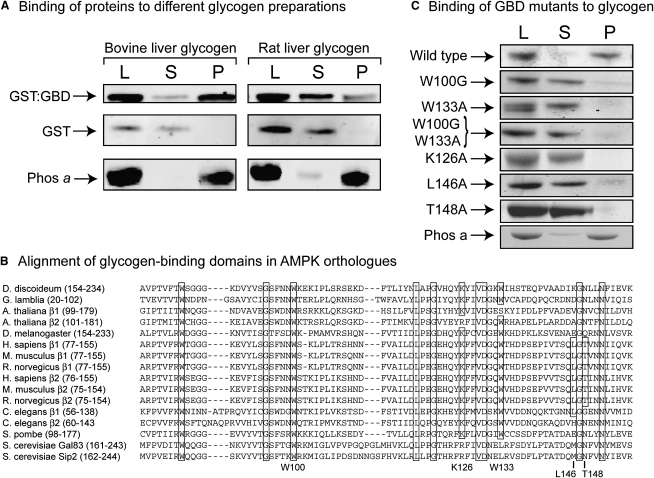
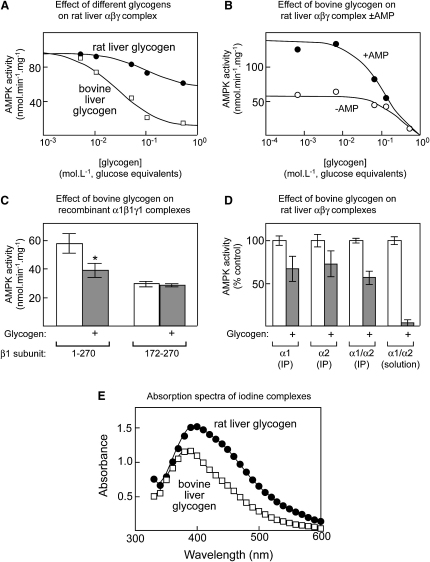
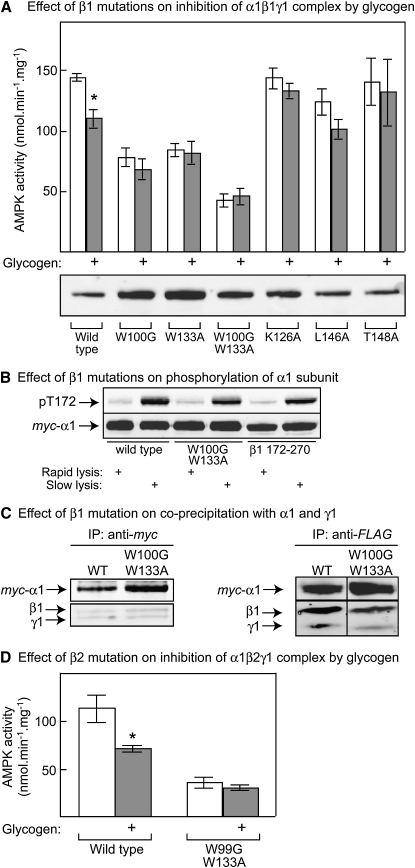
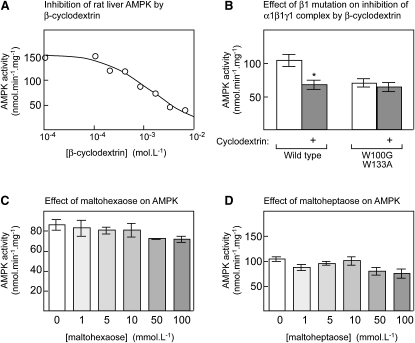
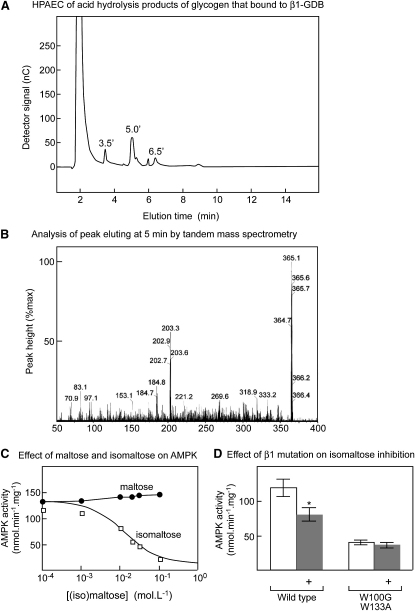
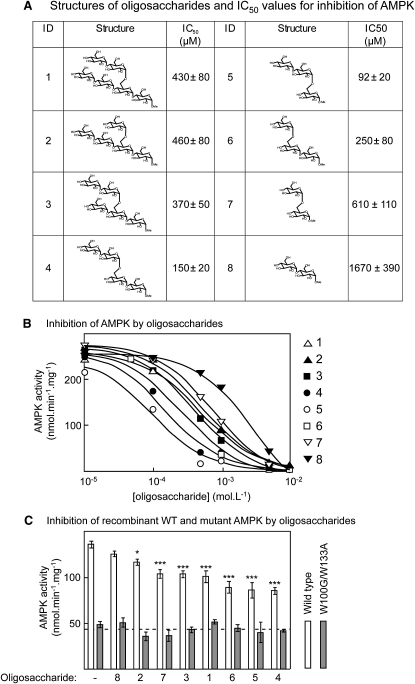
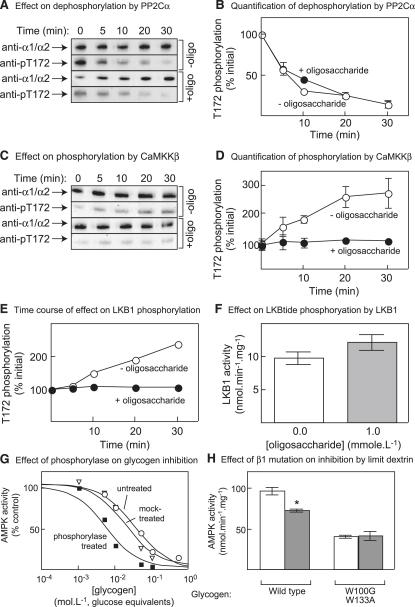
AMPK beta subunits contain a conserved domain that causes association with glycogen. Although glycogen availability is known to affect AMPK regulation in vivo, the molecular mechanism for this has not been clear. We now show that AMPK is inhibited by glycogen, particularly preparations with high branching content. We synthesized a series of branched oligosaccharides and show that those with a single alpha1-->6 branch are allosteric inhibitors that also inhibit phosphorylation by upstream kinases. Removal of the outer chains of glycogen using phosphorylase, thus exposing the outer branches, renders inhibition of AMPK more potent. Inhibition by all carbohydrates tested was dependent on the glycogen-binding domain being abolished by mutation of residues required for carbohydrate binding. Our results suggest the hypothesis that AMPK, as well as monitoring immediate energy availability by sensing AMP/ATP, may also be able to sense the status of cellular energy reserves in the form of glycogen.
Overview
The claims and statistics of this paper haven’t been checked yet.
Run the check — free, no account needed. It reads the open-access text and checks the sources it cites.
Integrity signals
Registry
Cites
Statistics
Figures
Verification
Claims the paper makes
The claims and statistics of this paper haven’t been checked yet.
Run the check — free, no account needed. It reads the open-access text and checks the sources it cites.
Claims other papers make about this one
Each is checked against this paper’s own text: does it say what the citing paper says it does?
The source backs part of the claim, not all of it — or backs it for a different population, condition or comparison.
In the citing paper
“there may even be benefits from deliberately withholding CHO after a high quality training session to minimise glycogen restoration and extend the period during which adaptive responses are elevated (65).”
From Postexercise muscle glycogen resynthesis in humans. (2017) · cites this paper as [65]
Experimental — accuracy not yet measuredThe cited source says what the claim attributes to it.
In the citing paper
“AMPK can be activated by low glycogen [66]”
From Using Molecular Biology to Maximize Concurrent Training (2014) · cites this paper as [66]
In the citing paper
“These data suggest that when glycogen is depleted AMPK is more active.”
From New strategies in sport nutrition to increase exercise performance (2016) · cites this paper as [20]
In the citing paper
“In addition to being a direct AMP:ATP ratio sensor, AMPK also has the capacity to be modulated by the glycogen storage status of a cell [20].The β-subunit of AMPK binds to specific branch points on glycogen inhibiting the enzyme and preventing it from being phosphorylated by upstream kinases [20].”
From New strategies in sport nutrition to increase exercise performance (2016) · cites this paper as [20]
In the citing paper
“Recently, mutations in the CBM have been shown to prevent glycogen binding and reduce total AMPK activity in cell-free assays [130] and in vivo [131].”
From AMPK and Exercise: Glucose Uptake and Insulin Sensitivity (2013) · cites this paper as [130]
In the citing paper
“Glycogen can also inhibit AMPK, suggesting that AMPK may regulate cellular energy status through glycogen sensing [130].”
From AMPK and Exercise: Glucose Uptake and Insulin Sensitivity (2013) · cites this paper as [130]
Self-check
Percentages, sums and reported differences re-computed from the paper’s own numbers.
The self-check needs the paper’s full text.
Citations
Cites
Kahn, B. B., Alquier, T., Carling, D., & Hardie, D. G. (2005) · Cell Metabolism · doi:10.1016/j.cmet.2004.12.003 · Cited by 2,799
AMP-activated/SNF1 protein kinases: conserved guardians of cellular energy
Hardie, D. G. (2007) · Nature Reviews Molecular Cell Biology · doi:10.1038/nrm2249 · Cited by 2,261
Hawley, S. A., Boudeau, J., Reid, J. L., Mustard, K. J., Udd, L., Mäkelä, T. P., Alessi, D. R., & Hardie, D. G. (2003) · Journal of Biology · doi:10.1186/1475-4924-2-28 · Cited by 1,694
LKB1 is the upstream kinase in the AMP-activated protein kinase cascade
Woods, A., Johnstone, S. R., Dickerson, K., Leiper, F. C., Fryer, L. G. D., Neumann, D., Schlattner, U., Wallimann, T., Carlson, M., & Carling, D. (2003) · Current Biology · doi:10.1016/j.cub.2003.10.031 · Cited by 1,650
Hawley, S. A., Pan, D. A., Mustard, K. J., Ross, L., Bain, J., Edelman, A. M., Frenguelli, B. G., & Hardie, D. G. (2005) · Cell Metabolism · doi:10.1016/j.cmet.2005.05.009 · Cited by 1,589
Self-citationLKB1 is a master kinase that activates 13 kinases of the AMPK subfamily, including MARK/PAR‐1
Lizcano, J. M., Göransson, O., Toth, R., Deak, M., Morrice, N. A., Boudeau, J., Hawley, S. A., Udd, L., Mäkelä, T. P., Hardie, D. G., et al. (2004) · The EMBO Journal · doi:10.1038/sj.emboj.7600110 · Cited by 1,381
Hawley, S. A., Davison, M., Woods, A., Davies, S. P., Beri, R. K., Carling, D., & Hardie, D. G. (1996) · Journal of Biological Chemistry · doi:10.1074/jbc.271.44.27879 · Cited by 1,264
Scott, J. W., Hawley, S. A., Green, K. A., Anis, M., Stewart, G., Scullion, G. A., Norman, D. G., & Hardie, D. G. (2004) · Journal of Clinical Investigation · doi:10.1172/jci19874 · Cited by 754
Self-citationStructural basis for AMP binding to mammalian AMP-activated protein kinase
Xiao, B., Heath, R., Saiu, P., Leiper, F. C., Leone, P., Jing, C., Walker, P. A., Haire, L., Eccleston, J. F., Davis, C. T., et al. (2007) · Nature · doi:10.1038/nature06161 · Cited by 591
Effect of physical exercise on sensitivity and responsiveness to insulin in humans
Mikines, K. J., Sonne, B., Farrell, P. A., Tronier, B., & Galbo, H. (1988) · American Journal of Physiology-Endocrinology and Metabolism · doi:10.1152/ajpendo.1988.254.3.e248 · Cited by 538
Muscle Glucose Metabolism following Exercise in the Rat
Richter, E. A., Garetto, L. P., Goodman, M. N., & Ruderman, N. B. (1982) · Journal of Clinical Investigation · doi:10.1172/jci110517 · Cited by 510
Suter, M., Riek, U., Tuerk, R. D., Schlattner, U., Wallimann, T., & Neumann, D. (2006) · Journal of Biological Chemistry · doi:10.1074/jbc.m606357200 · Cited by 473
Glycogen Synthetase Activity in Skeletal Muscle
Danforth, W. H. (1965) · Journal of Biological Chemistry · doi:10.1016/s0021-9258(17)45214-8 · Cited by 435
AMPK β Subunit Targets Metabolic Stress Sensing to Glycogen
Polekhina, G., Gupta, A., Michell, B. J., van Denderen, B., Murthy, S., Feil, S. C., Jennings, I. G., Campbell, D. J., Witters, L. A., Parker, M. W., et al. (2003) · Current Biology · doi:10.1016/s0960-9822(03)00292-6 · Cited by 423
AMP-Activated Protein Kinase as a Drug Target
Hardie, D. G. (2006) · The Annual Review of Pharmacology and Toxicology · doi:10.1146/annurev.pharmtox.47.120505.105304 · Cited by 411
Wojtaszewski, J. F. P., MacDonald, C., Nielsen, J. N., Hellsten, Y., Hardie, D. G., Kemp, B. E., Kiens, B., & Richter, E. A. (2003) · American Journal of Physiology-Endocrinology and Metabolism · doi:10.1152/ajpendo.00436.2002 · Cited by 348
Sanders, M. J., Ali, Z. S., Hegarty, B. D., Heath, R., Snowden, M. A., & Carling, D. (2007) · Journal of Biological Chemistry · doi:10.1074/jbc.m706543200 · Cited by 347
Hudson, E. R., Pan, D. A., James, J., Lucocq, J. M., Hawley, S. A., Green, K. A., Baba, O., Terashima, T., & Hardie, D. G. (2003) · Current Biology · doi:10.1016/s0960-9822(03)00249-5 · Cited by 332
Self-citationCarling, D., & Grahame Hardie, D. (1989) · Biochimica et Biophysica Acta (BBA) - Molecular Cell Research · doi:10.1016/0167-4889(89)90014-1 · Cited by 296
Woods, A., Salt, I. P., Scott, J., Hardie, D. G., & Carling, D. (1996) · FEBS Letters · doi:10.1016/s0014-5793(96)01209-4 · Cited by 261
Wojtaszewski, J. F. P., Jørgensen, S. B., Hellsten, Y., Hardie, D. G., & Richter, E. A. (2002) · Diabetes · doi:10.2337/diabetes.51.2.284 · Cited by 261
Glucose, exercise and insulin: emerging concepts
Richter, E. A., Derave, W., & Wojtaszewski, J. F. P. (2001) · The Journal of Physiology · doi:10.1111/j.1469-7793.2001.t01-2-00313.x · Cited by 258
Jørgensen, S. B., Nielsen, J. N., Birk, J. B., Olsen, G. S., Viollet, B., Andreelli, F., Schjerling, P., Vaulont, S., Hardie, D. G., Hansen, B. F., et al. (2004) · Diabetes · doi:10.2337/diabetes.53.12.3074 · Cited by 241
AMP‐activated protein kinase: role in metabolism and therapeutic implications
Schimmack, G., DeFronzo, R. A., & Musi, N. (2006) · Diabetes Obesity and Metabolism · doi:10.1111/j.1463-1326.2005.00561.x · Cited by 231
Structural Basis for Glycogen Recognition by AMP-Activated Protein Kinase
Polekhina, G., Gupta, A., van Denderen, B. J. W., Feil, S. C., Kemp, B. E., Stapleton, D., & Parker, M. W. (2005) · Structure · doi:10.1016/j.str.2005.07.008 · Cited by 191
Crystal Structures of the Adenylate Sensor from Fission Yeast AMP-Activated Protein Kinase
Townley, R. A., & Shapiro, L. S. (2007) · Science · doi:10.1126/science.1137503 · Cited by 190
Optimization of molecular design in the evolution of metabolism: the glycogen molecule
Meléndez‐Hevia, E., Waddell, T. K., & Shelton, E. D. (1993) · Biochemical Journal · doi:10.1042/bj2950477 · Cited by 187
Derave, W., Ai, H., Ihlemann, J., Witters, L. A., Kristiansen, S., Richter, E. A., & Ploug, T. (2000) · Diabetes · doi:10.2337/diabetes.49.8.1281 · Cited by 168
Walker, G. J., & Whelan, W. J. (1960) · Biochemical Journal · doi:10.1042/bj0760264 · Cited by 141
Nielsen, J. N., Derave, W., Kristiansen, S., Ralston, E., Ploug, T., & Richter, E. A. (2001) · The Journal of Physiology · doi:10.1111/j.1469-7793.2001.0757h.x · Cited by 138
Structure of Glycogens and Amylopectins
Illingworth, B. A., Larner, J., & Cori, G. T. (1952) · Journal of Biological Chemistry · doi:10.1016/s0021-9258(18)38501-6 · Cited by 128
Aschenbach, W. G., Suzuki, Y., Breeden, K., Prats, C., Hirshman, M. F., Dufresne, S. D., Sakamoto, K., Vilardo, P. G., Steele, M., Kim, J.-H., et al. (2001) · Journal of Biological Chemistry · doi:10.1074/jbc.m105518200 · Cited by 106
Skurat, A. V., Wang, Y., & Roach, P. J. (1994) · Journal of Biological Chemistry · doi:10.1016/s0021-9258(18)47282-1 · Cited by 99
Nielsen, J. N., Wojtaszewski, J. F. P., Haller, R. G., Hardie, D. G., Kemp, B. E., Richter, E. A., & Vissing, J. (2002) · The Journal of Physiology · doi:10.1113/jphysiol.2002.018044 · Cited by 86
Regulation of Glycogen Synthase Kinase-3 in Human Skeletal Muscle
Wojtaszewski, J. F. P., Nielsen, P., Kiens, B., & Richter, E. A. (2001) · Diabetes · doi:10.2337/diabetes.50.2.265 · Cited by 83
Structural and functional studies on rabbit liver glycogenin
Smythe, C., VILLAR‐PALASI, C., & Cohen, P. (1989) · European Journal of Biochemistry · doi:10.1111/j.1432-1033.1989.tb14914.x · Cited by 48
Lai, Y., Stuenæs, J. T., Kuo, C., & Jensen, J. (2007) · American Journal of Physiology-Endocrinology and Metabolism · doi:10.1152/ajpendo.00113.2007 · Cited by 48
Koay, A. Z., Rimmer, K. A., Mertens, H. D. T., Gooley, P. R., & Stapleton, D. (2007) · FEBS Letters · doi:10.1016/j.febslet.2007.09.044 · Cited by 45
AMP-activated protein kinase does not associate with glycogen α-particles from rat liver
Parker, G. J., Koay, A. Z., Gilbert‐Wilson, R., Waddington, L. J., & Stapleton, D. (2007) · Biochemical and Biophysical Research Communications · doi:10.1016/j.bbrc.2007.08.080 · Cited by 37
Cited by
Sorted by citations
AMPK: Mechanisms of Cellular Energy Sensing and Restoration of Metabolic Balance
Garcia, D., & Shaw, R. J. (2017) · Molecular Cell · doi:10.1016/j.molcel.2017.05.032 · Cited by 2,061
The LKB1-AMPK pathway: metabolism and growth control in tumour suppression
Shackelford, D. B., & Shaw, R. J. (2009) · Nature Reviews Cancer · doi:10.1038/nrc2676 · Cited by 1,943
Steinberg, G. R., & Kemp, B. E. (2009) · Physiological Reviews · doi:10.1152/physrev.00011.2008 · Cited by 1,672
AMPK: Sensing Glucose as well as Cellular Energy Status
Lin, S., & Hardie, D. G. (2017) · Cell Metabolism · doi:10.1016/j.cmet.2017.10.009 · Cited by 1,198
Regulation and function of AMPK in physiology and diseases
Jeon, S. (2016) · Experimental & Molecular Medicine · doi:10.1038/emm.2016.81 · Cited by 1,149
Metadata
- Authors
- McBride, A., Ghilagaber, S., Nikolaev, A., & Hardie, D. G.
- Affiliations
- University of Dundee (GB)
- Corresponding author
- Hardie, D. Grahame
- Venue
- Cell Metabolism
- Publisher
- Elsevier BV
- Published
- 2009-01
- Volume
- 9
- Issue
- 1
- Pages
- 23-34
- ISSN
- 1550-4131 (ISSN-L)
- PMC
- PMC2642990
- OpenAlex
- W2123429601
- Cited by
- 432
- References
- 40
- Citations by year
- 2026: 11 · 2025: 17 · 2024: 14 · 2023: 19 · 2022: 18 · 2021: 23 · 2020: 22 · 2019: 19 · 2018: 31 · 2017: 21 · 2016: 28 · 2015: 31 · 2014: 27 · 2013: 28 · 2012: 36
- FWCI
- 16.26
- Type
- journal article
- Language
- en
- Open access
- hybrid
- doi.org
- Licence
- Locations
- Cell Metabolism (publishedVersion, cc-by)
- PubMed Central (publishedVersion, cc-by)
- PubMed (publishedVersion)
- Discovery Research Portal (University of Dundee) (submittedVersion)
- Edinburgh Research Explorer (University of Edinburgh) (submittedVersion, other-oa)
- Funders
- Pfizer
- AstraZeneca
- GlaxoSmithKline
- Merck KGaA
- Wellcome Trust
- European Commission (LSHMCT-2004-005272)
- Topics
- Life Sciences › Biochemistry, Genetics and Molecular Biology › Molecular Biology › Metabolism, Diabetes, and Cancer
- Life Sciences › Biochemistry, Genetics and Molecular Biology › Biochemistry › Glycogen Storage Diseases and Myoclonus
- Life Sciences › Biochemistry, Genetics and Molecular Biology › Molecular Biology › Biochemical and Molecular Research
- Keywords
- AMPK, allosteric inhibition, branched oligosaccharides, phosphorylase, energy reserves, kinase regulation, carbohydrate binding
- MeSH terms
- AMP-Activated Protein Kinase Kinases, Allosteric Regulation, Amino Acid Sequence, Animals, Binding Sites, Cattle, Energy Metabolism, Glycogen, Glycogen Synthase, Molecular Sequence Data, Mutation, Oligosaccharides, Phosphorylation, Mutagenesis, Site-Directed, Protein Serine-Threonine Kinases, Protein Structure, Tertiary, Rats, Calcium-Calmodulin-Dependent Protein Kinase Kinase, AMP-Activated Protein Kinases
About these checks
Registry, retraction, Cites and statistics results are computed, not judged, with one exception: a printed reference that no index lists is read once by a model before it counts as a citation error. Claims are extracted by a model and kept only when their quote appears verbatim in the text; each cited source is then checked, with a model’s help, for whether it says what the claim relies on. Those verdicts can be wrong — read the claim’s quote and the cited source before relying on one.
Statistics and arithmetic are recomputed, not judged.
Confidence bands are shown only for fields calibrated on our annotated test set. None is calibrated yet, so no band is shown.
What counts as a claim ›How we measure confidence ›How we check this ›
Are you an author, or do you see a problem with this page? Request a review
