

The DOI matches its Crossref record; 48 of the 49 references it cites were found in a registry or an index.
The Hippocampus and Entorhinal Cortex Encode the Path and Euclidean Distances to Goals during Navigation
Open accessAbstract
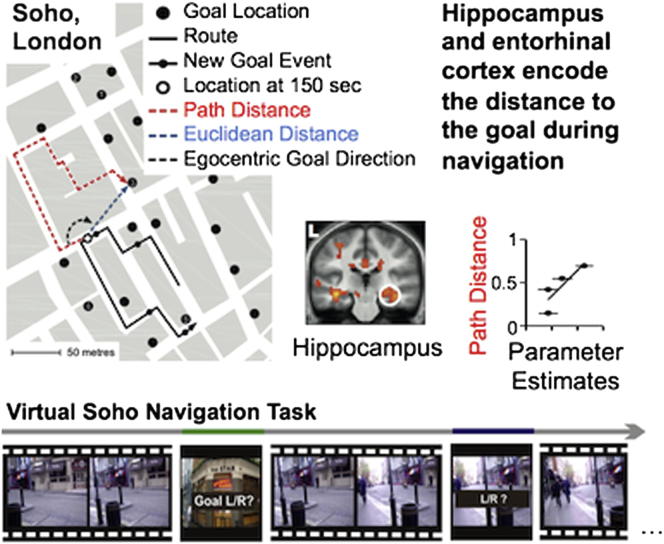
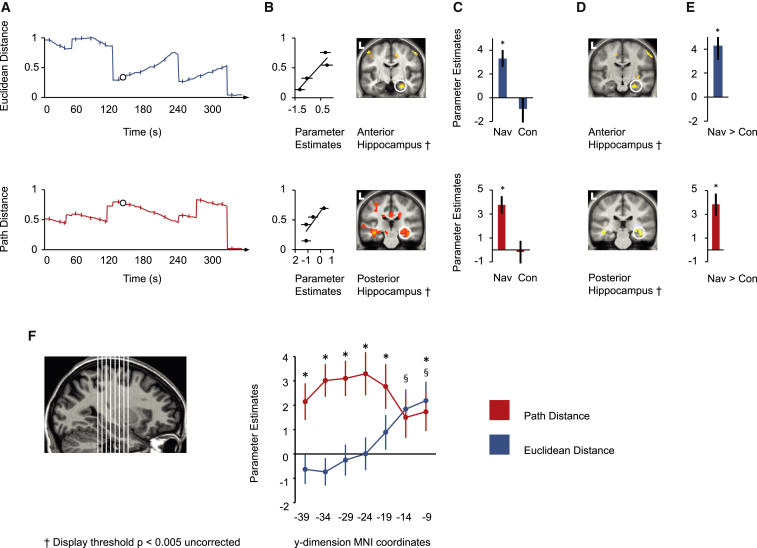
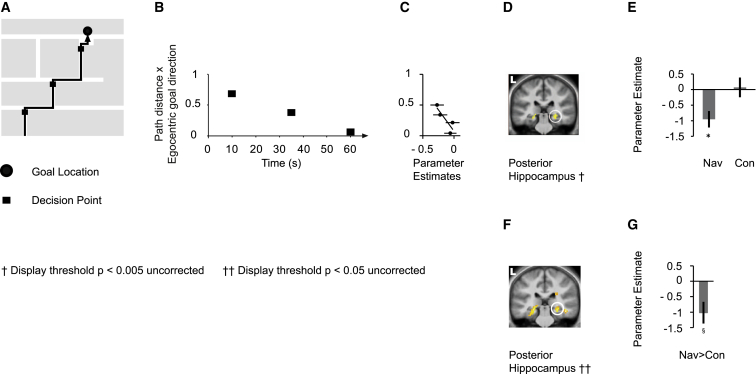
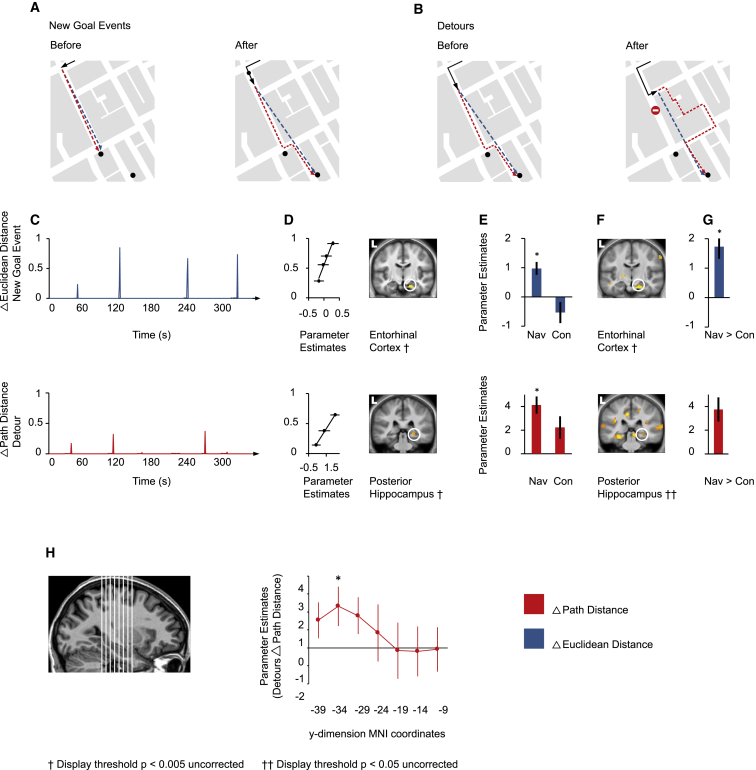
BACKGROUND: Despite decades of research on spatial memory, we know surprisingly little about how the brain guides navigation to goals. While some models argue that vectors are represented for navigational guidance, other models postulate that the future path is computed. Although the hippocampal formation has been implicated in processing spatial goal information, it remains unclear whether this region processes path- or vector-related information. RESULTS: We report neuroimaging data collected from subjects navigating London's Soho district; these data reveal that both the path distance and the Euclidean distance to the goal are encoded by the medial temporal lobe during navigation. While activity in the posterior hippocampus was sensitive to the distance along the path, activity in the entorhinal cortex was correlated with the Euclidean distance component of a vector to the goal. During travel periods, posterior hippocampal activity increased as the path to the goal became longer, but at decision points, activity in this region increased as the path to the goal became closer and more direct. Importantly, sensitivity to the distance was abolished in these brain areas when travel was guided by external cues. CONCLUSIONS: The results indicate that the hippocampal formation contains representations of both the Euclidean distance and the path distance to goals during navigation. These findings argue that the hippocampal formation houses a flexible guidance system that changes how it represents distance to the goal depending on the fluctuating demands of navigation.
Overview
The claims and statistics of this paper haven’t been checked yet.
Run the check — free, no account needed. It reads the open-access text and checks the sources it cites.
Integrity signals
Registry
Cites
Statistics
Figures
Verification
Claims the paper makes
The claims and statistics of this paper haven’t been checked yet.
Run the check — free, no account needed. It reads the open-access text and checks the sources it cites.
Claims other papers make about this one
Each is checked against this paper’s own text: does it say what the citing paper says it does?
In the citing paper
“The hippocampus mask was a combination of right mid and posterior sections (a priori based on the results of Howard et al. 2014).”
From Hippocampal and Retrosplenial Goal Distance Coding After Long-term Consolidation of a Real-World Environment (2019) · cites this paper as Howard et al. 2014
In the citing paper
“such distance tracking is not automatic and requires goal-directed navigation.”
From Hippocampal and Retrosplenial Goal Distance Coding After Long-term Consolidation of a Real-World Environment (2019) · cites this paper as Howard et al. 2014
In the citing paper
“However, while Howard et al. (2014) found a positive correlation between posterior right hippocampal activity and distance, we observed a negative correlation in the recently learned environments.”
From Hippocampal and Retrosplenial Goal Distance Coding After Long-term Consolidation of a Real-World Environment (2019) · cites this paper as Howard et al. 2014
In the citing paper
“The observation that this was specific to navigation routes and not present in control routes is consistent with prior evidence (Howard et al. 2014) that such distance tracking is not automatic and requires goal-directed navigation.”
From Hippocampal and Retrosplenial Goal Distance Coding After Long-term Consolidation of a Real-World Environment (2019) · cites this paper as Howard et al. 2014
In the citing paper
“The correlation of hippocampal activity to distance to goal during travel periods in navigation routes in the recently learned environment agrees with prior fMRI reports of similar coding (Viard et al. 2011; Sherrill et al. 2013; Howard et al. 2014; Balaguer et al. 2016) and supports models which argue the hippocampus computes information about the future path to goal for navigational guidance (Er”
From Hippocampal and Retrosplenial Goal Distance Coding After Long-term Consolidation of a Real-World Environment (2019) · cites this paper as Howard et al. 2014
Self-check
Percentages, sums and reported differences re-computed from the paper’s own numbers.
The self-check needs the paper’s full text.
Citations
Cites
(1978) · UA Campus Repository (The University of Arizona) · Cited by 8,010
The hippocampus as a cognitive map
Passingham, R. E. (1979) · Neuroscience · doi:10.1016/0306-4522(79)90015-0 · Cited by 5,128
Microstructure of a spatial map in the entorhinal cortex
Hafting, T., Fyhn, M., Molden, S., Moser, M.-B., & Moser, E. I. (2005) · Nature · doi:10.1038/nature03721 · Cited by 4,068
Taube, J., Muller, R., & Ranck, J. (1990) · The Journal of Neuroscience · doi:10.1523/jneurosci.10-02-00420.1990 · Cited by 1,809
Andersen, R. A., Snyder, L. H., Bradley, D. C., & Xing, J. (1997) · Annual Review of Neuroscience · doi:10.1146/annurev.neuro.20.1.303 · Cited by 1,486
Two cortical systems for memory-guided behaviour
Ranganath, C., & Ritchey, M. (2012) · Nature Reviews Neuroscience · doi:10.1038/nrn3338 · Cited by 1,377
Knowing Where and Getting There: A Human Navigation Network
Maguire, E. A., Burgess, N., Donnett, J. G., Frackowiak, R. S. J., Frith, C. D., & O'Keefe, J. (1998) · Science · doi:10.1126/science.280.5365.921 · Cited by 1,303
Hippocampal place-cell sequences depict future paths to remembered goals
Pfeiffer, B. E., & Foster, D. J. (2013) · Nature · doi:10.1038/nature12112 · Cited by 1,216
Long-axis specialization of the human hippocampus
Poppenk, J., Evensmoen, H. R., Moscovitch, M., & Nadel, L. (2013) · Trends in Cognitive Sciences · doi:10.1016/j.tics.2013.03.005 · Cited by 1,100
Neural ensembles in CA3 transiently encode paths forward of the animal at a decision point
Johnson, A., & Redish, A. D. (2007) · The Journal of Neuroscience · doi:10.1523/jneurosci.3761-07.2007 · Cited by 1,003
Cited by
Sorted by citations
Episodic memory and beyond: the hippocampus and neocortex in transformation
Moscovitch, M., Cabeza, R., Winocur, G., & Nadel, L. (2016) · Annual Review of Psychology · doi:10.1146/annurev-psych-113011-143733 · Cited by 1,062
The cognitive map in humans: spatial navigation and beyond
Epstein, R. A., Patai, E. Z., Julian, J. B., & Spiers, H. J. (2017) · Nature Neuroscience · doi:10.1038/nn.4656 · Cited by 921
Self-citationRedish, A. D. (2016) · Nature reviews. Neuroscience · doi:10.1038/nrn.2015.30 · Cited by 485
Space and Time: The Hippocampus as a Sequence Generator
Buzsáki, G., & Tingley, D. (2018) · Trends in Cognitive Sciences · doi:10.1016/j.tics.2018.07.006 · Cited by 461
A map of abstract relational knowledge in the human hippocampal-entorhinal cortex
Garvert, M. M., Dolan, R. J., & Behrens, T. E. (2017) · eLife · doi:10.7554/elife.17086 · Cited by 379
Metadata
- Authors
- Howard, L. R., Javadi, A. H., Yu, Y., Mill, R. D., Morrison, L. C., Knight, R., Loftus, M. M., Staskute, L., & Spiers, H. J.
- Affiliations
- German Center for Neurodegenerative Diseases (DE)
- University College London (GB)
- University of St Andrews (GB)
- University of Hertfordshire (GB)
- Corresponding author
- Spiers, Hugo J.
- Venue
- Current Biology
- Publisher
- Elsevier BV
- Published
- 2014-06
- Volume
- 24
- Issue
- 12
- Pages
- 1331-1340
- ISSN
- 0960-9822 (ISSN-L)
- PMC
- PMC4062938
- OpenAlex
- W2098497273
- Cited by
- 298
- References
- 49
- Citations by year
- 2026: 18 · 2025: 29 · 2024: 30 · 2023: 29 · 2022: 24 · 2021: 22 · 2020: 24 · 2019: 27 · 2018: 31 · 2017: 28 · 2016: 18 · 2015: 14 · 2014: 3
- FWCI
- 11.72
- Type
- journal article
- Language
- en
- Open access
- hybrid
- doi.org
- Locations
- Current Biology (publishedVersion, cc-by)
- Europe PMC (PubMed Central) (publishedVersion, cc-by)
- PubMed Central (publishedVersion, cc-by)
- PubMed (publishedVersion)
- Kent Academic Repository (University of Kent) (acceptedVersion)
- University of Hertfordshire Research Archive (University of Hertfordshire) (acceptedVersion)
- UCL Discovery (University College London) (submittedVersion)
- DZNE Pub (submittedVersion)
- University of Hertfordshire Research Archive (University of Hertfordshire) (submittedVersion, cc-by)
- Funders
- James S. McDonnell Foundation
- Wellcome Trust (094850/Z/10/Z, 094850)
- Biotechnology and Biological Sciences Research Council
- Topics
- Life Sciences › Neuroscience › Cognitive Neuroscience › Memory and Neural Mechanisms
- Social Sciences › Psychology › Experimental and Cognitive Psychology › Spatial Cognition and Navigation
- Life Sciences › Neuroscience › Cognitive Neuroscience › Memory Processes and Influences
- Keywords
- hippocampus, entorhinal cortex, path distance, Euclidean distance, spatial navigation, goal-directed navigation, vector representation, medial temporal lobe, external cues, spatial memory
- MeSH terms
- Adult, Cues, Hippocampus, Humans, London, Male, Orientation, Temporal Lobe, Entorhinal Cortex, Young Adult, Spatial Navigation
About these checks
Registry, retraction, Cites and statistics results are computed, not judged, with one exception: a printed reference that no index lists is read once by a model before it counts as a citation error. Claims are extracted by a model and kept only when their quote appears verbatim in the text; each cited source is then checked, with a model’s help, for whether it says what the claim relies on. Those verdicts can be wrong — read the claim’s quote and the cited source before relying on one.
Statistics and arithmetic are recomputed, not judged.
Confidence bands are shown only for fields calibrated on our annotated test set. None is calibrated yet, so no band is shown.
What counts as a claim ›How we measure confidence ›How we check this ›
Are you an author, or do you see a problem with this page? Request a review
