

The DOI matches its Crossref record; 48 of the 49 references it cites were found in a registry or an index.
The Hippocampus and Entorhinal Cortex Encode the Path and Euclidean Distances to Goals during Navigation
Open accessAbstract
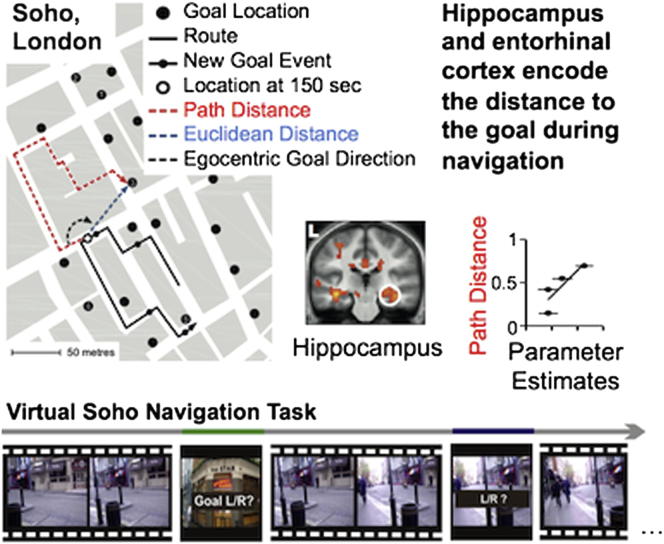
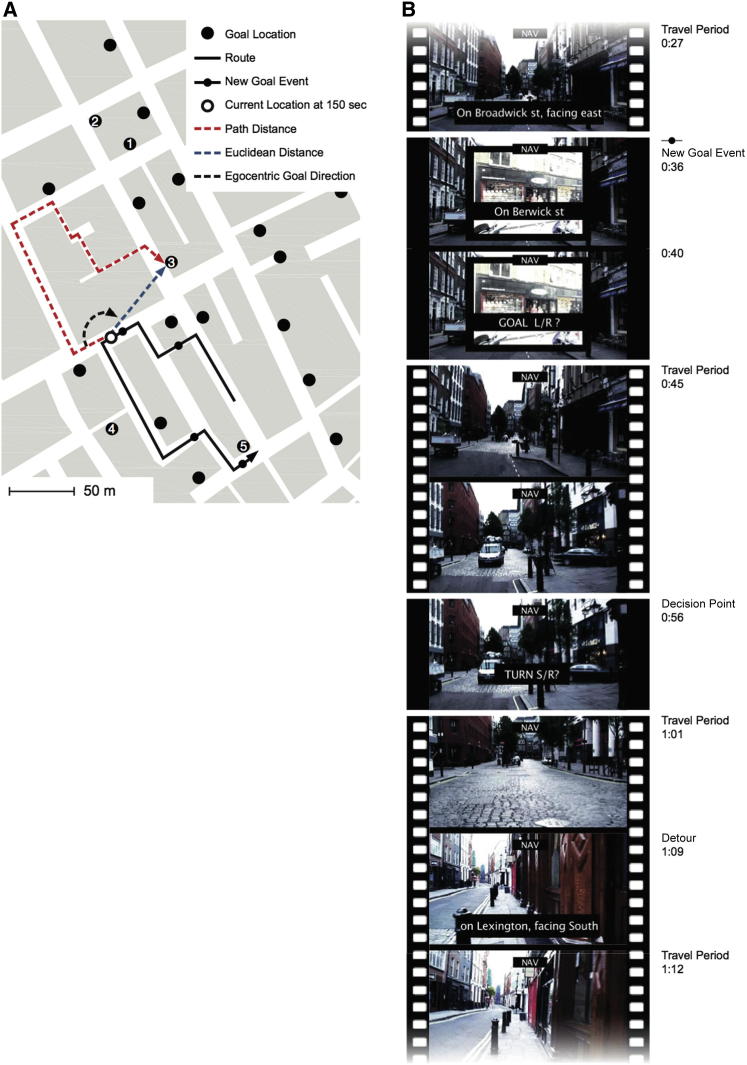
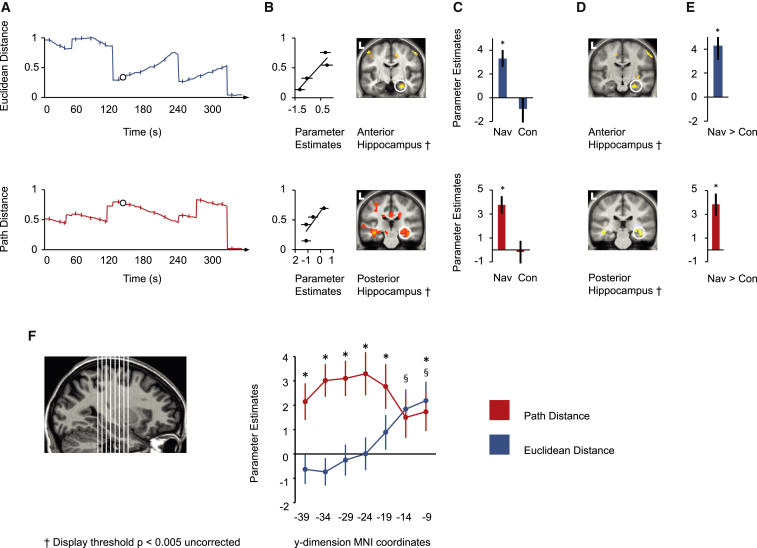
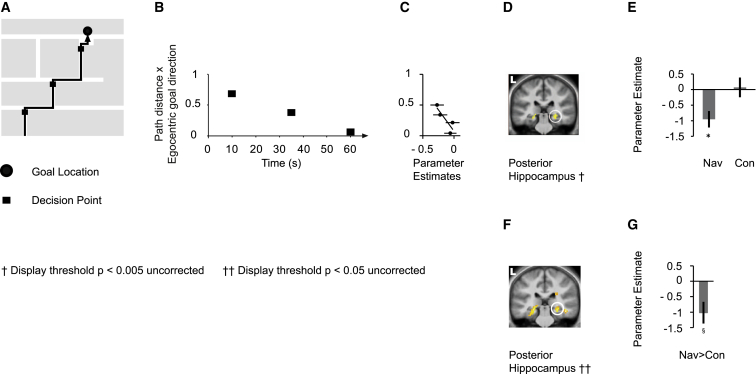
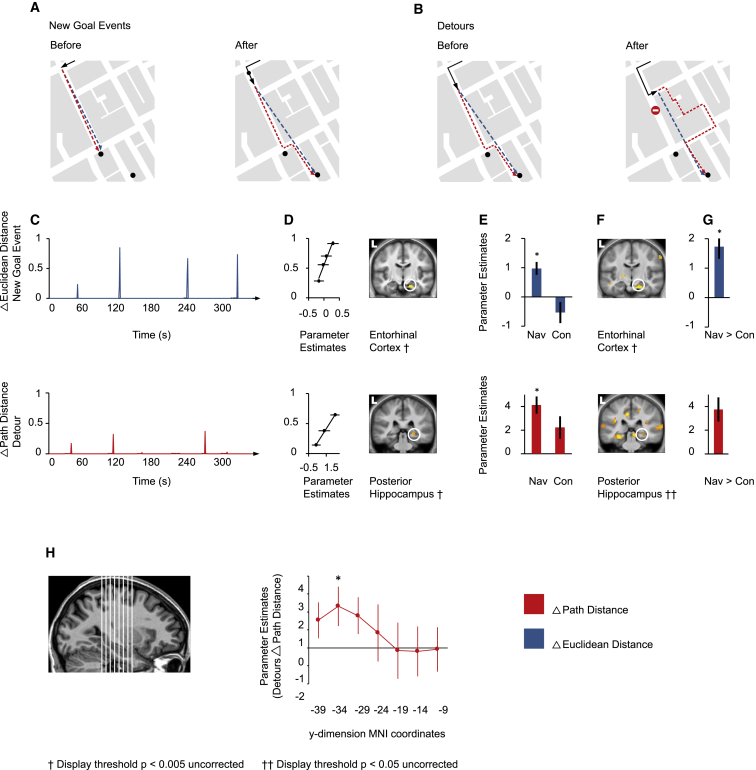
BACKGROUND: Despite decades of research on spatial memory, we know surprisingly little about how the brain guides navigation to goals. While some models argue that vectors are represented for navigational guidance, other models postulate that the future path is computed. Although the hippocampal formation has been implicated in processing spatial goal information, it remains unclear whether this region processes path- or vector-related information. RESULTS: We report neuroimaging data collected from subjects navigating London's Soho district; these data reveal that both the path distance and the Euclidean distance to the goal are encoded by the medial temporal lobe during navigation. While activity in the posterior hippocampus was sensitive to the distance along the path, activity in the entorhinal cortex was correlated with the Euclidean distance component of a vector to the goal. During travel periods, posterior hippocampal activity increased as the path to the goal became longer, but at decision points, activity in this region increased as the path to the goal became closer and more direct. Importantly, sensitivity to the distance was abolished in these brain areas when travel was guided by external cues. CONCLUSIONS: The results indicate that the hippocampal formation contains representations of both the Euclidean distance and the path distance to goals during navigation. These findings argue that the hippocampal formation houses a flexible guidance system that changes how it represents distance to the goal depending on the fluctuating demands of navigation.
Overview
The claims and statistics of this paper haven’t been checked yet.
Run the check — free, no account needed. It reads the open-access text and checks the sources it cites.
Integrity signals
Registry
Cites
Statistics
Figures
Verification
Claims the paper makes
The claims and statistics of this paper haven’t been checked yet.
Run the check — free, no account needed. It reads the open-access text and checks the sources it cites.
Claims other papers make about this one
Each is checked against this paper’s own text: does it say what the citing paper says it does?
In the citing paper
“The hippocampus mask was a combination of right mid and posterior sections (a priori based on the results of Howard et al. 2014).”
From Hippocampal and Retrosplenial Goal Distance Coding After Long-term Consolidation of a Real-World Environment (2019) · cites this paper as Howard et al. 2014
In the citing paper
“such distance tracking is not automatic and requires goal-directed navigation.”
From Hippocampal and Retrosplenial Goal Distance Coding After Long-term Consolidation of a Real-World Environment (2019) · cites this paper as Howard et al. 2014
In the citing paper
“However, while Howard et al. (2014) found a positive correlation between posterior right hippocampal activity and distance, we observed a negative correlation in the recently learned environments.”
From Hippocampal and Retrosplenial Goal Distance Coding After Long-term Consolidation of a Real-World Environment (2019) · cites this paper as Howard et al. 2014
In the citing paper
“The observation that this was specific to navigation routes and not present in control routes is consistent with prior evidence (Howard et al. 2014) that such distance tracking is not automatic and requires goal-directed navigation.”
From Hippocampal and Retrosplenial Goal Distance Coding After Long-term Consolidation of a Real-World Environment (2019) · cites this paper as Howard et al. 2014
In the citing paper
“The correlation of hippocampal activity to distance to goal during travel periods in navigation routes in the recently learned environment agrees with prior fMRI reports of similar coding (Viard et al. 2011; Sherrill et al. 2013; Howard et al. 2014; Balaguer et al. 2016) and supports models which argue the hippocampus computes information about the future path to goal for navigational guidance (Er”
From Hippocampal and Retrosplenial Goal Distance Coding After Long-term Consolidation of a Real-World Environment (2019) · cites this paper as Howard et al. 2014
Self-check
Percentages, sums and reported differences re-computed from the paper’s own numbers.
The self-check needs the paper’s full text.
Citations
Cites
(1978) · UA Campus Repository (The University of Arizona) · Cited by 8,010
The hippocampus as a cognitive map
Passingham, R. E. (1979) · Neuroscience · doi:10.1016/0306-4522(79)90015-0 · Cited by 5,128
Microstructure of a spatial map in the entorhinal cortex
Hafting, T., Fyhn, M., Molden, S., Moser, M.-B., & Moser, E. I. (2005) · Nature · doi:10.1038/nature03721 · Cited by 4,068
Taube, J., Muller, R., & Ranck, J. (1990) · The Journal of Neuroscience · doi:10.1523/jneurosci.10-02-00420.1990 · Cited by 1,809
Andersen, R. A., Snyder, L. H., Bradley, D. C., & Xing, J. (1997) · Annual Review of Neuroscience · doi:10.1146/annurev.neuro.20.1.303 · Cited by 1,486
Two cortical systems for memory-guided behaviour
Ranganath, C., & Ritchey, M. (2012) · Nature Reviews Neuroscience · doi:10.1038/nrn3338 · Cited by 1,377
Knowing Where and Getting There: A Human Navigation Network
Maguire, E. A., Burgess, N., Donnett, J. G., Frackowiak, R. S. J., Frith, C. D., & O'Keefe, J. (1998) · Science · doi:10.1126/science.280.5365.921 · Cited by 1,303
Hippocampal place-cell sequences depict future paths to remembered goals
Pfeiffer, B. E., & Foster, D. J. (2013) · Nature · doi:10.1038/nature12112 · Cited by 1,216
Long-axis specialization of the human hippocampus
Poppenk, J., Evensmoen, H. R., Moscovitch, M., & Nadel, L. (2013) · Trends in Cognitive Sciences · doi:10.1016/j.tics.2013.03.005 · Cited by 1,100
Neural ensembles in CA3 transiently encode paths forward of the animal at a decision point
Johnson, A., & Redish, A. D. (2007) · The Journal of Neuroscience · doi:10.1523/jneurosci.3761-07.2007 · Cited by 1,003
Cited by
Sorted by citations
Episodic memory and beyond: the hippocampus and neocortex in transformation
Moscovitch, M., Cabeza, R., Winocur, G., & Nadel, L. (2016) · Annual Review of Psychology · doi:10.1146/annurev-psych-113011-143733 · Cited by 1,062
The cognitive map in humans: spatial navigation and beyond
Epstein, R. A., Patai, E. Z., Julian, J. B., & Spiers, H. J. (2017) · Nature Neuroscience · doi:10.1038/nn.4656 · Cited by 921
Self-citationRedish, A. D. (2016) · Nature reviews. Neuroscience · doi:10.1038/nrn.2015.30 · Cited by 485
Space and Time: The Hippocampus as a Sequence Generator
Buzsáki, G., & Tingley, D. (2018) · Trends in Cognitive Sciences · doi:10.1016/j.tics.2018.07.006 · Cited by 461
A map of abstract relational knowledge in the human hippocampal-entorhinal cortex
Garvert, M. M., Dolan, R. J., & Behrens, T. E. (2017) · eLife · doi:10.7554/elife.17086 · Cited by 379
Hippocampal theta sequences reflect current goals
Wikenheiser, A. M., & Redish, A. D. (2015) · Nature Neuroscience · doi:10.1038/nn.3909 · Cited by 367
Using Grid Cells for Navigation
Bush, D., Barry, C., Manson, D., & Burgess, N. (2015) · Neuron · doi:10.1016/j.neuron.2015.07.006 · Cited by 347
Vectorial representation of spatial goals in the hippocampus of bats
Sarel, A., Finkelstein, A., Las, L., & Ulanovsky, N. (2017) · Science · doi:10.1126/science.aak9589 · Cited by 345
Structuring knowledge with cognitive maps and cognitive graphs
Peer, M., Brunec, I. K., Newcombe, N. S., & Epstein, R. A. (2021) · Trends in Cognitive Sciences · doi:10.1016/j.tics.2020.10.004 · Cited by 283
Map Making: Constructing, Combining, and Inferring on Abstract Cognitive Maps
Park, S. A., Miller, D. S., Nili, H., Ranganath, C., & Boorman, E. D. (2020) · Neuron · doi:10.1016/j.neuron.2020.06.030 · Cited by 285
Multiple Scales of Representation along the Hippocampal Anteroposterior Axis in Humans
Brunec, I. K., Bellana, B., Ozubko, J. D., Man, V. Y., Robin, J., Liu, Z., Grady, C. L., Rosenbaum, R. S., Winocur, G., Barense, M. D., et al. (2018) · Current Biology · doi:10.1016/j.cub.2018.05.016 · Cited by 305
Entropy of city street networks linked to future spatial navigation ability
Coutrot, A., Manley, E., Goodroe, S., Gahnstrom, C., Filomena, G., Yesiltepe, D., Dalton, R. C., Wiener, J. M., Hölscher, C., Hornberger, M., et al. (2022) · Nature · doi:10.1038/s41586-022-04486-7 · Cited by 243
Self-citationProspective representation of navigational goals in the human hippocampus
Brown, T. I., Carr, V. A., LaRocque, K. F., Favila, S. E., Gordon, A. M., Bowles, B., Bailenson, J. N., & Wagner, A. D. (2016) · Science · doi:10.1126/science.aaf0784 · Cited by 233
Howett, D., Castegnaro, A., Krzywicka, K., Hagman, J., Marchment, D., Henson, R. N., Rio, M., King, J. A., Burgess, N., & Chan, D. (2019) · Brain · doi:10.1093/brain/awz116 · Cited by 243
An event map of memory space in the hippocampus
Deuker, L., Bellmund, J. L. S., Schröder, T. N., & Doeller, C. F. (2016) · eLife · doi:10.7554/elife.16534 · Cited by 243
The representation of space in the brain
Grieves, R. M., & Jeffery, K. J. (2016) · Behavioural Processes · doi:10.1016/j.beproc.2016.12.012 · Cited by 247
Hippocampal and prefrontal processing of network topology to simulate the future
Javadi, A.-H., Emo, B., Howard, L. R., Zisch, F. E., Yu, Y., Knight, R., Pinelo Silva, J., & Spiers, H. J. (2017) · Nature Communications · doi:10.1038/ncomms14652 · Cited by 207
Self-citationEkstrom, A. D., Huffman, D. J., & Starrett, M. (2017) · Journal of Neurophysiology · doi:10.1152/jn.00531.2017 · Cited by 186
Schafer, M., & Schiller, D. (2018) · Neuron · doi:10.1016/j.neuron.2018.10.006 · Cited by 186
Local and Distant Input Controlling Excitation in Layer II of the Medial Entorhinal Cortex
Fuchs, E. C., Neitz, A., Pinna, R., Melzer, S., Caputi, A., & Monyer, H. (2015) · Neuron · doi:10.1016/j.neuron.2015.11.029 · Cited by 182
Grid-like processing of imagined navigation
Horner, A. J., Bisby, J. A., Zotow, E., Bush, D., & Burgess, N. (2016) · Current Biology · doi:10.1016/j.cub.2016.01.042 · Cited by 173
Neural Mechanisms of Hierarchical Planning in a Virtual Subway Network
Balaguer, J., Spiers, H., Hassabis, D., & Summerfield, C. (2016) · Neuron · doi:10.1016/j.neuron.2016.03.037 · Cited by 163
Self-citationLearning structures: Predictive representations, replay, and generalization
Momennejad, I. (2020) · Current Opinion in Behavioral Sciences · doi:10.1016/j.cobeha.2020.02.017 · Cited by 159
Phase precession in the human hippocampus and entorhinal cortex
Qasim, S. E., Fried, I., & Jacobs, J. (2021) · Cell · doi:10.1016/j.cell.2021.04.017 · Cited by 167
The Hippocampus Encodes Distances in Multidimensional Feature Space
Theves, S., Fernández, G., & Doeller, C. F. (2019) · Current Biology · doi:10.1016/j.cub.2019.02.035 · Cited by 156
Role of the Default Mode Network in Cognitive Transitions
Smith, V., Mitchell, D. J., & Duncan, J. (2018) · Cerebral Cortex · doi:10.1093/cercor/bhy167 · Cited by 151
Spatial goal coding in the hippocampal formation
Nyberg, N., Duvelle, É., Barry, C., & Spiers, H. J. (2022) · Neuron · doi:10.1016/j.neuron.2021.12.012 · Cited by 141
Self-citationBoundaries Shape Cognitive Representations of Spaces and Events
Brunec, I. K., Moscovitch, M., & Barense, M. D. (2018) · Trends in Cognitive Sciences · doi:10.1016/j.tics.2018.03.013 · Cited by 149
Alexander, A. S., & Nitz, D. A. (2017) · Current Biology · doi:10.1016/j.cub.2017.04.036 · Cited by 146
The Versatile Wayfinder: Prefrontal Contributions to Spatial Navigation
Patai, E. Z., & Spiers, H. J. (2021) · Trends in Cognitive Sciences · doi:10.1016/j.tics.2021.02.010 · Cited by 141
Self-citationChrastil, E. R., Sherrill, K. R., Hasselmo, M. E., & Stern, C. E. (2015) · The Journal of Neuroscience · doi:10.1523/jneurosci.1209-15.2015 · Cited by 128
A Goal Direction Signal in the Human Entorhinal/Subicular Region
Chadwick, M. J., Jolly, A., Amos, D. P., Hassabis, D., & Spiers, H. J. (2014) · Current Biology · doi:10.1016/j.cub.2014.11.001 · Cited by 133
Self-citationA network linking scene perception and spatial memory systems in posterior cerebral cortex
Steel, A., Billings, M. M., Silson, E. H., & Robertson, C. E. (2021) · Nature Communications · doi:10.1038/s41467-021-22848-z · Cited by 132
Neural systems supporting navigation
Spiers, H. J., & Barry, C. (2014) · Current Opinion in Behavioral Sciences · doi:10.1016/j.cobeha.2014.08.005 · Cited by 125
Self-citationPredictive Representations in Hippocampal and Prefrontal Hierarchies
Brunec, I. K., & Momennejad, I. (2021) · Journal of Neuroscience · doi:10.1523/jneurosci.1327-21.2021 · Cited by 123
Unmasking selective path integration deficits in Alzheimer’s disease risk carriers
Bierbrauer, A., Kunz, L., Gomes, C. A., Luhmann, M., Deuker, L., Getzmann, S., Wascher, E., Gajewski, P. D., Hengstler, J. G., Fernandez-Alvarez, M., et al. (2020) · Science Advances · doi:10.1126/sciadv.aba1394 · Cited by 125
The Hippocampus Maps Concept Space, Not Feature Space
Theves, S., Fernández, G., & Doeller, C. F. (2020) · Journal of Neuroscience · doi:10.1523/jneurosci.0494-20.2020 · Cited by 121
Mattar, M. G., & Lengyel, M. (2022) · Neuron · doi:10.1016/j.neuron.2021.12.018 · Cited by 120
Place cells on a maze encode routes rather than destinations
Grieves, R. M., Wood, E. R., & Dudchenko, P. A. (2016) · eLife · doi:10.7554/elife.15986 · Cited by 120
Predictive maps in rats and humans for spatial navigation
de Cothi, W., Nyberg, N., Griesbauer, E.-M., Ghanamé, C., Zisch, F., Lefort, J. M., Fletcher, L., Newton, C., Renaudineau, S., Bendor, D., et al. (2022) · Current Biology · doi:10.1016/j.cub.2022.06.090 · Cited by 109
Self-citationGeo-EEG: Towards the Use of EEG in the Study of Urban Behaviour
Mavros, P., Austwick, M. Z., & Hudson‐Smith, A. (2016) · Applied Spatial Analysis and Policy · doi:10.1007/s12061-015-9181-z · Cited by 107
Phase-tuned neuronal firing encodes human contextual representations for navigational goals
Watrous, A. J., Miller, J. F., Qasim, S. E., Fried, I., & Jacobs, J. (2018) · eLife · doi:10.7554/elife.32554 · Cited by 110
Patai, E. Z., Javadi, A.-H., Ozubko, J. D., O’Callaghan, A., Ji, S., Robin, J., Grady, C., Winocur, G., Rosenbaum, R. S., Moscovitch, M., et al. (2019) · Cerebral Cortex · doi:10.1093/cercor/bhz044 · Cited by 102
Self-citationA central role for the retrosplenial cortex in de novo environmental learning
Auger, S. D., Zeidman, P., & Maguire, E. A. (2015) · eLife · doi:10.7554/elife.09031 · Cited by 99
Vector-based pedestrian navigation in cities
Bongiorno, C., Zhou, Y., Kryven, M., Theurel, D., Rizzo, A., Santi, P., Tenenbaum, J. B., & Ratti, C. (2021) · Nature Computational Science · doi:10.1038/s43588-021-00130-y · Cited by 110
Solving the detour problem in navigation: a model of prefrontal and hippocampal interactions
Spiers, H. J., & Gilbert, S. J. (2015) · Frontiers in Human Neuroscience · doi:10.3389/fnhum.2015.00125 · Cited by 94
Self-citationThe Complex Nature of Hippocampal-Striatal Interactions in Spatial Navigation
Goodroe, S. C., Starnes, J., & Brown, T. I. (2018) · Frontiers in Human Neuroscience · doi:10.3389/fnhum.2018.00250 · Cited by 102
Mapping sequence structure in the human lateral entorhinal cortex
Bellmund, J. L. S., Deuker, L., & Doeller, C. F. (2019) · eLife · doi:10.7554/elife.45333 · Cited by 98
Distance and Direction Codes Underlie Navigation of a Novel Semantic Space in the Human Brain
Viganò, S., & Manuela Piazza, A. (2020) · Journal of Neuroscience · doi:10.1523/jneurosci.1849-19.2020 · Cited by 99
Memory integration constructs maps of space, time, and concepts
Morton, N. W., Sherrill, K. R., & Preston, A. R. (2017) · Current Opinion in Behavioral Sciences · doi:10.1016/j.cobeha.2017.08.007 · Cited by 98
Evensmoen, H. R., Lehn, H., Xu, J., Witter, M. P., Nadel, L., & Haberg, A. K. (2013) · Journal of Cognitive Neuroscience · doi:10.1162/jocn_a_00436 · Cited by 83
Hippocampal spatio-predictive cognitive maps adaptively guide reward generalization
Garvert, M. M., Saanum, T., Schulz, E., Schuck, N. W., & Doeller, C. F. (2023) · Nature Neuroscience · doi:10.1038/s41593-023-01283-x · Cited by 90
The Neural Representation of Prospective Choice during Spatial Planning and Decisions
Kaplan, R., King, J. A., Koster, R., Penny, W. D., Burgess, N., & Friston, K. J. (2017) · PLoS Biology · doi:10.1371/journal.pbio.1002588 · Cited by 81
Electrophysiological Signatures of Spatial Boundaries in the Human Subiculum
Lee, S. A., Miller, J. F., Watrous, A. J., Sperling, M. R., Sharan, A. D., Worrell, G. A., Berry, B. M., Jobst, B. C., Davis, K. A., Gross, R. E., et al. (2018) · Journal of Neuroscience · doi:10.1523/jneurosci.3216-17.2018 · Cited by 81
Gallistel, C. R. (2017) · Trends in Cognitive Sciences · doi:10.1016/j.tics.2017.04.012 · Cited by 83
Chrastil, E. R., Sherrill, K. R., Aselcioglu, I., Hasselmo, M. E., & Stern, C. E. (2017) · eNeuro · doi:10.1523/eneuro.0346-16.2017 · Cited by 74
Tu, S., Spiers, H. J., Hodges, J. R., Piguet, O., & Hornberger, M. (2017) · Journal of Alzheimer’s Disease · doi:10.3233/jad-160592 · Cited by 70
Self-citationThe Role of the Human Entorhinal Cortex in a Representational Account of Memory
Schultz, H., Sommer, T., & Peters, J. (2015) · Frontiers in Human Neuroscience · doi:10.3389/fnhum.2015.00628 · Cited by 73
Linking hippocampal multiplexed tuning, Hebbian plasticity and navigation
Moore, J. J., Cushman, J. D., Acharya, L., Popeney, B., & Mehta, M. R. (2021) · Nature · doi:10.1038/s41586-021-03989-z · Cited by 69
Wolpe, N., Ingram, J. N., Tsvetanov, K. A., Henson, R. N., Wolpert, D. M., TYLER, L. K., Brayne, C., Bullmore, E. T., Calder, A. C., Cusack, R., et al. (2020) · Neurobiology of Aging · doi:10.1016/j.neurobiolaging.2020.02.016 · Cited by 69
Mesoscopic Neural Representations in Spatial Navigation
Kunz, L., Maidenbaum, S., Chen, D., Wang, L., Jacobs, J., & Axmacher, N. (2019) · Trends in Cognitive Sciences · doi:10.1016/j.tics.2019.04.011 · Cited by 71
The rodent hippocampus as a bilateral structure: A review of hemispheric lateralization
Jordan, J. T. (2019) · Hippocampus · doi:10.1002/hipo.23188 · Cited by 72
The grid code for ordered experience
Rueckemann, J. W., Sosa, M., Giocomo, L. M., & Buffalo, E. A. (2021) · Nature reviews. Neuroscience · doi:10.1038/s41583-021-00499-9 · Cited by 69
Ramping activity in midbrain dopamine neurons signifies the use of a cognitive mapPreprint
Guru, A., Seo, C., Post, R. J., Kullakanda, D. S., Schaffer, J. A., & Warden, M. R. (2020) · bioRxiv (Cold Spring Harbor Laboratory) · doi:10.1101/2020.05.21.108886 · Cited by 61
Cognitive mapping style relates to posterior–anterior hippocampal volume ratio
Brunec, I. K., Robin, J., Patai, E. Z., Ozubko, J. D., Javadi, A., Barense, M. D., Spiers, H. J., & Moscovitch, M. (2019) · Hippocampus · doi:10.1002/hipo.23072 · Cited by 68
Self-citationEEG correlates of spatial orientation in the human retrosplenial complex
Lin, C., Chiu, T.-C., & Gramann, K. (2015) · NeuroImage · doi:10.1016/j.neuroimage.2015.07.009 · Cited by 64
Ekman, M., Kusch, S., & de Lange, F. P. (2023) · eLife · doi:10.7554/elife.78904 · Cited by 63
Meilinger, T., Strickrodt, M., & Bülthoff, H. (2016) · Cognition · doi:10.1016/j.cognition.2016.06.003 · Cited by 60
Cohen, N. J. (2015) · Hippocampus · doi:10.1002/hipo.22443 · Cited by 54
Familiarity expands space and contracts time
Jafarpour, A., & Spiers, H. (2017) · Hippocampus · doi:10.1002/hipo.22672 · Cited by 52
Self-citationGoal-seeking compresses neural codes for space in the human hippocampus and orbitofrontal cortex
Muhle-Karbe, P. S., Sheahan, H., Pezzulo, G., Spiers, H. J., Chien, S., Schuck, N. W., & Summerfield, C. (2023) · Neuron · doi:10.1016/j.neuron.2023.08.021 · Cited by 54
Self-citationJacob, P.-Y., Gordillo-Salas, M., Facchini, J., Poucet, B., Save, É., & Sargolini, F. (2017) · Brain Structure and Function · doi:10.1007/s00429-017-1368-4 · Cited by 53
Familiar environments enhance object and spatial memory in both younger and older adults
Merriman, N. A., Ondřej, J., Roudaia, E., O’Sullivan, C., & Newell, F. N. (2016) · Experimental Brain Research · doi:10.1007/s00221-016-4557-0 · Cited by 53
Path integration maintains spatial periodicity of grid cell firing in a 1D circular track
Jacob, P.-Y., Capitano, F., Poucet, B., Save, É., & Sargolini, F. (2019) · Nature Communications · doi:10.1038/s41467-019-08795-w · Cited by 51
Which way and how far? Tracking of translation and rotation information for human path integration
Chrastil, E. R., Sherrill, K. R., Hasselmo, M. E., & Stern, C. E. (2016) · Human Brain Mapping · doi:10.1002/hbm.23265 · Cited by 50
Kim, M., & Maguire, E. A. (2018) · Cerebral Cortex · doi:10.1093/cercor/bhy054 · Cited by 45
Planning at decision time and in the background during spatial navigation
Pezzulo, G., Donnarumma, F., Maisto, D., & Stoianov, I. P. (2019) · Current Opinion in Behavioral Sciences · doi:10.1016/j.cobeha.2019.04.009 · Cited by 47
Paper Notebooks vs. Mobile Devices: Brain Activation Differences During Memory Retrieval
Umejima, K., Ibaraki, T., Yamazaki, T., & Sakai, K. L. (2021) · Frontiers in Behavioral Neuroscience · doi:10.3389/fnbeh.2021.634158 · Cited by 52
Common Neural Representations for Visually Guided Reorientation and Spatial Imagery
Vass, L. K., & Epstein, R. A. (2016) · Cerebral Cortex · doi:10.1093/cercor/bhv343 · Cited by 45
The time to remember: Temporal compression and duration judgements in memory for real-life events
Jeunehomme, O., & D’Argembeau, A. (2018) · Quarterly Journal of Experimental Psychology · doi:10.1177/1747021818773082 · Cited by 57
Neural mechanisms of navigation involving interactions of cortical and subcortical structures
Hinman, J. R., Dannenberg, H., Alexander, A. S., & Hasselmo, M. E. (2018) · Journal of Neurophysiology · doi:10.1152/jn.00498.2017 · Cited by 45
Gregorians, L., Velasco, P. F., Zisch, F., & Spiers, H. J. (2022) · Journal of Environmental Psychology · doi:10.1016/j.jenvp.2022.101841 · Cited by 46
Self-citationExploration patterns shape cognitive map learning
Brunec, I. K., Nantais, M. M., Sutton, J. E., Epstein, R. A., & Newcombe, N. S. (2022) · Cognition · doi:10.1016/j.cognition.2022.105360 · Cited by 44
Nemati, S. S., Sadeghi, L., Dehghan, G., & Sheibani, N. (2023) · Behavioural Brain Research · doi:10.1016/j.bbr.2023.114657 · Cited by 41
A Network for Computing Value Equilibrium in the Human Medial Prefrontal Cortex
Juechems, K., Balaguer, J., Castañón, S. H., Ruz, M., O’Reilly, J. X., & Summerfield, C. (2019) · Neuron · doi:10.1016/j.neuron.2018.12.029 · Cited by 44
Goal-oriented representations in the human hippocampus during planning and navigation
Crivelli-Decker, J. E., Clarke, A., Park, S. A., Huffman, D. J., Boorman, E. D., & Ranganath, C. (2023) · Nature Communications · doi:10.1038/s41467-023-35967-6 · Cited by 48
Hippocampal Attractor Dynamics Predict Memory-Based Decision Making
Steemers, B., Vicente-Grabovetsky, A., Barry, C., Smulders, P., Schröder, T. N., Burgess, N., & Doeller, C. F. (2016) · Current Biology · doi:10.1016/j.cub.2016.04.063 · Cited by 41
Poucet, B., & Hok, V. (2017) · Current Opinion in Behavioral Sciences · doi:10.1016/j.cobeha.2017.06.003 · Cited by 43
Turns during navigation act as boundaries that enhance spatial memory and expand time estimation
Brunec, I. K., Ozubko, J. D., Ander, T., Guo, R., Moscovitch, M., & Barense, M. D. (2020) · Neuropsychologia · doi:10.1016/j.neuropsychologia.2020.107437 · Cited by 43
The parahippocampal place area and hippocampus encode the spatial significance of landmark objects
Sun, L., Frank, S., Epstein, R. A., & Tse, P. U. (2021) · NeuroImage · doi:10.1016/j.neuroimage.2021.118081 · Cited by 43
Hippocampal CA1 activity correlated with the distance to the goal and navigation performance
Spiers, H. J., Ólafsdóttir, H. F., & Lever, C. (2017) · Hippocampus · doi:10.1002/hipo.22813 · Cited by 42
Self-citationContracted time and expanded space: the impact of circumnavigation on judgements of space and time
Brunec, I. K., Javadi, A.-H., Zisch, F. E. L., & Spiers, H. J. (2017) · Cognition · doi:10.1016/j.cognition.2017.06.004 · Cited by 37
Self-citationOttink, L., Buimer, H. P., van Raalte, B., Doeller, C. F., van der Geest, T. M., & Wezel, R. J. A. V. (2022) · Neuroscience & Biobehavioral Reviews · doi:10.1016/j.neubiorev.2022.104797 · Cited by 42
Striatal and hippocampal contributions to flexible navigation in rats and humans
Gahnstrom, C. J., & Spiers, H. J. (2020) · Brain and Neuroscience Advances · doi:10.1177/2398212820979772 · Cited by 34
Self-citationLi, J., Zhang, R., Liu, S., Liang, Q., Zheng, S., He, X., & Huang, R. (2021) · NeuroImage · doi:10.1016/j.neuroimage.2021.118264 · Cited by 37
Laczó, M., Martinkovič, L., Lerch, O., Wiener, J. M., Kalinová, J., Matušková, V., Nedelská, Z., Vyhnálek, M., Hort, J., & Laczó, J. (2022) · Frontiers in Aging Neuroscience · doi:10.3389/fnagi.2022.886778 · Cited by 34
A map of spatial navigation for neuroscience
Parra-Barrero, E., Vijayabaskaran, S., Seabrook, E., Wiskott, L., & Cheng, S. (2023) · Neuroscience & Biobehavioral Reviews · doi:10.1016/j.neubiorev.2023.105200 · Cited by 39
Steel, A., Robertson, C. E., & Taube, J. S. (2020) · Journal of Cognitive Neuroscience · doi:10.1162/jocn_a_01635 · Cited by 34
Human hippocampal pre-activation predicts behavior
Jafarpour, A., Piai, V., Lin, J. J., & Knight, R. T. (2017) · Scientific Reports · doi:10.1038/s41598-017-06477-5 · Cited by 35
Self-citationA specific brain network for a social map in the human brain
Zhang, L., Chen, P., Schafer, M., Zheng, S., Chen, L., Wang, S., Liang, Q., Qi, Q., Zhang, Y., & Huang, R. (2022) · Scientific Reports · doi:10.1038/s41598-022-05601-4 · Cited by 30
Metadata
- Authors
- Howard, L. R., Javadi, A. H., Yu, Y., Mill, R. D., Morrison, L. C., Knight, R., Loftus, M. M., Staskute, L., & Spiers, H. J.
- Affiliations
- German Center for Neurodegenerative Diseases (DE)
- University College London (GB)
- University of St Andrews (GB)
- University of Hertfordshire (GB)
- Corresponding author
- Spiers, Hugo J.
- Venue
- Current Biology
- Publisher
- Elsevier BV
- Published
- 2014-06
- Volume
- 24
- Issue
- 12
- Pages
- 1331-1340
- ISSN
- 0960-9822 (ISSN-L)
- PMC
- PMC4062938
- OpenAlex
- W2098497273
- Cited by
- 298
- References
- 49
- Citations by year
- 2026: 18 · 2025: 29 · 2024: 30 · 2023: 29 · 2022: 24 · 2021: 22 · 2020: 24 · 2019: 27 · 2018: 31 · 2017: 28 · 2016: 18 · 2015: 14 · 2014: 3
- FWCI
- 11.72
- Type
- journal article
- Language
- en
- Open access
- hybrid
- doi.org
- Locations
- Current Biology (publishedVersion, cc-by)
- Europe PMC (PubMed Central) (publishedVersion, cc-by)
- PubMed Central (publishedVersion, cc-by)
- PubMed (publishedVersion)
- Kent Academic Repository (University of Kent) (acceptedVersion)
- University of Hertfordshire Research Archive (University of Hertfordshire) (acceptedVersion)
- UCL Discovery (University College London) (submittedVersion)
- DZNE Pub (submittedVersion)
- University of Hertfordshire Research Archive (University of Hertfordshire) (submittedVersion, cc-by)
- Funders
- James S. McDonnell Foundation
- Wellcome Trust (094850/Z/10/Z, 094850)
- Biotechnology and Biological Sciences Research Council
- Topics
- Life Sciences › Neuroscience › Cognitive Neuroscience › Memory and Neural Mechanisms
- Social Sciences › Psychology › Experimental and Cognitive Psychology › Spatial Cognition and Navigation
- Life Sciences › Neuroscience › Cognitive Neuroscience › Memory Processes and Influences
- Keywords
- hippocampus, entorhinal cortex, path distance, Euclidean distance, spatial navigation, goal-directed navigation, vector representation, medial temporal lobe, external cues, spatial memory
- MeSH terms
- Adult, Cues, Hippocampus, Humans, London, Male, Orientation, Temporal Lobe, Entorhinal Cortex, Young Adult, Spatial Navigation
About these checks
Registry, retraction, Cites and statistics results are computed, not judged, with one exception: a printed reference that no index lists is read once by a model before it counts as a citation error. Claims are extracted by a model and kept only when their quote appears verbatim in the text; each cited source is then checked, with a model’s help, for whether it says what the claim relies on. Those verdicts can be wrong — read the claim’s quote and the cited source before relying on one.
Statistics and arithmetic are recomputed, not judged.
Confidence bands are shown only for fields calibrated on our annotated test set. None is calibrated yet, so no band is shown.
What counts as a claim ›How we measure confidence ›How we check this ›
Are you an author, or do you see a problem with this page? Request a review
