

Drug discovery for enzymes
Open accessThe DOI matches its Crossref record; 111 of the 112 references it cites were found in a registry or an index, and 1 are not checked yet; none of the 72 sources its claims cite is checked for support yet.
Abstract
Enzymes are essential, physiological catalysts involved in all processes of life, including metabolism, cellular signaling and motility, as well as cell growth and division. They are attractive drug targets because of the presence of defined substrate-binding pockets, which can be exploited as binding sites for pharmaceutical enzyme inhibitors. Understanding the reaction mechanisms of enzymes and the molecular mode of action of enzyme inhibitors is indispensable for the discovery and development of potent, efficacious, and safe novel drugs. The combination of classical concepts of enzymology with new experimental and data analysis methods opens new routes for drug discovery.
Checked 2026-11-27 · 1 reference not checked yet
Overview
CoChat Summary
TL;DR
This review argues that thorough enzymatic assay design and quantitative data analysis are central to drug discovery for enzymes, from target assessment through lead optimization to clinical candidate nomination. It surveys kinetic principles, assay biases, tight-binding and covalent inhibition, transition-state analogs, allostery, crowding effects, and emerging therapeutic modalities.
Key findings
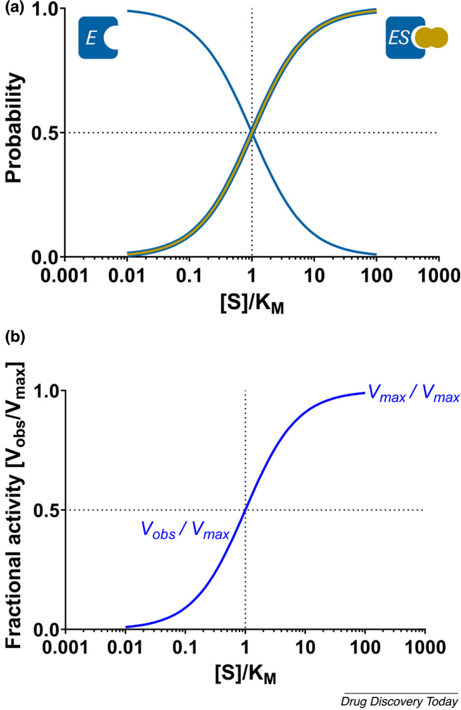
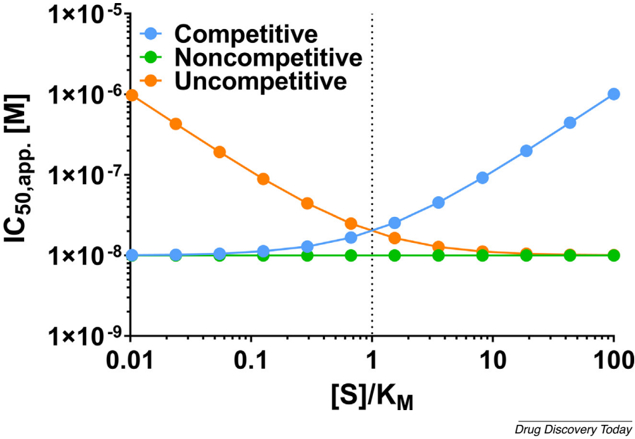
- Assay conditions can bias inhibitor detection: at [S] = K_M, half the enzyme is substrate-bound; high substrate selects against competitive inhibitors and favors uncompetitive inhibitors, whereas low substrate allows weak competitive inhibitors to bind. Apparent IC50 can increase twofold at ≥75% substrate turnover versus <10% conversion, and an assay cannot resolve IC50 values lower than half the enzyme concentration (the “IC50 wall”).
- Tight-binding inhibitors require special analysis: the Morrison equation accounts for depletion of both enzyme and inhibitor. Cathepsin K dipeptide nitriles showed fast tight binding, whereas corresponding azadipeptide inhibitors were slow tight binders.
- Transition-state stabilization underlies enzyme catalysis and inhibitor design; approved transition-state-inspired drugs include fosinopril, HIV protease inhibitors (darunavir, atazanavir, lopinavir/ritonavir, saquinavir), and forodesine. Aurora A sampled active (77% occupancy) and inactive (23% occupancy) activation-loop conformations; MLN8054 or CD532 increased the inactive population, and TPX2 reversed this effect.
- Crowding and conformational dynamics matter: intracellular protein concentration is estimated at 0.2 g/ml, occupying 30–40% of volume (~4 mM for 50 kDa proteins), while most assays use 10^-9–10^-8 M enzyme. For yeast alcohol dehydrogenase, crowders decreased K_M and V_max, with glucose/sucrose more effective than dextran/ficoll; correcting for excluded volume did not mitigate effects. Fixing adenylate kinase in a high-energy state increased AMP/ATP affinity ~200-fold but reduced kcat ~200-fold.
Methods
- Narrative review; no primary experimental data or systematic search/meta-analysis described. It synthesizes enzymology, assay design, high-throughput screening, kinetic analysis, and drug discovery literature.
- Covers biochemical assay formats, Michaelis-Menten and inhibition kinetics, tight-binding/covalent inhibitors, transition-state analogs, allostery, molecular crowding, and new therapeutic modalities; uses equations, boxed explanations, and cited examples.
Limitations
- Stated: detailed characterization of irreversible enzyme inhibitors is beyond the scope of the article.
- Evident: as a narrative review, it lacks systematic search criteria, primary data, and quantitative synthesis; examples are illustrative rather than exhaustive.
- Author is an employee of F. Hoffmann-La Roche Ltd (declared conflict).
Model-written summary. Check it against the paper before relying on it.
Integrity signals
Registry
Cites
Statistics
Figures

Verification
Claims the paper makes
0 Valid · 6 Not valid · 54 Not checked · 40 Own results and interpretations
None of the sources cited for this claim could be matched to a paper, so there is nothing to check it against.
In the paper
“Biophysical methods with readouts that are orthogonal to that used in the primary HTS have the potential to deliver unambiguous information on reference and hit compound properties and direct engagement with the target [6][7][8].”
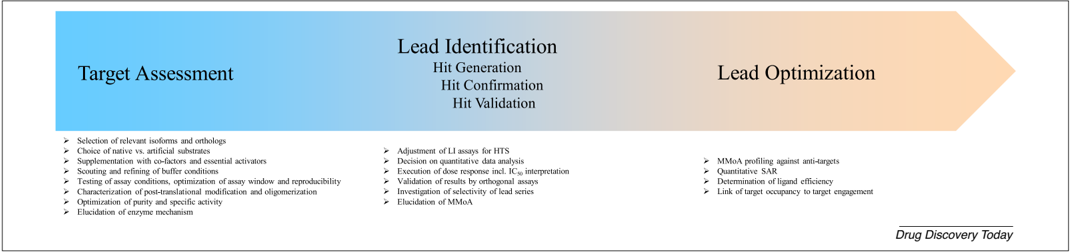
§ Teaser Thorough design of enzymatic assays and quantitative data analysis are the mainstays of drug discovery for enzymes, throughout the value chain from target assessment over > Abstract
What the sources say
- Not matchedcites [6]
The reference list we hold has no entry [6].
- Not matchedcites [7]
The reference list we hold has no entry [7].
- Not matchedcites [8]
The reference list we hold has no entry [8].
hedgedstates a possible cause- Asserted: passes — The authors put it forward as true.
- Checkable: passes — It can be checked against evidence.
- Load-bearing: passes — The paper’s conclusions depend on it.
- Based: passes — The paper gives a reason why it holds.
- Not matched
In the paper
“Highthroughput experimental approaches and analytical concepts based on ratios of IC 50 values determined at two different substrate concentrations can be applied for characterization of hit and lead compounds [12].”
§ Teaser Thorough design of enzymatic assays and quantitative data analysis are the mainstays of drug discovery for enzymes, throughout the value chain from target assessment over > GLOSSARY
What the sources say
- Not matchedcites [12]
The reference list we hold has no entry [12].
plain- Asserted: passes — The authors put it forward as true.
- Checkable: passes — It can be checked against evidence.
- Load-bearing: passes — The paper’s conclusions depend on it.
- Based: passes — The paper gives a reason why it holds.
- Not matched
None of the sources cited for this claim could be matched to a paper, so there is nothing to check it against.
In the paper
“Given their specific physicochemical properties, small-molecule compounds can interfere with assay components in unexpected manner or with the readout principle of the assay.”
§ Teaser Thorough design of enzymatic assays and quantitative data analysis are the mainstays of drug discovery for enzymes, throughout the value chain from target assessment over > Abstract
What the sources say
- Not matchedcites [3]
The reference list we hold has no entry [3].
- Not matchedcites [4]
The reference list we hold has no entry [4].
plainstates a cause- Asserted: passes — The authors put it forward as true.
- Checkable: passes — It can be checked against evidence.
- Load-bearing: passes — The paper’s conclusions depend on it.
- Based: passes — The paper gives a reason why it holds.
- Not matched
A conclusion the paper draws from its own results — it cites no other source for it, so there is none to check. The quote shows it is in the paper.
In the paper
“The reduction of observed percent enzyme activity in the presence of a putative hit compound might then be confounded by the concentration ratio of remaining substrate to compound at the single time point chosen for a HTS assay.”
§ Teaser Thorough design of enzymatic assays and quantitative data analysis are the mainstays of drug discovery for enzymes, throughout the value chain from target assessment over > GLOSSARY
hedgedstates a possible cause- Asserted: passes — The authors put it forward as true.
- Checkable: passes — It can be checked against evidence.
- Load-bearing: passes — The paper’s conclusions depend on it.
- Based: passes — The paper gives a reason why it holds.
A conclusion the paper draws from its own results — it cites no other source for it, so there is none to check. The quote shows it is in the paper.
In the paper
“This is because the choice of concentrations for enzyme, substrate, and compound as well as the time-point of the measurement relative to the rates of substrate turnover and product formation can introduce a bias regarding the sensitivity of the assay to inhibitors with different MMoA.”
§ Teaser Thorough design of enzymatic assays and quantitative data analysis are the mainstays of drug discovery for enzymes, throughout the value chain from target assessment over > GLOSSARY
plainstates a cause- Asserted: passes — The authors put it forward as true.
- Checkable: passes — It can be checked against evidence.
- Load-bearing: passes — The paper’s conclusions depend on it.
- Based: passes — The paper gives a reason why it holds.
43 more claims
Create a free account to see all 100 claims and every source verdict.
- Probably not a substantial claim. 29
- It may state two separate claims as one. 30
Citations
Cites
Yung-Chi, C., & Prusoff, W. H. (1973) · Biochemical Pharmacology · doi:10.1016/0006-2952(73)90196-2 · Cited by 12,922
DrugBank 5.0: a major update to the DrugBank database for 2018
Wishart, D. S., Feunang, Y. D., Guo, A. C., Lo, E. J., Marcu, A., Grant, J. R., Sajed, T., Johnson, D., Li, C., Sayeeda, Z., et al. (2018) · Nucleic Acids Research · doi:10.1093/nar/gkx1037 · Cited by 8,404
Zhang, J.-H., Chung, T. D. Y., & Oldenburg, K. R. (1999) · SLAS Discovery · doi:10.1177/108705719900400206 · Cited by 6,847
Baell, J. B., & Holloway, G. A. (2010) · Journal of Medicinal Chemistry · doi:10.1021/jm901137j · Cited by 3,944
COPASI—a COmplex PAthway SImulator
Hoops, S., Sahle, S., Gauges, R., Lee, C., Pahle, J., Simus, N., Singhal, M., Xu, L., Mendes, P., & Kummer, U. (2006) · Bioinformatics · doi:10.1093/bioinformatics/btl485 · Cited by 2,618
Program DYNAFIT for the Analysis of Enzyme Kinetic Data: Application to HIV Proteinase
Kuzmič, P. (1996) · Analytical Biochemistry · doi:10.1006/abio.1996.0238 · Cited by 1,495
The Original Michaelis Constant: Translation of the 1913 Michaelis–Menten Paper
Johnson, K. A., & Goody, R. S. (2011) · Biochemistry · doi:10.1021/bi201284u · Cited by 1,418
Activity-Based Protein Profiling: From Enzyme Chemistry to Proteomic Chemistry
Cravatt, B. F., Wright, A. T., & Kozarich, J. W. (2008) · Annual Review of Biochemistry · doi:10.1146/annurev.biochem.75.101304.124125 · Cited by 1,270
The Depth of Chemical Time and the Power of Enzymes as Catalysts
Wolfenden, R., & Snider, M. J. (2001) · Accounts of Chemical Research · doi:10.1021/ar000058i · Cited by 930
Kinetics of the reversible inhibition of enzyme-catalysed reactions by tight-binding inhibitors
Morrison, J. F. (1969) · Biochimica et Biophysica Acta (BBA) - Enzymology · doi:10.1016/0005-2744(69)90420-3 · Cited by 905
Cited by
Mons, E., Roet, S., Kim, R. Q., & Mulder, M. P. C. (2022) · Current Protocols · doi:10.1002/cpz1.419 · Cited by 126
“We assume that the uninhibited enzymatic substrate processing reaction (E + S <-> ES → E + P) complies with Michaelis–Menten enzyme kinetics (Pollard & De La Cruz, 2013; Rufer, 2021).”
MethodPhysicochemical Insights on Terahertz Wave Diminished Side Effects of Drugs from Slow Dissociation
Li, Y., Zhu, Z. H., Sun, L., Xiang, Z., Chang, C., & Fan, C. (2022) · ACS Nano · doi:10.1021/acsnano.2c02952 · Cited by 107
Renewable processes of synthesis of biolubricants catalyzed by lipases
de Sousa, I. G., Mota, G. F., Cavalcante, A. L. G., Rocha, T. G., Sousa, P. D. S., Alexandre, J. Y. N. H., Souza, J. E. D. S., Neto, F. S., Cavalcante, F. T. T., Lopes, A. A. S., et al. (2022) · Journal of environmental chemical engineering · doi:10.1016/j.jece.2022.109006 · Cited by 87
Inhibitory activities of grape bioactive compounds against enzymes linked with human diseases
Dwibedi, V., Jain, S., Singhal, D., Mittal, A., Rath, S. K., & Saxena, S. (2022) · Applied Microbiology and Biotechnology · doi:10.1007/s00253-022-11801-9 · Cited by 55
“2018; Rufer 2021).”
Ak, G., Gevrenova, R., Sinan, K. I., Zengin, G., Zheleva‐Dimitrova, D., Mahomoodally, M. F., Şenkardeş, İ., Brunetti, L., Leone, S., Simone, S. C. D., et al. (2021) · Food and Chemical Toxicology · doi:10.1016/j.fct.2021.112268 · Cited by 55
Neto, F. S., Neta, M. M. F. D. M., Sales, M. B., de Oliveira, F. A. S., Bizerra, V. D. C., Lopes, A. A. S., Rios, M. A. D. S., & dos Santos, J. C. S. (2023) · Polymers · doi:10.3390/polym15092057 · Cited by 49
Seidah, N. G., Pasquato, A., & Andréo, U. (2021) · Viruses · doi:10.3390/v13071229 · Cited by 40
Zengin, G., Raey, M. A. E., El‐Kashak, W. A., Batiha, G. E., Althumairy, D., Alamer, S. A., Mostafa, N. M., & Eldahshan, O. A. (2023) · Amino Acids · doi:10.1007/s00726-023-03262-9 · Cited by 39
“Enzymes are one of the most important cornerstones in the pharmaceutical and nutraceutical fields (Rufer 2021).”
Natural products from plants targeting key enzymes for the future development of antidiabetic agents
Mata, R., Flores‐Bocanegra, L., Ovalle‐Magallanes, B., & Figueroa, M. (2023) · Natural Product Reports · doi:10.1039/d3np00007a · Cited by 38
Kovner, D., Yuk, I. H. Y., Shen, A. Y., Li, H., Graf, T., Gupta, S. K., Liu, W., & Tomlinson, A. (2023) · Journal of Pharmaceutical Sciences · doi:10.1016/j.xphs.2023.01.003 · Cited by 38
Rao, M. S., McDuffie, E., & Sachs, C. W. (2023) · Toxics · doi:10.3390/toxics11100875 · Cited by 35
“…molecules used to treat a diverse array of medical conditions by in fl uencing their enzymatic activity [42,43]. enzymes serve as important therapeutic targets for the development the small molecules used to treat a diverse array of medical conditions by influencing their enzymatic activity [42,43].”
Recent advances on discovery of enzyme inhibitors from natural products using bioactivity screening
Yan, T., Cao, J., & Ye, L. (2022) · Journal of Separation Science · doi:10.1002/jssc.202200084 · Cited by 31
New challenges in drug discovery
Bano, I., Butt, U. D., & Mohsan, S. A. H. (2022) · Elsevier eBooks · doi:10.1016/b978-0-323-91376-8.00021-5 · Cited by 30
Arslan, M. A., Brignole‐Baudouin, F., Chardonnet, S., Pionneau, C., Blond, F., Baudouin, C., & Kessal, K. (2023) · Scientific Reports · doi:10.1038/s41598-023-42104-2 · Cited by 25
Contributions of Hyperactive Mutations in M pro from SARS-CoV-2 to Drug Resistance
Flynn, J. M., Zvornicanin, S. N., Tsepal, T., Shaqra, A. M., Yılmaz, N. K., Jia, W., Moquin, S. A., Dovala, D., Schiffer, C. A., & Bolon, D. N. A. (2024) · ACS Infectious Diseases · doi:10.1021/acsinfecdis.3c00560 · Cited by 24
Recent Advances in Enzyme Inhibition: A Pharmacological Review
Singh, K., Bhushan, B., Mittal, N., Kushwaha, A., Raikwar, C. K., Sharma, A. K., Chanchal, D. K., Kumar, S., & Agrawal, M. (2023) · Current Enzyme Inhibition · doi:10.2174/0115734080271639231030093152 · Cited by 22
Thamm, S., Willwacher, M. K., Aspnes, G. E., Bretschneider, T., Brown, N. F., Buschbom-Helmke, S., Fox, T., Gargano, E. M., Grabowski, D., Hoenke, C., et al. (2023) · Journal of Medicinal Chemistry · doi:10.1021/acs.jmedchem.2c01884 · Cited by 22
Pan, C., & Kakeya, H. (2025) · European Journal of Medicinal Chemistry · doi:10.1016/j.ejmech.2025.117481 · Cited by 18
Baral, B., Nial, P. S., & Subudhi, U. (2023) · International Journal of Biological Macromolecules · doi:10.1016/j.ijbiomac.2023.124677 · Cited by 17
Induced-volatolomics for the design of tumour activated therapy
Châtre, R., Blochouse, E., Eid, R., Djago, F., Lange, J., Tarighi, M., Renoux, B., Sobilo, J., Pape, A. L., Clarhaut, J. A., et al. (2023) · Chemical Science · doi:10.1039/d2sc06797h · Cited by 14
Azadeh, M., Good, J., Gunsior, M., Kulagina, N., Lu, Y., McNally, J., Myler, H. A., Ni, Y. G., Pelto, R., Quadrini, K. J., et al. (2024) · The AAPS Journal · doi:10.1208/s12248-024-00966-y · Cited by 10
On-flow enzymatic inhibitor screening: The emerging success of liquid chromatography-based assays
de Oliveira, P. C. O., Lessa, R., Ceroullo, M. S., Wegermann, C. A., & de Moraes, M. C. (2022) · Frontiers in Analytical Science · doi:10.3389/frans.2022.1004113 · Cited by 7
“Efficient therapies can be achieved by using enzymes as drugs or in diagnostics (Farhadi et al., 2018; Rufer, 2021).”
BackgroundRational peptide design for targeting cancer cell invasion
Gomari, M. M., Arab, S. S., Balalaie, S., Ramezanpour, S., Hosseini, A., Dokholyan, N. V., & Tarighi, P. (2023) · Proteins Structure Function and Bioinformatics · doi:10.1002/prot.26580 · Cited by 7
Khan, S., Anwar, S., Choudhury, A., Mohammad, T., & Hassan, M. I. (2024) · Elsevier eBooks · doi:10.1016/b978-0-443-22222-1.00007-6 · Cited by 6
Abouelwafa, M., Ibrahim, T. M., El-Hadidi, M. S., Mahnashi, M. H., Owaidah, A., Saeedi, N. H., Attia, H. G., Georrge, J. J., & Mostafa, A. (2023) · Frontiers in Molecular Biosciences · doi:10.3389/fmolb.2023.1248885 · Cited by 6
“These targets must either be inhibited in the case of over-expression or activated in the case of downregulation (Smith et al., 2010; Rufer, 2021).”
BackgroundEnzyme inhibitors for drug discovery
Meffre, P. R., Benfodda, Z., & Albrecht, S. J. ‐. (2023) · Amino Acids · doi:10.1007/s00726-023-03357-3 · Cited by 6
“…targets for the development of drug candidates and offer novel opportunities for therapeutic discoveries in the field of oncology, viral/ parasitic diseases, bacterial infections as well as in diverse metabolic dysfunctions and neurological disorders (Lloyd 2020; Rufer 2021; Newman 2022).”
Peptide nucleic acids can form hairpins and bind RNA-binding proteins
Zhong, Y., Wilkinson‐White, L. E., Zhang, E., Mohanty, B., Zhang, B. B., McRae, M. S., Luo, R., Allport, T. A., Duff, A. P., Zhao, J., et al. (2024) · PLoS ONE · doi:10.1371/journal.pone.0310565 · Cited by 5
“In contrast, many small-molecule antagonists and agonists have been discovered for major protein classes such as enzymes and receptors [3, 4], as well as engineered peptides and proteins (including antibodies) that specifically recognise protein-interaction interfaces [5, 6].”
Fioretti, I., Kim, T. K., & Sponchioni, M. (2022) · Advances in chemical engineering · doi:10.1016/bs.ache.2022.03.002 · Cited by 5
Choudhir, G., Israil, Iram, F., Shahid, M., Shamsi, A., Hassan, M. I., & Islam, A. (2025) · Aspects of Molecular Medicine · doi:10.1016/j.amolm.2025.100076 · Cited by 5
Gültekin, E., Atalay, A., & Şirin, Y. (2026) · Future Medicinal Chemistry · doi:10.1080/17568919.2026.2617604 · Cited by 5
Bartolo, N. D., Mortimer, N., Manter, M. A., Sanchez, N., Riley, M. M., O’Malley, T. T., & Hooker, J. M. (2022) · ACS Chemical Neuroscience · doi:10.1021/acschemneuro.2c00607 · Cited by 4
Chaira, S., Bouzghaia, B., Hanfer, M., Kaddi, I., Moussa, M. T. B., Pale, P., & Harkat, H. (2024) · European Journal of Integrative Medicine · doi:10.1016/j.eujim.2024.102349 · Cited by 4
Bergasa-Caceres, F., & RABITZ, H. A. (2022) · International Journal of Molecular Sciences · doi:10.3390/ijms23073906 · Cited by 4
“Such targets include enzymatic active sites [4], receptor binding sites [5], and allosteric regulation regions [6].”
BackgroundMahanta, P. J., & Lhouvum, K. (2024) · Protein Expression and Purification · doi:10.1016/j.pep.2024.106539 · Cited by 4
Exploration of biochemical reactivity with a QM/MM growing string method
McFarlane, N. R., & Harvey, J. N. (2024) · Physical Chemistry Chemical Physics · doi:10.1039/d3cp05772k · Cited by 4
Bruystens, J. G. H., Wu, J., Tan, G., Bertinetti, D., Zenn, H.-M., Zimmermann, B., Chen, L., Köckenberger, J., Massaro, F., Sankaran, B., et al. (2026) · Proceedings of the National Academy of Sciences · doi:10.1073/pnas.2536312123 · Cited by 3
“C concentration exceeds the determined IC 50 literature value for BLU0588, which means that with a classic sigmoidal dose– response analysis the calculated IC 50 value is error - prone (48, 49).”
Nature and biological irrelevance of mixed-type enzyme inhibitionPreprint
Pesaresi, A. (2022) · bioRxiv (Cold Spring Harbor Laboratory) · doi:10.1101/2022.12.20.521168 · Cited by 3
“This implies two consequences: first, the mechanism of inhibition is critical 395 to predict the pharmacodynamic properties of a drug [51,52], and hence, it should be regarded as a key factor 396 in the development of guidelines for pharmacological research [13,53].”
BackgroundGarcía-Vázquez, N., Nada, H., Upadhyay, S., & Gabr, M. T. (2025) · RSC Advances · doi:10.1039/d5ra03914b · Cited by 3
Research progress in immobilized nanozymes based on hybrid nanoflowers, MOFs and nanogels
Sun, C., Lin, X., Du, W., & Tian, J. (2026) · Microchimica Acta · doi:10.1007/s00604-026-08178-1 · Cited by 3
Zhai, Y., Chen, Y., Luo, Y., Mei, X., Wu, L., Mo, X., Zou, M., Zhou, M., Wu, Y., Zheng, G., et al. (2022) · Analytical Cellular Pathology · doi:10.1155/2022/8776079 · Cited by 3
“Metabolomics has been successfully used for the diagnosis and classification of early tumors [28], Alzheimer’s disease [29], cardiovascular disease [30], cancer [31], and diabetes [32].”
MethodVasios, A.-G., Skonta, A., Patila, M., & Stamatis, H. (2024) · Micromachines · doi:10.3390/mi15020288 · Cited by 3
“Results were calculated for each step in three iterations and the results were saved after every step was complete.”
MethodAUKAT: Conditional VAE-Driven Augmentation and Neural Modeling of Enzyme Turnover Numbers
Liu, M., Ni, X., & Bryliński, M. (2026) · Biomolecules · doi:10.3390/biom16071049 · Cited by 2
MolBiC: the cell-based landscape illustrating molecular bioactivities
Ge, Y., Yang, M., Yu, X., Zhou, Y., Zhang, Y., Mou, M., Chen, Z., Sun, X., Ni, F., Fu, T., et al. (2024) · Nucleic Acids Research · doi:10.1093/nar/gkae868 · Cited by 2
Hou, Y., Zeng, C., Yang, Y., & Peng, T. (2025) · Natural Product Research · doi:10.1080/14786419.2025.2462117 · Cited by 2
“As advancements in research and technology progress, the methods for acquiring drugs have expanded, encompassing techniques such as isolation from botanical and other organic origins, chemical synthesis, combinatorial chemistry, and molecular modelling (Rufer 2021).”
Divergent Approaches Toward Drug Discovery and Development
Koul, S. (2023) · Springer eBooks · doi:10.1007/978-981-99-1284-1_34 · Cited by 1
Structural studies of drug targets and a drug metabolizing enzyme
Cederfelt, D. (2023) · Uppsala University Publications (Uppsala University) · Cited by 1
Matsuzaka, Y., & Yashiro, R. (2024) · Computing and artificial intelligence. · doi:10.59400/cai.v2i2.1279
“…widely used methods include POVME, which predicts drug binding sites based on the protein surface shape, Fpocket and SiteMap, which make estimations by considering the properties of the protein surface, and FTMap, which locates small probe molecules and finds energetically stable spaces [76].”
MethodIntegrative Approaches in Protein Structure/Function Analysis, Design, and Engineering
孙洲同, Yuan, B., Shi, J., & Wang, Y. (2026) · Advances in biochemical engineering, biotechnology · doi:10.1007/10_2026_369
Balcı, N. (2025) · Iğdır Üniversitesi Fen Bilimleri Enstitüsü Dergisi · doi:10.21597/jist.1720689
Tear Proteomic Analysis and Biomarker Investigations for Dry Eye Disease
Arslan, M. A. (2023) · theses.fr (ABES) · doi:10.70675/8b72fc67zda8cz4dd7z9aacz6e16bd467b58
Fungal Enzyme Inhibitors: Potent Repository of Lead Compounds to Curb Cancer
Gambhir, L., & Kapoor, N. (2024) · Springer eBooks · doi:10.1007/978-981-99-5696-8_13
Enzyme-responsive 2-dimensional nanomaterials for targeted breast cancer treatment
Lavanya, N., Vijayabharathi, S., M, M. N. I. A., Sherin, F., & Soman, S. (2026) · Journal of drug targeting · doi:10.1080/1061186x.2026.2692597
“…of the enzyme and the affinity of the substrate; hence, engineering linkers with optimal kinetic profiles will help regulate drug release [50]. collectively, these parameters must be carefully optimised to achieve a balance between circulatory stability and efficient activation within…”
Special Issue of “Synthesis, Biological Evaluation and Molecular Modeling of Enzyme Inhibitors”
Mikstacka, R., Dutkiewicz, Z., & Wierzchowski, M. (2023) · Processes · doi:10.3390/pr11113128
Better understanding of biomolecules as drug target: a literature review
Fadhilah, A. N., Jati, Y. S., Sekarini, D. N., Afifah, L., Vierin, P. N. A. S., & Fitriyani, R. (2025) · Indonesian Journal of Pharmacology and Therapy · doi:10.22146/ijpther.13074
Développement de stratégies pour la détection de marqueurs protéiques du cancer
Djago, F. (2023) · theses.fr (ABES) · doi:10.70675/21e3288ezdff9z4ff2zaa22zc8935ae033ad
Exploring emerging therapeutic opportunities of druggable enzyme targets involved in type 2 diabetes
Tomović, K., Šmelcerović, A., & Anderluh, M. (2026) · European Journal of Medicinal Chemistry · doi:10.1016/j.ejmech.2026.119482
The protagonism of bioanalytical methods in high-throughput drug discovery
de Moraes, M. C., de Almeida, F. G., & Tinoco, L. W. (2023) · Frontiers research topics · doi:10.3389/978-2-8325-2494-7
Annisadila, S., Jamil, A. S., & Muchlisin, M. A. (2023) · Proceedings of International Pharmacy Ulul Albab Conference and Seminar (PLANAR) · doi:10.18860/planar.v3i0.2478
“In order to discover and develop new effective, efficient, and safe drugs, it is essential to understand the mechanisms of the enzyme reaction and the molecular mechanism of action of enzyme inhibitors (Rufer, 2021).”
BackgroundImobilização de calicreína para aplicação na triagem de ligantes
Rocha, C. L. (2023) · Digital Library of Theses and Dissertations (Universidade de São Paulo) · doi:10.11606/d.59.2023.tde-14112023-171056
Vidhya, C. S., Gomadhi, G., Belagalla, N., Prabhavathi, S. J., Majumder, J., Gangopadhyay, S., Biswas, S., Behera, H. S., Malathi, G., & Kalaiselvi, P. (2024) · UTTAR PRADESH JOURNAL OF ZOOLOGY · doi:10.56557/upjoz/2024/v45i124113
Liu, Z. (2025) · European Journal of Public Health and Environmental Research · doi:10.71222/xwzr0q07
In vitro inhibition effect of various pharmacologically relevant drugs on recombinant paraoxonase 1
Smerkolj, J., Žnidaršič, N., Bavec, A., & Goličnik, M. (2025) · Chemico-Biological Interactions · doi:10.1016/j.cbi.2025.111682
Roet, S. (2022) · NVA (Nasjonalt vitenarkiv)
Byway for fattening: possible role of inhibition of lipolytic enzymes by ionophore
Lyagin, I. (2026) · International Journal of Biological Macromolecules · doi:10.1016/j.ijbiomac.2026.150313
Landwehr, E. (2025) · KOPS (University of Konstanz)
Plantan, M. (2026) · Repository of the University of Ljubljana (University of Ljubljana)
Karim, L. A., Mumtaz, A., Ejaz, S. A., Ismail, T., Mannan, A., Siddique, M., Shahzadi, I., Shahzadi, A., & Fatima, N. (2026) · Future Medicinal Chemistry · doi:10.1080/17568919.2026.2736313
Stancheva, R., Iliev, I. R., Merdzhanova, A., & Georgieva, S. F. (2026) · Bulgarian Chemical Communications · doi:10.34049/bcc.58.2.ncc04
Morato, N. M., Dhanabalan, K., Feng, Y., Patra, D., Setty, T. G., Higgins, C., Subramanian, R., & Cooks, R. G. (2026) · Insights in Biochemistry and Molecular Biology · doi:10.1016/j.ibmbio.2026.100015
Metadata
- Authors
- Rufer, A. C.
- Affiliations
- F. Hoffmann-La Roche AG (CH)
- Corresponding author
- Rufer, Arne Christian
- Venue
- Drug Discovery Today
- Publisher
- Elsevier BV
- Published
- 2021-04
- Volume
- 26
- Issue
- 4
- Pages
- 875-886
- ISSN
- 1359-6446 (ISSN-L)
- OpenAlex
- W3120829760
- Semantic Scholar
- a197699f49bd4bd0c04b08b431befddd69091d7b
- Cited by
- 69
- References
- 112
- Citations by year
- 2026: 12 · 2025: 9 · 2024: 12 · 2023: 21 · 2022: 13 · 2021: 2
- FWCI
- 1.16
- Type
- journal article
- Language
- en
- Open access
- hybrid
- doi.org
- Licence
- cc-by-nc-nd
- www.elsevier.com/tdm/userlicense/1.0/ (tdm)
- www.elsevier.com/legal/tdmrep-license (tdm)
- creativecommons.org/licenses/by-nc-nd/4.0/ (vor)
- Locations
- Drug Discovery Today (publishedVersion, cc-by-nc-nd)
- PubMed (publishedVersion)
- Topics
- Life Sciences › Biochemistry, Genetics and Molecular Biology › Molecular Biology › Enzyme function and inhibition
- Life Sciences › Pharmacology, Toxicology and Pharmaceutics › Drug Discovery › Computational Drug Discovery Methods
- Life Sciences › Biochemistry, Genetics and Molecular Biology › Structural Biology › Enzyme Structure and Function
- Keywords
- enzyme inhibitors, substrate binding pocket, enzyme mechanism, enzyme kinetics, drug discovery
- MeSH terms
- Enzyme Inhibitors, Enzymes, Humans, Drug Design, Drug Discovery, Molecular Targeted Therapy
About these checks
Registry, retraction, Cites and statistics results are computed, not judged, with one exception: a printed reference that no index lists is read once by a model before it counts as a citation error. Claims are extracted by a model and kept only when their quote appears verbatim in the text; each cited source is then checked, with a model’s help, for whether it says what the claim relies on. Those verdicts can be wrong — read the claim’s quote and the cited source before relying on one.
A language model drew the claims from the paper on 2026-11-27, under version 3 of the claim definition (model deepseek-v4.1-flash, prompt extract-v3).
A second model labelled each claim on 2026-11-27 (model jev-1.13-20260917, definition revision gold-guideline-v0.2).
Statistics and arithmetic are recomputed, not judged.
Confidence bands are shown only for fields calibrated on our annotated test set. None is calibrated yet, so no band is shown.
What counts as a claim ›How we measure confidence ›How we check this ›
Are you an author, or do you see a problem with this page? Request a review
Data sources
Bibliographic data: Semantic Scholar, OpenAlex, Crossref.
Contains information from the Semantic Scholar Academic Graph Datasets, made available under the ODC Attribution License (ODC-BY 1.0).
Semantic Scholar’s data is described in: Kinney, R., et al. (2023). The Semantic Scholar Open Data Platform. arXiv:2301.10140.
