

Drug discovery for enzymes
Open accessThe DOI matches its Crossref record; 111 of the 112 references it cites were found in a registry or an index, and 1 are not checked yet; none of the 72 sources its claims cite is checked for support yet.
Abstract
Enzymes are essential, physiological catalysts involved in all processes of life, including metabolism, cellular signaling and motility, as well as cell growth and division. They are attractive drug targets because of the presence of defined substrate-binding pockets, which can be exploited as binding sites for pharmaceutical enzyme inhibitors. Understanding the reaction mechanisms of enzymes and the molecular mode of action of enzyme inhibitors is indispensable for the discovery and development of potent, efficacious, and safe novel drugs. The combination of classical concepts of enzymology with new experimental and data analysis methods opens new routes for drug discovery.
Checked 2026-11-27 · 1 reference not checked yet
Overview
CoChat Summary
TL;DR
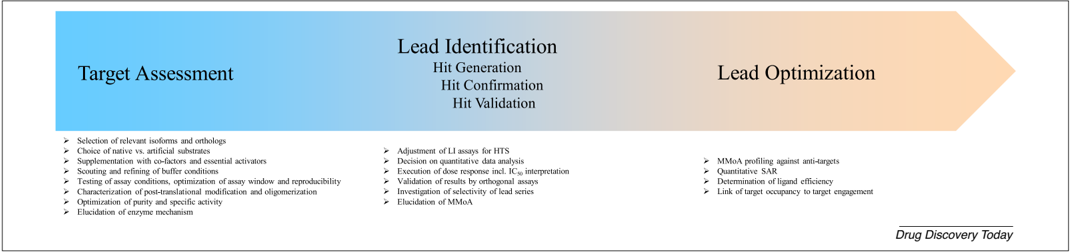
This review argues that thorough enzymatic assay design and quantitative data analysis are central to drug discovery for enzymes, from target assessment through lead optimization to clinical candidate nomination. It surveys kinetic principles, assay biases, tight-binding and covalent inhibition, transition-state analogs, allostery, crowding effects, and emerging therapeutic modalities.
Key findings
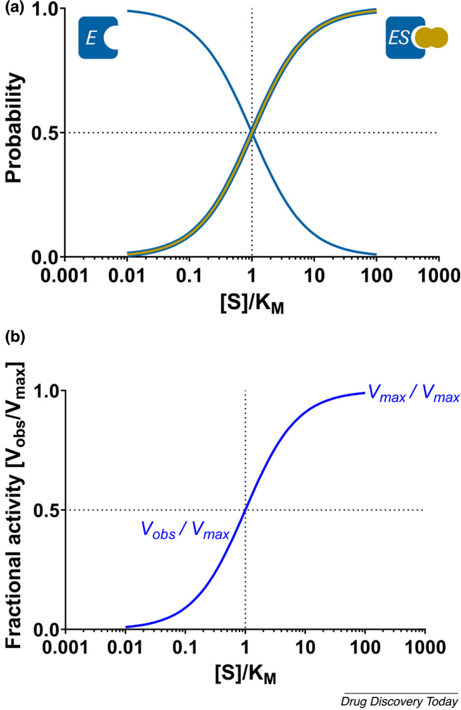
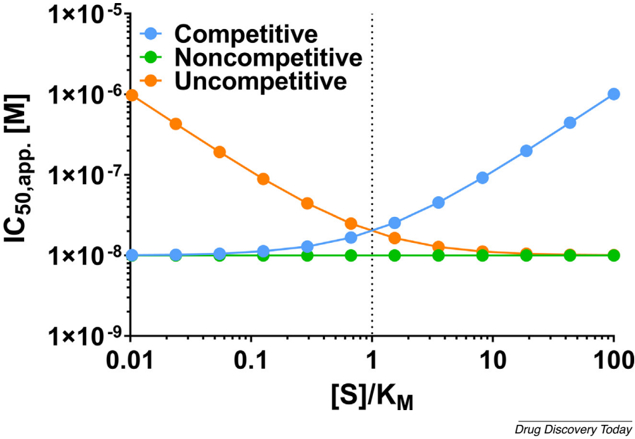
- Assay conditions can bias inhibitor detection: at [S] = K_M, half the enzyme is substrate-bound; high substrate selects against competitive inhibitors and favors uncompetitive inhibitors, whereas low substrate allows weak competitive inhibitors to bind. Apparent IC50 can increase twofold at ≥75% substrate turnover versus <10% conversion, and an assay cannot resolve IC50 values lower than half the enzyme concentration (the “IC50 wall”).
- Tight-binding inhibitors require special analysis: the Morrison equation accounts for depletion of both enzyme and inhibitor. Cathepsin K dipeptide nitriles showed fast tight binding, whereas corresponding azadipeptide inhibitors were slow tight binders.
- Transition-state stabilization underlies enzyme catalysis and inhibitor design; approved transition-state-inspired drugs include fosinopril, HIV protease inhibitors (darunavir, atazanavir, lopinavir/ritonavir, saquinavir), and forodesine. Aurora A sampled active (77% occupancy) and inactive (23% occupancy) activation-loop conformations; MLN8054 or CD532 increased the inactive population, and TPX2 reversed this effect.
- Crowding and conformational dynamics matter: intracellular protein concentration is estimated at 0.2 g/ml, occupying 30–40% of volume (~4 mM for 50 kDa proteins), while most assays use 10^-9–10^-8 M enzyme. For yeast alcohol dehydrogenase, crowders decreased K_M and V_max, with glucose/sucrose more effective than dextran/ficoll; correcting for excluded volume did not mitigate effects. Fixing adenylate kinase in a high-energy state increased AMP/ATP affinity ~200-fold but reduced kcat ~200-fold.
Methods
- Narrative review; no primary experimental data or systematic search/meta-analysis described. It synthesizes enzymology, assay design, high-throughput screening, kinetic analysis, and drug discovery literature.
- Covers biochemical assay formats, Michaelis-Menten and inhibition kinetics, tight-binding/covalent inhibitors, transition-state analogs, allostery, molecular crowding, and new therapeutic modalities; uses equations, boxed explanations, and cited examples.
Limitations
- Stated: detailed characterization of irreversible enzyme inhibitors is beyond the scope of the article.
- Evident: as a narrative review, it lacks systematic search criteria, primary data, and quantitative synthesis; examples are illustrative rather than exhaustive.
- Author is an employee of F. Hoffmann-La Roche Ltd (declared conflict).
Model-written summary. Check it against the paper before relying on it.
Integrity signals
Registry
Cites
Statistics
Figures

Verification
Claims the paper makes
0 Valid · 6 Not valid · 54 Not checked · 40 Own results and interpretations
None of the sources cited for this claim could be matched to a paper, so there is nothing to check it against.
In the paper
“Biophysical methods with readouts that are orthogonal to that used in the primary HTS have the potential to deliver unambiguous information on reference and hit compound properties and direct engagement with the target [6][7][8].”
§ Teaser Thorough design of enzymatic assays and quantitative data analysis are the mainstays of drug discovery for enzymes, throughout the value chain from target assessment over > Abstract
What the sources say
- Not matchedcites [6]
The reference list we hold has no entry [6].
- Not matchedcites [7]
The reference list we hold has no entry [7].
- Not matchedcites [8]
The reference list we hold has no entry [8].
hedgedstates a possible cause- Asserted: passes — The authors put it forward as true.
- Checkable: passes — It can be checked against evidence.
- Load-bearing: passes — The paper’s conclusions depend on it.
- Based: passes — The paper gives a reason why it holds.
- Not matched
In the paper
“Highthroughput experimental approaches and analytical concepts based on ratios of IC 50 values determined at two different substrate concentrations can be applied for characterization of hit and lead compounds [12].”
§ Teaser Thorough design of enzymatic assays and quantitative data analysis are the mainstays of drug discovery for enzymes, throughout the value chain from target assessment over > GLOSSARY
What the sources say
- Not matchedcites [12]
The reference list we hold has no entry [12].
plain- Asserted: passes — The authors put it forward as true.
- Checkable: passes — It can be checked against evidence.
- Load-bearing: passes — The paper’s conclusions depend on it.
- Based: passes — The paper gives a reason why it holds.
- Not matched
None of the sources cited for this claim could be matched to a paper, so there is nothing to check it against.
In the paper
“Given their specific physicochemical properties, small-molecule compounds can interfere with assay components in unexpected manner or with the readout principle of the assay.”
§ Teaser Thorough design of enzymatic assays and quantitative data analysis are the mainstays of drug discovery for enzymes, throughout the value chain from target assessment over > Abstract
What the sources say
- Not matchedcites [3]
The reference list we hold has no entry [3].
- Not matchedcites [4]
The reference list we hold has no entry [4].
plainstates a cause- Asserted: passes — The authors put it forward as true.
- Checkable: passes — It can be checked against evidence.
- Load-bearing: passes — The paper’s conclusions depend on it.
- Based: passes — The paper gives a reason why it holds.
- Not matched
A conclusion the paper draws from its own results — it cites no other source for it, so there is none to check. The quote shows it is in the paper.
In the paper
“The reduction of observed percent enzyme activity in the presence of a putative hit compound might then be confounded by the concentration ratio of remaining substrate to compound at the single time point chosen for a HTS assay.”
§ Teaser Thorough design of enzymatic assays and quantitative data analysis are the mainstays of drug discovery for enzymes, throughout the value chain from target assessment over > GLOSSARY
hedgedstates a possible cause- Asserted: passes — The authors put it forward as true.
- Checkable: passes — It can be checked against evidence.
- Load-bearing: passes — The paper’s conclusions depend on it.
- Based: passes — The paper gives a reason why it holds.
A conclusion the paper draws from its own results — it cites no other source for it, so there is none to check. The quote shows it is in the paper.
In the paper
“This is because the choice of concentrations for enzyme, substrate, and compound as well as the time-point of the measurement relative to the rates of substrate turnover and product formation can introduce a bias regarding the sensitivity of the assay to inhibitors with different MMoA.”
§ Teaser Thorough design of enzymatic assays and quantitative data analysis are the mainstays of drug discovery for enzymes, throughout the value chain from target assessment over > GLOSSARY
plainstates a cause- Asserted: passes — The authors put it forward as true.
- Checkable: passes — It can be checked against evidence.
- Load-bearing: passes — The paper’s conclusions depend on it.
- Based: passes — The paper gives a reason why it holds.
43 more claims
Create a free account to see all 100 claims and every source verdict.
- Probably not a substantial claim. 29
- It may state two separate claims as one. 30
Citations
Cites
Yung-Chi, C., & Prusoff, W. H. (1973) · Biochemical Pharmacology · doi:10.1016/0006-2952(73)90196-2 · Cited by 12,922
DrugBank 5.0: a major update to the DrugBank database for 2018
Wishart, D. S., Feunang, Y. D., Guo, A. C., Lo, E. J., Marcu, A., Grant, J. R., Sajed, T., Johnson, D., Li, C., Sayeeda, Z., et al. (2018) · Nucleic Acids Research · doi:10.1093/nar/gkx1037 · Cited by 8,404
Zhang, J.-H., Chung, T. D. Y., & Oldenburg, K. R. (1999) · SLAS Discovery · doi:10.1177/108705719900400206 · Cited by 6,847
Baell, J. B., & Holloway, G. A. (2010) · Journal of Medicinal Chemistry · doi:10.1021/jm901137j · Cited by 3,944
COPASI—a COmplex PAthway SImulator
Hoops, S., Sahle, S., Gauges, R., Lee, C., Pahle, J., Simus, N., Singhal, M., Xu, L., Mendes, P., & Kummer, U. (2006) · Bioinformatics · doi:10.1093/bioinformatics/btl485 · Cited by 2,618
Program DYNAFIT for the Analysis of Enzyme Kinetic Data: Application to HIV Proteinase
Kuzmič, P. (1996) · Analytical Biochemistry · doi:10.1006/abio.1996.0238 · Cited by 1,495
The Original Michaelis Constant: Translation of the 1913 Michaelis–Menten Paper
Johnson, K. A., & Goody, R. S. (2011) · Biochemistry · doi:10.1021/bi201284u · Cited by 1,418
Activity-Based Protein Profiling: From Enzyme Chemistry to Proteomic Chemistry
Cravatt, B. F., Wright, A. T., & Kozarich, J. W. (2008) · Annual Review of Biochemistry · doi:10.1146/annurev.biochem.75.101304.124125 · Cited by 1,270
The Depth of Chemical Time and the Power of Enzymes as Catalysts
Wolfenden, R., & Snider, M. J. (2001) · Accounts of Chemical Research · doi:10.1021/ar000058i · Cited by 930
Kinetics of the reversible inhibition of enzyme-catalysed reactions by tight-binding inhibitors
Morrison, J. F. (1969) · Biochimica et Biophysica Acta (BBA) - Enzymology · doi:10.1016/0005-2744(69)90420-3 · Cited by 905
Cited by
Mons, E., Roet, S., Kim, R. Q., & Mulder, M. P. C. (2022) · Current Protocols · doi:10.1002/cpz1.419 · Cited by 126
“We assume that the uninhibited enzymatic substrate processing reaction (E + S <-> ES → E + P) complies with Michaelis–Menten enzyme kinetics (Pollard & De La Cruz, 2013; Rufer, 2021).”
MethodPhysicochemical Insights on Terahertz Wave Diminished Side Effects of Drugs from Slow Dissociation
Li, Y., Zhu, Z. H., Sun, L., Xiang, Z., Chang, C., & Fan, C. (2022) · ACS Nano · doi:10.1021/acsnano.2c02952 · Cited by 107
Renewable processes of synthesis of biolubricants catalyzed by lipases
de Sousa, I. G., Mota, G. F., Cavalcante, A. L. G., Rocha, T. G., Sousa, P. D. S., Alexandre, J. Y. N. H., Souza, J. E. D. S., Neto, F. S., Cavalcante, F. T. T., Lopes, A. A. S., et al. (2022) · Journal of environmental chemical engineering · doi:10.1016/j.jece.2022.109006 · Cited by 87
Inhibitory activities of grape bioactive compounds against enzymes linked with human diseases
Dwibedi, V., Jain, S., Singhal, D., Mittal, A., Rath, S. K., & Saxena, S. (2022) · Applied Microbiology and Biotechnology · doi:10.1007/s00253-022-11801-9 · Cited by 55
“2018; Rufer 2021).”
Ak, G., Gevrenova, R., Sinan, K. I., Zengin, G., Zheleva‐Dimitrova, D., Mahomoodally, M. F., Şenkardeş, İ., Brunetti, L., Leone, S., Simone, S. C. D., et al. (2021) · Food and Chemical Toxicology · doi:10.1016/j.fct.2021.112268 · Cited by 55
Metadata
- Authors
- Rufer, A. C.
- Affiliations
- F. Hoffmann-La Roche AG (CH)
- Corresponding author
- Rufer, Arne Christian
- Venue
- Drug Discovery Today
- Publisher
- Elsevier BV
- Published
- 2021-04
- Volume
- 26
- Issue
- 4
- Pages
- 875-886
- ISSN
- 1359-6446 (ISSN-L)
- OpenAlex
- W3120829760
- Semantic Scholar
- a197699f49bd4bd0c04b08b431befddd69091d7b
- Cited by
- 69
- References
- 112
- Citations by year
- 2026: 12 · 2025: 9 · 2024: 12 · 2023: 21 · 2022: 13 · 2021: 2
- FWCI
- 1.16
- Type
- journal article
- Language
- en
- Open access
- hybrid
- doi.org
- Licence
- cc-by-nc-nd
- www.elsevier.com/tdm/userlicense/1.0/ (tdm)
- www.elsevier.com/legal/tdmrep-license (tdm)
- creativecommons.org/licenses/by-nc-nd/4.0/ (vor)
- Locations
- Drug Discovery Today (publishedVersion, cc-by-nc-nd)
- PubMed (publishedVersion)
- Topics
- Life Sciences › Biochemistry, Genetics and Molecular Biology › Molecular Biology › Enzyme function and inhibition
- Life Sciences › Pharmacology, Toxicology and Pharmaceutics › Drug Discovery › Computational Drug Discovery Methods
- Life Sciences › Biochemistry, Genetics and Molecular Biology › Structural Biology › Enzyme Structure and Function
- Keywords
- enzyme inhibitors, substrate binding pocket, enzyme mechanism, enzyme kinetics, drug discovery
- MeSH terms
- Enzyme Inhibitors, Enzymes, Humans, Drug Design, Drug Discovery, Molecular Targeted Therapy
About these checks
Registry, retraction, Cites and statistics results are computed, not judged, with one exception: a printed reference that no index lists is read once by a model before it counts as a citation error. Claims are extracted by a model and kept only when their quote appears verbatim in the text; each cited source is then checked, with a model’s help, for whether it says what the claim relies on. Those verdicts can be wrong — read the claim’s quote and the cited source before relying on one.
A language model drew the claims from the paper on 2026-11-27, under version 3 of the claim definition (model deepseek-v4.1-flash, prompt extract-v3).
A second model labelled each claim on 2026-11-27 (model jev-1.13-20260917, definition revision gold-guideline-v0.2).
Statistics and arithmetic are recomputed, not judged.
Confidence bands are shown only for fields calibrated on our annotated test set. None is calibrated yet, so no band is shown.
What counts as a claim ›How we measure confidence ›How we check this ›
Are you an author, or do you see a problem with this page? Request a review
Data sources
Bibliographic data: Semantic Scholar, OpenAlex, Crossref.
Contains information from the Semantic Scholar Academic Graph Datasets, made available under the ODC Attribution License (ODC-BY 1.0).
Semantic Scholar’s data is described in: Kinney, R., et al. (2023). The Semantic Scholar Open Data Platform. arXiv:2301.10140.
