

Drug discovery for enzymes
Open accessThe DOI matches its Crossref record; 111 of the 112 references it cites were found in a registry or an index, and 1 are not checked yet; none of the 72 sources its claims cite is checked for support yet.
Abstract
Enzymes are essential, physiological catalysts involved in all processes of life, including metabolism, cellular signaling and motility, as well as cell growth and division. They are attractive drug targets because of the presence of defined substrate-binding pockets, which can be exploited as binding sites for pharmaceutical enzyme inhibitors. Understanding the reaction mechanisms of enzymes and the molecular mode of action of enzyme inhibitors is indispensable for the discovery and development of potent, efficacious, and safe novel drugs. The combination of classical concepts of enzymology with new experimental and data analysis methods opens new routes for drug discovery.
Checked 2026-11-27 · 1 reference not checked yet
Overview
CoChat Summary
TL;DR
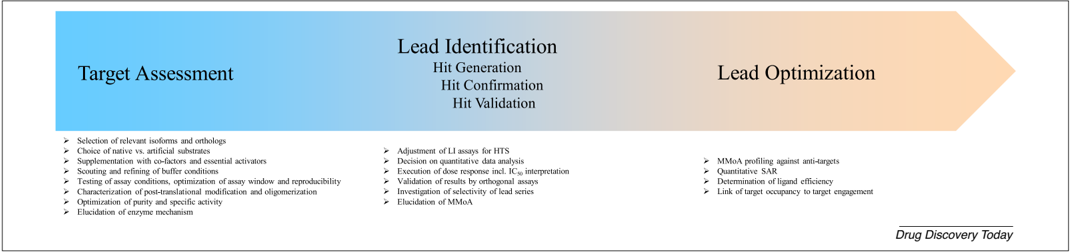
This review argues that thorough enzymatic assay design and quantitative data analysis are central to drug discovery for enzymes, from target assessment through lead optimization to clinical candidate nomination. It surveys kinetic principles, assay biases, tight-binding and covalent inhibition, transition-state analogs, allostery, crowding effects, and emerging therapeutic modalities.
Key findings
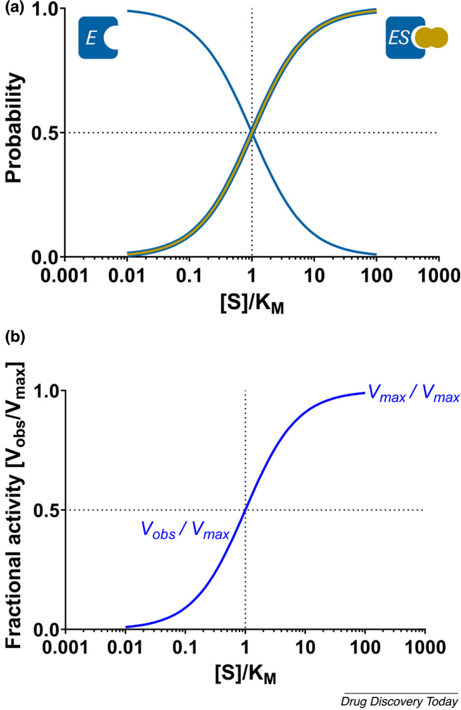
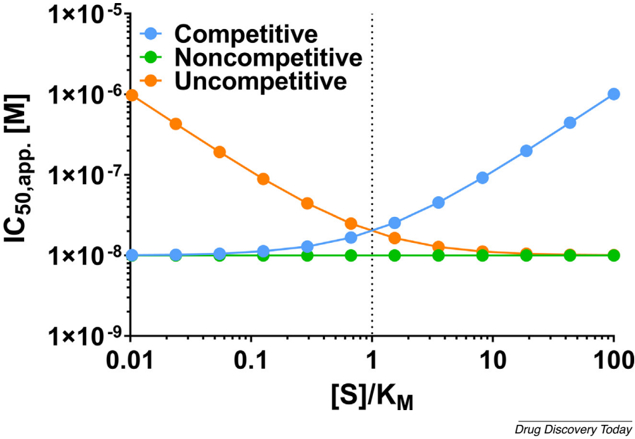
- Assay conditions can bias inhibitor detection: at [S] = K_M, half the enzyme is substrate-bound; high substrate selects against competitive inhibitors and favors uncompetitive inhibitors, whereas low substrate allows weak competitive inhibitors to bind. Apparent IC50 can increase twofold at ≥75% substrate turnover versus <10% conversion, and an assay cannot resolve IC50 values lower than half the enzyme concentration (the “IC50 wall”).
- Tight-binding inhibitors require special analysis: the Morrison equation accounts for depletion of both enzyme and inhibitor. Cathepsin K dipeptide nitriles showed fast tight binding, whereas corresponding azadipeptide inhibitors were slow tight binders.
- Transition-state stabilization underlies enzyme catalysis and inhibitor design; approved transition-state-inspired drugs include fosinopril, HIV protease inhibitors (darunavir, atazanavir, lopinavir/ritonavir, saquinavir), and forodesine. Aurora A sampled active (77% occupancy) and inactive (23% occupancy) activation-loop conformations; MLN8054 or CD532 increased the inactive population, and TPX2 reversed this effect.
- Crowding and conformational dynamics matter: intracellular protein concentration is estimated at 0.2 g/ml, occupying 30–40% of volume (~4 mM for 50 kDa proteins), while most assays use 10^-9–10^-8 M enzyme. For yeast alcohol dehydrogenase, crowders decreased K_M and V_max, with glucose/sucrose more effective than dextran/ficoll; correcting for excluded volume did not mitigate effects. Fixing adenylate kinase in a high-energy state increased AMP/ATP affinity ~200-fold but reduced kcat ~200-fold.
Methods
- Narrative review; no primary experimental data or systematic search/meta-analysis described. It synthesizes enzymology, assay design, high-throughput screening, kinetic analysis, and drug discovery literature.
- Covers biochemical assay formats, Michaelis-Menten and inhibition kinetics, tight-binding/covalent inhibitors, transition-state analogs, allostery, molecular crowding, and new therapeutic modalities; uses equations, boxed explanations, and cited examples.
Limitations
- Stated: detailed characterization of irreversible enzyme inhibitors is beyond the scope of the article.
- Evident: as a narrative review, it lacks systematic search criteria, primary data, and quantitative synthesis; examples are illustrative rather than exhaustive.
- Author is an employee of F. Hoffmann-La Roche Ltd (declared conflict).
Model-written summary. Check it against the paper before relying on it.
Integrity signals
Registry
Cites
Statistics
Figures

Verification
Claims the paper makes
0 Valid · 6 Not valid · 54 Not checked · 40 Own results and interpretations
None of the sources cited for this claim could be matched to a paper, so there is nothing to check it against.
In the paper
“Biophysical methods with readouts that are orthogonal to that used in the primary HTS have the potential to deliver unambiguous information on reference and hit compound properties and direct engagement with the target [6][7][8].”
§ Teaser Thorough design of enzymatic assays and quantitative data analysis are the mainstays of drug discovery for enzymes, throughout the value chain from target assessment over > Abstract
What the sources say
- Not matchedcites [6]
The reference list we hold has no entry [6].
- Not matchedcites [7]
The reference list we hold has no entry [7].
- Not matchedcites [8]
The reference list we hold has no entry [8].
hedgedstates a possible cause- Asserted: passes — The authors put it forward as true.
- Checkable: passes — It can be checked against evidence.
- Load-bearing: passes — The paper’s conclusions depend on it.
- Based: passes — The paper gives a reason why it holds.
- Not matched
In the paper
“Highthroughput experimental approaches and analytical concepts based on ratios of IC 50 values determined at two different substrate concentrations can be applied for characterization of hit and lead compounds [12].”
§ Teaser Thorough design of enzymatic assays and quantitative data analysis are the mainstays of drug discovery for enzymes, throughout the value chain from target assessment over > GLOSSARY
What the sources say
- Not matchedcites [12]
The reference list we hold has no entry [12].
plain- Asserted: passes — The authors put it forward as true.
- Checkable: passes — It can be checked against evidence.
- Load-bearing: passes — The paper’s conclusions depend on it.
- Based: passes — The paper gives a reason why it holds.
- Not matched
None of the sources cited for this claim could be matched to a paper, so there is nothing to check it against.
In the paper
“Given their specific physicochemical properties, small-molecule compounds can interfere with assay components in unexpected manner or with the readout principle of the assay.”
§ Teaser Thorough design of enzymatic assays and quantitative data analysis are the mainstays of drug discovery for enzymes, throughout the value chain from target assessment over > Abstract
What the sources say
- Not matchedcites [3]
The reference list we hold has no entry [3].
- Not matchedcites [4]
The reference list we hold has no entry [4].
plainstates a cause- Asserted: passes — The authors put it forward as true.
- Checkable: passes — It can be checked against evidence.
- Load-bearing: passes — The paper’s conclusions depend on it.
- Based: passes — The paper gives a reason why it holds.
- Not matched
A conclusion the paper draws from its own results — it cites no other source for it, so there is none to check. The quote shows it is in the paper.
In the paper
“The reduction of observed percent enzyme activity in the presence of a putative hit compound might then be confounded by the concentration ratio of remaining substrate to compound at the single time point chosen for a HTS assay.”
§ Teaser Thorough design of enzymatic assays and quantitative data analysis are the mainstays of drug discovery for enzymes, throughout the value chain from target assessment over > GLOSSARY
hedgedstates a possible cause- Asserted: passes — The authors put it forward as true.
- Checkable: passes — It can be checked against evidence.
- Load-bearing: passes — The paper’s conclusions depend on it.
- Based: passes — The paper gives a reason why it holds.
A conclusion the paper draws from its own results — it cites no other source for it, so there is none to check. The quote shows it is in the paper.
In the paper
“This is because the choice of concentrations for enzyme, substrate, and compound as well as the time-point of the measurement relative to the rates of substrate turnover and product formation can introduce a bias regarding the sensitivity of the assay to inhibitors with different MMoA.”
§ Teaser Thorough design of enzymatic assays and quantitative data analysis are the mainstays of drug discovery for enzymes, throughout the value chain from target assessment over > GLOSSARY
plainstates a cause- Asserted: passes — The authors put it forward as true.
- Checkable: passes — It can be checked against evidence.
- Load-bearing: passes — The paper’s conclusions depend on it.
- Based: passes — The paper gives a reason why it holds.
43 more claims
Create a free account to see all 100 claims and every source verdict.
- Probably not a substantial claim. 29
- It may state two separate claims as one. 30
Citations
Cites
Yung-Chi, C., & Prusoff, W. H. (1973) · Biochemical Pharmacology · doi:10.1016/0006-2952(73)90196-2 · Cited by 12,922
DrugBank 5.0: a major update to the DrugBank database for 2018
Wishart, D. S., Feunang, Y. D., Guo, A. C., Lo, E. J., Marcu, A., Grant, J. R., Sajed, T., Johnson, D., Li, C., Sayeeda, Z., et al. (2018) · Nucleic Acids Research · doi:10.1093/nar/gkx1037 · Cited by 8,404
Zhang, J.-H., Chung, T. D. Y., & Oldenburg, K. R. (1999) · SLAS Discovery · doi:10.1177/108705719900400206 · Cited by 6,847
Baell, J. B., & Holloway, G. A. (2010) · Journal of Medicinal Chemistry · doi:10.1021/jm901137j · Cited by 3,944
COPASI—a COmplex PAthway SImulator
Hoops, S., Sahle, S., Gauges, R., Lee, C., Pahle, J., Simus, N., Singhal, M., Xu, L., Mendes, P., & Kummer, U. (2006) · Bioinformatics · doi:10.1093/bioinformatics/btl485 · Cited by 2,618
Program DYNAFIT for the Analysis of Enzyme Kinetic Data: Application to HIV Proteinase
Kuzmič, P. (1996) · Analytical Biochemistry · doi:10.1006/abio.1996.0238 · Cited by 1,495
The Original Michaelis Constant: Translation of the 1913 Michaelis–Menten Paper
Johnson, K. A., & Goody, R. S. (2011) · Biochemistry · doi:10.1021/bi201284u · Cited by 1,418
Activity-Based Protein Profiling: From Enzyme Chemistry to Proteomic Chemistry
Cravatt, B. F., Wright, A. T., & Kozarich, J. W. (2008) · Annual Review of Biochemistry · doi:10.1146/annurev.biochem.75.101304.124125 · Cited by 1,270
The Depth of Chemical Time and the Power of Enzymes as Catalysts
Wolfenden, R., & Snider, M. J. (2001) · Accounts of Chemical Research · doi:10.1021/ar000058i · Cited by 930
Kinetics of the reversible inhibition of enzyme-catalysed reactions by tight-binding inhibitors
Morrison, J. F. (1969) · Biochimica et Biophysica Acta (BBA) - Enzymology · doi:10.1016/0005-2744(69)90420-3 · Cited by 905
The Behavior and Significance of Slow‐Binding Enzyme Inhibitors
Morrison, J. F., & Walsh, C. T. (1988) · Advances in Enzymology - and Related Areas of Molecular Biology · doi:10.1002/9780470123072.ch5 · Cited by 840
Csermely, P., Palotai, R., & Nussinov, R. (2010) · Trends in Biochemical Sciences · doi:10.1016/j.tibs.2010.04.009 · Cited by 821
Enzymes: A Practical Introduction to Structure, Mechanism, and Data Analysis
Copeland, R. A. (2000) · Wiley eBooks · doi:10.1002/0471220639 · Cited by 726
The drug–target residence time model: a 10-year retrospective
Copeland, R. A. (2016) · Nature Reviews Drug Discovery · doi:10.1038/nrd.2015.18 · Cited by 722
[17] The kinetics of reversible tight-binding inhibition
Williams, J. W., & Morrison, J. F. (1979) · Methods in Enzymology · doi:10.1016/0076-6879(79)63019-7 · Cited by 693
Seven Year Itch: Pan-Assay Interference Compounds (PAINS) in 2017—Utility and Limitations
Baell, J. B., & Nissink, J. W. M. (2018) · ACS Chemical Biology · doi:10.1021/acschembio.7b00903 · Cited by 648
Milo, R. (2013) · BioEssays · doi:10.1002/bies.201300066 · Cited by 614
The allosteric inhibitor ABL001 enables dual targeting of BCR–ABL1
Wylie, A. A., Schoepfer, J., Jahnke, W., Cowan-Jacob, S. W., Loo, A., Furet, P., Marzinzik, A. L., Pelle, X., Donovan, J., Zhu, W., et al. (2017) · Nature · doi:10.1038/nature21702 · Cited by 614
Nonlinear least-squares data fitting in Excel spreadsheets
Kemmer, G., & Keller, S. (2010) · Nature Protocols · doi:10.1038/nprot.2009.182 · Cited by 535
Kitazawa, T., Igawa, T., Sampei, Z., Muto, A., Kojima, T., Soeda, T., Yoshihashi, K., Okuyama-Nishida, Y., Saito, H., Tsunoda, H., et al. (2012) · Nature Medicine · doi:10.1038/nm.2942 · Cited by 507
THE CONCISE GUIDE TO PHARMACOLOGY 2019/20: Enzymes
Alexander, S. P. H., Fabbro, D., Kelly, E., Mathie, A., Peters, J. A., Veale, E. L., Armstrong, J. F., Faccenda, E., Harding, S. D., Pawson, A. J., et al. (2019) · British Journal of Pharmacology · doi:10.1111/bph.14752 · Cited by 505
Lienhard, G. E. (1973) · Science · doi:10.1126/science.180.4082.149 · Cited by 503
Cha, S. (1975) · Biochemical Pharmacology · doi:10.1016/0006-2952(75)90050-7 · Cited by 502
Asciminib in Chronic Myeloid Leukemia after ABL Kinase Inhibitor Failure
Hughes, T. P., Mauro, M. J., Cortes, J. E., Minami, H., Rea, D., DeAngelo, D. J., Breccia, M., Goh, Y.-T., Talpaz, M., Hochhaus, A., et al. (2019) · New England Journal of Medicine · doi:10.1056/nejmoa1902328 · Cited by 471
Macromolecular Crowding In Vitro , In Vivo , and In Between
Rivas, G., & Minton, A. P. (2016) · Trends in Biochemical Sciences · doi:10.1016/j.tibs.2016.08.013 · Cited by 470
A Perspective on the Kinetics of Covalent and Irreversible Inhibition
Strelow, J. M. (2017) · SLAS Discovery · doi:10.1177/1087057116671509 · Cited by 392
BRENDA in 2019: a European ELIXIR core data resource
Jeske, L., Placzek, S., Schomburg, I., Chang, A., & Schomburg, D. (2019) · Nucleic Acids Research · doi:10.1093/nar/gky1048 · Cited by 385
RAF inhibitors that evade paradoxical MAPK pathway activation
Zhang, C., Spevak, W., Zhang, Y., Burton, E. A., Ma, Y., Habets, G., Zhang, J., Lin, J., Ewing, T., Matusow, B., et al. (2015) · Nature · doi:10.1038/nature14982 · Cited by 382
Fluctuating Enzymes: Lessons from Single-Molecule Studies
Min, W., English, B. P., Luo, G., Cherayil, B. J., Kou, S. C., & Xie, X. S. (2005) · Accounts of Chemical Research · doi:10.1021/ar040133f · Cited by 361
Allostery: an illustrated definition for the ‘second secret of life’
Fenton, A. W. (2008) · Trends in Biochemical Sciences · doi:10.1016/j.tibs.2008.05.009 · Cited by 320
Matthews, D. A., Dragovich, P. S., Webber, S. E., Fuhrman, S. A., Patick, A. K., Zalman, L. S., Hendrickson, T. F., Love, R. A., Prins, T. J., Marakovits, J. T., et al. (1999) · Proceedings of the National Academy of Sciences · doi:10.1073/pnas.96.20.11000 · Cited by 318
Comparability of Mixed IC50 Data – A Statistical Analysis
Kalliokoski, T., Kramer, C., Vulpetti, A., & Gedeck, P. (2013) · PLoS ONE · doi:10.1371/journal.pone.0061007 · Cited by 315
Desnick, R. J., & Schuchman, E. H. (2012) · Annual Review of Genomics and Human Genetics · doi:10.1146/annurev-genom-090711-163739 · Cited by 269
A simple test for inactivation of an enzyme during assay
Selwyn, M. J. (1965) · Biochimica et Biophysica Acta (BBA) - Enzymology and Biological Oxidation · doi:10.1016/s0926-6593(65)80190-4 · Cited by 253
Chapter 23 Fitting Enzyme Kinetic Data with KinTek Global Kinetic Explorer
Johnson, K. A. (2009) · Methods in Enzymology · doi:10.1016/s0076-6879(09)67023-3 · Cited by 241
The Experimental Uncertainty of Heterogeneous Public Ki Data
Kramer, C., Kalliokoski, T., Gedeck, P., & Vulpetti, A. (2012) · Journal of Medicinal Chemistry · doi:10.1021/jm300131x · Cited by 233
[3] Analysis of enzyme progress curves by nonlinear regression
Duggleby, R. G. (1995) · Methods in enzymology on CD-ROM/Methods in enzymology · doi:10.1016/0076-6879(95)49031-0 · Cited by 231
Rusting of the Lock and Key Model for Protein-Ligand Binding
Jorgensen, W. L. (1991) · Science · doi:10.1126/science.1719636 · Cited by 226
Enzymatic Transition States, Transition-State Analogs, Dynamics, Thermodynamics, and Lifetimes
Schramm, V. L. (2011) · Annual Review of Biochemistry · doi:10.1146/annurev-biochem-061809-100742 · Cited by 225
Enzyme dynamics point to stepwise conformational selection in catalysis
Ma, B., & Nussinov, R. (2010) · Current Opinion in Chemical Biology · doi:10.1016/j.cbpa.2010.08.012 · Cited by 219
Cha, S., Agarwal, R. P., & Parks, R. E. (1975) · Biochemical Pharmacology · doi:10.1016/0006-2952(75)90051-9 · Cited by 184
Targeted protein degradation as a powerful research tool in basic biology and drug target discovery
Wu, T., Yoon, H., Xiong, Y., Dixon-Clarke, S. E., Nowak, R. P., & Fischer, E. S. (2020) · Nature Structural & Molecular Biology · doi:10.1038/s41594-020-0438-0 · Cited by 180
Analysis of the size dependence of macromolecular crowding shows that smaller is better
Sharp, K. A. (2015) · Proceedings of the National Academy of Sciences · doi:10.1073/pnas.1505396112 · Cited by 179
Cisar, J. S., Weber, O. D., Clapper, J. R., Blankman, J. L., Henry, C. L., Simon, G. M., Alexander, J. P., Jones, T. K., Ezekowitz, R. A. B., O’Neill, G. P., et al. (2018) · Journal of Medicinal Chemistry · doi:10.1021/acs.jmedchem.8b00951 · Cited by 177
Mechanistic considerations in high-throughput screening
Copeland, R. A. (2003) · Analytical Biochemistry · doi:10.1016/s0003-2697(03)00346-4 · Cited by 171
Sullivan, S. M., & Holyoak, T. (2008) · Proceedings of the National Academy of Sciences · doi:10.1073/pnas.0805364105 · Cited by 167
New Promise and Opportunities for Allosteric Kinase Inhibitors
Lu, X., Smaill, J. B., & Ding, K. (2020) · Angewandte Chemie International Edition · doi:10.1002/anie.201914525 · Cited by 164
Intrasteric regulation of protein kinases and phosphatases
Kemp, B. E., & Pearson, R. B. (1991) · Biochimica et Biophysica Acta (BBA) - Molecular Cell Research · doi:10.1016/0167-4889(91)90027-u · Cited by 158
Effects of target binding kinetics onin vivodrug efficacy: koff, konand rebinding
Vauquelin, G. (2016) · British Journal of Pharmacology · doi:10.1111/bph.13504 · Cited by 158
Mechanism-Based Inhibition: Deriving KI and kinact Directly from Time-Dependent IC50 Values
Krippendorff, B.-F., Neuhaus, R., Lienau, P., Reichel, A., & Huisinga, W. (2009) · SLAS Discovery · doi:10.1177/1087057109336751 · Cited by 155
[6] Kinetics of slow and tight-binding inhibitors
Szedlacsek, S. E., & Duggleby, R. G. (1995) · Methods in enzymology on CD-ROM/Methods in enzymology · doi:10.1016/0076-6879(95)49034-5 · Cited by 142
Parameter estimation using a direct solution of the integrated Michaelis-Menten equation
Goudar, C. T., Sonnad, J. R., & Duggleby, R. G. (1999) · Biochimica et Biophysica Acta (BBA) - Protein Structure and Molecular Enzymology · doi:10.1016/s0167-4838(98)00247-7 · Cited by 133
Roskoski, R. J. (2016) · Pharmacological Research · doi:10.1016/j.phrs.2016.12.009 · Cited by 128
Targeted protein degradation and the enzymology of degraders
Fisher, S. L., & Phillips, A. J. (2018) · Current Opinion in Chemical Biology · doi:10.1016/j.cbpa.2018.05.004 · Cited by 126
The use of the direct linear plot for determining initial velocities
Cornish-Bowden, A. (1975) · Biochemical Journal · doi:10.1042/bj1490305 · Cited by 123
In vivo Target Residence Time and Kinetic Selectivity: The Association Rate Constant as Determinant
de Witte, W. E. A., Danhof, M., van der Graaf, P. H., & de Lange, E. C. M. (2016) · Trends in Pharmacological Sciences · doi:10.1016/j.tips.2016.06.008 · Cited by 121
Caldwell, G. W., Yan, Z., Lang, W., & Masucci, J. A. (2012) · Current Topics in Medicinal Chemistry · doi:10.2174/156802612800672844 · Cited by 120
Murphy, D. J. (2004) · Analytical Biochemistry · doi:10.1016/j.ab.2003.12.018 · Cited by 114
Variegin, a Novel Fast and Tight Binding Thrombin Inhibitor from the Tropical Bont Tick
Koh, C. Y., Kazimírová, M., Trimnell, A. R., Takáč, P., Labuda, M., Nuttall, P. A., & Kini, R. M. (2007) · Journal of Biological Chemistry · doi:10.1074/jbc.m705600200 · Cited by 108
Convertino, M., Das, J., & Dokholyan, N. V. (2016) · ACS Chemical Biology · doi:10.1021/acschembio.6b00195 · Cited by 105
Toward an understanding of biochemical equilibria within living cells
Rivas, G., & Minton, A. P. (2017) · Biophysical Reviews · doi:10.1007/s12551-017-0347-6 · Cited by 103
RAF inhibitors promote RAS-RAF interaction by allosterically disrupting RAF autoinhibition
Jin, T., Lavoie, H., Sahmi, M., David, M., Hilt, C., Hammell, A., & Therrien, M. (2017) · Nature Communications · doi:10.1038/s41467-017-01274-0 · Cited by 102
Estimating KI values for tight binding inhibitors from dose-response plots
Copeland, R. A., Lombardo, D., Giannaras, J. V., & Decicco, C. P. (1995) · Bioorganic & Medicinal Chemistry Letters · doi:10.1016/0960-894x(95)00330-v · Cited by 99
Frizler, M., Lohr, F., Furtmann, N., Kläs, J., & Gütschow, M. (2010) · Journal of Medicinal Chemistry · doi:10.1021/jm101272p · Cited by 89
ENZO: A Web Tool for Derivation and Evaluation of Kinetic Models of Enzyme Catalyzed Reactions
Bevc, S., Konc, J., Stojan, J., Hodošček, M., Penca, M., Praprotnik, M., & Janežič, D. (2011) · PLoS ONE · doi:10.1371/journal.pone.0022265 · Cited by 86
Structural basis for ligand binding to an enzyme by a conformational selection pathway
Kovermann, M., Grundström, C., Sauer-Eriksson, A. E., Sauer, U. H., & Wolf‐Watz, M. (2017) · Proceedings of the National Academy of Sciences · doi:10.1073/pnas.1700919114 · Cited by 84
Determining Appropriate Substrate Conversion for Enzymatic Assays in High-Throughput Screening
Wu, G., Yuan, Y., & Hodge, C. N. (2003) · SLAS DISCOVERY · doi:10.1177/1087057103260050 · Cited by 81
Kinase Atlas: Druggability Analysis of Potential Allosteric Sites in Kinases
Yueh, C., Rettenmaier, J., Xia, B., Hall, D. R., Alekseenko, A. E., Porter, K. A., Barkovich, K. J., Keserű, G. M., Whitty, A., Wells, J. A., et al. (2019) · Journal of Medicinal Chemistry · doi:10.1021/acs.jmedchem.9b00089 · Cited by 79
Defining Balanced Conditions for Inhibitor Screening Assays That Target Bisubstrate Enzymes
Yang, J., Copeland, R. A., & Lai, Z. (2009) · SLAS DISCOVERY · doi:10.1177/1087057108328763 · Cited by 77
Quantifying Target Occupancy of Small Molecules Within Living Cells
Robers, M. B., Ohana, R. F., Huber, K., Kilpatrick, L. E., Vasta, J. D., Berger, B., Chaudhry, C., Hill, S. J., Müller, S., Knapp, S., et al. (2020) · Annual Review of Biochemistry · doi:10.1146/annurev-biochem-011420-092302 · Cited by 75
Revisiting a dogma: the effect of volume exclusion in molecular crowding
Politou, A. S., & Temussi, P. A. (2014) · Current Opinion in Structural Biology · doi:10.1016/j.sbi.2014.10.005 · Cited by 73
Optimizing coupled enzyme assays
Cleland, W. W. (1979) · Analytical Biochemistry · doi:10.1016/0003-2697(79)90055-1 · Cited by 71
Tatò, M., Kumar, S. V. R., Liu, Y., Mulay, S. R., Moll, S., Popper, B., Eberhard, J. N., Thomasová, D., Rufer, A. C., Grüner, S., et al. (2017) · Scientific Reports · doi:10.1038/s41598-017-01894-y · Cited by 65
Self-citationMcIntyre, P. J., Collins, P. M., Vrzal, L., Birchall, K., Arnold, L. H., Mpamhanga, C., Coombs, P. J., Burgess, S. G., Richards, M. W., Winter, A., et al. (2017) · ACS Chemical Biology · doi:10.1021/acschembio.7b00537 · Cited by 62
Biophysical Methods in Drug Discovery from Small Molecule to Pharmaceutical
Holdgate, G. A., Geschwindner, S., Breeze, A. L., Davies, G. M., Colclough, N., Temesi, D. G., & Ward, L. T. (2013) · Methods in molecular biology · doi:10.1007/978-1-62703-398-5_12 · Cited by 54
Spatola, B. N., Lerner, A. G., Wong, C., Cruz, T. D., Welch, M., Fung, W., Kovalenko, M. A., Losenkova, K., Yegutkin, G. G., Beers, C., et al. (2020) · mAbs · doi:10.1080/19420862.2020.1838036 · Cited by 52
Explicit reformulations of time-dependent solution for a Michaelis–Menten enzyme reaction model
Goličnik, M. (2010) · Analytical Biochemistry · doi:10.1016/j.ab.2010.06.041 · Cited by 51
Quantitative full time course analysis of nonlinear enzyme cycling kinetics
Cao, W., & Cruz, E. M. D. L. (2013) · Scientific Reports · doi:10.1038/srep02658 · Cited by 48
Hilpert, H., Mauser, H., Humm, R., Anselm, L., Kuehne, H., Hartmann, G. R., Gruener, S., Banner, D. W., Benz, J., Gsell, B., et al. (2013) · Journal of Medicinal Chemistry · doi:10.1021/jm401528k · Cited by 48
Dynamic Equilibrium of the Aurora A Kinase Activation Loop Revealed by Single‐Molecule Spectroscopy
Gilburt, J. A. H., Sarkar, H., Sheldrake, P. W., Blagg, J., Ying, L., & Dodson, C. A. (2017) · Angewandte Chemie International Edition · doi:10.1002/anie.201704654 · Cited by 47
Small-Molecule Compounds Exhibiting Target-Mediated Drug Disposition (TMDD): A Minireview
An, G. (2016) · The Journal of Clinical Pharmacology · doi:10.1002/jcph.804 · Cited by 47
Mechanism of Selective Enzyme Inhibition through Uncompetitive Regulation of an Allosteric Agonist
Boulton, S., Selvaratnam, R., Blondeau, J., Lezoualc’h, F., & Melacini, G. (2018) · Journal of the American Chemical Society · doi:10.1021/jacs.8b05044 · Cited by 47
Goličnik, M. (2011) · Biochemistry and Molecular Biology Education · doi:10.1002/bmb.20479 · Cited by 47
Bezerra, R. M. F., Fraga, I., & Dias, A. A. (2012) · Computer Methods and Programs in Biomedicine · doi:10.1016/j.cmpb.2012.08.017 · Cited by 43
Functional selection of protease inhibitory antibodies
Lopez, T., Mustafa, Z., Chen, C., Lee, K. B., Ramirez, A., Benitez, C., Luo, X., Ji, R., & Ge, X. (2019) · Proceedings of the National Academy of Sciences of the United States of America · doi:10.1073/pnas.1903330116 · Cited by 42
Importance of target-mediated drug disposition for small molecules
Smith, D. A., van Waterschoot, R. A. B., Parrott, N. J., Olivares‐Morales, A., Lavé, T., & Rowland, M. (2018) · Drug Discovery Today · doi:10.1016/j.drudis.2018.06.010 · Cited by 40
Identification of Compounds That Interfere with High‐Throughput Screening Assay Technologies
David, L., Walsh, J. J., Sturm, N., Feierberg, I., Nissink, J. W. M., Chen, H., Bajorath, J., & Engkvist, O. (2019) · ChemMedChem · doi:10.1002/cmdc.201900395 · Cited by 37
The integrated Michaelis-Menten rate equation:déjà vuorvu jàdé?
Goličnik, M. (2012) · Journal of Enzyme Inhibition and Medicinal Chemistry · doi:10.3109/14756366.2012.688039 · Cited by 33
High-Throughput Determination of Mode of Inhibition in Lead Identification and Optimization
Wei, M., Wynn, R., Hollis, G. F., Liao, B., Margulis, A. R., Reid, B. G., Klabe, R. M., Liu, P. C. C., Becker-Pasha, M., Rupar, M. J., et al. (2007) · SLAS DISCOVERY · doi:10.1177/1087057106296679 · Cited by 33
Grewal, A. S., Lather, V., Charaya, N., Sharma, N., Singh, S., & Kairys, V. (2020) · Current Pharmaceutical Design · doi:10.2174/1381612826666200414163148 · Cited by 32
Statistical Mechanics of Allosteric Enzymes
Einav, T., Mažutis, L., & Phillips, R. (2016) · The Journal of Physical Chemistry B · doi:10.1021/acs.jpcb.6b01911 · Cited by 32
A comprehensive company database analysis of biological assay variability
Krämer, C., Dahl, G., Tyrchan, C., & Ulander, J. (2016) · Drug Discovery Today · doi:10.1016/j.drudis.2016.03.015 · Cited by 31
Biophysics: for HTS hit validation, chemical lead optimization, and beyond
Genick, C. C., & Wright, S. K. (2017) · Expert Opinion on Drug Discovery · doi:10.1080/17460441.2017.1349096 · Cited by 31
Wolfenden, R. V. (2014) · Journal of Biological Chemistry · doi:10.1074/jbc.r114.567081 · Cited by 31
Schneider, S. H., Lockwood, S. P., Hargreaves, D. I., Slade, D. J., LoConte, M. A., Logan, B. E., McLaughlin, E. E., Conroy, M. J., & Slade, K. M. (2015) · Biochemistry · doi:10.1021/acs.biochem.5b00533 · Cited by 31
Uses and misuses of progress curve analysis in enzyme kinetics
Nikolova, N. D., Tenekedjiev, K. I., & Kolev, K. (2008) · Open Life Sciences · doi:10.2478/s11535-008-0035-4 · Cited by 31
Macrocyclic Peptides Uncover a Novel Binding Mode for Reversible Inhibitors of LSD1
Yang, J., Talibov, V., Peintner, S., Rhee, C., Poongavanam, V., Geitmann, M., Sebastiano, M. R., Simon, B., Hennig, J., Dobritzsch, D., et al. (2020) · ACS Omega · doi:10.1021/acsomega.9b03493 · Cited by 30
A High-Throughput Method for Measuring Drug Residence Time Using the Transcreener ADP Assay
Kumar, M. A., & Lowery, R. G. (2017) · SLAS DISCOVERY · doi:10.1177/2472555217695080 · Cited by 27
Goličnik, M. (2011) · Analytical Biochemistry · doi:10.1016/j.ab.2011.01.016 · Cited by 26
The transition to magic bullets – transition state analogue drug design
Evans, G. B., Schramm, V. L., & Tyler, P. C. (2018) · MedChemComm · doi:10.1039/c8md00372f · Cited by 22
Primordial chemistry and enzyme evolution in a hot environment
Wolfenden, R. V. (2014) · Cellular and Molecular Life Sciences · doi:10.1007/s00018-014-1587-2 · Cited by 20
Zhang, R., & Wong, K. K. (2016) · Expert Opinion on Drug Discovery · doi:10.1080/17460441.2017.1245721 · Cited by 20
Basics of Enzymatic Assays for HTS
Brooks, H. B., Geeganage, S., Kahl, S. D., Montrose, C., Sittampalam, S., Smith, M. C., & Weidner, J. R. (2012) · PubMed · Cited by 19
Liu, Y., Wylie, D. C., Zhao, J., Cure, R., Cutler, C., Cannon‐Carlson, S., Yang, X., Nagabhushan, T. L., & Pramanik, B. N. (2010) · Analytical Biochemistry · doi:10.1016/j.ab.2010.08.033 · Cited by 17
Transition State Analogues of Enzymatic Reaction as Potential Drugs
Gluza, K., & Kafarski, P. K. (2013) · InTech eBooks · doi:10.5772/52504 · Cited by 15
Sen, S., Yu, J., Yamanishi, M., Schellhorn, D., & Banerjee, R. V. (2005) · Biochemistry · doi:10.1021/bi051046d · Cited by 15
Zang, P., Gong, A., Zhang, P., & Jin-ling, Y. (2015) · Pharmaceutical Biology · doi:10.3109/13880209.2015.1068338 · Cited by 15
Hirai, G., & Sodeoka, M. (2015) · Accounts of Chemical Research · doi:10.1021/acs.accounts.5b00048 · Cited by 14
Svensson, F., Engen, K., Lundbäck, T., Larhed, M., & Sköld, C. (2015) · Journal of Chemical Information and Modeling · doi:10.1021/acs.jcim.5b00359 · Cited by 12
Protein Allostery in Rational Drug Design
Kinoshita, T. (2019) · Advances in experimental medicine and biology · doi:10.1007/978-981-13-8719-7_3 · Cited by 11
Assessing molecular interactions with biophysical methods using the validation cross
Gossert, A. D. (2018) · Biochemical Society Transactions · doi:10.1042/bst20180271 · Cited by 5
Liu, Y., Ramanathan, L., Malcolm, B. A., Njoroge, G. F., Chan, T., & Pramanik, B. N. (2011) · Journal of Mass Spectrometry · doi:10.1002/jms.1948 · Cited by 2
Cited by
Mons, E., Roet, S., Kim, R. Q., & Mulder, M. P. C. (2022) · Current Protocols · doi:10.1002/cpz1.419 · Cited by 126
“We assume that the uninhibited enzymatic substrate processing reaction (E + S <-> ES → E + P) complies with Michaelis–Menten enzyme kinetics (Pollard & De La Cruz, 2013; Rufer, 2021).”
MethodPhysicochemical Insights on Terahertz Wave Diminished Side Effects of Drugs from Slow Dissociation
Li, Y., Zhu, Z. H., Sun, L., Xiang, Z., Chang, C., & Fan, C. (2022) · ACS Nano · doi:10.1021/acsnano.2c02952 · Cited by 107
Renewable processes of synthesis of biolubricants catalyzed by lipases
de Sousa, I. G., Mota, G. F., Cavalcante, A. L. G., Rocha, T. G., Sousa, P. D. S., Alexandre, J. Y. N. H., Souza, J. E. D. S., Neto, F. S., Cavalcante, F. T. T., Lopes, A. A. S., et al. (2022) · Journal of environmental chemical engineering · doi:10.1016/j.jece.2022.109006 · Cited by 87
Inhibitory activities of grape bioactive compounds against enzymes linked with human diseases
Dwibedi, V., Jain, S., Singhal, D., Mittal, A., Rath, S. K., & Saxena, S. (2022) · Applied Microbiology and Biotechnology · doi:10.1007/s00253-022-11801-9 · Cited by 55
“2018; Rufer 2021).”
Ak, G., Gevrenova, R., Sinan, K. I., Zengin, G., Zheleva‐Dimitrova, D., Mahomoodally, M. F., Şenkardeş, İ., Brunetti, L., Leone, S., Simone, S. C. D., et al. (2021) · Food and Chemical Toxicology · doi:10.1016/j.fct.2021.112268 · Cited by 55
Metadata
- Authors
- Rufer, A. C.
- Affiliations
- F. Hoffmann-La Roche AG (CH)
- Corresponding author
- Rufer, Arne Christian
- Venue
- Drug Discovery Today
- Publisher
- Elsevier BV
- Published
- 2021-04
- Volume
- 26
- Issue
- 4
- Pages
- 875-886
- ISSN
- 1359-6446 (ISSN-L)
- OpenAlex
- W3120829760
- Semantic Scholar
- a197699f49bd4bd0c04b08b431befddd69091d7b
- Cited by
- 69
- References
- 112
- Citations by year
- 2026: 12 · 2025: 9 · 2024: 12 · 2023: 21 · 2022: 13 · 2021: 2
- FWCI
- 1.16
- Type
- journal article
- Language
- en
- Open access
- hybrid
- doi.org
- Licence
- cc-by-nc-nd
- www.elsevier.com/tdm/userlicense/1.0/ (tdm)
- www.elsevier.com/legal/tdmrep-license (tdm)
- creativecommons.org/licenses/by-nc-nd/4.0/ (vor)
- Locations
- Drug Discovery Today (publishedVersion, cc-by-nc-nd)
- PubMed (publishedVersion)
- Topics
- Life Sciences › Biochemistry, Genetics and Molecular Biology › Molecular Biology › Enzyme function and inhibition
- Life Sciences › Pharmacology, Toxicology and Pharmaceutics › Drug Discovery › Computational Drug Discovery Methods
- Life Sciences › Biochemistry, Genetics and Molecular Biology › Structural Biology › Enzyme Structure and Function
- Keywords
- enzyme inhibitors, substrate binding pocket, enzyme mechanism, enzyme kinetics, drug discovery
- MeSH terms
- Enzyme Inhibitors, Enzymes, Humans, Drug Design, Drug Discovery, Molecular Targeted Therapy
About these checks
Registry, retraction, Cites and statistics results are computed, not judged, with one exception: a printed reference that no index lists is read once by a model before it counts as a citation error. Claims are extracted by a model and kept only when their quote appears verbatim in the text; each cited source is then checked, with a model’s help, for whether it says what the claim relies on. Those verdicts can be wrong — read the claim’s quote and the cited source before relying on one.
A language model drew the claims from the paper on 2026-11-27, under version 3 of the claim definition (model deepseek-v4.1-flash, prompt extract-v3).
A second model labelled each claim on 2026-11-27 (model jev-1.13-20260917, definition revision gold-guideline-v0.2).
Statistics and arithmetic are recomputed, not judged.
Confidence bands are shown only for fields calibrated on our annotated test set. None is calibrated yet, so no band is shown.
What counts as a claim ›How we measure confidence ›How we check this ›
Are you an author, or do you see a problem with this page? Request a review
Data sources
Bibliographic data: Semantic Scholar, OpenAlex, Crossref.
Contains information from the Semantic Scholar Academic Graph Datasets, made available under the ODC Attribution License (ODC-BY 1.0).
Semantic Scholar’s data is described in: Kinney, R., et al. (2023). The Semantic Scholar Open Data Platform. arXiv:2301.10140.
