

The DOI matches its Crossref record; 45 of the 45 references it cites were found in a registry or an index.
Physical Activity and Depression and Anxiety Disorders: A Systematic Review of Reviews and Assessment of Causality
Open accessAbstract
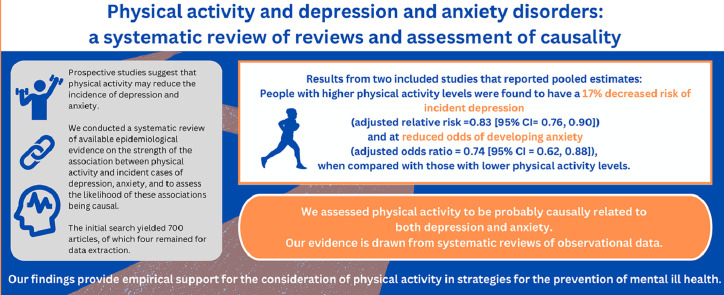
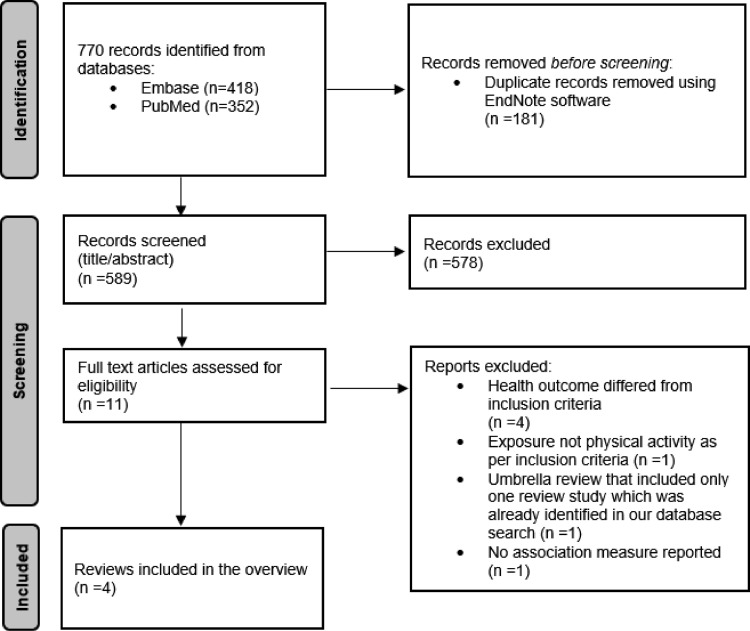
Introduction: Globally, depressive and anxiety disorders are the leading contributors to mental ill health. Physical activity reduces symptoms of depression and anxiety and has been proposed as an adjunct treatment therapy for depression and anxiety. Prospective studies suggest that physical activity may reduce the incidence of depression and anxiety. We conducted a systematic review of reviews with the aim to provide a comprehensive overview of available epidemiologic evidence on the strength of the association between physical activity and incident cases of depression and anxiety and to assess the likelihood of these associations being causal. Methods: We searched Embase and PubMed databases for systematic reviews published between January 1, 2000 and March 19, 2020 that reported findings on the strength of association between physical activity and incidence of depression and anxiety. We updated this search to October 15, 2022. Two reviewers independently assessed the methodologic quality of the included reviews using the Assessment of Multiple Systematic Reviews rating scale. We carried out a narrative synthesis of the evidence. We used the Bradford Hill criteria to assess the likelihood of associations being causal. Results: The initial search yielded 770 articles, of which 4 remained for data extraction. Two of the included reviews were scored as high quality, and 2 were scored as low quality. From the 2 included reviews that reported pooled estimates, people with high physical activity levels were found to have a decreased risk of incident depression (adjusted RR=0.83, 95% CI=0.76, 0.90) and reduced odds of developing anxiety (adjusted OR=0.74,95% CI=0.62, 0.88) when compared with those with low physical activity levels. We assessed physical activity to be probably causally related to both depression and anxiety. Discussion: Our evidence is drawn from systematic reviews of observational data. Further high-quality studies, such as randomized control trials, would help to strengthen the evidence base of the associations between physical activity and depression and anxiety. Nonetheless, our findings provide empirical support for the consideration of physical activity in strategies for the prevention of mental ill health.
Overview
The claims and statistics of this paper haven’t been checked yet.
Run the check — free, no account needed. It reads the open-access text and checks the sources it cites.
Integrity signals
Registry
Cites
Statistics
Figures
Verification
Claims the paper makes
The claims and statistics of this paper haven’t been checked yet.
Run the check — free, no account needed. It reads the open-access text and checks the sources it cites.
Claims other papers make about this one
Each is checked against this paper’s own text: does it say what the citing paper says it does?
The source backs part of the claim, not all of it — or backs it for a different population, condition or comparison.
In the citing paper
“Findings from this study support earlier studies indicating that regular PA is associated with higher PWB levels [16,43].”
From Relationships Between Physical Activity, Sleep, Psychological Well-Being, and Academic Performance Among Native American College Students (2026) · cites this paper as [16]
Experimental — accuracy not yet measuredThe source backs part of the claim, not all of it — or backs it for a different population, condition or comparison.
In the citing paper
“Lifestyle factors, such as physical activity (PA) and sleep duration, may play an important role in shaping psychological well-being (PWB) [13,14,15,16].”
From Relationships Between Physical Activity, Sleep, Psychological Well-Being, and Academic Performance Among Native American College Students (2026) · cites this paper as [16]
Experimental — accuracy not yet measured
Self-check
Percentages, sums and reported differences re-computed from the paper’s own numbers.
The self-check needs the paper’s full text.
Citations
Cites
The PRISMA 2020 statement: An updated guideline for reporting systematic reviews
Page, M. J., McKenzie, J. E., Bossuyt, P. M., Boutron, I., Hoffmann, T. C., Mulrow, C. D., Shamseer, L., Tetzlaff, J. M., Akl, E. A., Brennan, S. E., et al. (2021) · BMJ · doi:10.1136/bmj.n71 · Cited by 108,283
PRISMA-P Group, Moher, D., Shamseer, L., Clarke, M., Ghersi, D., Liberati, A., Petticrew, M., Shekelle, P., & Stewart, L. A. (2015) · Systematic Reviews · doi:10.1186/2046-4053-4-1 · Cited by 26,223
Vos, T., Lim, S. S., Abbafati, C., Abbas, K. M., Abbasi, M., Abbasifard, M., Abbasi-Kangevari, M., Abbastabar, H., Abd-Allah, F., Abdelalim, A., et al. (2020) · The Lancet · doi:10.1016/s0140-6736(20)30925-9 · Cited by 19,358
Cochrane Handbook for Systematic Reviews of Interventions
(2019) · doi:10.1002/9781119536604 · Cited by 14,828
World Health Organization 2020 guidelines on physical activity and sedentary behaviour
Bull, F. C., Al-Ansari, S. S., Biddle, S., Borodulin, K., Buman, M. P., Cardon, G., Carty, C., Chaput, J.-P., Chastin, S., Chou, R., et al. (2020) · British Journal of Sports Medicine · doi:10.1136/bjsports-2020-102955 · Cited by 11,657
Shea, B. J., Reeves, B. C., Wells, G., Thuku, M., Hamel, C., Moran, J., Moher, D., Tugwell, P., Welch, V., Kristjansson, E., et al. (2017) · BMJ · doi:10.1136/bmj.j4008 · Cited by 10,636
Lee, I.-M., Shiroma, E. J., Lobelo, F., Puska, P., Blair, S. N., & Katzmarzyk, P. T. (2012) · The Lancet · doi:10.1016/s0140-6736(12)61031-9 · Cited by 8,215
Santomauro, D. F., Mantilla Herrera, A. M., Shadid, J., Zheng, P., Ashbaugh, C., Pigott, D. M., Abbafati, C., Adolph, C., Amlag, J. O., Aravkin, A. Y., et al. (2021) · The Lancet · doi:10.1016/s0140-6736(21)02143-7 · Cited by 5,444
Guthold, R., Stevens, G. A., Riley, L. M., & Bull, F. C. (2018) · The Lancet Global Health · doi:10.1016/s2214-109x(18)30357-7 · Cited by 4,819
Correlates of physical activity: why are some people physically active and others not?
Bauman, A. E., Reis, R. S., Sallis, J. F., Wells, J. C., Loos, R. J., & Martin, B. W. (2012) · The Lancet · doi:10.1016/s0140-6736(12)60735-1 · Cited by 4,151
Fit Yourself and Take Your Lungs to Heart
Palange, P., & Bonini, M. (2013) · Respiration · doi:10.1159/000350831 · Cited by 2,780
Lack of Exercise Is a Major Cause of Chronic Diseases
Booth, F. W., Roberts, C. K., & Laye, M. J. (2012) · Comprehensive Physiology · doi:10.1002/cphy.c110025 · Cited by 2,575
Physical Activity and Incident Depression: A Meta-Analysis of Prospective Cohort Studies
Schuch, F. B., Vancampfort, D., Firth, J., Rosenbaum, S., Ward, P. B., Silva, E. S., Hallgren, M., Ponce De Leon, A., Dunn, A. L., Deslandes, A. C., et al. (2018) · American Journal of Psychiatry · doi:10.1176/appi.ajp.2018.17111194 · Cited by 1,763
Biddle, S. J. H., Ciaccioni, S., Thomas, G., & Vergeer, I. (2019) · Psychology of Sport and Exercise · doi:10.1016/j.psychsport.2018.08.011 · Cited by 1,454
Association Between Physical Activity and Risk of Depression: A Systematic Review and Meta-analysis
Pearce, M., Garcia, L., Abbas, A., Strain, T., Schuch, F. B., Golubic, R., Kelly, P., Khan, S., Utukuri, M., Laird, Y., et al. (2022) · JAMA Psychiatry · doi:10.1001/jamapsychiatry.2022.0609 · Cited by 1,332
Rebar, A. L., Stanton, R., Geard, D., Short, C., Duncan, M. J., & Vandelanotte, C. (2015) · Health Psychology Review · doi:10.1080/17437199.2015.1022901 · Cited by 1,323
Firth, J., Solmi, M., Wootton, R. E., Vancampfort, D., Schuch, F. B., Hoare, E., Gilbody, S., Torous, J., Teasdale, S. B., Jackson, S. E., et al. (2020) · World Psychiatry · doi:10.1002/wps.20773 · Cited by 1,242
Cunningham, C., O' Sullivan, R., Caserotti, P., & Tully, M. A. (2020) · Scandinavian Journal of Medicine & Science in Sports · doi:10.1111/sms.13616 · Cited by 1,154
Physical Activity and the Prevention of Depression
Mammen, G., & Faulkner, G. (2013) · American Journal of Preventive Medicine · doi:10.1016/j.amepre.2013.08.001 · Cited by 1,122
Gates, M., Gates, A., Pieper, D., Fernandes, R. M., Tricco, A. C., Moher, D., Brennan, S. E., Li, T., Pollock, M., Lunny, C., et al. (2022) · BMJ · doi:10.1136/bmj-2022-070849 · Cited by 856
Random measurement error and regression dilution bias
Hutcheon, J. A., Chiolero, A., & Hanley, J. A. (2010) · BMJ · doi:10.1136/bmj.c2289 · Cited by 752
Comparison of Self-reported versus Accelerometer-Measured Physical Activity
Dyrstad, S. M., Hansen, B. H., Holme, I., & Anderssen, S. A. (2013) · Medicine & Science in Sports & Exercise · doi:10.1249/mss.0b013e3182a0595f · Cited by 748
Physical Activity Interventions for People With Mental Illness
Rosenbaum, S., Tiedemann, A., Sherrington, C., Curtis, J., & Ward, P. B. (2014) · The Journal of Clinical Psychiatry · doi:10.4088/jcp.13r08765 · Cited by 696
The benefits of exercise for the clinically depressed
Craft, L. L., & Perna, F. M. (2004) · The Primary Care Companion For CNS Disorders · doi:10.4088/pcc.v06n0301 · Cited by 692
Outcomes of Nordic mental health systems: life expectancy of patients with mental disorders
Wahlbeck, K., Westman, J., Nordentoft, M., Gissler, M., & Laursen, T. M. (2011) · British Journal of Psychiatry · doi:10.1192/bjp.bp.110.085100 · Cited by 623
Effects of exercise and physical activity on anxiety
Anderson, E., & Shivakumar, G. (2013) · Frontiers in Psychiatry · doi:10.3389/fpsyt.2013.00027 · Cited by 602
Physical activity protects from incident anxiety: A meta‐analysis of prospective cohort studies
Schuch, F. B., Stubbs, B., Meyer, J., Heissel, A., Zech, P., Vancampfort, D., Rosenbaum, S., Deenik, J., Firth, J., Ward, P. B., et al. (2019) · Depression and Anxiety · doi:10.1002/da.22915 · Cited by 427
Health, T. L. G. (2020) · The Lancet Global Health · doi:10.1016/s2214-109x(20)30432-0 · Cited by 417
Physical Activity and Anxiety: A Systematic Review and Meta-analysis of Prospective Cohort Studies
McDowell, C. P., Dishman, R. K., Gordon, B. R., & Herring, M. P. (2019) · American Journal of Preventive Medicine · doi:10.1016/j.amepre.2019.05.012 · Cited by 385
Dale, L. P., Vanderloo, L., Moore, S., & Faulkner, G. (2019) · Mental Health and Physical Activity · doi:10.1016/j.mhpa.2018.12.001 · Cited by 366
Dawel, A., Shou, Y., Smithson, M., Cherbuin, N., Banfield, M., Calear, A. L., Farrer, L. M., Gray, D., Gulliver, A., Housen, T., et al. (2020) · Frontiers in Psychiatry · doi:10.3389/fpsyt.2020.579985 · Cited by 362
Dishman, R. K., McDowell, C. P., & Herring, M. P. (2021) · British Journal of Sports Medicine · doi:10.1136/bjsports-2020-103140 · Cited by 177
Physical Exercise in Major Depression: Reducing the Mortality Gap While Improving Clinical Outcomes
Belvederi Murri, M., Ekkekakis, P., Magagnoli, M., Zampogna, D., Cattedra, S., Capobianco, L., Serafini, G., Calcagno, P., Zanetidou, S., & Amore, M. (2019) · Frontiers in Psychiatry · doi:10.3389/fpsyt.2018.00762 · Cited by 163
Modifiable risk and protective factors for anxiety disorders among adults: A systematic review
Zimmermann, M., Chong, A. K., Vechiu, C., & Papa, A. (2020) · Psychiatry Research · doi:10.1016/j.psychres.2019.112705 · Cited by 133
The Bangkok Declaration on Physical Activity for Global Health and Sustainable Development
ISPAH International Society for Physical Activity and Health (2017) · British Journal of Sports Medicine · doi:10.1136/bjsports-2017-098063 · Cited by 108
Essential Epidemiology: An Introduction for Students and Health Professionals
Schoonhoven, L. (2006) · Journal of Clinical Nursing · doi:10.1111/j.1365-2702.2006.01567.x · Cited by 105
Physical activity and depressive symptoms in Taiwanese older adults: A seven-year follow-up study
Ku, P., Fox, K. R., & Chen, L. (2009) · Preventive Medicine · doi:10.1016/j.ypmed.2009.01.006 · Cited by 85
Dishman, R. K., Vandenberg, R. J., Motl, R. W., & Nigg, C. R. (2010) · Annals of Behavioral Medicine · doi:10.1007/s12160-010-9196-2 · Cited by 76
McDowell, C. P., Dishman, R. K., Vancampfort, D., Hallgren, M., Stubbs, B., MacDonncha, C., & Herring, M. P. (2018) · International Journal of Epidemiology · doi:10.1093/ije/dyy141 · Cited by 73
Brady, R., Brown, W. J., Hillsdon, M. M., & Mielke, G. I. (2022) · Medicine & Science in Sports & Exercise · doi:10.1249/mss.0000000000002900 · Cited by 60
Excess mortality in depressive and anxiety disorders: The Lifelines Cohort Study
Voshaar, R. C. O., Aprahamian, I., Borges, M. K., van den Brink, R. H. S., Marijnissen, R. M., Hoogendijk, E. O., Munster, B. C. V., & Jeuring, H. W. (2021) · European Psychiatry · doi:10.1192/j.eurpsy.2021.2229 · Cited by 52
Universal depression prevention: An umbrella review of meta-analyses
Hoare, E., Collins, S., Marx, W., Callaly, E., Moxham‐Smith, R., Cuijpers, P. J., Holte, A., Nierenberg, A. A., Reavley, N. J., Christensen, H. M., et al. (2021) · Journal of Psychiatric Research · doi:10.1016/j.jpsychires.2021.10.006 · Cited by 48
Shook, R. P., Gribben, N. C., Hand, G. A., Paluch, A. E., Welk, G. J., Jakicic, J. M., Hutto, B., Burgess, S., & Blair, S. N. (2015) · Journal of Physical Activity and Health · doi:10.1123/jpah.2014-0543 · Cited by 42
Guo, Z., Li, R., & Lu, S. (2022) · Medicine · doi:10.1097/md.0000000000029917 · Cited by 40
Physical Activity and Depression and Anxiety Disorders in Australia: A Lifetable Analysis
Wanjau, M. N., Möller, H., Haigh, F., Milat, A., Hayek, R., Lucas, P., & Veerman, L. J. (2022) · AJPM Focus · doi:10.1016/j.focus.2022.100030 · Cited by 8
Self-citation
Research works printed but not linked: 1
- Covidence Systematic Review Software. Veritas Health Innovation. www.covidence.org.
Cited by
Sorted by citations
Anghel, L., Ciubară, A., Pătraș, D., & Ciubară, A. B. (2025) · Journal of Clinical Medicine · doi:10.3390/jcm14061809 · Cited by 48
Guerrera, C. S., Platania, G. A., Boccaccio, F. M., Sarti, P., Varrasi, S., Colliva, C., Grasso, M., Vivo, S. D., Cavallaro, D., Tascedda, F., et al. (2023) · BMC Psychiatry · doi:10.1186/s12888-023-05300-y · Cited by 31
Liu, Y., Wang, P., Duan, L., Shen, Q., Xu, L., & Zhang, T. (2025) · Psychology and Psychotherapy Theory Research and Practice · doi:10.1111/papt.12580 · Cited by 30
Căliman-Sturdza, O. A., Gheorghita, R. E., & Lobiuc, A. (2025) · Life · doi:10.3390/life15030439 · Cited by 32
Yuan, Y., Yang, J., Huang, W., Hu, C., Zhang, W., & Chen, B. (2025) · Frontiers in Psychology · doi:10.3389/fpsyg.2025.1694344 · Cited by 20
Metadata
- Authors
- Wanjau, M. N., Möller, H., Haigh, F., Milat, A., Hayek, R., Lucas, P., & Veerman, J. L.
- Affiliations
- Griffith University (AU)
- UNSW Sydney (AU)
- The University of Sydney (AU)
- New South Wales Department of Health (AU)
- Venue
- AJPM Focus
- Publisher
- Elsevier BV
- Published
- 2023-06
- Volume
- 2
- Issue
- 2
- Pages
- 100074
- ISSN
- 2773-0654 (ISSN-L)
- PMC
- PMC10546525
- OpenAlex
- W4319065961
- Cited by
- 111
- References
- 45
- Citations by year
- 2026: 40 · 2025: 43 · 2024: 19 · 2023: 8
- FWCI
- 3.92
- Type
- journal article
- Language
- en
- Open access
- gold
- doi.org
- Licence
- Locations
- AJPM Focus (publishedVersion, cc-by-nc-nd)
- PubMed Central (publishedVersion, cc-by-nc-nd)
- PubMed (publishedVersion)
- UNSWorks (University of New South Wales, Sydney, Australia) (submittedVersion, cc-by-nc-nd)
- DOAJ (DOAJ: Directory of Open Access Journals) (submittedVersion, cc-by-sa)
- Griffith Research Online (submittedVersion, cc-by-nc-nd)
- Funders
- Griffith University
- NSW Ministry of Health
- Topics
- Health Sciences › Medicine › Public Health, Environmental and Occupational Health › Physical Activity and Health
- Health Sciences › Medicine › Psychiatry and Mental health › Mental Health Treatment and Access
- Social Sciences › Psychology › Experimental and Cognitive Psychology › Anxiety, Depression, Psychometrics, Treatment, Cognitive Processes
- Keywords
- physical activity, depression, anxiety disorders, depression incidence, causal inference, Bradford Hill criteria, mental illness prevention, methodological quality of systematic reviews
About these checks
Registry, retraction, Cites and statistics results are computed, not judged, with one exception: a printed reference that no index lists is read once by a model before it counts as a citation error. Claims are extracted by a model and kept only when their quote appears verbatim in the text; each cited source is then checked, with a model’s help, for whether it says what the claim relies on. Those verdicts can be wrong — read the claim’s quote and the cited source before relying on one.
Statistics and arithmetic are recomputed, not judged.
Confidence bands are shown only for fields calibrated on our annotated test set. None is calibrated yet, so no band is shown.
What counts as a claim ›How we measure confidence ›How we check this ›
Are you an author, or do you see a problem with this page? Request a review
