

The application of Herzberg's two-factor theory of motivation to job satisfaction in clinical laboratories in Omani hospitals
Open accessThe DOI matches its Crossref record; 45 of the 45 references it cites were found in a registry or an index; none of the 40 sources its claims cite is checked for support yet.
Abstract
BACKGROUND: Job satisfaction is an important condition for staff retention in most healthcare Organizations. As a concept, job satisfaction is linked to motivation theory. Herzberg's two factor theory of motivation is used in this study to explore what motivational elements are associated with job satisfaction among medical laboratory professionals (MLPs) in Oman. METHODS: A mixed-method approach was adopted, and focus group discussions (FGDs) were used for data collection. The FGDs were conducted in the main hospitals in Oman. Data were analyzed by directed content analysis, and frequencies of statements related to factors were calculated for a comparison with the Herzberg theory. RESULTS: The following job dissatisfaction factors (hygiene) were identified: health and safety, heavy workload, salary, promotion, recognition and organizational policies. The satisfaction (motivators) were: relationships with co-workers, relationship with leaders, and professional development. CONCLUSIONS: The job dissatisfaction reported was resulted from the absence of hygiene factors and some of the motivators in accordance with Hertzberg's theory. Hospital managers need to address these factors, defined by Hertzberg, in order to improve motivation and job satisfaction.
Overview
CoChat Summary
TL;DR
In focus groups with 101 medical laboratory professionals at three Omani hospitals, lack of health and safety, heavy workload, salary, promotion, recognition, and organizational policies emerged as dissatisfiers, while relationships with co-workers/leaders and professional development were satisfiers. Findings largely aligned with Herzberg’s two-factor theory, though recognition appeared as a hygiene factor rather than a motivator.
Key findings
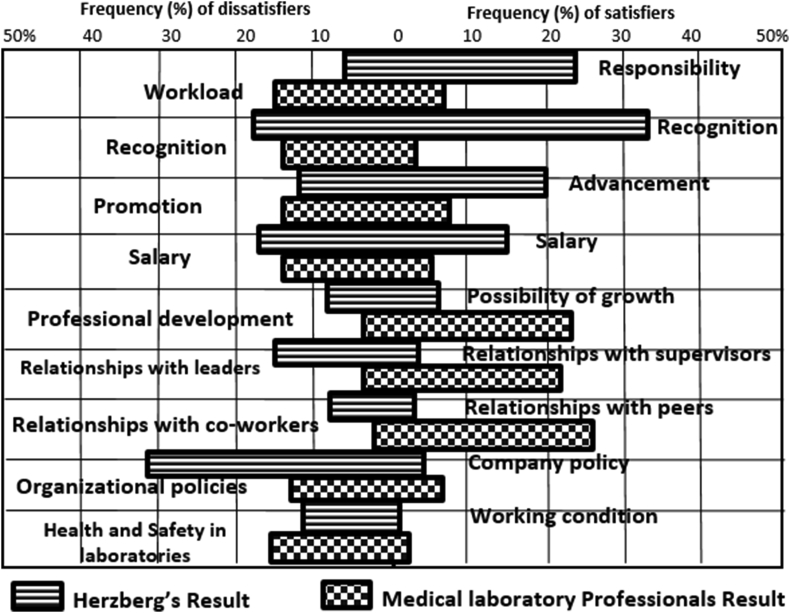
- Job dissatisfaction factors included health and safety (16% dissatisfying vs 2% satisfying), workload (15% vs 7%), salary (14% vs 5%), promotion (14% vs 8%), organizational policies (12% vs 6%), and recognition (12% vs 3%).
- Job satisfaction factors included relationships with co-workers (26% satisfying vs 2% dissatisfying), professional development (22% vs 4%), and relationships with leaders (21% vs 3%).
- The most frequently mentioned source of dissatisfaction was lack of laboratory health and safety, with poor ventilation, exposure to toxic chemicals, samples without biohazard labels, lack of safety officers, and lack of health and safety training.
- Salary and promotion dissatisfaction was linked to the 2014 Medical and Allied Health Personnel Executive Bylaw, perceived unfairness, lack of risk allowance, unclear or delayed promotions, and no differentiation between hard workers and others. Recognition contradicted Herzberg’s theory by acting as a hygiene/dissatisfier rather than a motivator.
Methods
- Mixed-method study using focus group discussions conducted February–June 2017 at Royal, Al Nahdha, and Khoula Hospitals in Oman; 18 groups (nine Royal, five Khoula, four Al Nahdha), each with six to eight participants, totaling 101 medical laboratory professionals from hematology, biochemistry, pathology, and microbiology.
- Discussions followed an interview guide derived from Herzberg’s two-factor theory, lasted 60–90 minutes, and included member checking at the end of each session.
- Data were transcribed and analyzed by directed content analysis; meaning units were condensed into categories and themes, and frequencies of statements were calculated for comparison with Herzberg’s original distribution of motivating and hygiene factors.
Limitations
- The authors state that this was a qualitative study using focus groups, so findings cannot be generalized to the whole population of MLPs, although participants were representative of laboratory staff in the three hospitals.
- The authors acknowledge possible FGD disadvantages: participants may be more or less vocal, sensitive topics may be harder to discuss in a group, and group pressure may silence participants, potentially distorting results; they also note that comparing FGD-based frequencies with Herzberg’s critical incident technique and individual interviews requires scrutiny.
- Evident from the text: recruitment relied on volunteers through laboratory supervisors, the study covered only three MOH hospitals, and the semi-quantitative comparison was based on statements generated in group discussions rather than individual critical incident interviews.
Model-written summary. Check it against the paper before relying on it.
Integrity signals
Registry
Cites
Statistics
Figures
Verification
Claims the paper makes
0 Valid · 3 Not valid · 38 Not checked · 65 Own results and interpretations
A result the paper reports from its own data — it cites no other source for it, so there is none to check. The quote shows it is in the paper.
In the paper
“The Royal hospital MLPs also reported dissatisfaction with their salaries, believing that they deserved higher salaries and bonuses since they had to work more night shifts than MLPs in other hospitals in the country.”
§ The application of Herzberg's two-factor theory of motivation to job satisfaction in clinical laboratories in Omani hospitals > Results > Salary and promotion
plain- Asserted: passes — The authors put it forward as true.
- Checkable: passes — It can be checked against evidence.
- Load-bearing: unclear — It is unclear whether the paper’s conclusions depend on it.
- Based: passes — The paper gives a reason why it holds.
A result the paper reports from its own data — it cites no other source for it, so there is none to check. The quote shows it is in the paper.
In the paper
“The MLPs in all three main hospitals (the Royal, Al Nahdha, and Khoula Hospitals) also noted that they were unhappy with the new Medical and Allied Health Personnel Executive Bylaw, introduced in 2014 for paramedical staff, which defined the rules for the employment, promotion, retention development and termination of medical and allied health personnel.”
§ The application of Herzberg's two-factor theory of motivation to job satisfaction in clinical laboratories in Omani hospitals > Results > Salary and promotion
plain- Asserted: passes — The authors put it forward as true.
- Checkable: passes — It can be checked against evidence.
- Load-bearing: unclear — It is unclear whether the paper’s conclusions depend on it.
- Based: passes — The paper gives a reason why it holds.
A result the paper reports from its own data — it cites no other source for it, so there is none to check. The quote shows it is in the paper.
In the paper
“Relations with co-workers, relation with leaders and professional development are three factors seen as important motivating factors, high on the positive end of the continuum (satisfied 26 per cent, 21 per cent, and 22 per cent respectively.”
§ The application of Herzberg's two-factor theory of motivation to job satisfaction in clinical laboratories in Omani hospitals > Discussion
plain- Asserted: passes — The authors put it forward as true.
- Checkable: passes — It can be checked against evidence.
- Load-bearing: passes — The paper’s conclusions depend on it.
- Based: passes — The paper gives a reason why it holds.
A result the paper reports from its own data — it cites no other source for it, so there is none to check. The quote shows it is in the paper.
In the paper
“FGDs participants identified workload as another dissatisfier, especially when colleagues took unplanned leave, which lead to the accumulation of samples for processing and for others to handle.”
§ The application of Herzberg's two-factor theory of motivation to job satisfaction in clinical laboratories in Omani hospitals > Results > Heavy workload
plainstates a cause- Asserted: passes — The authors put it forward as true.
- Checkable: passes — It can be checked against evidence.
- Load-bearing: unclear — It is unclear whether the paper’s conclusions depend on it.
- Based: passes — The paper gives a reason why it holds.
A result the paper reports from its own data — it cites no other source for it, so there is none to check. The quote shows it is in the paper.
In the paper
“Professional development emerged as a satisfaction factor for participants from all three hospitals.”
§ The application of Herzberg's two-factor theory of motivation to job satisfaction in clinical laboratories in Omani hospitals > Results > Professional development and training
plain- Asserted: passes — The authors put it forward as true.
- Checkable: passes — It can be checked against evidence.
- Load-bearing: unclear — It is unclear whether the paper’s conclusions depend on it.
- Based: passes — The paper gives a reason why it holds.
34 more claims
Create a free account to see all 106 claims and to verify the 27 references still open.
- It may state two separate claims as one. 21
- The quote only partly states this claim. 2
- Probably not a substantial claim. 52
Self-check
Percentages, sums and reported differences re-computed from the paper’s own numbers.
Each contradiction between two passages listed here was confirmed by an independent check.
Rated minor: it would not touch a result — a value no result rests on, a p-value that stays on the same side of the significance level, or a conflict that is clerical, resolved elsewhere in the paper, or outside its own findings.
In the paper
§ The application of Herzberg's two-factor theory of motivation to job satisfaction in clinical laboratories in Omani hospitals > Introduction > Herzberg's two-factor theory of motivation
“dissatisfiers (hygiene factors), which are the main causes of job dissatisfaction (Herzberg, 1966) and include factors such as working conditions, salaries, relationships with colleagues, administrative policies, and supervision.”
§ The application of Herzberg's two-factor theory of motivation to job satisfaction in clinical laboratories in Omani hospitals > Discussion
“Herzberg's two-factor theory suggests that salary is a motivator, but that after some time, it tends to become a dissatisfier (hygiene factor) for employees.”
Rated minor: it would not touch a result — a value no result rests on, a p-value that stays on the same side of the significance level, or a conflict that is clerical, resolved elsewhere in the paper, or outside its own findings.
In the paper
§ The application of Herzberg's two-factor theory of motivation to job satisfaction in clinical laboratories in Omani hospitals > Introduction > Herzberg's two-factor theory of motivation
“satisfiers (motivators), which are the main drivers of job satisfaction and include achievements, recognition, responsibility, and work advancement”
§ The application of Herzberg's two-factor theory of motivation to job satisfaction in clinical laboratories in Omani hospitals > Results > Relationships with coworkers
“The heavy workload in this study represent the “responsibility” in Herzberg's study as a hygiene factor.”
Rated minor: it would not touch a result — a value no result rests on, a p-value that stays on the same side of the significance level, or a conflict that is clerical, resolved elsewhere in the paper, or outside its own findings.
In the paper
§ The application of Herzberg's two-factor theory of motivation to job satisfaction in clinical laboratories in Omani hospitals > Methods > Setting and participants
“nine groups from the Royal Hospital, five groups from Khoula Hospital, and four groups from Al Nahdha Hospital. Each group had between six and eight participants (Krueger and Casey, 2015).”
§ The application of Herzberg's two-factor theory of motivation to job satisfaction in clinical laboratories in Omani hospitals > Methods > Setting and participants
“A total of 101 medical laboratory professionals participated in the FGDs.”
Citations
Cites
(1997) · Naming the Mind: How Psychology Found its Language · doi:10.4135/9781446221815.n7 · Cited by 15,148
Kline, P. (1993) · Personality and Individual Differences · doi:10.1016/0191-8869(93)90054-7 · Cited by 8,744
A Protection Motivation Theory of Fear Appeals and Attitude Change1
Rogers, R. W. (1975) · The Journal of Psychology · doi:10.1080/00223980.1975.9915803 · Cited by 6,805
Herzberg, F., Mausner, B., & Snyderman, B. B. (2017) · Routledge eBooks · doi:10.4324/9781315124827 · Cited by 5,559
Member Checking: A Tool to Enhance Trustworthiness or Merely a Nod to Validation?
Birt, L., Scott, S., Cavers, D., Campbell, C., & Walter, F. (2016) · Qualitative Health Research · doi:10.1177/1049732316654870 · Cited by 3,970
Dunnette, M. D., & Herzberg, F. (1967) · Administrative Science Quarterly · doi:10.2307/2391218 · Cited by 3,170
The World Health report 2006 1 : Working together for health 2
Guilbert, J.-J. (2006) · Education for Health: Change in Learning & Practice · doi:10.1080/13576280600937911 · Cited by 2,654
One More Time: How Do You Motivate Employees?
Herzberg, F. (1976) · Job Satisfaction — A Reader · doi:10.1007/978-1-349-02701-9_2 · Cited by 2,180
Health and Well-Being in the Workplace: A Review and Synthesis of the Literature
Danna, K., & Griffin, R. W. (1999) · Journal of Management · doi:10.1016/s0149-2063(99)00006-9 · Cited by 1,743
Understanding and Managing Organizational Behavior
George, J. M., & Jones, G. R. (1995) · Cited by 1,159
Research works printed but not linked: 4
- Kian T. Wan W. Rajah S. European journal of business and social sciences Eur. J. Bus. Soc. Sci. 3 2 2014 94 102
- Krueger R. 2d edition Krueger Richard A. Focus Groups: A Practical Guide for Applied Research 13 1996 Sage Publications, Inc. Thousand Oaks, CA 273 274 1994. 255 + xiv pages. $21.50. Journal Of Product Innovation Management
- Krueger R. Casey M. Focus Groups 2015 SAGE Los Angeles
- WHO The world health report 2006 - working together for health Retrieved from https://www.who.int/whr/2006/en/ 2006 17178522
Cited by
Items 101–200 of 464
AI-based Reward System and Job Satisfaction: The Mediating role of Motivation
Batool, F., Rafiq, M., & Haider, G. (2025) · International Journal of Management Research and Emerging Sciences · doi:10.56536/ijmres.v15i3.795 · Cited by 3
Ocak, M., Bozagaç, F., & Doğan, S. (2025) · Discover Psychology · doi:10.1007/s44202-025-00514-5 · Cited by 3
Predicting turnover intention among newly graduated nurses in South Korea: a decision tree analysis
Moon, M., & Kang, H.-W. (2025) · BMC Nursing · doi:10.1186/s12912-025-04041-5 · Cited by 5
Chance, E. A., & Théophile, P. (2026) · Discover Global Society · doi:10.1007/s44282-025-00284-4 · Cited by 3
Maritime TVET in Transition: Global Trends, Institutional Innovation, and Strategic Reform
Kamis, A. S., Fuad, A. F. A., Ali, S. A., Mansor, W. N. W., Ahmad, S. Z. A. S., & Akhbar, M. F. A. (2026) · TransNav the International Journal on Marine Navigation and Safety of Sea Transportation · doi:10.12716/1001.20.01.14 · Cited by 3
What Motivates New Venture Investors? A Mixed-Method Study Approach
Vazirani, A., & Bhattacharjee, T. (2024) · IEEE Transactions on Engineering Management · doi:10.1109/tem.2024.3404882 · Cited by 4
The Urgency of Job Motivation and Job Satisfaction for Members of Papua Sports Organizations
Nanariain, D., Sanusi, A., & Supriadi, B. (2022) · East African Scholars Journal of Economics Business and Management · doi:10.36349/easjebm.2022.v05i06.003 · Cited by 3
Analysis of Job Satisfaction of Implementing Nurses on Work Productivity
Jumrana, J., Saleh, A., & Erika, K. A. (2022) · Journal of Asian Multicultural Research for Medical and Health Science Study · doi:10.47616/jamrmhss.v3i4.350 · Cited by 3
Aliyu, M. S., Abbas, S. M. S., & Kachalla, D. (2023) · International Journal of Social Science Humanity & Management Research · doi:10.58806/ijsshmr.2023.v2i3n05 · Cited by 3
Oamen, T. E. (2023) · Texila international journal of management · doi:10.21522/tijmg.2015.09.02.art003 · Cited by 3
Exploring Nurses' Job Satisfaction in India: A Discussion Paper
Kumar, M., & Jeet, K. (2023) · International Journal of Science and Healthcare Research · doi:10.52403/ijshr.20230348 · Cited by 3
Factors of Increasing Intention to Use Information Systems
Siswanto, S., & Kusumapradja, R. (2024) · Jurnal Manajemen dan Organisasi · doi:10.29244/jmo.v15i1.50298 · Cited by 3
Andayani, K. S., Sugiyanta, & Iqbal, M. (2024) · The Indonesian Journal of Public Health · doi:10.20473/ijph.v19i1.2024.106-117 · Cited by 3
Kock, N., Haddoud, M. Y., Onjewu, A.-K. E., & Yang, S. (2025) · Personnel Review · doi:10.1108/pr-03-2024-0251 · Cited by 4
Nadhiroh, U., & Khoir, M. M. (2025) · International Journal of Religion and Social Community · doi:10.30762/ijoresco.v3i1.3590 · Cited by 3
Employee Retention Strategies in Selected Small and Medium Enterprises in Nigeria
Omeoga, I. (2023) · ScholarWorks (Walden University) · Cited by 3
The influence of favouritism as non financial incentives on employee performance
John Rotanna, E. (2023) · DiVA at Umeå University (Umeå University) · Cited by 4
Job Satisfaction and OrganisationalCommitment of Academic Staff inKyambogo University, Uganda
Kato, J. K., Mugizi, W., & Kasule, G. W. (2023) · doi:10.58653/nche.v10i2.03 · Cited by 2
Cabiao, D. S. (2023) · European Journal of Human Resource Management Studies · doi:10.46827/ejhrms.v7i1.1540 · Cited by 2
Medical laboratory scientist motivation to pursue graduate education
Blagg, L. N. (2024) · Laboratory Medicine · doi:10.1093/labmed/lmae041 · Cited by 3
Performance Appraisal and Job Productivity of Academic Staff in Kwara State University, Malete
Brimah, A. N., & Oduwole, M. B. (2024) · African Journal of Humanities and Contemporary Education Research · doi:10.62154/ajhcer.2024.017.010510 · Cited by 2
Work motivation among midwives in medium-sized labour wards in Denmark – An interview study
Storm, A., Damm, M. F., Moos, C. M., & Prinds, C. (2025) · Sexual & Reproductive Healthcare · doi:10.1016/j.srhc.2025.101151 · Cited by 2
Reward and Performance: Why Social and Extrinsic Rewards Fail to Improve Job Performance?
Hayati, K., & Rini, S. D. A. (2025) · Studi Akuntansi Keuangan dan Manajemen · doi:10.35912/sakman.v5i2.5355 · Cited by 2
The determinants of health workers’ job satisfaction in the Saudi Arabian health facilities
Alkhateeb, M., Ahmed, S., Lövestad, S., & Khan, J. (2026) · Human Resources for Health · doi:10.1186/s12960-025-01045-9 · Cited by 2
Work and Motivation in a Generative Artificial Intelligence Augmented Workplace
Cruz, E. D. L. (2026) · IGI Global eBooks · doi:10.4018/979-8-3373-2287-2.ch004 · Cited by 2
Fajar Kurniawan, N. (2024) · Frontiers in Health Informatics · Cited by 2
Tian, X., Chen, X., Sahayrak, K., & Swatdikun, T. (2024) · Journal for Strategy and Enterprise Competitiveness · Cited by 2
Validation of the Cadre’s Satisfaction of the Posyandu Lansia Questionnaire
Aufa, S. T., Gondodiputro, S., & Martini, N. (2022) · Global Medical & Health Communication (GMHC) · doi:10.29313/gmhc.v10i1.8609 · Cited by 2
Development and evaluation of the pharmacy alumni employment experience questionnaire
Elshami, S., Stewart, D. C., Awaisu, A., & Mukhalalati, B. (2022) · Pharmacy Education · doi:10.46542/pe.2022.221.913935 · Cited by 2
Impact of Work Ethics on Job Satisfaction in Malaysian Organisations
Balakrishnan, K., & Saifuddin, N. B. M. (2022) · International Journal of Academic Research in Business and Social Sciences · doi:10.6007/ijarbss/v12-i12/15721 · Cited by 2
Description of the Role of Government Employees' Competence and Performance
Putra, F. T., Kustiani, L., & Supriadi, B. (2023) · Cross Current International Journal of Economics Management and Media Studies · doi:10.36344/ccijemms.2023.v05i04.002 · Cited by 2
Analysis of Core Employee Satisfaction for Port Project: A Case Study of Dalian Port
Jin, G., Meng, Q., Feng, W., & Yang, C. (2023) · Journal of Human Resource Development · doi:10.23977/jhrd.2023.050608 · Cited by 2
Impact of Work From Home Factors on Employee Work Engagement
Okoye, S. O., & Zainuddin, M. N. (2024) · International Journal of Management Finance and Accounting · doi:10.33093/ijomfa.2024.5.2.2 · Cited by 2
Sepiriti, S. (2024) · European Journal of Educational Management · doi:10.12973/eujem.7.4.185 · Cited by 2
Wanjiru, K. E., Karanja, N. P., & Muceke, N. J. (2024) · American Journal of Business and Strategic Management · doi:10.58425/ajbsm.v3i1.299 · Cited by 2
Teaching at a Minimum: Exploring the Wellbeing of Filipino Tertiary Educators who Quiet Quit
Varias, A. C. S., & Conway, G. D. (2024) · Journal of Indonesian Psychological Science (JIPS) · doi:10.18860/jips.v4i2.26927 · Cited by 3
Torre, Y. G. L. (2024) · Gestión en el Tercer Milenio · doi:10.15381/gtm.v27i54.27596 · Cited by 2
Factores de Riesgo Psicosocial asociados a cumplir turnos rotativos en empresa de sector estratégico
Vera, J. H. O., Pinargote, J. W. G., Meza, A. M. R., & Moreira, K. X. M. (2025) · RECIAMUC · doi:10.26820/reciamuc/9.(1).ene.2025.105-119 · Cited by 2
Perception of job satisfaction: insights from South African public sector administrative employees
Mothema, M. M., Ramasimu, N. F., & Maake, G. (2025) · International Journal of Business Ecosystem and Strategy (2687-2293) · doi:10.36096/ijbes.v7i2.785 · Cited by 2
Motivation, satisfaction, and work commitment among Peruvian workers
Angulo, L. E. V., Rios, M. P. U., & Cabada, R. I. S. (2025) · REVISTA EUGENIO ESPEJO · doi:10.37135/ee.04.23.07 · Cited by 2
Synergizing Technology and Ethics: How Job Satisfaction Drives Job Performance
Rumangkit, S., Phungpumkaew, H., Pradana, H. A., Wijaya, L., & Leksana, C. J. (2025) · International Conference on Web Research (ICWR) · doi:10.1109/icwr65219.2025.11006226 · Cited by 2
Mennita, R., Astuti, W., & Assih, P. (2024) · The International Journal of Accounting and Business Society · doi:10.21776/ijabs.2024.32.3.860 · Cited by 2
Impact of human resource management on employee retention: A study of the IT industry in Tamil Nadu
Ravindran, K., Chavadi, C. A., Pandian, P., & Poojara, R. (2025) · AIP conference proceedings · doi:10.1063/5.0275827 · Cited by 2
Astuti, I. S. W., Kuntoro, K., Qomaruddin, M. B., Budiono, R. S. H., Raharjo, A. M., Wulandari, P., Marchianti, A. C. N., Rachmawati, D. A., Kusuma, I. F., Hakiim, A., et al. (2023) · Journal of Public Health in Africa · doi:10.4081/jphia.2023.2551 · Cited by 2
Gikunda, E. K., Mburu, C. M., & Kibiti, C. M. (2024) · Journal of Agriculture Science and Technology · doi:10.4314/jagst.v22i6.6 · Cited by 2
Purwanto, A., Herlina, E., & Kardiyati, E. N. (2025) · Strata International Journal of Social Issues · doi:10.59631/sijosi.v2i1.294 · Cited by 2
Jainurakhma, J. (2022) · Jurnal Ilmiah Kesehatan Media Husada · doi:10.33475/jikmh.v11i1.284 · Cited by 2
Giyanto, G., Rasaili, W., Fitriyah, N. S., Aini, D. N., Hasanah, U., & Susanto, H. (2022) · Empiricism Journal · doi:10.36312/ej.v3i2.994 · Cited by 2
Mofokeng, R. (2023) · International Journal of Studies in Psychology · doi:10.38140/ijspsy.v3i1.896 · Cited by 2
Xue, H., Din, N. N. O., Balakrishna, S., & Zainal, N. (2024) · International Journal of Academic Research in Business and Social Sciences · doi:10.6007/ijarbss/v14-i1/20475 · Cited by 2
سليمان, ي., Ishola, M. A., Sekinat, K. O., & Jemeelah, O. O. (2021) · ASEAN Entrepreneurship Journal · doi:10.24191/aej.v7i2.14582 · Cited by 2
Ntshele, N. P. (2021) · DUT Open Scholar (Durban University of Technology) · doi:10.51415/10321/4304 · Cited by 2
Managerial Strategies to Increase Employee Retention in the Restaurant Industry
MITCHELL, T. V. (2024) · ScholarWorks (Walden University) · Cited by 2
Executive Coaching and Promoting Organizational Change
Clark, M. L. (2024) · ScholarWorks (Walden University) · Cited by 2
Sarabi, N. (2021) · Trends in Medical Sciences · doi:10.5812/tms.115791 · Cited by 1
PRINCIPAL’S LEADERSHIP AND THE TEACHERS’ STRESS AND SATISFACTION IN BEDOUIN SCHOOLS IN ISRAEL
ABURKAYEK, S. (2023) · Annals of Faculty of Economics · doi:10.47535/1991auoes32(1)047 · Cited by 1
Akkaya, B. (2024) · Scientific Papers of Silesian University of Technology Organization and Management Series · doi:10.29119/1641-3466.2024.196.1 · Cited by 3
ETHICAL PREDICTABILITY OF HUMAN RESOURCES IN IRANIAN HOSPITALS
Malekzadeh, R., Ziapour, A., Abedi, G., & Szarpak, Ł. (2024) · Disaster and Emergency Medicine Journal · doi:10.5603/demj.99198 · Cited by 1
Ranking Influential Factors on Job Satisfaction Based on University Students' Perspective
Doan, T. B., Tran, H. T., Huyền, N. T. T., Pham, A. V., Tran, T. X., Nguyen, N. T. H., & Pham, Y. T. H. (2024) · Frontier Management Science · doi:10.53893/fms.v1i2.272 · Cited by 1
Shinwari, S., Rahimi, M. H., Shinwari, A., & Khan, D. B. (2025) · Journal for social science archives · doi:10.59075/jssa.v3i1.108 · Cited by 1
Willim, S. P., Febiriyani, P., & Rosman, D. (2024) · International Conference on Business and Industrial Research (ICBIR) · doi:10.1109/icbir61386.2024.10875980 · Cited by 2
Pentury, L. A., Tanuwijaya, J., & Gunawan, A. W. (2025) · JURNAL ECONOMIC RESOURCE · doi:10.57178/jer.v7i2.1086 · Cited by 3
Nkgapele, S. M. (2025) · Journal Managment & Business Studies · doi:10.32457/jmabs.v7i1.2637 · Cited by 1
Motivation and Job Satisfaction among Mexican Workers: Empirical Analysis of Alderfer’s ERG Theory
Juárez, U. A. D. C., Máynez-Guaderrama, A. I., Gutiérrez, A. A., Argüelles, V. T., & Morales, S. A. N. (2024) · doi:10.61728/ae20240523 · Cited by 1
Syam, A. Z. M., Adiningsih, S. H., Damasinta, A., & Pratama, I. A. (2025) · Jurnal Penelitian Multidisiplin Bangsa · doi:10.59837/jpnmb.v1i11.404 · Cited by 1
Rachman, M. (2025) · International Journal of Social Science Humanity & Management Research · doi:10.58806/ijsshmr.2025.v4i7n11 · Cited by 1
Bakri, M., & Erfan, M. (2025) · Advances in Management & Financial Reporting · doi:10.60079/amfr.v3i3.603 · Cited by 3
THE PERFORMANCE OF CIVIL SERVANTS WITH JOB SATISFACTION AS A MEDIATOR
Misriyani, S., Supeno, B., & Burhan, B. (2025) · PENANOMICS International Journal of Economics · doi:10.56107/penanomics.v4i2.225 · Cited by 1
Surianto, S. (2025) · PARADOKS Jurnal Ilmu Ekonomi · doi:10.57178/paradoks.v8i4.1773 · Cited by 1
Employees’ Motivation and Job Satisfaction in a National Government Agency in the Philippines
Briones, J. P., Regala, K. T., Reposar, A. M. T., Reposar, G. T., Austria, E. M. L., Lomillo, A. C., & Avila, M. D. (2025) · Organization and Human Capital Development · doi:10.31098/orcadev.v4i2.3186 · Cited by 1
Ayun, Q., Taufik, T., & Ruhaena, L. (2025) · The Open Psychology Journal · doi:10.2174/0118743501401728251104101925 · Cited by 1
Leadership-Proximal Climate and Job Satisfaction in Local Government: An HR-Oriented Diagnostic
Menéndez, F. M. M., Silguera, R. D. T., Sánchez-Guzmán, C. R., Infantes, M. S., Sánchez-Mattos, W. A., Orellana, F. P., Díaz-Urbano, R. V., & González-Prida, V. (2025) · Administrative Sciences · doi:10.3390/admsci15120465 · Cited by 1
Aga, O. N. L., Manurung, A. H., Widyastuti, T., Supardi, S., & Pasaribu, A. M. N. (2025) · JURNAL IQRA · doi:10.25217/ji.v10i3.6826 · Cited by 1
Pengaruh Gaya Kepemimpinan dan Motivasi Kerja Organisasi Terhadap Retensi Karyawan
Suci, R. A. R. (2025) · Journal of Economics Review (JOER) · doi:10.55098/joer.v5i1.133 · Cited by 1
Hidayati, T., Hudayah, S., & Putit, L. (2025) · International Journal of Management and Sustainability · doi:10.18488/11.v14i3.4428 · Cited by 1
Kebadie, W. M. (2026) · Strategic Business Research · doi:10.1016/j.sbr.2026.100089 · Cited by 1
Matan, A. A., Mohamed, J. S., & Kyeyune, J. K. (2026) · BMC Health Services Research · doi:10.1186/s12913-026-14378-5 · Cited by 1
Sutino, M., Syahbandi, S., Yakin, I., Rosnani, T., & Hasanudin, H. (2026) · Journal of Management and Digital Business · doi:10.53088/jmdb.v6i1.2840 · Cited by 1
Khaeroni, K., Ilzamudin, I., & Subhan, S. (2026) · Management of Education Jurnal Manajemen Pendidikan Islam · doi:10.18592/moe.v12i1.20094 · Cited by 1
Assessment of the National Policy on Health Workforce Migration
Aiseosa, O., OKPALAUGO, P. N., Osadolor, O. O., & OKPALAUGO, C. M. (2026) · Applied Research in Administrative Sciences · doi:10.24818/aras/2026/7/2.01 · Cited by 1
Hartono, R. (2023) · Majalah Ilmiah Bijak · doi:10.31334/bijak.v20i1.2976 · Cited by 1
Ahmad, A. B. (2025) · International Journal of Academic Research in Progressive Education and Development · doi:10.6007/ijarped/v14-i4/25478 · Cited by 1
Gammon, E. J. (2025) · Scholars Crossing (Liberty University) · Cited by 1
Contributing Factors of Job Satisfaction Among Industrial Workers in The Johor Industrial Sector
Goindan, S., Omar, S. S., & Aris, N. F. M. (2025) · Management and Accounting Review · doi:10.24191/mar.v24i03-16 · Cited by 1
Abarquez, M., & Sim, M. J. (2025) · Psychology and Education A Multidisciplinary Journal · doi:10.70838/pemj.510105 · Cited by 1
(2026) · International Journal of Progressive Research in Engineering Management and Science · doi:10.58257/ijprems52130 · Cited by 1
Mokoena, S., Khosa, R. M., & Maluleke, A. F. (2026) · Acta Commercii · doi:10.4102/ac.v26i1.1491 · Cited by 1
Ibrahim, Z. K., Ong, A. K. S., Mejia, E. J. B., & Gumasing, M. J. J. (2026) · Human Factors in Healthcare · doi:10.1016/j.hfh.2026.100135 · Cited by 1
Kelani, S., & Dwianto, A. S. (2026) · Ilomata International Journal of Management · doi:10.61194/ijjm.v7i2.2107 · Cited by 1
Review of Herzberg's Two‐Factor Theory: Limitations and Improvements
Cai, J., & Qu, J. (2026) · Systems Research and Behavioral Science · doi:10.1002/sres.70071 · Cited by 1
Dinata, A. P., & Nasution, N. (2026) · Jambura Economic Education Journal · doi:10.37479/jeej.v8i2.36679 · Cited by 1
The influence of compensation on agent retention in the Zambian life insurance industry
Mwansa, B. C., Kawimbe, S., & Mweemba, B. (2026) · African Journal of Empirical Research · doi:10.51867/ajernet.7.2.114 · Cited by 1
Catipon, M., & Catipon, M. J. B. (2026) · International Journal of Health & Business Analytics · doi:10.65166/xfdvrh86 · Cited by 1
Laelani, S. N. E. A., Ramadhan, Y., Hilmy, M. R., Kusumapradja, R., & Nofierni, N. (2024) · Science Midwifery · Cited by 1
Owek, C. J., Machoka, P., & Aseka, E. M. (2021) · African Journal of Emerging Issues · Cited by 2
PENGARUH KEPUASAN KERJA, DISIPLIN, DAN MOTIVASI TERHADAP KINERJA KARYAWAN DI PT AIRTECH GLOBALINDO
Marsiti, U., & Wasiman, W. (2023) · Jesya (Jurnal Ekonomi & Ekonomi Syariah) · doi:10.36778/jesya.v6i2.1104 · Cited by 1
Rimadianti, G., & Supartha, I. W. G. (2023) · Russian Journal of Agricultural and Socio-Economic Sciences · doi:10.18551/rjoas.2023-07.12 · Cited by 1
Altamimi, A. S., Khodary, E. F., Alawi, A. T., Alawi, A. T., Banjar, H. A., Alhindi, Y. M., & Shabi, I. H. (2023) · Journal of Pharmaceutical Research International · doi:10.9734/jpri/2023/v35i297451 · Cited by 1
Exploration of Factors Influencing Intention to Leave: Indonesian Professional Working in Qatar Case
Siswadi, Y., & Gustomo, A. (2024) · Journal of Business and Management Studies · doi:10.32996/jbms.2024.6.1.2 · Cited by 1
Newsome, M. (2024) · The Journal of Educators Online · doi:10.9743/jeo.2024.21.1.7 · Cited by 1
Metadata
- Authors
- Alrawahi, S., Sellgren, S. F., Altouby, S., Alwahaibi, N., & Brommels, M.
- Affiliations
- Karolinska Institutet (SE)
- Karolinska University Hospital (SE)
- Sultan Qaboos University (OM)
- Corresponding author
- Alrawahi, Samira
- Venue
- Heliyon
- Publisher
- Elsevier BV
- Published
- 2020-09
- Volume
- 6
- Issue
- 9
- Pages
- e04829
- ISSN
- 2405-8440 (ISSN-L)
- PMC
- PMC7486437
- OpenAlex
- W3083379900
- Semantic Scholar
- 366aa04c4a6e0f6e1c1f5cef8bf83c9eb2082a7d
- Cited by
- 428
- References
- 45
- Citations by year
- 2026: 100 · 2025: 97 · 2024: 113 · 2023: 68 · 2022: 28 · 2021: 19 · 2020: 2
- FWCI
- 31.61
- Type
- journal article
- Language
- en
- Open access
- gold
- doi.org
- Licence
- cc-by-nc-nd
- www.elsevier.com/tdm/userlicense/1.0/ (tdm)
- www.elsevier.com/legal/tdmrep-license (tdm)
- creativecommons.org/licenses/by-nc-nd/4.0/ (vor)
- Locations
- Heliyon (publishedVersion, cc-by-nc-nd)
- PubMed (publishedVersion)
- PubMed Central (publishedVersion, cc-by-nc-nd)
- DOAJ (DOAJ: Directory of Open Access Journals) (submittedVersion, cc-by-sa)
- Topics
- Social Sciences › Business, Management and Accounting › Organizational Behavior and Human Resource Management › Employee Performance and Management
- Health Sciences › Nursing › Research and Theory › Nursing education and management
- Social Sciences › Business, Management and Accounting › Organizational Behavior and Human Resource Management › Job Satisfaction and Organizational Behavior
- Keywords
- Herzberg's two-factor theory, job satisfaction, motivation, hygiene factors, motivators, medical laboratory professionals, clinical laboratory staff, hospital staff retention, workload, pay and promotion, professional development, workplace relationships, Oman
About these checks
Registry, retraction, Cites and statistics results are computed, not judged, with one exception: a printed reference that no index lists is read once by a model before it counts as a citation error. Claims are extracted by a model and kept only when their quote appears verbatim in the text; each cited source is then checked, with a model’s help, for whether it says what the claim relies on. Those verdicts can be wrong — read the claim’s quote and the cited source before relying on one.
A language model drew the claims from the paper on 2026-11-16, under version 3 of the claim definition (model deepseek-v4.1-flash, prompt extract-v3).
A second model labelled each claim on 2026-11-16 (model jev-1.13-20260917, definition revision gold-guideline-v0.2).
Statistics and arithmetic are recomputed, not judged.
Confidence bands are shown only for fields calibrated on our annotated test set. None is calibrated yet, so no band is shown.
What counts as a claim ›How we measure confidence ›How we check this ›
Are you an author, or do you see a problem with this page? Request a review
Data sources
Bibliographic data: Semantic Scholar, OpenAlex, Crossref.
Contains information from the Semantic Scholar Academic Graph Datasets, made available under the ODC Attribution License (ODC-BY 1.0).
Semantic Scholar’s data is described in: Kinney, R., et al. (2023). The Semantic Scholar Open Data Platform. arXiv:2301.10140.
