

The application of Herzberg's two-factor theory of motivation to job satisfaction in clinical laboratories in Omani hospitals
Open accessThe DOI matches its Crossref record; 45 of the 45 references it cites were found in a registry or an index; none of the 40 sources its claims cite is checked for support yet.
Abstract
BACKGROUND: Job satisfaction is an important condition for staff retention in most healthcare Organizations. As a concept, job satisfaction is linked to motivation theory. Herzberg's two factor theory of motivation is used in this study to explore what motivational elements are associated with job satisfaction among medical laboratory professionals (MLPs) in Oman. METHODS: A mixed-method approach was adopted, and focus group discussions (FGDs) were used for data collection. The FGDs were conducted in the main hospitals in Oman. Data were analyzed by directed content analysis, and frequencies of statements related to factors were calculated for a comparison with the Herzberg theory. RESULTS: The following job dissatisfaction factors (hygiene) were identified: health and safety, heavy workload, salary, promotion, recognition and organizational policies. The satisfaction (motivators) were: relationships with co-workers, relationship with leaders, and professional development. CONCLUSIONS: The job dissatisfaction reported was resulted from the absence of hygiene factors and some of the motivators in accordance with Hertzberg's theory. Hospital managers need to address these factors, defined by Hertzberg, in order to improve motivation and job satisfaction.
Overview
CoChat Summary
TL;DR
In focus groups with 101 medical laboratory professionals at three Omani hospitals, lack of health and safety, heavy workload, salary, promotion, recognition, and organizational policies emerged as dissatisfiers, while relationships with co-workers/leaders and professional development were satisfiers. Findings largely aligned with Herzberg’s two-factor theory, though recognition appeared as a hygiene factor rather than a motivator.
Key findings
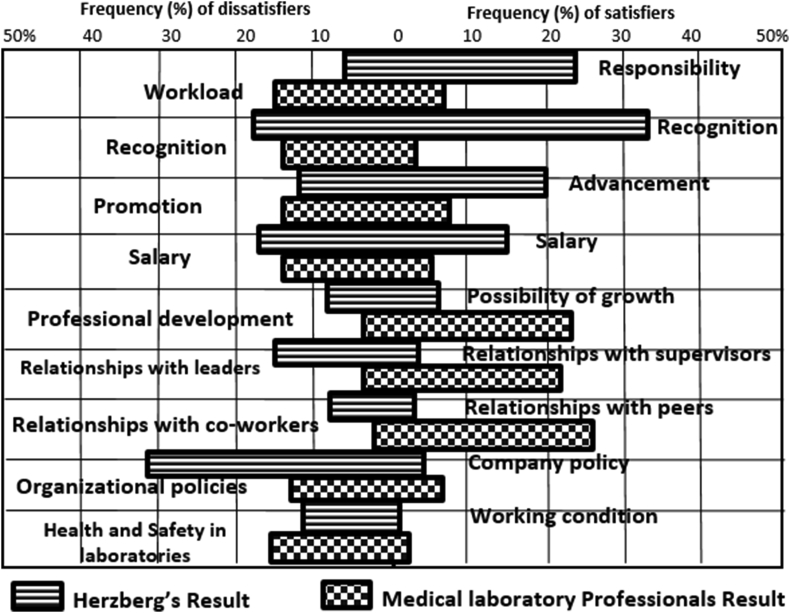
- Job dissatisfaction factors included health and safety (16% dissatisfying vs 2% satisfying), workload (15% vs 7%), salary (14% vs 5%), promotion (14% vs 8%), organizational policies (12% vs 6%), and recognition (12% vs 3%).
- Job satisfaction factors included relationships with co-workers (26% satisfying vs 2% dissatisfying), professional development (22% vs 4%), and relationships with leaders (21% vs 3%).
- The most frequently mentioned source of dissatisfaction was lack of laboratory health and safety, with poor ventilation, exposure to toxic chemicals, samples without biohazard labels, lack of safety officers, and lack of health and safety training.
- Salary and promotion dissatisfaction was linked to the 2014 Medical and Allied Health Personnel Executive Bylaw, perceived unfairness, lack of risk allowance, unclear or delayed promotions, and no differentiation between hard workers and others. Recognition contradicted Herzberg’s theory by acting as a hygiene/dissatisfier rather than a motivator.
Methods
- Mixed-method study using focus group discussions conducted February–June 2017 at Royal, Al Nahdha, and Khoula Hospitals in Oman; 18 groups (nine Royal, five Khoula, four Al Nahdha), each with six to eight participants, totaling 101 medical laboratory professionals from hematology, biochemistry, pathology, and microbiology.
- Discussions followed an interview guide derived from Herzberg’s two-factor theory, lasted 60–90 minutes, and included member checking at the end of each session.
- Data were transcribed and analyzed by directed content analysis; meaning units were condensed into categories and themes, and frequencies of statements were calculated for comparison with Herzberg’s original distribution of motivating and hygiene factors.
Limitations
- The authors state that this was a qualitative study using focus groups, so findings cannot be generalized to the whole population of MLPs, although participants were representative of laboratory staff in the three hospitals.
- The authors acknowledge possible FGD disadvantages: participants may be more or less vocal, sensitive topics may be harder to discuss in a group, and group pressure may silence participants, potentially distorting results; they also note that comparing FGD-based frequencies with Herzberg’s critical incident technique and individual interviews requires scrutiny.
- Evident from the text: recruitment relied on volunteers through laboratory supervisors, the study covered only three MOH hospitals, and the semi-quantitative comparison was based on statements generated in group discussions rather than individual critical incident interviews.
Model-written summary. Check it against the paper before relying on it.
Integrity signals
Registry
Cites
Statistics
Figures
Verification
Claims the paper makes
0 Valid · 3 Not valid · 38 Not checked · 65 Own results and interpretations
A result the paper reports from its own data — it cites no other source for it, so there is none to check. The quote shows it is in the paper.
In the paper
“The Royal hospital MLPs also reported dissatisfaction with their salaries, believing that they deserved higher salaries and bonuses since they had to work more night shifts than MLPs in other hospitals in the country.”
§ The application of Herzberg's two-factor theory of motivation to job satisfaction in clinical laboratories in Omani hospitals > Results > Salary and promotion
plain- Asserted: passes — The authors put it forward as true.
- Checkable: passes — It can be checked against evidence.
- Load-bearing: unclear — It is unclear whether the paper’s conclusions depend on it.
- Based: passes — The paper gives a reason why it holds.
A result the paper reports from its own data — it cites no other source for it, so there is none to check. The quote shows it is in the paper.
In the paper
“The MLPs in all three main hospitals (the Royal, Al Nahdha, and Khoula Hospitals) also noted that they were unhappy with the new Medical and Allied Health Personnel Executive Bylaw, introduced in 2014 for paramedical staff, which defined the rules for the employment, promotion, retention development and termination of medical and allied health personnel.”
§ The application of Herzberg's two-factor theory of motivation to job satisfaction in clinical laboratories in Omani hospitals > Results > Salary and promotion
plain- Asserted: passes — The authors put it forward as true.
- Checkable: passes — It can be checked against evidence.
- Load-bearing: unclear — It is unclear whether the paper’s conclusions depend on it.
- Based: passes — The paper gives a reason why it holds.
A result the paper reports from its own data — it cites no other source for it, so there is none to check. The quote shows it is in the paper.
In the paper
“Relations with co-workers, relation with leaders and professional development are three factors seen as important motivating factors, high on the positive end of the continuum (satisfied 26 per cent, 21 per cent, and 22 per cent respectively.”
§ The application of Herzberg's two-factor theory of motivation to job satisfaction in clinical laboratories in Omani hospitals > Discussion
plain- Asserted: passes — The authors put it forward as true.
- Checkable: passes — It can be checked against evidence.
- Load-bearing: passes — The paper’s conclusions depend on it.
- Based: passes — The paper gives a reason why it holds.
A result the paper reports from its own data — it cites no other source for it, so there is none to check. The quote shows it is in the paper.
In the paper
“FGDs participants identified workload as another dissatisfier, especially when colleagues took unplanned leave, which lead to the accumulation of samples for processing and for others to handle.”
§ The application of Herzberg's two-factor theory of motivation to job satisfaction in clinical laboratories in Omani hospitals > Results > Heavy workload
plainstates a cause- Asserted: passes — The authors put it forward as true.
- Checkable: passes — It can be checked against evidence.
- Load-bearing: unclear — It is unclear whether the paper’s conclusions depend on it.
- Based: passes — The paper gives a reason why it holds.
A result the paper reports from its own data — it cites no other source for it, so there is none to check. The quote shows it is in the paper.
In the paper
“Professional development emerged as a satisfaction factor for participants from all three hospitals.”
§ The application of Herzberg's two-factor theory of motivation to job satisfaction in clinical laboratories in Omani hospitals > Results > Professional development and training
plain- Asserted: passes — The authors put it forward as true.
- Checkable: passes — It can be checked against evidence.
- Load-bearing: unclear — It is unclear whether the paper’s conclusions depend on it.
- Based: passes — The paper gives a reason why it holds.
34 more claims
Create a free account to see all 106 claims and to verify the 27 references still open.
- It may state two separate claims as one. 21
- The quote only partly states this claim. 2
- Probably not a substantial claim. 52
Self-check
Percentages, sums and reported differences re-computed from the paper’s own numbers.
Each contradiction between two passages listed here was confirmed by an independent check.
Rated minor: it would not touch a result — a value no result rests on, a p-value that stays on the same side of the significance level, or a conflict that is clerical, resolved elsewhere in the paper, or outside its own findings.
In the paper
§ The application of Herzberg's two-factor theory of motivation to job satisfaction in clinical laboratories in Omani hospitals > Introduction > Herzberg's two-factor theory of motivation
“dissatisfiers (hygiene factors), which are the main causes of job dissatisfaction (Herzberg, 1966) and include factors such as working conditions, salaries, relationships with colleagues, administrative policies, and supervision.”
§ The application of Herzberg's two-factor theory of motivation to job satisfaction in clinical laboratories in Omani hospitals > Discussion
“Herzberg's two-factor theory suggests that salary is a motivator, but that after some time, it tends to become a dissatisfier (hygiene factor) for employees.”
Rated minor: it would not touch a result — a value no result rests on, a p-value that stays on the same side of the significance level, or a conflict that is clerical, resolved elsewhere in the paper, or outside its own findings.
In the paper
§ The application of Herzberg's two-factor theory of motivation to job satisfaction in clinical laboratories in Omani hospitals > Introduction > Herzberg's two-factor theory of motivation
“satisfiers (motivators), which are the main drivers of job satisfaction and include achievements, recognition, responsibility, and work advancement”
§ The application of Herzberg's two-factor theory of motivation to job satisfaction in clinical laboratories in Omani hospitals > Results > Relationships with coworkers
“The heavy workload in this study represent the “responsibility” in Herzberg's study as a hygiene factor.”
Rated minor: it would not touch a result — a value no result rests on, a p-value that stays on the same side of the significance level, or a conflict that is clerical, resolved elsewhere in the paper, or outside its own findings.
In the paper
§ The application of Herzberg's two-factor theory of motivation to job satisfaction in clinical laboratories in Omani hospitals > Methods > Setting and participants
“nine groups from the Royal Hospital, five groups from Khoula Hospital, and four groups from Al Nahdha Hospital. Each group had between six and eight participants (Krueger and Casey, 2015).”
§ The application of Herzberg's two-factor theory of motivation to job satisfaction in clinical laboratories in Omani hospitals > Methods > Setting and participants
“A total of 101 medical laboratory professionals participated in the FGDs.”
Citations
Cites
(1997) · Naming the Mind: How Psychology Found its Language · doi:10.4135/9781446221815.n7 · Cited by 15,148
Kline, P. (1993) · Personality and Individual Differences · doi:10.1016/0191-8869(93)90054-7 · Cited by 8,744
A Protection Motivation Theory of Fear Appeals and Attitude Change1
Rogers, R. W. (1975) · The Journal of Psychology · doi:10.1080/00223980.1975.9915803 · Cited by 6,805
Herzberg, F., Mausner, B., & Snyderman, B. B. (2017) · Routledge eBooks · doi:10.4324/9781315124827 · Cited by 5,559
Member Checking: A Tool to Enhance Trustworthiness or Merely a Nod to Validation?
Birt, L., Scott, S., Cavers, D., Campbell, C., & Walter, F. (2016) · Qualitative Health Research · doi:10.1177/1049732316654870 · Cited by 3,970
Dunnette, M. D., & Herzberg, F. (1967) · Administrative Science Quarterly · doi:10.2307/2391218 · Cited by 3,170
The World Health report 2006 1 : Working together for health 2
Guilbert, J.-J. (2006) · Education for Health: Change in Learning & Practice · doi:10.1080/13576280600937911 · Cited by 2,654
One More Time: How Do You Motivate Employees?
Herzberg, F. (1976) · Job Satisfaction — A Reader · doi:10.1007/978-1-349-02701-9_2 · Cited by 2,180
Health and Well-Being in the Workplace: A Review and Synthesis of the Literature
Danna, K., & Griffin, R. W. (1999) · Journal of Management · doi:10.1016/s0149-2063(99)00006-9 · Cited by 1,743
Understanding and Managing Organizational Behavior
George, J. M., & Jones, G. R. (1995) · Cited by 1,159
Research works printed but not linked: 4
- Kian T. Wan W. Rajah S. European journal of business and social sciences Eur. J. Bus. Soc. Sci. 3 2 2014 94 102
- Krueger R. 2d edition Krueger Richard A. Focus Groups: A Practical Guide for Applied Research 13 1996 Sage Publications, Inc. Thousand Oaks, CA 273 274 1994. 255 + xiv pages. $21.50. Journal Of Product Innovation Management
- Krueger R. Casey M. Focus Groups 2015 SAGE Los Angeles
- WHO The world health report 2006 - working together for health Retrieved from https://www.who.int/whr/2006/en/ 2006 17178522
Cited by
Items 401–464 of 464
Durman, A., Syamsuddin, S., Japari, A., Santos, H. A. D., Suhuyanli, I., & Tanra, A. J. (2026) · Journal of Education and Health Promotion · doi:10.4103/jehp.jehp_515_26
WORK STRESS AND WORK MOTIVATION IN RELATION TO PERCEIVED WORK PRODUCTIVITY AMONG INPATIENT NURSES
Latif, I., Fauzi, M., & Putri, S. R. (2026) · Jurnal Kesehatan Kusuma Husada · doi:10.34035/jk.v17i2.1975
The Impact That Accountant Salary and Remote Working Have on Job Satisfaction
Cooper, A., Hopson, K., Landgraf, K. B., & Shimamoto, D. (2026) · Journal of Organizational Psychology · doi:10.33423/csx69w45
Oktaviansyah, A. D., Ardyanto, P. P., & Enkaputri, Z. D. (2026) · Psikodinamika - Jurnal Literasi Psikologi · doi:10.36636/psikodinamika.v6i2.9958
Krishnapriya, S., Chitra, A., Sankar, M., Mahadevan, A., Gopalakrishnan, K., & Ramesh, R. (2026) · International Academic Journal of Science and Engineering · doi:10.71086/iajse/v13i2/iajse1371
Relationship Between Faculty Workload Management and Job Satisfaction Among College Instructors
Park, M. A. A. (2026) · International journal of research and scientific innovation · doi:10.51244/ijrsi.2026.1307000166
Wilkins, M. W. (2026) · ScholarWorks (Walden University)
Fitrawan, N. Z., Mulyono, M., & Wulandari, W. (2026) · RIGGS Journal of Artificial Intelligence and Digital Business · doi:10.31004/riggs.v5i2.11888
Stephen, F. G., Kanyaru, R., & Chesigor, F. (2026) · Journal of human resource & leadership. · doi:10.70619/vol6iss2pp41-52-891
Lee, Y., Lin, C. Y., Chang, S.-J., Ting-Yu, Y., Chang, C., & Sun, H. (2026) · Research in Nursing & Health · doi:10.1002/nur.70120
Almubark, S. (2026) · White Rose eTheses Online (University of Leeds, The University of Sheffield, University of York)
Swartz, B. S. (2026) · Digital Commons (Liberty University)
Fronda, R. M. (2026) · Journal of Public Administration, Public Affairs, and Management · doi:10.14456/pa.2026.2
Primary School Teachers' Work Motivation and their Job Satisfaction
San, S. S. S., Tao, D., Masud, N. A., & KiBong, K. (2026) · International Journal on Social and Education Sciences · doi:10.46328/ijonses.7562
Galay-Limos, J. A., Primero-Reyes, M. A. T., -, H. N. U., Unson, M. J. G., & Sario, J. A. (2026) · International Journal of Research Studies in Management · doi:10.5861/ijrsm.2026.26121
Syarah, A., Hayadi, B. H., & Mutoharoh, M. (2026) · LANCAH Jurnal Inovasi dan Tren · doi:10.35870/ljit.v4i2.8506
Amalia, N., Kosasih, & Agusiady, R. (2026) · Jurnal Indonesia Sosial Sains · doi:10.59141/jiss.v7i8.2546
Analisis Beban Kerja dan Motivasi terhadap Kepuasan Pelayanan Perawat pada Klinik Rodondo Pamulang
Kartikasari, Y., Madiistriyatno, H., & Devi, N. K. (2026) · AKADEMIK Jurnal Mahasiswa Ekonomi & Bisnis · doi:10.37481/jmeb.v6i3.2211
Registered Nurses’ Perceptions of Relational Service Behaviors in Nursing Practice
Johnson, D. T. (2026) · ScholarWorks (Walden University)
Effective Strategies Human Resource Business Leaders Use to Decrease Employee Turnover
Norton, D. (2026) · ScholarWorks (Walden University)
Dayo-Alademomi, N. J., Adegoke, O. O., Alademomi, J. E., & Dada, J. A. (2026) · Journal of Business Development and Management Research · doi:10.70382/ajbdmr.v13i7.0101
Teachers’ Ancillary Works: Its Significance to Their Teaching Performance
Magpulong, J. J. (2026) · Psychology and Education A Multidisciplinary Journal · doi:10.70838/pemj.630108
Doctors intention to quit or stay: a multifaceted analysis in Embu County
Wanjala, M. (2025) · SU+ Digital Repository (Strathmore University)
Mose, F. M. (2026) · SU+ Digital Repository (Strathmore University)
Onibala, M. M., Mangantar, M., & Trang, I. (2022) · Web of Synergy: International Interdisciplinary Research Journal
Sodhi, J., Arora, P., & Satpathy, S. (2021) · International Journal of Health Systems and Implementation Research
Exploring the Effect of Hybrid Work and Onsite Work on Employee Motivation in Thailand
Sermcharoenkit, P., & Thanasrivanitchai, J. (2025) · Rajapark Journal
Kurniyanto, T., & Jata, A. A. G. D. (2026) · Jurnal Mantik · doi:10.35335/mantik.v10i2.7275
Sampurna, I. G. A., & Korry, P. D. P. (2025) · Center of Economic Students Journal · doi:10.56750/zpr3da02
Evaluasi Pelaksanaan Penerapan Standar Jasa Profesi Tenaga Teknis Kefarmasian di Kota Manado
Samatara, K. (2025) · PHARMACON · doi:10.35799/mybx3s61
Permuto, A. H., Nievas, M. J., & Ghissi, D. (2025) · Repositorio Digital de la UNC (National University of Cordoba)
Arayhan, A., & Sunimah, S. (2026) · Indonesian Interdisciplinary Journal of Sharia Economics (IIJSE)
Tahir, Y. Y., Dilapanga, A. R., & Siwij, D. S. R. (2024) · Bureaucracy Journal Indonesia Journal of Law and Social-Political Governance
Elatr, H. M. A. (2026) · SBS Journal of Applied Business Research
Employee Motivation Hcl Technology, Hyderabad
Kumar, 2. S. 1. M. P. (2026) · American Journal of Management and IOT Medical Computing
THE SIGNIFICANT IMPACT OF WORK SCHEDULE ON WORK-LIFE BALANCE IN ORGANIZATIONS
TAIWO, O. M., & Nwogwugwu, N. (2024) · International Journal of Social Science Research and Anthropology
The Impact of Empathetic Leadership on Recruitment and Retention in Hong Kong's Pink-Collar SMEs
Lam, R. (2026) · SBS Journal of Applied Business Research
Hansyah, F., & Riswan (2026) · International Journal of Economics Business and Innovation Research · doi:10.63922/ijebir.v5i01.2807
Setiadi, A. W., & Vedy, N. K. (2026) · International Journal of Economics Business and Innovation Research · doi:10.63922/ijebir.v5i03.3955
MANAGEMENT OF EMPLOYEE DIVERSITY IN COMPANY X AND ITS IMPACT ON ORGANIZATIONAL PERFORMANCE
Kravanja, T. (2026) · University of Maribor digital library (University of Maribor)
Dewi, N. K. A. D. C., Parwita, G. B. S., & Putra, I. G. M. K. P. (2025) · VALUES
MOTIVATIONAL AND HYGIENE FACTORS AFFECTING EMPLOYEE PERFORMANCE AT LENOVO (BEIJING) CO., LTD.
Liu, S., & Trisakhon, C. (2026) · Sarasas Journal of Humanities and Social Science
Motivation and the impact of transformational leadership on PT. Bintang Sayap Utama Palangka Raya
Arief, M. L., Ferdinand, F., & Darung, F. (2024) · JSM: Jurnal Sains Manajemen
Yupanqui, A. A. P., Pillajo, D. J. R., & Monge, E. J. A. (2025) · Polo del Conocimiento · doi:10.23857/pc.v10i4.9372
Does employees' (dis)satisfaction predict their intention to change job?
Senica, J. (2026) · Repository of the University of Ljubljana (University of Ljubljana)
The relationship between job satisfaction and motivating climate: the mediation of decent work
Hufkie, C. (2025) · Nelson Mandela University Research Repository
Gijana, N. (2024) · Nelson Mandela University Research Repository
Shrestha, U. (2026) · Quest Journal of Management and Social Sciences · doi:10.3126/qjmss.v8i3.100318
Strategic Effort for Employee Retention in the Financial Industry
Flores, G. N. (2026) · ScholarWorks (Walden University)
Gbenyi, F. N. (2026) · INTERNATIONAL JOURNAL OF RESEARCH IN SOCIAL SCIENCE AND HUMANITIES · doi:10.47505/ijrss.2026.9.11
Ohirat, I., Razak, M., & Megawaty (2026) · Center of Economic Students Journal · doi:10.56750/m2nskt20
Hadi, S., Yasin, N. H. M., & Mohamad, S. R. (2026) · International Journal of Entrepreneurship and Management Practices · doi:10.35631/ijemp.936030
Rewards and Work Environment as Predictors of Employee Job Satisfaction at PTPN IV Regional I
Ningrum, W. P., Nasution, M. I. P., & Harahap, M. I. (2026) · International Journal of Management Entrepreneurship Social Sciences and Humanities · doi:10.31098/ijmesh.v10i1.4519
PRIME HRM Implementation and Employees’ Performance in the Schools Division of Eastern Samar
Asio, L. J. B., & Guial, C. M. G. (2026) · International Journal of Research and Innovation in Social Science · doi:10.47772/ijriss.2026.1026edu0655
Challenges faced by librarians in private universities in Malawi
Chifuniro, E., Kambiring'oma, I. I. M., & Nampapi, E. O. (2026) · Library Management · doi:10.1108/lm-06-2025-0091
Amini, R., Sunardi, S., & Supriadi, B. (2025) · ABM International Journal of Administration Business and Management · doi:10.31967/abm.v8i1.1520
Nuñez, L., Obiso, D. L., & Pabroa, J. (2026) · Psychology and Education A Multidisciplinary Journal · doi:10.70838/pemj.640802
Wong, J. M. S., Wong, H. Y. H., & Li, K. C. (2026) · Education Sciences · doi:10.3390/educsci16111802
Jacobs, C. (2026) · Boloka Institutional Repository (North-west University)
Мотиваційні чинники в роботі медичних сестер закладів охорони здоров’я різних форм власності
Yuskiv, K., & Reha, N. I. (2026) · Медсестринство · doi:10.11603/2411-1597.2026.3.16758
Indarwati, I., Herman, S., & Rahman, A. (2026) · Journal of Multidisciplinary Science MIKAILALSYS · doi:10.58578/mikailalsys.v4i3.12604
Bahaudin, Kusumawati, E. A., & Umalihayati, U. (2026) · Journal of Education and Teaching Learning · doi:10.59211/mjpjetl.v4i2.481
Metadata
- Authors
- Alrawahi, S., Sellgren, S. F., Altouby, S., Alwahaibi, N., & Brommels, M.
- Affiliations
- Karolinska Institutet (SE)
- Karolinska University Hospital (SE)
- Sultan Qaboos University (OM)
- Corresponding author
- Alrawahi, Samira
- Venue
- Heliyon
- Publisher
- Elsevier BV
- Published
- 2020-09
- Volume
- 6
- Issue
- 9
- Pages
- e04829
- ISSN
- 2405-8440 (ISSN-L)
- PMC
- PMC7486437
- OpenAlex
- W3083379900
- Semantic Scholar
- 366aa04c4a6e0f6e1c1f5cef8bf83c9eb2082a7d
- Cited by
- 428
- References
- 45
- Citations by year
- 2026: 100 · 2025: 97 · 2024: 113 · 2023: 68 · 2022: 28 · 2021: 19 · 2020: 2
- FWCI
- 31.61
- Type
- journal article
- Language
- en
- Open access
- gold
- doi.org
- Licence
- cc-by-nc-nd
- www.elsevier.com/tdm/userlicense/1.0/ (tdm)
- www.elsevier.com/legal/tdmrep-license (tdm)
- creativecommons.org/licenses/by-nc-nd/4.0/ (vor)
- Locations
- Heliyon (publishedVersion, cc-by-nc-nd)
- PubMed (publishedVersion)
- PubMed Central (publishedVersion, cc-by-nc-nd)
- DOAJ (DOAJ: Directory of Open Access Journals) (submittedVersion, cc-by-sa)
- Topics
- Social Sciences › Business, Management and Accounting › Organizational Behavior and Human Resource Management › Employee Performance and Management
- Health Sciences › Nursing › Research and Theory › Nursing education and management
- Social Sciences › Business, Management and Accounting › Organizational Behavior and Human Resource Management › Job Satisfaction and Organizational Behavior
- Keywords
- Herzberg's two-factor theory, job satisfaction, motivation, hygiene factors, motivators, medical laboratory professionals, clinical laboratory staff, hospital staff retention, workload, pay and promotion, professional development, workplace relationships, Oman
About these checks
Registry, retraction, Cites and statistics results are computed, not judged, with one exception: a printed reference that no index lists is read once by a model before it counts as a citation error. Claims are extracted by a model and kept only when their quote appears verbatim in the text; each cited source is then checked, with a model’s help, for whether it says what the claim relies on. Those verdicts can be wrong — read the claim’s quote and the cited source before relying on one.
A language model drew the claims from the paper on 2026-11-16, under version 3 of the claim definition (model deepseek-v4.1-flash, prompt extract-v3).
A second model labelled each claim on 2026-11-16 (model jev-1.13-20260917, definition revision gold-guideline-v0.2).
Statistics and arithmetic are recomputed, not judged.
Confidence bands are shown only for fields calibrated on our annotated test set. None is calibrated yet, so no band is shown.
What counts as a claim ›How we measure confidence ›How we check this ›
Are you an author, or do you see a problem with this page? Request a review
Data sources
Bibliographic data: Semantic Scholar, OpenAlex, Crossref.
Contains information from the Semantic Scholar Academic Graph Datasets, made available under the ODC Attribution License (ODC-BY 1.0).
Semantic Scholar’s data is described in: Kinney, R., et al. (2023). The Semantic Scholar Open Data Platform. arXiv:2301.10140.
