

The DOI matches its Crossref record; 75 of the 76 references it cites were found in a registry or an index; 1 of the 28 sources its claims cite were checked for support.
Artificial intelligence in future nursing care: Exploring perspectives of nursing professionals - A descriptive qualitative study
Open accessAbstract
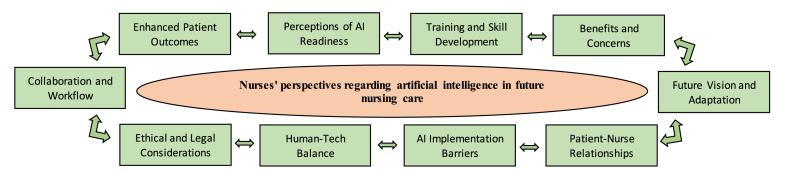
Background: The healthcare landscape is rapidly evolving, with artificial intelligence (AI) emerging as a transformative force. In this context, understanding the viewpoints of nursing professionals regarding the integration of AI in future nursing care is crucial. Aims: This study aimed to provide insights into the perceptions of nursing professionals regarding the role of AI in shaping the future of healthcare. Methods: A cohort of 23 nursing professionals was recruited between April 7, 2023, and May 4, 2023, for this study. Employing a thematic analysis approach, qualitative data from interviews with nursing professionals were analyzed. Verbatim transcripts underwent rigorous coding, and these codes were organized into themes through constant comparative analysis. The themes were refined and developed through the grouping of related codes, ensuring an authentic representation of participants' viewpoints. Results: After careful data analysis, ten key themes emerged including: (I) Perceptions of AI readiness; (II) Benefits and concerns; (III) Enhanced patient outcomes; (IV) Collaboration and workflow; (V) Human-tech balance: (VI) Training and skill development; (VII) Ethical and legal considerations; (VIII) AI implementation barriers; (IX) Patient-nurse relationships; (X) Future vision and adaptation. Conclusion: This study provides valuable insights into nursing professionals' perspectives on the integration of AI in future nursing care. It highlights their enthusiasm for AI's potential benefits while emphasizing the importance of ethical and compassionate nursing practice. The findings underscore the need for comprehensive training programs to equip nursing professionals with the skills necessary for successful AI integration. Ultimately, this research contributes to the ongoing discourse on the role of AI in nursing, paving the way for a future where innovative technologies complement and enhance the delivery of patient-centered care.
Overview
AI snapshot
Written from the paper’s full text.
TL;DR
This descriptive qualitative study interviewed 23 nursing professionals in Dhaka, Bangladesh, and identified ten themes about AI in future nursing care, including optimism, ethical concerns, training needs, and the importance of human connection. Participants generally saw AI as an opportunity to enhance care rather than replace nurses, while emphasizing compassionate practice and preparation.
Key findings
- Ten key themes emerged: perceptions of AI readiness; benefits and concerns; enhanced patient outcomes; collaboration and workflow; human-tech balance; training and skill development; ethical and legal considerations; AI implementation barriers; patient-nurse relationships; future vision and adaptation.
- Nurses described AI readiness as a blend of optimism and caution, seeing AI as a way to enhance patient care and streamline processes while preserving nursing expertise and human connection.
- Participants expected AI to support early detection, predictive insights, individualized treatment, workflow coordination, and more time for patient relationships, but raised concerns about data privacy, security, subtle clinical nuances, limited resources, and resistance to change.
- Training and skill development were repeatedly emphasized, with nurses calling for comprehensive education to use AI effectively and ethically.
Methods
- Descriptive qualitative design using thematic analysis, reported according to the COREQ checklist, conducted at three tertiary-level private hospitals in Dhaka city, Bangladesh.
- Purposive sampling recruited 23 nursing professionals between April 7, 2023, and May 4, 2023; inclusion required at least a master’s degree and at least 5 years of professional experience, with registered nurses and nurse educators emphasized.
- Data came from semi-structured interviews of approximately 45–60 minutes, audio-recorded with consent, transcribed verbatim, coded, and organized into themes through constant comparative analysis.
Limitations
- The paper states that the sample size may not represent the diversity of nursing professionals’ perspectives and recommends a larger, more diverse sample.
- The paper states that it did not include viewpoints of patients and AI developers, which could provide a more holistic understanding.
- Evident from the text: the study was limited to three private tertiary hospitals in Dhaka and recruited only highly educated, experienced nurses, which may restrict transferability to other settings or nursing cadres.
Model-written summary. Check it against the paper before relying on it.
Integrity signals
Registry
Cites
Statistics
Figures
Verification
Claims the paper makes
40 Own result · 31 Not checked yet · 12 Own method · 7 Own interpretation · 1 Supported
A result the paper reports from its own data — it cites no other source for it, so there is none to check. The quote shows it is in the paper.
In the paper
“This study revealed that nurses' viewpoints on AI readiness encompass a blend of optimism and caution.”
§ Artificial intelligence in future nursing care: Exploring perspectives of nursing professionals - A descriptive qualitative study > Results > Perceptions of AI readiness
plain- Asserted: passes — The authors put it forward as true.
- Checkable: passes — It can be checked against evidence.
- Load-bearing: passes — The paper’s conclusions depend on it.
- Based: passes — The paper gives a reason why it holds.
A result the paper reports from its own data — it cites no other source for it, so there is none to check. The quote shows it is in the paper.
In the paper
“The nurses' willingness to explore AI's potential contribution to diagnoses and customized treatment strategies speaks to their dedication.”
§ Artificial intelligence in future nursing care: Exploring perspectives of nursing professionals - A descriptive qualitative study > Results > Enhanced patient outcomes
plain- Asserted: passes — The authors put it forward as true.
- Checkable: passes — It can be checked against evidence.
- Load-bearing: passes — The paper’s conclusions depend on it.
- Based: passes — The paper gives a reason why it holds.
A result the paper reports from its own data — it cites no other source for it, so there is none to check. The quote shows it is in the paper.
In the paper
“After careful data analysis, ten key themes emerged including: (I) Perceptions of AI readiness; (II) Benefits and concerns; (III) Enhanced patient outcomes; (IV) Collaboration and workflow; (V) Human-tech balance: (VI) Training and skill development; (VII) Ethical and legal considerations; (VIII) AI implementation barriers; (IX) Patient-nurse relationships; (X) Future vision and adaptation.”
§ Artificial intelligence in future nursing care: Exploring perspectives of nursing professionals - A descriptive qualitative study > Abstract > Results
plain- Asserted: passes — The authors put it forward as true.
- Checkable: passes — It can be checked against evidence.
- Load-bearing: passes — The paper’s conclusions depend on it.
- Based: passes — The paper gives a reason why it holds.
A result the paper reports from its own data — it cites no other source for it, so there is none to check. The quote shows it is in the paper.
In the paper
“AI's facilitative role in information sharing aligns with their commitment to optimizing patient outcomes, demonstrating a forward-looking approach where collaboration and technology intertwine for the betterment of patient care.”
§ Artificial intelligence in future nursing care: Exploring perspectives of nursing professionals - A descriptive qualitative study > Results > Collaboration and workflow
boosteddirect- Asserted: passes — The authors put it forward as true.
- Checkable: passes — It can be checked against evidence.
- Load-bearing: unclear — It is unclear whether the paper’s conclusions depend on it.
- Based: passes — The paper gives a reason why it holds.
A result the paper reports from its own data — it cites no other source for it, so there is none to check. The quote shows it is in the paper.
In the paper
“They envision AI as a tool to amplify their caregiving role rather than replace it, emphasizing the holistic approach that defines nursing.”
§ Artificial intelligence in future nursing care: Exploring perspectives of nursing professionals - A descriptive qualitative study > Results > Perceptions of AI readiness
plain- Asserted: passes — The authors put it forward as true.
- Checkable: passes — It can be checked against evidence.
- Load-bearing: passes — The paper’s conclusions depend on it.
- Based: passes — The paper gives a reason why it holds.
A result the paper reports from its own data — it cites no other source for it, so there is none to check. The quote shows it is in the paper.
In the paper
“While acknowledging initial apprehensions, the nurses' unwavering belief in education and training underscores their confidence in AI integration.”
§ Artificial intelligence in future nursing care: Exploring perspectives of nursing professionals - A descriptive qualitative study > Results > Perceptions of AI readiness
plaindirect- Asserted: passes — The authors put it forward as true.
- Checkable: passes — It can be checked against evidence.
- Load-bearing: passes — The paper’s conclusions depend on it.
- Based: passes — The paper gives a reason why it holds.
A result the paper reports from its own data — it cites no other source for it, so there is none to check. The quote shows it is in the paper.
In the paper
“Nursing professionals participating in this study conveyed a collective sense of preparedness and optimism when it comes to embracing the integration of AI into nursing care.”
§ Artificial intelligence in future nursing care: Exploring perspectives of nursing professionals - A descriptive qualitative study > Discussion
plain- Asserted: passes — The authors put it forward as true.
- Checkable: passes — It can be checked against evidence.
- Load-bearing: passes — The paper’s conclusions depend on it.
- Based: passes — The paper gives a reason why it holds.
A result the paper reports from its own data — it cites no other source for it, so there is none to check. The quote shows it is in the paper.
In the paper
“While the potential of AI is vast, the nurses recognize the need to surmount obstacles such as limited resources and resistance to change for a successful integration.”
§ Artificial intelligence in future nursing care: Exploring perspectives of nursing professionals - A descriptive qualitative study > Results > AI implementation barriers
plain- Asserted: passes — The authors put it forward as true.
- Checkable: passes — It can be checked against evidence.
- Load-bearing: passes — The paper’s conclusions depend on it.
- Based: passes — The paper gives a reason why it holds.
A result the paper reports from its own data — it cites no other source for it, so there is none to check. The quote shows it is in the paper.
In the paper
“Their proactive involvement in discussions surrounding AI's implementation highlights their pivotal role in shaping a future where AI seamlessly aligns with ethical imperatives, preserving the foundational trust that underpins their practice.”
§ Artificial intelligence in future nursing care: Exploring perspectives of nursing professionals - A descriptive qualitative study > Results > Ethical and legal considerations
boosted- Asserted: passes — The authors put it forward as true.
- Checkable: passes — It can be checked against evidence.
- Load-bearing: passes — The paper’s conclusions depend on it.
- Based: passes — The paper gives a reason why it holds.
A result the paper reports from its own data — it cites no other source for it, so there is none to check. The quote shows it is in the paper.
In the paper
“Moreover, nurses emphasized the paramount importance of safeguarding patient rights and confidentiality.”
§ Artificial intelligence in future nursing care: Exploring perspectives of nursing professionals - A descriptive qualitative study > Results > Ethical and legal considerations
boosted- Asserted: passes — The authors put it forward as true.
- Checkable: passes — It can be checked against evidence.
- Load-bearing: unclear — It is unclear whether the paper’s conclusions depend on it.
- Based: passes — The paper gives a reason why it holds.
- It may state two separate claims as one. 41
- Probably not a substantial claim. 40
- The quote only partly states this claim. 2
Every source the paper cites for this claim was checked and supports it.
In the paper
“Their unwavering dedication to delivering compassionate care in the face of technological advancements aligns with studies advocating for the integration of AI in alignment with patient-centered values [68].”
§ Artificial intelligence in future nursing care: Exploring perspectives of nursing professionals - A descriptive qualitative study > Discussion
What the sources say
- Supportedcites [68] Ergin, 2022, Artificial intelligence and robot nurses: from nurse managers' perspective: a descriptive cross‐sectional study, J. Nurs. Manag. source
The Discussion (page unavailable) argues that nurses should help develop technologies that meet patients’ needs rather than require patients to adapt to technology. It also distinguishes nurses’ capacity for empathy from robots’ difficulty modelling compassion. Together, these passages support the cited point about aligning AI integration with patient-centred care; the citing authors’ description of their own participants is not attributed to this source. (LLM, conf=0.87)
plaincorrelational- Asserted: passes — The authors put it forward as true.
- Checkable: passes — It can be checked against evidence.
- Load-bearing: unclear — It is unclear whether the paper’s conclusions depend on it.
- Based: passes — The paper gives a reason why it holds.
It may state two separate claims as one.
- Supported
In the paper
“Their readiness to embrace AI is coupled with a call for comprehensive training, highlighting their commitment to ensuring a seamless integration that leverages AI's benefits [40].”
§ Artificial intelligence in future nursing care: Exploring perspectives of nursing professionals - A descriptive qualitative study > Results > Perceptions of AI readiness
What the sources say
- Not checked yetcites [40] Van Der Gaag, 2023, Artificial intelligence in health professions regulation: an exploratory qualitative study of nurse regulators in three urisdictions, Journal of Nursing Regulation source
plaincorrelational- Asserted: passes — The authors put it forward as true.
- Checkable: passes — It can be checked against evidence.
- Load-bearing: passes — The paper’s conclusions depend on it.
- Based: passes — The paper gives a reason why it holds.
It may state two separate claims as one.
None of the sources cited for this claim have been checked yet.
In the paper
“However, a notable apprehension looms – the possibility that AI might overlook subtle nuances perceivable only by a seasoned human observer [42].”
§ Artificial intelligence in future nursing care: Exploring perspectives of nursing professionals - A descriptive qualitative study > Results > Benefits and concerns
hedged- Asserted: passes — The authors put it forward as true.
- Checkable: passes — It can be checked against evidence.
- Load-bearing: fails — The paper’s conclusions may not depend on it.
- Based: passes — The paper gives a reason why it holds.
Probably not a substantial claim. The paper’s conclusions may not depend on it.
A result the paper reports from its own data — it cites no other source for it, so there is none to check. The quote shows it is in the paper.
In the paper
“In addition, nurses believed that nursing is depicted as a tapestry interwoven with empathy and genuine human connections. While AI contributes technical support, it's the nurses' unique ability to forge authentic bonds that distinguishes their practice [47].”
§ Artificial intelligence in future nursing care: Exploring perspectives of nursing professionals - A descriptive qualitative study > Results > Human-tech balance
plain- Asserted: passes — The authors put it forward as true.
- Checkable: passes — It can be checked against evidence.
- Load-bearing: passes — The paper’s conclusions depend on it.
- Based: passes — The paper gives a reason why it holds.
Probably not a substantial claim. It may state two separate claims as one.
A result the paper reports from its own data — it cites no other source for it, so there is none to check. The quote shows it is in the paper.
In the paper
“This optimism, however, is paralleled by concerns about the preservation of their expertise and the unique human connection central to nursing.”
§ Artificial intelligence in future nursing care: Exploring perspectives of nursing professionals - A descriptive qualitative study > Results > Perceptions of AI readiness
plaincorrelational- Asserted: passes — The authors put it forward as true.
- Checkable: passes — It can be checked against evidence.
- Load-bearing: passes — The paper’s conclusions depend on it.
- Based: passes — The paper gives a reason why it holds.
It may state two separate claims as one.
None of the sources cited for this claim have been checked yet.
In the paper
“This evolving landscape demands a thorough reassessment of training programs to ensure nurses possess the aptitude to navigate AI seamlessly within their practice [48].”
§ Artificial intelligence in future nursing care: Exploring perspectives of nursing professionals - A descriptive qualitative study > Results > Training and skill development
plaindirect- Asserted: passes — The authors put it forward as true.
- Checkable: passes — It can be checked against evidence.
- Load-bearing: passes — The paper’s conclusions depend on it.
- Based: passes — The paper gives a reason why it holds.
Probably not a substantial claim.
None of the sources cited for this claim have been checked yet.
In the paper
“The prospect of AI's contribution to early detection of critical medical indicators sparks excitement, offering the potential to enhance swift interventions and ultimately save lives [41].”
§ Artificial intelligence in future nursing care: Exploring perspectives of nursing professionals - A descriptive qualitative study > Results > Benefits and concerns
hedged- Asserted: passes — The authors put it forward as true.
- Checkable: passes — It can be checked against evidence.
- Load-bearing: fails — The paper’s conclusions may not depend on it.
- Based: passes — The paper gives a reason why it holds.
Probably not a substantial claim. The paper’s conclusions may not depend on it.
A result the paper reports from its own data — it cites no other source for it, so there is none to check. The quote shows it is in the paper.
In the paper
“Nursing thrives on teamwork, and the prospect of AI as a seamless partner, streamlining tasks and fostering coordination, presents an enticing avenue for improved efficiency.”
§ Artificial intelligence in future nursing care: Exploring perspectives of nursing professionals - A descriptive qualitative study > Results > Collaboration and workflow
hedged- Asserted: passes — The authors put it forward as true.
- Checkable: passes — It can be checked against evidence.
- Load-bearing: passes — The paper’s conclusions depend on it.
- Based: passes — The paper gives a reason why it holds.
It may state two separate claims as one.
A result the paper reports from its own data — it cites no other source for it, so there is none to check. The quote shows it is in the paper.
In the paper
“The potential benefits of AI are acknowledged, yet the nurses' unwavering commitment to compassionate care remains the cornerstone.”
§ Artificial intelligence in future nursing care: Exploring perspectives of nursing professionals - A descriptive qualitative study > Results > Benefits and concerns
plain- Asserted: passes — The authors put it forward as true.
- Checkable: passes — It can be checked against evidence.
- Load-bearing: passes — The paper’s conclusions depend on it.
- Based: passes — The paper gives a reason why it holds.
It may state two separate claims as one.
A result the paper reports from its own data — it cites no other source for it, so there is none to check. The quote shows it is in the paper.
In the paper
“Moreover, AI's potential to amplify the collective expertise of healthcare teams resonates strongly. Envisioning AI as an integral addition, providing valuable insights for shared decision-making, hints at a future where technology seamlessly complements human expertise [46].”
§ Artificial intelligence in future nursing care: Exploring perspectives of nursing professionals - A descriptive qualitative study > Results > Collaboration and workflow
hedged- Asserted: passes — The authors put it forward as true.
- Checkable: passes — It can be checked against evidence.
- Load-bearing: passes — The paper’s conclusions depend on it.
- Based: passes — The paper gives a reason why it holds.
It may state two separate claims as one.
A result the paper reports from its own data — it cites no other source for it, so there is none to check. The quote shows it is in the paper.
In the paper
“Despite AI's potential for medical progress, the nurses' unwavering commitment to compassionate care stands as the bedrock of nursing. Their statements underscore a collective belief in AI's potential to augment nursing, provided it complements and strengthens the deeply rooted values that define this noble profession.”
§ Artificial intelligence in future nursing care: Exploring perspectives of nursing professionals - A descriptive qualitative study > Results > Human-tech balance
plaindirect- Asserted: passes — The authors put it forward as true.
- Checkable: passes — It can be checked against evidence.
- Load-bearing: passes — The paper’s conclusions depend on it.
- Based: passes — The paper gives a reason why it holds.
Probably not a substantial claim. It may state two separate claims as one.
A result the paper reports from its own data — it cites no other source for it, so there is none to check. The quote shows it is in the paper.
In the paper
“As AI integration advances, the nurses emphasize the enduring essence of their role – one that extends beyond mere technology. Patients seek not just clinical expertise, but also the warmth of compassion and understanding, virtues that transcend AI's capabilities.”
§ Artificial intelligence in future nursing care: Exploring perspectives of nursing professionals - A descriptive qualitative study > Results > Human-tech balance
plain- Asserted: passes — The authors put it forward as true.
- Checkable: passes — It can be checked against evidence.
- Load-bearing: passes — The paper’s conclusions depend on it.
- Based: passes — The paper gives a reason why it holds.
It may state two separate claims as one.
A result the paper reports from its own data — it cites no other source for it, so there is none to check. The quote shows it is in the paper.
In the paper
“The thought of AI relieving nurses from routine tasks is invigorating, envisioning a future where professionals can channel their energies towards intricate patient needs and fostering deeper connections.”
§ Artificial intelligence in future nursing care: Exploring perspectives of nursing professionals - A descriptive qualitative study > Results > Benefits and concerns
plainconditional- Asserted: passes — The authors put it forward as true.
- Checkable: passes — It can be checked against evidence.
- Load-bearing: fails — The paper’s conclusions may not depend on it.
- Based: passes — The paper gives a reason why it holds.
Probably not a substantial claim. The paper’s conclusions may not depend on it. It may state two separate claims as one.
A result the paper reports from its own data — it cites no other source for it, so there is none to check. The quote shows it is in the paper.
In the paper
“The nurses' adaptability shines through, as they acknowledge AI's alignment with their innovative spirit and express their willingness to evolve with the technology.”
§ Artificial intelligence in future nursing care: Exploring perspectives of nursing professionals - A descriptive qualitative study > Results > Perceptions of AI readiness
plain- Asserted: passes — The authors put it forward as true.
- Checkable: passes — It can be checked against evidence.
- Load-bearing: unclear — It is unclear whether the paper’s conclusions depend on it.
- Based: passes — The paper gives a reason why it holds.
It may state two separate claims as one.
A result the paper reports from its own data — it cites no other source for it, so there is none to check. The quote shows it is in the paper.
In the paper
“Furthermore, nurses mentioned that the envisioned partnership between nurses and AI is portrayed as symbiotic, with AI handling analytical tasks while nurses focus on the human facets of patient care.”
§ Artificial intelligence in future nursing care: Exploring perspectives of nursing professionals - A descriptive qualitative study > Results > Human-tech balance
plain- Asserted: passes — The authors put it forward as true.
- Checkable: passes — It can be checked against evidence.
- Load-bearing: passes — The paper’s conclusions depend on it.
- Based: passes — The paper gives a reason why it holds.
Probably not a substantial claim.
None of the sources cited for this claim have been checked yet.
In the paper
“In addition, imagining treatment plans meticulously tailored to individual patient needs, guided by AI's analytical prowess, opens the door to a new era of patient care. This concept promises a level of personalization previously unattainable, with the potential to redefine the very essence of healthcare [45].”
§ Artificial intelligence in future nursing care: Exploring perspectives of nursing professionals - A descriptive qualitative study > Results > Enhanced patient outcomes
hedged- Asserted: passes — The authors put it forward as true.
- Checkable: passes — It can be checked against evidence.
- Load-bearing: fails — The paper’s conclusions may not depend on it.
- Based: passes — The paper gives a reason why it holds.
Probably not a substantial claim. The paper’s conclusions may not depend on it.
A result the paper reports from its own data — it cites no other source for it, so there is none to check. The quote shows it is in the paper.
In the paper
“As AI integration progresses, the nurses' emphasis on safeguarding patient data privacy and security resonates deeply.”
§ Artificial intelligence in future nursing care: Exploring perspectives of nursing professionals - A descriptive qualitative study > Results > Benefits and concerns
plain- Asserted: passes — The authors put it forward as true.
- Checkable: passes — It can be checked against evidence.
- Load-bearing: fails — The paper’s conclusions may not depend on it.
- Based: passes — The paper gives a reason why it holds.
Probably not a substantial claim. The paper’s conclusions may not depend on it.
A result the paper reports from its own data — it cites no other source for it, so there is none to check. The quote shows it is in the paper.
In the paper
“Moreover, the rapid analytical capabilities of AI offer the prospect of swifter insights and more immediate decision-making in patient treatment, particularly critical in life-or-death situations.”
§ Artificial intelligence in future nursing care: Exploring perspectives of nursing professionals - A descriptive qualitative study > Results > Enhanced patient outcomes
hedgedconditional- Asserted: passes — The authors put it forward as true.
- Checkable: passes — It can be checked against evidence.
- Load-bearing: passes — The paper’s conclusions depend on it.
- Based: passes — The paper gives a reason why it holds.
Probably not a substantial claim.
None of the sources cited for this claim have been checked yet.
In the paper
“The notion of AI foreseeing potential patient deteriorations before they manifest sparks excitement, hinting at the possibility of timelier interventions and improved clinical results [44].”
§ Artificial intelligence in future nursing care: Exploring perspectives of nursing professionals - A descriptive qualitative study > Results > Enhanced patient outcomes
hedgedconditional- Asserted: passes — The authors put it forward as true.
- Checkable: passes — It can be checked against evidence.
- Load-bearing: fails — The paper’s conclusions may not depend on it.
- Based: passes — The paper gives a reason why it holds.
Probably not a substantial claim. The paper’s conclusions may not depend on it. It may state two separate claims as one.
A result the paper reports from its own data — it cites no other source for it, so there is none to check. The quote shows it is in the paper.
In the paper
“They see the integration of AI as an opportunity to enhance patient care and streamline processes, recognizing its potential to redefine healthcare.”
§ Artificial intelligence in future nursing care: Exploring perspectives of nursing professionals - A descriptive qualitative study > Results > Perceptions of AI readiness
plain- Asserted: passes — The authors put it forward as true.
- Checkable: passes — It can be checked against evidence.
- Load-bearing: passes — The paper’s conclusions depend on it.
- Based: passes — The paper gives a reason why it holds.
It may state two separate claims as one.
A result the paper reports from its own data — it cites no other source for it, so there is none to check. The quote shows it is in the paper.
In the paper
“They accentuate the need for discourse aimed at establishing frameworks that guide the ethical incorporation and application of AI within nursing.”
§ Artificial intelligence in future nursing care: Exploring perspectives of nursing professionals - A descriptive qualitative study > Results > Ethical and legal considerations
plain- Asserted: passes — The authors put it forward as true.
- Checkable: passes — It can be checked against evidence.
- Load-bearing: passes — The paper’s conclusions depend on it.
- Based: passes — The paper gives a reason why it holds.
Probably not a substantial claim.
A result the paper reports from its own data — it cites no other source for it, so there is none to check. The quote shows it is in the paper.
In the paper
“While AI offers data-driven insights, the nurses emphasize that their aptitude for delivering compassionate care remains unmatched [52].”
§ Artificial intelligence in future nursing care: Exploring perspectives of nursing professionals - A descriptive qualitative study > Results > Patient-nurse relationships
plain- Asserted: passes — The authors put it forward as true.
- Checkable: passes — It can be checked against evidence.
- Load-bearing: passes — The paper’s conclusions depend on it.
- Based: passes — The paper gives a reason why it holds.
Probably not a substantial claim.
A result the paper reports from its own data — it cites no other source for it, so there is none to check. The quote shows it is in the paper.
In the paper
“In addition, the nurses regard AI's integration as the herald of a transformative epoch in nursing. Their embrace of change and forward-looking mindset positions them to harness AI's potential, emerging as leaders in an evolving landscape where innovation prevails.”
§ Artificial intelligence in future nursing care: Exploring perspectives of nursing professionals - A descriptive qualitative study > Results > Future vision and adaptation
plain- Asserted: passes — The authors put it forward as true.
- Checkable: passes — It can be checked against evidence.
- Load-bearing: unclear — It is unclear whether the paper’s conclusions depend on it.
- Based: passes — The paper gives a reason why it holds.
It may state two separate claims as one.
A result the paper reports from its own data — it cites no other source for it, so there is none to check. The quote shows it is in the paper.
In the paper
“A collaborative approach to address these challenges is underscored as pivotal for a seamless transition.”
§ Artificial intelligence in future nursing care: Exploring perspectives of nursing professionals - A descriptive qualitative study > Results > AI implementation barriers
plaindirect- Asserted: passes — The authors put it forward as true.
- Checkable: passes — It can be checked against evidence.
- Load-bearing: fails — The paper’s conclusions may not depend on it.
- Based: passes — The paper gives a reason why it holds.
Probably not a substantial claim. The paper’s conclusions may not depend on it.
A result the paper reports from its own data — it cites no other source for it, so there is none to check. The quote shows it is in the paper.
In the paper
“With AI's emergence in their domain, nurses keenly recognize the intricate ethical inquiries it prompts, especially concerning patient privacy and data security. They proactively adopt the role of advocates, embracing the responsibility to champion these concerns and ensure the conscientious and ethical use of AI.”
§ Artificial intelligence in future nursing care: Exploring perspectives of nursing professionals - A descriptive qualitative study > Results > Ethical and legal considerations
plain- Asserted: passes — The authors put it forward as true.
- Checkable: passes — It can be checked against evidence.
- Load-bearing: passes — The paper’s conclusions depend on it.
- Based: passes — The paper gives a reason why it holds.
It may state two separate claims as one.
None of the sources cited for this claim have been checked yet.
In the paper
“Regarding this, AI's integration demands a united endeavor to overcome technical complexities and entrenched resistance within healthcare systems [50].”
§ Artificial intelligence in future nursing care: Exploring perspectives of nursing professionals - A descriptive qualitative study > Results > AI implementation barriers
plain- Asserted: passes — The authors put it forward as true.
- Checkable: passes — It can be checked against evidence.
- Load-bearing: fails — The paper’s conclusions may not depend on it.
- Based: passes — The paper gives a reason why it holds.
Probably not a substantial claim. The paper’s conclusions may not depend on it.
A result the paper reports from its own data — it cites no other source for it, so there is none to check. The quote shows it is in the paper.
In the paper
“They advocate for a harmonious integration of AI that augments, rather than substitutes, their capacity to connect with and understand the unique needs of patients.”
§ Artificial intelligence in future nursing care: Exploring perspectives of nursing professionals - A descriptive qualitative study > Results > Patient-nurse relationships
plain- Asserted: passes — The authors put it forward as true.
- Checkable: passes — It can be checked against evidence.
- Load-bearing: passes — The paper’s conclusions depend on it.
- Based: passes — The paper gives a reason why it holds.
Probably not a substantial claim.
A result the paper reports from its own data — it cites no other source for it, so there is none to check. The quote shows it is in the paper.
In the paper
“In addition, the nurses' commitment to embracing AI is underscored by a dedication to continuous learning. They emphasize the significance of actively seeking opportunities to enhance their AI-related understanding, highlighting its pivotal role in delivering exceptional patient care.”
§ Artificial intelligence in future nursing care: Exploring perspectives of nursing professionals - A descriptive qualitative study > Results > Training and skill development
plain- Asserted: passes — The authors put it forward as true.
- Checkable: passes — It can be checked against evidence.
- Load-bearing: unclear — It is unclear whether the paper’s conclusions depend on it.
- Based: passes — The paper gives a reason why it holds.
It may state two separate claims as one.
A result the paper reports from its own data — it cites no other source for it, so there is none to check. The quote shows it is in the paper.
In the paper
“This study also explored that nurses believe AI's potential in nursing is acknowledged as a frontier of innovation, necessitating an investment in training that empowers nurses to harness its capabilities effectively.”
§ Artificial intelligence in future nursing care: Exploring perspectives of nursing professionals - A descriptive qualitative study > Results > Training and skill development
plain- Asserted: passes — The authors put it forward as true.
- Checkable: passes — It can be checked against evidence.
- Load-bearing: passes — The paper’s conclusions depend on it.
- Based: passes — The paper gives a reason why it holds.
It may state two separate claims as one.
A result the paper reports from its own data — it cites no other source for it, so there is none to check. The quote shows it is in the paper.
In the paper
“Amidst evolving nursing care, adaptation takes precedence. Their vision of a future harmonizing AI underscores their role as drivers of innovation, shaping a path where novel technologies and compassionate patient care seamlessly converge.”
§ Artificial intelligence in future nursing care: Exploring perspectives of nursing professionals - A descriptive qualitative study > Results > Future vision and adaptation
plaindirect- Asserted: passes — The authors put it forward as true.
- Checkable: passes — It can be checked against evidence.
- Load-bearing: passes — The paper’s conclusions depend on it.
- Based: passes — The paper gives a reason why it holds.
Probably not a substantial claim. It may state two separate claims as one.
A result the paper reports from its own data — it cites no other source for it, so there is none to check. The quote shows it is in the paper.
In the paper
“The nurses' candid perspective acknowledges the inextricable link between nursing care and AI's trajectory. Their readiness to embrace new technologies and recalibrate their approach positions them to influence a future where cutting-edge innovations enhance their dedication to patient well-being.”
§ Artificial intelligence in future nursing care: Exploring perspectives of nursing professionals - A descriptive qualitative study > Results > Future vision and adaptation
plaincorrelational- Asserted: passes — The authors put it forward as true.
- Checkable: passes — It can be checked against evidence.
- Load-bearing: passes — The paper’s conclusions depend on it.
- Based: passes — The paper gives a reason why it holds.
Probably not a substantial claim. It may state two separate claims as one.
A result the paper reports from its own data — it cites no other source for it, so there is none to check. The quote shows it is in the paper.
In the paper
“They emphasize that staying informed, embracing innovation, and maintaining an open-minded perspective are pivotal in shaping a future where AI elevates their practice.”
§ Artificial intelligence in future nursing care: Exploring perspectives of nursing professionals - A descriptive qualitative study > Results > Future vision and adaptation
plaindirect- Asserted: passes — The authors put it forward as true.
- Checkable: passes — It can be checked against evidence.
- Load-bearing: passes — The paper’s conclusions depend on it.
- Based: passes — The paper gives a reason why it holds.
Probably not a substantial claim. It may state two separate claims as one. The quote only partly states this claim.
A result the paper reports from its own data — it cites no other source for it, so there is none to check. The quote shows it is in the paper.
In the paper
“Fostering a culture of adaptability and innovation, the nurses advocate for a proactive stance that equips them to collectively surmount barriers and seamlessly incorporate AI.”
§ Artificial intelligence in future nursing care: Exploring perspectives of nursing professionals - A descriptive qualitative study > Results > AI implementation barriers
plain- Asserted: passes — The authors put it forward as true.
- Checkable: passes — It can be checked against evidence.
- Load-bearing: fails — The paper’s conclusions may not depend on it.
- Based: passes — The paper gives a reason why it holds.
Probably not a substantial claim. The paper’s conclusions may not depend on it.
A result the paper reports from its own data — it cites no other source for it, so there is none to check. The quote shows it is in the paper.
In the paper
“By proactively anticipating and embracing AI's potential, the nurses carve a trail towards pioneering nursing's future [53].”
§ Artificial intelligence in future nursing care: Exploring perspectives of nursing professionals - A descriptive qualitative study > Results > Future vision and adaptation
plaindirect- Asserted: passes — The authors put it forward as true.
- Checkable: passes — It can be checked against evidence.
- Load-bearing: fails — The paper’s conclusions may not depend on it.
- Based: passes — The paper gives a reason why it holds.
Probably not a substantial claim. The paper’s conclusions may not depend on it.
A result the paper reports from its own data — it cites no other source for it, so there is none to check. The quote shows it is in the paper.
In the paper
“They assert that despite AI's potential to revolutionize patient care, upholding the human touch remains paramount, preserving the essence of nursing and genuine patient connections.”
§ Artificial intelligence in future nursing care: Exploring perspectives of nursing professionals - A descriptive qualitative study > Results > Patient-nurse relationships
plain- Asserted: passes — The authors put it forward as true.
- Checkable: passes — It can be checked against evidence.
- Load-bearing: passes — The paper’s conclusions depend on it.
- Based: passes — The paper gives a reason why it holds.
Probably not a substantial claim.
A result the paper reports from its own data — it cites no other source for it, so there is none to check. The quote shows it is in the paper.
In the paper
“As the integration of AI gains momentum, nursing education's evolution becomes crucial, engaging both aspiring and seasoned nurses in a journey of learning that ensures harmonious collaboration with AI-driven systems.”
§ Artificial intelligence in future nursing care: Exploring perspectives of nursing professionals - A descriptive qualitative study > Results > Training and skill development
plain- Asserted: passes — The authors put it forward as true.
- Checkable: passes — It can be checked against evidence.
- Load-bearing: passes — The paper’s conclusions depend on it.
- Based: passes — The paper gives a reason why it holds.
Probably not a substantial claim.
None of the sources cited for this claim have been checked yet.
In the paper
“In the participants' view, AI is envisioned as a collaborative partner within healthcare teams, reinforcing research that explores AI's role in augmenting healthcare professionals' capabilities and promoting interdisciplinary collaboration [65].”
§ Artificial intelligence in future nursing care: Exploring perspectives of nursing professionals - A descriptive qualitative study > Discussion
plain- Asserted: passes — The authors put it forward as true.
- Checkable: passes — It can be checked against evidence.
- Load-bearing: passes — The paper’s conclusions depend on it.
- Based: passes — The paper gives a reason why it holds.
Probably not a substantial claim.
A result the paper reports from its own data — it cites no other source for it, so there is none to check. The quote shows it is in the paper.
In the paper
“They acknowledge the potential of AI to amplify patient outcomes and optimize care processes through technological advancements.”
§ Artificial intelligence in future nursing care: Exploring perspectives of nursing professionals - A descriptive qualitative study > Discussion
plaindirect- Asserted: passes — The authors put it forward as true.
- Checkable: passes — It can be checked against evidence.
- Load-bearing: passes — The paper’s conclusions depend on it.
- Based: passes — The paper gives a reason why it holds.
It may state two separate claims as one.
None of the sources cited for this claim have been checked yet.
In the paper
“AI's role is envisioned as enhancing patient interactions, extending the time available for nurturing profound relationships, and providing the emotional support that patients rely upon [51].”
§ Artificial intelligence in future nursing care: Exploring perspectives of nursing professionals - A descriptive qualitative study > Results > Patient-nurse relationships
plaindirect- Asserted: passes — The authors put it forward as true.
- Checkable: passes — It can be checked against evidence.
- Load-bearing: passes — The paper’s conclusions depend on it.
- Based: passes — The paper gives a reason why it holds.
Probably not a substantial claim. It may state two separate claims as one.
What the paper did — it cites no source for this, so there is none to check. The quote shows it is in the paper.
In the paper
“Ethical guidelines and principles outlined by relevant research ethics committees were adhered to at all stages of the study, including approval from the Mahbubur Rahman Memorial Hospital & Nursing Institute (Approval number: MRMHNI/IRB/HR-03/September 11, 2023).”
§ Artificial intelligence in future nursing care: Exploring perspectives of nursing professionals - A descriptive qualitative study > Methodology > Ethical considerations, trustworthiness and rigor
plain- Asserted: passes — The authors put it forward as true.
- Checkable: passes — It can be checked against evidence.
- Load-bearing: fails — The paper’s conclusions may not depend on it.
- Based: passes — The paper gives a reason why it holds.
Probably not a substantial claim. The paper’s conclusions may not depend on it.
What the paper did — it cites no source for this, so there is none to check. The quote shows it is in the paper.
In the paper
“Informed consent was obtained from all participants, ensuring their voluntary participation.”
§ Artificial intelligence in future nursing care: Exploring perspectives of nursing professionals - A descriptive qualitative study > Methodology > Ethical considerations, trustworthiness and rigor
plain- Asserted: passes — The authors put it forward as true.
- Checkable: passes — It can be checked against evidence.
- Load-bearing: fails — The paper’s conclusions may not depend on it.
- Based: passes — The paper gives a reason why it holds.
Probably not a substantial claim. The paper’s conclusions may not depend on it.
What the paper did — it cites no source for this, so there is none to check. The quote shows it is in the paper.
In the paper
“This methodical journey encompassed coding, theme development, and member checking, collectively enhancing the dependability and authenticity of the identified patterns and themes.”
§ Artificial intelligence in future nursing care: Exploring perspectives of nursing professionals - A descriptive qualitative study > Methodology > Ethical considerations, trustworthiness and rigor
plain- Asserted: passes — The authors put it forward as true.
- Checkable: passes — It can be checked against evidence.
- Load-bearing: fails — The paper’s conclusions may not depend on it.
- Based: passes — The paper gives a reason why it holds.
Probably not a substantial claim. The paper’s conclusions may not depend on it.
What the paper did — it cites no source for this, so there is none to check. The quote shows it is in the paper.
In the paper
“Participants' confidentiality and anonymity were strictly maintained during data collection, analysis, and reporting.”
§ Artificial intelligence in future nursing care: Exploring perspectives of nursing professionals - A descriptive qualitative study > Methodology > Ethical considerations, trustworthiness and rigor
plain- Asserted: passes — The authors put it forward as true.
- Checkable: passes — It can be checked against evidence.
- Load-bearing: fails — The paper’s conclusions may not depend on it.
- Based: passes — The paper gives a reason why it holds.
Probably not a substantial claim. The paper’s conclusions may not depend on it.
What the paper did — it cites no source for this, so there is none to check. The quote shows it is in the paper.
In the paper
“The inclusion of participants spanning a spectrum of experience and expertise bolstered the depth and breadth of insights, culminating in a well-rounded comprehension of the subject matter.”
§ Artificial intelligence in future nursing care: Exploring perspectives of nursing professionals - A descriptive qualitative study > Methodology > Ethical considerations, trustworthiness and rigor
plaindirect- Asserted: passes — The authors put it forward as true.
- Checkable: passes — It can be checked against evidence.
- Load-bearing: passes — The paper’s conclusions depend on it.
- Based: passes — The paper gives a reason why it holds.
Probably not a substantial claim.
What the paper did — it cites no source for this, so there is none to check. The quote shows it is in the paper.
In the paper
“This method involved the intentional selection of individuals with pertinent knowledge and experience in the domains of nursing care and AI.”
§ Artificial intelligence in future nursing care: Exploring perspectives of nursing professionals - A descriptive qualitative study > Methodology > Sampling strategy
plain- Asserted: passes — The authors put it forward as true.
- Checkable: passes — It can be checked against evidence.
- Load-bearing: passes — The paper’s conclusions depend on it.
- Based: passes — The paper gives a reason why it holds.
Probably not a substantial claim.
What the paper did — it cites no source for this, so there is none to check. The quote shows it is in the paper.
In the paper
“The researchers ensured that the Consolidated Criteria for Reporting Qualitative Research (COREQ) checklist was followed throughout the study to enhance the rigor and transparency of the qualitative research process.”
§ Artificial intelligence in future nursing care: Exploring perspectives of nursing professionals - A descriptive qualitative study > Methodology > Research design
plain- Asserted: passes — The authors put it forward as true.
- Checkable: passes — It can be checked against evidence.
- Load-bearing: fails — The paper’s conclusions may not depend on it.
- Based: passes — The paper gives a reason why it holds.
Probably not a substantial claim. The paper’s conclusions may not depend on it.
None of the sources cited for this claim have been checked yet.
In the paper
“The participants' unwavering commitment to sustaining dedicated and compassionate care amidst AI integration resonates with studies that emphasize the essential nature of preserving the humanistic essence of caregiving [59,60].”
§ Artificial intelligence in future nursing care: Exploring perspectives of nursing professionals - A descriptive qualitative study > Discussion
What the sources say
- Not checked yetcites [59] Poncette, 2019, Clinical requirements of future patient monitoring in the intensive care unit: qualitative study, JMIR Med Inform source
- Not checked yetcites [60] Yoo, 2022, Critical role of information and communication technology in nursing during the COVID‐19 pandemic: a qualitative study, J. Nurs. Manag. source
plaincorrelational- Asserted: passes — The authors put it forward as true.
- Checkable: passes — It can be checked against evidence.
- Load-bearing: unclear — It is unclear whether the paper’s conclusions depend on it.
- Based: passes — The paper gives a reason why it holds.
It may state two separate claims as one.
In the paper
“Moreover, the recognition of time as a pivotal factor in patient care aligns with the growing recognition of AI's capacity to expedite decision-making, particularly in critical scenarios [64].”
§ Artificial intelligence in future nursing care: Exploring perspectives of nursing professionals - A descriptive qualitative study > Discussion
What the sources say
- Not checked yetcites [64] Shang, 2021, A concept analysis on the use of artificial intelligence in nursing. Cureus, Published online May 5
plaincorrelational- Asserted: passes — The authors put it forward as true.
- Checkable: passes — It can be checked against evidence.
- Load-bearing: unclear — It is unclear whether the paper’s conclusions depend on it.
- Based: passes — The paper gives a reason why it holds.
It may state two separate claims as one.
In the paper
“Participants' emphasis on a cautious approach to AI implementation aligns with research that underscores the imperative of addressing concerns surrounding data security and privacy in the context of AI integration [58].”
§ Artificial intelligence in future nursing care: Exploring perspectives of nursing professionals - A descriptive qualitative study > Discussion
What the sources say
- Not checked yetcites [58] Hassan, 2022, 7 Healthcare staff perceptions on using artificial intelligence predictive tools: a qualitative study
plaincorrelational- Asserted: passes — The authors put it forward as true.
- Checkable: passes — It can be checked against evidence.
- Load-bearing: unclear — It is unclear whether the paper’s conclusions depend on it.
- Based: passes — The paper gives a reason why it holds.
It may state two separate claims as one.
In the paper
“Regarding this, the participants' accentuation of the symbiotic partnership between nursing professionals and AI, with AI enhancing nursing practice while preserving the unique human touch, echoes research discussing AI as a supportive tool that supplements, rather than supplants, the role of healthcare providers [67].”
§ Artificial intelligence in future nursing care: Exploring perspectives of nursing professionals - A descriptive qualitative study > Discussion
What the sources say
- Not checked yetcites [67] Ahmad, 2022, Artificial intelligence for nursing practice and management: current and potential research and education, Comput. Inf. Nurs.
plaindirect- Asserted: passes — The authors put it forward as true.
- Checkable: passes — It can be checked against evidence.
- Load-bearing: passes — The paper’s conclusions depend on it.
- Based: passes — The paper gives a reason why it holds.
It may state two separate claims as one.
None of the sources cited for this claim have been checked yet.
In the paper
“The concept of tailoring individualized treatment plans through AI guidance corresponds with studies delving into personalized medicine and its anticipated impact on patient well-being [62,63].”
§ Artificial intelligence in future nursing care: Exploring perspectives of nursing professionals - A descriptive qualitative study > Discussion
What the sources say
plaincorrelational- Asserted: passes — The authors put it forward as true.
- Checkable: passes — It can be checked against evidence.
- Load-bearing: fails — The paper’s conclusions may not depend on it.
- Based: passes — The paper gives a reason why it holds.
Probably not a substantial claim. The paper’s conclusions may not depend on it. It may state two separate claims as one. The quote only partly states this claim.
In the paper
“Similarly, the participants' enthusiasm for AI's predictive potential in identifying patient deteriorations finds resonance with existing research highlighting AI's ability to analyze intricate datasets and offer timely insights [61].”
§ Artificial intelligence in future nursing care: Exploring perspectives of nursing professionals - A descriptive qualitative study > Discussion
What the sources say
- Not checked yetcites [61] Yoo, 2023, Healthcare professionals' expectations of medical artificial intelligence and strategies for its clinical implementation: a qualitative study, Healthc Inform Res source
plaincorrelational- Asserted: passes — The authors put it forward as true.
- Checkable: passes — It can be checked against evidence.
- Load-bearing: unclear — It is unclear whether the paper’s conclusions depend on it.
- Based: passes — The paper gives a reason why it holds.
It may state two separate claims as one.
In the paper
“Moreover, the participants' acknowledgment of the necessity for comprehensive training and continuous skill enhancement in AI integration is harmonious with research emphasizing the pivotal role of nursing education in effectively harnessing AI technologies [54].”
§ Artificial intelligence in future nursing care: Exploring perspectives of nursing professionals - A descriptive qualitative study > Discussion
What the sources say
- Not checked yetcites [54] Petersson, 2022, Challenges to implementing artificial intelligence in healthcare: a qualitative interview study with healthcare leaders in Sweden, BMC Health Serv. Res. source
plaincorrelational- Asserted: passes — The authors put it forward as true.
- Checkable: passes — It can be checked against evidence.
- Load-bearing: unclear — It is unclear whether the paper’s conclusions depend on it.
- Based: passes — The paper gives a reason why it holds.
It may state two separate claims as one.
A conclusion the paper draws from its own results — it cites no other source for it, so there is none to check. The quote shows it is in the paper.
In the paper
“With careful planning, education, and collaboration, AI can become a valuable tool in the hands of nursing professionals, ultimately improving healthcare delivery and patient outcomes.”
§ Artificial intelligence in future nursing care: Exploring perspectives of nursing professionals - A descriptive qualitative study > Conclusions
plainconditional- Asserted: passes — The authors put it forward as true.
- Checkable: fails — It may be too vague to check against evidence.
- Load-bearing: passes — The paper’s conclusions depend on it.
- Based: fails — The paper may give no reason why it holds.
Probably not a substantial claim. It may be too vague to check against evidence. The paper may give no reason why it holds. It may state two separate claims as one.
What the paper did — it cites no source for this, so there is none to check. The quote shows it is in the paper.
In the paper
“The use of interviews and thematic analysis provided rich data for a comprehensive understanding of the subject.”
§ Artificial intelligence in future nursing care: Exploring perspectives of nursing professionals - A descriptive qualitative study > Strengths and limitations
plaindirect- Asserted: passes — The authors put it forward as true.
- Checkable: passes — It can be checked against evidence.
- Load-bearing: passes — The paper’s conclusions depend on it.
- Based: passes — The paper gives a reason why it holds.
Probably not a substantial claim.
A conclusion the paper draws from its own results — it cites no other source for it, so there is none to check. The quote shows it is in the paper.
In the paper
“As AI technologies continue to advance, nursing care stands on the brink of a transformative era.”
§ Artificial intelligence in future nursing care: Exploring perspectives of nursing professionals - A descriptive qualitative study > Conclusions
plain- Asserted: passes — The authors put it forward as true.
- Checkable: fails — It may be too vague to check against evidence.
- Load-bearing: fails — The paper’s conclusions may not depend on it.
- Based: fails — The paper may give no reason why it holds.
Probably not a substantial claim. It may be too vague to check against evidence. The paper’s conclusions may not depend on it. The paper may give no reason why it holds.
- Rests on an assumption: AI technologies will continue to advance.
A conclusion the paper draws from its own results — it cites no other source for it, so there is none to check. The quote shows it is in the paper.
In the paper
“This study concludes that AI is not a threat to nursing but rather an opportunity for growth and enhanced care delivery.”
§ Artificial intelligence in future nursing care: Exploring perspectives of nursing professionals - A descriptive qualitative study > Conclusions
plain- Asserted: passes — The authors put it forward as true.
- Checkable: passes — It can be checked against evidence.
- Load-bearing: passes — The paper’s conclusions depend on it.
- Based: passes — The paper gives a reason why it holds.
It may state two separate claims as one.
A conclusion the paper draws from its own results — it cites no other source for it, so there is none to check. The quote shows it is in the paper.
In the paper
“Firstly, it underscores the growing acceptance of AI in nursing care, indicating a paradigm shift in healthcare delivery.”
§ Artificial intelligence in future nursing care: Exploring perspectives of nursing professionals - A descriptive qualitative study > Implications of this study
hedged- Asserted: passes — The authors put it forward as true.
- Checkable: passes — It can be checked against evidence.
- Load-bearing: passes — The paper’s conclusions depend on it.
- Based: passes — The paper gives a reason why it holds.
It may state two separate claims as one.
- Rests on an assumption: The positive attitudes of the study participants reflect a growing acceptance of AI among nursing professionals generally.
In the paper
“The participants' emphasis on nurturing patient-nurse relationships amidst AI integration corresponds with research that underscores AI's role in enhancing, rather than replacing, these human connections [58].”
§ Artificial intelligence in future nursing care: Exploring perspectives of nursing professionals - A descriptive qualitative study > Discussion
What the sources say
- Not checked yetcites [58] Hassan, 2022, 7 Healthcare staff perceptions on using artificial intelligence predictive tools: a qualitative study
plaindirect- Asserted: passes — The authors put it forward as true.
- Checkable: passes — It can be checked against evidence.
- Load-bearing: unclear — It is unclear whether the paper’s conclusions depend on it.
- Based: passes — The paper gives a reason why it holds.
It may state two separate claims as one.
What the paper did — it cites no source for this, so there is none to check. The quote shows it is in the paper.
In the paper
“Firstly, the study's sample size may not represent the diversity of nursing professionals' perspectives.”
§ Artificial intelligence in future nursing care: Exploring perspectives of nursing professionals - A descriptive qualitative study > Strengths and limitations
hedged- Asserted: passes — The authors put it forward as true.
- Checkable: passes — It can be checked against evidence.
- Load-bearing: fails — The paper’s conclusions may not depend on it.
- Based: passes — The paper gives a reason why it holds.
Probably not a substantial claim. The paper’s conclusions may not depend on it.
In the paper
“In terms of this, the participants' unwavering commitment to ethical and responsible AI utilization resonates with findings from studies highlighting the significance of addressing ethical and legal ramifications in the integration of AI [40].”
§ Artificial intelligence in future nursing care: Exploring perspectives of nursing professionals - A descriptive qualitative study > Discussion
What the sources say
- Not checked yetcites [40] Van Der Gaag, 2023, Artificial intelligence in health professions regulation: an exploratory qualitative study of nurse regulators in three urisdictions, Journal of Nursing Regulation source
plaincorrelational- Asserted: passes — The authors put it forward as true.
- Checkable: passes — It can be checked against evidence.
- Load-bearing: unclear — It is unclear whether the paper’s conclusions depend on it.
- Based: passes — The paper gives a reason why it holds.
It may state two separate claims as one.
In the paper
“Their resolute determination to harness the potential benefits of AI is in sync with research emphasizing AI's transformative potential within the realm of healthcare [71].”
§ Artificial intelligence in future nursing care: Exploring perspectives of nursing professionals - A descriptive qualitative study > Discussion
What the sources say
- Not checked yetcites [71] Dong, 2021, Medical information mining-based visual artificial intelligence emergency nursing management system. Rajakani K, Journal of Healthcare Engineering
plaincorrelational- Asserted: passes — The authors put it forward as true.
- Checkable: passes — It can be checked against evidence.
- Load-bearing: unclear — It is unclear whether the paper’s conclusions depend on it.
- Based: passes — The paper gives a reason why it holds.
It may state two separate claims as one.
In the paper
“In addition to that, the participants' acknowledgment of obstacles and the necessity for collective efforts to overcome these challenges aligns with studies that delve into the hurdles of AI implementation and advocate for cultivating an innovative organizational culture [19].”
§ Artificial intelligence in future nursing care: Exploring perspectives of nursing professionals - A descriptive qualitative study > Discussion
What the sources say
- Not checked yetcites [19] Al Kuwaiti, 2023, A review of the role of artificial intelligence in healthcare, J. Phys. Math.
plaincorrelational- Asserted: passes — The authors put it forward as true.
- Checkable: passes — It can be checked against evidence.
- Load-bearing: unclear — It is unclear whether the paper’s conclusions depend on it.
- Based: passes — The paper gives a reason why it holds.
It may state two separate claims as one.
In the paper
“Their readiness to embrace novel technologies and challenge traditional norms mirrors research advocating for active nursing involvement in shaping the future of healthcare [73].”
§ Artificial intelligence in future nursing care: Exploring perspectives of nursing professionals - A descriptive qualitative study > Discussion
What the sources say
- Not checked yetcites [73] Ergin, 2023, Can artificial intelligence and robotic nurses replace operating room nurses? The quasi-experimental research, J Robotic Surg source
plaincorrelational- Asserted: passes — The authors put it forward as true.
- Checkable: passes — It can be checked against evidence.
- Load-bearing: unclear — It is unclear whether the paper’s conclusions depend on it.
- Based: passes — The paper gives a reason why it holds.
It may state two separate claims as one.
In the paper
“Furthermore, the participants' forward-looking perspective on AI integration resonates with studies discussing AI's transformative potential in shaping the trajectory of nursing practice [41].”
§ Artificial intelligence in future nursing care: Exploring perspectives of nursing professionals - A descriptive qualitative study > Discussion
What the sources say
- Not checked yetcites [41] Jordan, 2023, The impact of cultural embeddedness on the implementation of an artificial intelligence program at triage: a qualitative study, J. Transcult. Nurs. source
plaincorrelational- Asserted: passes — The authors put it forward as true.
- Checkable: passes — It can be checked against evidence.
- Load-bearing: unclear — It is unclear whether the paper’s conclusions depend on it.
- Based: passes — The paper gives a reason why it holds.
It may state two separate claims as one.
What the paper did — it cites no source for this, so there is none to check. The quote shows it is in the paper.
In the paper
“Secondly, the study focused on the perspectives of nursing professionals, but it did not include the viewpoints of patients and AI developers.”
§ Artificial intelligence in future nursing care: Exploring perspectives of nursing professionals - A descriptive qualitative study > Strengths and limitations
plain- Asserted: passes — The authors put it forward as true.
- Checkable: passes — It can be checked against evidence.
- Load-bearing: fails — The paper’s conclusions may not depend on it.
- Based: passes — The paper gives a reason why it holds.
Probably not a substantial claim. The paper’s conclusions may not depend on it. It may state two separate claims as one.
A conclusion the paper draws from its own results — it cites no other source for it, so there is none to check. The quote shows it is in the paper.
In the paper
“The future of nursing care is a dynamic amalgamation of human expertise and AI, a synergy that has the potential to redefine healthcare.”
§ Artificial intelligence in future nursing care: Exploring perspectives of nursing professionals - A descriptive qualitative study > Conclusions
hedgedconditional- Asserted: passes — The authors put it forward as true.
- Checkable: fails — It may be too vague to check against evidence.
- Load-bearing: passes — The paper’s conclusions depend on it.
- Based: passes — The paper gives a reason why it holds.
Probably not a substantial claim. It may be too vague to check against evidence. It may state two separate claims as one.
In the paper
“Their advocacy for patient rights and privacy aligns with research underscoring nurses' accountability in ensuring the ethical integration of AI [70].”
§ Artificial intelligence in future nursing care: Exploring perspectives of nursing professionals - A descriptive qualitative study > Discussion
What the sources say
- Not checked yetcites [70] Taskiran, 2023, Effect of artificial intelligence course in nursing on students' medical artificial intelligence readiness: a comparative quasi-experimental study, Nurse Educat. source
plaincorrelational- Asserted: passes — The authors put it forward as true.
- Checkable: passes — It can be checked against evidence.
- Load-bearing: unclear — It is unclear whether the paper’s conclusions depend on it.
- Based: passes — The paper gives a reason why it holds.
It may state two separate claims as one.
What the paper did — it cites no source for this, so there is none to check. The quote shows it is in the paper.
In the paper
“One strength of this study is its qualitative approach, which allowed for in-depth exploration of nursing professionals' perspectives.”
§ Artificial intelligence in future nursing care: Exploring perspectives of nursing professionals - A descriptive qualitative study > Strengths and limitations
plaindirect- Asserted: passes — The authors put it forward as true.
- Checkable: passes — It can be checked against evidence.
- Load-bearing: passes — The paper’s conclusions depend on it.
- Based: passes — The paper gives a reason why it holds.
Probably not a substantial claim.
The paper relies on this without support.
A gap exists in qualitative research focusing on the perspectives of nursing professionals regarding AI integration.
“However, despite the evident enthusiasm for AI in healthcare, a gap exists in qualitative research focusing on the perspectives of nursing professionals.”
The paper relies on this without support.
AI technologies will continue to advance.
“As AI technologies continue to advance, nursing care stands on the brink of a transformative era.”
The paper relies on this without support.
The positive attitudes of the study participants reflect a growing acceptance of AI among nursing professionals generally.
“Firstly, it underscores the growing acceptance of AI in nursing care, indicating a paradigm shift in healthcare delivery.”
Claims other papers make about this one
Each is checked against this paper’s own text: does it say what the citing paper says it does?
In the citing paper
“Overall, the 18 studies were rated as having a moderate risk of bias (29–48).”
From Artificial intelligence in nursing: an integrative review of clinical and operational impacts (2025) · cites this paper as [38]
In the citing paper
“Studies by Hong et al. and Rony et al. (32, 38) highlighted significant apprehensions regarding the extensive collection and use of personal health data by AI systems.”
From Artificial intelligence in nursing: an integrative review of clinical and operational impacts (2025) · cites this paper as [38]
Self-check
Percentages, sums and reported differences re-computed from the paper’s own numbers.
Each contradiction between two passages listed here was confirmed by an independent check.
Rated major: it would touch a result — a value a result rests on, reported and recomputed p-values on opposite sides of the significance level, two passages that conflict with no sign which is right, or a cited work retracted before this paper was published.
In the paper
§ Artificial intelligence in future nursing care: Exploring perspectives of nursing professionals - A descriptive qualitative study > Methodology > Ethical considerations, trustworthiness and rigor
“Ethical guidelines and principles outlined by relevant research ethics committees were adhered to at all stages of the study, including approval from the Mahbubur Rahman Memorial Hospital & Nursing Institute (Approval number: MRMHNI/IRB/HR-03/September 11, 2023).”
§ Artificial intelligence in future nursing care: Exploring perspectives of nursing professionals - A descriptive qualitative study > Methodology > Sample size
“In this study, a participant cohort of 23 nursing professionals was recruited from April 7, 2023, to May 4, 2023.”
Rated minor: it would not touch a result — a value no result rests on, a p-value that stays on the same side of the significance level, or a conflict that is clerical, resolved elsewhere in the paper, or outside its own findings.
In the paper
§ Artificial intelligence in future nursing care: Exploring perspectives of nursing professionals - A descriptive qualitative study > Methodology > Sample size
“| Participant 23 | 28 | Female | Masters in Public Health | Lecturer | 6 | Education | Benefits and concerns, Perceptions of AI readiness |”
§ Artificial intelligence in future nursing care: Exploring perspectives of nursing professionals - A descriptive qualitative study > Results > Perceptions of AI readiness
“(Participant 23, male, lecturer)”
Citations
Cites
1 retracted
Xu, J., Wang, L., Sun, H., & Liu, S. (2022) · Journal of Healthcare Engineering · doi:10.1155/2022/6505672 · Cited by 15
RetractedBraun, V., & Clarke, V. (2021) · Qualitative Research in Sport, Exercise and Health · doi:10.1080/2159676x.2019.1704846 · Cited by 4,776
Dwivedi, Y. K., Hughes, L., Ismagilova, E., Aarts, G., Coombs, C., Crick, T., Duan, Y., Dwivedi, R., Edwards, J., Eirug, A., et al. (2021) · International Journal of Information Management · doi:10.1016/j.ijinfomgt.2019.08.002 · Cited by 4,611 · cited 1×
“The surge in AI ’ s popularity can be attributed to remarkable advancements in machine learning, deep learning, and natural language processing, making it a trans-formative force in fields as diverse as finance, manufacturing, entertainment, and, crucially, healthcare [6,7].”
BackgroundThematic analysis of qualitative data: AMEE Guide No. 131
Kiger, M. E., & Varpio, L. (2020) · Medical Teacher · doi:10.1080/0142159x.2020.1755030 · Cited by 3,787
Purposive sampling: complex or simple? Research case examples
Campbell, S., Greenwood, M., Prior, S., Shearer, T., Walkem, K., Young, S., Bywaters, D., & Walker, K. (2020) · Journal of Research in Nursing · doi:10.1177/1744987120927206 · Cited by 3,772
A Review of the Quality Indicators of Rigor in Qualitative Research
Johnson, J. L., Adkins, D., & Chauvin, S. (2020) · American Journal of Pharmaceutical Education · doi:10.5688/ajpe7120 · Cited by 2,076 · cited 1×
“Secondly, prior to the commencement of data collection activities, participants were provided with comprehensive and transparent information detailing the research ’ s objectives, methodologies, potential implications, and ethical considerations [31].”
BackgroundA practical guide to reflexivity in qualitative research: AMEE Guide No. 149.
Olmos-Vega, F. M., Stalmeijer, R. E., Varpio, L., & Kahlke, R. (2023) · Medical Teacher · doi:10.1080/0142159x.2022.2057287 · Cited by 2,014 · cited 1×
“…of the participants ’ demographics, professional backgrounds, and major findings or perspectives regarding the integration of AI in nursing care. grounded in the aspiration to derive valuable and meaningful insights while ensuring the research process ’ s feasibility and man-ageability [29].”
BackgroundSerdar, C. C., Cihan, M., Yücel, D., & Serdar, M. A. (2020) · Biochemia Medica · doi:10.11613/bm.2021.010502 · Cited by 1,868
Research and scholarly methods: Semi‐structured interviews
Adeoye‐Olatunde, O. A., & Olenik, N. L. (2021) · JACCP JOURNAL OF THE AMERICAN COLLEGE OF CLINICAL PHARMACY · doi:10.1002/jac5.1441 · Cited by 1,821
The rise of artificial intelligence in healthcare applications
Bohr, A., & Memarzadeh, K. (2020) · Artificial Intelligence in Healthcare · doi:10.1016/b978-0-12-818438-7.00002-2 · Cited by 1,636
Research works printed but not linked: 1
- Chen, 2022, vol. 2022, 1
Cited by
Sorted by citations
The integration of AI in nursing: addressing current applications, challenges, and future directions
Wei, Q., Pan, S., Liu, X., Hong, M., Nong, C., & Zhang, W. (2025) · Frontiers in Medicine · doi:10.3389/fmed.2025.1545420 · Cited by 143
Ramadan, O. M. E., Alruwaili, M. M., Alruwaili, A. N., Elsehrawy, M. G., & Alanazi, S. (2024) · BMC Nursing · doi:10.1186/s12912-024-02571-y · Cited by 161
Artificial intelligence in nursing: an integrative review of clinical and operational impacts
Hassanein, S., El Arab, R. A., Abdrbo, A., Abu-Mahfouz, M. S., Gaballah, M. K. F., Seweid, M. M., Almari, M., & Alzghoul, H. (2025) · Frontiers in Digital Health · doi:10.3389/fdgth.2025.1552372 · Cited by 134
Arab, R. A. E., Moosa, O. A. A., Sagbakken, M., Ghannam, A., Abuadas, F. H. A., Somerville, J. G., & Mutair, A. S. A. (2025) · Frontiers in Public Health · doi:10.3389/fpubh.2025.1619378 · Cited by 122
El Arab, R. A., Alshakihs, A. H., Alabdulwahab, S. H., Almubarak, Y. S., Alkhalifah, S. S., Abdrbo, A., Hassanein, S., & Sagbakken, M. (2025) · Frontiers in Digital Health · doi:10.3389/fdgth.2025.1666005 · Cited by 113
Rony, M. K. K., Parvin, M. R., Wahiduzzaman, M., Debnath, M., Bala, S. D., & Kayesh, I. (2024) · SAGE Open Nursing · doi:10.1177/23779608241245220 · Cited by 117
Self-citationWang, X., Fei, F., Wei, J., Huang, M., Xiang, F., Tu, J., Wang, Y., & Gan, J. (2024) · Frontiers in Public Health · doi:10.3389/fpubh.2024.1433252 · Cited by 106
Bodur, G., Çakır, H., Turan, S., Seren, A. K. H., & Göktaş, P. (2025) · BMC Nursing · doi:10.1186/s12912-025-03775-6 · Cited by 108
Rony, M. K. K., Numan, S. M., Akter, K., Tushar, H., Debnath, M., Johra, F. T., Akter, F., Mondal, S., Das, M., Uddin, M. J., et al. (2024) · Heliyon · doi:10.1016/j.heliyon.2024.e36702 · Cited by 93
Self-citationBadawy, W., Zinhom, H., & Shaban, M. (2025) · International Nursing Review · doi:10.1111/inr.13059 · Cited by 80
Artificial Intelligence in the Organization of Nursing Care: A Scoping Review
Silva, J. M. A. V., Martins, M. M., Trindade, L. D. L., Faria, A. D. C. A., Pereira, S. C. D. A., Züge, S. S., & Ribeiro, O. M. P. L. (2024) · Nursing Reports · doi:10.3390/nursrep14040202 · Cited by 79
Almagharbeh, W. T., Alfanash, H. A., Alnawafleh, K. A., Alasmari, A. A., Alsaraireh, F. A., Dreidi, M. M., & Nashwan, A. J. (2025) · BMC Nursing · doi:10.1186/s12912-024-02658-6 · Cited by 74
Compassion through technology: Digital empathy concept analysis and implications in nursing
Hashish, E. A. A. (2025) · Digital Health · doi:10.1177/20552076251326221 · Cited by 73
Rony, M. K. K., Akter, K., Nesa, L., Islam, M. T., Johra, F. T., Akter, F., Uddin, M. J., Begum, J., Noor, M. A., Ahmad, S., et al. (2024) · Heliyon · doi:10.1016/j.heliyon.2024.e40775 · Cited by 72
Self-citationArtificial Intelligence in Nursing: New Opportunities and Challenges
Ramírez‐Baraldes, E., García‐Gutiérrez, D., & Salido, C. G. (2025) · European Journal of Education · doi:10.1111/ejed.70033 · Cited by 69
Examining the Role of AI in Changing the Role of Nurses in Patient Care: Systematic Review
Khatib, I. A., & Ndiaye, M. (2024) · JMIR Nursing · doi:10.2196/63335 · Cited by 65
Rony, M. K. K., Numan, S. M., Johra, F. T., Akter, K., Akter, F., Debnath, M., Mondal, S., Wahiduzzaman, M., Das, M., Ullah, M., et al. (2024) · Health Science Reports · doi:10.1002/hsr2.70006 · Cited by 72
Self-citationTuncer, G. Z., & Tuncer, M. (2024) · Digital Health · doi:10.1177/20552076241277025 · Cited by 57
Ghimire, A., & Qiu, Y. (2025) · Nurse Education in Practice · doi:10.1016/j.nepr.2025.104330 · Cited by 52
Rony, M. K. K., Das, D. C., Khatun, M. T., Ferdousi, S., Akter, M. R., Khatun, M. A., Begum, M. H., Khalil, M. I., Parvin, M. R., Alrazeeni, D. M., et al. (2025) · Digital Health · doi:10.1177/20552076251330528 · Cited by 50
Self-citationThe role of artificial intelligence in enhancing nurses' work-life balance
Rony, M. K. K., Alrazeeni, D. M., Akter, F., Nesa, L., Das, D. C., Uddin, M. J., Begum, J., Khatun, M. T., Noor, M. A., Ahmad, S., et al. (2024) · Journal of Medicine Surgery and Public Health · doi:10.1016/j.glmedi.2024.100135 · Cited by 45
Self-citationYılmaz, D., Yılmaz, D. U., & Dikmen, Y. (2025) · BMC Nursing · doi:10.1186/s12912-025-02732-7 · Cited by 43
Abdelmohsen, S. A., & Al‐Jabri, M. M. (2025) · Journal of Nursing Scholarship · doi:10.1111/jnu.70040 · Cited by 45
Rony, M. K. K., Ahmad, S., Das, D. C., Tanha, S. M., Deb, T. R., Akter, M. R., Khatun, M. A., Khalil, M. I., Peu, U. R., Parvin, M. R., et al. (2025) · Health Science Reports · doi:10.1002/hsr2.70728 · Cited by 38
Self-citationExploring geriatric nurses' perspectives on the adoption of AI in elderly care a qualitative study
Badawy, W., & Shaban, M. (2024) · Geriatric Nursing · doi:10.1016/j.gerinurse.2024.10.078 · Cited by 41
Joo, J. Y., Liu, M. F., & Ho, M. (2025) · Nurse Education in Practice · doi:10.1016/j.nepr.2025.104542 · Cited by 39
The paradigm of digital health: AI applications and transformative trends
Rashid, Z., Ahmed, H., Nadeem, N., Zafar, S. B., & Yousaf, M. Z. (2025) · Neural Computing and Applications · doi:10.1007/s00521-025-11081-0 · Cited by 45
Nurses perceptions and use of artificial intelligence in healthcare
Areshtanab, H. N., Rahmani, F., Vahidi, M., Saadati, S. Z., & Pourmahmood, A. (2025) · Scientific Reports · doi:10.1038/s41598-025-11002-0 · Cited by 37
Ünal, A. S., & Avcı, A. (2024) · Journal of Pediatric Nursing · doi:10.1016/j.pedn.2024.09.012 · Cited by 33
Alruwaili, A. N., Alshammari, A. M., Alhaiti, A., Elsharkawy, N. B., Ali, S. I., & Ramadan, O. M. E. (2025) · BMC Nursing · doi:10.1186/s12912-025-03038-4 · Cited by 33
Pepito, J. A., Acaso, N. J., Merioles, R., & Ismael, J. D. (2025) · JMIR Nursing · doi:10.2196/72674 · Cited by 26
Ethical concerns of AI in healthcare: A systematic review of qualitative studies
Hou, J., Cheng, X., Liao, J., Zhang, Z., & Wang, W. (2025) · Nursing Ethics · doi:10.1177/09697330251385024 · Cited by 33
(2025) · doi:10.1177/23779608251342931 · Cited by 32
Self-citationSallam, M., Al-Mahzoum, K., Almutairi, Y. M., Alaqeel, O., Abu Salami, A., Almutairi, Z. E., Alsarraf, A. N., & Barakat, M. (2024) · International Medical Education · doi:10.3390/ime3040031 · Cited by 30
Ruksakulpiwat, S., Phianhasin, L., Benjasirisan, C., Su, T., Riangkam, C., Thorngthip, S., Aldossary, H. M., Ahmed, B. H., Pongsuwun, K., & Angkaew, N. (2025) · International Nursing Review · doi:10.1111/inr.70080 · Cited by 32
Lei, P., Duo, E. N., Gao, Y., & Zhu, X. (2025) · BMC Nursing · doi:10.1186/s12912-025-03704-7 · Cited by 30
Nesa, L., Rony, M. K. K., Chowdhury, S., Naznin, M. B., Halder, K., Ara, M. H., Akter, N. N., Mankhin, K., Shabnur, J. M., Alam, J., et al. (2025) · Journal of Evaluation in Clinical Practice · doi:10.1111/jep.70170 · Cited by 29
Self-citationGundlack, J., Negash, S., Thiel, C., Buch, C., Schildmann, J., Unverzagt, S., Mikolajczyk, R., & Frese, T. (2025) · Health Expectations · doi:10.1111/hex.70216 · Cited by 31
Zhao, Y., Yuan, Y., Wen, Z., Leng, L., Shi, L., Hu, X., Xiaoman, W., Zuo, M., Mou, J., Luo, Q., et al. (2025) · Frontiers in Public Health · doi:10.3389/fpubh.2025.1648416 · Cited by 29
Hoelscher, S. H., Taylor-Pearson, K., & Wei, H. (2024) · Nurse Leader · doi:10.1016/j.mnl.2024.07.011 · Cited by 26
Chen, C., & Lee, W. (2024) · Journal of Advanced Nursing · doi:10.1111/jan.16495 · Cited by 29
Elbassal, N. A. M. M., El‐Sayed, A. A. I., & Elgamal, H. G. (2025) · BMC Nursing · doi:10.1186/s12912-025-03896-y · Cited by 26
Dai, Q., Li, M., Shi, S., Yang, M., Wang, Z., Liao, J., Li, Z., Liu, J., Deng, J. J., & Tao, L. (2025) · BMC Nursing · doi:10.1186/s12912-025-03748-9 · Cited by 25
Rony, M. K. K., Akter, K., Debnath, M., Rahman, M. M., Johra, F. T., Akter, F., Das, D. C., Mondal, S., Das, M., Uddin, M. J., et al. (2024) · Journal of Medicine Surgery and Public Health · doi:10.1016/j.glmedi.2024.100113 · Cited by 28
Self-citationKiwanuka, F., Stevanin, S., Younas, A., Owusu, B., Nurmeksela, A., & Kvist, T. A. (2025) · Journal of Advanced Nursing · doi:10.1111/jan.70296 · Cited by 24
Karnehed, S., Larsson, I., Petersson, L., Erlandsson, L., & Tyskbo, D. (2025) · BMC Nursing · doi:10.1186/s12912-025-03348-7 · Cited by 26
Ethical boundaries and data‐sharing practices in AI‐enhanced nursing: An Arab perspective
Badawy, W., Helal, M. M. I., Hashim, A., Zinhom, H., & Shaban, M. (2025) · International Nursing Review · doi:10.1111/inr.70013 · Cited by 23
Dornan, M. (2025) · Digital Health · doi:10.1177/20552076251377939 · Cited by 21
Chen, Y., Wu, F., Zhang, W., Xing, W., Zhu, Z., Huang, Q., & Yuan, C. (2025) · Nursing Reports · doi:10.3390/nursrep15060218 · Cited by 22
Shaban, M., Osman, Y. M. M., Mohamed, N. A., & Shaban, M. M. (2025) · BMC Nursing · doi:10.1186/s12912-025-03585-w · Cited by 21
Alqaraleh, M., Almagharbeh, W. T., & Ahmad, M. W. (2025) · Nurse Education in Practice · doi:10.1016/j.nepr.2025.104438 · Cited by 18
Şengül, T., Bilgiç, Ş., Macit, B., Sevim, F., Alik, S., & Kirkland‐Kyhn, H. (2025) · Nurse Education in Practice · doi:10.1016/j.nepr.2025.104432 · Cited by 19
Groeneveld, S., van Os‐Medendorp, H., van Gemert‐Pijnen, J. E. W. C., Verdaasdonk, R. M., van Houwelingen, T., Dekkers, T., & den Ouden, M. E. M. (2025) · Nurse Education Today · doi:10.1016/j.nedt.2025.106659 · Cited by 21
Mauro, L. D., Capasso, E., Tettamanti, C., Casella, C., Francaviglia, M., Volonnino, G., Rinaldi, R., Esposito, M., & Chisari, M. G. (2025) · Journal of Forensic and Legal Medicine · doi:10.1016/j.jflm.2025.102941 · Cited by 16
Attitudes of older patients toward artificial intelligence in decision-making in healthcare
Rony, M. K. K., Deb, T. R., Khatun, M. T., Nesa, L., Begum, J., Afrin, M., Noor, M. A., Akter, M. R., Khatun, M. A., Begum, M. H., et al. (2025) · Journal of Medicine Surgery and Public Health · doi:10.1016/j.glmedi.2025.100193 · Cited by 15
Self-citationNirgiz, C., Sarı, M. K., & Çaylı, N. (2026) · BMC Nursing · doi:10.1186/s12912-026-04293-9 · Cited by 15
Jooss, S., Solnet, D., Knight, C., Worsteling, A., Rinta-Kahila, T., & Hansen, A. M. (2025) · Journal of service management · doi:10.1108/josm-12-2024-0535 · Cited by 15
Application of Large Language Models in Traditional Chinese Medicine: A State-of-the-Art Review
Shataer, D., Cao, S.-X., Liu, X., Aierken, K., Bhattacharya, P., Sinha, A., & Liu, H. (2025) · The American Journal of Chinese Medicine · doi:10.1142/s0192415x25500375 · Cited by 14
Continuous nursing symptom management in cancer chemotherapy patients using deep learning
Zhang, J., lv, X.-N., Wang, M., Zhang, J., & Qi, F. (2025) · Scientific Reports · doi:10.1038/s41598-025-92762-7 · Cited by 13
Calabrò, R. S., Calderone, A., & Fiorente, N. (2025) · Journal of Functional Morphology and Kinesiology · doi:10.3390/jfmk10020119 · Cited by 13
Batran, A., Ayed, A., Aqtam, I. F., Al-Amer, R. M., Othman, E. H., Ejheisheh, M. A., daamsa, H. N. A., Alkhatib, S. G., & Farajallah, M. (2025) · SAGE Open Nursing · doi:10.1177/23779608251376177 · Cited by 12
The good, the bad, and the binary
Hoelscher, S. H. (2025) · Nursing · doi:10.1097/nsg.0000000000000160 · Cited by 12
Artificial intelligence-assisted nursing care: a concept analysis using Walker and Avant approach
Maleki, R. N., Shahbazi, S., Hoseinzadeh, M., Ghafourifard, M., Gougjehyaran, H. G., & Faravan, A. (2025) · BMC Nursing · doi:10.1186/s12912-025-03818-y · Cited by 12
Ye, C., Wang, Z., Wu, M., Kang, R., Yuan, F., & Chen, C. (2025) · Frontiers in Public Health · doi:10.3389/fpubh.2025.1650804 · Cited by 12
Qutishat, M., Alhadidi, M. M. B., Shakman, L., Alshdefat, A., Ghunaimi, A.-A. A., & Al-Barwani, S. S. (2025) · Teaching and learning in nursing · doi:10.1016/j.teln.2025.05.016 · Cited by 12
Qutishat, M., & Shakman, L. (2025) · International Nursing Review · doi:10.1111/inr.70077 · Cited by 11
Sürme, Y., Topan, H., & Baydoğan, G. M. (2025) · Nurse Education in Practice · doi:10.1016/j.nepr.2025.104649 · Cited by 10
Artificial intelligence: A huge augmentation in nursing curriculum
Verma, R. A., Das, A. N. A., Danapure, R. H., Kosare, P. D., Moon, S. B., & Chokhare, A. G. (2024) · IP Journal of Paediatrics and Nursing Science · doi:10.18231/j.ijpns.2024.025 · Cited by 9
Benfatah, M. (2025) · Journal of Radiology Nursing · doi:10.1016/j.jradnu.2024.12.010 · Cited by 10
Benfatah, M., Elazizi, I., Belhaj, H., & Lamiri, A. (2025) · Journal of Nursing Regulation · doi:10.1016/j.jnr.2025.08.004 · Cited by 8
Utilisation of Artificial Intelligence in Quranic Learning: Innovation or Threat?
Engkizar, E., Jaafar, A., Alias, M. F. B., Guspita, R., & Albizar, A. (2025) · Journal of Quranic Teaching and Learning · doi:10.67055/8170mw54 · Cited by 9
Artificial Intelligence in Nursing Education: Challenges and Opportunities in the Chinese Context
Jiang, Y. (2024) · Open Journal of Social Sciences · doi:10.4236/jss.2024.1211004 · Cited by 10
Küçükkaya, A., Aktaş, E., Moons, P., & Göktaş, P. (2025) · European Journal of Cardiovascular Nursing · doi:10.1093/eurjcn/zvaf104 · Cited by 9
Digital resilience of clinical nurses: a concept analysis
Mo, Y., Zhang, H., Bai, X., Lei, S., & Han, L. (2025) · BMC Nursing · doi:10.1186/s12912-025-03713-6 · Cited by 8
Zhaksylykova, D., Tursynbek, A., Nadirbekova, G., Cruz, J. P., & Balay‐odao, E. M. (2025) · Nurse Education in Practice · doi:10.1016/j.nepr.2025.104600 · Cited by 8
Seven, A., Soylu, A., & Soylu, D. (2025) · International Nursing Review · doi:10.1111/inr.70134 · Cited by 8
Influence of Attitude toward Artificial Intelligence (AI) on Job Performance with AI in Nurses
Morales-García, W. C., Sairitupa-Sanchez, L. Z., Flores-Paredes, A., Morales-García, M., & Gutierrez-Caballero, F. N. (2025) · Data and Metadata · doi:10.56294/dm2025221 · Cited by 6
Bibliometric Analysis (2000-2024) of Research on Artificial Intelligence in Nursing
Monaco, F., Andretta, V., Bellocchio, U., Cerrone, V., Cascella, M., & Piazza, O. (2024) · Advances in Nursing Science · doi:10.1097/ans.0000000000000542 · Cited by 9
Embracing innovation and GenAI in nursing: Early lessons from the field
Cognetta-Rieke, C., Rocchio, B. J., Seys, J. D., Breece, T. L., Denison, C. L., & Barey, E. (2025) · Nursing Outlook · doi:10.1016/j.outlook.2025.102519 · Cited by 7
Alatawi, F., & Kerari, A. (2025) · Journal of Multidisciplinary Healthcare · doi:10.2147/jmdh.s567485 · Cited by 7
Digital Ethics in Nursing: A Scoping Review
Bayram, A., Betül, B. A. L., Chiappinotto, S., & Palese, A. (2025) · International Nursing Review · doi:10.1111/inr.70141 · Cited by 7
Kasaye, M. D., Getahun, A. G., & Kalayou, M. H. (2025) · Digital Health · doi:10.1177/20552076251330552 · Cited by 8
Artificially intelligent nursing homes: a scoping review of palliative care interventions
Ronan, I., Tabirca, S., Murphy, D., Cornally, N., Saab, M. M., & Crowley, P. (2025) · Frontiers in Digital Health · doi:10.3389/fdgth.2025.1484304 · Cited by 6
Nurses’ Perspectives on AI in Clinical Practice
Lansdowne, M., Sperling, J. B., Lytle, K. S., Allen, D., Merrill, T., & Cary, M. P. (2025) · Nursing Administration Quarterly · doi:10.1097/naq.0000000000000710 · Cited by 6
Phanphairoj, K., Wisesrith, W., & Chumwichan, S. (2025) · International Journal of Nursing Sciences · doi:10.1016/j.ijnss.2025.12.011 · Cited by 7
Yang, Q., Zhao, M., Yang, L., Wang, X., & Yang, C. (2026) · Frontiers in Medicine · doi:10.3389/fmed.2026.1753024 · Cited by 6
Ali, S. I., & Shaban, M. (2026) · Nurse Education in Practice · doi:10.1016/j.nepr.2026.104771 · Cited by 6
Future nurses' attitudes and anxiety toward artificial intelligence: A cross-sectional study
Kanat, C., Çetinkaya, Z. S., & Durak, A. (2026) · Nurse Education Today · doi:10.1016/j.nedt.2026.107033 · Cited by 6
Yang, Y., Wang, H., Du, K., Wang, X., Zhao, J., Han, D. H., Yang, Y., & Zang, S. (2025) · BMC Nursing · doi:10.1186/s12912-025-03453-7 · Cited by 6
Artificial Intelligence for Knee Osteoarthritis Care and Rehabilitation: A Systematic Review
Wang, F., Wang, L., Zhong, L., Feng, J., & Wang, X. (2025) · Pain Management Nursing · doi:10.1016/j.pmn.2025.07.013 · Cited by 5
Islam, M. A., Hosen, A., Rony, M. K. K., Vanu, N., Bhuiyan, M. F. H., Tasnim, A. F., Tiwari, A., Yeasmin, S., & Manik, M. M. T. G. (2025) · Advances in Public Health · doi:10.1155/adph/2190224 · Cited by 6
Self-citationÖzbay, S. Ç., Gelin, D., & Sarıkahya, S. D. (2025) · Seminars in Oncology Nursing · doi:10.1016/j.soncn.2025.152082 · Cited by 5
Ali, S. I., & Shaban, M. (2026) · Nursing in Critical Care · doi:10.1111/nicc.70480 · Cited by 5
Martinez‐Puertas, J., Frutos‐Rodríguez, N., Winderholler, A., Morales-Plaza, C., Martinez‐Ortigosa, A., & Rodríguez-Arrastia, M. J. (2026) · Journal of Clinical Nursing · doi:10.1111/jocn.70326 · Cited by 5
Artificial intelligence readiness in management education: Scale development and validation
Wang, I.-Y., Hung, C.-Y., Lin, H.-H., Lai, W.-H., & Wang, Y. (2026) · The International Journal of Management Education · doi:10.1016/j.ijme.2026.101429 · Cited by 5
Xie, M., Xu, J., Liu, Y., Su, H., Long, Q., & Zou, Y. (2026) · Scientific Reports · doi:10.1038/s41598-026-58212-8 · Cited by 5
AI-Driven Healthcare in France
-, R. E. (2024) · International Journal For Multidisciplinary Research · doi:10.36948/ijfmr.2024.v06i03.22936 · Cited by 5
Robotic surgical nurses’ perceptions of artificial intelligence: a qualitative study
Alptekin, H. M., Kara, Ö., Ak, E. S., & Şabahat, F. (2025) · Journal of Robotic Surgery · doi:10.1007/s11701-025-02924-y · Cited by 5
ANALYSIS OF THE IMPACT OF CHATGPT ON LEARNING PRODUCTIVITY OF ISLAMIC EDUCATION STUDENTS
Baiquni, A., Rusli, T. I., Juhardin, J., Kholida, L., & Arsam, A. (2025) · EDURELIGIA JURNAL PENDIDIKAN AGAMA ISLAM · doi:10.33650/edureligia.v9i1.10407 · Cited by 5
Akter, F., Rony, M. K. K., Peu, U. R., Alam, M. S., Shaleah, A. Z. M., Akther, D., Deb, B., Mitu, S. A., Halder, C. R., Farzana, Z., et al. (2025) · Contemporary Nurse · doi:10.1080/10376178.2025.2590147 · Cited by 4
Self-citation
Metadata
- Authors
- Rony, M. K. K., Kayesh, I., Bala, S. D., Akter, F., & Parvin, M. R.
- Affiliations
- University of Dhaka (BD)
- International University of Business Agriculture and Technology (BD)
- Shahjalal University of Science and Technology (BD)
- Corresponding author
- Rony, Moustaq Karim Khan
- Venue
- Heliyon
- Publisher
- Elsevier BV
- Published
- 2024-02
- Volume
- 10
- Issue
- 4
- Pages
- e25718
- ISSN
- 2405-8440 (ISSN-L)
- PMC
- PMC10869862
- OpenAlex
- W4391650202
- Semantic Scholar
- d6e7ae833fcda793f8d280599ec606bd6bc032a3
- Cited by
- 190
- References
- 76
- Citations by year
- 2026: 65 · 2025: 101 · 2024: 24
- FWCI
- 17.66
- Type
- journal article
- Language
- en
- Open access
- gold
- doi.org
- Licence
- Locations
- Heliyon (publishedVersion, cc-by)
- PubMed Central (publishedVersion, cc-by)
- PubMed (publishedVersion)
- DOAJ (DOAJ: Directory of Open Access Journals) (submittedVersion, cc-by-sa)
- Greater South Information System
- Topics
- Health Sciences › Medicine › Health Informatics › Artificial Intelligence in Healthcare and Education
- Physical Sciences › Computer Science › Artificial Intelligence › Artificial Intelligence Applications
- Health Sciences › Nursing › Research and Theory › Nursing Diagnosis and Documentation
- Keywords
- artificial intelligence in nursing, nursing professionals' perceptions, AI readiness, human-technology collaboration, nursing workflow, implementation barriers, nurse-patient relationship, patient-centered care
About these checks
Registry, retraction, Cites and statistics results are computed, not judged, with one exception: a printed reference that no index lists is read once by a model before it counts as a citation error. Claims are extracted by a model and kept only when their quote appears verbatim in the text; each cited source is then checked, with a model’s help, for whether it says what the claim relies on. Those verdicts can be wrong — read the claim’s quote and the cited source before relying on one.
A language model drew the claims from the paper on 2026-10-09, under version 3 of the claim definition (model deepseek-v4.1-flash, prompt extract-v3).
A second model labelled each claim on 2026-10-09 (model jev-1.13-20260917, definition revision gold-guideline-v0.2).
Cited sources are checked with a language model’s help (gpt-6-sol).
Statistics and arithmetic are recomputed, not judged.
Confidence bands are shown only for fields calibrated on our annotated test set. None is calibrated yet, so no band is shown.
What counts as a claim ›How we measure confidence ›How we check this ›
Are you an author, or do you see a problem with this page? Request a review
