

The DOI matches its Crossref record; 110 of the 113 references it cites were found in a registry or an index.
Extended TAM based acceptance of AI-Powered ChatGPT for supporting metacognitive self-regulated learning in education: A mixed-methods study
Open accessAbstract
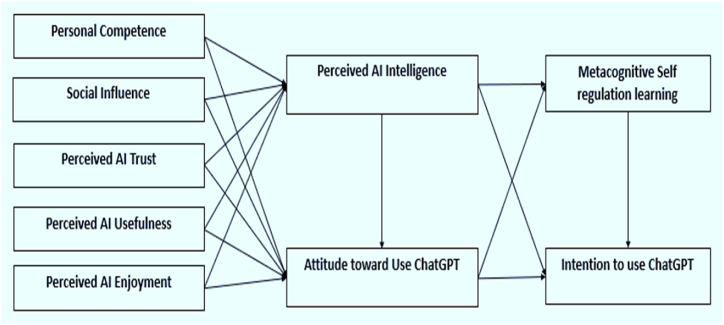
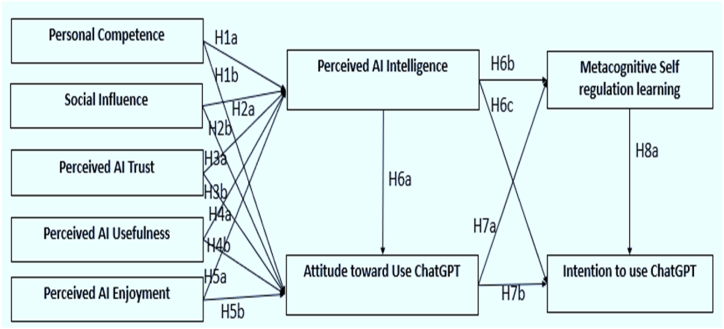
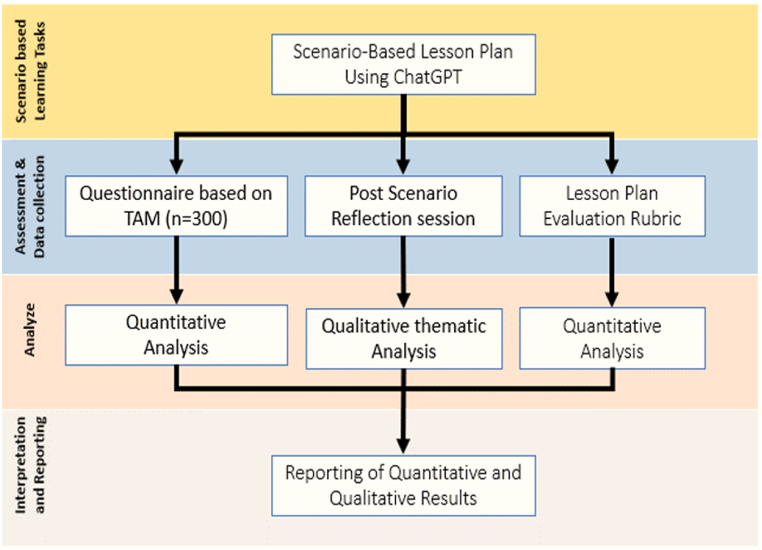
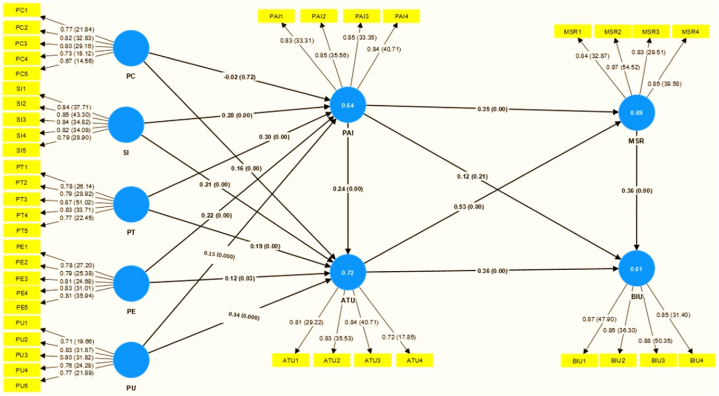
This mixed-method study explores the acceptance of ChatGPT as a tool for Metacognitive Self-Regulated Learning (MSRL) among academics. Despite the growing attention towards ChatGPT as a metacognitive learning tool, there is a need for a comprehensive understanding of the factors influencing its acceptance in academic settings. Engaging 300 preservice teachers through a ChatGPT-based scenario learning activity and utilizing convenience sampling, this study administered a questionnaire based on the proposed Technology Acceptance Model at UTM University's School of Education. Structural equation modelling was applied to analyze participants' perspectives on ChatGPT, considering factors like MSRL's impact on usage intention. Post-reflection sessions, semi-structured interviews, and record analysis were conducted to gather results. Findings indicate a high acceptance of ChatGPT, significantly influenced by personal competency, social influence, perceived AI usefulness, enjoyment, trust, AI intelligence, positive attitude, and metacognitive self-regulated learning. Interviews and record analysis suggest that academics view ChatGPT positively as an educational tool, seeing it as a solution to challenges in teaching and learning processes. The study highlights ChatGPT's potential to enhance MSRL and holds implications for teacher education and AI integration in educational settings.
Overview
The claims and statistics of this paper haven’t been checked yet.
Run the check — free, no account needed. It reads the open-access text and checks the sources it cites.
Integrity signals
Registry
Cites
Statistics
Figures
Verification
Claims the paper makes
The claims and statistics of this paper haven’t been checked yet.
Run the check — free, no account needed. It reads the open-access text and checks the sources it cites.
Claims other papers make about this one
Each is checked against this paper’s own text: does it say what the citing paper says it does?
The cited source says what the claim attributes to it.
In the citing paper
“Similarly, the positive effects of SI are consistent with prior research indicating that social expectations, peer endorsement, and collective support can shape users’ acceptance of new technologies [61,103,104,105,106].”
Self-check
Percentages, sums and reported differences re-computed from the paper’s own numbers.
The self-check needs the paper’s full text.
Citations
Cites
1 retracted
Wang, C., Ahmad, S. F., Ahmad, A. Y. A. B., Awwad, E. M., Irshad, M., Ali, Y. A., Al‐Razgan, M., Khan, Y., & Han, H. (2023) · Heliyon · doi:10.1016/j.heliyon.2023.e18349 · Cited by 297
RetractedUsing thematic analysis in psychology
Braun, V., & Clarke, V. (2006) · Qualitative Research in Psychology · doi:10.1191/1478088706qp063oa · Cited by 194,414
Evaluating structural equation models with unobservable variables and measurement error
Fornell, C., & Larcker, D. F. (1981) · Journal of Marketing Research · doi:10.1177/002224378101800104 · Cited by 109,190 · cited 4×
“These collective findings affirm that these constructs effectively measure distinct latent variables, ensuring the absence of multicollinearity or overlapping influences [125 – 127]. technology for educational purposes.”
BackgroundMethodResultInfluentialPerceived usefulness, perceived ease of use, and user acceptance of information technology
Davis, F. D. (1989) · MIS Quarterly · doi:10.2307/249008 · Cited by 68,483 · cited 3×
“Empirical support for this concept is evident in Dent and Koenka ’ s [19] meta-analysis of 61 studies, where measures of metacognitive processes exhibited stronger correlations with achievement compared to measures of cognitive strategy utilization.”
BackgroundA new criterion for assessing discriminant validity in variance-based structural equation modeling
Henseler, J., Ringle, C. M., & Sarstedt, M. (2015) · Journal of the Academy of Marketing Science · doi:10.1007/s11747-014-0403-8 · Cited by 38,459
(1975) · PhilPapers (PhilPapers Foundation) · Cited by 36,737
When to Use and How to Report the Results of PLS-SEM
Hair, J. F., Risher, J. J., Sarstedt, M., & Ringle, C. M. (2019) · European Business Review · doi:10.1108/ebr-11-2018-0203 · Cited by 27,541 · cited 5×
“These values surpass the recommended threshold of 0.7, affirming strong internal consistency [102,123].”
BackgroundInfluentialUser Acceptance of Computer Technology: A Comparison of Two Theoretical Models
Davis, F. D., Bagozzi, R. P., & Warshaw, P. R. (1989) · Management Science · doi:10.1287/mnsc.35.8.982 · Cited by 25,709 · cited 3×
“The model explains that PU and PEOU shape individuals ’ attitudes and both PU and attitudes toward technology usage predict BI [46,60].”
BackgroundMethodPartial least squares structural equation modeling (PLS-SEM): An emerging tool in business research
F. Hair Jr, J., Sarstedt, M., Hopkins, L., & G. Kuppelwieser, V. (2014) · European Business Review · doi:10.1108/ebr-10-2013-0128 · Cited by 11,728 · cited 2×
“This was done per the well-established two-step approach suggested by other research [116,115,117,118].”
BackgroundMethodComparison of convenience sampling and purposive sampling
Etikan, I. (2016) · American Journal of Theoretical and Applied Statistics · doi:10.11648/j.ajtas.20160501.11 · Cited by 11,412 · cited 4×
“[110,111].”
MethodResultInfluential
Research works printed but not linked: 10
- Jiang, 2016, Assessing teachers' metacognition in teaching: the teacher metacognition inventory, Teach, Teach. Educ., 59, 403
- Lai, 2011, Metacognition: a literature review, always learn, Pearson Res. Rep., 24, 1
- Bran, 2011, Metacognitive regulation and in-depth learning. A study on the students preparing to become teachers, Procedia-Social, Behav. Sci., 11, 107
- Muijs D., Bokhove C., Metacognition and self-regulation: evidence review, Educ. Endow. Found. (2020). report 2020.
- Altwairesh, 2021, Mobile payments from merchants' perspective: an empirical study using the TAM model in Saudi Arabia, Int. J. Comput. Sci. Netw. Secur., 21, 317
- McAuley, 1985, Modeling and self-efficacy: a test of Bandura's model, J. Sport Exerc, Psychol., 7, 283
- Lee, 2023, Understanding continuance intention of artificial intelligence (AI)-enabled mobile banking applications: an extension of AI characteristics to an expectation confirmation model, Humanit, Soc. Sci. Commun., 10, 1
- Alshenqeeti, 2014, Interviewing as a data collection method: a critical review, English Linguist, Res., 3, 39
- Hair, 2006, vol. 6
- Morris, 2000, Age differences in technology adoption decisions: implications for a changing work force, Pers, Psychol., 53, 375
Cited by
Sorted by citations
Almogren, A. S., Al-Rahmi, W. M., & Dahri, N. A. (2024) · Heliyon · doi:10.1016/j.heliyon.2024.e31887 · Cited by 250
Schei, O. M., Møgelvang, A., & Ludvigsen, K. (2024) · Education Sciences · doi:10.3390/educsci14080922 · Cited by 166
“Dahri et al. [30] used an extended TAM model, finding a high acceptance of ChatGPT among university students.”
Zong, Y., & Yang, L. (2025) · European Journal of Education · doi:10.1111/ejed.12925 · Cited by 173
Almulla, M. A. (2024) · Heliyon · doi:10.1016/j.heliyon.2024.e32220 · Cited by 174
“Satisfied students exhibit higher levels of persistence and achieve better learning outcomes, adopting a positive learning environment [34,35].”
BackgroundMethodResultInfluentialAlshammarı, S. H., & Babu, E. (2025) · Scientific Reports · doi:10.1038/s41598-025-91634-4 · Cited by 161
“Technology solutions that students perceive as easy to use, such as ChatGPT, are more likely to be used and to interact with 30 .”
Metadata
- Authors
- Dahri, N. A., Yahaya, N., Al-Rahmi, W. M., Aldraiweesh, A., Alturki, U., Almutairy, S., Shutaleva, A., & Soomro, R. B.
- Affiliations
- University of Technology Malaysia (MY)
- King Saud University (SA)
- Ural Federal University (RU)
- Corresponding author
- Dahri, Nisar Ahmed
- Yahaya, Noraffandy
- ORCID
- Venue
- Heliyon
- Publisher
- Elsevier BV
- Published
- 2024-04
- Volume
- 10
- Issue
- 8
- Pages
- e29317
- ISSN
- 2405-8440 (ISSN-L)
- PMC
- PMC11016976
- OpenAlex
- W4394611033
- Cited by
- 239
- References
- 113
- Citations by year
- 2026: 117 · 2025: 99 · 2024: 23
- FWCI
- 89.86
- Type
- journal article
- Language
- en
- Open access
- gold
- doi.org
- Licence
- Locations
- Heliyon (publishedVersion, cc-by)
- PubMed Central (publishedVersion, cc-by)
- PubMed (publishedVersion)
- DOAJ (DOAJ: Directory of Open Access Journals) (submittedVersion, cc-by-sa)
- Greater South Information System
- Funders
- King Saud University (RSP2024R159)
- Universiti Teknologi Malaysia (Q.J130000.21A2.07E10)
- Research Management Centre, Universiti Teknologi Malaysia
- Microsoft Research
- Topics
- Social Sciences › Education › Artificial Intelligence in Education
- Social Sciences › Decision Sciences › Information Systems and Management › Technology Adoption and User Behaviour
- Social Sciences › Education › Education and Learning Interventions
- Keywords
- ChatGPT, technology acceptance, pre-service teachers, artificial intelligence in education, trust in AI, teacher professional development, AI integration in schools
About these checks
Registry, retraction, Cites and statistics results are computed, not judged, with one exception: a printed reference that no index lists is read once by a model before it counts as a citation error. Claims are extracted by a model and kept only when their quote appears verbatim in the text; each cited source is then checked, with a model’s help, for whether it says what the claim relies on. Those verdicts can be wrong — read the claim’s quote and the cited source before relying on one.
Statistics and arithmetic are recomputed, not judged.
Confidence bands are shown only for fields calibrated on our annotated test set. None is calibrated yet, so no band is shown.
What counts as a claim ›How we measure confidence ›How we check this ›
Are you an author, or do you see a problem with this page? Request a review
