

The DOI matches its Crossref record; 110 of the 113 references it cites were found in a registry or an index.
Extended TAM based acceptance of AI-Powered ChatGPT for supporting metacognitive self-regulated learning in education: A mixed-methods study
Open accessAbstract
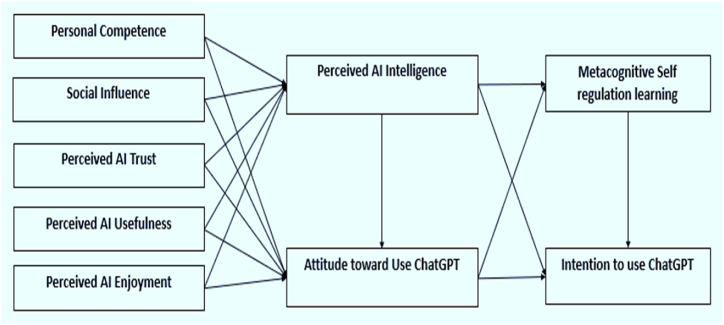
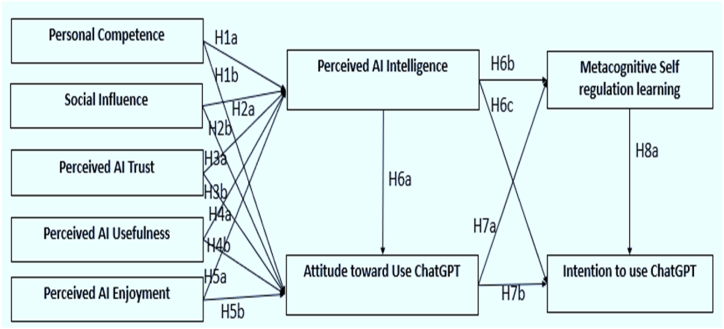
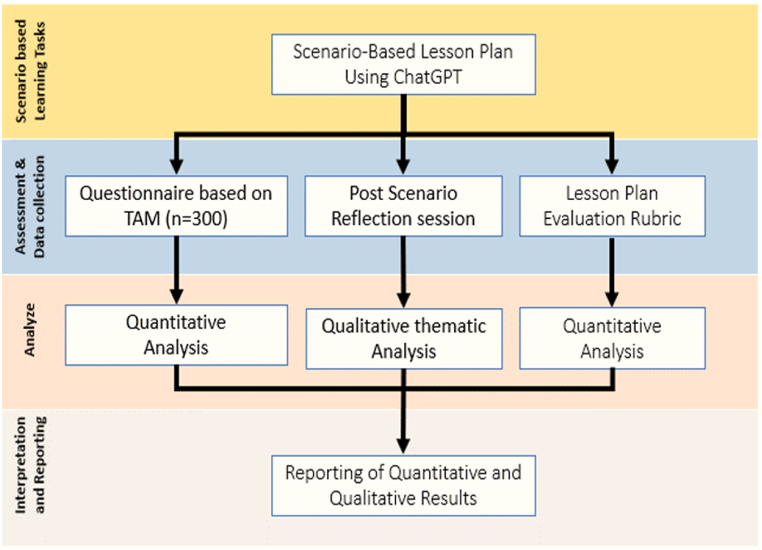
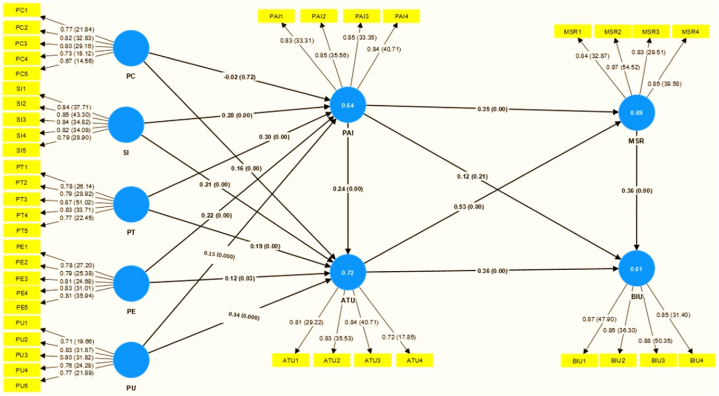
This mixed-method study explores the acceptance of ChatGPT as a tool for Metacognitive Self-Regulated Learning (MSRL) among academics. Despite the growing attention towards ChatGPT as a metacognitive learning tool, there is a need for a comprehensive understanding of the factors influencing its acceptance in academic settings. Engaging 300 preservice teachers through a ChatGPT-based scenario learning activity and utilizing convenience sampling, this study administered a questionnaire based on the proposed Technology Acceptance Model at UTM University's School of Education. Structural equation modelling was applied to analyze participants' perspectives on ChatGPT, considering factors like MSRL's impact on usage intention. Post-reflection sessions, semi-structured interviews, and record analysis were conducted to gather results. Findings indicate a high acceptance of ChatGPT, significantly influenced by personal competency, social influence, perceived AI usefulness, enjoyment, trust, AI intelligence, positive attitude, and metacognitive self-regulated learning. Interviews and record analysis suggest that academics view ChatGPT positively as an educational tool, seeing it as a solution to challenges in teaching and learning processes. The study highlights ChatGPT's potential to enhance MSRL and holds implications for teacher education and AI integration in educational settings.
Overview
The claims and statistics of this paper haven’t been checked yet.
Run the check — free, no account needed. It reads the open-access text and checks the sources it cites.
Integrity signals
Registry
Cites
Statistics
Figures
Verification
Claims the paper makes
The claims and statistics of this paper haven’t been checked yet.
Run the check — free, no account needed. It reads the open-access text and checks the sources it cites.
Claims other papers make about this one
Each is checked against this paper’s own text: does it say what the citing paper says it does?
The cited source says what the claim attributes to it.
In the citing paper
“Similarly, the positive effects of SI are consistent with prior research indicating that social expectations, peer endorsement, and collective support can shape users’ acceptance of new technologies [61,103,104,105,106].”
Self-check
Percentages, sums and reported differences re-computed from the paper’s own numbers.
The self-check needs the paper’s full text.
Citations
Cites
1 retracted
Wang, C., Ahmad, S. F., Ahmad, A. Y. A. B., Awwad, E. M., Irshad, M., Ali, Y. A., Al‐Razgan, M., Khan, Y., & Han, H. (2023) · Heliyon · doi:10.1016/j.heliyon.2023.e18349 · Cited by 297
RetractedUsing thematic analysis in psychology
Braun, V., & Clarke, V. (2006) · Qualitative Research in Psychology · doi:10.1191/1478088706qp063oa · Cited by 194,414
Evaluating structural equation models with unobservable variables and measurement error
Fornell, C., & Larcker, D. F. (1981) · Journal of Marketing Research · doi:10.1177/002224378101800104 · Cited by 109,190 · cited 4×
“These collective findings affirm that these constructs effectively measure distinct latent variables, ensuring the absence of multicollinearity or overlapping influences [125 – 127]. technology for educational purposes.”
BackgroundMethodResultInfluentialPerceived usefulness, perceived ease of use, and user acceptance of information technology
Davis, F. D. (1989) · MIS Quarterly · doi:10.2307/249008 · Cited by 68,483 · cited 3×
“Empirical support for this concept is evident in Dent and Koenka ’ s [19] meta-analysis of 61 studies, where measures of metacognitive processes exhibited stronger correlations with achievement compared to measures of cognitive strategy utilization.”
BackgroundA new criterion for assessing discriminant validity in variance-based structural equation modeling
Henseler, J., Ringle, C. M., & Sarstedt, M. (2015) · Journal of the Academy of Marketing Science · doi:10.1007/s11747-014-0403-8 · Cited by 38,459
(1975) · PhilPapers (PhilPapers Foundation) · Cited by 36,737
When to Use and How to Report the Results of PLS-SEM
Hair, J. F., Risher, J. J., Sarstedt, M., & Ringle, C. M. (2019) · European Business Review · doi:10.1108/ebr-11-2018-0203 · Cited by 27,541 · cited 5×
“These values surpass the recommended threshold of 0.7, affirming strong internal consistency [102,123].”
BackgroundInfluentialUser Acceptance of Computer Technology: A Comparison of Two Theoretical Models
Davis, F. D., Bagozzi, R. P., & Warshaw, P. R. (1989) · Management Science · doi:10.1287/mnsc.35.8.982 · Cited by 25,709 · cited 3×
“The model explains that PU and PEOU shape individuals ’ attitudes and both PU and attitudes toward technology usage predict BI [46,60].”
BackgroundMethodPartial least squares structural equation modeling (PLS-SEM): An emerging tool in business research
F. Hair Jr, J., Sarstedt, M., Hopkins, L., & G. Kuppelwieser, V. (2014) · European Business Review · doi:10.1108/ebr-10-2013-0128 · Cited by 11,728 · cited 2×
“This was done per the well-established two-step approach suggested by other research [116,115,117,118].”
BackgroundMethodComparison of convenience sampling and purposive sampling
Etikan, I. (2016) · American Journal of Theoretical and Applied Statistics · doi:10.11648/j.ajtas.20160501.11 · Cited by 11,412 · cited 4×
“[110,111].”
MethodResultInfluential
Research works printed but not linked: 10
- Jiang, 2016, Assessing teachers' metacognition in teaching: the teacher metacognition inventory, Teach, Teach. Educ., 59, 403
- Lai, 2011, Metacognition: a literature review, always learn, Pearson Res. Rep., 24, 1
- Bran, 2011, Metacognitive regulation and in-depth learning. A study on the students preparing to become teachers, Procedia-Social, Behav. Sci., 11, 107
- Muijs D., Bokhove C., Metacognition and self-regulation: evidence review, Educ. Endow. Found. (2020). report 2020.
- Altwairesh, 2021, Mobile payments from merchants' perspective: an empirical study using the TAM model in Saudi Arabia, Int. J. Comput. Sci. Netw. Secur., 21, 317
- McAuley, 1985, Modeling and self-efficacy: a test of Bandura's model, J. Sport Exerc, Psychol., 7, 283
- Lee, 2023, Understanding continuance intention of artificial intelligence (AI)-enabled mobile banking applications: an extension of AI characteristics to an expectation confirmation model, Humanit, Soc. Sci. Commun., 10, 1
- Alshenqeeti, 2014, Interviewing as a data collection method: a critical review, English Linguist, Res., 3, 39
- Hair, 2006, vol. 6
- Morris, 2000, Age differences in technology adoption decisions: implications for a changing work force, Pers, Psychol., 53, 375
Cited by
Sorted by citations
Almogren, A. S., Al-Rahmi, W. M., & Dahri, N. A. (2024) · Heliyon · doi:10.1016/j.heliyon.2024.e31887 · Cited by 250
Schei, O. M., Møgelvang, A., & Ludvigsen, K. (2024) · Education Sciences · doi:10.3390/educsci14080922 · Cited by 166
“Dahri et al. [30] used an extended TAM model, finding a high acceptance of ChatGPT among university students.”
Zong, Y., & Yang, L. (2025) · European Journal of Education · doi:10.1111/ejed.12925 · Cited by 173
Almulla, M. A. (2024) · Heliyon · doi:10.1016/j.heliyon.2024.e32220 · Cited by 174
“Satisfied students exhibit higher levels of persistence and achieve better learning outcomes, adopting a positive learning environment [34,35].”
BackgroundMethodResultInfluentialAlshammarı, S. H., & Babu, E. (2025) · Scientific Reports · doi:10.1038/s41598-025-91634-4 · Cited by 161
“Technology solutions that students perceive as easy to use, such as ChatGPT, are more likely to be used and to interact with 30 .”
Sardi, J., Darmansyah, Candra, O., Yuliana, D. F., Habibullah, Yanto, D. T. P., & Eliza, F. (2025) · International Journal of Engineering Pedagogy (iJEP) · doi:10.3991/ijep.v15i1.53379 · Cited by 105
Soomro, R. B., Al-Rahmi, W. M., Dahri, N. A., Almuqren, L., Almogren, A. S., & Aldaijy, A. (2025) · Scientific Reports · doi:10.1038/s41598-025-86464-3 · Cited by 164
Al-kfairy, M. (2024) · Applied System Innovation · doi:10.3390/asi7060110 · Cited by 123
“This method involves coding the data and organizing them into meaningful categories that reflect the key factors influencing the adoption of ChatGPT [15,21].”
InfluentialDahri, N. A., Yahaya, N., Al-Rahmi, W. M., Almuqren, L., Almgren, A. S., Alshimai, A., & Al‐Adwan, A. S. (2025) · IEEE Access · doi:10.1109/access.2025.3560567 · Cited by 111
“Teachers often struggle to incorporate 21st-century teaching approaches due to a lack of knowledge and training, further compounding these issues [12], [13].”
Zhang, C., Hu, M., Wu, W., Kamran, F., & Wang, X. (2024) · Education and Information Technologies · doi:10.1007/s10639-024-12905-7 · Cited by 102
“Likewise, Dahri et al. (2024) investigated the acceptance of ChatGPT as a metacognitive self-regulated learning (MSRL) tool among 300 pre-service teachers.”
Iqbal, J., Hashmi, Z. F., Asghar, M. Z., & Abid, M. N. (2025) · Scientific Reports · doi:10.1038/s41598-025-01676-x · Cited by 82
Banihashem, S. K., Bond, M., Bergdahl, N., Khosravi, H., & Noroozi, O. (2025) · International Journal of Educational Technology in Higher Education · doi:10.1186/s41239-025-00548-8 · Cited by 82
“Additionally, AI aids metacognition by providing feedback, helping with study planning, and assessing progress, thereby fostering self-awareness and strategic learning (Afzaal et al., 2024; Dahri et al., 2024).”
Balaskas, S., Tsiantos, V., Chatzifotiou, S., & Rigou, M. (2025) · Information · doi:10.3390/info16020082 · Cited by 81
“These findings contribute to theoretical discussions on the evolving dynamics in the adoption of AI, where utility alone may not be sufficient without addressing users’ basic concerns [21,26,32].”
Soomro, R. B., Memon, S. G., Dahri, N. A., Al-Rahmi, W. M., Aldriwish, K., Salameh, A. A. M., Al‐Adwan, A. S., & Saleem, A. (2024) · Sustainability · doi:10.3390/su16177351 · Cited by 127
Ocen, S., Elasu, J., Aarakit, S. M., & Olupot, C. (2025) · Frontiers in Education · doi:10.3389/feduc.2025.1530247 · Cited by 157
Jeilani, A., & Abubakar, S. (2025) · Frontiers in Education · doi:10.3389/feduc.2025.1548900 · Cited by 64
Ursavaş, Ö. F., Yalçın, Y., İslamoğlu, H., Bakır-Yalçın, E., & Cukurova, M. (2025) · International Journal of Educational Technology in Higher Education · doi:10.1186/s41239-025-00535-z · Cited by 69
“This finding indicates that fostering positive attitudes toward GenAI tools is critical for driving their adoption and use among university students, consistent with previous research (Dahri et al., 2024; Nazaretsky et al., 2022; Zou & Huang, 2023).”
InfluentialHuang, L., & Zhao, Y. (2025) · Frontiers in Psychology · doi:10.3389/fpsyg.2025.1669247 · Cited by 55
Large language models: Expectations for semantics-driven systems engineering
Buchmann, R. A., Eder, J., Fill, H.-G., Frank, U., Karagiannis, D., Laurenzi, E., Mylopoulos, J., Plexousakis, D., & Santos, M. Y. (2024) · Data & Knowledge Engineering · doi:10.1016/j.datak.2024.102324 · Cited by 59
Aldraiweesh, A., & Alturki, U. (2025) · IEEE Access · doi:10.1109/access.2025.3534099 · Cited by 78
“These tools, powered by large language models (LLMs), enable students to access real-time, contextually relevant explanations, generate creative content, and receive writing assistance [59], [60].”
García-Alonso, E. M., León-Mejía, A. C., Sánchez-Cabrero, R., & Guzmán-Ordaz, R. (2024) · Behavioral Sciences · doi:10.3390/bs14070612 · Cited by 53
Li, J., & Lv, C. (2024) · PLoS ONE · doi:10.1371/journal.pone.0308267 · Cited by 55
Exploring the influence of ChatGPT on student academic success and career readiness
Dahri, N. A., Yahaya, N., & Al-Rahmi, W. M. (2024) · Education and Information Technologies · doi:10.1007/s10639-024-13148-2 · Cited by 69
“Furthermore, research has shown that ChatGPT usage can have a significant impact on user outcomes, such as improved academic performance (Dahri et al., 2024a; Lund et al., 2023), enhanced customer satisfaction (Rathore, 2023), and increased user engagement (Choudhury & Shamszare, 2023).”
InfluentialŞimşek, A. S., Cengiz, G. Ş. T., & Bal, M. (2025) · Education and Information Technologies · doi:10.1007/s10639-025-13591-9 · Cited by 65
“Additionally, Dahri et al. (2024) emphasized that addressing teachers’ cognitive and practical needs enhances their willingness to adopt technology.”
InfluentialXia, Q., Liu, Q., Tlili, A., & Chiu, T. K. F. (2025) · Computers & Education · doi:10.1016/j.compedu.2025.105465 · Cited by 77
Kim, M., Kim, J., Knotts, T. L., & Albers, N. D. (2025) · Education and Information Technologies · doi:10.1007/s10639-025-13398-8 · Cited by 38
“For example, Dahri et al. ( 2024 ) explored the acceptance of ChatGPT in supporting metacognitive self-regulated learning (MSRL) using an extended Technology Acceptance Model (TAM).”
Liu, F., Chang, X., Zhu, Q., Huang, Y., Li, Y., & Wang, H. (2024) · BMC Medical Education · doi:10.1186/s12909-024-06232-1 · Cited by 35
“As peer-to-peer communication is an important way for people to obtain new technology, the adoption of LLMs could be influenced by social impact with network externalities [21, 22].”
BackgroundTohănean, D. I., Vulpe, A.-M., Mijaică, R., & Alexe, D. I. (2025) · Applied Sciences · doi:10.3390/app15179826 · Cited by 35
Ning, Y., Zheng, H., Wu, H., Jin, Z. M., Chang, H., & Wijaya, T. T. (2025) · Education and Information Technologies · doi:10.1007/s10639-025-13477-w · Cited by 43
Understanding Teachers’ Adoption of AI Technologies: An Empirical Study from Chinese Middle Schools
Zhao, J., Li, S., & Zhang, J. (2025) · Systems · doi:10.3390/systems13040302 · Cited by 46
“Furthermore, under the theme of acceptance of AI teaching technologies, novel latent variables—such as Teacher’s Trust [24,27], Subjective Norms [28,29], Anxiety [27,30], and Perceived Risk [13,31]—have emerged, alongside conventional variables like Performance Expectancy, Facilitating Conditions,…”
He, A. J., Zhang, Z., Anand, P., & McMinn, S. (2024) · Journal of Asian Public Policy · doi:10.1080/17516234.2024.2447195 · Cited by 44
“In the context of academic learning, learners who have positive attitudes towards the usefulness of ChatGPT tend to demonstrate a higher level of behavioural intention that positively predicts their actual use of it (Abdaljaleel et al., 2024; Almogren et al., 2024; Dahri et al., 2024).”
Uludağ, F., Kılıç, E., & Çelik, H. E. (2025) · Humanities and Social Sciences Communications · doi:10.1057/s41599-025-05641-x · Cited by 41
“Various studies (Algera fi et al. 2023; Zhang et al. 2023; Boubker, 2024; Dahri et al. 2024; Albayati, 2024; Abdalla, 2024) emphasized that SI has an effect on PU.”
Alwakid, W. N., Dahri, N. A., Humayun, M., & Alwakid, G. N. (2025) · Systems · doi:10.3390/systems13070517 · Cited by 62
Alqurni, J. S. (2026) · Frontiers in Artificial Intelligence · doi:10.3389/frai.2026.1738774 · Cited by 41
A Systematic Review of User Attitudes Toward GenAI: Influencing Factors and Industry Perspectives
Chen, J., Wei, X., Xie, Q., Hu, A., Qiao, Y., Wan, R., & Liu, Y. (2025) · Journal of Intelligence · doi:10.3390/jintelligence13070078 · Cited by 41
Şengül, T., Sarıköse, S., Uncu, B., & Kaya, N. (2025) · Nurse Education in Practice · doi:10.1016/j.nepr.2025.104516 · Cited by 26
Ngo, T. T. A., Vo, T. T. A., & Phan, M. T. (2025) · Acta Psychologica · doi:10.1016/j.actpsy.2025.105789 · Cited by 32
AI support in self‐regulated learning: A decade of technological evolution and meta‐analysis
Xu, J. H., Luo, Y., Wang, C., Wang, M., & Wu, Y. (2026) · British Journal of Educational Technology · doi:10.1111/bjet.70058 · Cited by 26
AI Adoption for Collaboration: Factors Influencing Inclusive Learning Adoption in Higher Education
Alyoussef, I. Y., Drwish, A. M., Albakheet, F. A., Alqahtani, R. H. A., & Technology, A. A. A. E. (2025) · IEEE Access · doi:10.1109/access.2025.3567656 · Cited by 46
“AI enables personalized instruction, real-time feedback, and information-driven understandings, empowering educators to deliver tailored educational experiences that optimize student learning outcomes [10], [11], [12].”
InfluentialAbdi, A.-N. M., Omar, A. M., Ahmed, M. H., & Ahmed, A. A. (2025) · Cogent Education · doi:10.1080/2331186x.2025.2460250 · Cited by 30
“Moreover, consistent with the recent literature, the study found that PEU is positively and significantly associated with the students ’ behavioral intention to use ChatGPT (BIU) for academic reasons (Almogren et al., 2024; Dahri et al., 2024; Yu et al., 2024).”
InfluentialStudents’ Reliance on AI in Higher Education: Identifying Contributing Factors
Pitts, G., Rani, N., Mildort, W., & Cook, E.-M. (2026) · Communications in computer and information science · doi:10.1007/978-3-032-12773-0_9 · Cited by 64
Huang, W., & Hew, K. F. (2024) · IEEE Transactions on Learning Technologies · doi:10.1109/tlt.2024.3523199 · Cited by 32
Koteczki, R., & Balassa, B. E. (2025) · Education Sciences · doi:10.3390/educsci15081044 · Cited by 39
Salam, U. (2024) · Computers in the Schools · doi:10.1080/07380569.2024.2446239 · Cited by 33
“Dahri et al. (2024) explored the TAM of the acceptance of ChatGPT for Metacognitive Self-Regulated Learning (MSRL).”
Abduljawad, S. A. (2025) · International Journal of Computer-Assisted Language Learning and Teaching · doi:10.4018/ijcallt.367276 · Cited by 19
Dahri, N. A., Yahaya, N., Vighio, M. S., & Jumaat, N. F. (2025) · Education and Information Technologies · doi:10.1007/s10639-025-13539-z · Cited by 23
“In this way, teachers can integrate AI-driven applications to create an inclusive classroom envi - ronment that helps cater to diverse student needs and enables higher-order thinking skills for all students (Dahri et al., 2024a, b, c , d ).”
InfluentialOyundari, B., Yondon, C., Enkhbat, R., Darkhijav, B., & Rahman, M. (2025) · Future Business Journal · doi:10.1186/s43093-025-00504-y · Cited by 25
Gong, Y., Xu, C., Luo, S., & Lin, J. (2025) · Scientific Reports · doi:10.1038/s41598-025-03298-9 · Cited by 32
“Teachers’ acceptance of ChatGPT is closely tied to their teaching roles: novice educators are more likely to rely on AI for teaching design, whereas experienced educators tend to view it as a supplementary tool 46 .”
Zhang, Q., Pan, X., & Fan, J. (2025) · European Journal of Education · doi:10.1111/ejed.70336 · Cited by 21
Kukanja, M. (2024) · Systems · doi:10.3390/systems12120526 · Cited by 28
“Empirical research has validated these modified models across a variety of applications, demonstrating their effectiveness in predicting user acceptance [58,59].”
Sun, X., Dou, W., & Yang, Y. (2025) · Acta Psychologica · doi:10.1016/j.actpsy.2025.105956 · Cited by 16
Bukar, U. A., Sayeed, M. S., Razak, A., Yogarayan, S., & Sneesl, R. (2024) · Education Sciences · doi:10.3390/educsci14090959 · Cited by 24
Bai, L. (2025) · Current Psychology · doi:10.1007/s12144-024-07167-y · Cited by 17
“The integration of these frameworks captures both the environmental influences and rational decision pro - cesses that shape user behavior in educational technology adoption (Dahri et al., 2024).”
Sasongko, A. T., Ekhsan, M., & Fatchan, M. (2025) · Telematics and Informatics Reports · doi:10.1016/j.teler.2025.100192 · Cited by 28
Yang, S. C. (2026) · Computers in Human Behavior · doi:10.1016/j.chb.2026.108933 · Cited by 17
Alwakid, W. N., Dahri, N. A., Humayun, M., & Alwakid, G. N. (2025) · The International Journal of Management Education · doi:10.1016/j.ijme.2025.101252 · Cited by 18
Alwakid, W., & Dahri, N. A. (2025) · Education and Information Technologies : Official Journal of the IFIP technical committee on Education · doi:10.1007/s10639-025-13777-1 · Cited by 10
“SEM is well known for its capacity to test sophisticated theoretical models and measure latent constructs through multiple observed indica - tors (Dahri et al., 2024a, b , 2025c; Soormo et al., 2024).”
Liu, M., Zhang, L. J., & Neufeld, T. J. E. (2025) · Innovation in Language Learning and Teaching · doi:10.1080/17501229.2025.2549754 · Cited by 18
Assessing ChatGPT Adoption in Higher Education: An Empirical Analysis
Dorobăț, I., & Corbea, A. M. I. (2025) · Electronics · doi:10.3390/electronics14234739 · Cited by 16
Zhang, N., Wong, W. L., & Barrot, J. S. (2025) · Scientific Reports · doi:10.1038/s41598-025-21205-0 · Cited by 19
“The two attitudinal drivers that predict behavioural intention in extended TAM research on ChatGPT adoption 13 .”
Changes in Public Perception of ChatGPT: A Text Mining Perspective Based on Social Media
Liu, Y., & Lyu, Z. (2024) · International Journal of Human-Computer Interaction · doi:10.1080/10447318.2024.2406966 · Cited by 14
“Partial scholars based on unstructured questionnaires employed qualitative analysis methods to investigate perceptions of ChatGPT, compensating for the drawbacks of structured questionnaires (Dahri et al., 2024; Wei et al., 2024).”
Generative AI and Its Potential Impact on Humanity
Nasr, R. S., & El‐Deeb, S. (2025) · International Journal of Consumer Studies · doi:10.1111/ijcs.70024 · Cited by 16
What Shapes Learners’ Trust in AI? A Meta-Analytic Review of Its Antecedents and Consequences
Cui, Y., Zeng, M. L., Du, X. K., & He, W. M. (2025) · IEEE Access · doi:10.1109/access.2025.3611367 · Cited by 18
“Prior research has consistently emphasized that trust in technology is a key determinant of users’ willingness to accept and use new systems [83], [109], as it helps alleviate learners’ concerns about potential risks and uncertainties associated with novel technologies [110].”
Ingason, H. Þ., Aaltonen, K., Asmundarson, A. S., Friðgeirsson, Þ. V., Huemann, D., Huemann, M., Kujala, J., Lampela, H., Mancini, M., Mariani, C., et al. (2025) · Project Leadership and Society · doi:10.1016/j.plas.2025.100193 · Cited by 17
Dahri, N. A., Dahri, F. H., Laghari, A. A., & Javed, M. (2025) · Complex Engineering Systems · doi:10.20517/ces.2025.07 · Cited by 10
Foresight for Sustainable Last-Mile Delivery: A Delphi-Based Scenario Study for Smart Cities in 2030
Mutambik, I. (2025) · Sustainability · doi:10.3390/su17156660 · Cited by 9
Exploring students’ perceptions of generative AI-generated feedback in learning programming
Khor, E. T., Chan, L., Koh, E., & Seow, P. (2025) · Educational Psychology · doi:10.1080/01443410.2025.2564894 · Cited by 9
“…2024), other studies in different educational and cultural contexts find that subjective norms instead indirectly influence students’ behavioural intentions through its positive effect on students’ acceptance attitudes towards using GenAI (Albayati, 2024; dahri et al., 2024; Tiwari et al., 2024).”
Sun, Y., Li, L., Zhang, X., Chen, X., Deng, S., & Hu, X. (2026) · BMC Psychology · doi:10.1186/s40359-026-03989-6 · Cited by 15
Liu, H., Fang, X., Cui, Q., & Chiu, T. K. F. (2026) · Review of Education · doi:10.1002/rev3.70141 · Cited by 12
Dahri, N. A., Yahaya, N., & Vighio, M. S. (2025) · Education and Information Technologies · doi:10.1007/s10639-025-13583-9 · Cited by 11
“This hypothesis aligns with research showing that SRL enhances students’engagement and performance in collaborative settings, driving group learning success (Dahri et al., 2024b; Zimmerman, 1989).”
Zhao, J., Yao, H., & Zhang, J. (2025) · Education and Information Technologies · doi:10.1007/s10639-025-13661-y · Cited by 9
“Over the last few years, there has been growing academic interest in artificial intelli - gence (AI) and how to apply it effectively in the teaching process (Dahri et al., 2024).”
InfluentialAL-Qadri, A. H., & Al-khresheh, M. H. (2025) · The Electronic Library · doi:10.1108/el-12-2024-0391 · Cited by 10
Tian, J., & Zhang, R. (2026) · Humanities and Social Sciences Communications · doi:10.1057/s41599-026-07153-8 · Cited by 18
“…use AI as a cognitive scaffold — requesting explanations, counter-arguments, and alternative perspectives — and then actively interrogating these outputs, which can stimulate evaluation and metacognitive monitoring in academic tasks (Cheng and Jiang, 2022; Dahri et al., 2024; Wang and Fan, 2025).”
Giray, L., Fabros, B. G., Villarama, J. A., Gumalin, D. L., & Saavedra, J. B. (2025) · Internet Reference Services Quarterly · doi:10.1080/10875301.2025.2542212 · Cited by 9
“In their study on ChatGPT’s acceptability, Dahri et al. (2024) revealed how personal competency and social elements support the aim of utilizing AI in metacognitive self-regulated learning among pre-service teachers.”
Noor, N., Tong, A., & Zainol, Z. (2025) · Journal of Information Communication and Ethics in Society · doi:10.1108/jices-03-2025-0071 · Cited by 9
Subuhpoto, S., Liu, G., Su, W., & Aziz, F. (2025) · The Electronic Library · doi:10.1108/el-03-2025-0077 · Cited by 8
Luo, Y., Zhou, G., & Cui, Y. (2026) · Education and Information Technologies · doi:10.1007/s10639-025-13885-y · Cited by 14
Adekoya, O. D., Ajonbadi, H. A., Mordi, C., Samuel, P., & Nguyen, H. (2026) · British Educational Research Journal · doi:10.1002/berj.70138 · Cited by 11
Promoting Interdisciplinary Learning With Generative AI Through Self‐Regulated Scaffolding
Xia, Q., Yang, Y., Wang, W., & Yin, H. (2026) · Journal of Computer Assisted Learning · doi:10.1002/jcal.70214 · Cited by 11
Ateş, H., & GÜNDÜZALP, C. (2025) · Education and Information Technologies · doi:10.1007/s10639-025-13480-1 · Cited by 12
“Research confirms that ease of use significantly influences perceptions of usefulness, reinforcing the role of usability in technology adoption (Al-Adwan et al., 2024; Ateş & Yilmaz, 2024; Dahri et al., 2024; Venkatesh & Davis, 2000).”
AI misuse and passiveness of students in medical education
Hosseini, S. M. (2025) · AJP Advances in Physiology Education · doi:10.1152/advan.00164.2025 · Cited by 7
Bećirović, S., Augustín, M., Mattoš, B., & Dančo, J. (2026) · Discover Computing · doi:10.1007/s10791-026-10042-y · Cited by 7
Sanchez, J. M. P., Sumalinog, G. G., Mananay, J. A., Goles, C. E., Alejandro, I. M. V., & Fernandez, C. B. (2025) · STEM Education · doi:10.3934/steme.2025045 · Cited by 10
Khojasteh, L., Karimian, Z., Nasiri, E., Kafipour, R., & Farahmandi, A. Y. (2025) · BMC Medical Education · doi:10.1186/s12909-025-08288-z · Cited by 10
“Data analysis was conducted using SPSS software, version 26, for Exploratory Factor Analysis.”
Li, F., Chen, J., Shao, T., & Sun, J. (2026) · Frontiers in Psychology · doi:10.3389/fpsyg.2026.1756708 · Cited by 5
DeepL Translate can be a scaffold to speaking fluency: Technology Acceptance Model (TAM)
Imran, M. C., Marzuki, M., Sasabobe, L., Jubhari, Y., & Sujarwo, S. (2025) · EDULEC Education Language and Culture Journal · doi:10.56314/edulec.v5i1.302 · Cited by 5
Alsaedi, N. S. (2025) · Contemporary Educational Technology · doi:10.30935/cedtech/17302 · Cited by 4
The impact of DeepSeek’s perceived interactivity on medical students’ self-directed learning ability
Ju, Y., Li, J., Zhang, X., Wu, M., Pang, X., Li, Z., Wang, J., Li, J., Zhang, Y., & Dai, X. (2026) · Scientific Reports · doi:10.1038/s41598-025-33780-3 · Cited by 4
“Many surveyed educators stated they use AI technologies due to positive peer experiences 60 .”
Büyükeke, A. (2025) · Üniversite Araştırmaları Dergisi · doi:10.32329/uad.1728785 · Cited by 4
Munusamy, S., Rao, S., & Rajagopalan, V. (2026) · American Journal of Pharmaceutical Education · doi:10.1016/j.ajpe.2026.101943 · Cited by 5
Huang, F., & Zhang, H. (2026) · Applied Linguistics · doi:10.1093/applin/amag009 · Cited by 4
Examining the use of artificial intelligence in pre-service teacher education
Ponomarenko, E. B., Sergeeva, O. V., ZHELTUKHINA, M. R., Baranova, K. M., Budkevich, R. L., & Melnik, M. V. (2026) · Contemporary Educational Technology · doi:10.30935/cedtech/18458 · Cited by 5
Empowering Learners: GenIA and Their Impact on Self-regulated learning
Safsouf, Y., & Mouachi, R. (2024) · ITM Web of Conferences · doi:10.1051/itmconf/20246901004 · Cited by 4
“The study revealed a strong acceptance of GenAI chatbots among trainee teachers as tools to support self-regulated learning (SRL) in teaching [18].”
Predicting the actual use of artificial intelligence features of Apple Vision Pro using PLS-SEM
Al-Maroof, R. S., Tawafak, R. M., Al-Rahmi, W. M., Alhashmi, K. A., & Alyoussef, I. Y. (2025) · Contemporary Educational Technology · doi:10.30935/cedtech/16208 · Cited by 4
Exploring educators’ perspectives on ChatGPT integration in engineering and management education
Bhaskar, P., Khan, M., & Bhaskar, P. (2025) · Journal of Information Communication and Ethics in Society · doi:10.1108/jices-04-2025-0088 · Cited by 5
AI in Tourism Education: A Review of AIGC Teaching and Evaluation Tools
Tan, Z., Yang, Y., Yang, X., Liu, X., Wei, Q., & Kong, L. H. (2025) · International Conference on Education and Training Technologies (ICETT) · doi:10.1109/icett66247.2025.11136881 · Cited by 3
“The integration of AI in education has transformed traditional teaching and learning paradigms through several key applications [33].”
AI-based career management to improve the quality of decision making in higher education
Fawaid, A., Baharun, H., Hamzah, M., Rohimah, R., Munawwaroh, I., & Putri, D. F. (2025) · IEEE Integrated STEM Education Conference (ISEC) · doi:10.1109/isec64801.2025.11147274 · Cited by 48
“With a system that can analyze data quickly and accurately, higher education can provide more targeted career recommendations for students, based on their abilities, interests, and relevant job market trends[27].”
Kılıç, E., Almasri, F., & Çelik, H. E. (2025) · Computers and Education Artificial Intelligence · doi:10.1016/j.caeai.2025.100486 · Cited by 5
Lu, H., & Li, X. (2025) · Humanities and Social Sciences Communications · doi:10.1057/s41599-025-06392-5 · Cited by 3
“In terms of AI device adoption, Dahri et al. (2024) integrated factors such as perceived AI trust and perceived AI capability into the TAM to study ChatGPT usage behavioral intentions.”
Zahrani, A. A. (2025) · IEEE Access · doi:10.1109/access.2025.3647788 · Cited by 3
“For example, digital infrastructure has been shown to influence e-learning adoption [76], [77], cloud computing acceptance [78], [82], and AI integration in organizational [79].”
Metadata
- Authors
- Dahri, N. A., Yahaya, N., Al-Rahmi, W. M., Aldraiweesh, A., Alturki, U., Almutairy, S., Shutaleva, A., & Soomro, R. B.
- Affiliations
- University of Technology Malaysia (MY)
- King Saud University (SA)
- Ural Federal University (RU)
- Corresponding author
- Dahri, Nisar Ahmed
- Yahaya, Noraffandy
- ORCID
- Venue
- Heliyon
- Publisher
- Elsevier BV
- Published
- 2024-04
- Volume
- 10
- Issue
- 8
- Pages
- e29317
- ISSN
- 2405-8440 (ISSN-L)
- PMC
- PMC11016976
- OpenAlex
- W4394611033
- Cited by
- 239
- References
- 113
- Citations by year
- 2026: 117 · 2025: 99 · 2024: 23
- FWCI
- 89.86
- Type
- journal article
- Language
- en
- Open access
- gold
- doi.org
- Licence
- Locations
- Heliyon (publishedVersion, cc-by)
- PubMed Central (publishedVersion, cc-by)
- PubMed (publishedVersion)
- DOAJ (DOAJ: Directory of Open Access Journals) (submittedVersion, cc-by-sa)
- Greater South Information System
- Funders
- King Saud University (RSP2024R159)
- Universiti Teknologi Malaysia (Q.J130000.21A2.07E10)
- Research Management Centre, Universiti Teknologi Malaysia
- Microsoft Research
- Topics
- Social Sciences › Education › Artificial Intelligence in Education
- Social Sciences › Decision Sciences › Information Systems and Management › Technology Adoption and User Behaviour
- Social Sciences › Education › Education and Learning Interventions
- Keywords
- ChatGPT, technology acceptance, pre-service teachers, artificial intelligence in education, trust in AI, teacher professional development, AI integration in schools
About these checks
Registry, retraction, Cites and statistics results are computed, not judged, with one exception: a printed reference that no index lists is read once by a model before it counts as a citation error. Claims are extracted by a model and kept only when their quote appears verbatim in the text; each cited source is then checked, with a model’s help, for whether it says what the claim relies on. Those verdicts can be wrong — read the claim’s quote and the cited source before relying on one.
Statistics and arithmetic are recomputed, not judged.
Confidence bands are shown only for fields calibrated on our annotated test set. None is calibrated yet, so no band is shown.
What counts as a claim ›How we measure confidence ›How we check this ›
Are you an author, or do you see a problem with this page? Request a review
