

The DOI matches its Crossref record; 65 of the 67 references it cites were found in a registry or an index.
Augmenting the algorithm: Emerging human-in-the-loop work configurations
Open accessAbstract
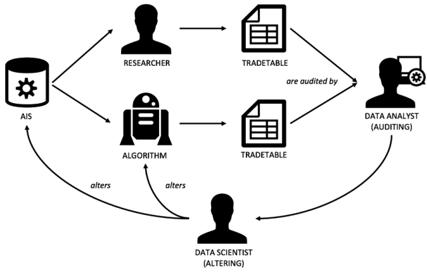
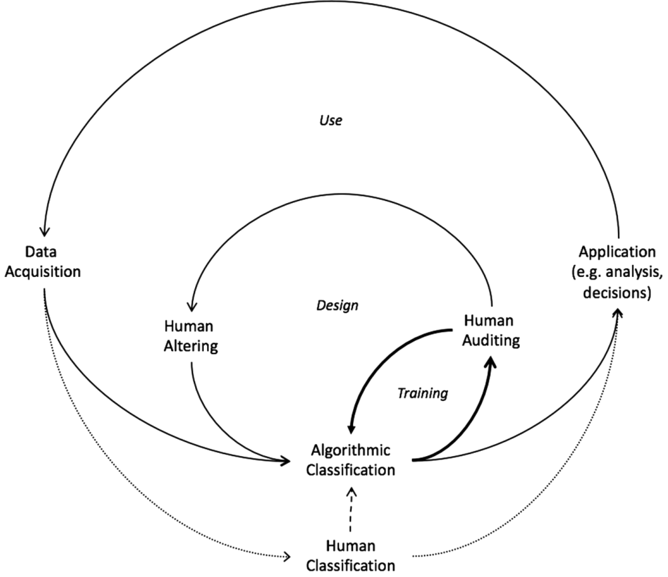
How do configurations of humans and algorithms evolve as firms adopt artificial intelligence (AI) capabilities, and what are the implications for work and organization? We explored these questions through a two-year long case study of an organization in the international maritime trade that introduced automated algorithmic support for data analysis and prediction work. Drawing on a human–machine configuration perspective, we found that humans and the algorithm were configured and reconfigured in multiple ways over time as the organization dealt with the introduction of algorithmic analysis. In contrast to replacing human work, the emergent configurations required new roles and redistribution of extant expertise to augment and improve the accuracy of the algorithm. Our analysis suggests that the new configuration resembled a human-in-the-loop pattern, comprised of both the augmentation work of auditing (i.e. the generation of a ground truth and assessment of the algorithmic output against this) as well as the work of altering the algorithm and the data acquisition architecture. Our research points to the strategic importance of a human-in-the-loop pattern for organizational reflexivity to ensure that the performance of the algorithm meets the organization’s requirements and changes in the environment.
Overview
The claims and statistics of this paper haven’t been checked yet.
Run the check — free, no account needed. It reads the open-access text and checks the sources it cites.
Integrity signals
Registry
Cites
Statistics
Figures

Verification
Claims the paper makes
The claims and statistics of this paper haven’t been checked yet.
Run the check — free, no account needed. It reads the open-access text and checks the sources it cites.
Claims other papers make about this one
Each is checked against this paper’s own text: does it say what the citing paper says it does?
The source backs part of the claim, not all of it — or backs it for a different population, condition or comparison.
In the citing paper
“In short, the deployment of algorithmic man-agement in organizational work introduces novel “human–machine configurations” that could transform relationships between managers and workers and their respective roles (Grønsund and Aanestad, 2020).”
From Algorithmic management in a work context (2021) · cites this paper as Grønsund and Aanestad, 2020
Experimental — accuracy not yet measuredIn the citing paper
“Simultaneously, the AI algorithms can be considered performative in the sense that they assist in decision-making, the extent to which their use can form organizational processes, or even take autonomous decisions (Faraj et al., 2018; Grønsund & Aanestad, 2020) that leads to new organization capabilities through AI.”
From Toward AI Governance: Identifying Best Practices and Potential Barriers and Outcomes (2023) · cites this paper as Grønsund & Aanestad, 2020
Self-check
Percentages, sums and reported differences re-computed from the paper’s own numbers.
The self-check needs the paper’s full text.
Citations
Cites
Strategies for Theorizing from Process Data
Langley, A. (1999) · The Academy of Management Review · doi:10.5465/amr.1999.2553248 · Cited by 7,008 · cited 1×
“The third stage of analysis involved a deeper production of case narratives (Langley, 1999) and vignettes from our empirical material, while still engaging in the field and collecting data.”
BackgroundUnderstanding dynamic capabilities
Winter, S. G. (2003) · Strategic Management Journal · doi:10.1002/smj.318 · Cited by 5,315 · cited 2×
“While the terms ‘reconfigure' and ‘configurations’ are central to extant definitions of dyna mic capabilities (Teece et al., 1997; Eisenhardt and Martin, 2000; Winter, 2003), the terms are not unpacked in detail, neither generally nor specifically relating to human-machine interplay.”
BackgroundPlans and Situated Actions: The Problem of Human-Machine Communication
Kantowitz, B. H., & Suchman, L. A. (1990) · The American Journal of Psychology · doi:10.2307/1423221 · Cited by 5,307 · cited 2×
“To do this, we build on Lucy Suchman’s seminal study at Xerox PARC (Suchman, 1987) which challenged fundamental ideas about humans’ and machines’ cognition and communication; ideas that had guided the design of the intelligent interface of the advanced copying machines used by the scientists she…”
MethodA Set of Principles for Conducting and Evaluating Interpretive Field Studies in Information Systems1
Klein, H. K., & Myers, M. D. (1999) · MIS Quarterly · doi:10.2307/249410 · Cited by 5,263 · cited 1×
“For example, from one of the meetings we produced and circulated a summary of our understanding of the strategic conditions and problem context, which served as a means for confirmation and contextualization (Klein and Myers, 1999).”
BackgroundA model for types and levels of human interaction with automation
Parasuraman, R., Sheridan, T. B., & Wickens, C. D. (2000) · IEEE Transactions on Systems, Man, and Cybernetics - Part A: Systems and Humans · doi:10.1109/3468.844354 · Cited by 4,195 · cited 1×
“, human) performance to fully automatic performance (Parasuraman et al., 2000).”
BackgroundWhy Are There Still So Many Jobs? The History and Future of Workplace Automation
Autor, D. H. (2015) · Journal of Economic Perspectives · doi:10.1257/jep.29.3.3 · Cited by 3,917 · cited 1×
“In addition, one may see indirect effects where not only does automation substitute labour , it also “complements labor, raises output in ways that lead to higher demand for labor, and interacts with adjustments in labor supply” (Autor, 2015, p. 5).”
BackgroundInterpretive case studies in IS research: nature and method
Walsham, G. (1995) · European Journal of Information Systems · doi:10.1057/ejis.1995.9 · Cited by 3,834 · cited 1×
“We have conducted an in-depth, qualitative case study based on the interpretive research paradigm (Walsham, 1995).”
MethodArtificial Intelligence and Management: The Automation–Augmentation Paradox
Raisch, S., & Krakowski, S. (2021) · Academy of Management Review · doi:10.5465/amr.2018.0072 · Cited by 2,755 · cited 4×
“This suggests that the processes of automation and augmentation influence one another in a reciprocal manner (Raisch and Krakowski, 2020), and that their organizing emerges as a core capability.”
BackgroundMethodInfluentialThe structure of ill structured problems
Simon, H. A. (1973) · Artificial Intelligence · doi:10.1016/0004-3702(73)90011-8 · Cited by 2,600 · cited 1×
“…that algorithms are more appropriate for structured problem-solving and where outcomes can be clearly described; and human processing is more apt for ill-structured problem-solving, to which solutions tend to require human interpretation and judgment (e.g., Simon, 1973; Shrestha et al., 2019).”
BackgroundRankings and Reactivity: How Public Measures Recreate Social Worlds
Espeland, W. N., & Sauder, M. (2007) · American Journal of Sociology · doi:10.1086/517897 · Cited by 2,584
Research works printed but not linked: 2
- DalleMule, 2017, What’s your data strategy, Harvard Bus. Rev., 95, 112
- Lebovitz, S., Levina, N., Lifshitz-Assaf, H., 2019. Doubting the Diagnosis: How Artificial Intelligence Increases Ambiguity during Professional Decision Making. Available at SSRN 3480593.
Cited by
Sorted by citations
Collins, C., Dennehy, D., Conboy, K., & Mikalef, P. (2021) · International Journal of Information Management · doi:10.1016/j.ijinfomgt.2021.102383 · Cited by 783
Budhwar, P., Malik, A., De Silva, M. T. T., & Thevisuthan, P. (2022) · The International Journal of Human Resource Management · doi:10.1080/09585192.2022.2035161 · Cited by 723
“It is also argued that a feedback loop is needed for learning and innovation in organisations (Grønsund & Aanestad, 2020).”
BackgroundInfluentialAlgorithmic management in a work context
Jarrahi, M. H., Newlands, G., Lee, M. K., Wolf, C. T., Kinder, E., & Sutherland, W. (2021) · Big Data & Society · doi:10.1177/20539517211020332 · Cited by 532
“In short, the deployment of algorithmic management in organizational work introduces novel “human–machine configurations” that could transform relationships between managers and workers and their respective roles (Grønsund and Aanestad, 2020).”
BackgroundAlgorithms as work designers: How algorithmic management influences the design of jobs
Parent-Rocheleau, X., & Parker, S. K. (2022) · Human Resource Management Review · doi:10.1016/j.hrmr.2021.100838 · Cited by 512
Kulkov, I., Kulkova, J., Rohrbeck, R., Menvielle, L., Kaartemo, V., & Makkonen, H. S. (2023) · Sustainable Development · doi:10.1002/sd.2773 · Cited by 543
Metadata
- Authors
- Grønsund, T., & Aanestad, M.
- Affiliations
- University of Oslo (NO)
- Corresponding author
- Grønsund, Tor
- ORCID
- Aanestad, Margunn
- Venue
- The Journal of Strategic Information Systems
- Publisher
- Elsevier BV
- Published
- 2020-06
- Volume
- 29
- Issue
- 2
- Pages
- 101614
- ISSN
- 0963-8687 (ISSN-L)
- OpenAlex
- W3037276488
- Cited by
- 364
- References
- 67
- Citations by year
- 2026: 55 · 2025: 70 · 2024: 56 · 2023: 102 · 2022: 42 · 2021: 37 · 2020: 2
- FWCI
- 61.20
- Type
- journal article
- Language
- en
- Open access
- hybrid
- doi.org
- Licence
- Locations
- The Journal of Strategic Information Systems (publishedVersion, cc-by-nc-nd)
- NORA - Norwegian Open Research Archives (submittedVersion, cc-by-nc-nd)
- NORA - Norwegian Open Research Archives (submittedVersion, other-oa)
- Funders
- Norges Forskningsråd
- Topics
- Social Sciences › Business, Management and Accounting › Management Information Systems › Information Systems Theories and Implementation
- Social Sciences › Business, Management and Accounting › Organizational Behavior and Human Resource Management › AI and HR Technologies
- Social Sciences › Decision Sciences › Management Science and Operations Research › Impact of AI and Big Data on Business and Society
- Keywords
- human-in-the-loop, artificial intelligence adoption, algorithmic auditing, maritime trade, algorithmic prediction, data acquisition architecture, human-algorithm collaboration
About these checks
Registry, retraction, Cites and statistics results are computed, not judged, with one exception: a printed reference that no index lists is read once by a model before it counts as a citation error. Claims are extracted by a model and kept only when their quote appears verbatim in the text; each cited source is then checked, with a model’s help, for whether it says what the claim relies on. Those verdicts can be wrong — read the claim’s quote and the cited source before relying on one.
Statistics and arithmetic are recomputed, not judged.
Confidence bands are shown only for fields calibrated on our annotated test set. None is calibrated yet, so no band is shown.
What counts as a claim ›How we measure confidence ›How we check this ›
Are you an author, or do you see a problem with this page? Request a review
