

The DOI matches its Crossref record; 39 of the 39 references it cites were found in a registry or an index.
Replication fork slowing and reversal upon DNA damage require PCNA polyubiquitination and ZRANB3 DNA translocase activity.
Open accessAbstract
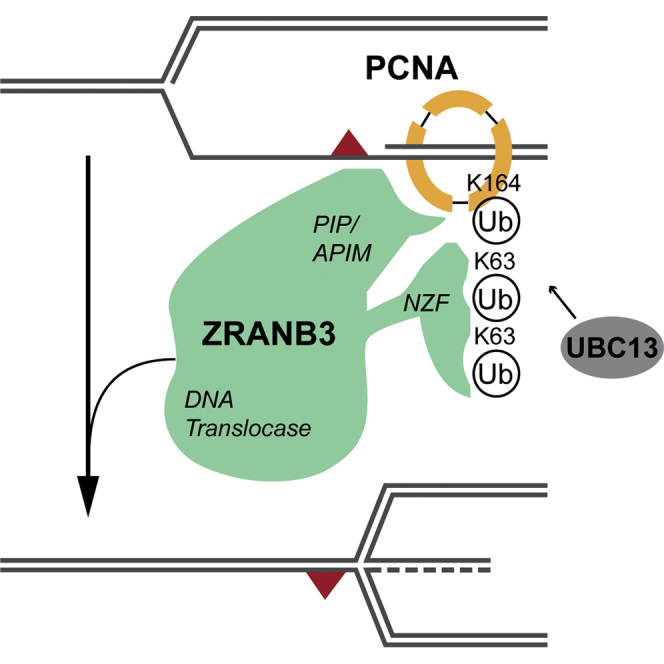
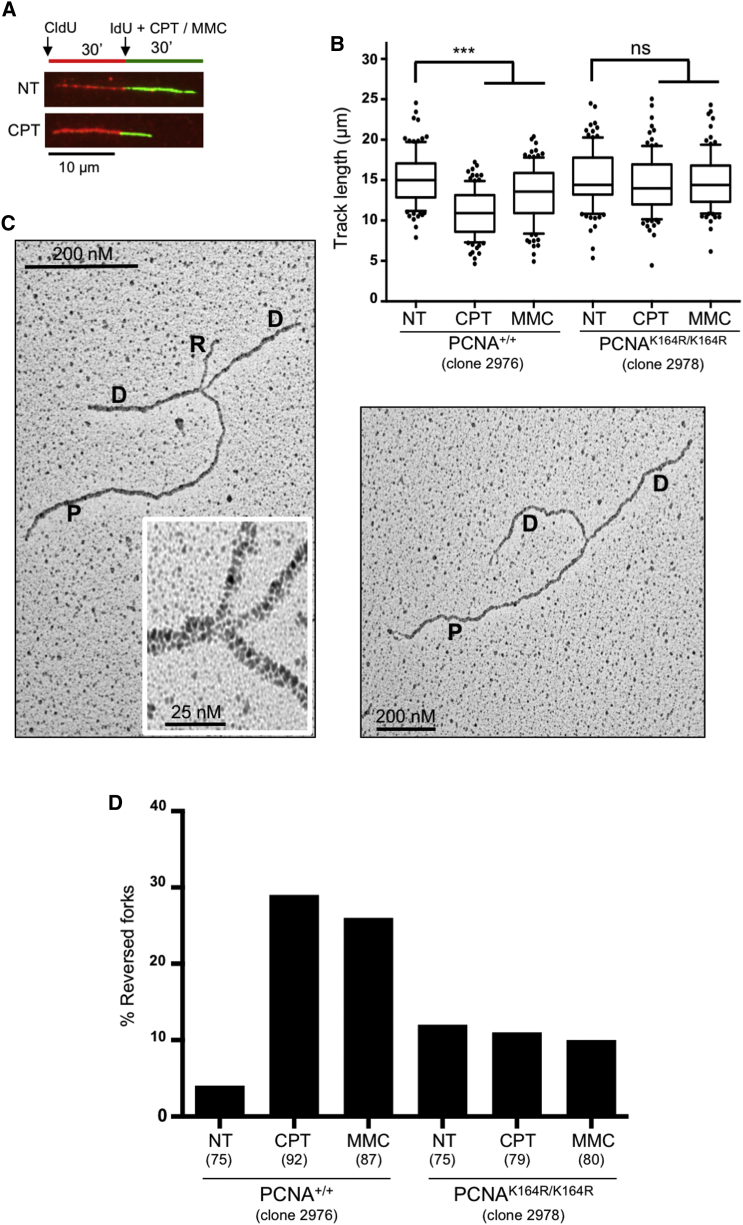
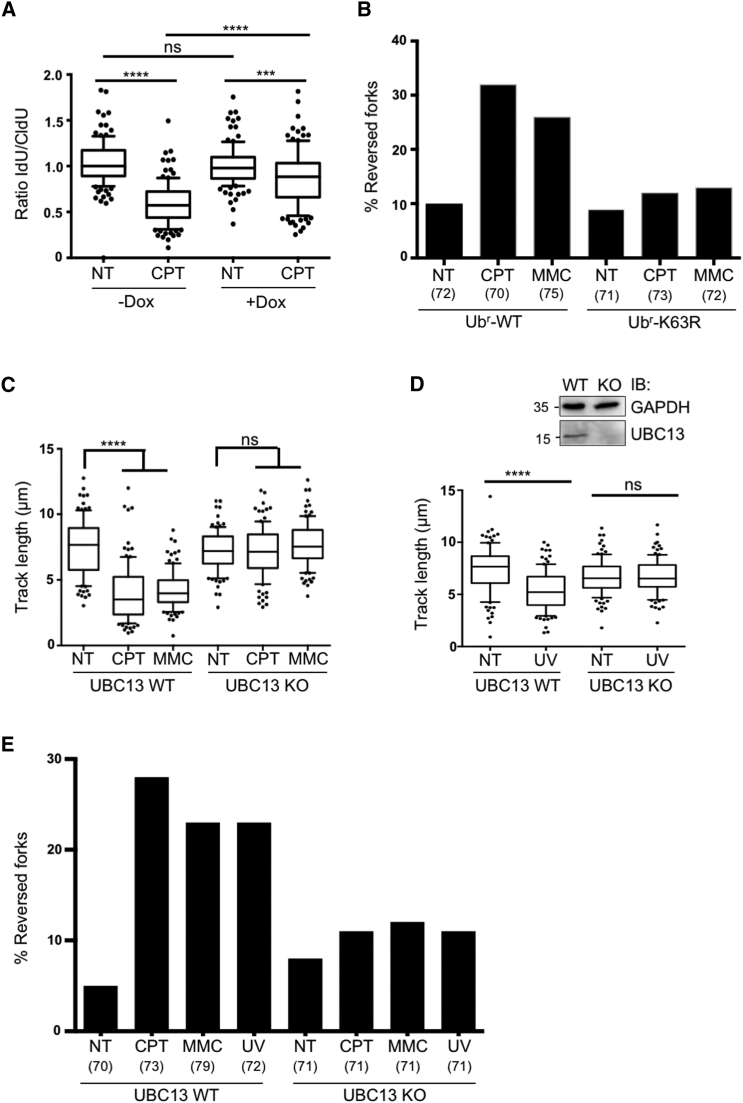
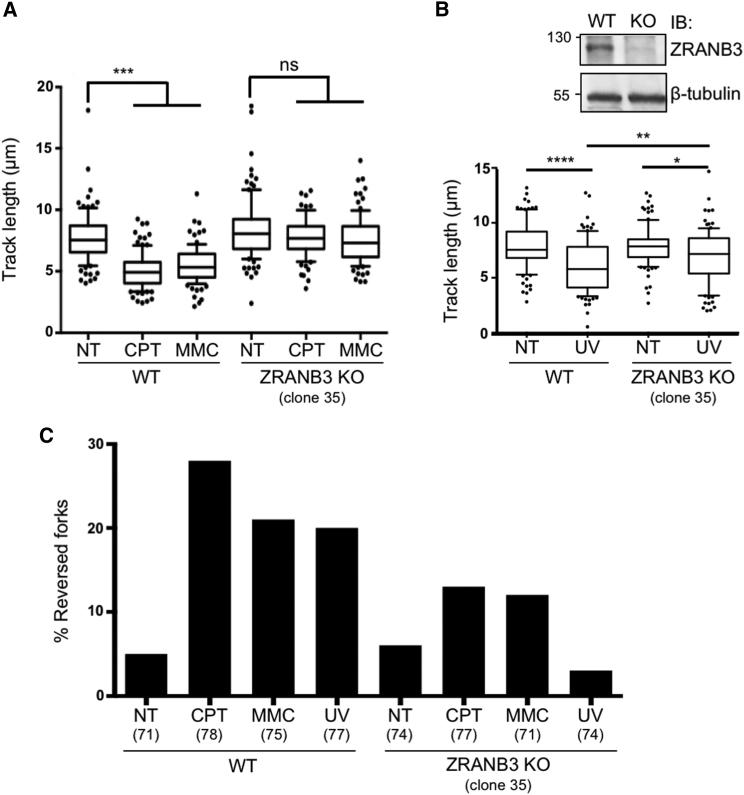
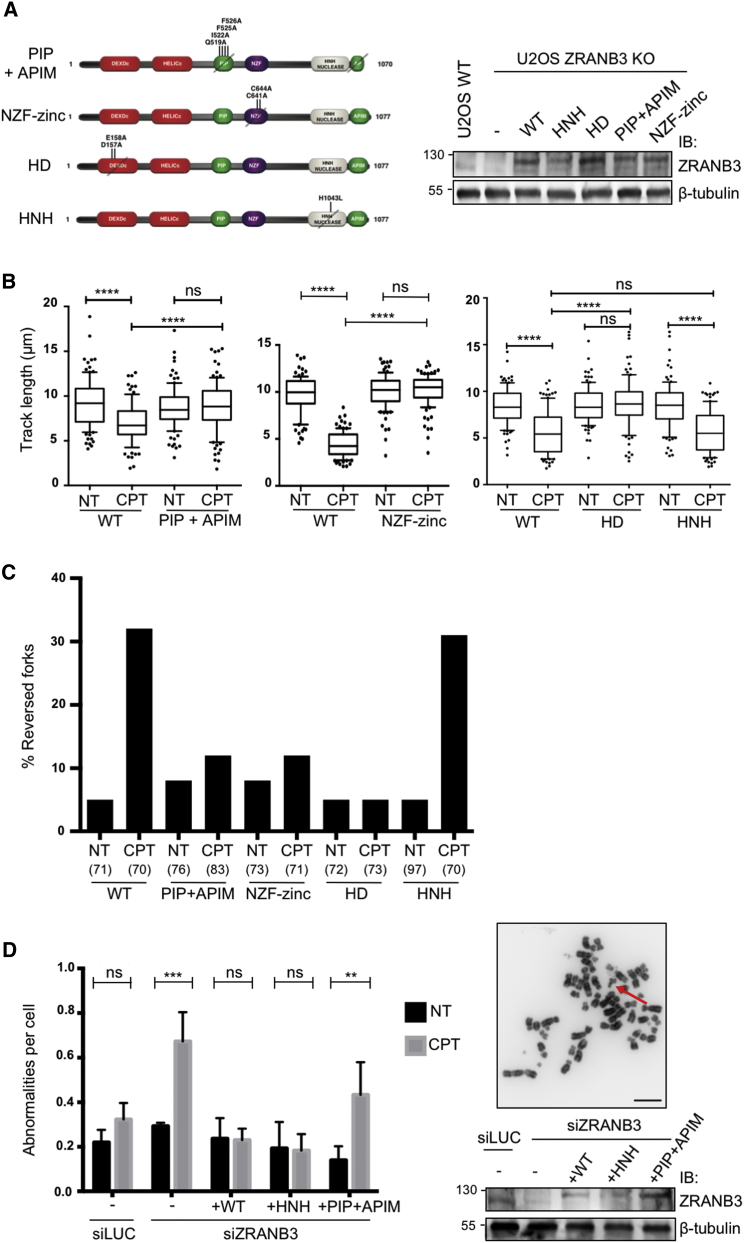
DNA damage tolerance during eukaryotic replication is orchestrated by PCNA ubiquitination. While monoubiquitination activates mutagenic translesion synthesis, polyubiquitination activates an error-free pathway, elusive in mammals, enabling damage bypass by template switching. Fork reversal is driven in vitro by multiple enzymes, including the DNA translocase ZRANB3, shown to bind polyubiquitinated PCNA. However, whether this interaction promotes fork remodeling and template switching in vivo was unknown. Here we show that damage-induced fork reversal in mammalian cells requires PCNA ubiquitination, UBC13, and K63-linked polyubiquitin chains, previously involved in error-free damage tolerance. Fork reversal in vivo also requires ZRANB3 translocase activity and its interaction with polyubiquitinated PCNA, pinpointing ZRANB3 as a key effector of error-free DNA damage tolerance. Mutations affecting fork reversal also induced unrestrained fork progression and chromosomal breakage, suggesting fork remodeling as a global fork slowing and protection mechanism. Targeting these fork protection systems represents a promising strategy to potentiate cancer chemotherapy.
Overview
The claims and statistics of this paper haven’t been checked yet.
Run the check — free, no account needed. It reads the open-access text and checks the sources it cites.
Integrity signals
Registry
Cites
Statistics
Figures
Verification
Claims the paper makes
The claims and statistics of this paper haven’t been checked yet.
Run the check — free, no account needed. It reads the open-access text and checks the sources it cites.
Claims other papers make about this one
Each is checked against this paper’s own text: does it say what the citing paper says it does?
In the citing paper
“Recently, K63-linked polyubiquitination of PCNA was found to stimulate template switching by creating a binding platform for the DNA translocase, ZRANB3 (Vujanovic et al., 2017).”
From USP7 Is a Master Regulator of Genome Stability (2020) · cites this paper as Vujanovic et al., 2017
Self-check
Percentages, sums and reported differences re-computed from the paper’s own numbers.
The self-check needs the paper’s full text.
Citations
Cites
RAD6-dependent DNA repair is linked to modification of PCNA by ubiquitin and SUMO
Hoege, C., Pfander, B., Moldovan, G., Pyrowolakis, G., & Jentsch, S. (2002) · Nature · doi:10.1038/nature00991 · Cited by 2,202
The Bloom's syndrome helicase suppresses crossing over during homologous recombination
Wu, L., & Hickson, I. D. (2003) · Nature · doi:10.1038/nature02253 · Cited by 1,087
Fork Reversal and ssDNA Accumulation at Stalled Replication Forks Owing to Checkpoint Defects
Sogo, J. M., Lopes, M., & Foiani, M. (2002) · Science · doi:10.1126/science.1074023 · Cited by 824
Self-citationUbiquitin-binding domains in Y-family polymerases regulate translesion synthesis.
Bienko, M., Green, C. M., Crosetto, N., Rudolf, F., Zapart, G., Coull, B., Kannouche, P., Wider, G., Peter, M., Lehmann, A. R., et al. (2005) · Science · doi:10.1126/science.1120615 · Cited by 712
Rad51-mediated replication fork reversal is a global response to genotoxic treatments in human cells
Zellweger, R., Dalcher, D., Mutreja, K., Berti, M., Schmid, J. A., Herrador, R., Vindigni, A., & Lopes, M. (2015) · The Journal of Cell Biology · doi:10.1083/jcb.201406099 · Cited by 691
Self-citationTopoisomerase I poisoning results in PARP-mediated replication fork reversal
Chaudhuri, A. R., Hashimoto, Y., Herrador, R., Neelsen, K. J., Fachinetti, D., Bermejo, R., Cocito, A., Costanzo, V., & Lopes, M. (2012) · Nature Structural & Molecular Biology · doi:10.1038/nsmb.2258 · Cited by 524
Self-citationReplication fork reversal in eukaryotes: from dead end to dynamic response
Neelsen, K. J., & Lopes, M. (2015) · Nature Reviews Molecular Cell Biology · doi:10.1038/nrm3935 · Cited by 523
Self-citationA model for replication repair in mammalian cells
Higgins, N. P., Kato, K., & Strauss, B. S. (1976) · Journal of Molecular Biology · doi:10.1016/0022-2836(76)90156-x · Cited by 444
Histone H1 couples initiation and amplification of ubiquitin signalling after DNA damage
Thorslund, T., Ripplinger, A., Hoffmann, S., Wild, T., Uckelmann, M., Villumsen, B. H., Narita, T., Sixma, T. K., Choudhary, C., Bekker‐Jensen, S., et al. (2015) · Nature · doi:10.1038/nature15401 · Cited by 438
Betous, R., Mason, A. C., Rambo, R. P., Bansbach, C. E., Badu-Nkansah, A., Sirbu, B. M., Eichman, B. F., & Cortez, D. (2012) · Genes & Development · doi:10.1101/gad.178459.111 · Cited by 313
Self-citationCiccia, A., Nimonkar, A. V., Hu, Y., Hajdú, I., Achar, Y. J., Izhar, L., Petit, S. A., Adamson, B., Yoon, J. C., Kowalczykowski, S. C., et al. (2012) · Molecular Cell · doi:10.1016/j.molcel.2012.05.024 · Cited by 308
Self-citationMotegi, A., Liaw, H.-J., Lee, K.-Y., Roest, H. P., Maas, A., Wu, X., Moinova, H., Markowitz, S. D., Ding, H., Hoeijmakers, J. H. J., et al. (2008) · Proceedings of the National Academy of Sciences · doi:10.1073/pnas.0805685105 · Cited by 304
Blastyák, A., Pintér, L., Unk, I., Prakash, L., Prakash, S., & Haracska, L. (2007) · Molecular Cell · doi:10.1016/j.molcel.2007.07.030 · Cited by 285
Replication stress: getting back on track
Berti, M., & Vindigni, A. (2016) · Nature Structural & Molecular Biology · doi:10.1038/nsmb.3163 · Cited by 249
Xu, M., Skaug, B. A., Zeng, W., & Chen, Z. J. (2009) · Molecular Cell · doi:10.1016/j.molcel.2009.10.002 · Cited by 248
Edmunds, C. E., Simpson, L. J., & Sale, J. E. (2008) · Molecular Cell · doi:10.1016/j.molcel.2008.03.024 · Cited by 239
HLTF’s Ancient HIRAN Domain Binds 3′ DNA Ends to Drive Replication Fork Reversal
Kile, A. C., Chavez, D., Bacal, J., Eldirany, S. A., Korzhnev, D. M., Bezsonova, I., Eichman, B. F., & Cimprich, K. A. (2015) · Molecular Cell · doi:10.1016/j.molcel.2015.05.013 · Cited by 201
Controlling the subcellular localization of DNA polymerases ι and η via interactions with ubiquitin
Plosky, B. S., Vidal, A. E., de Henestrosa, A. R. F., McLenigan, M. P., McDonald, J. P., Mead, S., & Woodgate, R. (2006) · The EMBO Journal · doi:10.1038/sj.emboj.7601178 · Cited by 201
Oncogenes induce genotoxic stress by mitotic processing of unusual replication intermediates
Neelsen, K. J., Zanini, I. M. Y., Herrador, R., & Lopes, M. (2013) · Journal of Cell Biology · doi:10.1083/jcb.201212058 · Cited by 188
Self-citationLin, J., Zeman, M. K., Chen, J.-Y., Yee, M., & Cimprich, K. A. (2011) · Molecular Cell · doi:10.1016/j.molcel.2011.02.026 · Cited by 182
Role of yeast Rad5 and its human orthologs, HLTF and SHPRH in DNA damage tolerance
Unk, I., Hajdú, I., Blastyák, A., & Haracska, L. (2010) · DNA repair · doi:10.1016/j.dnarep.2009.12.013 · Cited by 178
Substrate-Selective Repair and Restart of Replication Forks by DNA Translocases
Betous, R., Couch, F. B., Mason, A. C., Eichman, B. F., Mañosas, M., & Cortez, D. (2013) · Cell Reports · doi:10.1016/j.celrep.2013.05.002 · Cited by 177
Self-citationRegulation of proliferating cell nuclear antigen ubiquitination in mammalian cells
Niimi, A., Brown, S. E., Sabbioneda, S., Kannouche, P. L., Scott, A., Yasui, A., Green, C., & Lehmann, A. R. (2008) · Proceedings of the National Academy of Sciences · doi:10.1073/pnas.0802727105 · Cited by 171
HARP Is an ATP-Driven Annealing Helicase
Yusufzai, T. M., & Kadonaga, J. T. (2008) · Science · doi:10.1126/science.1161233 · Cited by 169
A/T mutagenesis in hypermutated immunoglobulin genes strongly depends on PCNAK164 modification
Langerak, P., Nygren, A. O. H., Krijger, P. H. L., van den Berk, P. C. M., & Jacobs, H. (2007) · The Journal of Experimental Medicine · doi:10.1084/jem.20070902 · Cited by 166
Self-citationVisualization of recombination-mediated damage bypass by template switching
Giannattasio, M., Zwicky, K., Follonier, C., Foiani, M., Lopes, M., & Branzei, D. (2014) · Nature Structural & Molecular Biology · doi:10.1038/nsmb.2888 · Cited by 147
Self-citationFumasoni, M., Zwicky, K., Vanoli, F., Lopes, M., & Branzei, D. (2015) · Molecular Cell · doi:10.1016/j.molcel.2014.12.038 · Cited by 138
Self-citationZRANB3 is a structure-specific ATP-dependent endonuclease involved in replication stress responsePreprint
Weston, R., Peeters, H. J. M., & Ahel, D. (2012) · Genes & Development · doi:10.1101/gad.193516.112 · Cited by 123
Yuan, J., Ghosal, G., & Chen, J. (2012) · Molecular Cell · doi:10.1016/j.molcel.2012.05.025 · Cited by 120
Competition, collaboration and coordination – determining how cells bypass DNA damage
Sale, J. E. (2012) · Journal of Cell Science · doi:10.1242/jcs.094748 · Cited by 96
Follonier, C., Oehler, J., Herrador, R., & Lopes, M. (2013) · Nature Structural & Molecular Biology · doi:10.1038/nsmb.2520 · Cited by 93
Self-citationFunctions of Ubiquitin and SUMO in DNA Replication and Replication Stress
García‐Rodríguez, N., Wong, R. P. C., & Ulrich, H. D. (2016) · Frontiers in Genetics · doi:10.3389/fgene.2016.00087 · Cited by 90
Branzei, D., & Psakhye, I. (2016) · Current Opinion in Cell Biology · doi:10.1016/j.ceb.2016.03.015 · Cited by 80
Krijger, P. H. L., Lee, K., Wit, N., van den Berk, P. C. M., Wu, X., Roest, H. P., Maas, A., Ding, H., Hoeijmakers, J. H. J., Myung, K., et al. (2011) · DNA repair · doi:10.1016/j.dnarep.2010.12.008 · Cited by 63
Self-citationThe genome maintenance factor Mgs1 is targeted to sites of replication stress by ubiquitylated PCNA
Saugar, I., Parker, J. L., Zhao, S., & Ulrich, H. D. (2011) · Nucleic Acids Research · doi:10.1093/nar/gkr738 · Cited by 60
Annealing helicase 2 (AH2), a DNA-rewinding motor with an HNH motif
Yusufzai, T. M., & Kadonaga, J. T. (2010) · Proceedings of the National Academy of Sciences · doi:10.1073/pnas.1011196107 · Cited by 55
Dynamic Architecture of Eukaryotic DNA Replication Forks In Vivo, Visualized by Electron Microscopy
Zellweger, R., & Lopes, M. (2017) · Methods in molecular biology · doi:10.1007/978-1-4939-7306-4_19 · Cited by 47
Self-citationRegulation of PCNA polyubiquitination in human cells
Brun, J., Chiu, R. K., Wouters, B. G., & Gray, D. A. (2010) · BMC Research Notes · doi:10.1186/1756-0500-3-85 · Cited by 27
Follonier, C., & Lopes, M. (2013) · Methods in molecular biology · doi:10.1007/978-1-62703-706-8_16 · Cited by 8
Self-citation
Cited by
Sorted by citations
DNA double-strand break repair-pathway choice in somatic mammalian cells
Scully, R., Panday, A., Elango, R., & Willis, N. A. (2019) · Nature Reviews Molecular Cell Biology · doi:10.1038/s41580-019-0152-0 · Cited by 1,532
Hallmarks of DNA replication stress
Saxena, S., & Zou, L. (2022) · Molecular Cell · doi:10.1016/j.molcel.2022.05.004 · Cited by 443
Mechanisms of Oncogene-Induced Replication Stress: Jigsaw Falling into Place
Kotsantis, P., Petermann, E., & Boulton, S. J. (2018) · Cancer Discovery · doi:10.1158/2159-8290.cd-17-1461 · Cited by 416
Taglialatela, A., Álvarez, S., Leuzzi, G., Sannino, V., Ranjha, L., Huang, J., Madubata, C. J., Anand, R., Levy, B., Rabadán, R., et al. (2017) · Molecular Cell · doi:10.1016/j.molcel.2017.09.036 · Cited by 407
Self-citationReplication fork reversal triggers fork degradation in BRCA2-defective cells
Mijic, S., Zellweger, R., Chappidi, N., Berti, M., Jacobs, K., Mutreja, K., Ursich, S., Chaudhuri, A. R., Nussenzweig, A., Janščák, P., et al. (2017) · Nature Communications · doi:10.1038/s41467-017-01164-5 · Cited by 380
Self-citation
Metadata
- Authors
- Vujanovic, M., Krietsch, J., Raso, M. C., Terraneo, N., Zellweger, R., Schmid, J. A., Taglialatela, A., Huang, J.-W., Holland, C. L., Zwicky, K., Herrador, R., Jacobs, H., Cortez, D., Ciccia, A., Penengo, L., & Lopes, M.
- Affiliations
- University of Zurich (CH)
- Columbia University Irving Medical Center (US)
- Vanderbilt University (US)
- The Netherlands Cancer Institute (NL)
- Corresponding author
- Lopes, Massimo
- ORCID
- Venue
- Molecular Cell
- Publisher
- Elsevier BV
- Published
- 2017-09
- Volume
- 67
- Issue
- 5
- Pages
- 882-890.e5
- ISSN
- 1097-2765 (ISSN-L)
- PMC
- PMC5594246
- OpenAlex
- W2751450140
- Cited by
- 227
- References
- 39
- Citations by year
- 2026: 10 · 2025: 19 · 2024: 25 · 2023: 27 · 2022: 23 · 2021: 28 · 2020: 35 · 2019: 26 · 2018: 27 · 2017: 7
- FWCI
- 10.62
- Type
- journal article
- Language
- en
- Open access
- hybrid
- doi.org
- Licence
- Locations
- Molecular Cell (publishedVersion, cc-by-nc-nd)
- Europe PMC (PubMed Central) (publishedVersion, cc-by-nc-nd)
- PubMed Central (publishedVersion, cc-by-nc-nd)
- PubMed (publishedVersion)
- DORA PSI (Paul Scherrer Institute) (submittedVersion, cc-by-nc-nd)
- Funders
- SNF (31003A_146924, 31003A_169959, 31003A_166370)
- ERC Consolidator (617102)
- Helmut Horten
- NIH (R01CA197774, GM116616)
- KWF (NKI-2012-5243)
- ZonMW Top (91213018)
- Topics
- Life Sciences › Biochemistry, Genetics and Molecular Biology › Molecular Biology › DNA Repair Mechanisms
- Life Sciences › Biochemistry, Genetics and Molecular Biology › Molecular Biology › Ubiquitin and proteasome pathways
- Life Sciences › Biochemistry, Genetics and Molecular Biology › Molecular Biology › Epigenetics and DNA Methylation
- Keywords
- replication fork reversal, DNA damage tolerance, ZRANB3, DNA translocase, Ubc13, K63-linked polyubiquitin, template switching, chromosome breakage, cancer chemotherapy
- MeSH terms
- Animals, DNA Damage, DNA Replication, DNA Helicases, DNA, Neoplasm, Humans, Kinetics, Mutation, Neoplasms, Transfection, Replication Origin, Proliferating Cell Nuclear Antigen, Polyubiquitin, RNA Interference, Ubiquitin-Conjugating Enzymes, HCT116 Cells, Mice, Ubiquitination, HEK293 Cells, CRISPR-Cas Systems
About these checks
Registry, retraction, Cites and statistics results are computed, not judged, with one exception: a printed reference that no index lists is read once by a model before it counts as a citation error. Claims are extracted by a model and kept only when their quote appears verbatim in the text; each cited source is then checked, with a model’s help, for whether it says what the claim relies on. Those verdicts can be wrong — read the claim’s quote and the cited source before relying on one.
Statistics and arithmetic are recomputed, not judged.
Confidence bands are shown only for fields calibrated on our annotated test set. None is calibrated yet, so no band is shown.
What counts as a claim ›How we measure confidence ›How we check this ›
Are you an author, or do you see a problem with this page? Request a review
