

The DOI matches its Crossref record; 108 of the 109 references it cites were found in a registry or an index.
Programming assembly of biomimetic exosomes: An emerging theranostic nanomedicine platform
Open accessAbstract
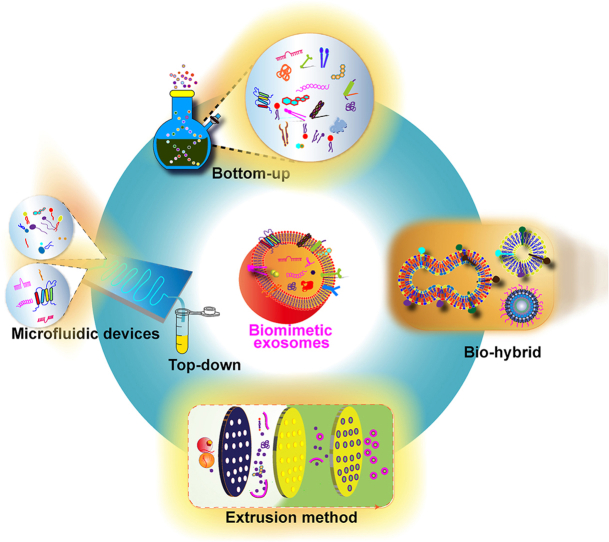
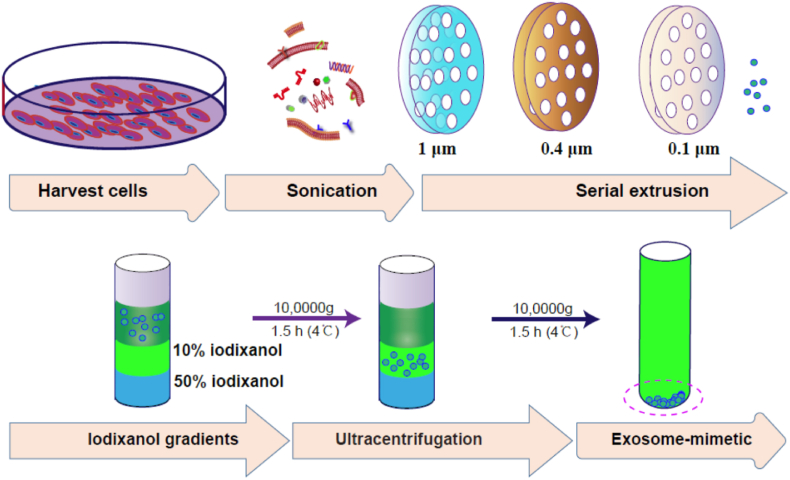
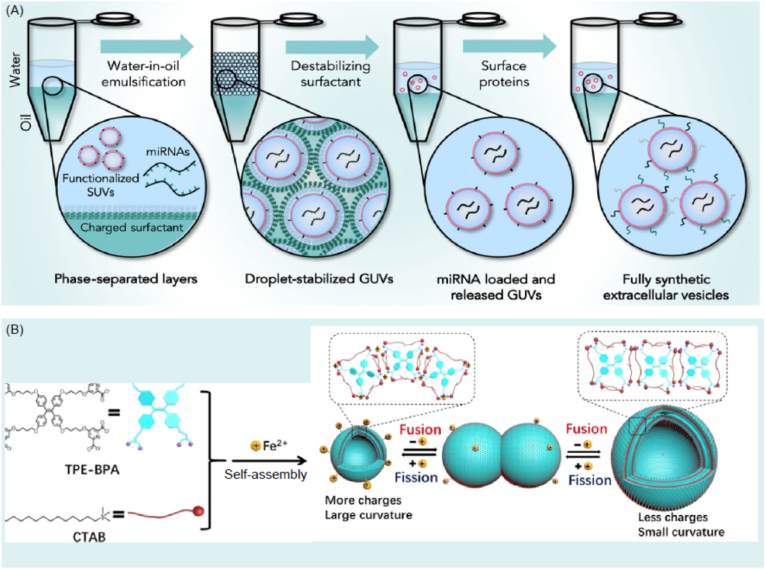
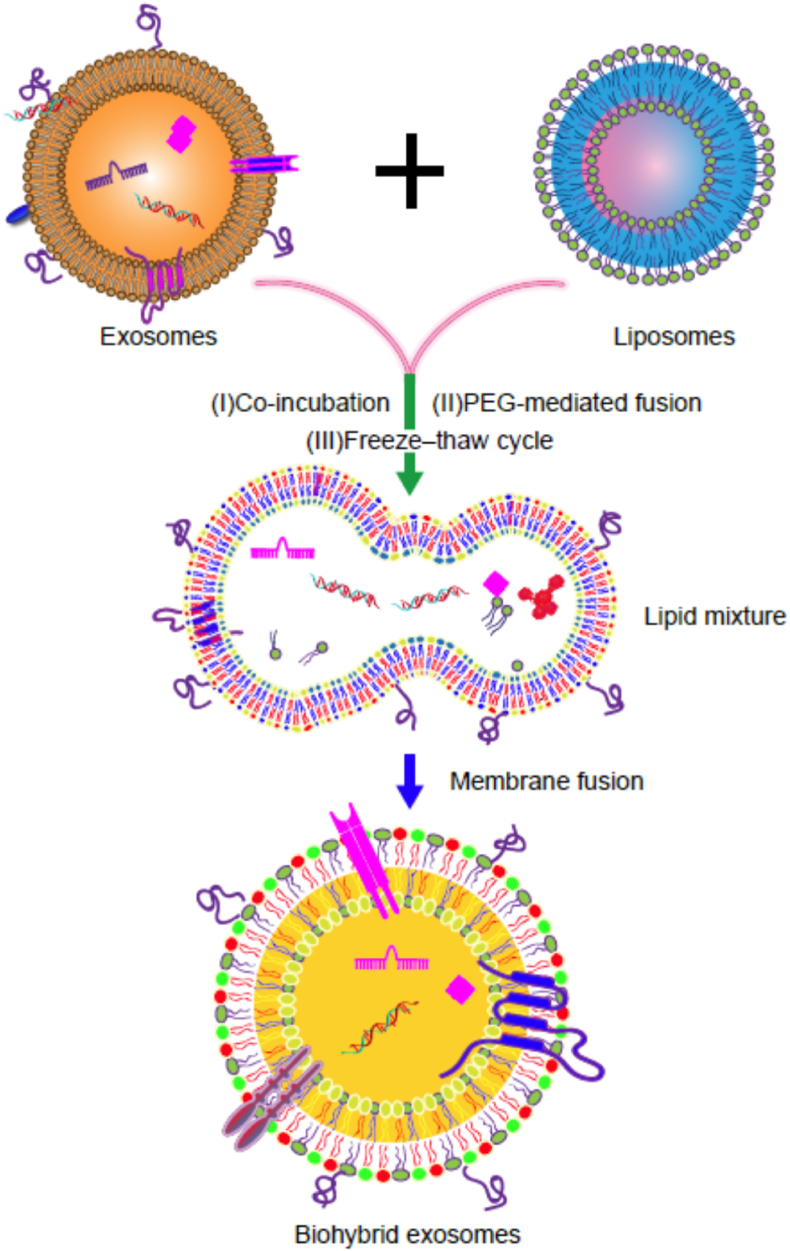
Exosomes have emerged as a promising cell-free therapeutic approach. However, challenges in large-scale production, quality control, and heterogeneity must be overcome before they can be used clinically. Biomimetic exosomes containing key components of natural exosomes have been assembled through extrusion, artificial synthesis, and liposome fusion to address these limitations. These exosome-mimetics (EMs) possess similar morphology and function but provide higher yields, faster large-scale production, and similar size compared to conventional exosomes. This article provides an overview of the chemical and biological properties of various synthetic exosome systems, including nanovesicles (NVs), EMs, and hybrid exosomes. We highlight recent advances in the production and applications of nanobiotechnology and discuss the advantages, limitations, and potential clinical applications of programming assembly of exosome mimetics.
Overview
The claims and statistics of this paper haven’t been checked yet.
Run the check — free, no account needed. It reads the open-access text and checks the sources it cites.
Integrity signals
Registry
Cites
Statistics
Figures
Verification
Claims the paper makes
The claims and statistics of this paper haven’t been checked yet.
Run the check — free, no account needed. It reads the open-access text and checks the sources it cites.
Claims other papers make about this one
Each is checked against this paper’s own text: does it say what the citing paper says it does?
The cited source says what the claim attributes to it.
In the citing paper
“Two primary approaches can accomplish the loading of specific cargoes into exosomes.”
From Exosome for mRNA delivery: Strategies and therapeutic applications (2024) · cites this paper as [95]
Self-check
Percentages, sums and reported differences re-computed from the paper’s own numbers.
The self-check needs the paper’s full text.
Citations
Cites
The biology , function , and biomedical applications of exosomes
Kalluri, R., & LeBleu, V. S. (2020) · Science · doi:10.1126/science.aau6977 · Cited by 10,770
Microenvironmental pH Is a Key Factor for Exosome Traffic in Tumor Cells
Parolini, I., Federici, C., Raggi, C., Lugini, L., Palleschi, S., Milito, A. D., Coscia, C., Iessi, E., Logozzi, M., Molinari, A., et al. (2009) · Journal of Biological Chemistry · doi:10.1074/jbc.m109.041152 · Cited by 1,614
Engineering exosomes for targeted drug delivery
Liang, Y., Duan, L., Lu, J., & Xia, J. (2021) · Theranostics · doi:10.7150/thno.52570 · Cited by 1,547
Self-citationZhang, Y., Bi, J., Huang, J., Tang, Y., Du, S., & Li, P. (2020) · International Journal of Nanomedicine · doi:10.2147/ijn.s264498 · Cited by 1,323
Self-citationEngineering exosomes as refined biological nanoplatforms for drug delivery
Luan, X., Sansanaphongpricha, K., Myers, I., Chen, H., Yuan, H., & Sun, D. (2017) · Acta Pharmacologica Sinica · doi:10.1038/aps.2017.12 · Cited by 1,196
Jang, S. C., Kim, O. Y., Yoon, C. M., Choi, D., Roh, T., Park, J., Nilsson, J. A., Lötvall, J. O., Kim, Y., & Gho, Y. S. (2013) · ACS Nano · doi:10.1021/nn402232g · Cited by 1,037
Exosome Release Is Regulated by a Calcium-dependent Mechanism in K562 Cells
Savina, A., Furlán, M., Vidal, M., & Colombo, M. I. (2003) · Journal of Biological Chemistry · doi:10.1074/jbc.m301642200 · Cited by 835
Engineering hybrid exosomes by membrane fusion with liposomes
Sato, Y. T., Umezaki, K., Sawada, S., Mukai, S.-A., Sasaki, Y., Harada, N., Shiku, H., & Akiyoshi, K. (2016) · Scientific Reports · doi:10.1038/srep21933 · Cited by 744
Takahashi, Y., Nishikawa, M., Shinotsuka, H., Matsui, Y., Ohara, S., Imai, T., & Takakura, Y. (2013) · Journal of Biotechnology · doi:10.1016/j.jbiotec.2013.03.013 · Cited by 743
Exosomes: Large-scale production, isolation, drug loading efficiency, and biodistribution and uptake
Kimiz-Gebologlu, I., & Oncel, S. S. (2022) · Journal of Controlled Release · doi:10.1016/j.jconrel.2022.05.027 · Cited by 722
Cited by
Sorted by citations
Brucea javanica derived exosome-like nanovesicles deliver miRNAs for cancer therapy
Yan, G., Xiao, Q., Zhao, J., Chen, H., Xu, Y., Tan, M., & Peng, L. (2024) · Journal of Controlled Release · doi:10.1016/j.jconrel.2024.01.060 · Cited by 174
Exosome for mRNA delivery: Strategies and therapeutic applications
Iqbal, Z., Rehman, K., Mahmood, A., Shabbir, M., Liang, Y., Duan, L., & Zeng, H. (2024) · Journal of Nanobiotechnology · doi:10.1186/s12951-024-02634-x · Cited by 144
Self-citationNanoparticle-Based Drug Delivery Systems in Inhaled Therapy: Improving Respiratory Medicine
Cojocaru, E., Petriș, O. R., & Cojocaru, C. (2024) · Pharmaceuticals · doi:10.3390/ph17081059 · Cited by 129
Research Advances of Engineered Exosomes as Drug Delivery Carrier
Huang, L., Wu, E., Liao, J., Wei, Z., Wang, J., & Chen, Z. (2023) · ACS Omega · doi:10.1021/acsomega.3c04479 · Cited by 113
Wang, Y., Deng, T., Liu, X., Fang, X., Mo, Y., Xie, N., Nie, G., Zhang, B., & Fan, X. (2024) · International Journal of Nanomedicine · doi:10.2147/ijn.s459710 · Cited by 112
Metadata
- Authors
- Xu, X., Xu, L., Wen, C., Xia, J., Zhang, Y., & Liang, Y.
- Affiliations
- Affiliated Hospital of Jining Medical University (CN)
- Chinese University of Hong Kong (HK)
- Corresponding author
- Zhang, Yuanmin
- Liang, Yujie
- Venue
- Materials Today Bio
- Publisher
- Elsevier BV
- Published
- 2023-10
- Volume
- 22
- Pages
- 100760
- ISSN
- 2590-0064 (ISSN-L)
- PMC
- PMC10450992
- OpenAlex
- W4385755937
- Cited by
- 101
- References
- 109
- Citations by year
- 2026: 29 · 2025: 33 · 2024: 29 · 2023: 10
- FWCI
- 2.67
- Type
- journal article
- Language
- en
- Open access
- gold
- doi.org
- Licence
- Locations
- Materials Today Bio (publishedVersion, cc-by-nc-nd)
- PubMed Central (publishedVersion, cc-by-nc-nd)
- PubMed (publishedVersion)
- DOAJ (DOAJ: Directory of Open Access Journals) (submittedVersion, cc-by-sa)
- Funders
- National Natural Science Foundation of China (82102607)
- Innovation and Technology Commission
- Natural Science Foundation of Shandong Province (ZR2023QH148)
- Jining Medical University (2022-BS-03, 2022-BS-04)
- Topics
- Life Sciences › Biochemistry, Genetics and Molecular Biology › Molecular Biology › Extracellular vesicles in disease
- Physical Sciences › Materials Science › Biomaterials › Nanoparticle-Based Drug Delivery
- Life Sciences › Biochemistry, Genetics and Molecular Biology › Molecular Biology › RNA Interference and Gene Delivery
- Keywords
- exosome mimetics, nanovesicles, extrusion, liposome fusion, artificial synthesis, cell-free therapy, theranostics, nanomedicine, mass production, quality control
About these checks
Registry, retraction, Cites and statistics results are computed, not judged, with one exception: a printed reference that no index lists is read once by a model before it counts as a citation error. Claims are extracted by a model and kept only when their quote appears verbatim in the text; each cited source is then checked, with a model’s help, for whether it says what the claim relies on. Those verdicts can be wrong — read the claim’s quote and the cited source before relying on one.
Statistics and arithmetic are recomputed, not judged.
Confidence bands are shown only for fields calibrated on our annotated test set. None is calibrated yet, so no band is shown.
What counts as a claim ›How we measure confidence ›How we check this ›
Are you an author, or do you see a problem with this page? Request a review
