

The DOI matches its Crossref record; 200 of the 200 references it cites were found in a registry or an index.
Interaction of language, auditory and memory brain networks in auditory verbal hallucinations
Open accessAbstract
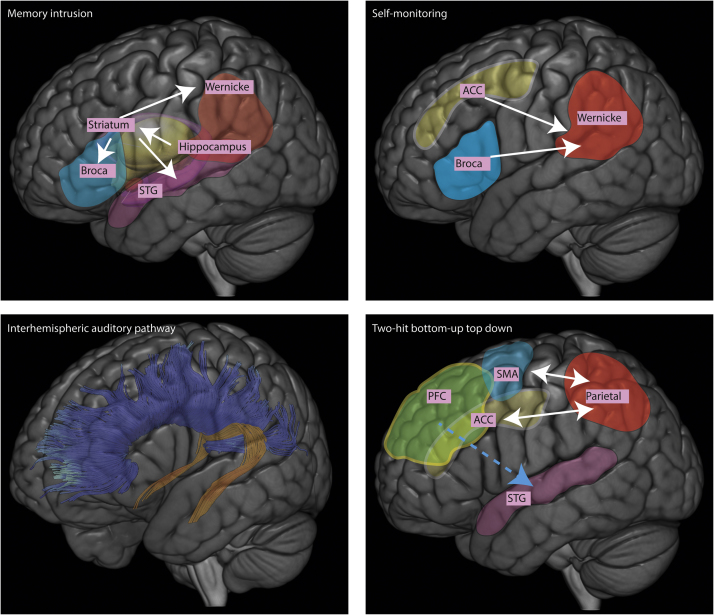
Auditory verbal hallucinations (AVH) occur in psychotic disorders, but also as a symptom of other conditions and even in healthy people. Several current theories on the origin of AVH converge, with neuroimaging studies suggesting that the language, auditory and memory/limbic networks are of particular relevance. However, reconciliation of these theories with experimental evidence is missing. We review 50 studies investigating functional (EEG and fMRI) and anatomic (diffusion tensor imaging) connectivity in these networks, and explore the evidence supporting abnormal connectivity in these networks associated with AVH. We distinguish between functional connectivity during an actual hallucination experience (symptom capture) and functional connectivity during either the resting state or a task comparing individuals who hallucinate with those who do not (symptom association studies). Symptom capture studies clearly reveal a pattern of increased coupling among the auditory, language and striatal regions. Anatomical and symptom association functional studies suggest that the interhemispheric connectivity between posterior auditory regions may depend on the phase of illness, with increases in non-psychotic individuals and first episode patients and decreases in chronic patients. Leading hypotheses involving concepts as unstable memories, source monitoring, top-down attention, and hybrid models of hallucinations are supported in part by the published connectivity data, although several caveats and inconsistencies remain. Specifically, possible changes in fronto-temporal connectivity are still under debate. Precise hypotheses concerning the directionality of connections deduced from current theoretical approaches should be tested using experimental approaches that allow for discrimination of competing hypotheses.
Overview
The claims and statistics of this paper haven’t been checked yet.
Run the check — free, no account needed. It reads the open-access text and checks the sources it cites.
Integrity signals
Registry
Cites
Statistics
Figures
Verification
Claims the paper makes
The claims and statistics of this paper haven’t been checked yet.
Run the check — free, no account needed. It reads the open-access text and checks the sources it cites.
Claims other papers make about this one
Each is checked against this paper’s own text: does it say what the citing paper says it does?
In the citing paper
“In addition, evidence supports the hypothesis that hallucinations arise from release of those sensory signals by reduced top-down inhibition from higher-order centers such as frontal areas and their connections with the thalamus. 40-43”
From Towards an Integrative Account of Potential Mechanisms Mediating the Path From Sleep Dysfunction to Hallucinations (2025) · cites this paper as [41]
Self-check
Percentages, sums and reported differences re-computed from the paper’s own numbers.
The self-check needs the paper’s full text.
Citations
Cites
The organization of the human cerebral cortex estimated by intrinsic functional connectivity
Thomas Yeo, B. T., Krienen, F. M., Sepulcre, J., Sabuncu, M. R., Lashkari, D., Hollinshead, M., Roffman, J. L., Smoller, J. W., Zöllei, L., Polimeni, J. R., et al. (2011) · Journal of Neurophysiology · doi:10.1152/jn.00338.2011 · Cited by 9,182
The organization of the human cerebellum estimated by intrinsic functional connectivity
Buckner, R. L., Krienen, F. M., Castellanos, A., Diaz, J. C., & Yeo, B. T. T. (2011) · Journal of Neurophysiology · doi:10.1152/jn.00339.2011 · Cited by 7,304
Cognitive and emotional influences in anterior cingulate cortex
Bush, G., Luu, P., & Posner, M. I. (2000) · Trends in Cognitive Sciences · doi:10.1016/s1364-6613(00)01483-2 · Cited by 6,259 · cited 1×
“It comprises the following areas: the anterior cingulate, involved in error monitoring and emotional processing and learning (Bush et al., 2000); the hippocampus, generally involved in memory processes (Squire et al.”
BackgroundThe brainweb: phase synchronization and large-scale integration
Varela, F., Lachaux, J.-P., Rodriguez, E., & Martinerie, J. (2001) · Nature Reviews Neuroscience · doi:10.1038/35067550 · Cited by 4,761 · cited 1×
“It has been proposed that a potential mechanism for information processing by the brain is synchronization of distant neuronal assemblies (Varela et al., 2001; Fries, 2005; David and Friston, 2003).”
BackgroundThe basis of anisotropic water diffusion in the nervous system—A technical review.
Beaulieu, C. (2002) · NMR in Biomedicine · doi:10.1002/nbm.782 · Cited by 4,628
Friston, K. J., Harrison, L., & Penny, W. (2003) · NeuroImage · doi:10.1016/s1053-8119(03)00202-7 · Cited by 4,583
A mechanism for cognitive dynamics: neuronal communication through neuronal coherence.
Fries, P. (2005) · Trends in Cognitive Sciences · doi:10.1016/j.tics.2005.08.011 · Cited by 4,284 · cited 1×
“It has been proposed that a potential mechanism for information processing by the brain is synchronization of distant neuronal assemblies (Varela et al., 2001; Fries, 2005; David and Friston, 2003).”
BackgroundFunctional and Effective Connectivity: A Review
Friston, K. J. (2011) · Brain Connectivity · doi:10.1089/brain.2011.0008 · Cited by 3,415 · cited 2×
“EC approaches allow inferences about the influence one neural system exerts over another (Friston, 2011), have been used, to a lesser extent.”
BackgroundMethodContributions of the Amygdala to Emotion Processing: From Animal Models to Human Behavior
Phelps, E. A., & LeDoux, J. E. (2005) · Neuron · doi:10.1016/j.neuron.2005.09.025 · Cited by 3,203 · cited 1×
“These comprise the amygdala and “the memory regions”: the hippocampus, the para-hippocampal gyrus involved in emotional memory (Phelps and LeDoux, 2005; LeDoux, 1996; McGaugh et al., 1996) and together with striatum in associative memory (Sperling et al.”
BackgroundLarge-scale neurocognitive networks and distributed processing for attention, language, and memory
Mesulam, M. (1990) · Annals of Neurology · doi:10.1002/ana.410280502 · Cited by 2,684
Research works printed but not linked: 1
- Mulert, 2011, Hearing voices: a role of interhemispheric auditory connectivity?, World J. Biol. Psychiatry, 1
Cited by
Sorted by citations
Items 201–223 of 223
Daidone, C., Rai, H. P., & Loveless, K. (2024) · Cureus · doi:10.7759/cureus.53764
“Research suggests an increase in connectivity between the auditory and language cortexes of the brain and deep brain structures during auditory and visual hallucinations [18].”
BackgroundSilkis, I. G. (2024) · Neurochemical Journal · doi:10.1134/s181971242470003x
Li, J.-G., He, J., Ren, H., Li, Z.-C., Ma, X.-Q., Yuan, L., Ouyang, L., Liao, A.-J., Peng, H., He, Y., et al. (2024) · Schizophrenia Research · doi:10.1016/j.schres.2024.10.028
Bioelectrical Brain Activity in Schizophrenic Female Patients with Auditory Verbal Hallucinations
Leonovich, D., Шевалдова, О. В., Vartanov, A., Дмитриевна, К. М., Игоревна, З. В., & Ochneva, A. (2025) · Bulletin of Kemerovo State University Series Humanities and Social Sciences · doi:10.21603/2542-1840-2025-9-1-1-10
Features of occurrence of maladaptive daydreaming in young people
Gridneva, R. P., Ryabysh, O. E., & Khudina, Y. S. (2024) · Vestnik nevrologii psihiatrii i nejrohirurgii (Bulletin of Neurology Psychiatry and Neurosurgery) · doi:10.33920/med-01-2407-13
A frame network study of first-episode schizophrenia, ultra-high risk, and healthy populations
Zhang, Z., Ma, X., Ouyang, L., Li, Z., Liu, W. W., Hé, Y., Lv, J., Chen, X., & Yuan, L. (2025) · Schizophrenia · doi:10.1038/s41537-025-00658-2
“Several studies have consistently reported abnormalities within these brain regions in schizophrenia patients 35 – 38 , alongside interhemispheric functional disturbances 39 – 42 .”
Alhazmi, F. (2025) · Brain Science · doi:10.3390/brainsci15090914 · Cited by 3
Noninvasive transcranial brain stimulation to treat schizophrenia
Mondino, M., Palm, U., Valiengo, L. D. C. L., & Brunelin, J. (2025) · Handbook of behavioral neuroscience · doi:10.1016/b978-0-443-26602-7.00020-8
Impairments of Language and Communication in the Different Phases of Schizophrenia
Cabezas, A. S., Heim, S., & Jimeno, N. (2025) · Zeitschrift für Neuropsychologie · doi:10.1024/1016-264x/a000421
Jardri, R., Yger, P., Amor, Z., Plaze, M., Amad, A., Roman, D., Szaffarczyk, S., Lefebvre, S., Pins, D., Cuenca, M., et al. (2026) · medRxiv · doi:10.64898/2026.01.13.26344004
Xie, Y., Zhang, T., Ouyang, A., Guan, M., Lin, X., Wang, L., Diao, X., Li, Y., He, W., Dong, Q., et al. (2026) · Neuroscience & Biobehavioral Reviews · doi:10.1016/j.neubiorev.2026.106579
Complex auditory hallucinations associated with hearing impairment in elderly adults
Ashwin, J. V., Shahi, M. K., Singh, A., Singh, B., & Balasubramaniam, S. (2026) · Industrial Psychiatry Journal · doi:10.4103/ipj.ipj_191_25
Problems with Hallucinations in Individuals Living with Serious Mental Illness
McKeegan, G. F. (2026) · Evidence-based practices in behavioral health · doi:10.1007/978-3-032-18372-9_7
Fortier, A., Dumais, A., Athanassiou, M., Hudon, A., Stip, É., & Potvin, S. (2026) · The World Journal of Biological Psychiatry · doi:10.1080/15622975.2026.2690065
“The left IFG is a core component of the language network (Fedorenko et al. 2024; Hsu et al. 2025), and alterations in this network have been highly related to AVHs (Ćurčić-Blake et al. 2017).”
InfluentialThe effects of music intervention on inhibitory control in patients with frontal lobe epilepsy
Lu, J., Yin, Y., Li, J., Pan, C., Qiu, C., Yan, B., Zhao, T., Wang, H., Sun, J., Rodríguez-Labrada, R., et al. (2026) · Epilepsy & Behavior · doi:10.1016/j.yebeh.2026.111197
Prieult, Y. L., Otte, M., Schmitgen, M. M., Koç, M. İ., Tech, C., & Wolf, R. C. (2026) · Brain Structure and Function · doi:10.1007/s00429-026-03162-0
“…via diffusion-based techniques could yield a more comprehensive understanding, as alterations in white matter microstructure (e.g., arcuate fasciculus) and demyelination have been repeatedly implicated in the pathophysiology of AVH in SZ (Curcic-Blake et al. 2017; Whitford et al. 2012).”
Neural encoding of auditory processing in schizophrenia
Vuyyuru, L. R., & Raju, A. (2026) · Frontiers in Neuroscience · doi:10.3389/fnins.2026.1893300
“…often advanced in the AVH literature: that endogenously generated speech-like activity in hallucination-prone patients adds variance to the BOLD signal that a purely stimulus-driven encoding model cannot explain, lowering measured alignment (´Curˇci´c-Blake et al., 2017; 10.3389 /fnins.2026.”
InfluentialDeng, S., Xiao, Y., 董自梅, Zhong, C., Yu, Y., Yang, C., Pan, L., Weng, B., Chen, Y., Ye, Z., et al. (2026) · Brain and Behavior · doi:10.1002/brb3.71798
“This information is then transmitted via the thalamus to higher-order language areas, including Wernicke’s area, for integration (Ćurčić-Blake et al. 2017 ).”
Metadata
- Authors
- Ćurčić-Blake, B., Ford, J. M., Hubl, D., Orlov, N. D., Sommer, I. E., Waters, F., Allen, P., Jardri, R., Woodruff, P. W., David, O., Mulert, C., Woodward, T. S., & Aleman, A.
- Affiliations
- San Francisco VA Medical Center (US)
- University of Bern (CH)
- King's College London (GB)
- University Medical Center Utrecht (NL)
- The University of Western Australia (AU)
- Centre National de la Recherche Scientifique (FR)
- University of Sheffield (GB)
- University Medical Center Hamburg-Eppendorf (DE)
- University of British Columbia (CA)
- University Medical Center Groningen (NL)
- ORCID
- Venue
- Progress in Neurobiology
- Publisher
- Elsevier BV
- Published
- 2017-01
- Volume
- 148
- Pages
- 1-20
- ISSN
- 0301-0082 (ISSN-L)
- PMC
- PMC5240789
- OpenAlex
- W2552561399
- Cited by
- 224
- References
- 200
- Citations by year
- 2026: 13 · 2025: 21 · 2024: 20 · 2023: 18 · 2022: 21 · 2021: 28 · 2020: 34 · 2019: 35 · 2018: 20 · 2017: 13
- FWCI
- 2.43
- Type
- journal article
- Language
- en
- Open access
- hybrid
- doi.org
- Licence
- Locations
- Progress in Neurobiology (publishedVersion, cc-by-nc-nd)
- Europe PMC (PubMed Central) (publishedVersion, cc-by-nc-nd)
- PubMed Central (publishedVersion, cc-by-nc-nd)
- PubMed (publishedVersion)
- University of Groningen research database (University of Groningen / Centre for Information Technology) (publishedVersion, cc-by-nc-nd)
- HAL (submittedVersion, cc-by-nc-nd)
- UWA Profiles and Research Repository (UWA) (submittedVersion, cc-by-nc-nd)
- BORIS (University Library Bern) (submittedVersion, cc-by-nc-nd)
- Utrecht University Repository (Utrecht University) (submittedVersion, other-oa)
- Research Portal (King's College London) (submittedVersion, cc-by-nc-nd)
- LillOA (Université de Lille (University Of Lille)) (submittedVersion, cc-by-nc-nd)
- University of Groningen research database (University of Groningen / Centre for Information Technology) (submittedVersion, cc-by-nc-nd)
- Open Access CRIS of the University of Bern
- Funders
- NWO VICI (453-11-004)
- Topics
- Life Sciences › Neuroscience › Cognitive Neuroscience › Hallucinations in medical conditions
- Health Sciences › Medicine › Psychiatry and Mental health › Schizophrenia research and treatment
- Life Sciences › Neuroscience › Cognitive Neuroscience › Functional Brain Connectivity Studies
- Keywords
- auditory verbal hallucinations, language network, auditory network, functional connectivity, structural connectivity, symptom association, interhemispheric connectivity, striatum, source monitoring, top-down attention, psychosis, first-episode psychosis, chronic psychosis, fronto-temporal connectivity
- MeSH terms
- Auditory Perception, Hallucinations, Humans, Language, Memory, Nerve Net
About these checks
Registry, retraction, Cites and statistics results are computed, not judged, with one exception: a printed reference that no index lists is read once by a model before it counts as a citation error. Claims are extracted by a model and kept only when their quote appears verbatim in the text; each cited source is then checked, with a model’s help, for whether it says what the claim relies on. Those verdicts can be wrong — read the claim’s quote and the cited source before relying on one.
Statistics and arithmetic are recomputed, not judged.
Confidence bands are shown only for fields calibrated on our annotated test set. None is calibrated yet, so no band is shown.
What counts as a claim ›How we measure confidence ›How we check this ›
Are you an author, or do you see a problem with this page? Request a review
