

The DOI matches its Crossref record; 10 of the 10 references it cites were found in a registry or an index.
Information decomposition and the informational architecture of the brain
Overview
The claims and statistics of this paper haven’t been checked yet.
Run the check — free, no account needed. It reads the open-access text and checks the sources it cites.
Integrity signals
Registry
Cites
Statistics
Figures
Verification
Claims the paper makes
The claims and statistics of this paper haven’t been checked yet.
Run the check — free, no account needed. It reads the open-access text and checks the sources it cites.
Claims other papers make about this one
Each is checked against this paper’s own text: does it say what the citing paper says it does?
In the citing paper
“our analyses of real fMRI recordings with Gaussian PID confirm that previous reports of synergy in cross-area brain interactions are genuine and not due to biased estimates”
From Sampling bias corrections for discrete and Gaussian partial information decompositions (2026) · cites this paper as [23]
Self-check
Percentages, sums and reported differences re-computed from the paper’s own numbers.
The self-check needs the paper’s full text.
Citations
Cites
Large-scale automated synthesis of human functional neuroimaging data.
Yarkoni, T., Poldrack, R. A., Nichols, T. E., Van Essen, D. C., & Wager, T. D. (2011) · Nature Methods · doi:10.1038/nmeth.1635 · Cited by 3,686 · cited 1×
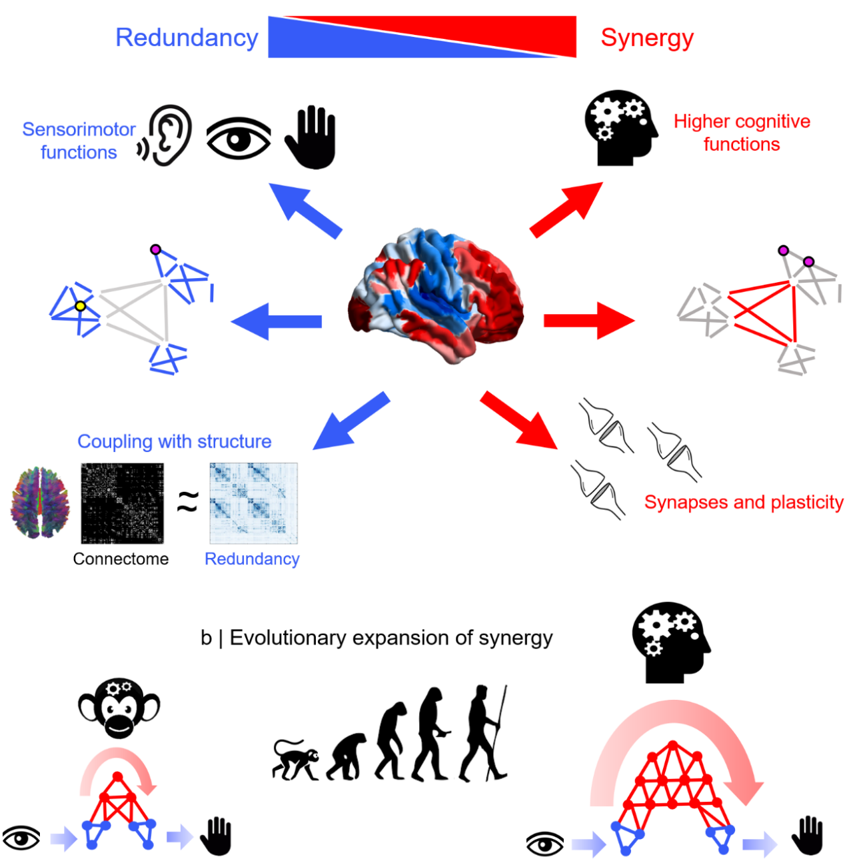
“A NeuroSynth meta-analysis [61] of over 15 000 neuroimaging studies indicated that high-redundancy regions activate in response to modality-speci fi c tasks, whereas high-synergy cortices load onto terms pertaining to higher-order cognitive functions [46].”
An anatomically comprehensive atlas of the adult human brain transcriptome
Hawrylycz, M. J., Lein, E. S., Guillozet-Bongaarts, A. L., Shen, E. H., Ng, L., Miller, J. A., van de Lagemaat, L. N., Smith, K. A., Ebbert, A., Riley, Z. L., et al. (2012) · Nature · doi:10.1038/nature11405 · Cited by 3,083
Experimental and theoretical approaches to conscious processing
Dehaene, S., & Changeux, J.-P. (2011) · Neuron · doi:10.1016/j.neuron.2011.03.018 · Cited by 2,573
Situating the default-mode network along a principal gradient of macroscale cortical organization
Margulies, D. S., Ghosh, S. S., Goulas, A., Falkiewicz, M., Huntenburg, J. M., Langs, G., Bezgin, G., Eickhoff, S. B., Castellanos, F. X., Petrides, M., et al. (2016) · Proceedings of the National Academy of Sciences · doi:10.1073/pnas.1608282113 · Cited by 2,321 · cited 1×
“Figure adapted in part from [49], originally published under CC-BY license, and with permission from Margulies et al. [140].”
The importance of mixed selectivity in complex cognitive tasks
Rigotti, M., Barak, O., Warden, M. R., Wang, X.-J., Daw, N. D., Miller, E. K., & Fusi, S. (2013) · Nature · doi:10.1038/nature12160 · Cited by 1,639
Conscious Processing and the Global Neuronal Workspace Hypothesis
Mashour, G. A., Roelfsema, P., Changeux, J.-P., & Dehaene, S. (2020) · Neuron · doi:10.1016/j.neuron.2020.01.026 · Cited by 1,164 · cited 1×
“…able to perform cognitively useful computation just by having redundant copies of the same information (integration-as-oneness): computation and complex cognition demand that information should eventually be combined (integration-as-cooperation) if they are to subserve adaptive behaviour [29,30].”
Structural reducibility of multilayer networks
De Domenico, M., Nicosia, V., Arenas, A., & Latora, V. (2015) · Nature Communications · doi:10.1038/ncomms7864 · Cited by 661
Imaging synaptic density in the living human brain
Finnema, S. J., Nabulsi, N. B., Eid, T., Detyniecki, K., Lin, S.-F., Chen, M.-K., Dhaher, R., Matuskey, D., Baum, E., Holden, D., et al. (2016) · Science Translational Medicine · doi:10.1126/scitranslmed.aaf6667 · Cited by 575
Cooperative and competitive spreading dynamics on the human connectome
Mišić, B., Betzel, R. F., Nematzadeh, A., Goñi, J., Griffa, A., Hagmann, P., Flammini, A., Ahn, Y.-Y., & Sporns, O. (2015) · Neuron · doi:10.1016/j.neuron.2015.05.035 · Cited by 342
A spectrum of routing strategies for brain networks
Avena-Koenigsberger, A., Yan, X., Kolchinsky, A., van den Heuvel, M. P., Hagmann, P., & Sporns, O. (2019) · PLOS Computational Biology · doi:10.1371/journal.pcbi.1006833 · Cited by 115
Research works printed but not linked: 123
- Shannon, 1948, A mathematical theory of communication, Bell Syst. Tech. J., 27, 379, 10.1002/j.1538-7305.1948.tb01338.x · DOI · Paper page
- Timme, 2018, A tutorial for information theory in neuroscience, eNeuro, 5, 10.1523/ENEURO.0052-18.2018 · DOI
- Wibral, 2017, Partial information decomposition as a unified approach to the specification of neural goal functions, Brain Cogn., 112, 25, 10.1016/j.bandc.2015.09.004 · DOI
- Amico, 2021, Toward an information theoretical description of communication in brain networks, Netw. Neurosci., 5, 646
- Ince, 2017, A statistical framework for neuroimaging data analysis based on mutual information estimated via a Gaussian copula, Hum. Brain Mapp., 38, 1541, 10.1002/hbm.23471 · DOI
- Quian Quiroga, 2009, Extracting information from neuronal populations: information theory and decoding approaches, Nat. Rev. Neurosci., 10, 173, 10.1038/nrn2578 · DOI
- Ince, 2017, The partial entropy decomposition: decomposing multivariate entropy and mutual information via pointwise common surprisal, arXiv
- James, 2011, Anatomy of a bit: information in a time series observation, Chaos, 21, 10.1063/1.3637494 · DOI
- Kolchinsky, 2022, A novel approach to the partial information decomposition, Entropy, 24, 403, 10.3390/e24030403 · DOI
- Lizier, 2018, Information decomposition of target effects from multi-source interactions: perspectives on previous, current and future work, Entropy, 20, 307, 10.3390/e20040307 · DOI
- Mediano, 2021, Towards an extended taxonomy of information dynamics via integrated information decomposition, arXiv
- Varley, 2023, Decomposing past and future: integrated information decomposition based on shared probability mass exclusions, PLoS One, 18, 10.1371/journal.pone.0282950 · DOI
- Williams, 2010, Nonnegative decomposition of multivariate information, arXiv
- Rassouli, 2020, Data disclosure under perfect sample privacy, IEEE Trans. Inf. Forensics Secur., 15, 2012, 10.1109/TIFS.2019.2954652 · DOI
- Ay, 2007, Geometric robustness theory and biological networks, Theory Biosci., 125, 93
- Glassman, 1987, An hypothesis about redundancy and reliability in the brains of higher species: analogies with genes, internal organs, and engineering systems, Neurosci. Biobehav. Rev., 11, 275, 10.1016/S0149-7634(87)80014-3 · DOI
- Tononi, 1999, Measures of degeneracy and redundancy in biological networks, Proc. Natl. Acad. Sci. U. S. A., 96, 3257, 10.1073/pnas.96.6.3257 · DOI · Paper page
- Newman, 2022, Revealing the dynamics of neural information processing with multivariate information decomposition, Entropy, 24, 930, 10.3390/e24070930 · DOI
- McIntosh, 2004, Contexts and catalysts: a resolution of the localization and integration of function in the brain, Neuroinformatics, 2, 175, 10.1385/NI:2:2:175 · DOI
- Mediano, 2022, Integrated information as a common signature of dynamical and information-processing complexity, Chaos Interdiscip. J. Nonlinear Sci., 32, 10.1063/5.0063384 · DOI
- Tononi, 1998, Complexity and coherency: integrating information in the brain, Trends Cogn. Sci., 2, 474, 10.1016/S1364-6613(98)01259-5 · DOI
- Tononi, 1994, A measure for brain complexity: relating functional segregation and integration in the nervous system, Proc. Natl. Acad. Sci. U. S. A., 91, 5033, 10.1073/pnas.91.11.5033 · DOI · Paper page
- Vakorin, 2011, Variability of brain signals processed locally transforms into higher connectivity with brain development, J. Neurosci., 31, 6405, 10.1523/JNEUROSCI.3153-10.2011 · DOI
- Watanabe, 1960, Information theoretical analysis of multivariate correlation, IBM J. Res. Dev., 4, 66, 10.1147/rd.41.0066 · DOI
- Joe, 1989, Relative entropy measures of multivariate dependence, J. Am. Stat. Assoc., 84, 157, 10.1080/01621459.1989.10478751 · DOI
- Tononi, 1998, Consciousness and complexity, Science, 282, 1846, 10.1126/science.282.5395.1846 · DOI · Paper page
- Schneidman, 2003, Synergy, redundancy, and independence in population codes, J. Neurosci., 23, 11539, 10.1523/JNEUROSCI.23-37-11539.2003 · DOI
- Varley, 2023, Partial entropy decomposition reveals higher-order structures in human brain activity, Proc. Natl. Acad. Sci. U. S. A., 120, 10.1073/pnas.2300888120 · DOI · Paper page
- Brenner, 2000, Synergy in a neural code, Neural Comput., 12, 1531, 10.1162/089976600300015259 · DOI
- Puchalla, 2005, Redundancy in the population code of the retina, Neuron, 46, 493, 10.1016/j.neuron.2005.03.026 · DOI
- Reich, 2001, Independent and redundant information in nearby cortical neurons, Science, 294, 2566, 10.1126/science.1065839 · DOI
- Panzeri, 2022, The structures and functions of correlations in neural population codes, Nat. Rev. Neurosci., 23, 551, 10.1038/s41583-022-00606-4 · DOI
- Panzeri, 1999, Correlations and the encoding of information in the nervous system, Proc. R. Soc. Lond. B Biol. Sci., 266, 1001, 10.1098/rspb.1999.0736 · DOI
- Latham, 2005, Synergy, redundancy, and independence in population codes, revisited, J. Neurosci., 25, 5195, 10.1523/JNEUROSCI.5319-04.2005 · DOI
- Nirenberg, 2003, Decoding neuronal spike trains: how important are correlations?, Proc. Natl. Acad. Sci. U. S. A., 100, 7348, 10.1073/pnas.1131895100 · DOI
- Pola, 2003, An exact method to quantify the information transmitted by different mechanisms of correlational coding, Network, 14, 35, 10.1088/0954-898X/14/1/303 · DOI · Paper page
- Delis, 2022, Neural encoding of active multi-sensing enhances perceptual decision-making via a synergistic cross-modal interaction, J. Neurosci., 42, 2344, 10.1523/JNEUROSCI.0861-21.2022 · DOI
- Francis, 2022, Sequential transmission of task-relevant information in cortical neuronal networks, Cell Rep., 39, 10.1016/j.celrep.2022.110878 · DOI
- Chicharro, 2017, Synergy and redundancy in dual decompositions of mutual information gain and information loss, Entropy, 19, 71, 10.3390/e19020071 · DOI
- Varley, 2023, Information-processing dynamics in neural networks of macaque cerebral cortex reflect cognitive state and behavior, Proc. Natl. Acad. Sci. U. S. A., 120, 10.1073/pnas.2207677120 · DOI
- Luppi, 2022, A synergistic core for human brain evolution and cognition, Nat. Neurosci., 25, 771, 10.1038/s41593-022-01070-0 · DOI · Paper page
- Varley, 2023, Multivariate information theory uncovers synergistic subsystems of the human cerebral cortex, Commun. Biol., 6, 451, 10.1038/s42003-023-04843-w · DOI · Paper page
- Finn, 2020, Generalised measures of multivariate information content, Entropy, 22, 216, 10.3390/e22020216 · DOI
- Deco, 2021, Revisiting the global workspace: orchestration of the functional hierarchical organisation of the human brain, Nat. Hum. Behav., 5, 497, 10.1038/s41562-020-01003-6 · DOI · Paper page
- Mesulam, 1998, From sensation to cognition, Brain, 121, 1013, 10.1093/brain/121.6.1013 · DOI · Paper page
- Sydnor, 2021, Neurodevelopment of the association cortices: patterns, mechanisms, and implications for psychopathology, Neuron, 109, 2820, 10.1016/j.neuron.2021.06.016 · DOI
- Wolff, 2022, Intrinsic neural timescales: temporal integration and segregation, Trends Cogn. Sci., 26, 159, 10.1016/j.tics.2021.11.007 · DOI
- Chelaru, 2021, High-order interactions explain the collective behavior of cortical populations in executive but not sensory areas, Neuron, 109, 3954, 10.1016/j.neuron.2021.09.042 · DOI
- Baum, 2020, Development of structure–function coupling in human brain networks during youth, Proc. Natl. Acad. Sci. U. S. A., 117, 771, 10.1073/pnas.1912034117 · DOI · Paper page
- Paquola, 2019, Microstructural and functional gradients are increasingly dissociated in transmodal cortices, PLoS Biol., 17, 10.1371/journal.pbio.3000284 · DOI
- Preti, 2019, Decoupling of brain function from structure reveals regional behavioral specialization in humans, Nat. Commun., 10, 4747, 10.1038/s41467-019-12765-7 · DOI
- Vázquez-Rodríguez, 2019, Gradients of structure–function tethering across neocortex, Proc. Natl. Acad. Sci. U. S. A., 116, 21219, 10.1073/pnas.1903403116 · DOI
- Wu, 2020, Hierarchy of connectivity–function relationship of the human cortex revealed through predicting activity across functional domains, Cereb. Cortex (New York, NY), 30, 4607
- Holtmaat, 2006, Experience-dependent and cell-type-specific spine growth in the neocortex, Nature, 441, 979, 10.1038/nature04783 · DOI · Paper page
- Sherrill, 2020, Correlated activity favors synergistic processing in local cortical networks in vitro at synaptically relevant timescales, Netw. Neurosci., 4, 678, 10.1162/netn_a_00141 · DOI
- Valente, 2021, Correlations enhance the behavioral readout of neural population activity in association cortex, Nat. Neurosci., 24, 975, 10.1038/s41593-021-00845-1 · DOI
- Omidvarnia, 2021, Temporal complexity of fMRI is reproducible and correlates with higher order cognition, NeuroImage, 230, 10.1016/j.neuroimage.2021.117760 · DOI
- Wei, 2019, Genetic mapping and evolutionary analysis of human-expanded cognitive networks, Nat. Commun., 10, 4839, 10.1038/s41467-019-12764-8 · DOI
- Bianchi, 2013, Dendritic morphology of pyramidal neurons in the chimpanzee neocortex: regional specializations and comparison to humans, Cereb. Cortex, 23, 2429, 10.1093/cercor/bhs239 · DOI
- Elston, 2011, Pyramidal cells in prefrontal cortex of primates: marked differences in neuronal structure among species, Front. Neuroanat., 5, 1
- Gidon, 2020, Dendritic action potentials and computation in human layer 2/3 cortical neurons, Science, 367, 83, 10.1126/science.aax6239 · DOI
- Rosas, 2020, An operational information decomposition via synergistic disclosure, J. Phys. A Math. Theor., 53, 10.1088/1751-8121/abb723 · DOI
- Nigam, 2019, Synergistic coding of visual information in columnar networks, Neuron, 104, 402, 10.1016/j.neuron.2019.07.006 · DOI
- Frey, 2018, Synergistic information processing encrypts strategic reasoning in poker, Cogn. Sci., 42, 1457, 10.1111/cogs.12632 · DOI
- Tax, 2017, The partial information decomposition of generative neural network models, Entropy, 19, 474, 10.3390/e19090474 · DOI · Paper page
- Ehrlich, 2023, A measure of the complexity of neural representations based on partial information decomposition, Trans. Mach. Learn. Res., 2023, 2835
- Proca, 2022, Synergistic information supports modality integration and flexible learning in neural networks solving multiple tasks, arXiv
- Luppi, 2023, In vivo mapping of pharmacologically induced functional reorganization onto the human brain’s neurotransmitter landscape. Science, Advances, 9
- Luppi, 2023, A synergistic workspace for human consciousness revealed by integrated information decomposition, eLife, 12
- Faes, 2022, A new framework for the time- and frequency-domain assessment of high-order interactions in networks of random processes, IEEE Trans. Signal Process., 70, 5766, 10.1109/TSP.2022.3221892 · DOI
- Gatica, 2021, High-order interdependencies in the aging brain, Brain Connect., 11, 737, 10.1089/brain.2020.0982 · DOI
- Koen, 2019, The relationship between age, neural differentiation, and memory performance, J. Neurosci., 39, 149, 10.1523/JNEUROSCI.1498-18.2018 · DOI
- Koen, 2019, Neural dedifferentiation in the aging brain, Trends Cogn. Sci., 23, 547, 10.1016/j.tics.2019.04.012 · DOI
- Goulas, 2021, The natural axis of transmitter receptor distribution in the human cerebral cortex, Proc. Natl. Acad. Sci. U. S. A., 118, 10.1073/pnas.2020574118 · DOI
- Luppi, 2023, Reduced emergent character of neural dynamics in patients with a disrupted connectome, Neuroimage, 269, 10.1016/j.neuroimage.2023.119926 · DOI
- Gatica, 2022, High-order functional redundancy in ageing explained via alterations in the connectome in a whole-brain model, PLoS Comput. Biol., 18, 10.1371/journal.pcbi.1010431 · DOI
- Nuzzi, 2020, Synergistic information in a dynamical model implemented on the human structural connectome reveals spatially distinct associations with age, Netw. Neurosci., 4, 910, 10.1162/netn_a_00146 · DOI
- Luppi, 2022, Oxygen and the spark of human brain evolution: complex interactions of metabolism and cortical expansion across development and evolution, Neuroscientist
- Donahue, 2018, Quantitative assessment of prefrontal cortex in humans relative to nonhuman primates, Proc. Natl. Acad. Sci. U. S. A., 115, 10.1073/pnas.1721653115 · DOI · Paper page
- Xu, 2020, Cross-species functional alignment reveals evolutionary hierarchy within the connectome, NeuroImage, 223, 10.1016/j.neuroimage.2020.117346 · DOI · Paper page
- Avena-Koenigsberger, 2017, Communication dynamics in complex brain networks, Nat. Rev. Neurosci., 19, 17, 10.1038/nrn.2017.149 · DOI · Paper page
- Goñi, 2014, Resting-brain functional connectivity predicted by analytic measures of network communication, Proc. Natl. Acad. Sci. U. S. A., 111, 833, 10.1073/pnas.1315529111 · DOI
- Seguin, 2023, Brain network communication: concepts, models and applications, Nat. Rev. Neurosci., 24, 557, 10.1038/s41583-023-00718-5 · DOI
- Seguin, 2023, Communication dynamics in the human connectome shape the cortex-wide propagation of direct electrical stimulation, Neuron, 111, 1391, 10.1016/j.neuron.2023.01.027 · DOI
- Seguin, 2018, Navigation of brain networks, Proc. Natl. Acad. Sci. U. S. A., 115, 6297, 10.1073/pnas.1801351115 · DOI · Paper page
- Harush, 2017, Dynamic patterns of information flow in complex networks, Nat. Commun., 8, 2181, 10.1038/s41467-017-01916-3 · DOI
- Kirst, 2016, Dynamic information routing in complex networks, Nat. Commun., 7, 10.1038/ncomms11061 · DOI
- Hao, 2020, Creative destruction: sparse activity emerges on the mammal connectome under a simulated communication strategy with collisions and redundancy, Netw. Neurosci., 4, 1055, 10.1162/netn_a_00165 · DOI
- Battiston, 2021, The physics of higher-order interactions in complex systems, Nat. Phys., 17, 1093, 10.1038/s41567-021-01371-4 · DOI
- Petri, 2021, Topological limits to the parallel processing capability of network architectures, Nat. Phys., 17, 646, 10.1038/s41567-021-01170-x · DOI
- Santoro, 2023, Higher-order organization of multivariate time series, Nat. Phys., 19, 221
- James, 2018, Unique information via dependency constraints, J. Phys. A Math. Theor., 52
- Fakhar, 2022, Systematic perturbation of an artificial neural network: a step towards quantifying causal contributions in the brain, PLoS Comput. Biol., 18, 10.1371/journal.pcbi.1010250 · DOI
- Kötter, 2007, Shapley ratings in brain networks, Front Neuroinform., 1, 2, 10.3389/neuro.11.002.2007 · DOI
- Malherbe, 2021, Game-theoretical mapping of fundamental brain functions based on lesion deficits in acute stroke, Brain Commun., 3, 10.1093/braincomms/fcab204 · DOI
- Ofir-Geva, 2023, Use of multi-perturbation Shapley analysis in lesion studies of functional networks: the case of upper limb paresis, Hum. Brain Mapp., 44, 1320, 10.1002/hbm.26105 · DOI
- Ay, 2020, Information decomposition based on cooperative game theory, Kybernetika, 56, 979
- Sadiq, 2021, Accrual of functional redundancy along the lifespan and its effects on cognition, Neuroimage, 229, 10.1016/j.neuroimage.2021.117737 · DOI
- Stanford, 2022, A robust core architecture of functional brain networks supports topological resilience and cognitive performance in middle- and old-aged adults, Proc. Natl. Acad. Sci. U. S. A., 119, 10.1073/pnas.2203682119 · DOI
- Wook Yoo, 2015, A network flow-based analysis of cognitive reserve in normal ageing and Alzheimer’s disease, Sci. Rep., 5, 10.1038/srep10057 · DOI
- Finn, 2018, Pointwise partial information decomposition using the specificity and ambiguity lattices, Entropy, 20, 297, 10.3390/e20040297 · DOI
- Griffith, 2014, Intersection information based on common randomness, Entropy, 16, 1985, 10.3390/e16041985 · DOI
- Ince, 2017, Measuring multivariate redundant information with pointwise common change in surprisal, Entropy, 19, 318, 10.3390/e19070318 · DOI
- Makkeh, 2021, Introducing a differentiable measure of pointwise shared information, Phys. Rev. E, 103, 10.1103/PhysRevE.103.032149 · DOI
- Makkeh, 2018, BROJA-2PID: a robust estimator for bivariate partial information decomposition, Entropy, 20, 271, 10.3390/e20040271 · DOI
- Rosas, 2018, An information-theoretic approach to self-organisation: emergence of complex interdependencies in coupled dynamical systems, Entropy, 20, 793, 10.3390/e20100793 · DOI
- Rosas, 2019, Quantifying high-order interdependencies via multivariate extensions of the mutual information, Phys. Rev. E, 100, 10.1103/PhysRevE.100.032305 · DOI
- Stramaglia, 2021, Quantifying dynamical high-order interdependencies from the O-information: an application to neural spiking dynamics, Front. Physiol., 11, 10.3389/fphys.2020.595736 · DOI
- Schreiber, 2000, Measuring information transfer, Phys. Rev. Lett., 85, 461, 10.1103/PhysRevLett.85.461 · DOI
- Barnett, 2009, Granger causality and transfer entropy are equivalent for Gaussian variables, Phys. Rev. Lett., 103, 10.1103/PhysRevLett.103.238701 · DOI
- Novelli, 2020, Deriving pairwise transfer entropy from network structure and motifs, Proc. R. Soc. A Math. Phys. Eng. Sci., 476
- Novelli, 2021, Inferring network properties from time series using transfer entropy and mutual information: validation of multivariate versus bivariate approaches, Netw. Neurosci., 5, 373
- Shorten, 2022, Early lock-in of structured and specialised information flows during neural development, eLife, 11, 10.7554/eLife.74651 · DOI
- Ursino, 2020, Transfer entropy as a measure of brain connectivity: a critical analysis with the help of neural mass models, Front. Comput. Neurosci., 14, 45, 10.3389/fncom.2020.00045 · DOI
- Williams, 2011, Generalized measures of information transfer, arXiv
- Celotto, 2023, An information-theoretic quantification of the content of communication between brain regions, bioRxiv
- Beer, 2015, Information processing and dynamics in minimally cognitive agents, Cogn. Sci., 39, 1, 10.1111/cogs.12142 · DOI
- Reing, 2021, Discovering higher-order interactions through neural information decomposition, Entropy, 23, 79, 10.3390/e23010079 · DOI
- Yu, 2021, Understanding convolutional neural networks with information theory: an initial exploration, IEEE Trans. Neural Netw. Learn. Systems, 32, 435, 10.1109/TNNLS.2020.2968509 · DOI
- Kringelbach, 2020, Brain states and transitions: insights from computational neuroscience, Cell Rep., 32, 10.1016/j.celrep.2020.108128 · DOI
- Shine, 2021, Computational models link cellular mechanisms of neuromodulation to large-scale neural dynamics, Nat. Neurosci., 24, 765, 10.1038/s41593-021-00824-6 · DOI
- Deco, 2021, Dynamical consequences of regional heterogeneity in the brain’s transcriptional landscape, Sci. Adv., 7, 10.1126/sciadv.abf4752 · DOI
- Demirtaş, 2019, Hierarchical heterogeneity across human cortex shapes large-scale neural dynamics, Neuron, 101, 1181, 10.1016/j.neuron.2019.01.017 · DOI
Cited by
Sorted by citations
Sampling bias corrections for discrete and Gaussian partial information decompositions
Lorenz, G. M., Engel, N. M., Koçillari, L., Celotto, M., Orsenigo, D., Curreli, S., Malerba, S. B., Engel, A. K., Kayser, C., Fellin, T., et al. (2026) · Patterns · doi:10.1016/j.patter.2026.101619 · Cited by 9
Self-citationMcNamara, P. (2025) · Frontiers in Psychiatry · doi:10.3389/fpsyt.2025.1625811
“Thus, PAG and likely 5HT2A receptors are key neural systems implicated in REM onset, maintenance and intensity (18, 19).”
Metadata
- Authors
- Luppi, A. I., Rosas, F. E., Mediano, P. A. M., Menon, D. K., & Stamatakis, E. A.
- Venue
- Trends in Cognitive Sciences
- Publisher
- Elsevier BV
- Published
- 2024-04
- Volume
- 28
- Issue
- 4
- Pages
- 352-368
- ISSN
- 1364-6613
- Cited by
- 140
- References
- 10
- Language
- en
- Licence
- Funders
- Royal College of Anaesthetists
- Canadian Institute for Advanced Research (RCZB/072 RG93193)
- Fonds de recherche du Québec – Nature et technologies (2020-RS4-265502)
- McGill University
- UCLH Biomedical Research Centre
- National Institute for Health and Care Research
About these checks
Registry, retraction, Cites and statistics results are computed, not judged, with one exception: a printed reference that no index lists is read once by a model before it counts as a citation error. Claims are extracted by a model and kept only when their quote appears verbatim in the text; each cited source is then checked, with a model’s help, for whether it says what the claim relies on. Those verdicts can be wrong — read the claim’s quote and the cited source before relying on one.
Statistics and arithmetic are recomputed, not judged.
Confidence bands are shown only for fields calibrated on our annotated test set. None is calibrated yet, so no band is shown.
What counts as a claim ›How we measure confidence ›How we check this ›
Are you an author, or do you see a problem with this page? Request a review
