

Technological transitions as evolutionary reconfiguration processes: a multi-level perspective and a case-study
Open accessThe DOI matches its Crossref record; 86 of the 94 references it cites were found in a registry or an index; 1 of the 45 sources its claims cite were checked for support.
Overview
CoChat Summary
TL;DR
Geels proposes a multi-level perspective on technological transitions, combining evolutionary economics and technology studies around niches, sociotechnical regimes, and landscape. He illustrates it with a qualitative longitudinal case study of the transition from sailing ships to steamships, 1780–1900, identifying niche-cumulation, technological add-on/hybridisation, and riding along with market growth.
Key findings
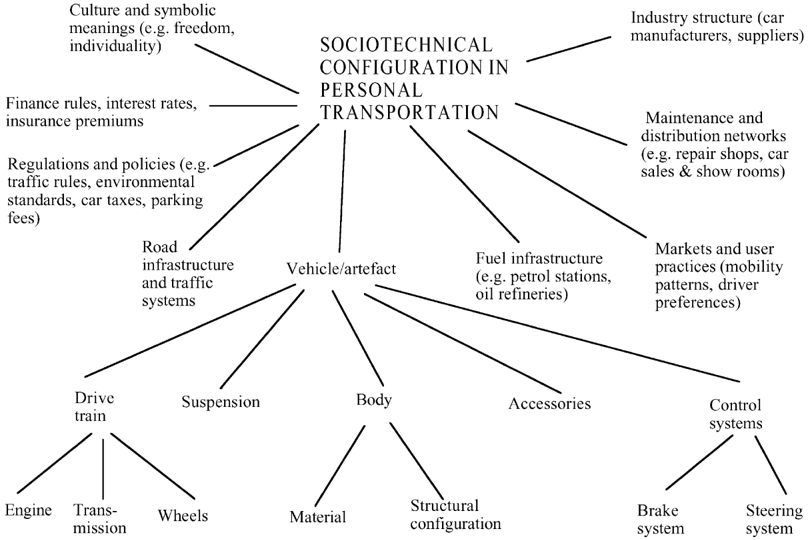
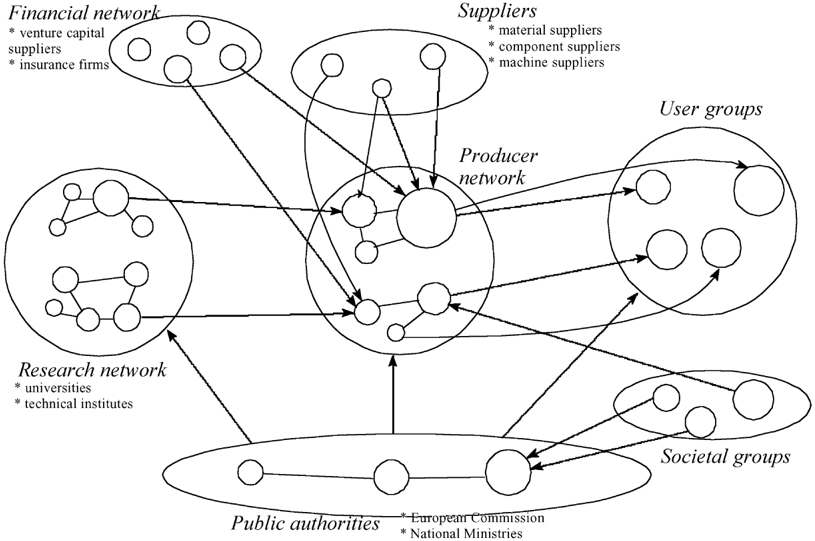
- Technological transitions are major, long-term changes in how societal functions are fulfilled; they involve not only technology but also user practices, regulation, industrial networks, infrastructure, and symbolic meaning or culture.
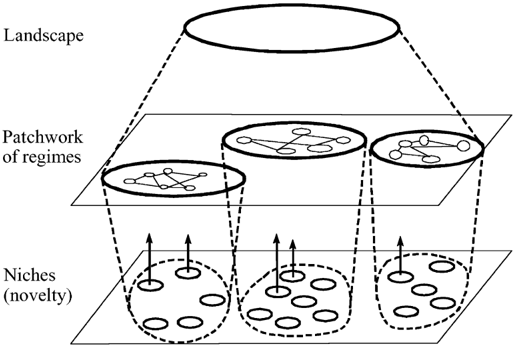
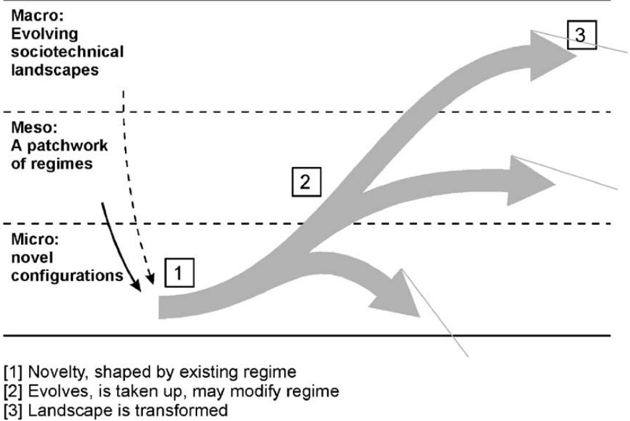
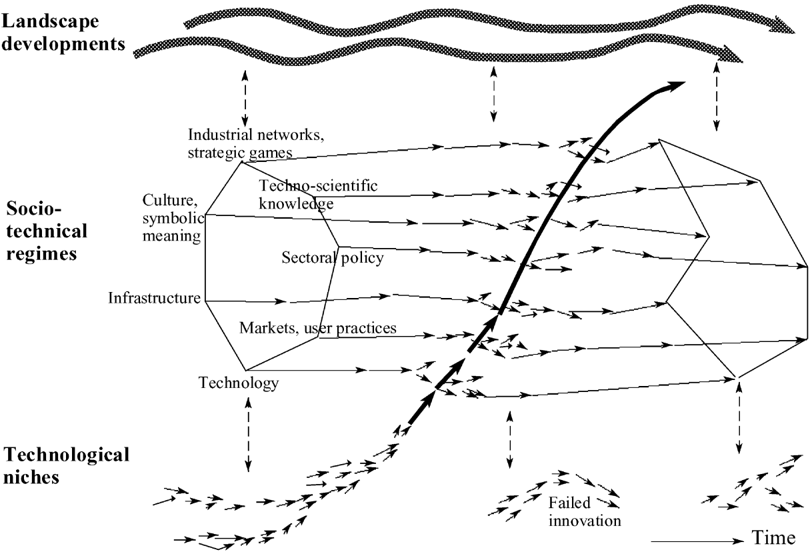
- The multi-level perspective treats niches as loci of radical variety, sociotechnical regimes as selection/retention mechanisms, and the landscape as slower external structure; breakthroughs occur when developments at multiple levels align and create a “window of opportunity.”
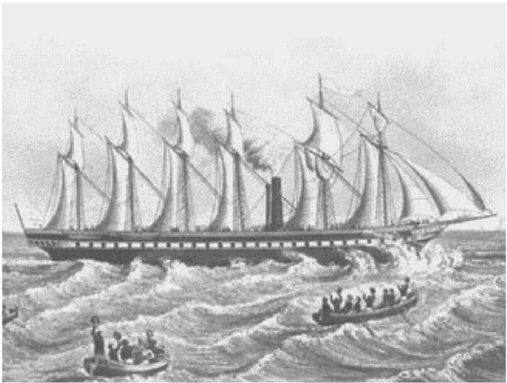
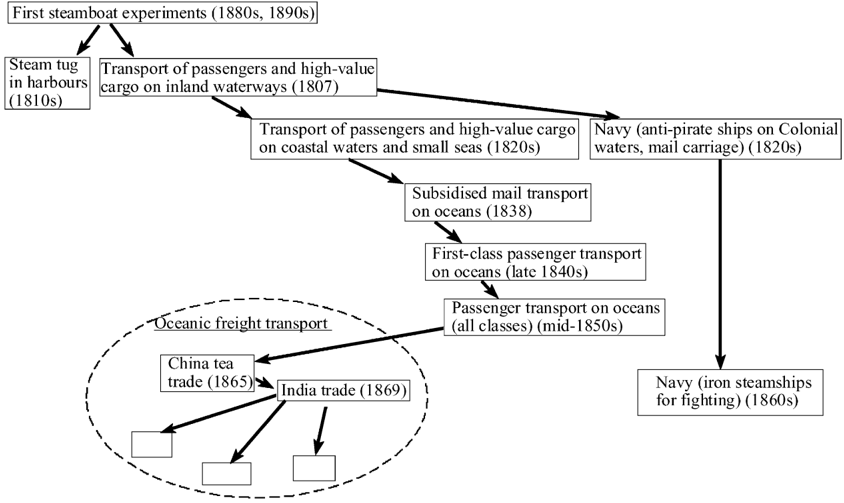
- In the steamship case, breakthrough followed niche-cumulation through inland waterways, coastal routes, mail subsidies, passenger transport, and freight; mechanisms included steam engines as auxiliary add-ons to sailing ships, hybrid sail/steam and iron/wood forms, and riding along with market growth.
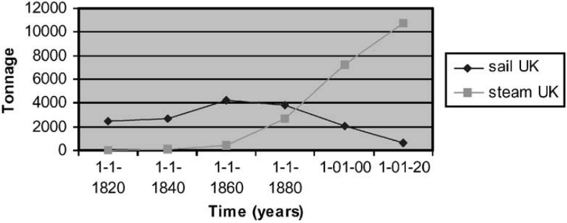
- Reported numbers include: European emigrants travelling by steamer rose from 45% in 1863 to 81% in 1866; compound engines enabled fuel-consumption reductions of 60%; the distance margin where steam was competitive reached 3000–3500 miles by the late 1860s; during the steamship mania (1869–1874), steamers rose from 17% to 31% of British registered tonnage.
Methods
- The paper uses “appreciative theory,” synthesising insights from evolutionary economics and technology studies into a multi-level perspective.
- It presents a qualitative longitudinal case study of the transition from sailing ships to steamships, 1780–1900, focused on Great Britain.
- The case is written in a mosaic style, shifting across markets, ship designs, insurance rules, actor groups, institutions, mail subsidies, persistent/emerging problems, and management practices to illustrate the conceptual framework.
Limitations
- The paper states that the multi-level perspective is fairly complex, requires many data, often qualitative, and that sociotechnical regimes are a broad unit of analysis with difficult-to-draw precise boundaries; boundary work deserves more attention.
- The paper states that the single case study has a drawback because 19th-century craft-based innovation differs from 20th-century science-based innovation, and the perspective would be more robust with more case studies varied over time periods and sectors.
- Evident in the text: the empirical analysis is focused on Great Britain and shipping, and the mechanisms are illustrated through selected historical examples rather than formal comparative or quantitative testing.
Model-written summary. Check it against the paper before relying on it.
Integrity signals
Registry
Cites
Statistics
Figures

Verification
Claims the paper makes
1 Valid · 5 Not valid · 42 Not checked · 63 Own results and interpretations
The cited sources support only part of this claim — read each source’s verdict below.
In the paper
“Aspecific mechanism in the breakthrough of radical innovations is technological add-on and hybridisation . It means that new technologies in their early phase physically link up with established technologies, often to solve particular bottlenecks. Thus, old and new technologies do not immediately compete head on, but form some sort of symbiosis (see also Pistorius and Utterback, 1997).”
What the sources say
- Partly supportedcites Pistorius and Utterback, 1997 matched to “Multi-mode interaction among technologies” (1997) sourceExperimental — accuracy not yet measured
Split into 2 atoms — 0 confirmed, 2 partially supported, 0 disputed, 0 misattributed, 0 unverifiable. Expand the claim to see per-atom verdicts.
plainstates a cause- Asserted: passes — The authors put it forward as true.
- Checkable: passes — It can be checked against evidence.
- Load-bearing: passes — The paper’s conclusions depend on it.
- Based: passes — The paper gives a reason why it holds.
- Partly supported
A result the paper states — it cites no source for it, so there is none to check. The quote shows it is in the paper.
In the paper
“These subsidies created a protective environment for the use and development of oceanic steamships.”
plainstates a cause- Asserted: passes — The authors put it forward as true.
- Checkable: passes — It can be checked against evidence.
- Load-bearing: unclear — It is unclear whether the paper’s conclusions depend on it.
- Based: passes — The paper gives a reason why it holds.
- Rests on an assumption not shown here.
In the paper
“Between 1838 and 1862 a global network of British intercontinental steam companies was created on the basis of imperial mail subsidies (Broeze, 1982).”
What the sources say
- Not matchedcites Broeze, 1982
An author–year citation the paper’s reference list doesn’t settle. We don’t search these by name.
plainstates a cause- Asserted: passes — The authors put it forward as true.
- Checkable: passes — It can be checked against evidence.
- Load-bearing: unclear — It is unclear whether the paper’s conclusions depend on it.
- Based: passes — The paper gives a reason why it holds.
- Rests on an assumption not shown here.
- Not matched
A result the paper states — it cites no source for it, so there is none to check. The quote shows it is in the paper.
In the paper
“Another innovation in the late 18th century shipping regime was the emergence of new social groups: professional shipowners, shipbrokers and insurance companies.”
plain- Asserted: passes — The authors put it forward as true.
- Checkable: passes — It can be checked against evidence.
- Load-bearing: unclear — It is unclear whether the paper’s conclusions depend on it.
- Based: passes — The paper gives a reason why it holds.
- Rests on an assumption not shown here.
A result the paper states — it cites no source for it, so there is none to check. The quote shows it is in the paper.
In the paper
“The emergence of professional shipowners was stimulated by the French Wars (1789-1815) which pushed up freight prices as demand for ships increased.”
plainstates a cause- Asserted: passes — The authors put it forward as true.
- Checkable: passes — It can be checked against evidence.
- Load-bearing: unclear — It is unclear whether the paper’s conclusions depend on it.
- Based: passes — The paper gives a reason why it holds.
- Rests on an assumption not shown here.
24 more claims
Create a free account to see all 111 claims and every source verdict.
- Probably not a substantial claim. 28
- It may state two separate claims as one. 69
- The quote only partly states this claim. 2
Claims other papers make about this one
Each is checked against this paper’s own text: does it say what the citing paper says it does?
In the citing paper
“The model of Geels (2002) describes new technologies as arising and maturing within existing technology systems [18].”
From Lessons Learned From a Living Lab on the Broad Adoption of eHealth in Primary Health Care (2018) · cites this paper as [18]
In the citing paper
“The multi-level perspective (Rip and Kemp, 1998;Geels, 2002;Geels, 2004;Geels and Schot, 2007) is a framework for understanding sustainability transitions that provides an overall view of the multi-dimensional complexity of changes in socio-technical systems.”
From Ontologies, socio-technical transitions (to sustainability), and the multi-level perspective (2010) · cites this paper as Geels, 2002
Citations
Cites
An Evolutionary Theory of Economic Change.
Loasby, B. J., Nelson, R. R., & Winter, S. G. (1983) · The Economic Journal · doi:10.2307/2232409 · Cited by 21,366
(1934) · SSRN Electronic Journal · Cited by 7,609
Technological Discontinuities and Organizational Environments
Tushman, M. L., & Anderson, P. (1986) · Administrative Science Quarterly · doi:10.2307/2392832 · Cited by 6,112
von Hippel, E. (2007) · Das Summa Summarum des Management · doi:10.1007/978-3-8349-9320-5_10 · Cited by 5,098
Technical Change and Economic Theory.
Swann, P., & Dosi, G. (1989) · The Economic Journal · doi:10.2307/2234048 · Cited by 4,041
Shaping Technology, Building Society: Studies in Sociotechnical Change.
Lynch, M., Bijker, W. E., & Law, J. (1993) · Contemporary Sociology · doi:10.2307/2074370 · Cited by 3,540
Technological Discontinuities and Dominant Designs: A Cyclical Model of Technological Change
Anderson, P., & Tushman, M. L. (1990) · Administrative Science Quarterly · doi:10.2307/2393511 · Cited by 3,255
Bijker, W. E., Hughes, T. P., & Pinch, T. (1987) · Cited by 2,957
Kemp, R., Schot, J., & Hoogma, R. (1998) · Technology Analysis & Strategic Management · doi:10.1080/09537329808524310 · Cited by 2,860
Innovation: Mapping the winds of creative destruction
Abernathy, W. J., & Clark, K. B. (1985) · Research Policy · doi:10.1016/0048-7333(85)90021-6 · Cited by 2,791
Research works printed but not linked: 9
- Broeze, F.J.A., 1982. The international diffusion of ocean steam navigation: the myth of the retardation of Netherlands steam navigation to the East Indies. Economisch-en Sociaal-Historisch Jaarboek 45, 77-95.
- Callon, M. (Ed.), 1998. The Laws of the Market. Blackwell, Oxford.
- Garrat, G.R.M., Goodman, D.C., Russel, C.A., 1973. Science and Engineering, Units 14 and 15. Open University Press, Bletchley.
- Jackson, G., 1998. Ports, ships and government in the nineteenth and twentieth centuries. In: Van Royen, P.C., Fischer, L.R., Williams, D.M. (Eds.), Proceedings of the Second International Congress of Maritime History on Frutta di Mare: Evolution and revolution in the maritime world in the 19th and 20th centuries. Amsterdam/Rotterdam, The Netherlands, 5-8 June, 1996. Batavian Lion International, Amsterdam, pp. 161-176.
- Lundvall, B.A., 1988. Innovation as an interactive process: from user-producer interaction to the national system of innovation. In: Dosi, G., Freeman, C., Nelson, R., Silverberg, G., Soete, L. (Eds.), Technical Change and Economic Theory. Pinter, London, pp. 349-369.
- Maddocks, M., 1982. De Grote Oversteek. Time-Life, London. Mayntz, R., Hughes, T.P. (Eds.), 1988. The Development of Large
- Mokyr, J., 1990. The Lever of Riches. Oxford University Press, New York.
- Rip, A., Kemp, R., 1996. Towards a Theory of Socio-Technical Change. Mimeo University of Twente, Report prepared for Batelle Pacific Northwest Laboratories, Washington, DC. (An edited version has been published as book chapter Rip and Kemp 1998).
- Sloan, E.W., 1998. Private enterprise as public utility: the management of capital in two centuries of shipping business. In: Van Royen, P.C., Fischer, L.R., Williams, D.M. (Eds.), Proceedings of the Second International Congress of Maritime History on Frutta di Mare: Evolution and Revolution in the Maritime World in the 19th and 20th Centuries. Amsterdam/Rotterdam, The Netherlands, 5-8 June, 1996. Batavian Lion International, Amsterdam, pp. 89-100.
Cited by
Items 701–800 of 7,210
What explains the emergence and diffusion of green bonds?
Monk, A., & Perkins, R. (2020) · Energy Policy · doi:10.1016/j.enpol.2020.111641 · Cited by 131
Kok, K. P. W., Loeber, A., & Grin, J. (2020) · Research Policy · doi:10.1016/j.respol.2020.104183 · Cited by 118
Automating Agroecology: How to Design a Farming Robot Without a Monocultural Mindset?
Ditzler, L., & Driessen, C. (2022) · Journal of Agricultural and Environmental Ethics · doi:10.1007/s10806-021-09876-x · Cited by 87
“The dominant sociotechnical regime is robust, favoring developments that fit within a monoculture approach and positioning diversified cropping systems in a niche outside the boundaries of the prevailing innovation landscape (Geels, 2002; Morel et al., 2020).”
BackgroundBergek, A., Hellsmark, H., & Karltorp, K. (2023) · Industry and Innovation · doi:10.1080/13662716.2022.2163882 · Cited by 111
“…of this new paradigm is influenced by, on the one hand, literature on socio-technical transitions (e.g. Berkhout, Smith, and Stirling 2003; Geels 2002, 2004; Kemp, Schot, and Hoogma 1998) and, on the other hand, economics-CONTACT oriented literature (Foray 2018a; Mazzucato 2016, 2018;…”
BackgroundPost carbon pathways: A meta-analysis of 18 large-scale post carbon economy transition strategies
Wiseman, J., Edwards, T., & Luckins, K. (2013) · Environmental Innovation and Societal Transitions · doi:10.1016/j.eist.2013.04.001 · Cited by 91
Colvin, J., Blackmore, C., Chimbuya, S., Collins, K., Dent, M. C., Goss, J. R., Ison, R. L., Roggero, P. P., & Seddaiu, G. (2014) · Research Policy · doi:10.1016/j.respol.2013.12.010 · Cited by 137
Stakeholder involvement in sustainability science—A critical view
Mielke, J., Vermaßen, H., Ellenbeck, S., Milan, B. F., & Jaeger, C. C. (2016) · Energy Research & Social Science · doi:10.1016/j.erss.2016.04.001 · Cited by 118
Andersen, A. D., Steen, M., Mäkitie, T., Hanson, J., Thune, T. M., & Soppe, B. (2020) · Environmental Innovation and Societal Transitions · doi:10.1016/j.eist.2019.11.009 · Cited by 92
Shakou, L. M., Wybo, J., Reniers, G., & Boustras, G. (2019) · Safety Science · doi:10.1016/j.ssci.2019.05.019 · Cited by 116
A systematic review of energy systems: The role of policymaking in sustainable transitions
Munro, F. R., & Cairney, P. (2019) · Renewable and Sustainable Energy Reviews · doi:10.1016/j.rser.2019.109598 · Cited by 102
Hoffman, J. (2013) · Policy Sciences · doi:10.1007/s11077-013-9173-2 · Cited by 123
White, R., & Stirling, A. (2013) · Global Environmental Change · doi:10.1016/j.gloenvcha.2013.06.004 · Cited by 92
Towards a sharing economy – Innovating ecologies of business models
Boons, F., & Bocken, N. (2018) · Technological Forecasting and Social Change · doi:10.1016/j.techfore.2018.06.031 · Cited by 91
Saari, U. A., Herstatt, C., Tiwari, R., Dedehayir, O., & Mäkinen, S. (2020) · Trends in Food Science & Technology · doi:10.1016/j.tifs.2020.10.003 · Cited by 117
Chou, T., Kosmas, V., Acciaro, M., & Renken, K. (2021) · Sustainability · doi:10.3390/su13041880 · Cited by 136
Natural powers: from the bio-economy to the eco-economy and sustainable place-making
Marsden, T., & Farioli, F. (2015) · Sustainability Science · doi:10.1007/s11625-014-0287-z · Cited by 110
Intelligent Transport Systems: The propensity for environmental and economic benefits
Grant‐Muller, S., & Usher, M. D. (2013) · Technological Forecasting and Social Change · doi:10.1016/j.techfore.2013.06.010 · Cited by 103
Local strategic planning processes and sustainability transitions in infrastructure sectors
Truffer, B., Störmer, E., Maurer, M., & Ruef, A. (2010) · Environmental Policy and Governance · doi:10.1002/eet.550 · Cited by 113
The stuttering energy transition in Germany: Wind energy policy and feed-in tariff lock-in
Nordensvärd, J., & Urban, F. (2015) · Energy Policy · doi:10.1016/j.enpol.2015.03.009 · Cited by 128
Ockwell, D., & Byrne, R. (2015) · Climate Policy · doi:10.1080/14693062.2015.1052958 · Cited by 112
Warbroek, B., & Hoppe, T. (2017) · Sustainability · doi:10.3390/su9010075 · Cited by 113
Aka, K. G. (2019) · Journal of Cleaner Production · doi:10.1016/j.jclepro.2019.03.351 · Cited by 121
Beyond experiments: Embedding outcomes in climate governance
Sengers, F., Turnheim, B., & Berkhout, F. (2020) · Environment and Planning C Politics and Space · doi:10.1177/2399654420953861 · Cited by 136
Emergence and phase transitions in service ecosystems
Polese, F., Payne, A., Frow, P., Sarno, D., & Nenonen, S. (2021) · Journal of Business Research · doi:10.1016/j.jbusres.2020.11.067 · Cited by 109
Behaviour in sustainability transitions: A mixed methods literature review
Kaufman, S., Saeri, A. K., Raven, R. P. J. M., Malekpour, S., & Smith, L. D. G. (2021) · Environmental Innovation and Societal Transitions · doi:10.1016/j.eist.2021.10.010 · Cited by 122
Prost, L., Martin, G., Ballot, R., Benoît, M., Bergez, J.-É., Bockstaller, C., Cerf, M., Deytieux, V., Hossard, L., Jeuffroy, M., et al. (2023) · Agronomy for Sustainable Development · doi:10.1007/s13593-022-00855-8 · Cited by 155
“2001; Geels and Kemp 2007).”
Employee skills for circular business model implementation: A taxonomy
Straub, L., Hartley, K., Dyakonov, I., Gupta, H., van Vuuren, D. P., & Kirchherr, J. (2023) · Journal of Cleaner Production · doi:10.1016/j.jclepro.2023.137027 · Cited by 125
“One driver of socio-technical transitions is a shift in skills, as some skills relevant in the old system lose their value in a new system (Geels, 2002).”
BackgroundGoverning transitions: Cases and insights from two periods in the history of the UK gas industry
Arapostathis, S., Carlsson-Hyslop, A., Pearson, P. J. G., Thornton, J., Gradillas, M., Laczay, S., & Wallis, S. (2012) · Energy Policy · doi:10.1016/j.enpol.2012.08.016 · Cited by 106
Emerging energy transitions: PV uptake beyond subsidies
Ford, R., Walton, S. C., Stephenson, J. R., Rees, D. H. E., Scott, M., King, G., Williams, J., & Wooliscroft, B. (2016) · Technological Forecasting and Social Change · doi:10.1016/j.techfore.2016.12.007 · Cited by 107
Pahl‐Wostl, C., Giupponi, C., Richards, K., Binder, C. R., de Sherbinin, A., Sprinz, D. F., Toonen, T. A. J., & van Bers, C. (2012) · Environmental Science & Policy · doi:10.1016/j.envsci.2012.11.009 · Cited by 101
Child, M., & Breyer, C. (2017) · Energy Policy · doi:10.1016/j.enpol.2017.04.022 · Cited by 122
Liu, Z., & Stephens, V. (2019) · Journal of Open Innovation Technology Market and Complexity · doi:10.3390/joitmc5030048 · Cited by 130
Yadav, P., Davies, P. J., & Sarkodie, S. A. (2019) · Energy Strategy Reviews · doi:10.1016/j.esr.2019.100424 · Cited by 89
Sustainable development goals in the research and innovation policy of the European Union
Kastrinos, N., & Weber, M. (2020) · Technological Forecasting and Social Change · doi:10.1016/j.techfore.2020.120056 · Cited by 107
A Literature Review of Inter-Organizational Sustainability Learning
Dzhengiz, T. (2020) · Sustainability · doi:10.3390/su12124876 · Cited by 89
Exploring the role of failure in socio-technical transitions research
Turnheim, B., & Sovacool, B. K. (2020) · Environmental Innovation and Societal Transitions · doi:10.1016/j.eist.2020.09.005 · Cited by 112
Ohlendorf, N., Jakob, M., & Steckel, J. C. (2022) · Energy Research & Social Science · doi:10.1016/j.erss.2022.102590 · Cited by 115
Wassermann, S., Reeg, M., & Nienhaus, K. (2014) · Energy Policy · doi:10.1016/j.enpol.2014.10.013 · Cited by 111
Brown, J., & Hendry, C. (2009) · Energy Policy · doi:10.1016/j.enpol.2009.01.040 · Cited by 92
Trencher, G., Broto, V. C., Takagi, T., Sprigings, Z., Nishida, Y., & Yarime, M. (2016) · Environmental Science & Policy · doi:10.1016/j.envsci.2016.06.021 · Cited by 102
Cultural heritage, tourist attractiveness and augmented reality: insights from Italy
Graziano, T., & Privitera, D. (2020) · Journal of Heritage Tourism · doi:10.1080/1743873x.2020.1719116 · Cited by 89
Burch, S. L., Andrachuk, M., Carey, D., Frantzeskaki, N., Schroeder, H., Mischkowski, N. S., & Loorbach, D. A. (2016) · Current Opinion in Environmental Sustainability · doi:10.1016/j.cosust.2017.04.002 · Cited by 123
Food Sovereignty, Agroecology And Biocultural Diversity: Constructing and Contesting Knowledge
Pimbert, M. P. (2017) · Routledge eBooks · doi:10.4324/9781315666396 · Cited by 88
Kotilainen, K., Aalto, P., Valta, J., Rautiainen, A., Kojo, M., & Sovacool, B. K. (2019) · Policy Sciences · doi:10.1007/s11077-019-09361-3 · Cited by 108
Supplying resilience through assessing diversity of responses to disruption
Kahiluoto, H., Mäkinen, H., & Kaseva, J. (2020) · International Journal of Operations & Production Management · doi:10.1108/ijopm-01-2019-0006 · Cited by 110
The Age of Sustainability: Just Transitions in a Complex World
Swilling, M. (2019) · Routledge eBooks · doi:10.4324/9780429057823 · Cited by 247
Framing different energy futures? Comparing Fridays for Future and Extinction Rebellion in Germany
Buzogány, Á., & Scherhaufer, P. (2022) · Futures · doi:10.1016/j.futures.2022.102904 · Cited by 119
A brief history and the possible future of urban energy systems
Rutter, P., & Keirstead, J. E. (2012) · Energy Policy · doi:10.1016/j.enpol.2012.03.072 · Cited by 116
Young, J., & Brans, M. (2017) · Journal of Cleaner Production · doi:10.1016/j.jclepro.2017.08.023 · Cited by 113
Schmidt, T. S., Matsuo, T., & Michaelowa, A. (2017) · Global Environmental Change · doi:10.1016/j.gloenvcha.2017.05.004 · Cited by 106
Hoekstra, A., Steinbuch, M., & Verbong, G. P. J. (2017) · Complexity · doi:10.1155/2017/1967645 · Cited by 109
Twenty years of technology and strategic roadmapping research: A school of thought perspective
Park, H., Phaal, R., Ho, J., & O’Sullivan, E. (2020) · Technological Forecasting and Social Change · doi:10.1016/j.techfore.2020.119965 · Cited by 112
The Global Forest Transition as a Human Affair
García, C., Savilaakso, S., Verburg, R. W., Gutierrez, V. S., Wilson, S. J., Krug, C. B., Sassen, M., Robinson, B. E., Moersberger, H., Naimi, B., et al. (2020) · One Earth · doi:10.1016/j.oneear.2020.05.002 · Cited by 108
COVID, CITIES and CLIMATE: Historical Precedents and Potential Transitions for the New Economy
Newman, P. W. G. (2020) · Urban Science · doi:10.3390/urbansci4030032 · Cited by 104
Pathways of regional transformation and Industry 4.0
Propris, L. D., & Bailey, D. (2021) · Regional Studies · doi:10.1080/00343404.2021.1960962 · Cited by 120
Vehicle-to-Grid: A Sociotechnical Transition Beyond Electric Mobility
Noel, L., de Rubens, G. Z., Kester, J., & Sovacool, B. K. (2019) · Springer eBooks · doi:10.1007/978-3-030-04864-8 · Cited by 160
Enang, E., Bashiri, M., & Jarvis, D. (2023) · International Journal of Production Research · doi:10.1080/00207543.2023.2221344 · Cited by 109
van den Heiligenberg, H. A. R. M., Heimeriks, G. J., Hekkert, M. P., & Oort, F. G. V. (2017) · Journal of Cleaner Production · doi:10.1016/j.jclepro.2017.06.177 · Cited by 108
Grillitsch, M. (2018) · Regional Studies · doi:10.1080/00343404.2018.1463436 · Cited by 119
Innovation systems for technology diffusion: An analytical framework and two case studies
Palm, A. (2022) · Technological Forecasting and Social Change · doi:10.1016/j.techfore.2022.121821 · Cited by 116
The impact of COVID-19 on the evolution of online retail: The pandemic as a window of opportunity
Szász, L., Bálint, C., Csíki, O., Nagy, B. Z., Rácz, B.-G., Csala, D., & Harris, L. C. (2022) · Journal of Retailing and Consumer Services · doi:10.1016/j.jretconser.2022.103089 · Cited by 123
“…represents a change from one socio-technical configuration (regime) to other: beyond the substitution of an older technology with a newer one, such transitions include changes in other socio-technical dimensions such as infrastructures, policies, user practices, and markets (Geels, 2002, 2004).”
BackgroundResultInfluentialThe Dutch energy transition approach
Kemp, R. (2010) · International Economics and Economic Policy · doi:10.1007/s10368-010-0163-y · Cited by 123
The political economy of carbon capture and storage: An analysis of two demonstration projects
Kern, F., Gaede, J. R., Meadowcroft, J., & Watson, J. (2015) · Technological Forecasting and Social Change · doi:10.1016/j.techfore.2015.09.010 · Cited by 96
Heiskanen, E., Kivisaari, S., Lovio, R., & Mickwitz, P. (2009) · Policy Sciences · doi:10.1007/s11077-009-9094-2 · Cited by 123
Binz, C., & Anadón, L. D. (2018) · Environmental Innovation and Societal Transitions · doi:10.1016/j.eist.2018.03.005 · Cited by 102
The challenging paradigm of interrelated energy systems towards a more sustainable future
Soares, N., Martins, A. G., de Carvalho, A. L., Caldeira, C., Du, C., Castanheira, É. G., Rodrigues, E. M. D. S., Oliveira, G. R. D. C., Pereira, G. I., Bastos, J., et al. (2018) · Renewable and Sustainable Energy Reviews · doi:10.1016/j.rser.2018.07.023 · Cited by 102
Garcia, M., Koebele, E. A., Deslatte, A., Ernst, K. M., Manago, K. F., & Treuer, G. (2019) · Global Environmental Change · doi:10.1016/j.gloenvcha.2019.101967 · Cited by 111
Assembling Sustainable Smart City Transitions: An Interdisciplinary Theoretical Perspective
Mora, L., Deakin, M., Zhang, X., Batty, M., de Jong, M., Santi, P., & Appio, F. P. (2021) · Journal of Urban Technology · doi:10.1080/10630732.2020.1834831 · Cited by 75
Food system narratives to end hunger: extractive versus regenerative
Anderson, M. D., & Rivera‐Ferre, M. G. (2021) · Current Opinion in Environmental Sustainability · doi:10.1016/j.cosust.2020.12.002 · Cited by 104
A comprehensive review on wind energy in Africa: Challenges, benefits and recommendations
Boadu, S., & Otoo, E. (2023) · Renewable and Sustainable Energy Reviews · doi:10.1016/j.rser.2023.114035 · Cited by 108
Integrating social-ecological dynamics and resilience into energy systems research
Hodbod, J., & Adger, W. N. (2014) · Energy Research & Social Science · doi:10.1016/j.erss.2014.03.001 · Cited by 100
Duru, M., & Thérond, O. (2014) · Regional Environmental Change · doi:10.1007/s10113-014-0722-9 · Cited by 129
Ingram, J., Maye, D., Kirwan, J., Curry, N., & Kubinakova, K. (2015) · The Journal of Agricultural Education and Extension · doi:10.1080/1389224x.2014.991114 · Cited by 85
Hendry, C., Harborne, P., & Brown, J. (2010) · Energy Policy · doi:10.1016/j.enpol.2010.04.005 · Cited by 102
AgroEcological Transitions : changes and breakthroughs in the making
Elzen, B., Augustyn, A. M., Barbier, M., & van Mierlo, B. (2017) · doi:10.18174/407609 · Cited by 85
Bohnsack, R., Pinkse, J., & Kolk, A. (2014) · Research Policy · doi:10.1016/j.respol.2013.10.014 · Cited by 85
Transitions: Taking complexity seriously
Vasileiadou, E., & Safarzyńska, K. (2010) · Futures · doi:10.1016/j.futures.2010.07.001 · Cited by 100
Janda, K. B. (2013) · Energy Policy · doi:10.1016/j.enpol.2013.08.058 · Cited by 115
Rosenbloom, D., Haley, B., & Meadowcroft, J. (2017) · Energy Research & Social Science · doi:10.1016/j.erss.2017.09.022 · Cited by 97
Turnheim, B., & Nykvist, B. (2018) · Research Policy · doi:10.1016/j.respol.2018.12.002 · Cited by 100
Bui, S., Costa, I., Schutter, O. D., Dedeurwaerdere, T., Hudon, M., & Feyereisen, M. (2019) · Agriculture and Human Values · doi:10.1007/s10460-019-09917-2 · Cited by 107
Strambach, S., & Pflitsch, G. (2020) · Research Policy · doi:10.1016/j.respol.2020.104006 · Cited by 95
An ecological macroeconomics model: The energy transition in the EU
Nieto, J., Carpintero, Ó., Lobejón, L. F., & Miguel, L. J. (2020) · Energy Policy · doi:10.1016/j.enpol.2020.111726 · Cited by 102
Lam, A., & Mercure, J.-F. (2021) · Energy Research & Social Science · doi:10.1016/j.erss.2021.101951 · Cited by 100
The Politics of Knowledge in Inclusive Development and Innovation
Ludwig, D., Boogaard, B. K., Macnaghten, P., & Leeuwis, C. (2021) · Routledge eBooks · doi:10.4324/9781003112525 · Cited by 104
Connecting the multi-level-perspective and social practice approach for sustainable transitions
Keller, M., Sahakian, M., & Hirt, L. F. (2022) · Environmental Innovation and Societal Transitions · doi:10.1016/j.eist.2022.05.004 · Cited by 107
Functionality of Innovation Systems as a Rationale for and Guide to Innovation Policy
Bergek, A., Jacobsson, S., Hekkert, M. P., & Smith, K. (2010) · Edward Elgar Publishing eBooks · doi:10.4337/9781849804424.00013 · Cited by 106
Multi-Level Perspective on System Innovation: Relevance for Industrial Transformation
Geels, F. W. (2006) · Kluwer Academic Publishers eBooks · doi:10.1007/1-4020-4418-6_9 · Cited by 174
Self-citationCompetition in a technological niche: the cars of the future
Bakker, S., van Lente, H., & Engels, R. (2012) · Technology Analysis & Strategic Management · doi:10.1080/09537325.2012.674666 · Cited by 84
Value chain upgrading in a textile dyeing industry
Angelis-Dimakis, A., Alexandratou, A., & Balzarini, A. (2016) · Journal of Cleaner Production · doi:10.1016/j.jclepro.2016.02.137 · Cited by 92
Lessons from the past for sustainability transitions? A meta-analysis of socio-technical studies
Arranz, A. M. (2017) · Global Environmental Change · doi:10.1016/j.gloenvcha.2017.03.007 · Cited by 98
Viewpoint: Transport's digital age transition
Lyons, G. D. (2014) · Journal of Transport and Land Use · doi:10.5198/jtlu.2014.751 · Cited by 130
Kulak, M., Nemecek, T., Frossard, E., & Gaillard, G. (2015) · Journal of Cleaner Production · doi:10.1016/j.jclepro.2015.11.002 · Cited by 87
Sustainability transitions in consumption-production systems
Geels, F. W., Kern, F., & Clark, W. C. (2023) · Proceedings of the National Academy of Sciences · doi:10.1073/pnas.2310070120 · Cited by 135
“…- level or “landscape” phenomena, which can include both slow - changing trends (e.g., demographics, climate heating, macro - cultural reper toires, societal concerns, geopolitics, macroeconomic trends) and acute shocks (e.g., wars, earthquakes, financial crises, oil price shocks, pandemics) (16).”
BackgroundSelf-citationGbadeyan, O. J., Muthivhi, J., Linganiso, L. Z., & Deenadayalu, N. (2024) · Clean Technologies · doi:10.3390/cleantechnol6030054 · Cited by 118
“Organizations, economists, and policymakers have recently focused on the energy transition, attempting to accelerate the swing from a carbon-intensive to a low-carbon or zero-carbon energy system [227,228].”
BackgroundInfluentialFostering sustainable technologies: a framework for analysing the governance of innovation systems
Hillman, K. M., Nilsson, M., Rickne, A., & Magnusson, T. (2011) · Science and Public Policy · doi:10.3152/030234211x12960315267499 · Cited by 112
An emerging market in fuel cells? Residential combined heat and power in four countries
Brown, J., Hendry, C., & Harborne, P. (2006) · Energy Policy · doi:10.1016/j.enpol.2006.07.002 · Cited by 101
Influence of governance structure on green stormwater infrastructure investment
Hopkins, K. G., Grimm, N. B., & York, A. M. (2018) · Environmental Science & Policy · doi:10.1016/j.envsci.2018.03.008 · Cited by 83
Policy mixes for the sustainability transition of the pulp and paper industry in Sweden
Scordato, L., Klitkou, A., Târţiu, V. E., & Coenen, L. (2018) · Journal of Cleaner Production · doi:10.1016/j.jclepro.2018.02.212 · Cited by 105
Transitions towards adaptive management of water facing climate and global change
Pahl‐Wostl, C. (2006) · Springer eBooks · doi:10.1007/978-1-4020-5591-1_4 · Cited by 104
Metadata
- Authors
- Geels, F. W.
- Affiliations
- University of Twente (NL)
- Corresponding author
- Geels, Frank W.
- ORCID
- Geels, Frank W.
- Venue
- Research Policy
- Publisher
- Elsevier BV
- Published
- 2002-12
- Volume
- 31
- Issue
- 8-9
- Pages
- 1257-1274
- ISSN
- 0048-7333 (ISSN-L)
- OpenAlex
- W2099330597
- Cited by
- 7,275
- References
- 94
- Citations by year
- 2026: 983 · 2025: 624 · 2024: 502 · 2023: 504 · 2022: 503 · 2021: 598 · 2020: 526 · 2019: 417 · 2018: 493 · 2017: 357 · 2016: 301 · 2015: 293 · 2014: 241 · 2013: 201 · 2012: 204
- FWCI
- 16.68
- Type
- journal article
- Language
- en
- Open access
- bronze
- doi.org
- Licence
- www.elsevier.com/tdm/userlicense/1.0/ (tdm)
- Locations
- Research Policy (publishedVersion)
- Research Explorer (The University of Manchester) (submittedVersion, other-oa)
- University of Twente Research Information (submittedVersion)
- TU/e Research Portal (submittedVersion)
- RePEc: Research Papers in Economics (submittedVersion)
- Figshare (submittedVersion, cc-by)
- University of Twente Research Information (submittedVersion, other-oa)
- Funders
- Nederlandse Organisatie voor Wetenschappelijk Onderzoek
- Topics
- Physical Sciences › Environmental Science › Global and Planetary Change › Sustainability and Climate Change Governance
- Social Sciences › Decision Sciences › Management Science and Operations Research › Innovation Diffusion and Forecasting
- Social Sciences › Economics, Econometrics and Finance › Economics and Econometrics › Economic Theory and Institutions
- Keywords
- technological transition, multi-level perspective, evolutionary economics, technology studies, hybridization, market growth, industrial networks, user practices, regulation, infrastructure
About these checks
Registry, retraction, Cites and statistics results are computed, not judged, with one exception: a printed reference that no index lists is read once by a model before it counts as a citation error. Claims are extracted by a model and kept only when their quote appears verbatim in the text; each cited source is then checked, with a model’s help, for whether it says what the claim relies on. Those verdicts can be wrong — read the claim’s quote and the cited source before relying on one.
The claim verdicts this report counts are experimental: their accuracy is not yet measured.
A language model drew the claims from the paper on 2026-10-10, under version 3 of the claim definition (model deepseek-v4.1-flash, prompt extract-v3).
A second model labelled each claim on 2026-10-10 (model jev-1.13-20260917, definition revision gold-guideline-v0.2).
Cited sources are checked with a language model’s help (gpt-6-sol).
Statistics and arithmetic are recomputed, not judged.
Confidence bands are shown only for fields calibrated on our annotated test set. None is calibrated yet, so no band is shown.
What counts as a claim ›How we measure confidence ›How we check this ›
Are you an author, or do you see a problem with this page? Request a review
Data sources
Bibliographic data: Semantic Scholar, OpenAlex, Crossref.
Contains information from the Semantic Scholar Academic Graph Datasets, made available under the ODC Attribution License (ODC-BY 1.0).
Semantic Scholar’s data is described in: Kinney, R., et al. (2023). The Semantic Scholar Open Data Platform. arXiv:2301.10140.
