

Technological transitions as evolutionary reconfiguration processes: a multi-level perspective and a case-study
Open accessThe DOI matches its Crossref record; 86 of the 94 references it cites were found in a registry or an index; 1 of the 45 sources its claims cite were checked for support.
Overview
CoChat Summary
TL;DR
Geels proposes a multi-level perspective on technological transitions, combining evolutionary economics and technology studies around niches, sociotechnical regimes, and landscape. He illustrates it with a qualitative longitudinal case study of the transition from sailing ships to steamships, 1780–1900, identifying niche-cumulation, technological add-on/hybridisation, and riding along with market growth.
Key findings
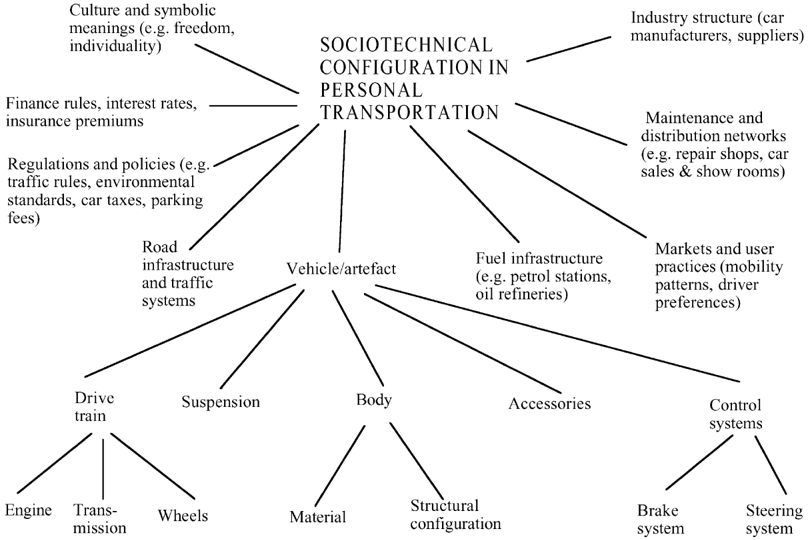
- Technological transitions are major, long-term changes in how societal functions are fulfilled; they involve not only technology but also user practices, regulation, industrial networks, infrastructure, and symbolic meaning or culture.
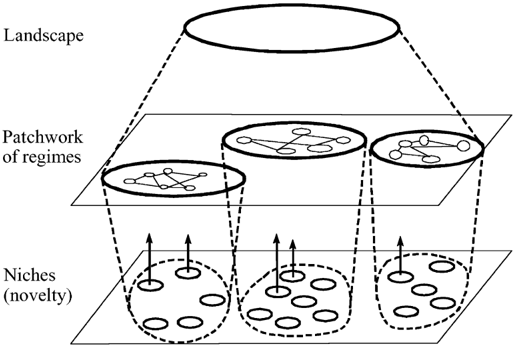
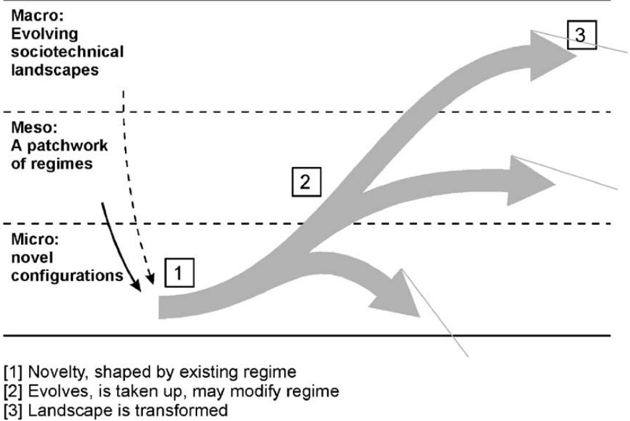
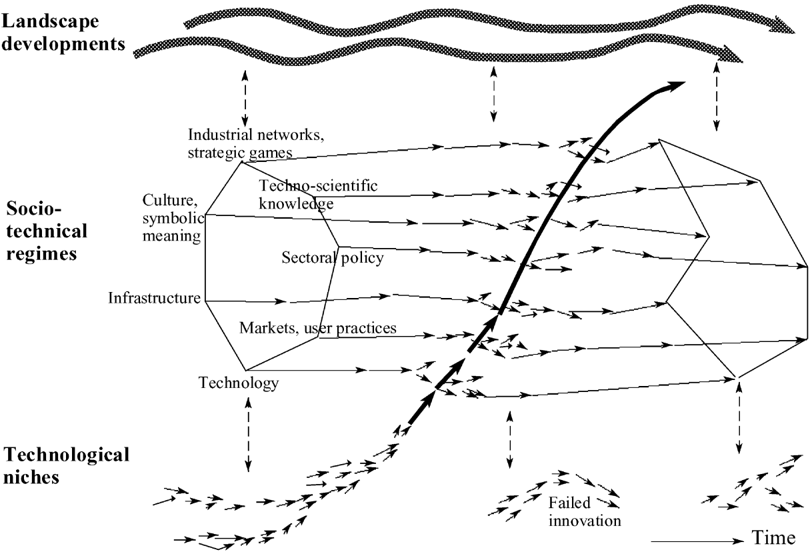
- The multi-level perspective treats niches as loci of radical variety, sociotechnical regimes as selection/retention mechanisms, and the landscape as slower external structure; breakthroughs occur when developments at multiple levels align and create a “window of opportunity.”
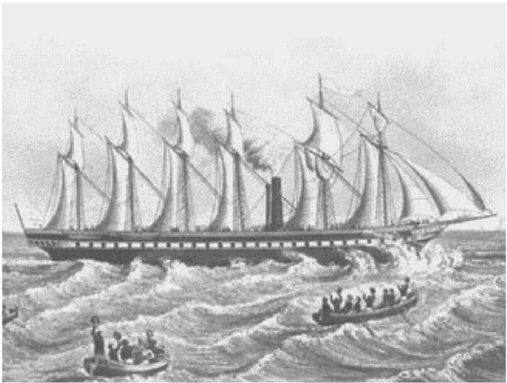
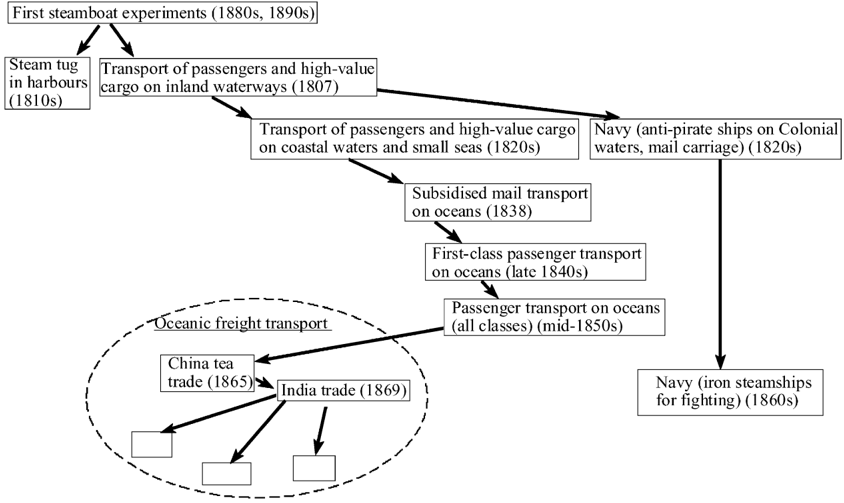
- In the steamship case, breakthrough followed niche-cumulation through inland waterways, coastal routes, mail subsidies, passenger transport, and freight; mechanisms included steam engines as auxiliary add-ons to sailing ships, hybrid sail/steam and iron/wood forms, and riding along with market growth.
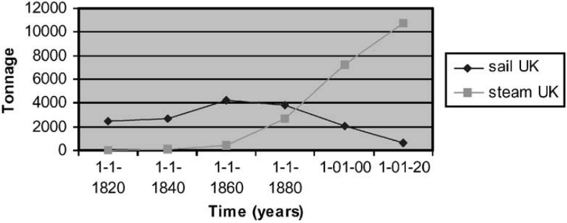
- Reported numbers include: European emigrants travelling by steamer rose from 45% in 1863 to 81% in 1866; compound engines enabled fuel-consumption reductions of 60%; the distance margin where steam was competitive reached 3000–3500 miles by the late 1860s; during the steamship mania (1869–1874), steamers rose from 17% to 31% of British registered tonnage.
Methods
- The paper uses “appreciative theory,” synthesising insights from evolutionary economics and technology studies into a multi-level perspective.
- It presents a qualitative longitudinal case study of the transition from sailing ships to steamships, 1780–1900, focused on Great Britain.
- The case is written in a mosaic style, shifting across markets, ship designs, insurance rules, actor groups, institutions, mail subsidies, persistent/emerging problems, and management practices to illustrate the conceptual framework.
Limitations
- The paper states that the multi-level perspective is fairly complex, requires many data, often qualitative, and that sociotechnical regimes are a broad unit of analysis with difficult-to-draw precise boundaries; boundary work deserves more attention.
- The paper states that the single case study has a drawback because 19th-century craft-based innovation differs from 20th-century science-based innovation, and the perspective would be more robust with more case studies varied over time periods and sectors.
- Evident in the text: the empirical analysis is focused on Great Britain and shipping, and the mechanisms are illustrated through selected historical examples rather than formal comparative or quantitative testing.
Model-written summary. Check it against the paper before relying on it.
Integrity signals
Registry
Cites
Statistics
Figures

Verification
Claims the paper makes
1 Valid · 5 Not valid · 42 Not checked · 63 Own results and interpretations
The cited sources support only part of this claim — read each source’s verdict below.
In the paper
“Aspecific mechanism in the breakthrough of radical innovations is technological add-on and hybridisation . It means that new technologies in their early phase physically link up with established technologies, often to solve particular bottlenecks. Thus, old and new technologies do not immediately compete head on, but form some sort of symbiosis (see also Pistorius and Utterback, 1997).”
What the sources say
- Partly supportedcites Pistorius and Utterback, 1997 matched to “Multi-mode interaction among technologies” (1997) sourceExperimental — accuracy not yet measured
Split into 2 atoms — 0 confirmed, 2 partially supported, 0 disputed, 0 misattributed, 0 unverifiable. Expand the claim to see per-atom verdicts.
plainstates a cause- Asserted: passes — The authors put it forward as true.
- Checkable: passes — It can be checked against evidence.
- Load-bearing: passes — The paper’s conclusions depend on it.
- Based: passes — The paper gives a reason why it holds.
- Partly supported
A result the paper states — it cites no source for it, so there is none to check. The quote shows it is in the paper.
In the paper
“These subsidies created a protective environment for the use and development of oceanic steamships.”
plainstates a cause- Asserted: passes — The authors put it forward as true.
- Checkable: passes — It can be checked against evidence.
- Load-bearing: unclear — It is unclear whether the paper’s conclusions depend on it.
- Based: passes — The paper gives a reason why it holds.
- Rests on an assumption not shown here.
In the paper
“Between 1838 and 1862 a global network of British intercontinental steam companies was created on the basis of imperial mail subsidies (Broeze, 1982).”
What the sources say
- Not matchedcites Broeze, 1982
An author–year citation the paper’s reference list doesn’t settle. We don’t search these by name.
plainstates a cause- Asserted: passes — The authors put it forward as true.
- Checkable: passes — It can be checked against evidence.
- Load-bearing: unclear — It is unclear whether the paper’s conclusions depend on it.
- Based: passes — The paper gives a reason why it holds.
- Rests on an assumption not shown here.
- Not matched
A result the paper states — it cites no source for it, so there is none to check. The quote shows it is in the paper.
In the paper
“Another innovation in the late 18th century shipping regime was the emergence of new social groups: professional shipowners, shipbrokers and insurance companies.”
plain- Asserted: passes — The authors put it forward as true.
- Checkable: passes — It can be checked against evidence.
- Load-bearing: unclear — It is unclear whether the paper’s conclusions depend on it.
- Based: passes — The paper gives a reason why it holds.
- Rests on an assumption not shown here.
A result the paper states — it cites no source for it, so there is none to check. The quote shows it is in the paper.
In the paper
“The emergence of professional shipowners was stimulated by the French Wars (1789-1815) which pushed up freight prices as demand for ships increased.”
plainstates a cause- Asserted: passes — The authors put it forward as true.
- Checkable: passes — It can be checked against evidence.
- Load-bearing: unclear — It is unclear whether the paper’s conclusions depend on it.
- Based: passes — The paper gives a reason why it holds.
- Rests on an assumption not shown here.
24 more claims
Create a free account to see all 111 claims and every source verdict.
- Probably not a substantial claim. 28
- It may state two separate claims as one. 69
- The quote only partly states this claim. 2
Claims other papers make about this one
Each is checked against this paper’s own text: does it say what the citing paper says it does?
In the citing paper
“The model of Geels (2002) describes new technologies as arising and maturing within existing technology systems [18].”
From Lessons Learned From a Living Lab on the Broad Adoption of eHealth in Primary Health Care (2018) · cites this paper as [18]
In the citing paper
“The multi-level perspective (Rip and Kemp, 1998;Geels, 2002;Geels, 2004;Geels and Schot, 2007) is a framework for understanding sustainability transitions that provides an overall view of the multi-dimensional complexity of changes in socio-technical systems.”
From Ontologies, socio-technical transitions (to sustainability), and the multi-level perspective (2010) · cites this paper as Geels, 2002
Citations
Cites
An Evolutionary Theory of Economic Change.
Loasby, B. J., Nelson, R. R., & Winter, S. G. (1983) · The Economic Journal · doi:10.2307/2232409 · Cited by 21,366
(1934) · SSRN Electronic Journal · Cited by 7,609
Technological Discontinuities and Organizational Environments
Tushman, M. L., & Anderson, P. (1986) · Administrative Science Quarterly · doi:10.2307/2392832 · Cited by 6,112
von Hippel, E. (2007) · Das Summa Summarum des Management · doi:10.1007/978-3-8349-9320-5_10 · Cited by 5,098
Technical Change and Economic Theory.
Swann, P., & Dosi, G. (1989) · The Economic Journal · doi:10.2307/2234048 · Cited by 4,041
Shaping Technology, Building Society: Studies in Sociotechnical Change.
Lynch, M., Bijker, W. E., & Law, J. (1993) · Contemporary Sociology · doi:10.2307/2074370 · Cited by 3,540
Technological Discontinuities and Dominant Designs: A Cyclical Model of Technological Change
Anderson, P., & Tushman, M. L. (1990) · Administrative Science Quarterly · doi:10.2307/2393511 · Cited by 3,255
Bijker, W. E., Hughes, T. P., & Pinch, T. (1987) · Cited by 2,957
Kemp, R., Schot, J., & Hoogma, R. (1998) · Technology Analysis & Strategic Management · doi:10.1080/09537329808524310 · Cited by 2,860
Innovation: Mapping the winds of creative destruction
Abernathy, W. J., & Clark, K. B. (1985) · Research Policy · doi:10.1016/0048-7333(85)90021-6 · Cited by 2,791
Research works printed but not linked: 9
- Broeze, F.J.A., 1982. The international diffusion of ocean steam navigation: the myth of the retardation of Netherlands steam navigation to the East Indies. Economisch-en Sociaal-Historisch Jaarboek 45, 77-95.
- Callon, M. (Ed.), 1998. The Laws of the Market. Blackwell, Oxford.
- Garrat, G.R.M., Goodman, D.C., Russel, C.A., 1973. Science and Engineering, Units 14 and 15. Open University Press, Bletchley.
- Jackson, G., 1998. Ports, ships and government in the nineteenth and twentieth centuries. In: Van Royen, P.C., Fischer, L.R., Williams, D.M. (Eds.), Proceedings of the Second International Congress of Maritime History on Frutta di Mare: Evolution and revolution in the maritime world in the 19th and 20th centuries. Amsterdam/Rotterdam, The Netherlands, 5-8 June, 1996. Batavian Lion International, Amsterdam, pp. 161-176.
- Lundvall, B.A., 1988. Innovation as an interactive process: from user-producer interaction to the national system of innovation. In: Dosi, G., Freeman, C., Nelson, R., Silverberg, G., Soete, L. (Eds.), Technical Change and Economic Theory. Pinter, London, pp. 349-369.
- Maddocks, M., 1982. De Grote Oversteek. Time-Life, London. Mayntz, R., Hughes, T.P. (Eds.), 1988. The Development of Large
- Mokyr, J., 1990. The Lever of Riches. Oxford University Press, New York.
- Rip, A., Kemp, R., 1996. Towards a Theory of Socio-Technical Change. Mimeo University of Twente, Report prepared for Batelle Pacific Northwest Laboratories, Washington, DC. (An edited version has been published as book chapter Rip and Kemp 1998).
- Sloan, E.W., 1998. Private enterprise as public utility: the management of capital in two centuries of shipping business. In: Van Royen, P.C., Fischer, L.R., Williams, D.M. (Eds.), Proceedings of the Second International Congress of Maritime History on Frutta di Mare: Evolution and Revolution in the Maritime World in the 19th and 20th Centuries. Amsterdam/Rotterdam, The Netherlands, 5-8 June, 1996. Batavian Lion International, Amsterdam, pp. 89-100.
Cited by
Items 101–200 of 7,210
Bergek, A., Jacobsson, S., & Sandén, B. A. (2008) · Technology Analysis & Strategic Management · doi:10.1080/09537320802292768 · Cited by 435
Exploring sustainability transitions in the electricity sector with socio-technical pathways
Verbong, G. P. J., & Geels, F. W. (2010) · Technological Forecasting and Social Change · doi:10.1016/j.techfore.2010.04.008 · Cited by 431
Self-citationUrban Energy Transitions: Places, Processes and Politics of Socio-technical Change
Rutherford, J., & Coutard, O. (2014) · Urban Studies · doi:10.1177/0042098013500090 · Cited by 435
Pigford, A.-A. E., Hickey, G. M., & Klerkx, L. (2018) · Agricultural Systems · doi:10.1016/j.agsy.2018.04.007 · Cited by 434
Geels, F. W. (2018) · Energy Research & Social Science · doi:10.1016/j.erss.2017.10.010 · Cited by 429
Self-citationStrong sustainable consumption governance – precondition for a degrowth path?
Lorek, S., & Fuchs, D. (2013) · Journal of Cleaner Production · doi:10.1016/j.jclepro.2011.08.008 · Cited by 433
How theories of practice can inform transition to a decarbonised transport system
Watson, M. (2012) · Journal of Transport Geography · doi:10.1016/j.jtrangeo.2012.04.002 · Cited by 429
Mission-oriented innovation systems
Hekkert, M. P., Janssen, M. J., Wesseling, J. H., & Negro, S. O. (2020) · Environmental Innovation and Societal Transitions · doi:10.1016/j.eist.2019.11.011 · Cited by 427
Meat alternatives: an integrative comparison
van der Weele, C., Feindt, P., Jan van der Goot, A., van Mierlo, B., & van Boekel, M. (2019) · Trends in Food Science & Technology · doi:10.1016/j.tifs.2019.04.018 · Cited by 430
Macroeconomic impact of stranded fossil fuel assets
Mercure, J.-F., Pollitt, H., Viñuales, J. E., Edwards, N. R., Holden, P. B., Chewpreecha, U., Salas, P., Sognnaes, I., Lam, A., & Knobloch, F. (2018) · Nature Climate Change · doi:10.1038/s41558-018-0182-1 · Cited by 430
Geels, F. W. (2020) · Technological Forecasting and Social Change · doi:10.1016/j.techfore.2019.119894 · Cited by 426
Self-citationBenneworth, P., & Jongbloed, B. W. A. (2009) · Higher Education · doi:10.1007/s10734-009-9265-2 · Cited by 615
Thinking through heterogeneous infrastructure configurations
Lawhon, M., Nilsson, D., Silver, J., Ernstson, H., & Lwasa, S. (2018) · Urban Studies · doi:10.1177/0042098017720149 · Cited by 426
Socio-technological Regimes and Transition Contexts
Berkhout, F., Smith, A., & Stirling, A. (2004) · System Innovation and the Transition to Sustainability · doi:10.4337/9781845423421.00013 · Cited by 421
The coming sustainable energy transition: History, strategies, and outlook
Solomon, B. D., & Krishna, K. (2011) · Energy Policy · doi:10.1016/j.enpol.2011.09.009 · Cited by 416
Monstadt, J. (2009) · Environment and Planning A: Economy and Space · doi:10.1068/a4145 · Cited by 419
Foxon, T., & Pearson, P. (2008) · Journal of Cleaner Production · doi:10.1016/j.jclepro.2007.10.011 · Cited by 414
Understanding change and continuity in residential energy consumption
Gram-Hanssen, K. (2011) · Journal of Consumer Culture · doi:10.1177/1469540510391725 · Cited by 414
Taste Regimes and Market-Mediated Practice
Arsel, Z., & Bean, J. (2013) · Journal of Consumer Research · doi:10.1086/666595 · Cited by 414
Fuenfschilling, L., & Truffer, B. (2016) · Technological Forecasting and Social Change · doi:10.1016/j.techfore.2015.11.023 · Cited by 408
Typology of future clean energy communities: An exploratory structure, opportunities, and challenges
Gui, E. M., & MacGill, I. (2018) · Energy Research & Social Science · doi:10.1016/j.erss.2017.10.019 · Cited by 396
Niches in evolutionary theories of technical change: A critical survey of the literature
Schot, J., & Geels, F. W. (2007) · Journal of Evolutionary Economics · doi:10.1007/s00191-007-0057-5 · Cited by 397
Self-citationNew design challenges to widely implement ‘Sustainable Product–Service Systems’
Vezzoli, C., Ceschin, F., Diehl, J. C., & Kohtala, C. (2015) · Journal of Cleaner Production · doi:10.1016/j.jclepro.2015.02.061 · Cited by 397
Eco-innovation in the transition to a circular economy: An analytical literature review
de Jesus, A., Antunes, P., Santos, R., & Mendonça, S. (2018) · Journal of Cleaner Production · doi:10.1016/j.jclepro.2017.11.111 · Cited by 397
Observed adaptation to climate change: UK evidence of transition to a well-adapting society
Tompkins, E. L., Adger, W. N., Boyd, E., Nicholson-Cole, S., Weatherhead, K., & Arnell, N. (2010) · Global Environmental Change · doi:10.1016/j.gloenvcha.2010.05.001 · Cited by 391
The emergence of an electric mobility trajectory
Dijk, M., Orsato, R. J., & Kemp, R. (2013) · Energy Policy · doi:10.1016/j.enpol.2012.04.024 · Cited by 384
Turnheim, B., & Geels, F. W. (2013) · Research Policy · doi:10.1016/j.respol.2013.04.009 · Cited by 382
Self-citationThe slow search for solutions: Lessons from historical energy transitions by sector and service
Fouquet, R. (2010) · Energy Policy · doi:10.1016/j.enpol.2010.06.029 · Cited by 381
Jenkins, K., Sovacool, B. K., & McCauley, D. (2018) · Energy Policy · doi:10.1016/j.enpol.2018.02.036 · Cited by 383
Evans, J., & Karvonen, A. (2014) · International Journal of Urban and Regional Research · doi:10.1111/1468-2427.12077 · Cited by 372
Low-carbon Transitions and the Reconfiguration of Urban Infrastructure
Bulkeley, H., Castán Broto, V., & Maassen, A. (2014) · Urban Studies · doi:10.1177/0042098013500089 · Cited by 371
The uniqueness of the energy security, justice, and governance problem
Goldthau, A., & Sovacool, B. K. (2012) · Energy Policy · doi:10.1016/j.enpol.2011.10.042 · Cited by 364
Shah, K. J., Pan, S.-Y., Lee, I., et al. (2021) · Journal of Cleaner Production · doi:10.1016/j.jclepro.2021.129392 · Cited by 365
The systemic impact of a transition fuel: Does natural gas help or hinder the energy transition?
Gürsan, C., & de Gooyert, V. (2021) · Renewable and Sustainable Energy Reviews · doi:10.1016/j.rser.2020.110552 · Cited by 364
Smart destinations and the evolution of ICTs: a new scenario for destination management?
Ivars-Baidal, J. A., Celdrán-Bernabeu, M. A., Mazón, J.-N., & Perles-Ivars, Á. F. (2019) · Current Issues in Tourism · doi:10.1080/13683500.2017.1388771 · Cited by 364
Digital Transition by COVID‐19 Pandemic? The German Food Online Retail
Dannenberg, P., Fuchs, M., Riedler, T., & Wiedemann, C. (2020) · Tijdschrift voor Economische en Sociale Geografie · doi:10.1111/tesg.12453 · Cited by 358
Transition pathways for a UK low carbon electricity future
Foxon, T. J. (2013) · Energy Policy · doi:10.1016/j.enpol.2012.04.001 · Cited by 359
Systemic perspectives on scaling agricultural innovations. A review
Wigboldus, S., Klerkx, L., Leeuwis, C., Schut, M., Muilerman, S., & Jochemsen, H. (2016) · Agronomy for Sustainable Development · doi:10.1007/s13593-016-0380-z · Cited by 355
The emerging field of energy transitions: Progress, challenges, and opportunities
Araújo, K. (2014) · Energy Research & Social Science · doi:10.1016/j.erss.2014.03.002 · Cited by 355
The politics of decarbonization and the catalytic impact of subnational climate experiments
Bernstein, S., & Hoffmann, M. (2018) · Policy Sciences · doi:10.1007/s11077-018-9314-8 · Cited by 350
Past and prospective energy transitions: Insights from history
Fouquet, R., & Pearson, P. J. G. (2012) · Energy Policy · doi:10.1016/j.enpol.2012.08.014 · Cited by 348
Entrepreneurship for Sustainable Development: A Review and Multilevel Causal Mechanism Framework
Johnson, M. P., & Schaltegger, S. (2020) · Entrepreneurship Theory and Practice · doi:10.1177/1042258719885368 · Cited by 342
Schmidt, T. S., & Sewerin, S. (2019) · Research Policy · doi:10.1016/j.respol.2018.03.012 · Cited by 347
Wesseling, J. H., Lechtenböhmer, S., Åhman, M., Nilsson, L. J., Worrell, E., & Coenen, L. (2017) · Renewable and Sustainable Energy Reviews · doi:10.1016/j.rser.2017.05.156 · Cited by 341
Negative emissions—Part 3: Innovation and upscaling
Nemet, G. F., Callaghan, M. W., Creutzig, F., Fuss, S., Hartmann, J., Hilaire, J., Lamb, W. F., Minx, J. C., Rogers, S., & Smith, P. (2018) · Environmental Research Letters · doi:10.1088/1748-9326/aabff4 · Cited by 343
Digital transformation, for better or worse: a critical multi‐level research agenda
Dąbrowska, J., Almpanopoulou, A., Brem, A., Chesbrough, H., Cucino, V., Di Minin, A., Giones, F., Hakala, H., Marullo, C., Mention, A., et al. (2022) · R&D Management · doi:10.1111/radm.12531 · Cited by 340
Keeping sustainable innovation on a leash? Exploring incumbents’ institutional strategies
Smink, M. M., Hekkert, M. P., & Negro, S. O. (2015) · Business Strategy and the Environment · doi:10.1002/bse.1808 · Cited by 335
A systems thinking approach to understanding the challenges of achieving the circular economy
Iacovidou, E., Hahladakis, J. N., & Purnell, P. (2021) · Environmental Science and Pollution Research · doi:10.1007/s11356-020-11725-9 · Cited by 334
Coenen, L., & Truffer, B. (2012) · European Planning Studies · doi:10.1080/09654313.2012.651802 · Cited by 330
Geels, F. (2005) · Technology in Society · doi:10.1016/j.techsoc.2005.04.008 · Cited by 325
Self-citationDesigning coupled innovations for the sustainability transition of agrifood systems
Meynard, J.-M., Jeuffroy, M.-H., Le Bail, M., Lefèvre, A., Magrini, M.-B., & Michon, C. (2017) · Agricultural Systems · doi:10.1016/j.agsy.2016.08.002 · Cited by 329
A multi-level perspective on innovation ecosystems for path-breaking innovation
Walrave, B., Talmar, M., Podoynitsyna, K. S., Romme, A. G. L., & Verbong, G. P. J. (2018) · Technological Forecasting and Social Change · doi:10.1016/j.techfore.2017.04.011 · Cited by 327
Capitalism in sustainability transitions research: Time for a critical turn?
Feola, G. (2020) · Environmental Innovation and Societal Transitions · doi:10.1016/j.eist.2019.02.005 · Cited by 323
Backcasting for sustainability: Introduction to the special issue
Vergragt, P. J., & Quist, J. (2011) · Technological Forecasting and Social Change · doi:10.1016/j.techfore.2011.03.010 · Cited by 326
Rethinking urban water management: Experimentation as a way forward?
Farrelly, M., & Brown, R. (2011) · Global Environmental Change · doi:10.1016/j.gloenvcha.2011.01.007 · Cited by 326
Levers and leverage points for pathways to sustainability
Chan, K. M. A., Boyd, D. R., Gould, R. K., Jetzkowitz, J., Liu, J., Muraca, B., Naidoo, R., Olmsted, P., Satterfield, T., Selomane, O., et al. (2020) · People and Nature · doi:10.1002/pan3.10124 · Cited by 323
The dynamics of sustainable innovation journeys
Geels, F. W., Hekkert, M. P., & Jacobsson, S. (2008) · Technology Analysis & Strategic Management · doi:10.1080/09537320802292982 · Cited by 322
Self-citationWhy social values cannot be changed for the sake of conservation
Manfredo, M. J., Bruskotter, J. T., Teel, T. L., Fulton, D., Schwartz, S. H., Arlinghaus, R., Oishi, S., Uskul, A. K., Redford, K., Kitayama, S., et al. (2017) · Conservation Biology · doi:10.1111/cobi.12855 · Cited by 323
Geels, F. W., Schwanen, T., Sorrell, S., Jenkins, K., & Sovacool, B. K. (2018) · Energy Research & Social Science · doi:10.1016/j.erss.2017.11.003 · Cited by 320
Self-citationScientific research about climate change mitigation in transport: A critical review
Schwanen, T., Banister, D., & Anable, J. (2011) · Transportation Research Part A: Policy and Practice · doi:10.1016/j.tra.2011.09.005 · Cited by 319
Conditions for innovation in public sector organizations
Demircioglu, M. A., & Audretsch, D. B. (2017) · Research Policy · doi:10.1016/j.respol.2017.08.004 · Cited by 318
Temper, L., Avila, S., Bene, D. D., Gobby, J., Kosoy, N., Billon, P. L., Martinez-Alier, J., Perkins, P., Roy, B., Scheidel, A., et al. (2020) · Environmental Research Letters · doi:10.1088/1748-9326/abc197 · Cited by 320
Exploring the transition potential of renewable energy communities
Dóci, G., Vasileiadou, E., & Petersen, A. C. (2015) · Futures · doi:10.1016/j.futures.2015.01.002 · Cited by 314
Socio-technical inertia: Understanding the barriers to electric vehicles
Steinhilber, S., Wells, P., & Thankappan, S. (2013) · Energy Policy · doi:10.1016/j.enpol.2013.04.076 · Cited by 312
Towards a theory of transformative social innovation: A relational framework and 12 propositions
Pel, B., Haxeltine, A., Avelino, F., Dumitru, A., Kemp, R., Bauler, T., Kunze, I., Dorland, J., Wittmayer, J., & Jørgensen, M. S. (2020) · Research Policy · doi:10.1016/j.respol.2020.104080 · Cited by 315
Geels, F. W. (2013) · Environmental Innovation and Societal Transitions · doi:10.1016/j.eist.2012.11.004 · Cited by 309
Self-citationBolton, R., & Hannon, M. (2016) · Research Policy · doi:10.1016/j.respol.2016.05.003 · Cited by 312
“Also, unlike the activity system, the LTS approach and the MLP incorporate politics and institutions into the system.”
BackgroundInfluentialInstitutional dynamics and technology legitimacy – A framework and a case study on biogas technology
Markard, J., Wirth, S., & Truffer, B. (2016) · Research Policy · doi:10.1016/j.respol.2015.10.009 · Cited by 313
Governing for sustainable energy system change: Politics, contexts and contingency
Kuzemko, C., Lockwood, M., Mitchell, C., & Hoggett, R. (2016) · Energy Research & Social Science · doi:10.1016/j.erss.2015.12.022 · Cited by 311
Sustainability transitions and the state
Johnstone, P., & Newell, P. (2018) · Environmental Innovation and Societal Transitions · doi:10.1016/j.eist.2017.10.006 · Cited by 306
Mapping and navigating transitions—The multi-level perspective compared with arenas of development
Jørgensen, U. (2012) · Research Policy · doi:10.1016/j.respol.2012.03.001 · Cited by 307
The life cycle of technological innovation systems
Markard, J. (2020) · Technological Forecasting and Social Change · doi:10.1016/j.techfore.2018.07.045 · Cited by 308
“This is the ‘classic’ substitution pattern we also know from historic studies of socio-technical transitions (Geels, 2002; Geels, 2006).”
BackgroundActor roles in transition: Insights from sociological perspectives
Wittmayer, J. M., Avelino, F., van Steenbergen, F., & Loorbach, D. (2017) · Environmental Innovation and Societal Transitions · doi:10.1016/j.eist.2016.10.003 · Cited by 307
Developing transition pathways for a low carbon electricity system in the UK
Foxon, T. J., Hammond, G. P., & Pearson, P. J. G. (2010) · Technological Forecasting and Social Change · doi:10.1016/j.techfore.2010.04.002 · Cited by 307
Citizen science and sustainability transitions
Sauermann, H., Vohland, K., Antoniou, V., Balázs, B., Göbel, C., Karatzas, K., Mooney, P., Perelló, J., Ponti, M., Samson, R., et al. (2020) · Research Policy · doi:10.1016/j.respol.2020.103978 · Cited by 302
Vargo, S. L., Akaka, M. A., & Wieland, H. (2020) · Journal of Business Research · doi:10.1016/j.jbusres.2020.01.038 · Cited by 305
Mobilizing innovation for sustainability transitions: A comment on transformative innovation policy
Fagerberg, J. (2018) · Research Policy · doi:10.1016/j.respol.2018.08.012 · Cited by 303
Historical energy transitions: Speed, prices and system transformation
Fouquet, R. (2016) · Energy Research & Social Science · doi:10.1016/j.erss.2016.08.014 · Cited by 296
Seyfang, G., & Longhurst, N. (2013) · Global Environmental Change · doi:10.1016/j.gloenvcha.2013.02.007 · Cited by 301
Sustainable urban systems: Co-design and framing for transformation
Webb, R., Bai, X., Smith, M. S., Costanza, R., Griggs, D., Moglia, M., Neuman, M., Newman, P., Newton, P., Norman, B., et al. (2018) · Ambio · doi:10.1007/s13280-017-0934-6 · Cited by 299
Jakku, E., Taylor, B., Fleming, A., Mason, C., Fielke, S., Sounness, C., & Thorburn, P. (2019) · NJAS: Wageningen Journal of Life Sciences · doi:10.1016/j.njas.2018.11.002 · Cited by 300
Urban Sustainability Transitions
(2017) · Routledge eBooks · doi:10.4324/9781315228389 · Cited by 297
Energy and complexity: New ways forward
Bale, C. S. E., Varga, L., & Foxon, T. J. (2015) · Applied Energy · doi:10.1016/j.apenergy.2014.10.057 · Cited by 293
Creating energy citizenship through material participation
Ryghaug, M., Skjølsvold, T. M., & Heidenreich, S. (2018) · Social Studies of Science · doi:10.1177/0306312718770286 · Cited by 290
Socio-technical lock-in hinders crop diversification in France
Meynard, J.-M., Charrier, F., Fares, M., Le Bail, M., Magrini, M.-B., Charlier, A., & Messéan, A. (2018) · Agronomy for Sustainable Development · doi:10.1007/s13593-018-0535-1 · Cited by 291
El Bilali, H. (2019) · Agriculture · doi:10.3390/agriculture9040074 · Cited by 289
Human geography and socio-technical transition studies: Promising intersections
Murphy, J. T. (2015) · Environmental Innovation and Societal Transitions · doi:10.1016/j.eist.2015.03.002 · Cited by 291
Ecologies of participation in socio-technical change: The case of energy system transitions
Chilvers, J., Pallett, H., & Hargreaves, T. (2018) · Energy Research & Social Science · doi:10.1016/j.erss.2018.03.020 · Cited by 290
Co-benefits approach: Opportunities for implementing sponge city and urban heat island mitigation
He, B.-J., Zhu, J., Zhao, D.-X., Gou, Z.-H., Qi, J.-D., & Wang, J. (2019) · Land Use Policy · doi:10.1016/j.landusepol.2019.05.003 · Cited by 288
Mitigation Pathways Compatible with Long-term Goals
(2023) · Climate Change 2022 - Mitigation of Climate Change · doi:10.1017/9781009157926.005 · Cited by 288
Metatheoretical perspectives on sustainability journeys: Evolutionary, relational and durational
Garud, R., & Gehman, J. (2012) · Research Policy · doi:10.1016/j.respol.2011.07.009 · Cited by 284
Fit-for-purpose governance: A framework to make adaptive governance operational
Rijke, J., Brown, R., Zevenbergen, C., Ashley, R., Farrelly, M., Morison, P., & van Herk, S. (2012) · Environmental Science & Policy · doi:10.1016/j.envsci.2012.06.010 · Cited by 285
Normative expectations in systems innovation
Berkhout, F. (2006) · Technology Analysis & Strategic Management · doi:10.1080/09537320600777010 · Cited by 284
Bomberg, E., & McEwen, N. (2012) · Energy Policy · doi:10.1016/j.enpol.2012.08.045 · Cited by 277
A review of socio-technical energy transition (STET) models
Li, F. G. N., Trutnevyte, E., & Strachan, N. (2015) · Technological Forecasting and Social Change · doi:10.1016/j.techfore.2015.07.017 · Cited by 277
Geels, F. W. (2006) · Research Policy · doi:10.1016/j.respol.2006.06.001 · Cited by 277
Self-citationGrillitsch, M., Hansen, T., Coenen, L., Miörner, J., & Moodysson, J. (2019) · Research Policy · doi:10.1016/j.respol.2018.10.004 · Cited by 280
Brown, R. R., Farrelly, M. A., & Loorbach, D. A. (2013) · Global Environmental Change · doi:10.1016/j.gloenvcha.2013.02.013 · Cited by 277
Coenen, L., & Díaz López, F. J. (2010) · Journal of Cleaner Production · doi:10.1016/j.jclepro.2010.04.003 · Cited by 278
Scaling the impact of sustainability initiatives: a typology of amplification processes
Lam, D. P. M., Martín-López, B., Wiek, A., Bennett, E. M., Frantzeskaki, N., Horcea-Milcu, A. I., & Lang, D. J. (2020) · Urban Transformations · doi:10.1186/s42854-020-00007-9 · Cited by 275
Metadata
- Authors
- Geels, F. W.
- Affiliations
- University of Twente (NL)
- Corresponding author
- Geels, Frank W.
- ORCID
- Geels, Frank W.
- Venue
- Research Policy
- Publisher
- Elsevier BV
- Published
- 2002-12
- Volume
- 31
- Issue
- 8-9
- Pages
- 1257-1274
- ISSN
- 0048-7333 (ISSN-L)
- OpenAlex
- W2099330597
- Cited by
- 7,275
- References
- 94
- Citations by year
- 2026: 983 · 2025: 624 · 2024: 502 · 2023: 504 · 2022: 503 · 2021: 598 · 2020: 526 · 2019: 417 · 2018: 493 · 2017: 357 · 2016: 301 · 2015: 293 · 2014: 241 · 2013: 201 · 2012: 204
- FWCI
- 16.68
- Type
- journal article
- Language
- en
- Open access
- bronze
- doi.org
- Licence
- www.elsevier.com/tdm/userlicense/1.0/ (tdm)
- Locations
- Research Policy (publishedVersion)
- Research Explorer (The University of Manchester) (submittedVersion, other-oa)
- University of Twente Research Information (submittedVersion)
- TU/e Research Portal (submittedVersion)
- RePEc: Research Papers in Economics (submittedVersion)
- Figshare (submittedVersion, cc-by)
- University of Twente Research Information (submittedVersion, other-oa)
- Funders
- Nederlandse Organisatie voor Wetenschappelijk Onderzoek
- Topics
- Physical Sciences › Environmental Science › Global and Planetary Change › Sustainability and Climate Change Governance
- Social Sciences › Decision Sciences › Management Science and Operations Research › Innovation Diffusion and Forecasting
- Social Sciences › Economics, Econometrics and Finance › Economics and Econometrics › Economic Theory and Institutions
- Keywords
- technological transition, multi-level perspective, evolutionary economics, technology studies, hybridization, market growth, industrial networks, user practices, regulation, infrastructure
About these checks
Registry, retraction, Cites and statistics results are computed, not judged, with one exception: a printed reference that no index lists is read once by a model before it counts as a citation error. Claims are extracted by a model and kept only when their quote appears verbatim in the text; each cited source is then checked, with a model’s help, for whether it says what the claim relies on. Those verdicts can be wrong — read the claim’s quote and the cited source before relying on one.
The claim verdicts this report counts are experimental: their accuracy is not yet measured.
A language model drew the claims from the paper on 2026-10-10, under version 3 of the claim definition (model deepseek-v4.1-flash, prompt extract-v3).
A second model labelled each claim on 2026-10-10 (model jev-1.13-20260917, definition revision gold-guideline-v0.2).
Cited sources are checked with a language model’s help (gpt-6-sol).
Statistics and arithmetic are recomputed, not judged.
Confidence bands are shown only for fields calibrated on our annotated test set. None is calibrated yet, so no band is shown.
What counts as a claim ›How we measure confidence ›How we check this ›
Are you an author, or do you see a problem with this page? Request a review
Data sources
Bibliographic data: Semantic Scholar, OpenAlex, Crossref.
Contains information from the Semantic Scholar Academic Graph Datasets, made available under the ODC Attribution License (ODC-BY 1.0).
Semantic Scholar’s data is described in: Kinney, R., et al. (2023). The Semantic Scholar Open Data Platform. arXiv:2301.10140.
