

The DOI matches its Crossref record; 30 of the 33 references it cites were found in a registry or an index.
Cost and Outcome of Behavioural Activation versus Cognitive Behavioural Therapy for Depression (COBRA): a randomised, controlled, non-inferiority trial
Open accessAbstract
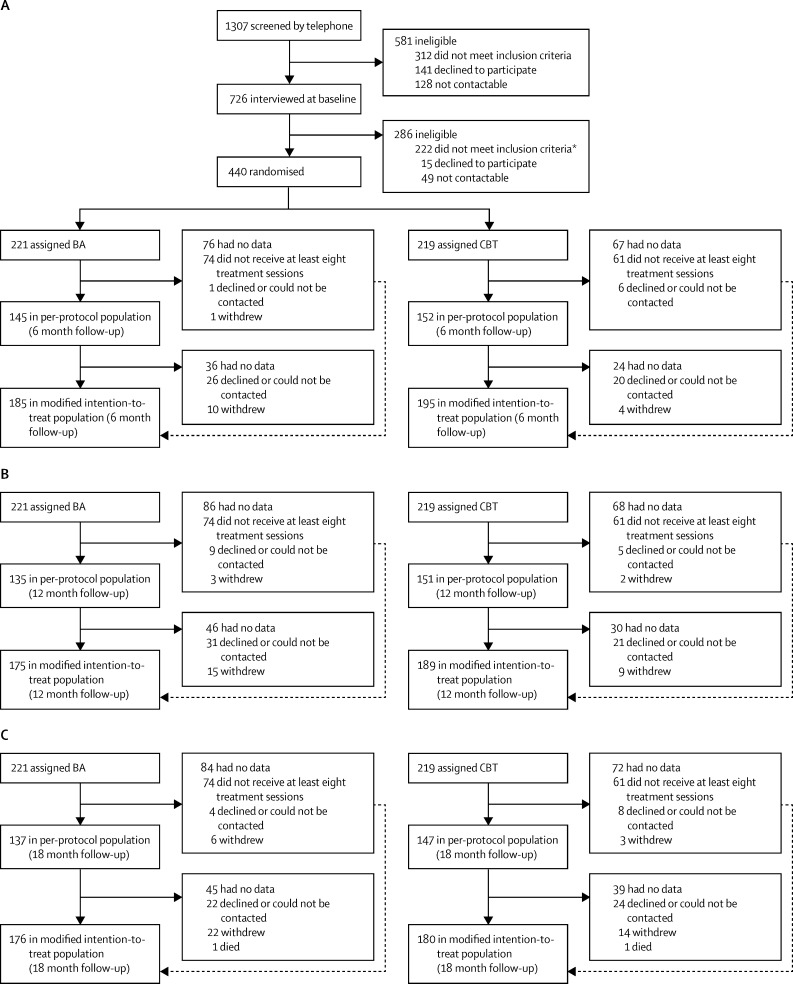
BACKGROUND: Depression is a common, debilitating, and costly disorder. Many patients request psychological therapy, but the best-evidenced therapy-cognitive behavioural therapy (CBT)-is complex and costly. A simpler therapy-behavioural activation (BA)-might be as effective and cheaper than is CBT. We aimed to establish the clinical efficacy and cost-effectiveness of BA compared with CBT for adults with depression. METHODS: In this randomised, controlled, non-inferiority trial, we recruited adults aged 18 years or older meeting Diagnostic and Statistical Manual of Mental Disorders IV criteria for major depressive disorder from primary care and psychological therapy services in Devon, Durham, and Leeds (UK). We excluded people who were receiving psychological therapy, were alcohol or drug dependent, were acutely suicidal or had attempted suicide in the previous 2 months, or were cognitively impaired, or who had bipolar disorder or psychosis or psychotic symptoms. We randomly assigned participants (1:1) remotely using computer-generated allocation (minimisation used; stratified by depression severity [Patient Health Questionnaire 9 (PHQ-9) score of <19 vs ≥19], antidepressant use, and recruitment site) to BA from junior mental health workers or CBT from psychological therapists. Randomisation done at the Peninsula Clinical Trials Unit was concealed from investigators. Treatment was given open label, but outcome assessors were masked. The primary outcome was depression symptoms according to the PHQ-9 at 12 months. We analysed all those who were randomly allocated and had complete data (modified intention to treat [mITT]) and also all those who were randomly allocated, had complete data, and received at least eight treatment sessions (per protocol [PP]). We analysed safety in the mITT population. The non-inferiority margin was 1·9 PHQ-9 points. This trial is registered with the ISCRTN registry, number ISRCTN27473954. FINDINGS: Between Sept 26, 2012, and April 3, 2014, we randomly allocated 221 (50%) participants to BA and 219 (50%) to CBT. 175 (79%) participants were assessable for the primary outcome in the mITT population in the BA group compared with 189 (86%) in the CBT group, whereas 135 (61%) were assessable in the PP population in the BA group compared with 151 (69%) in the CBT group. BA was non-inferior to CBT (mITT: CBT 8·4 PHQ-9 points [SD 7·5], BA 8·4 PHQ-9 points [7·0], mean difference 0·1 PHQ-9 points [95% CI -1·3 to 1·5], p=0·89; PP: CBT 7·9 PHQ-9 points [7·3]; BA 7·8 [6·5], mean difference 0·0 PHQ-9 points [-1·5 to 1·6], p=0·99). Two (1%) non-trial-related deaths (one [1%] multidrug toxicity in the BA group and one [1%] cancer in the CBT group) and 15 depression-related, but not treatment-related, serious adverse events (three in the BA group and 12 in the CBT group) occurred in three [2%] participants in the BA group (two [1%] patients who overdosed and one [1%] who self-harmed) and eight (4%) participants in the CBT group (seven [4%] who overdosed and one [1%] who self-harmed). INTERPRETATION: We found that BA, a simpler psychological treatment than CBT, can be delivered by junior mental health workers with less intensive and costly training, with no lesser effect than CBT. Effective psychological therapy for depression can be delivered without the need for costly and highly trained professionals. FUNDING: National Institute for Health Research.
Overview
The claims and statistics of this paper haven’t been checked yet.
Run the check — free, no account needed. It reads the open-access text and checks the sources it cites.
Integrity signals
Registry
Cites
Statistics
Figures
Verification
Claims the paper makes
The claims and statistics of this paper haven’t been checked yet.
Run the check — free, no account needed. It reads the open-access text and checks the sources it cites.
Claims other papers make about this one
Each is checked against this paper’s own text: does it say what the citing paper says it does?
The source backs part of the claim, not all of it — or backs it for a different population, condition or comparison.
In the citing paper
“they can be readily employed in assistant psychologist (AP) roles at lower cost than more specialist therapists”
From Increasing access to CBT for psychosis patients: A feasibility, randomised controlled trial evaluating brief, targeted CBT for distressing voices delivered by assistant psychologists (GiVE2) (2020) · cites this paper as [20]
Experimental — accuracy not yet measuredThe source backs part of the claim, not all of it — or backs it for a different population, condition or comparison.
In the citing paper
“Psychology graduates, however, are well-positioned to undertake such a role [18, 20]”
From Increasing access to CBT for psychosis patients: A feasibility, randomised controlled trial evaluating brief, targeted CBT for distressing voices delivered by assistant psychologists (GiVE2) (2020) · cites this paper as [20]
Experimental — accuracy not yet measuredThe check wasn’t confident either way, so it gives no verdict — never disputed.
In the citing paper
“their degree provides them with training in psychological models of emotion and behaviour”
From Increasing access to CBT for psychosis patients: A feasibility, randomised controlled trial evaluating brief, targeted CBT for distressing voices delivered by assistant psychologists (GiVE2) (2020) · cites this paper as [20]
Experimental — accuracy not yet measuredThe check wasn’t confident either way, so it gives no verdict — never disputed.
In the citing paper
“there is a large number of psychology graduates in the UK, the USA and elsewhere”
From Increasing access to CBT for psychosis patients: A feasibility, randomised controlled trial evaluating brief, targeted CBT for distressing voices delivered by assistant psychologists (GiVE2) (2020) · cites this paper as [20]
Experimental — accuracy not yet measured
Self-check
Percentages, sums and reported differences re-computed from the paper’s own numbers.
The self-check needs the paper’s full text.
Citations
Cites
The PHQ-9: Validity of a brief depression severity measure
Kroenke, K., Spitzer, R. L., & Williams, J. B. W. (2001) · Journal of General Internal Medicine · doi:10.1046/j.1525-1497.2001.016009606.x · Cited by 44,910
A Brief Measure for Assessing Generalized Anxiety Disorder: The GAD-7
Spitzer, R. L., Kroenke, K., Williams, J. B. W., & Löwe, B. (2006) · Archives of Internal Medicine · doi:10.1001/archinte.166.10.1092 · Cited by 31,765
Multiple Imputation for Nonresponse in Surveys
Rubin, D. B. (1987) · Wiley Series in Probability and Statistics · doi:10.1002/9780470316696 · Cited by 20,701
SF-36 health survey: Manual and interpretation guide
Ware, J. (2003) · Medical Entomology and Zoology · Cited by 11,424
EuroQol: the current state of play
Brooks, R. (1996) · Health Policy · doi:10.1016/0168-8510(96)00822-6 · Cited by 5,815
Ferrari, A. J., Charlson, F. J., Norman, R. E., Patten, S. B., Freedman, G., Murray, C. J. L., Vos, T., & Whiteford, H. A. (2013) · PLoS Medicine · doi:10.1371/journal.pmed.1001547 · Cited by 3,115
Multiple imputation of discrete and continuous data by fully conditional specification
van Buuren, S. (2007) · Statistical Methods in Medical Research · doi:10.1177/0962280206074463 · Cited by 2,827
Multiple Imputation for Nonresponse in Surveys.
Lynn, P. J., & Rubin, D. B. (1988) · Journal of the Royal Statistical Society Series D (The Statistician) · doi:10.2307/2348774 · Cited by 2,330
Cognitive Therapy: Basics and Beyond
Beck, J. S. (1995) · Medical Entomology and Zoology · Cited by 2,208
(2012) · RePEc: Research Papers in Economics · Cited by 1,951
Cited by
Sorted by citations
Items 201–300 of 595
Global sensitivity analysis of clinical trials with missing patient-reported outcomes
Scharfstein, D. O., & McDermott, A. (2018) · Statistical Methods in Medical Research · doi:10.1177/0962280218759565 · Cited by 14
Heißel, A., Pietrek, A., Schwefel, M., Abdulla, K., Wilbertz, G., Heinzel, S., & Rapp, M. A. (2020) · BMJ Open · doi:10.1136/bmjopen-2019-036287 · Cited by 13
Arnott, B., Kitchen, C. E. W., Ekers, D., Gega, L., & Tiffin, P. A. (2020) · BMJ Paediatrics Open · doi:10.1136/bmjpo-2019-000624 · Cited by 13
Self-citationKitchen, C. E. W., Tiffin, P. A., Lewis, S., Gega, L., & Ekers, D. (2020) · Child and Adolescent Mental Health · doi:10.1111/camh.12415 · Cited by 13
Self-citationIrish, M., Dalton, B., Potts, L. C., McCombie, C., Shearer, J., Au, K., Kern, N., Clark-Stone, S., Connan, F., Johnston, A. L., et al. (2022) · Trials · doi:10.1186/s13063-022-06386-7 · Cited by 13
Self-citationTang, Y., Gierc, M. S. H., Lam, R. W. M., Liu, S., & Faulkner, G. (2022) · JMIR Mental Health · doi:10.2196/38049 · Cited by 15
Effects of behavioural activation on the neural circuit related to intrinsic motivation
Mori, A., Okamoto, Y., Okada, G., Takagaki, K., Takamura, M., Jinnin, R., Ichikawa, N., Yamamura, T., Yokoyama, S., Shiota, S., et al. (2018) · BJPsych Open · doi:10.1192/bjo.2018.40 · Cited by 13
Treatment outcomes in depression: reducing drop-out rates in cognitive therapy
Pentaraki, A. (2018) · BJPsych Advances · doi:10.1192/bja.2017.8 · Cited by 12
Naithani, L., Goldie, C., Kaur, A., Butter, C., Lakhera, S., Leadbitter, K., & Divan, G. (2022) · Frontiers in Psychiatry · doi:10.3389/fpsyt.2022.914750 · Cited by 14
Management of Depression and Anxiety in Perioperative Medicine
Rolfzen, M. L., Nägele, P., Conway, C. R., Gibbons, R. D., & Bartels, K. (2024) · Anesthesiology · doi:10.1097/aln.0000000000005076 · Cited by 13
Ross, J. E., Field, C., Kaye, S. S., & Bowman, J. (2019) · International Journal of Prisoner Health · doi:10.1108/ijph-06-2018-0039 · Cited by 14
Schwarzkopf, L., Dorscht, L., Kraus, L., & Luttenberger, K. (2021) · BMC Health Services Research · doi:10.1186/s12913-021-07153-1 · Cited by 12
Stuart, R., Shah, P., Olive, R. R., Trevillion, K., & Henderson, C. (2023) · BMC Public Health · doi:10.1186/s12889-023-15280-z · Cited by 12
Yip, B. H. K., Lee, E. K. P., Sit, R. W. S., Wong, C. K. M., Li, X., Wong, E. L., Wong, M. C. S., Chung, R. Y. N., Chung, V. C., Kung, K., et al. (2018) · Scientific Reports · doi:10.1038/s41598-018-28721-2 · Cited by 12
Chronic Pain Self-Management Program for Low-Income Patients: Themes from a Qualitative Inquiry.
Turner, B., Rodríguez, N., Bobadilla, R., Hernández, A. E., & Yin, Z. (2018) · Pain medicine (Malden, Mass.) · doi:10.1093/pm/pny192 · Cited by 10
Beck, J. E., Zaugg, T. L., Egge, J. L. M., Lima, E. N., & Thielman, E. J. (2019) · American Journal of Audiology · doi:10.1044/2018_aja-ttr17-18-0040 · Cited by 12
Clarke, P., Bibby-Jones, A.-M., & Hayward, M. (2021) · The Cognitive Behaviour Therapist · doi:10.1017/s1754470x21000143 · Cited by 12
Roberts, K., Travers-Hill, E., Coker, S., Troup, J., Casey, S., Parkin, K., & Kim, Y. (2021) · The Cognitive Behaviour Therapist · doi:10.1017/s1754470x21000258 · Cited by 11
Eilert, N., Timulak, L., Duffy, D., Earley, C., Enrique, A., Kennedy, P., McCormack, C., Palacios, J., Wogan, R., & Richards, D. (2022) · Clinical Psychology & Psychotherapy · doi:10.1002/cpp.2619 · Cited by 11
Self-citationSun, Y., Wong, S. Y. S., Zhang, D., Chen, C. H. J., & Yip, B. H. K. (2021) · Journal of Psychiatric Research · doi:10.1016/j.jpsychires.2020.10.006 · Cited by 11
Association of environmental volatile organic compounds with depression in adults: NHANES 2013-2018
Zhuang, Y., Zhang, X., Sun, X., Liu, Z., Yu, Q., Dong, C., Guan, Q., & Xu, Q. (2023) · Hygiene and Environmental Health Advances · doi:10.1016/j.heha.2023.100058 · Cited by 12
Morgado, B., Silva, C., Agostinho, I. M. O., Brás, F., Amaro, P., Lusquinhos, L., Silva, M. R., da Fonseca, C. J. V., Albacar-Riobóo, N., & de Pinho, L. G. (2024) · Healthcare · doi:10.3390/healthcare12242551 · Cited by 11
Kuhn, M., Palermo, E. H., Pagnier, G. J., Blank, J. M., Steinberger, D. C., Long, Y., Nowicki, G. P., Cooper, J. A., Treadway, M. T., Frank, M. J., et al. (2025) · Biological Psychiatry Cognitive Neuroscience and Neuroimaging · doi:10.1016/j.bpsc.2025.02.006 · Cited by 15
Peipert, A., Rodríguez‐Quintana, N., & Lorenzo‐Luaces, L. (2022) · International Journal of Cognitive Therapy · doi:10.1007/s41811-022-00131-3 · Cited by 12
Rosenfeld, L. C., Wang, P., Holland, J., Ruble, M. W., Parsons, T., & Huang, H. Y. (2022) · Population Health Management · doi:10.1089/pop.2021.0366 · Cited by 15
Luoto, K. E., Lindholm, L. H., Paavonen, V., Koivukangas, A., Lassila, A., Leinonen, E. V. J., & Kampman, O. (2018) · BMC Psychiatry · doi:10.1186/s12888-018-1820-x · Cited by 11
Kern, D., Busch, A. M., Schneider, K. L., Miller, S. A., Appelhans, B. M., Waring, M. E., Whited, M. C., & Pagoto, S. (2018) · Journal of Behavioral Medicine · doi:10.1007/s10865-018-9993-9 · Cited by 13
Morita Therapy for depression (Morita Trial): an embedded qualitative study of acceptability
Sugg, H. V. R., Frost, J., & Richards, D. A. (2019) · BMJ Open · doi:10.1136/bmjopen-2018-023873 · Cited by 11
Self-citationOwens, M., Watkins, E. R., Bot, M., Brouwer, I. A., Roca, M., Kohls, E., Penninx, B. W. J. H., van Grootheest, G., Hegerl, U., Gili, M., et al. (2020) · Nutrition Bulletin · doi:10.1111/nbu.12447 · Cited by 13
Self-citationLee, E., Han, Y., Yun, J., Oh, J., Hwang, N.-R., Seo, H., & Choi, K. (2021) · Community Mental Health Journal · doi:10.1007/s10597-021-00828-3 · Cited by 10
Muyambi, K., Walsh, S., Bressington, D. T., Gray, R. J., Dennis, S., Brown, E., Grimshaw, M., Drummond, J. M., & Jones, M. (2023) · International Journal of Nursing Studies Advances · doi:10.1016/j.ijnsa.2023.100132 · Cited by 10
Chen, G., Chen, W. W., Qi, S., & Shek, D. T. L. (2024) · International Journal of Environmental Research and Public Health · doi:10.3390/ijerph21121576 · Cited by 15
Pertab, J. L., Merkley, T. L., Winiarski, H. R., Cramond, K. M. J., & Cramond, A. J. (2025) · Journal of Personalized Medicine · doi:10.3390/jpm15010033 · Cited by 12
Knight, M. J., Lyrtzis, E., Fourrier, C., Aboustate, N., Sampson, E., Hori, H., Cearns, M., Morgan, J., Toben, C. G., & Baune, B. T. (2021) · Psychiatry Research · doi:10.1016/j.psychres.2021.113906 · Cited by 12
Elucidating the Cognitive Mechanisms Underpinning Behavioural Activation
Myles, L. A. M., & Merlo, E. M. (2022) · International journal of psychological research · doi:10.21500/20112084.5400 · Cited by 34
Development of the Transdiagnostic Skills Scale (T2S)
Vancappel, A., Raysseguier, C., Bouyer, C., Jansen, E., Mangolini, A., Brunault, P., Barbe, P.-G., Réveillère, C., & El‐Hage, W. (2022) · Nordic Journal of Psychiatry · doi:10.1080/08039488.2022.2082522 · Cited by 10
Moffett, B., Pozuelo, J. R., van Heerden, A. C., O’Mahen, H., Craske, M. G., Sodi, T., Lund, C., Orkin, K., Kilford, E. J., Blakemore, S., et al. (2022) · BMJ Open · doi:10.1136/bmjopen-2022-065977 · Cited by 11
Self-citationLa terapia cognitivo-comportamentale è veramente la più efficace?
Leichsenring, F., & Steinert, C. (2017) · PSICOTERAPIA E SCIENZE UMANE · doi:10.3280/pu2017-004003 · Cited by 10
Walderhaug, E. P., Gjestad, R., Egeland, J., Havik, O. E., & Nordgreen, T. (2019) · Nordic Journal of Psychiatry · doi:10.1080/08039488.2019.1646803 · Cited by 8
Sørensen, C. W., Sonne, C., Sacha, M., Kristiansen, M., Hannemose, S. Z., Stein, D. J., & Carlsson, J. M. (2023) · Journal of Affective Disorders · doi:10.1016/j.jad.2023.01.038 · Cited by 10
Liu, X., Li, M., Xie, X.-Y., Li, Y., Li, K.-Y., Fan, J., He, J., & Zhuang, L.-X. (2023) · Frontiers in Psychiatry · doi:10.3389/fpsyt.2023.1240489 · Cited by 11
Kumar, D., Corner, S. E., Kim, R., & Meuret, A. E. (2024) · Behaviour Research and Therapy · doi:10.1016/j.brat.2024.104525 · Cited by 11
Yisma, E., Yisma, E., Hillier, S., Gillam, M., Gray, R., & Jones, M. (2024) · BJPsych Open · doi:10.1192/bjo.2024.721 · Cited by 10
Risk and Protective Factors for the Evolution of Subthreshold Depression During Early Adolescence
Chen, K., Li, Q., Zhu, Z., Zhang, J., Niu, L., Dai, H., Peng, L., Wang, X., Ma, Q., & Zhang, R. (2025) · Journal of Adolescent Health · doi:10.1016/j.jadohealth.2024.10.024 · Cited by 12
Kennedy, A. J., Gunn, K. M., Duke, S., Jones, M., Brown, E., Barnes, K., Macdonald, J., Brumby, S. A., Versace, V. L., & Gray, R. J. (2023) · Australian Journal of Rural Health · doi:10.1111/ajr.12982 · Cited by 9
Behavioural activation therapies for depression in adults
Uphoff, E., Ekers, D., Dawson, S., Richards, D. A., & Churchill, R. C. (2019) · Cochrane Database of Systematic Reviews · doi:10.1002/14651858.cd013305 · Cited by 10
Self-citationWu, H., Zhang, S., Meng, G., Qing, Z., Liu, L., Wu, H., Gu, Y., Wang, Y., Zhang, T., Wang, X., et al. (2021) · European Journal of Clinical Nutrition · doi:10.1038/s41430-021-00917-2 · Cited by 9
Bijker, L., de Wit, L. M., Cuijpers, P. J., Poolman, E. Y., Scholten-Peeters, G. G. M., & Coppieters, M. W. (2022) · BMJ Open · doi:10.1136/bmjopen-2021-050808 · Cited by 13
L’activation comportementale : un outil simple et efficace dans le traitement de la dépression
Dondé, C., Moirand, R., & Carre, A. (2017) · L Encéphale · doi:10.1016/j.encep.2017.02.006 · Cited by 11
van Luenen, S., Kraaij, V., Spinhoven, P., Wilderjans, T., & Garnefski, N. (2019) · JMIR Mental Health · doi:10.2196/12711 · Cited by 10
Kishon, R., Geronazzo‐Alman, L., Westphal, M., Chen, Y., Green, D., Sarda, A., Love, M., Cheng, B., Stewart, J. W., & Hollon, S. D. (2019) · International Journal of Cognitive Therapy · doi:10.1007/s41811-019-00062-6 · Cited by 10
Self-citationMurphy, S. T., Cooper, A. A., Hollars, S. N., & Strunk, D. R. (2021) · The Behavior Therapist · doi:10.1016/j.beth.2021.03.012 · Cited by 8
Dardas, L. A., Xu, H., Franklin, M. S., Scott, J., Vance, A. J., van de Water, B. J., & Pan, W. (2023) · Behavioural and Cognitive Psychotherapy · doi:10.1017/s1352465822000662 · Cited by 8
Kitchen, C. E. W., Lewis, S., Ekers, D., Gega, L., & Tiffin, P. A. (2023) · Psychology and Psychotherapy Theory Research and Practice · doi:10.1111/papt.12452 · Cited by 8
Self-citationKumar, D., Hameed, W., & Avan, B. I. (2023) · PLoS ONE · doi:10.1371/journal.pone.0295955 · Cited by 13
Co-designing behavioural activation for depression for autistic adolescents: A case series
Mohamed, Z., Russell, A., Palmer, M. L., Simonoff, E. A., & Hollocks, M. J. (2024) · Clinical Child Psychology and Psychiatry · doi:10.1177/13591045241229583 · Cited by 9
Huang, R., Li, A., Ge, H., Liu, L., Cheng, L. J., Zhang, M., & Cheng, H. (2024) · Cancer Medicine · doi:10.1002/cam4.70314 · Cited by 8
Cabasag, P., Sundram, F., Chan, A. H. Y., Beyene, K. A., Shepherd, L., & Harrison, J. (2025) · Depression and Anxiety · doi:10.1155/da/9497509 · Cited by 9
Liu, Z., Wan, J., & Liu, S. (2026) · Cancer Letters · doi:10.1016/j.canlet.2026.218318 · Cited by 8
Rochat, T., Dube, S., Herbst, K., Hoegfeldt, C. A., Redinger, S., Khoza, T., Bland, R., Richter, L., Linsell, L., Desmond, C., et al. (2021) · Trials · doi:10.1186/s13063-021-05672-0 · Cited by 8
Self-citationJenness, J. L., DeLonga, K., Lewandowski, R. E., Spiro, C. N., Crowe, K., Martell, C. R., Towbin, K. E., Stringaris, A. K., & McCauley, E. (2022) · Evidence-Based Practice in Child and Adolescent Mental Health · doi:10.1080/23794925.2022.2042871 · Cited by 8
Winder, R. E., Richards, S. H., Campbell, J. L., Richards, D. A., Dickens, C. M., Gandhi, M., Wright, C., & Turner, K. M. (2017) · Pilot and Feasibility Studies · doi:10.1186/s40814-017-0123-1 · Cited by 8
Self-citationTurner, K. M., Percival, J., Kessler, D. S., & Donovan, J. (2018) · Qualitative Health Research · doi:10.1177/1049732318803894 · Cited by 8
Modernizing Training in Psychotherapy Competencies With Adaptive Learning Systems: Proof of Concept
Renn, B. N., Areán, P. A., Raue, P. J., Aisenberg, E., Friedman, E. C., & Popović, Z. (2020) · Research on Social Work Practice · doi:10.1177/1049731520964854 · Cited by 10
Ayudhaya, W. S. N., Pityaratstian, N., Eungpinichpong, W., Rattananupong, T., Kitidumrongsuk, P., Loonlawong, S., & Jiamjarasrangsi, W. (2022) · BMC Psychiatry · doi:10.1186/s12888-022-03962-8 · Cited by 12
Maciag, R., Travers‐Hill, E., Morrison, N. R., & Kim, Y. (2022) · Counselling and Psychotherapy Research · doi:10.1002/capr.12566 · Cited by 8
Shearsmith, L., Coventry, P. A., Sloan, C., Henry, A. F., Newbronner, E., Littlewood, E., Bailey, D., Gascoyne, S., Burke, L., Ryde, E., et al. (2023) · BMJ Open · doi:10.1136/bmjopen-2022-064694 · Cited by 8
Self-citationBhudia, R., Ahmad, A. S., Akpenyi, O., Whiley, A., Wilks, M., & Oliver, R. T. D. (2017) · Scientific Reports · doi:10.1038/s41598-017-13782-6 · Cited by 8
Rohani, D. A., Tuxen, N., Lopategui, A. Q., Kessing, L. V., & Bardram, J. E. (2018) · JMIR Mental Health · doi:10.2196/10122 · Cited by 8
Strauss, C., Arbon, A., Barkham, M., Byford, S., Crane, R. S., de Visser, R. O., Heslin, M., Bibby-Jones, A.-M., Jones, F. W., Lea, L., et al. (2020) · Trials · doi:10.1186/s13063-020-04322-1 · Cited by 8
Self-citationHayward, M., Berry, C., Cameron, B., Arnold, K., Berry, K., Bremner, S., Cavanagh, K., Fowler, D., Gage, H., Greenwood, K., et al. (2020) · Trials · doi:10.1186/s13063-020-4181-y · Cited by 7
Melicherova, U., Schott, T., Köllner, V., & Hoyer, J. (2024) · Frontiers in Psychiatry · doi:10.3389/fpsyt.2024.1229380 · Cited by 7
The modern role of paraprofessionals in delivering brief psychological interventions
Morrison, N. R., Chang, M., Xie, A., & Kim, Y.-S. (2024) · Counselling and Psychotherapy Research · doi:10.1002/capr.12854 · Cited by 7
Huang, R., Ge, H., Nie, G., Li, A., Liu, L., Cheng, L. J., Zhang, M., & Cheng, H. (2024) · Psycho-Oncology · doi:10.1002/pon.70021 · Cited by 7
Moffett, B., Pozuelo, J. R., Musenge, E., Makhanya, Z., O’Mahen, H., Craske, M. G., van Heerden, A. C., Lund, C., Orkin, K., Sodi, T., et al. (2025) · JAACAP Open · doi:10.1016/j.jaacop.2025.06.009 · Cited by 8
Self-citationTurnbull, M. J., Kirk, H., Lincoln, M., Peacock, S., & Howey, L. (2023) · Clinical Child Psychology and Psychiatry · doi:10.1177/13591045231157621 · Cited by 7
North American open-label 16-week trial of the MindShift smartphone app for adult anxiety
Rappaport, L. M., Jerome, E., Van Ameringen, M., Whittal, M., & McLean, C. P. (2023) · Journal of Mood & Anxiety Disorders · doi:10.1016/j.xjmad.2023.100036 · Cited by 7
Testing a Behavioral Activation Gaming App for Depression During Pregnancy: Multimethod Pilot Study
Vanderkruik, R. C., Ferguson, C., Kobylski, L. A., Locascio, J. J., Hamlett, G. E., Killenberg, P. C., Lewis, R., Jones, N. C., Rossa, E. T., Dineen, H., et al. (2024) · JMIR Formative Research · doi:10.2196/44029 · Cited by 7
Krämer, L. V., Mueller-Weinitschke, C., Zeiss, T., Baumeister, H., Ebert, D. D., & Bengel, J. (2022) · BMJ Open · doi:10.1136/bmjopen-2021-054775 · Cited by 7
Empowering the (Extra)Ordinary
Patel, V., & Rahman, A. (2023) · Daedalus · doi:10.1162/daed_a_02041 · Cited by 7
The Importance of Interventions to Improve Maternal Mental Health
Edmond, K. M. (2016) · Journal of Tropical Pediatrics · doi:10.1093/tropej/fmw073 · Cited by 7
Life Values as an Intrinsic Guide for Cardiopulmonary Rehabilitation Program Engagement
Ellis, J. M., Whited, M. C., Freeman, J. T., Corson, A. T., Jameson, J. P., Greenway, S. B., Sager, D. M., Midgette, E. P., & Varju, E. V. (2017) · Journal of Cardiopulmonary Rehabilitation and Prevention · doi:10.1097/hcr.0000000000000295 · Cited by 7
Cognitive Behavioural Therapy in Treating Persons with Learning Disabilities.
Bekiroğulları, Z. (2018) · Cited by 7
Volunteer-led behavioural activation to reduce depression in residential care: a feasibility study
Bryant, C., Brown, L., Polacsek, M., Batchelor, F., Capon, H., & Dow, B. (2020) · Pilot and Feasibility Studies · doi:10.1186/s40814-020-00640-y · Cited by 7
Applying a Process-Oriented Model of Cultural Competence to Behavioral Activation for Depression
Santos, M. M., Nagy, G. A., Kanter, J. W., & López, S. R. (2021) · Cognitive and Behavioral Practice · doi:10.1016/j.cbpra.2020.11.007 · Cited by 7
Palermo, M., Staples, C., & Rancourt, D. (2021) · Eating Behaviors · doi:10.1016/j.eatbeh.2021.101503 · Cited by 7
Smith, I., Huws, J. C., Appleton, K., Cooper, S., Dagnan, D., Hastings, R. P., Hatton, C., Jones, R. S. P., Melville, C. A., Scott, K. D., et al. (2021) · Journal of Applied Research in Intellectual Disabilities · doi:10.1111/jar.12886 · Cited by 7
Tribe, R. H., Alcock, K., Scior, K., & Huddy, V. C. (2021) · Journal of Mental Health · doi:10.1080/09638237.2021.1922641 · Cited by 7
Wabnitz, P., Löhr, M., Schulz, M., Nienaber, A., Oppermann, G., Sauter, D., Schreiber, W., Gouzoulis‐Mayfrank, E., Claus, S., Hohl-Radke, F., et al. (2019) · Psychiatrische Praxis · doi:10.1055/a-0801-3847 · Cited by 10
Behavioural activation training for depression
Baumeister, H. (2017) · The Lancet · doi:10.1016/s0140-6736(17)30158-7 · Cited by 7
Seward, N., Peters, T. J., Loh, W. W., Nakamura, C. A., McMillan, D., Gilbody, S. M., Araya, R., & Scazufca, M. (2024) · Journal of Affective Disorders · doi:10.1016/j.jad.2024.12.024 · Cited by 6
Self-citationBeaglehole, B., Porter, R., Douglas, K. M., Lacey, C. J., de Bie, A., Jordan, J., Mentzel, C., Thwaites, B., Manuel, J., Murray, G., et al. (2024) · BMJ Open · doi:10.1136/bmjopen-2024-084844 · Cited by 6
Six-Week Problem Area–Concordant vs 8-Week Problem Area–Discordant Group Interpersonal Psychotherapy
Kasujja, R., Birungi, P., Bhamidipati, K., Assefa, F. B., Kim, H., Peterson, K. M., Kohrt, B. A., & Bershteyn, A. (2025) · JAMA Network Open · doi:10.1001/jamanetworkopen.2025.5242 · Cited by 7
Behavioural activation therapy for anxiety disorders in adults
Afaq, S., Uphoff, E., Borle, A. L., Brown, J. V. E., Coales, K., Dawson, S., Elduma, A. H., Iqbal, M., Jarde, A., Koly, K. N., et al. (2021) · Cochrane Database of Systematic Reviews · doi:10.1002/14651858.cd015026 · Cited by 6
Pinkston, M. M., Busch, A. M., Stein, M. D., Baker, J. V., Caviness, C. M., Herman, D. S., Weisberg, R. B., Abrantes, A. M., & Uebelacker, L. A. (2022) · Contemporary Clinical Trials · doi:10.1016/j.cct.2022.106842 · Cited by 6
Driessen, E., Cohen, Z. D., Lorenzo‐Luaces, L., Hollon, S. D., Richards, D. A., Dobson, K. S., Dimidjian, S., Delgadillo, J., Vázquez, F. L., McNamara, K., et al. (2022) · BJPsych Open · doi:10.1192/bjo.2022.560 · Cited by 6
Self-citationMuyambi, K., Dennis, S., Parange, N., Walsh, S., Gray, R. J., Martinez, L., Gunn, K. M., Kenyon, K., & Jones, M. (2022) · Health & Social Care in the Community · doi:10.1111/hsc.13978 · Cited by 6
Suen, Y. N., Leung, C. M., Wan, Y. S., Chan, K. T., Wong, M. T. H., Hui, C. L. M., Chan, S. K. W., Lee, E. H. M., & Chen, E. Y. H. (2023) · Journal of Adolescent Health · doi:10.1016/j.jadohealth.2023.08.022 · Cited by 15
Sebastianski, M., Gates, M., Gates, A., Nuspl, M., Bialy, L. M., Featherstone, R. M., Breault, L. J., Mason-Lai, P., & Hartling, L. (2019) · BMJ Open · doi:10.1136/bmjopen-2018-026847 · Cited by 7
Outcomes for adults with anorexia nervosa who do not respond early to outpatient treatment
Wade, T. D., Ambwani, S., Cardi, V., Albano, G., & Treasure, J. L. (2021) · International Journal of Eating Disorders · doi:10.1002/eat.23508 · Cited by 6
Metadata
- Authors
- Richards, D. A., Ekers, D., McMillan, D., Taylor, R. S., Byford, S., Warren, F. C., Barrett, B., Farrand, P. A., Gilbody, S., Kuyken, W., O'Mahen, H., Watkins, E. R., Wright, K. A., Hollon, S. D., Reed, N., Rhodes, S., Fletcher, E., & Finning, K.
- Affiliations
- University of Exeter (GB)
- Tees, Esk and Wear Valleys NHS Foundation Trust (GB)
- University of York (GB)
- King's College London (GB)
- Warneford Hospital (GB)
- Vanderbilt University (US)
- Corresponding author
- Richards, David A
- ORCID
- Venue
- The Lancet
- Publisher
- Elsevier BV
- Published
- 2016-08
- Volume
- 388
- Issue
- 10047
- Pages
- 871-880
- ISSN
- 0099-5355 (ISSN-L)
- 0140-6736
- PMC
- PMC5007415
- OpenAlex
- W2502560620
- Cited by
- 595
- References
- 33
- Citations by year
- 2026: 41 · 2025: 44 · 2024: 59 · 2023: 53 · 2022: 51 · 2021: 92 · 2020: 64 · 2019: 60 · 2018: 69 · 2017: 48 · 2016: 13
- FWCI
- 90.14
- Type
- journal article
- Language
- en
- Open access
- hybrid
- doi.org
- Locations
- The Lancet (publishedVersion, cc-by)
- Europe PMC (PubMed Central) (publishedVersion, cc-by)
- PubMed Central (publishedVersion, cc-by)
- PubMed (publishedVersion)
- ENLIGHTEN (Jurnal Bimbingan dan Konseling Islam) (acceptedVersion)
- Durham Research Online (Durham University) (acceptedVersion, other-oa)
- White Rose Research Online (University of Leeds, The University of Sheffield, University of York) (submittedVersion)
- Research Portal (King's College London) (submittedVersion, cc-by)
- Open Research Exeter (University of Exeter) (submittedVersion, cc-by)
- Funders
- National Institute for Health and Care Research (NF-SI-0514-10037, NF-SI-0611-10203, NF-SI-0514-10155, 10/50/14)
- European Science Foundation
- Collaboration for Leadership in Applied Health Research and Care - Greater Manchester
- Topics
- Social Sciences › Psychology › Experimental and Cognitive Psychology › Anxiety, Depression, Psychometrics, Treatment, Cognitive Processes
- Social Sciences › Psychology › Clinical Psychology › Psychotherapy Techniques and Applications
- Social Sciences › Psychology › Applied Psychology › Digital Mental Health Interventions
- Keywords
- behavioral activation, cognitive behavioral therapy, depression, major depressive disorder, cost-effectiveness, non-inferiority, PHQ-9, psychotherapy, primary care, treatment safety, depression severity, antidepressant use, remote treatment delivery, hopelessness
- MeSH terms
- Adult, Aged, Antidepressive Agents, Cost-Benefit Analysis, Depression, Depressive Disorder, Major, Major Depressive Disorder, Direct Service Costs, Educational Status, England, Female, Humans, Male, Middle Aged, Quality of Life, Comorbidity, Cognitive Behavioral Therapy, Linear Models, Treatment Outcome, Quality-Adjusted Life Years, Directive Counseling, Diagnostic and Statistical Manual of Mental Disorders
About these checks
Registry, retraction, Cites and statistics results are computed, not judged, with one exception: a printed reference that no index lists is read once by a model before it counts as a citation error. Claims are extracted by a model and kept only when their quote appears verbatim in the text; each cited source is then checked, with a model’s help, for whether it says what the claim relies on. Those verdicts can be wrong — read the claim’s quote and the cited source before relying on one.
Statistics and arithmetic are recomputed, not judged.
Confidence bands are shown only for fields calibrated on our annotated test set. None is calibrated yet, so no band is shown.
What counts as a claim ›How we measure confidence ›How we check this ›
Are you an author, or do you see a problem with this page? Request a review
