

Parent-mediated social communication therapy for young children with autism (PACT): long-term follow-up of a randomised controlled trial
Open accessThe DOI matches its Crossref record; 31 of the 31 references it cites were found in a registry or an index.
Abstract
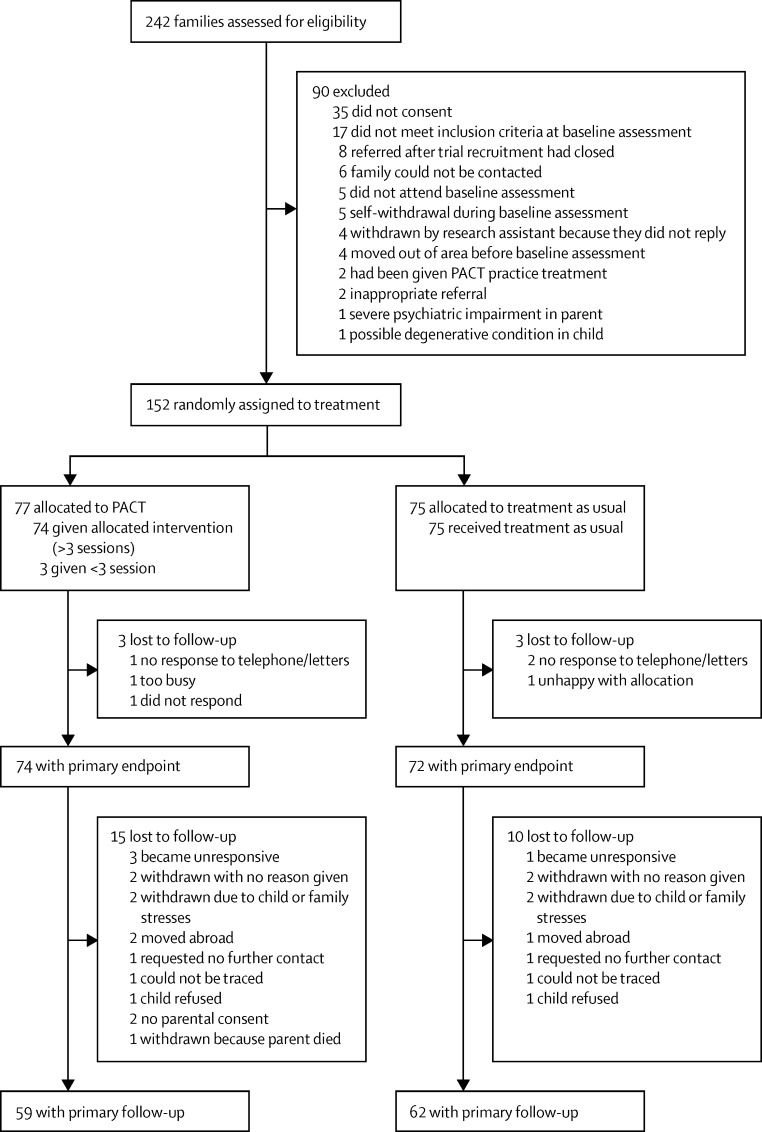
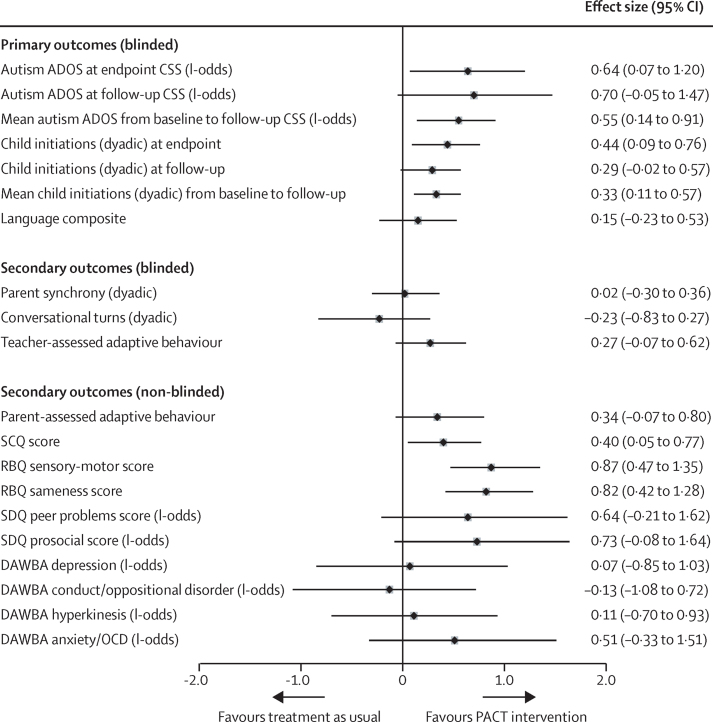
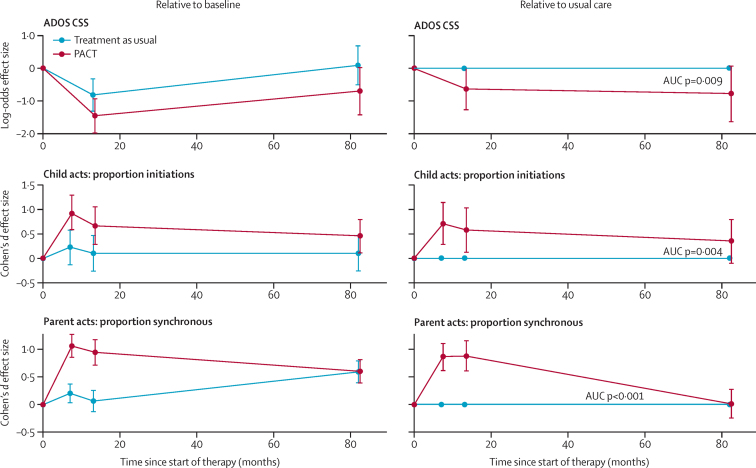
BACKGROUND: It is not known whether early intervention can improve long-term autism symptom outcomes. We aimed to follow-up the Preschool Autism Communication Trial (PACT), to investigate whether the PACT intervention had a long-term effect on autism symptoms and continued effects on parent and child social interaction. METHODS: PACT was a randomised controlled trial of a parent-mediated social communication intervention for children aged 2-4 years with core autism. Follow-up ascertainment was done at three specialised clinical services centres in the UK (London, Manchester, and Newcastle) at a median of 5·75 years (IQR 5·42-5·92) from the original trial endpoint. The main blinded outcomes were the comparative severity score (CSS) from the Autism Diagnostic Observation Schedule (ADOS), the Dyadic Communication Assessment Measure (DCMA) of the proportion of child initiatiations when interacting with the parent, and an expressive-receptive language composite. All analyses followed the intention-to-treat principle. PACT is registered with the ISRCTN registry, number ISRCTN58133827. FINDINGS: 121 (80%) of the 152 trial participants (59 [77%] of 77 assigned to PACT intervention vs 62 [83%] of 75 assigned to treatment as usual) were traced and consented to be assessed between July, 2013, and September, 2014. Mean age at follow-up was 10·5 years (SD 0·8). Group difference in favour of the PACT intervention based on ADOS CSS of log-odds effect size (ES) was 0·64 (95% CI 0·07 to 1·20) at treatment endpoint and ES 0·70 (95% CI -0·05 to 1·47) at follow-up, giving an overall reduction in symptom severity over the course of the whole trial and follow-up period (ES 0·55, 95% CI 0·14 to 0·91, p=0·004). Group difference in DCMA child initiations at follow-up showed a Cohen's d ES of 0·29 (95% CI -0.02 to 0.57) and was significant over the course of the study (ES 0·33, 95% CI 0·11 to 0·57, p=0·004). There were no group differences in the language composite at follow-up (ES 0·15, 95% CI -0·23 to 0·53). INTERPRETATION: The results are the first to show long-term symptom reduction after a randomised controlled trial of early intervention in autism spectrum disorder. They support the clinical value of the PACT intervention and have implications for developmental theory. FUNDING: Medical Research Council.
Overview
The claims and statistics of this paper haven’t been checked yet.
Free: it reads the open-access text and checks the first 5 claims that cite a source we can check. Create a free account to check every claim.
Integrity signals
Registry
Cites
Statistics
Figures
Verification
Claims the paper makes
The claims and statistics of this paper haven’t been checked yet.
Free: it reads the open-access text and checks the first 5 claims that cite a source we can check. Create a free account to check every claim.
Claims other papers make about this one
Each is checked against this paper’s own text: does it say what the citing paper says it does?
The source backs part of the claim, not all of it — or backs it for a different population, condition or comparison.
In the citing paper
“social skills training programs for which moderate evidence of benefit exists 186,187 .”
From Autism spectrum disorder (2020) · cites this paper as [186]
Experimental — accuracy not yet measured
Self-check
Percentages, sums and reported differences re-computed from the paper’s own numbers.
The self-check needs the paper’s full text.
Citations
Cites
1 retracted
Christensen, D. L., Baio, J., Braun, K. V. N., Bilder, D., Charles, J., Constantino, J. N., Daniels, J., Durkin, M. S., Fitzgerald, R. T., Kurzius-Spencer, M., et al. (2016) · MMWR. Surveillance Summaries · doi:10.15585/mmwr.ss6503a1 · Cited by 1,964
RetractedThe Strengths and Difficulties Questionnaire: A research note
Goodman, R. (1997) · Journal of Child Psychology and Psychiatry · doi:10.1111/j.1469-7610.1997.tb01545.x · Cited by 14,908
Lord, C., Rutter, M., & Le Couteur, A. (1994) · Journal of Autism and Developmental Disorders · doi:10.1007/bf02172145 · Cited by 9,065
Lord, C., Risi, S., Lambrecht, L., Cook, E. H., Leventhal, B. L., DiLavore, P. C., Pickles, A., & Rutter, M. (2000) · Journal of Autism and Developmental Disorders · doi:10.1023/a:1005592401947 · Cited by 7,520
Self-citationDawson, G., Rogers, S., Munson, J., Smith, M., Winter, J., Greenson, J., Donaldson, A., & Varley, J. (2010) · Pediatrics · doi:10.1542/peds.2009-0958 · Cited by 2,835
Baird, G., Simonoff, E., Pickles, A., Chandler, S., Loucas, T., Meldrum, D., & Charman, T. (2006) · The Lancet · doi:10.1016/s0140-6736(06)69041-7 · Cited by 2,104
Self-citationAutism Diagnostic Observation Schedule
Lord, C., Rutter, M., Goode, S., Heemsbergen, J., Jordan, H., Mawhood, L., & Schopler, E. (2016) · PsycTESTS Dataset · doi:10.1037/t54175-000 · Cited by 1,678
Standardizing ADOS Scores for a Measure of Severity in Autism Spectrum Disorders
Gotham, K., Pickles, A., & Lord, C. (2009) · Journal of Autism and Developmental Disorders · doi:10.1007/s10803-008-0674-3 · Cited by 1,605
Self-citationCosts of Autism Spectrum Disorders in the United Kingdom and the United States
Buescher, A. V. S., Cidav, Z., Knapp, M., & Mandell, D. S. (2014) · JAMA Pediatrics · doi:10.1001/jamapediatrics.2014.210 · Cited by 1,296
Long-term outcome for children with autism who received early intensive behavioral treatment.
McEachin, J. J., Smith, T. H., & Lövaas, O. I. (1993) · PubMed · Cited by 1,089
Social Communication Questionnaire
Lund, E. (2014) · Encyclopedia of Special Education · doi:10.1002/9781118660584.ese2224 · Cited by 972
Green, J., Charman, T., McConachie, H., Aldred, C., Slonims, V., Howlin, P., Le Couteur, A., Leadbitter, K., Hudry, K., Byford, S., et al. (2010) · The Lancet · doi:10.1016/s0140-6736(10)60587-9 · Cited by 857
Self-citationIntensive Behavioral Treatment for Children With Autism: Four-Year Outcome and Predictors
Sallows, G. O., & Graupner, T. D. (2005) · American Journal on Mental Retardation · doi:10.1352/0895-8017(2005)110[417:ibtfcw]2.0.co;2 · Cited by 788
Randomized Controlled Caregiver Mediated Joint Engagement Intervention for Toddlers with Autism
Kasari, C., Gulsrud, A. C., Wong, C., Kwon, S., & Locke, J. (2010) · Journal of Autism and Developmental Disorders · doi:10.1007/s10803-010-0955-5 · Cited by 751 · cited 2×
“On the basis of these results, we are now able to support the use of the PACT intervention for reducing symptoms of autism in young children, a revision of our initial view 6 and consistent with the results of a subsequent UK NICE metaanalysis.”
Systematic Review of Early Intensive Behavioral Interventions for Children With Autism
Howlin, P., Magiati, I., & Charman, T. (2009) · American Journal on Intellectual and Developmental Disabilities · doi:10.1352/2009.114:23-41 · Cited by 572
Self-citationLong-Term Outcomes of Early Intervention in 6-Year-Old Children With Autism Spectrum Disorder
Estes, A., Munson, J., Rogers, S. J., Greenson, J., Winter, J., & Dawson, G. (2015) · Journal of the American Academy of Child & Adolescent Psychiatry · doi:10.1016/j.jaac.2015.04.005 · Cited by 540
Parent-mediated early intervention for young children with autism spectrum disorders (ASD)
Oono, I. P., Honey, E. J., & McConachie, H. (2013) · Cochrane Database of Systematic Reviews · doi:10.1002/14651858.cd009774.pub2 · Cited by 470
Self-citationAldred, C., Green, J., & Adams, C. (2004) · Journal of Child Psychology and Psychiatry · doi:10.1111/j.1469-7610.2004.00338.x · Cited by 449
Self-citationAutism Diagnostic Observation Schedule
(2012) · SpringerReference · doi:10.1007/springerreference_184220 · Cited by 438
Hu, F. B., Goldberg, J., Hedeker, D., Flay, B. R., & Pentz, M. A. (1998) · American Journal of Epidemiology · doi:10.1093/oxfordjournals.aje.a009511 · Cited by 420
Anderson, D. K., Liang, J. W., & Lord, C. (2014) · Journal of Child Psychology and Psychiatry · doi:10.1111/jcpp.12178 · Cited by 401 · cited 1×
“31,32 Estes and colleagues reported an effect on parentrated adaptive function during their 2 year followup.”
Kasari, C., Gulsrud, A., Freeman, S., Paparella, T., & Hellemann, G. (2012) · Journal of the American Academy of Child & Adolescent Psychiatry · doi:10.1016/j.jaac.2012.02.019 · Cited by 305
Trajectories of Autism Severity in Children Using Standardized ADOS Scores
Gotham, K., Pickles, A., & Lord, C. (2012) · Pediatrics · doi:10.1542/peds.2011-3668 · Cited by 271
Self-citationLidstone, J., Uljarević, M., Sullivan, J., Rodgers, J., McConachie, H., Freeston, M., Le Couteur, A., Prior, M., & Leekam, S. (2014) · Research in Autism Spectrum Disorders · doi:10.1016/j.rasd.2013.10.001 · Cited by 264 · cited 1×
“However, our related hypothesis that levels of child anxiety, which are often linked to levels of restricted and repetitive behaviours in autism, 17 would also show a treatment effect at followup was refuted (figure 2).”
Self-citationVineland Adaptive Behavior Scales
(2007) · Encyclopedia of Measurement and Statistics · doi:10.4135/9781412952644.n476 · Cited by 214
Goodman, A., Heiervang, E., Collishaw, S., & Goodman, R. (2011) · Social Psychiatry and Psychiatric Epidemiology · doi:10.1007/s00127-010-0219-x · Cited by 195
An approximate likelihood-ratio test for ordinal response models
Wolfe, R. S., & Gould, W. (1998) · Stata technical bulletin · Cited by 168
Pickles, A., Harris, V., Green, J., Aldred, C., McConachie, H., Slonims, V., Le Couteur, A., Hudry, K., Charman, T., & the PACT Consortium (2015) · Journal of Child Psychology and Psychiatry · doi:10.1111/jcpp.12291 · Cited by 117
Self-citationAldred, C. R., Green, J., Emsley, R., & McConachie, H. (2011) · Journal of Autism and Developmental Disorders · doi:10.1007/s10803-011-1248-3 · Cited by 84
Self-citationKaale, A., Fagerland, M. W., Martinsen, E. W., & Smith, L. (2014) · Journal of the American Academy of Child & Adolescent Psychiatry · doi:10.1016/j.jaac.2013.09.019 · Cited by 82
Honey, E., McConachie, H., Turner, M., & Rodgers, J. (2012) · Research in Autism Spectrum Disorders · doi:10.1016/j.rasd.2011.06.009 · Cited by 62
Self-citation
Research works printed but not linked: 3
- NICE Autism spectrum disorder in under 19s: support and management. Clinical guideline 170 2013 National Institute for Health and Care Excellence https://www.nice.org.uk/guidance/cg170 (accessed Jan 31, 2016). 34283415
- Semel E Wiig E Secord W Clinical evaluation of language fundamentals, 7th edn, Australian standardised edn (CELF-4 Australian) 2006 Pearson Sydney
- Brownell R Receptive and expressive one-word picture vocabulary tests, 4th edn (ROWPVT-4, EOWPVT-4) 2010 Pearson Education San Antonio
Cited by
Lord, C., Elsabbagh, M., Baird, G., & Veenstra-Vanderweele, J. (2018) · The Lancet · doi:10.1016/s0140-6736(18)31129-2 · Cited by 2,819
Lord, C., Brugha, T. S., Charman, T., Cusack, J., Dumas, G., Frazier, T., Jones, E. J. H., Jones, R. M., Pickles, A., State, M. W., et al. (2020) · Nature Reviews Disease Primers · doi:10.1038/s41572-019-0138-4 · Cited by 1,859
Self-citationThe Lancet Commission on the future of care and clinical research in autism
Lord, C., Charman, T., Havdahl, A., Carbone, P., Anagnostou, E., Boyd, B., Carr, T., de Vries, P. J., Dissanayake, C., Divan, G., et al. (2022) · The Lancet · doi:10.1016/s0140-6736(21)01541-5 · Cited by 924
Self-citationProject AIM: Autism intervention meta-analysis for studies of young children.
Sandbank, M., Bottema-Beutel, K., Crowley, S., Cassidy, M., Dunham, K., Feldman, J. I., Crank, J., Albarran, S. A., Raj, S., Mahbub, P., et al. (2020) · Psychological Bulletin · doi:10.1037/bul0000215 · Cited by 606
Leadbitter, K., Buckle, K. L., Ellis, C., & Dekker, M. (2021) · Frontiers in Psychology · doi:10.3389/fpsyg.2021.635690 · Cited by 417
“Targeted interventions for autistic children can also build effective communication between the child and others, for example, by coaching caregivers and education professionals to “speak the child’s language” (e.g., Paediatric Autism Communication Therapy; Pickles et al., 2016; Green et al., 2018).”
BackgroundSelf-citation
Metadata
- Authors
- Pickles, A., Le Couteur, A., Leadbitter, K., Salomone, E., Cole-Fletcher, R., Tobin, H., Gammer, I., Lowry, J., Vamvakas, G., Byford, S., Aldred, C., Slonims, V., McConachie, H., Howlin, P., Parr, J. R., Charman, T., & Green, J.
- Affiliations
- King's College London (GB)
- University of Manchester (GB)
- Newcastle University (GB)
- Guy's and St Thomas' NHS Foundation Trust (GB)
- Manchester Academic Health Science Centre (GB)
- ORCID
- Venue
- The Lancet
- Publisher
- Elsevier BV
- Published
- 2016-11
- Volume
- 388
- Issue
- 10059
- Pages
- 2501-2509
- ISSN
- 0099-5355 (ISSN-L)
- 0140-6736
- PMC
- PMC5121131
- OpenAlex
- W2537346844
- Cited by
- 519
- References
- 30
- Citations by year
- 2026: 31 · 2025: 50 · 2024: 47 · 2023: 38 · 2022: 65 · 2021: 67 · 2020: 66 · 2019: 52 · 2018: 56 · 2017: 45 · 2016: 1
- FWCI
- 32.67
- Type
- journal article
- Language
- en
- Open access
- hybrid
- doi.org
- Licence
- cc-by
- www.elsevier.com/tdm/userlicense/1.0/ (tdm)
- creativecommons.org/licenses/by/4.0/ (vor)
- Locations
- The Lancet (publishedVersion, cc-by)
- PubMed Central (publishedVersion, cc-by)
- PubMed (publishedVersion)
- Research Portal (King's College London) (publishedVersion, cc-by)
- Research Explorer (The University of Manchester) (publishedVersion, other-oa)
- Sunderland Repository (University of Sunderland) (acceptedVersion)
- Institutional Research Information System University of Turin (University of Turin) (submittedVersion, other-oa)
- BOA (University of Milano-Bicocca) (submittedVersion)
- Griffith Research Online (submittedVersion, cc-by)
- Newcastle University ePrints (Newcastle Univesity) (cc-by)
- Funders
- Medical Research Council (MR/K005863/1)
- Topics
- Life Sciences › Neuroscience › Cognitive Neuroscience › Autism Spectrum Disorder Research
- Social Sciences › Psychology › Clinical Psychology › Family and Disability Support Research
- Health Sciences › Medicine › Psychiatry and Mental health › Child Nutrition and Feeding Issues
- Keywords
- parent-mediated intervention, social communication intervention, autism spectrum disorder, early intervention, young children, long-term follow-up, autism severity, usual care, intention-to-treat analysis
- MeSH terms
- Autism Spectrum Disorder, Autistic Disorder, Child, Communication, Follow-Up Studies, Humans, Parents
About these checks
Registry, retraction, Cites and statistics results are computed, not judged, with one exception: a printed reference that no index lists is read once by a model before it counts as a citation error. Claims are extracted by a model and kept only when their quote appears verbatim in the text; each cited source is then checked, with a model’s help, for whether it says what the claim relies on. Those verdicts can be wrong — read the claim’s quote and the cited source before relying on one.
Statistics and arithmetic are recomputed, not judged.
Confidence bands are shown only for fields calibrated on our annotated test set. None is calibrated yet, so no band is shown.
What counts as a claim ›How we measure confidence ›How we check this ›
Are you an author, or do you see a problem with this page? Request a review
Data sources
Bibliographic data: Semantic Scholar, OpenAlex, Crossref.
Contains information from the Semantic Scholar Academic Graph Datasets, made available under the ODC Attribution License (ODC-BY 1.0).
Semantic Scholar’s data is described in: Kinney, R., et al. (2023). The Semantic Scholar Open Data Platform. arXiv:2301.10140.
