

Parent-mediated social communication therapy for young children with autism (PACT): long-term follow-up of a randomised controlled trial
Open accessThe DOI matches its Crossref record; 31 of the 31 references it cites were found in a registry or an index.
Abstract
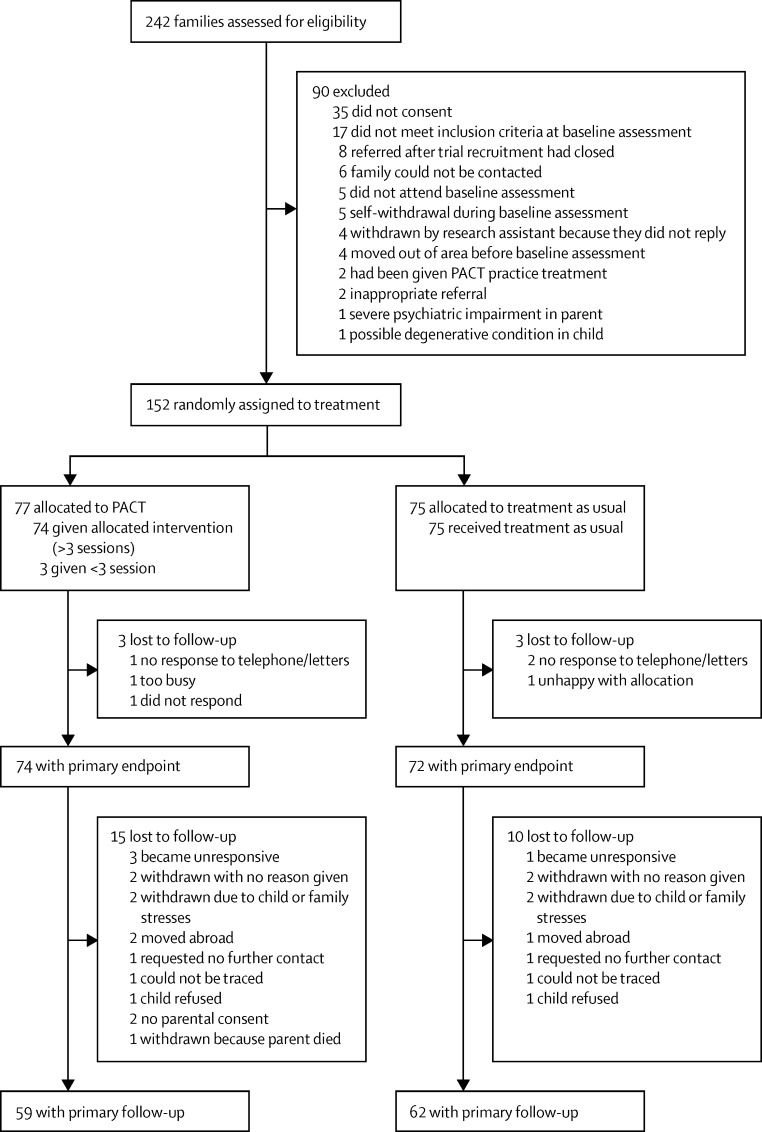
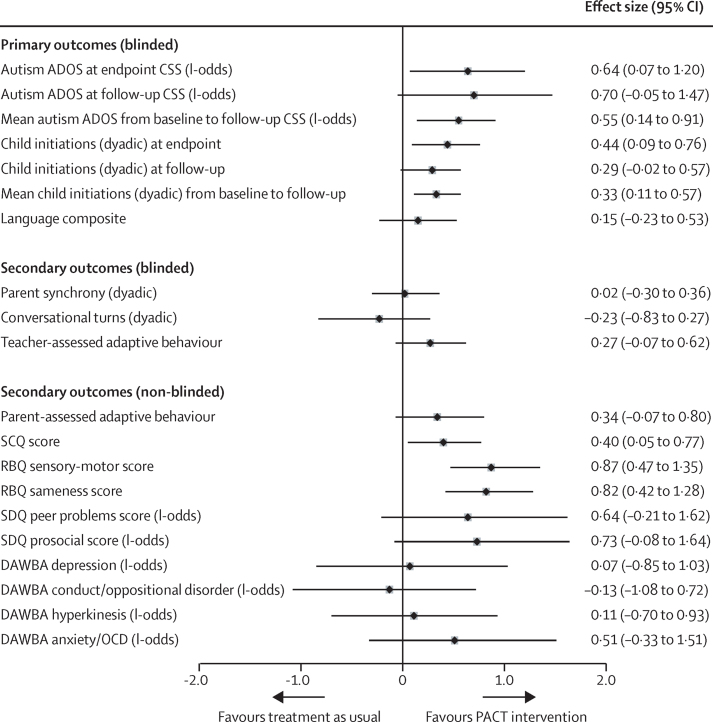
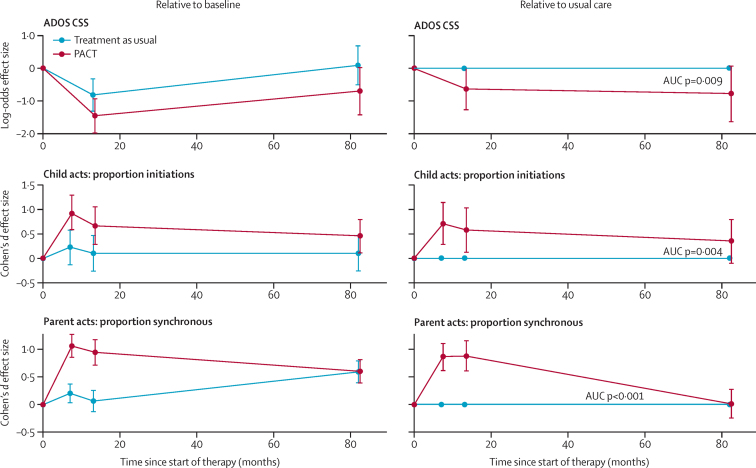
BACKGROUND: It is not known whether early intervention can improve long-term autism symptom outcomes. We aimed to follow-up the Preschool Autism Communication Trial (PACT), to investigate whether the PACT intervention had a long-term effect on autism symptoms and continued effects on parent and child social interaction. METHODS: PACT was a randomised controlled trial of a parent-mediated social communication intervention for children aged 2-4 years with core autism. Follow-up ascertainment was done at three specialised clinical services centres in the UK (London, Manchester, and Newcastle) at a median of 5·75 years (IQR 5·42-5·92) from the original trial endpoint. The main blinded outcomes were the comparative severity score (CSS) from the Autism Diagnostic Observation Schedule (ADOS), the Dyadic Communication Assessment Measure (DCMA) of the proportion of child initiatiations when interacting with the parent, and an expressive-receptive language composite. All analyses followed the intention-to-treat principle. PACT is registered with the ISRCTN registry, number ISRCTN58133827. FINDINGS: 121 (80%) of the 152 trial participants (59 [77%] of 77 assigned to PACT intervention vs 62 [83%] of 75 assigned to treatment as usual) were traced and consented to be assessed between July, 2013, and September, 2014. Mean age at follow-up was 10·5 years (SD 0·8). Group difference in favour of the PACT intervention based on ADOS CSS of log-odds effect size (ES) was 0·64 (95% CI 0·07 to 1·20) at treatment endpoint and ES 0·70 (95% CI -0·05 to 1·47) at follow-up, giving an overall reduction in symptom severity over the course of the whole trial and follow-up period (ES 0·55, 95% CI 0·14 to 0·91, p=0·004). Group difference in DCMA child initiations at follow-up showed a Cohen's d ES of 0·29 (95% CI -0.02 to 0.57) and was significant over the course of the study (ES 0·33, 95% CI 0·11 to 0·57, p=0·004). There were no group differences in the language composite at follow-up (ES 0·15, 95% CI -0·23 to 0·53). INTERPRETATION: The results are the first to show long-term symptom reduction after a randomised controlled trial of early intervention in autism spectrum disorder. They support the clinical value of the PACT intervention and have implications for developmental theory. FUNDING: Medical Research Council.
Overview
The claims and statistics of this paper haven’t been checked yet.
Free: it reads the open-access text and checks the first 5 claims that cite a source we can check. Create a free account to check every claim.
Integrity signals
Registry
Cites
Statistics
Figures
Verification
Claims the paper makes
The claims and statistics of this paper haven’t been checked yet.
Free: it reads the open-access text and checks the first 5 claims that cite a source we can check. Create a free account to check every claim.
Claims other papers make about this one
Each is checked against this paper’s own text: does it say what the citing paper says it does?
The source backs part of the claim, not all of it — or backs it for a different population, condition or comparison.
In the citing paper
“social skills training programs for which moderate evidence of benefit exists 186,187 .”
From Autism spectrum disorder (2020) · cites this paper as [186]
Experimental — accuracy not yet measured
Self-check
Percentages, sums and reported differences re-computed from the paper’s own numbers.
The self-check needs the paper’s full text.
Citations
Cites
1 retracted
Christensen, D. L., Baio, J., Braun, K. V. N., Bilder, D., Charles, J., Constantino, J. N., Daniels, J., Durkin, M. S., Fitzgerald, R. T., Kurzius-Spencer, M., et al. (2016) · MMWR. Surveillance Summaries · doi:10.15585/mmwr.ss6503a1 · Cited by 1,964
RetractedThe Strengths and Difficulties Questionnaire: A research note
Goodman, R. (1997) · Journal of Child Psychology and Psychiatry · doi:10.1111/j.1469-7610.1997.tb01545.x · Cited by 14,908
Lord, C., Rutter, M., & Le Couteur, A. (1994) · Journal of Autism and Developmental Disorders · doi:10.1007/bf02172145 · Cited by 9,065
Lord, C., Risi, S., Lambrecht, L., Cook, E. H., Leventhal, B. L., DiLavore, P. C., Pickles, A., & Rutter, M. (2000) · Journal of Autism and Developmental Disorders · doi:10.1023/a:1005592401947 · Cited by 7,520
Self-citationDawson, G., Rogers, S., Munson, J., Smith, M., Winter, J., Greenson, J., Donaldson, A., & Varley, J. (2010) · Pediatrics · doi:10.1542/peds.2009-0958 · Cited by 2,835
Baird, G., Simonoff, E., Pickles, A., Chandler, S., Loucas, T., Meldrum, D., & Charman, T. (2006) · The Lancet · doi:10.1016/s0140-6736(06)69041-7 · Cited by 2,104
Self-citationAutism Diagnostic Observation Schedule
Lord, C., Rutter, M., Goode, S., Heemsbergen, J., Jordan, H., Mawhood, L., & Schopler, E. (2016) · PsycTESTS Dataset · doi:10.1037/t54175-000 · Cited by 1,678
Standardizing ADOS Scores for a Measure of Severity in Autism Spectrum Disorders
Gotham, K., Pickles, A., & Lord, C. (2009) · Journal of Autism and Developmental Disorders · doi:10.1007/s10803-008-0674-3 · Cited by 1,605
Self-citationCosts of Autism Spectrum Disorders in the United Kingdom and the United States
Buescher, A. V. S., Cidav, Z., Knapp, M., & Mandell, D. S. (2014) · JAMA Pediatrics · doi:10.1001/jamapediatrics.2014.210 · Cited by 1,296
Long-term outcome for children with autism who received early intensive behavioral treatment.
McEachin, J. J., Smith, T. H., & Lövaas, O. I. (1993) · PubMed · Cited by 1,089
Research works printed but not linked: 3
- NICE Autism spectrum disorder in under 19s: support and management. Clinical guideline 170 2013 National Institute for Health and Care Excellence https://www.nice.org.uk/guidance/cg170 (accessed Jan 31, 2016). 34283415
- Semel E Wiig E Secord W Clinical evaluation of language fundamentals, 7th edn, Australian standardised edn (CELF-4 Australian) 2006 Pearson Sydney
- Brownell R Receptive and expressive one-word picture vocabulary tests, 4th edn (ROWPVT-4, EOWPVT-4) 2010 Pearson Education San Antonio
Cited by
Lord, C., Elsabbagh, M., Baird, G., & Veenstra-Vanderweele, J. (2018) · The Lancet · doi:10.1016/s0140-6736(18)31129-2 · Cited by 2,819
Lord, C., Brugha, T. S., Charman, T., Cusack, J., Dumas, G., Frazier, T., Jones, E. J. H., Jones, R. M., Pickles, A., State, M. W., et al. (2020) · Nature Reviews Disease Primers · doi:10.1038/s41572-019-0138-4 · Cited by 1,859
Self-citationThe Lancet Commission on the future of care and clinical research in autism
Lord, C., Charman, T., Havdahl, A., Carbone, P., Anagnostou, E., Boyd, B., Carr, T., de Vries, P. J., Dissanayake, C., Divan, G., et al. (2022) · The Lancet · doi:10.1016/s0140-6736(21)01541-5 · Cited by 924
Self-citationProject AIM: Autism intervention meta-analysis for studies of young children.
Sandbank, M., Bottema-Beutel, K., Crowley, S., Cassidy, M., Dunham, K., Feldman, J. I., Crank, J., Albarran, S. A., Raj, S., Mahbub, P., et al. (2020) · Psychological Bulletin · doi:10.1037/bul0000215 · Cited by 606
Leadbitter, K., Buckle, K. L., Ellis, C., & Dekker, M. (2021) · Frontiers in Psychology · doi:10.3389/fpsyg.2021.635690 · Cited by 417
“Targeted interventions for autistic children can also build effective communication between the child and others, for example, by coaching caregivers and education professionals to “speak the child’s language” (e.g., Paediatric Autism Communication Therapy; Pickles et al., 2016; Green et al., 2018).”
BackgroundSelf-citationLanda, R. J. (2018) · International Review of Psychiatry · doi:10.1080/09540261.2018.1432574 · Cited by 389
“While no group treatment effect was detected in autism severity in that study (Green et al., 2010), follow-up of the participants nearly 6 years later revealed that the PACT group displayed less severe ASD symptoms (Pickles et al., 2016).”
BackgroundReichow, B., Hume, K., Barton, E. E., & Boyd, B. A. (2018) · Cochrane Database of Systematic Reviews · doi:10.1002/14651858.cd009260.pub3 · Cited by 350
Howes, O. D., Rogdaki, M., Findon, J. L., Wichers, R. H., Charman, T., King, B. H., Loth, E., McAlonan, G. M., McCracken, J. T., Parr, J. R., et al. (2018) · Journal of Psychopharmacology · doi:10.1177/0269881117741766 · Cited by 342
“, 2010) and recent long-term follow-up has reported reduced ASD symptoms as measured by the ADOS and sustained increases in child initiations six years after treatment ended (Pickles et al., 2016).”
Self-citationPrevalence of Autism Spectrum Disorder in Preterm Infants: A Meta-analysis
Agrawal, S., Rao, S. C., Bulsara, M. K., & Patole, S. K. (2018) · Pediatrics · doi:10.1542/peds.2018-0134 · Cited by 332
Green, J., Pickles, A., Pasco, G., Bedford, R., Wan, M. W., Elsabbagh, M., Slonims, V., Gliga, T., Jones, E., Cheung, C., et al. (2017) · Journal of Child Psychology and Psychiatry · doi:10.1111/jcpp.12728 · Cited by 328
“Formal mediation tests in two related studies (Aldred et al., 2012; Pickles et al., 2016) show that such parental synchrony change mediates child symptom changes.”
Self-citationMatthews, D., Biney, H., & Abbot-Smith, K. (2018) · Language Learning and Development · doi:10.1080/15475441.2018.1455584 · Cited by 284
“However, there is potential to help children for whom pragmatic difficulities impair wellbeing (Adams et al., 2014; Pickles et al., 2016).”
BackgroundParenting behavior and the development of children with autism spectrum disorder
Crowell, J. A., Keluskar, J., & Gorecki, A. (2019) · Comprehensive Psychiatry · doi:10.1016/j.comppsych.2018.11.007 · Cited by 249
Lai, M.-C., Anagnostou, E., Wiznitzer, M., Allison, C., & Baron-Cohen, S. (2020) · The Lancet Neurology · doi:10.1016/s1474-4422(20)30034-x · Cited by 250
Whitehouse, A. J. O., Varcin, K. J., Pillar, S., Billingham, W., Alvares, G. A., Barbaro, J., Bent, C. A., Blenkley, D., Boutrus, M., Chee, A., et al. (2021) · JAMA Pediatrics · doi:10.1001/jamapediatrics.2021.3298 · Cited by 214
Self-citationPrevalence and Treatment Patterns of Autism Spectrum Disorder in the United States, 2016
Xu, G., Strathearn, L., Liu, B., O’Brien, M., Kopelman, T. G., Zhu, J., Snetselaar, L. G., & Bao, W. (2019) · JAMA Pediatrics · doi:10.1001/jamapediatrics.2018.4208 · Cited by 212
French, L., & Kennedy, E. M. M. (2018) · Journal of Child Psychology and Psychiatry · doi:10.1111/jcpp.12828 · Cited by 213
“…and adaptive behaviour at 6 years of age (Estes et al., 2015) and the more recent Preschool Autism Communication Trial (PACT) study is the first randomised controlled trial (RCT) to clearly demonstrate symptom reduction at long-term follow-up to middle childhood (7–11 years; Pickles et al., 2016).”
InfluentialBieleninik, L., Geretsegger, M., Mössler, K., Assmus, J., Thompson, G., Gattino, G., Elefant, C., Gottfried, T., Igliozzi, R., Muratori, F., et al. (2017) · JAMA · doi:10.1001/jama.2017.9478 · Cited by 200
“An intervention focused on parents was found efficacious in a small pilot trial in the UK,(22) but in a subsequent multicenter trial, effects were not apparent until five years after randomization.(25,27) A multicenter trial in the US of another parent-mediated intervention observed categorical effects on autism sever…”
BackgroundCommunication interventions for autism spectrum disorder in minimally verbal children
Brignell, A., Chenausky, K. V., Song, H., Zhu, J., Suo, C., & Morgan, A. T. (2018) · Cochrane Database of Systematic Reviews · doi:10.1002/14651858.cd012324.pub2 · Cited by 197
Mitochondria, Metabolism, and Redox Mechanisms in Psychiatric Disorders
Kim, Y., Vadodaria, K. C., Lenkei, Z., Kato, T., Gage, F. H., Marchetto, M. C., & Santos, R. (2019) · Antioxidants & Redox Signaling · doi:10.1089/ars.2018.7606 · Cited by 187
“There is very little evidence for interventions aimed at the core symptom of ASD, such as restricted and repetitive behavior, including antipsychotic medication (92, 344, 386).”
Fuentes, J., Hervás, A., Howlin, P., & Party), (. A. W. (2021) · European Child & Adolescent Psychiatry · doi:10.1007/s00787-020-01587-4 · Cited by 183
Self-citationFridenson-Hayo, S., Berggren, S., Lassalle, A., Tal, S., Pigat, D., Meir-Goren, N., O’Reilly, H., Ben-Zur, S., Bölte, S., Baron-Cohen, S., et al. (2017) · European Child & Adolescent Psychiatry · doi:10.1007/s00787-017-0968-0 · Cited by 163
“Studies which used more intensive parent training, such as the parent-mediated communication-focused treatment in children with autism (PACT), found that parent involvement in the intervention is beneficial to the child’s long-term outcome [73].”
BackgroundYoung, S., Hollingdale, J., Absoud, M., Bolton, P., Branney, P., Colley, W., Craze, E., Dave, M., Deeley, Q., Farrag, E., et al. (2020) · BMC Medicine · doi:10.1186/s12916-020-01585-y · Cited by 162
Pagnozzi, A. M., Conti, E., Calderoni, S., Fripp, J., & Rose, S. E. (2018) · International Journal of Developmental Neuroscience · doi:10.1016/j.ijdevneu.2018.08.010 · Cited by 162
“…for children with ASD, leading to improvements in cognitive performance, language and adaptive behaviour skills (Warren et al., 2011), and can help to prepare parents (Ingersoll and Dvortcsak, 2006) whose involvement can help facilitate outcomes in children with ASD (Pickles et al., 2016).”
BackgroundMottron, L. (2017) · European Child & Adolescent Psychiatry · doi:10.1007/s00787-017-0955-5 · Cited by 159
“This line of research led to the first large-scale (N = 152) randomized controlled trial on early intervention [23], showing weak, but demonstrable, effects on autistic symptoms 6 years after the intervention [52].”
de Belen, R. A. J., Bednarz, T. P., Sowmya, A., & Favero, D. D. (2020) · Translational Psychiatry · doi:10.1038/s41398-020-01015-w · Cited by 185
“This is critical as diagnosis and intervention within the fi rst few years of life can provide long-term improvements for the child and can even have greater effect on outcomes 4 .”
BackgroundLongitudinal follow‐up of academic achievement in children with autism from age 2 to 18
Kim, S. H., Bal, V. H., & Lord, C. (2018) · Journal of Child Psychology and Psychiatry · doi:10.1111/jcpp.12808 · Cited by 144
“…in early treatment for ASD (e.g., parent-mediated interventions) has shown significant short-term (Green et al., 2010; Kasari et al., 2014; Wetherby et al., 2014) as well as long-term effects (Pickles et al., 2016) on the child’s autism symptom severity and/or language and cognitive development.”
A radical change in our autism research strategy is needed: Back to prototypes
Mottron, L. (2021) · Autism Research · doi:10.1002/aur.2494 · Cited by 143
“However, there are undeniable examples (e.g., in intervention: Pickles et al., 2016) in which a single study is better than a thousand studies with lower standards (Dawson & Fletcher-Watson, 2020).”
BackgroundVivanti, G., Kasari, C., Green, J., Mandell, D., Maye, M., & Hudry, K. (2018) · Autism Research · doi:10.1002/aur.1900 · Cited by 141
“By way of illustration, Preschool Autism Communication Therapy (PACT), a parent-mediated approach originally developed and tested in the UK [Green et al., 2010; Pickles et al., 2016], was recently adapted for delivery in rural communities in South Asia [Divan et al., 2015].”
Self-citationMusic therapy for autistic people
Geretsegger, M., Fusar‐Poli, L., Elefant, C., Mössler, K. A., Vitale, G., & Gold, C. (2022) · Cochrane Database of Systematic Reviews · doi:10.1002/14651858.cd004381.pub4 · Cited by 208
Divan, G., Bhavnani, S., Leadbitter, K., Ellis, C., Dasgupta, J., Abubakar, A. A., Elsabbagh, M., Hamdani, S. U., Servili, C., Patel, V., et al. (2021) · Journal of Child Psychology and Psychiatry · doi:10.1111/jcpp.13404 · Cited by 150
Self-citationGreen, J., & Garg, S. (2018) · Journal of Child Psychology and Psychiatry · doi:10.1111/jcpp.12892 · Cited by 127
“PACT was tested in an RCT of 152 children with core autism (age 2–5 years), which found large endpoint effect in optimising parental synchrony across three geographically varied contexts in the United Kingdom (Green et al., 2010; Pickles et al., 2016).”
InfluentialSelf-citationAutistic adults’ views of their communication skills and needs
Cummins, C., Pellicano, E., & Crane, L. (2020) · International Journal of Language & Communication Disorders · doi:10.1111/1460-6984.12552 · Cited by 125
“…be targeted toward autistic children, with a range of established supports including parent-based approaches (e.g., Sussman and Hanen Centre 1999, Pickles et al. 2016), group-based approaches (e.g., Legoff and Sherman 2006, Barry et al. 2003), individual therapy (e.g., Flippin et al. 2010) and…”
BackgroundRipe for solution: Delayed development of multisensory processing in autism and its remediation
Beker, S., Foxe, J. J., & Molholm, S. (2018) · Neuroscience & Biobehavioral Reviews · doi:10.1016/j.neubiorev.2017.11.008 · Cited by 114
“…of connectivity between frontal and sensory cortices that occurs throughout adolescence (Simmonds, Hallquist, Asato, & Luna, 2014), or the extensive therapies that individuals with autism frequently receive (Pickles et al., 2016), could play a role in how multisensory information is processed.”
Binns, A. V., & Cardy, J. O. (2019) · Autism & Developmental Language Impairments · doi:10.1177/2396941518824497 · Cited by 132
Crank, J. E., Sandbank, M., Dunham, K., Crowley, S., Bottema‐Beutel, K., Feldman, J., & Woynaroski, T. G. (2021) · Autism Research · doi:10.1002/aur.2471 · Cited by 115
“A delayed effect on distal outcomes, for example, was observed in the landmark PACT study by Green et al. [2010; Pickles et al., 2016], wherein a significant difference in autism symptom reduction between the intervention and control groups was not detected until follow-up measures were collected,…”
ResultLow‐dose suramin in autism spectrum disorder: a small, phase I/II, randomized clinical trial
Naviaux, R. K., Curtis, B., Li, K., Naviaux, J. C., Bright, A. T., Reiner, G., Westerfield, M., Goh, S., Alaynick, W. A., Wang, L., et al. (2017) · Annals of Clinical and Translational Neurology · doi:10.1002/acn3.424 · Cited by 123
Brian, J. A., Smith, I. M., Zwaigenbaum, L., & Bryson, S. E. (2017) · Autism Research · doi:10.1002/aur.1818 · Cited by 107
Intervention Effects on Language in Children With Autism: A Project AIM Meta-Analysis
Sandbank, M. P., Bottema‐Beutel, K., Crowley, S., Cassidy, M. M., Feldman, J. I., Canihuante, M., & Woynaroski, T. G. (2020) · Journal of Speech Language and Hearing Research · doi:10.1044/2020_jslhr-19-00167 · Cited by 135
“…uncorrected comparisons are a common issue in meta-analytic literature and can give rise to Type I errors (i.e., the true effect is zero, but researchers incorrectly reject the null) and skew conclusions about the summary effects of intervention and putative moderators (Polanin & Pigott, 2015).”
BackgroundRutherford, M., Baxter, J., Grayson, Z., Johnston, L., & O'Hare, A. E. (2019) · Autism · doi:10.1177/1362361319871756 · Cited by 142
“…from philosophical approaches ranging from the didactic or behaviourially based (Denne et al., 2018) to social pragmatic frameworks (Boyd et al., 2014; Prizant, Wetherby, Rubin, & Laurent, 2003) in school/community/ clinic environments or parent-mediated interventions (Pickles et al., 2016).”
BackgroundRogers, S. J., Yoder, P., Estes, A., Warren, Z., McEachin, J., Munson, J., Rocha, M., Greenson, J., Wallace, L., Gardner, E., et al. (2021) · Journal of the American Academy of Child & Adolescent Psychiatry · doi:10.1016/j.jaac.2020.06.013 · Cited by 105
Tachibana, Y., Miyazaki, C., Ota, E., Mori, R., Hwang, Y., Kobayashi, E., Terasaka, A., Tang, J., & Kamio, Y. (2017) · PLOS ONE · doi:10.1371/journal.pone.0186502 · Cited by 101
“Their long-term follow-up study, however, demonstrated that the early intervention program for ASD was significantly effective in reducing autism symptoms [94].”
BackgroundWilliams, K. J., Jacoby, P. A., Whitehouse, A., Kim, R., Epstein, A., Murphy, N., Reid, S. M., Leonard, H., Reddihough, D. S., & Downs, J. A. (2020) · Developmental Medicine & Child Neurology · doi:10.1111/dmcn.14657 · Cited by 122
Autism severity and its relationship to disability
Waizbard‐Bartov, E., FEIN, D. A., Lord, C., & Amaral, D. G. (2023) · Autism Research · doi:10.1002/aur.2898 · Cited by 145
“…access to more resources in the parental and home environment (Fountain et al., 2012; Simonoff et al., 2019; Waizbard-Bartov et al., 2022) as well as to early diagnosis (Gabbay-Dizdar et al., 2021) and intervention (Pickles et al., 2016) can help promote gains and mitigate impairments over time.”
BackgroundHaartsen, R., Jones, E. J. H., Orekhova, E. V., Charman, T., Johnson, M. H., The BASIS team, Baron‐Cohen, S., Bedford, R., Blasi, A., Bolton, P., et al. (2019) · Translational Psychiatry · doi:10.1038/s41398-019-0380-2 · Cited by 106
Self-citationThe earlier the better: An RCT of treatment timing effects for toddlers on the autism spectrum
Guthrie, W., Wetherby, A. M., Woods, J., Schatschneider, C., Holland, R. D., Morgan, L., & Lord, C. E. (2023) · Autism · doi:10.1177/13623613231159153 · Cited by 101
“Unfortunately, the median age of diagnosis (50 months; Maenner et al., 2021) continues to be well above the age at which children can often be reliably diagnosed (Guthrie et al., 2013; Pierce et al., 2019).”
Vahabzadeh, A., Keshav, N. U., Abdus-Sabur, R., Huey, K., Liu, R., & Sahin, N. T. (2018) · Behavioral Sciences · doi:10.3390/bs8100085 · Cited by 91
“A range of psychosocial interventions have shown promise in improving social communication and other developmental markers, although evidence for the longer term impact of such approaches remains limited [13].”
BackgroundTrembath, D. L., Gurm, M., Scheerer, N. E., Trevisan, D. A., Paynter, J. M., Bohadana, G., Roberts, J., & Iarocci, G. (2019) · Autism Research · doi:10.1002/aur.2168 · Cited by 120
Leadbitter, K., Aldred, C. R., McConachie, H., Couteur, A. S. L., Kapadia, D., Charman, T., Macdonald, W., Salomone, E., Emsley, R., & Green, J. (2017) · Journal of Autism and Developmental Disorders · doi:10.1007/s10803-017-3350-7 · Cited by 112
Self-citationThe PACT Consortium, Salomone, E., Leadbitter, K., Aldred, C., Barrett, B., Byford, S., Charman, T., Howlin, P., Green, J., Le Couteur, A., et al. (2018) · Journal of Autism and Developmental Disorders · doi:10.1007/s10803-017-3392-x · Cited by 92
Self-citationKurzrok, J., McBride, E., & Grossman, R. B. (2021) · Autism · doi:10.1177/1362361321990931 · Cited by 86
Vivanti, G., Fanning, P. A. J., Hocking, D. R., Sievers, S. B., & Dissanayake, C. (2017) · Journal of Autism and Developmental Disorders · doi:10.1007/s10803-017-3106-4 · Cited by 118
“Recent advances in early intervention research highlight promising avenues for targeting social and joint attention deficits in ASD during early sensitive periods, before the social attention abnormalities associated with ASD are consolidated (Jones et al. 2017; Pickles et al. 2016; Rogers and Talbott 2016).”
BackgroundComputer Vision Analysis for Quantification of Autism Risk Behaviors
Hashemi, J., Dawson, G., Carpenter, K. L. H., Campbell, K. M., Qiu, Q., Espinosa, S., Marsan, S., Baker, J. P., EGGER, H. L., & Sapiro, G. (2018) · IEEE Transactions on Affective Computing · doi:10.1109/taffc.2018.2868196 · Cited by 101
“Not only can intensive early intervention provide long-term improvements for the child, but also starting intervention before the full syndrome is present can have an even greater effect on outcomes [21], [22], [23].”
BackgroundStahmer, A. C., Rieth, S. R., Dickson, K. S., Feder, J., Burgeson, M., Searcy, K., & Brookman-Frazee, L. I. (2019) · Autism · doi:10.1177/1362361319878080 · Cited by 99
“These changes may subsequently support child development and have sustained, long-term impacts on child outcomes (Pickles et al., 2016).”
BackgroundPre-symptomatic intervention for autism spectrum disorder (ASD): defining a research agenda
Grzadzinski, R., Amso, D., Landa, R. J., Watson, L. R., Guralnick, M. J., Zwaigenbaum, L., Deák, G. O., Estes, A. M., Brian, J. A., Bath, K. G., et al. (2021) · Journal of Neurodevelopmental Disorders · doi:10.1186/s11689-021-09393-y · Cited by 107
“Furthermore, these RCTs have found few significant post-intervention main effects; effect sizes generally have been small, although feasibility, acceptability, and implementation fidelity were high [74–78].”
BackgroundMethodInfluentialEfficacy of psychosocial interventions for Autism spectrum disorder: an umbrella review
Gosling, C. J., Cartigny, A., Mellier, B. C., Solanes, A., Radua, J., & Delorme, R. (2022) · Molecular Psychiatry · doi:10.1038/s41380-022-01670-z · Cited by 84
Divan, G., Vajaratkar, V., Cardozo, P., Huzurbazar, S., Verma, M., Howarth, E., Emsley, R., Taylor, C., Patel, V., & Green, J. (2019) · Autism Research · doi:10.1002/aur.1978 · Cited by 81
“These extensions aimed to make the PASS Plus intervention more comprehensive and applicable in the most demanding of health settings whilst increasing rigor and comparability of the trial to the UK PACT trials [Pickles et al., 2016], through the measurement of autism symptom outcomes in addition to the proximal interv…”
BackgroundMethodSelf-citationTrajectories of Autism Symptom Severity Change During Early Childhood
Waizbard-Bartov, E., Ferrer, E., Young, G. S., Heath, B., Rogers, S., Wu Nordahl, C., Solomon, M., & Amaral, D. G. (2021) · Journal of Autism and Developmental Disorders · doi:10.1007/s10803-020-04526-z · Cited by 81
Gibson, J. L., Pritchard-Rowe, E., & de Lemos, C. (2021) · Autism & Developmental Language Impairments · doi:10.1177/23969415211015840 · Cited by 119
Lombardo, M. V., Eyler, L. T., Moore, A., Datko, M., Barnes, C. C., Cha, D., Courchesne, E., & Pierce, K. (2019) · eLife · doi:10.7554/elife.47427 · Cited by 91
Pacia, C., Holloway, J., Gunning, C., & Lee, H. (2021) · Review Journal of Autism and Developmental Disorders · doi:10.1007/s40489-021-00249-8 · Cited by 103
“…Parent outcomes: treatment integrity, social validity SSRD Strong Penney and Schwartz (2018) Spontaneous imitation (IP): Questionable; 55% Parent outcome: Treatment integrity SSRD Weak Randolph et al. (2011) Initiations (LC): not effective; 0% Verbal responses (LC): very effective; 100% (1/1 with…”
InfluentialThe Human Spectrum: A Phenomenological Enquiry within Neurodiversity
Murray, D., Milton, D. E. M., Green, J., & Bervoets, J. (2022) · Psychopathology · doi:10.1159/000526213 · Cited by 86
Self-citationEarly Intervention with Parents of Children with Autism Spectrum Disorders: A Review of Programs
Rojas-Torres, L. P., Alonso-Esteban, Y., & Alcantud-Marín, F. (2020) · Children · doi:10.3390/children7120294 · Cited by 73
“In a subsequent follow-up study on the same sample [111], they observed that there was an improvement in the dyadic social communication between parents and children, although no relationship with the aims of conventional intervention on the nuclear symptoms of the disorder was observed.”
BackgroundBejarano‐Martín, Á., Canal‐Bedia, R., Magán‐Maganto, M., Fernández-Álvarez, C. J., Cilleros, M. V. M., Gómez, M. C. S., Primo, P. G., Rose-Sweeney, M., Boilson, A. M., Linertová, R., et al. (2019) · Journal of Autism and Developmental Disorders · doi:10.1007/s10803-019-04253-0 · Cited by 99
“In recent years, active involvement has also been shown, not only to increase service satisfaction, but also to improve intervention outcomes by, for instance, increasing progress in skill acquisition (Ingersoll and Wainer 2013; Kasari et al. 2015; Pickles et al. 2016).”
BackgroundMedavarapu, S., Marella, L. L., Sangem, A., & Kairam, R. (2019) · Cureus · doi:10.7759/cureus.3901 · Cited by 96
“This is the first study showing convincing benefits for autism patients, and this intervention mediated by parents was relatively inexpensive [48].”
BackgroundLeadbitter, K., Macdonald, W., Taylor, C., & Buckle, K. L. (2020) · Autism · doi:10.1177/1362361320936394 · Cited by 97
“A primary outcome treatment effect of reduced autism symptom severity was found at treatment endpoint and remained 6 years later (Pickles et al., 2016).”
BackgroundMethodResultSelf-citationExamining the relationship between social support and stress for parents of individuals with autism
Robinson, S., & Weiss, J. A. (2020) · Research in Autism Spectrum Disorders · doi:10.1016/j.rasd.2020.101557 · Cited by 70
Intervention Recommendations for Children With Autism in Light of a Changing Evidence Base
Sandbank, M. P., Bottema‐Beutel, K., & Woynaroski, T. G. (2020) · Archives of Pediatrics and Adolescent Medicine · doi:10.1001/jamapediatrics.2020.4730 · Cited by 75
Non-pharmacological interventions for autistic children: An umbrella review
Trembath, D. L., Varcin, K. J., Waddington, H. L., Sulek, R., Bent, C. A., Ashburner, J. K., Eapen, V., Goodall, E., Hudry, K., Roberts, J., et al. (2022) · Autism · doi:10.1177/13623613221119368 · Cited by 76
Wetherby, A. M., Woods, J., Guthrie, W., Delehanty, A., Brown, J. A., Morgan, L., Holland, R. D., Schatschneider, C., & Lord, C. (2018) · Journal of Speech, Language, and Hearing Research · doi:10.1044/2018_jslhr-l-rsaut-18-0028 · Cited by 65
Lichtlé, J., Downes, N., Engelberg, A., & Cappe, É. (2019) · Review Journal of Autism and Developmental Disorders · doi:10.1007/s40489-019-00190-x · Cited by 80
“The interventions proposed today in the field of autism are mostly parent-mediated, especially among families with children at preschool age (Pickles et al. 2016).”
BackgroundBrian, J. A., Drmic, I., Roncadin, C., Dowds, E., Shaver, C., Smith, I. M., Zwaigenbaum, L., Sacrey, L.-A. R., & Bryson, S. E. (2022) · Autism · doi:10.1177/13623613211068934 · Cited by 82
Pathological Demand Avoidance: symptoms but not a syndrome
Green, J., Absoud, M., Grahame, V., Malik, O., Simonoff, E. A., Couteur, A. S. L., & Baird, G. (2018) · The Lancet Child & Adolescent Health · doi:10.1016/s2352-4642(18)30044-0 · Cited by 89
Self-citationConti, E., Mitra, J., Calderoni, S., Pannek, K., Shen, K. K., Pagnozzi, A., Rose, S., Mazzotti, S., Scelfo, D., Tosetti, M., et al. (2017) · Human Brain Mapping · doi:10.1002/hbm.23520 · Cited by 63
Video feedback for parental sensitivity and attachment security in children under five years
O’Hara, L., Smith, E. R., Barlow, J., Livingstone, N., Herath, N. I., Wei, Y., Spreckelsen, T. F., & Macdonald, G. M. (2019) · Cochrane Database of Systematic Reviews · doi:10.1002/14651858.cd012348.pub2 · Cited by 84
Green, J., Leadbitter, K., Ellis, C., Taylor, L. J., Moore, H. L., Carruthers, S., James, K., Taylor, C., Balabanovska, M., Langhorne, S., et al. (2022) · The Lancet Psychiatry · doi:10.1016/s2215-0366(22)00029-3 · Cited by 73
Self-citationDelehanty, A. D., Stronach, S. T., Guthrie, W., Slate, E. H., & Wetherby, A. M. (2018) · Autism & Developmental Language Impairments · doi:10.1177/2396941518764764 · Cited by 80
“…with ASD who begin receiving intervention in the toddler and preschool years benefit substantially (Dawson et al., 2010; Kasari et al., 2014; Pickles et al., 2016; Vivanti, Dissanayake, & Victorian ASELCC Team, 2016; Wetherby et al., 2014), and research has begun to document the positive…”
BackgroundIdentifying autism symptom severity trajectories across childhood
Waizbard‐Bartov, E., Ferrer, E. E., Heath, B. E., Rogers, S. J., Nordahl, C. W., Solomon, M., & Amaral, D. G. (2022) · Autism Research · doi:10.1002/aur.2674 · Cited by 69
Adaptive trajectories and early risk factors in the autism spectrum: A 15‐year prospective study
Baghdadli, A., Michelon, C., Pernon, É., Picot, M., Miot, S., Sonié, S., Rattaz, C., & Mottron, L. (2018) · Autism Research · doi:10.1002/aur.2022 · Cited by 67
“The current absence of a demonstrated long-term effect of intervention highlights the urgent need for outcome studies with long-term measurement following the standards of clinical research [Pickles et al., 2016].”
BackgroundSengupta, K., Mahadik, S., & Kapoor, G. (2020) · Research in Autism · doi:10.1016/j.rasd.2020.101585 · Cited by 62
Rodgers, M., Simmonds, M. C., Marshall, D. C., Hodgson, R. M., Stewart, L. A., Rai, D., Wright, K. E., Ben‐Itzchak, E., Eikeseth, S., Eldevik, S., et al. (2021) · Autism · doi:10.1177/1362361320985680 · Cited by 77
“…most recent RCT of effectiveness (Rogers et al., 2019) and the availability of a range of other pre-school autism interventions that fall outside the scope of this review such as social communication interventions delivered through parents or teachers (Kasari et al., 2006; Pickles et al., 2016).”
BackgroundJurek, L., Leadbitter, K., Falissard, B., Colin, C., Touzet, S., & Geoffray, M. (2022) · Autism · doi:10.1177/13623613221112204 · Cited by 73
“As identification and diagnosis of autism spectrum dis order (ASD) in early childhood are now more common, several early interventions targeting core impairments of ASD have been developed and evaluated (Dawson, 2008; Pickles et al., 2016).”
BackgroundSelf-citationWaizbard‐Bartov, E., & Miller, M. R. (2022) · Clinical Psychology Review · doi:10.1016/j.cpr.2022.102230 · Cited by 65
Beadle‐Brown, J., Wilkinson, D. T., Richardson, L., Shaughnessy, N., Trimingham, M., Leigh, J., Whelton, B., & Himmerich, J. (2017) · Autism · doi:10.1177/1362361317710797 · Cited by 94
“These have included the NETT programme (Soorya et al., 2015) and parent- or caregiver-mediated approaches such as the PACT (e.g. Green et al., 2010; Pickles et al., 2016) and the PEERS programmes (Laugeson et al., 2015).”
Crawford, M., Gold, C., Odell‐Miller, H., Thana, L., Faber, S. E. M., Aßmus, J., Bieleninik, Ł., Geretsegger, M., Grant, C., Maratos, A., et al. (2017) · Health Technology Assessment · doi:10.3310/hta21590 · Cited by 72
Self-citationLiu, G., Wang, S., Liao, J., Ou, P., Huang, L., Xie, N., He, Y., Lin, J., He, H. G., & Hu, R. (2021) · JMIR Mental Health · doi:10.2196/23917 · Cited by 65
“Parenting training, a promising approach for teaching specific techniques and strategies, is recommended for parents with children with autism; such techniques can include parent-mediated social communication therapy and parent-child joint engagement [12,13].”
BackgroundEurosibs: Towards robust measurement of infant neurocognitive predictors of autism across Europe
Jones, E. J. H., Mason, L., Ali, J. B., van den Boomen, C., Braukmann, R., Cauvet, É., Demurie, E., Hessels, R. S., Ward, E. K., Hunnius, S., et al. (2019) · Infant Behavior and Development · doi:10.1016/j.infbeh.2019.03.007 · Cited by 59
Self-citationRoddy, Á., & O’Neill, C. (2018) · Autism · doi:10.1177/1362361318801586 · Cited by 69
“Despite this, caregiver implemented interventions are being promoted (Green et al., 2017; Pickles et al., 2016).”
BackgroundHampton, L. H., & Rodriguez, E. (2021) · Autism · doi:10.1177/13623613211050433 · Cited by 57
McDaniel, J., Slaboch, K. D., & Yoder, P. J. (2017) · Research in Developmental Disabilities · doi:10.1016/j.ridd.2017.11.010 · Cited by 58
“A uthor M anuscript A uthor M anuscript A uthor M anuscript A uthor M anuscript because addressing child and adult variables that influence one another and vocal development may be necessary for effective intervention (Gratier et al., 2015; Jaffe et al., 2001; Pickles et al., 2016).”
BackgroundPACT-G Group, Green, J., Aldred, C. R., Charman, T., Couteur, A. S. L., Emsley, R., Grahame, V., Howlin, P., Humphrey, N., Leadbitter, K., et al. (2018) · Trials · doi:10.1186/s13063-018-2881-3 · Cited by 53
Self-citationManohar, H., Kandasamy, P., Chandrasekaran, V., & Rajkumar, R. P. (2019) · Journal of Autism and Developmental Disorders · doi:10.1007/s10803-019-04032-x · Cited by 56
Rooks-Ellis, D. L., Howorth, S. K., Kunze, M. G., Boulette, S., & Sulinski, E. (2020) · Journal of Childhood Education & Society · doi:10.37291/2717638x.20201242 · Cited by 52
“In this study, parent fidelity increased during maintenance and generalization, and positive longterm effects of parent-mediated interventions have been reported to be sustained up to 6 years following the end of the intervention (Green et al., 2017; Pickles et al., 2016).”
BackgroundFäldt, A. E., Fabian, H. M., Thunberg, G., & Lucas, S. (2020) · Augmentative and Alternative Communication · doi:10.1080/07434618.2020.1811757 · Cited by 56
“Previous studies have shown that early parent-focused interventions can help parents to use strategies such as responsive communication and EMT in every-day life (Kaiser & Roberts, 2013; Mahoney et al., 2006; Pickles et al., 2016; Roberts & Kaiser, 2011).”
BackgroundAutism Spectrum Disorder Across the Lifespan
Tafolla, M., Singer, H., & Lord, C. (2025) · Annual Review of Clinical Psychology · doi:10.1146/annurev-clinpsy-081423-031110 · Cited by 71
Vivanti, G., Hamner, T., & Lee, N. (2018) · Current Neurology and Neuroscience Reports · doi:10.1007/s11910-018-0902-y · Cited by 57
Vibert, B., Dufek, S., Klein, C. B., Choi, Y. B., Winter, J., Lord, C., & Kim, S. H. (2020) · Journal of Autism and Developmental Disorders · doi:10.1007/s10803-019-04342-0 · Cited by 54
“2007), as well as Naturalistic Developmental Behavioral Interventions (NDBIs; Gengoux et al. 2015; Kasari et al. 2015; Pickles et al. 2016; Rogers et al. 2019a; Wetherby et al. 2014), have involved PMI as a core component.”
BackgroundMethodInfluentialKulasinghe, K., Whittingham, K., Mitchell, A. E., & Boyd, R. N. (2022) · Developmental Medicine & Child Neurology · doi:10.1111/dmcn.15432 · Cited by 60
Sandbank, M. P., Pustejovsky, J. E., Bottema‐Beutel, K., Caldwell, N., Feldman, J. I., Crowley, S., & Woynaroski, T. G. (2024) · Archives of Pediatrics and Adolescent Medicine · doi:10.1001/jamapediatrics.2024.1832 · Cited by 59
McKinney, A., Weisblatt, E., Hotson, K. L., Ahmed, Z. B., Días, C., Shalom, D. B., Foster, J., Murphy, S., Villar, S. S., & Belmonte, M. K. (2021) · Autism · doi:10.1177/1362361321998916 · Cited by 49
“…routinely recommended interventions for non-verbal or minimally verbal autistic children (Koegel et al., 2019), with the exception of the Pre-school Autism Communication Trial therapy (Pickles et al., 2016) and Applied Behaviour Analysis, but these are not widely available in the United Kingdom.”
BackgroundWeston, C. S. E. (2019) · Brain Sciences · doi:10.3390/brainsci9060130 · Cited by 57
“are at least partly sequelae of ASD symptomatology [34].”
Background
Metadata
- Authors
- Pickles, A., Le Couteur, A., Leadbitter, K., Salomone, E., Cole-Fletcher, R., Tobin, H., Gammer, I., Lowry, J., Vamvakas, G., Byford, S., Aldred, C., Slonims, V., McConachie, H., Howlin, P., Parr, J. R., Charman, T., & Green, J.
- Affiliations
- King's College London (GB)
- University of Manchester (GB)
- Newcastle University (GB)
- Guy's and St Thomas' NHS Foundation Trust (GB)
- Manchester Academic Health Science Centre (GB)
- ORCID
- Venue
- The Lancet
- Publisher
- Elsevier BV
- Published
- 2016-11
- Volume
- 388
- Issue
- 10059
- Pages
- 2501-2509
- ISSN
- 0099-5355 (ISSN-L)
- 0140-6736
- PMC
- PMC5121131
- OpenAlex
- W2537346844
- Cited by
- 519
- References
- 30
- Citations by year
- 2026: 31 · 2025: 50 · 2024: 47 · 2023: 38 · 2022: 65 · 2021: 67 · 2020: 66 · 2019: 52 · 2018: 56 · 2017: 45 · 2016: 1
- FWCI
- 32.67
- Type
- journal article
- Language
- en
- Open access
- hybrid
- doi.org
- Licence
- cc-by
- www.elsevier.com/tdm/userlicense/1.0/ (tdm)
- creativecommons.org/licenses/by/4.0/ (vor)
- Locations
- The Lancet (publishedVersion, cc-by)
- PubMed Central (publishedVersion, cc-by)
- PubMed (publishedVersion)
- Research Portal (King's College London) (publishedVersion, cc-by)
- Research Explorer (The University of Manchester) (publishedVersion, other-oa)
- Sunderland Repository (University of Sunderland) (acceptedVersion)
- Institutional Research Information System University of Turin (University of Turin) (submittedVersion, other-oa)
- BOA (University of Milano-Bicocca) (submittedVersion)
- Griffith Research Online (submittedVersion, cc-by)
- Newcastle University ePrints (Newcastle Univesity) (cc-by)
- Funders
- Medical Research Council (MR/K005863/1)
- Topics
- Life Sciences › Neuroscience › Cognitive Neuroscience › Autism Spectrum Disorder Research
- Social Sciences › Psychology › Clinical Psychology › Family and Disability Support Research
- Health Sciences › Medicine › Psychiatry and Mental health › Child Nutrition and Feeding Issues
- Keywords
- parent-mediated intervention, social communication intervention, autism spectrum disorder, early intervention, young children, long-term follow-up, autism severity, usual care, intention-to-treat analysis
- MeSH terms
- Autism Spectrum Disorder, Autistic Disorder, Child, Communication, Follow-Up Studies, Humans, Parents
About these checks
Registry, retraction, Cites and statistics results are computed, not judged, with one exception: a printed reference that no index lists is read once by a model before it counts as a citation error. Claims are extracted by a model and kept only when their quote appears verbatim in the text; each cited source is then checked, with a model’s help, for whether it says what the claim relies on. Those verdicts can be wrong — read the claim’s quote and the cited source before relying on one.
Statistics and arithmetic are recomputed, not judged.
Confidence bands are shown only for fields calibrated on our annotated test set. None is calibrated yet, so no band is shown.
What counts as a claim ›How we measure confidence ›How we check this ›
Are you an author, or do you see a problem with this page? Request a review
Data sources
Bibliographic data: Semantic Scholar, OpenAlex, Crossref.
Contains information from the Semantic Scholar Academic Graph Datasets, made available under the ODC Attribution License (ODC-BY 1.0).
Semantic Scholar’s data is described in: Kinney, R., et al. (2023). The Semantic Scholar Open Data Platform. arXiv:2301.10140.
