

Smoking prevalence and attributable disease burden in 195 countries and territories, 1990–2015: a systematic analysis from the Global Burden of Disease Study 2015
Open accessThe DOI matches its Crossref record; 67 of the 67 references it cites were found in a registry or an index; 25 of the 65 sources its claims cite were checked for support.
Abstract
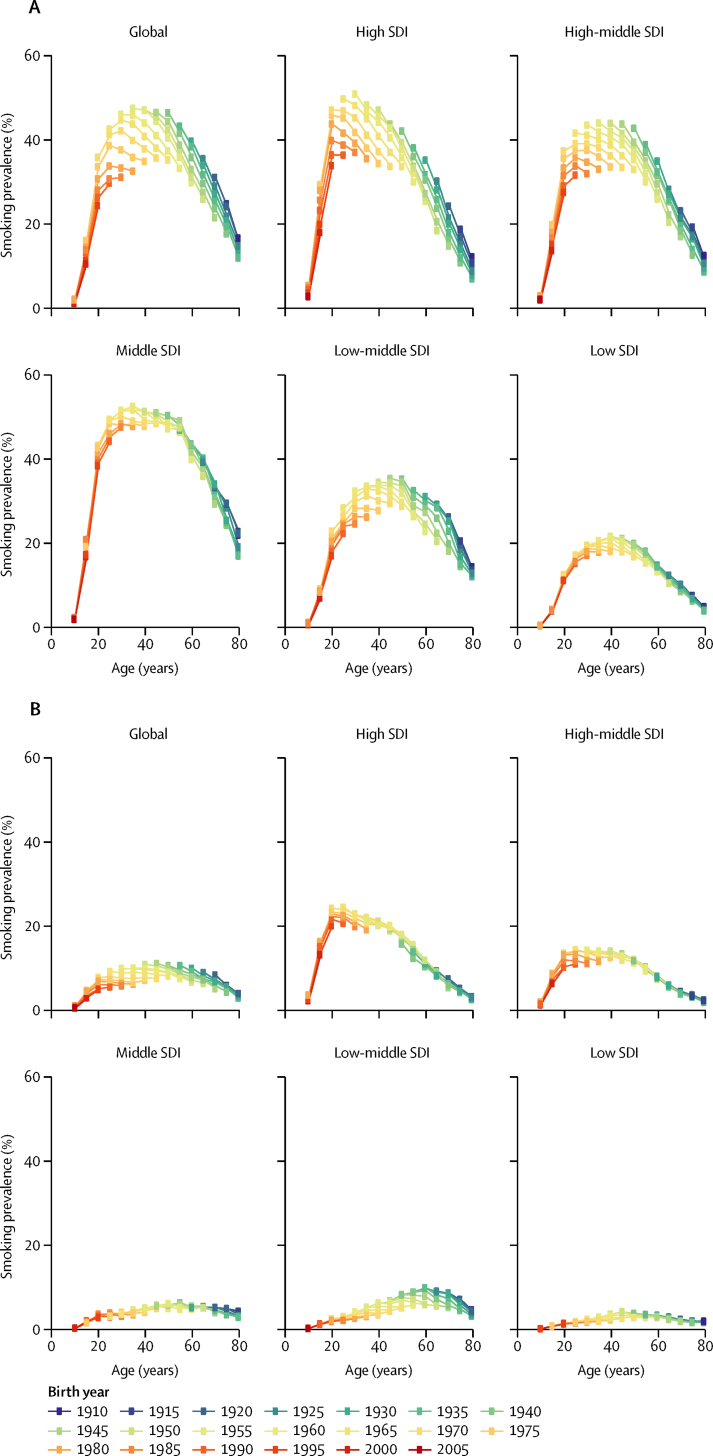
BACKGROUND: The scale-up of tobacco control, especially after the adoption of the Framework Convention for Tobacco Control, is a major public health success story. Nonetheless, smoking remains a leading risk for early death and disability worldwide, and therefore continues to require sustained political commitment. The Global Burden of Diseases, Injuries, and Risk Factors Study (GBD) offers a robust platform through which global, regional, and national progress toward achieving smoking-related targets can be assessed. METHODS: We synthesised 2818 data sources with spatiotemporal Gaussian process regression and produced estimates of daily smoking prevalence by sex, age group, and year for 195 countries and territories from 1990 to 2015. We analysed 38 risk-outcome pairs to generate estimates of smoking-attributable mortality and disease burden, as measured by disability-adjusted life-years (DALYs). We then performed a cohort analysis of smoking prevalence by birth-year cohort to better understand temporal age patterns in smoking. We also did a decomposition analysis, in which we parsed out changes in all-cause smoking-attributable DALYs due to changes in population growth, population ageing, smoking prevalence, and risk-deleted DALY rates. Finally, we explored results by level of development using the Socio-demographic Index (SDI). FINDINGS: Worldwide, the age-standardised prevalence of daily smoking was 25·0% (95% uncertainty interval [UI] 24·2-25·7) for men and 5·4% (5·1-5·7) for women, representing 28·4% (25·8-31·1) and 34·4% (29·4-38·6) reductions, respectively, since 1990. A greater percentage of countries and territories achieved significant annualised rates of decline in smoking prevalence from 1990 to 2005 than in between 2005 and 2015; however, only four countries had significant annualised increases in smoking prevalence between 2005 and 2015 (Congo [Brazzaville] and Azerbaijan for men and Kuwait and Timor-Leste for women). In 2015, 11·5% of global deaths (6·4 million [95% UI 5·7-7·0 million]) were attributable to smoking worldwide, of which 52·2% took place in four countries (China, India, the USA, and Russia). Smoking was ranked among the five leading risk factors by DALYs in 109 countries and territories in 2015, rising from 88 geographies in 1990. In terms of birth cohorts, male smoking prevalence followed similar age patterns across levels of SDI, whereas much more heterogeneity was found in age patterns for female smokers by level of development. While smoking prevalence and risk-deleted DALY rates mostly decreased by sex and SDI quintile, population growth, population ageing, or a combination of both, drove rises in overall smoking-attributable DALYs in low-SDI to middle-SDI geographies between 2005 and 2015. INTERPRETATION: The pace of progress in reducing smoking prevalence has been heterogeneous across geographies, development status, and sex, and as highlighted by more recent trends, maintaining past rates of decline should not be taken for granted, especially in women and in low-SDI to middle-SDI countries. Beyond the effect of the tobacco industry and societal mores, a crucial challenge facing tobacco control initiatives is that demographic forces are poised to heighten smoking's global toll, unless progress in preventing initiation and promoting cessation can be substantially accelerated. Greater success in tobacco control is possible but requires effective, comprehensive, and adequately implemented and enforced policies, which might in turn require global and national levels of political commitment beyond what has been achieved during the past 25 years. FUNDING: Bill & Melinda Gates Foundation and Bloomberg Philanthropies.
Overview
CoChat Summary
TL;DR
In 2015, global age-standardised daily smoking prevalence was 25·0% in men and 5·4% in women, with 6·4 million deaths and 148·6 million DALYs attributable to smoking. Although prevalence fell since 1990, progress was heterogeneous, and population growth and ageing drove increases in smoking-attributable DALYs in low-to-middle SDI geographies between 2005 and 2015.
Key findings
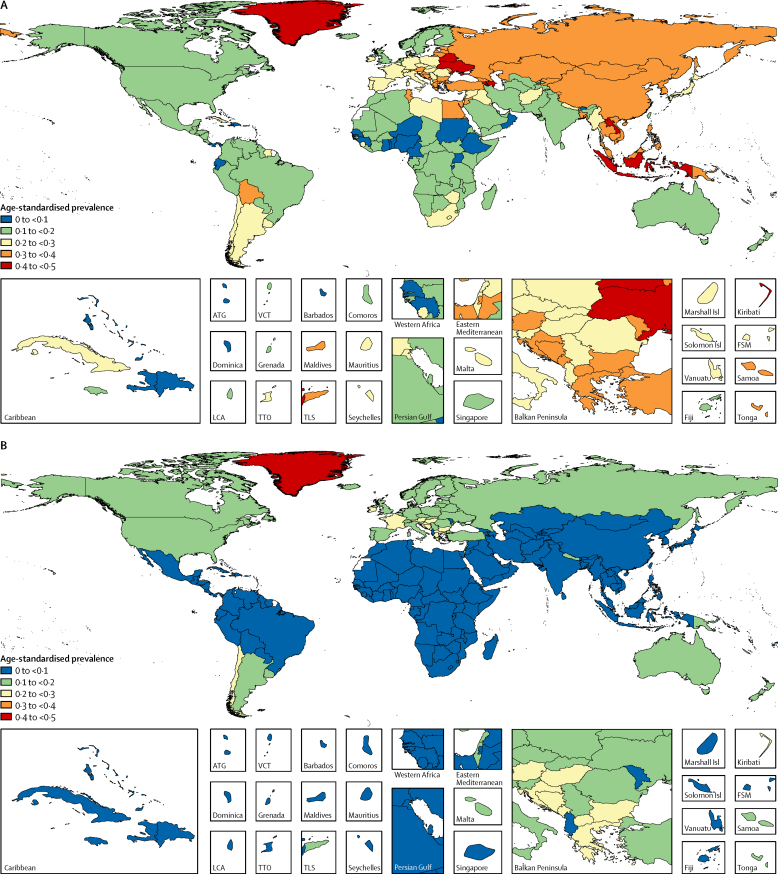
- Worldwide in 2015, age-standardised daily smoking prevalence was 25·0% (95% UI 24·2–25·7) for men and 5·4% (5·1–5·7) for women, representing reductions since 1990 of 28·4% (25·8–31·1) and 34·4% (29·4–38·6), respectively. There were 933·1 million daily smokers, 82·3% of whom were men; the ten countries with the largest smoking populations accounted for 63·6% of the world’s daily smokers.
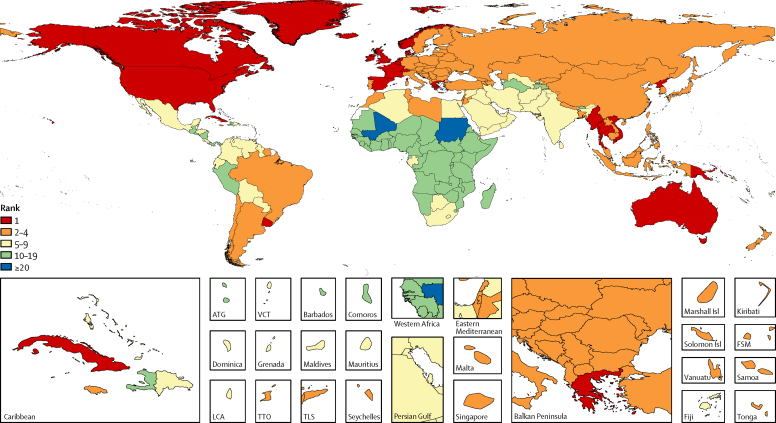
- In 2015, 11·5% of global deaths (6·4 million [95% UI 5·7–7·0 million]) were attributable to smoking, with 52·2% occurring in China, India, the USA, and Russia. Smoking-attributable DALYs totalled 148·6 million (134·2–163·1); smoking was among the five leading risk factors by DALYs in 109 countries and the leading risk factor in 24 countries.
- Since 2005, 53 (27%) of 195 countries had significant decreases in male daily smoking prevalence and 32 (16%) had significant decreases for women; only four countries had significant annualised increases between 2005 and 2015 (Congo [Brazzaville] and Azerbaijan for men; Kuwait and Timor-Leste for women). Thirteen countries recorded significant annualised declines in both 1990–2005 and 2005–2015.
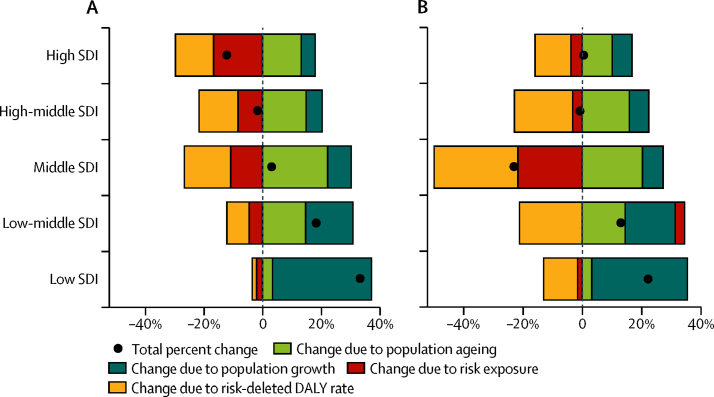
- Decomposition showed that high-SDI male all-cause smoking-attributable DALYs decreased by 11·8% (10·0–13·9) from 2005 to 2015, and middle-SDI female DALYs decreased by 22·6% (9·0–32·8). In low and low-middle SDI countries, smoking-attributable DALYs increased for men, driven mainly by population growth and population ageing.
Methods
- The study used the GBD 2015 comparative risk assessment framework, synthesising 2818 data sources covering 2928 geography-years with spatiotemporal Gaussian process regression to estimate daily smoking prevalence by sex, 5-year age group, and year for 195 countries and territories from 1990 to 2015.
- It analysed 38 risk-outcome pairs, using 5-year lagged smoking prevalence for some outcomes and the smoking impact ratio for cancers, COPD, interstitial lung disease, other chronic respiratory diseases, and pneumoconiosis; population attributable fractions were based on exposure, relative risks from prospective cohort studies, and a theoretical minimum risk exposure level of zero smoking. Uncertainty was propagated through 1000 draws to produce 95% UIs.
- Additional analyses included a birth-cohort analysis of smoking prevalence and a Das Gupta decomposition of changes in all-cause smoking-attributable DALYs from 2005 to 2015 into population growth, population ageing, smoking prevalence, and risk-deleted DALY rates, with results stratified by Socio-demographic Index (SDI).
Limitations
- The paper states that exposure estimation focused on smoked tobacco and excluded smokeless tobacco and e-cigarettes; it included current daily smokers only, not occasional or former smokers; and it did not account for smoking intensity or duration.
- The paper states that it relied on self-reported data with possible reporting biases across countries and time; used the smoking impact ratio for long-term cancer and chronic respiratory disease effects, which is not fully consistent with GBD’s independent exposure estimation and may be less robust where non-smoker lung cancer is affected by air pollution; and that DALY estimates are probably underestimates because relative risks may not fully represent all risk-outcome pairs. Minimal risk-outcome data were available for populations younger than 30 years, so burden attribution was limited to ages 30 years and older.
- Evident from the text: estimates depend on modelled ST-GPR outputs and survey inputs, and the authors note data gaps and inconsistent smoking questions/definitions across sources; these issues are described in the methods and discussion but are not framed as separate formal limitations beyond those listed above.
Model-written summary. Check it against the paper before relying on it.
Integrity signals
Registry
Cites
Statistics
Figures
Verification
Claims the paper makes
19 Valid · 2 Not valid · 24 Not checked · 112 Own results and interpretations
The cited sources support only part of this claim — read each source’s verdict below.
In the paper
“Previous analyses of smoking prevalence and attributable disease burden often were hindered by poor data availability, methodological limitations, or both.25, 26, 27”
§ Smoking prevalence and attributable disease burden in 195 countries and territories, 1990–2015: a systematic analysis from the Global Burden of Disease Study 2015 > Introduction
What the sources say
- Not checked yetcites [25] Lopez AD Collishaw NE Piha T A descriptive model of the cigarette epidemic in developed countries Tob Control 3 1994 242 247
- Partly supportedcites [26] Jha P Ranson MK Nguyen SN Yach D Estimates of global and regional smoking prevalence in 1995, by age and sex Am J Public Health 92 2002 1002 1006 12036796 PMC1447501 sourceExperimental — accuracy not yet measured
The Abstract says the 1997 WHO prevalence review relied heavily on older data, and the Discussion describes inconsistent smoking definitions and uncertain age-specific estimates. These passages support concerns about data and methods in smoking-prevalence analyses, but the paper does not establish that previous analyses of attributable disease burden were often hindered by those limitations. (LLM, conf=0.82)
- Not checked — no full text of the sourcecites [27] Ezzati M Lopez AD Estimates of global mortality attributable to smoking in 2000 Lancet 362 2003 847 852 13678970 source
plainstates a cause- Asserted: passes — The authors put it forward as true.
- Checkable: passes — It can be checked against evidence.
- Load-bearing: passes — The paper’s conclusions depend on it.
- Based: passes — The paper gives a reason why it holds.
Every source the paper cites for this claim was checked and supports it.
In the paper
“Smoking was the second leading risk factor for early death and disability worldwide in 2015.1”
§ Smoking prevalence and attributable disease burden in 195 countries and territories, 1990–2015: a systematic analysis from the Global Burden of Disease Study 2015 > Introduction
What the sources say
- Supportedcites [1] Forouzanfar MH Afshin A Alexander LT Global, regional, and national comparative risk assessment of 79 behavioural, environmental and occupational, and metabolic risks or clusters of risks, 1990–2015: a systematic analysis for the Global Burden of Disease Study 2015 Lancet 388 2016 1659 1724 27733284 PMC5388856 source
The Abstract Findings list smoking second among the largest contributors to global DALYs in 2015, after high systolic blood pressure. The Results describe attributable DALYs as a measure of early death and disability. No page numbers are supplied for these passages. (LLM, conf=0.94)
plain- Asserted: passes — The authors put it forward as true.
- Checkable: passes — It can be checked against evidence.
- Load-bearing: unclear — It is unclear whether the paper’s conclusions depend on it.
- Based: passes — The paper gives a reason why it holds.
- Supported
The cited sources that could be checked couldn’t confirm or dispute this claim.
In the paper
“many countries, including Australia, Brazil, Canada, South Korea, and the USA, among others, achieved sizeable declines in smoking prevalence well before FCTC adoption.15, 56, 57, 58”
§ Smoking prevalence and attributable disease burden in 195 countries and territories, 1990–2015: a systematic analysis from the Global Burden of Disease Study 2015 > Discussion
What the sources say
- Could not verifycites [15] Hammond D Fong GT McNeill A Borland R Cummings KM Effectiveness of cigarette warning labels in informing smokers about the risks of smoking: findings from the International Tobacco Control (ITC) Four Country Survey Tob Control 15 2006 iii19 iii25 16754942 PMC2593056 sourceExperimental — accuracy not yet measured
The Results (page unavailable) compare smokers’ knowledge and intentions to quit across four countries, not changes in smoking prevalence. The Conclusion (page unavailable) discusses warning labels and the FCTC, but does not report pre-FCTC prevalence trends. Searches for declines in smoking prevalence and for Brazil and South Korea found no passage addressing the claim. (LLM, conf=0.76)
- Not matchedcites [56] Institute of Medicine (IOM) Ending the tobacco problem: a blueprint for the nation 2007 IOM Washington DC
Its entry has no title and year that we can search by.
- Not checked — no full text of the sourcecites [57] Park EJ Koh HK Kwon JW Suh MK Kim H Cho SI Secular trends in adult male smoking from 1992 to 2006 in South Korea: Age-specific changes with evolving tobacco-control policies Public Health 123 2009 657 664 19892378 source
plain- Asserted: passes — The authors put it forward as true.
- Checkable: passes — It can be checked against evidence.
- Load-bearing: unclear — It is unclear whether the paper’s conclusions depend on it.
- Based: passes — The paper gives a reason why it holds.
- Could not verify
The cited sources support only part of this claim — read each source’s verdict below.
In the paper
“Smoking was the second-leading risk factor for attributable mortality among both sexes in both 2005 and 2015, following high-systolic blood pressure.1”
§ Smoking prevalence and attributable disease burden in 195 countries and territories, 1990–2015: a systematic analysis from the Global Burden of Disease Study 2015 > Results > Deaths and disease burden attributable to smoking
What the sources say
- Partly supportedcites [1] Forouzanfar MH Afshin A Alexander LT Global, regional, and national comparative risk assessment of 79 behavioural, environmental and occupational, and metabolic risks or clusters of risks, 1990–2015: a systematic analysis for the Global Burden of Disease Study 2015 Lancet 388 2016 1659 1724 27733284 PMC5388856 sourceExperimental — accuracy not yet measured
The Results section, “Global risk patterns by sex” (page unavailable), ranks smoking second for men in 2015 by attributable DALYs. That does not establish the claimed ranking for attributable mortality among both sexes in either 2005 or 2015, or show that high systolic blood pressure ranked immediately above smoking. (LLM, conf=0.83)
plain- Asserted: passes — The authors put it forward as true.
- Checkable: passes — It can be checked against evidence.
- Load-bearing: unclear — It is unclear whether the paper’s conclusions depend on it.
- Based: passes — The paper gives a reason why it holds.
- Partly supported
Every source the paper cites for this claim was checked and supports it.
In the paper
“We chose a 5-year lag based on findings showing that most risk-reduction occurs within 5 years of quitting smoking.45”
§ Smoking prevalence and attributable disease burden in 195 countries and territories, 1990–2015: a systematic analysis from the Global Burden of Disease Study 2015 > Methods > Estimating attributable burden
What the sources say
- Supportedcites [45] Unal B Critchley J Capewell S Impact of smoking reduction on coronary heart disease mortality trends during 1981–2000 in England and Wales Tob Induc Dis 1 2003 17 PMC2671547 19570259 source
The Discussion states that after quitting smoking, most risk reduction occurs within about five years. This directly supports the citing paper’s choice of a five-year lag, though the source says “about” rather than an exact cutoff. (LLM, conf=0.94)
plainstates a cause- Asserted: passes — The authors put it forward as true.
- Checkable: passes — It can be checked against evidence.
- Load-bearing: passes — The paper’s conclusions depend on it.
- Based: passes — The paper gives a reason why it holds.
- Supported
110 more claims · 3 with their cited sources checked
Create a free account to see all 157 claims and to verify the 13 references still open.
- Probably not a substantial claim. 25
- It may state two separate claims as one. 21
Claims other papers make about this one
Each is checked against this paper’s own text: does it say what the citing paper says it does?
The source backs part of the claim, not all of it — or backs it for a different population, condition or comparison.
In the citing paper
“these differences complement the differential effectiveness of tobacco control initiatives based on the sex of the individuals that receive the preventative messages56.”
From Sex and gender differences and biases in artificial intelligence for biomedicine and healthcare (2020) · cites this paper as [56]
Experimental — accuracy not yet measuredThe source backs part of the claim, not all of it — or backs it for a different population, condition or comparison.
In the citing paper
“Our findings are consistent with previous studies in terms of both the estimation of the overall burden of tobacco and the potential reduction of this burden through taxation.”
From The health and economic burden of smoking in 12 Latin American countries and the potential effect of increasing tobacco taxes: an economic modelling study. (2020) · cites this paper as [31]
Experimental — accuracy not yet measuredThe source backs part of the claim, not all of it — or backs it for a different population, condition or comparison.
In the citing paper
“Previous estimates of smoking-attributable burden in GBD relied on dichotomous exposures, despite well documented dose-response associations.”
From Spatial, temporal, and demographic patterns in prevalence of smoking tobacco use and attributable disease burden in 204 countries and territories, 1990–2019: a systematic analysis from the Global Burden of Disease Study 2019 (2021) · cites this paper as [20]
Experimental — accuracy not yet measuredThe source backs part of the claim, not all of it — or backs it for a different population, condition or comparison.
In the citing paper
“For the health outcomes modelled using the Smoking Impact Ratio method, reliability was low in countries with either scare or poor quality data on lung cancer mortality and in countries with other important competing risks for lung cancer, such as air pollution.”
From Spatial, temporal, and demographic patterns in prevalence of smoking tobacco use and attributable disease burden in 204 countries and territories, 1990–2019: a systematic analysis from the Global Burden of Disease Study 2019 (2021) · cites this paper as [20]
Experimental — accuracy not yet measuredThe cited source says what the claim attributes to it.
In the citing paper
“Tobacco smoking, which remains a worldwide health problem, is yet another source of xenobiotics that has been associated with a variety of inflammation-related diseases167”
From Chronic inflammation in the etiology of disease across the life span (2019) · cites this paper as [167]
6 more claims about this paper
Create a free account to see every claim other papers make about this one.
Self-check
Percentages, sums and reported differences re-computed from the paper’s own numbers.
Each contradiction between two passages listed here was confirmed by an independent check.
Rated minor: it would not touch a result — a value no result rests on, a p-value that stays on the same side of the significance level, or a conflict that is clerical, resolved elsewhere in the paper, or outside its own findings.
In the paper
§ Smoking prevalence and attributable disease burden in 195 countries and territories, 1990–2015: a systematic analysis from the Global Burden of Disease Study 2015 > Results > Global, regional, and national levels and trends of daily smoking
“| Japan | High SDI | 9·3 (8·9 to 9·6) | 26·6 (26·1 to 27·1)”
§ Smoking prevalence and attributable disease burden in 195 countries and territories, 1990–2015: a systematic analysis from the Global Burden of Disease Study 2015 > Results > Global, regional, and national levels and trends of daily smoking
“| Japan | 7 | 16 | 4·9 (4·4 to 5·6) | 15·3 (14·4 to 16·3) | 9·3 (8·9 to 9·6) | 26·7 (26·1 to 27·1)”
Rated minor: it would not touch a result — a value no result rests on, a p-value that stays on the same side of the significance level, or a conflict that is clerical, resolved elsewhere in the paper, or outside its own findings.
In the paper
§ Smoking prevalence and attributable disease burden in 195 countries and territories, 1990–2015: a systematic analysis from the Global Burden of Disease Study 2015 > Results > Global, regional, and national levels and trends of daily smoking
“| India | Low-middle SDI | 2·8 (2·6 to 3·2) | 17·4 (16·8 to 18·2)”
§ Smoking prevalence and attributable disease burden in 195 countries and territories, 1990–2015: a systematic analysis from the Global Burden of Disease Study 2015 > Results > Global, regional, and national levels and trends of daily smoking
“| India | 2 | 2 | 13·5 (9·4 to 19·7) | 90·8 (78·9 to 104·3) | 2·9 (2·6 to 3·2) | 17·5 (16·8 to 18·2)”
Rated minor: it would not touch a result — a value no result rests on, a p-value that stays on the same side of the significance level, or a conflict that is clerical, resolved elsewhere in the paper, or outside its own findings.
In the paper
§ Smoking prevalence and attributable disease burden in 195 countries and territories, 1990–2015: a systematic analysis from the Global Burden of Disease Study 2015 > Introduction
“Ng and colleagues generated the first comprehensive, comparable estimates of smoking prevalence and tobacco consumption for 188 countries from 1980 to 2013.”
§ Smoking prevalence and attributable disease burden in 195 countries and territories, 1990–2015: a systematic analysis from the Global Burden of Disease Study 2015 > References
“29. Ng M Freeman MK Fleming TD Smoking prevalence and cigarette consumption in 187 countries, 1980-2012 JAMA 311 2014 183 192”
Rated minor: it would not touch a result — a value no result rests on, a p-value that stays on the same side of the significance level, or a conflict that is clerical, resolved elsewhere in the paper, or outside its own findings.
In the paper
§ Smoking prevalence and attributable disease burden in 195 countries and territories, 1990–2015: a systematic analysis from the Global Burden of Disease Study 2015 > Results > Global, regional, and national levels and trends of daily smoking
“| Global | | 5·4 (5·1 to 5·7) | 25·0 (24·2 to 25·7)”
§ Smoking prevalence and attributable disease burden in 195 countries and territories, 1990–2015: a systematic analysis from the Global Burden of Disease Study 2015 > Results > Global, regional, and national levels and trends of daily smoking
“| Global | | | 165·0 (141·2 to 202·1) | 768·1 (690·1 to 852·2) | 5·4 (5·2 to 5·7) | 25·0 (24·2 to 25·7)”
Citations
Cites
Transforming Our World: The 2030 Agenda for Sustainable Development
(2018) · A New Era in Global Health · doi:10.1891/9780826190123.ap02 · Cited by 19,351
Lim, S. S., Vos, T., Flaxman, A. D., Danaei, G., Shibuya, K., Adair-Rohani, H., AlMazroa, M. A., Amann, M., Anderson, H. R., Andrews, K. G., et al. (2012) · The Lancet · doi:10.1016/s0140-6736(12)61766-8 · Cited by 11,805
Self-citationForouzanfar, M. H., Afshin, A., Alexander, L. T., Anderson, H. R., Bhutta, Z. A., Biryukov, S., Brauer, M., Burnett, R., Cercy, K., Charlson, F. J., et al. (2016) · The Lancet · doi:10.1016/s0140-6736(16)31679-8 · Cited by 7,698
Self-citationThe environment and disease: association or causation?
Hill, A. B. (2015) · Journal of the Royal Society of Medicine · doi:10.1177/0141076814562718 · Cited by 7,285
The Environment and Disease: Association or Causation?
Hill, A. B. (1965) · Proceedings of the Royal Society of Medicine · doi:10.1177/003591576505800503 · Cited by 6,974
Wang, H., Naghavi, M., Allen, C., Barber, R. M., Bhutta, Z. A., Carter, A., Casey, D. C., Charlson, F. J., Chen, A. Z., Coates, M. M., et al. (2016) · The Lancet · doi:10.1016/s0140-6736(16)31012-1 · Cited by 6,596
Self-citationFood, nutrition, physical activity, and the prevention of cancer: a global perspective
(2008) · Choice Reviews Online · doi:10.5860/choice.45-5024 · Cited by 5,350
The Health consequences of smoking—50 years of progress : a report of the Surgeon General
Lushniak, B. D., Samet, J. M., Pechacek, T. F., Norman, L., & Taylor, P. A. (2014) · Cited by 4,990
Forouzanfar, M. H., Alexander, L., Anderson, H. R., Bachman, V. F., Biryukov, S., Brauer, M., Burnett, R., Casey, D., Coates, M. M., Cohen, A., et al. (2015) · The Lancet · doi:10.1016/s0140-6736(15)00128-2 · Cited by 2,701
Self-citationGuidelines for accurate and transparent health estimates reporting: the GATHER statement
Stevens, G. A., Alkema, L., Black, R. E., Boerma, J. T., Collins, G. S., Ezzati, M., Grove, J. T., Hogan, D. R., Hogan, M. C., Horton, R., et al. (2016) · The Lancet · doi:10.1016/s0140-6736(16)30388-9 · Cited by 1,798
Self-citation
Research works printed but not linked: 1
- Mattioli B Quaranta MG Vella S Review on the evidence on public health impact of existing policies 2016 Foresight and Modelling for European Health Policy and Regulation Brussels, Belgium
Cited by
Items 101–200 of 2,019
Long-term trends in smoking prevalence and its socioeconomic inequalities in Korea, 1992–2016
Chang, Y., Kang, H.-Y., Lim, D., Cho, H.-J., & Khang, Y. (2019) · International Journal for Equity in Health · doi:10.1186/s12939-019-1051-x · Cited by 101
Self-citationSafiri, S., Kolahi, A., & Naghavi, M. (2021) · BMJ Global Health · doi:10.1136/bmjgh-2020-004128 · Cited by 132
Knudsen, A. K., Allebeck, P., Tollånes, M. C., Skogen, J. C., Iburg, K. M., McGrath, J. J., Juel, K., Agardh, E. E., Ärnlöv, J., Bjørge, T., et al. (2019) · The Lancet Public Health · doi:10.1016/s2468-2667(19)30224-5 · Cited by 156
Self-citationWho Smokes in Europe? Data From 12 European Countries in the TackSHS Survey (2017–2018)
Gallus, S., Lugo, A., Liu, X., BEHRAKIS, P. K., Boffi, R., Bosetti, C., Carreras, G., Chatenoud, L., Clancy, L., Continente, X., et al. (2020) · Journal of Epidemiology · doi:10.2188/jea.je20190344 · Cited by 121
Self-citationHuman Disease Variation in the Light of Population Genomics
Prohaska, A., Racimo, F., Schork, A. J., Sikora, M., Stern, A. J., Ilardo, M. A., Allentoft, M. E., Folkersen, L., Buil, A., Moreno-Mayar, J. V., et al. (2019) · Cell · doi:10.1016/j.cell.2019.01.052 · Cited by 125
A critical review of assays for hazardous components of air pollution
Forman, H. J., & Finch, C. E. (2018) · Free Radical Biology and Medicine · doi:10.1016/j.freeradbiomed.2018.01.030 · Cited by 122
Weinberger, A. H., Delnevo, C., Wyka, K., Gbedemah, M., Lee, J., Copeland, J., & Goodwin, R. (2019) · Nicotine & Tobacco Research · doi:10.1093/ntr/ntz085 · Cited by 82
Liao, Y., Xie, L., Chen, X., Kelly, B. C., Qi, C., Pan, C., Yang, M., Hao, W., Liu, T., & Tang, J. (2019) · BMC Public Health · doi:10.1186/s12889-019-6929-4 · Cited by 124
Liu, Z., Li, Y., Cui, Z., Li, L., Nie, X., Yu, C., Shan, G., Zhou, X., Qin, R., Cheng, A., et al. (2022) · The Lancet Regional Health - Western Pacific · doi:10.1016/j.lanwpc.2022.100464 · Cited by 129
Self-citationAune, D., Schlesinger, S., Norat, T., & Riboli, E. (2019) · European Journal of Preventive Cardiology · doi:10.1177/2047487318806658 · Cited by 103
Liao, Y., Wu, Q., Kelly, B. C., Zhang, F., Tang, Y.-Y., Wang, Q., Ren, H., Hao, Y., Yang, M., Cohen, J., et al. (2018) · PLOS Medicine · doi:10.1371/journal.pmed.1002713 · Cited by 99
Stop ‘controlling’ for sex and gender in global health research
Shapiro, J. R., Klein, S. L., & Morgan, R. (2021) · BMJ Global Health · doi:10.1136/bmjgh-2021-005714 · Cited by 100
Prevention and Treatment of Tobacco Use
Kalkhoran, S., Benowitz, N. L., & Rigotti, N. A. (2018) · Journal of the American College of Cardiology · doi:10.1016/j.jacc.2018.06.036 · Cited by 96
Children Present a Window of Opportunity for Promoting Health
Fernández‐Jiménez, R., Al‐Kazaz, M., Jaslow, R., Carvajal, I., & Fuster, V. (2018) · Journal of the American College of Cardiology · doi:10.1016/j.jacc.2018.10.031 · Cited by 115
Airway-On-A-Chip: Designs and Applications for Lung Repair and Disease
Bennet, T. J., Randhawa, A., Hua, J., & Cheung, K. C. (2021) · Cells · doi:10.3390/cells10071602 · Cited by 108
Yang, X., Zhang, T., Zhang, H., Sang, S., Chen, H., & Zuo, X. (2021) · Biomarker Research · doi:10.1186/s40364-021-00340-6 · Cited by 106
Self-citationStigmatization of people with addiction by health professionals: Current knowledge. A scoping review
Cazalis, A., Lambert, L., & Auriacombe, M. (2023) · Drug and Alcohol Dependence Reports · doi:10.1016/j.dadr.2023.100196 · Cited by 92
Bricker, J. B., Mull, K. E., McClure, J. B., Watson, N. L., & Heffner, J. L. (2018) · Addiction · doi:10.1111/add.14127 · Cited by 91
The influence of social and economic ties to the spread of COVID-19 in Europe
Mogi, R., & Spijker, J. (2021) · Journal of Population Research · doi:10.1007/s12546-021-09257-1 · Cited by 109
Personalized Treatment of Asthma: The Importance of Sex and Gender Differences
Jenkins, C. R., Boulet, L., Lavoie, K., Rahérison, C., & Singh, D. (2022) · The Journal of Allergy and Clinical Immunology In Practice · doi:10.1016/j.jaip.2022.02.002 · Cited by 116
Barn, P. K., Gombojav, E., Оchir, C., Laagan, B., Beejin, B., Naidan, G., Boldbaatar, B., Galsuren, J., Byambaa, T., Janes, C. R., et al. (2017) · The Science of The Total Environment · doi:10.1016/j.scitotenv.2017.09.291 · Cited by 94
Bai, J., Cui, J., Shi, F., & Yu, C. (2023) · International Journal of Public Health · doi:10.3389/ijph.2023.1605502 · Cited by 112
Self-citationPiirtola, M., Jelenkovic, A., Latvala, A., Sund, R., Honda, C., Inui, F., Watanabe, M., Tomizawa, R., Iwatani, Y., Ordoñana, J. R., et al. (2018) · PLoS ONE · doi:10.1371/journal.pone.0200140 · Cited by 98
Electronic cigarettes and narghile users in Brazil: Do they differ from cigarettes smokers?
Bertoni, N., Szklo, A. S., Boni, R. B. D., Coutinho, C. F. D. S., de Vasconcellos, M. T. L., Silva, P. N., de Almeida, L. M., & Bastos, F. I. (2019) · Addictive Behaviors · doi:10.1016/j.addbeh.2019.05.031 · Cited by 102
Yang, X.-R., Man, J.-Y., Chen, H., Zhang, T.-C., Yin, X.-L., He, Q., & Lu, M. (2020) · Lung Cancer · doi:10.1016/j.lungcan.2020.12.007 · Cited by 78
Self-citationNovel DNA methylation signatures of tobacco smoking with trans-ethnic effects
Christiansen, C., Fernandez, J. C., Domingo‐Relloso, A., Zhao, W., Moustafa, J. S. E.-S., Tsai, P.-C., Maddock, J., Haack, K., Cole, S. A., Kardia, S. L. R., et al. (2021) · Clinical Epigenetics · doi:10.1186/s13148-021-01018-4 · Cited by 83
Zhang, Z., Gao, X., Liu, S., Wang, Q., Wang, Y., Hou, S., Wang, J., & Zhang, Y. (2025) · Scientific Reports · doi:10.1038/s41598-025-92150-1 · Cited by 133
Self-citationPichon-Riviere, A., Alcaraz, A., Palacios, A., Rodríguez, B., Reynales-Shigematsu, L. M., Pinto, M., Castillo-Riquelme, M., Peña Torres, E., Osorio, D. I., Huayanay, L., et al. (2020) · The Lancet Global Health · doi:10.1016/s2214-109x(20)30311-9 · Cited by 82
Amiri, S., & Behnezhad, S. (2020) · Canadian Journal of Public Health · doi:10.17269/s41997-020-00308-3 · Cited by 82
Saxton, J., Rodda, S. N., Booth, N., Merkouris, S., & Dowling, N. A. (2021) · PLoS ONE · doi:10.1371/journal.pone.0248262 · Cited by 94
Safiri, S., Carson‐Chahhoud, K., Karamzad, N., Sullman, M. J. M., Nejadghaderi, S. A., Taghizadieh, A., Bell, A. W., Kolahi, A., Ansarin, K., Mansournia, M. A., et al. (2021) · CHEST Journal · doi:10.1016/j.chest.2021.09.042 · Cited by 98
Smoking in Correctional Settings Worldwide: Prevalence, Bans, and Interventions
Spaulding, A. C., Eldridge, G. D., Chico, C. E., Morisseau, N., Drobeniuc, A., Fils-Aime, R., Day, C., Hopkins, R., Jin, X., Chen, J., et al. (2018) · Epidemiologic Reviews · doi:10.1093/epirev/mxy005 · Cited by 94
Incentives for preventing smoking in children and adolescents
Hefler, M., Liberato, S. C., & Thomas, D. P. (2017) · Cochrane Database of Systematic Reviews · doi:10.1002/14651858.cd008645.pub3 · Cited by 79
Britton, J. R. (2017) · The Lancet · doi:10.1016/s0140-6736(17)30867-x · Cited by 93
Trends in the incidence of head and neck cancer by subsite between 1993 and 2015 in Japan
Kawakita, D., Oze, I., Iwasaki, S., Matsuda, T., Matsuo, K., & Ito, H. M. (2022) · Cancer Medicine · doi:10.1002/cam4.4539 · Cited by 79
He, L., Başar, E., Wiers, R. W. H. J., Antheunis, M. L., & Krahmer, E. (2022) · BMC Public Health · doi:10.1186/s12889-022-13115-x · Cited by 109
Tian, Y., Yang, J.-C., Hu, J., Ding, R., Ye, D., & Shang, J.-W. (2023) · Frontiers in Public Health · doi:10.3389/fpubh.2023.1119374 · Cited by 96
Hindocha, C., & McClure, E. A. (2020) · Addiction · doi:10.1111/add.15290 · Cited by 79
Tobacco smoking and risk of all-cause mortality in Indonesia
Holipah, H., Sulistomo, H. W., & Maharani, A. (2020) · PLoS ONE · doi:10.1371/journal.pone.0242558 · Cited by 130
Chen, X., Zhou, C.-W., Fu, Y., Li, Y.-Z., Chen, L., Zhang, Q., & Chen, Y. (2023) · Frontiers in Medicine · doi:10.3389/fmed.2023.1066804 · Cited by 107
Milić, M., Gazibara, T. M., Pekmezovic, T. D., Kisić-Tepavčević, D., Maric, G. D., Popović, A. S., Stevanović, J., Patil, K. H., & Levine, H. (2020) · PLoS ONE · doi:10.1371/journal.pone.0227042 · Cited by 99
Lai, F. Y., GARTNER, C. E., Hall, W., et al. (2018) · Addiction · doi:10.1111/add.14157 · Cited by 76
Crossing the barriers: Revisiting the gut feeling in rheumatoid arthritis
Brandl, C., Bucci, L., Schett, G. A., & Zaiss, M. M. (2021) · European Journal of Immunology · doi:10.1002/eji.202048876 · Cited by 84
Jeong, Y. D., Park, S., Kim, M. S., Hong, S. H., Aalruz, H., Abate, Y. H., Abbasgholizadeh, R., ElHafeez, S. A., Abdullahi, A., Aboagye, R. G., et al. (2025) · The Lancet Global Health · doi:10.1016/s2214-109x(25)00143-3 · Cited by 101
Self-citationEvidence of a Causal Relationship Between Smoking Tobacco and Schizophrenia Spectrum Disorders
Scott, J. G., Anthony, L., Niemelä, S., Miettunen, J., Emmerson, B., & Mustonen, A. (2018) · Frontiers in Psychiatry · doi:10.3389/fpsyt.2018.00607 · Cited by 85
Gan, H., Hou, X., Zhu, Z., Xue, M., Zhang, T., Huang, Z., Cheng, Z. J., & Sun, B. (2022) · BMC Pulmonary Medicine · doi:10.1186/s12890-022-01944-w · Cited by 91
Weinberger, A. H., Gbedemah, M., Wall, M. M., Hasin, D. S., Zvolensky, M. J., & Goodwin, R. D. (2017) · Addiction · doi:10.1111/add.14082 · Cited by 77
Zhang, M., Liu, S., Yang, L., Jiang, Y., Huang, Z., Zhao, Z., Deng, Q., Yichong, L., Zhou, M., Wang, L., et al. (2019) · Nicotine & Tobacco Research · doi:10.1093/ntr/ntz020 · Cited by 76
Self-citationChronic obstructive pulmonary disease ( COPD ) mortality trends worldwide: An update to 2019
Mei, F., Dalmartello, M., Bonifazi, M., Bertuccio, P., Levi, F., Boffetta, P., Negri, E., Vecchia, C. L., & Malvezzi, M. (2022) · Respirology · doi:10.1111/resp.14328 · Cited by 91
Safiri, S., Kolahi, A., Mansournia, M. A., Almasi‐Hashiani, A., Ashrafi‐Asgarabad, A., Sullman, M. J. M., Bettampadi, D., Qorbani, M., Moradi‐Lakeh, M., Ardalan, M., et al. (2020) · Scientific Reports · doi:10.1038/s41598-020-70840-2 · Cited by 80
Self-citationTrends of gastric cancer burdens attributable to risk factors in China from 2000 to 2050
He, F., Wang, S., Zheng, R., Gu, J., Zeng, H., Sun, K., Chen, R., Li, L., Han, B., Li, X., et al. (2024) · The Lancet Regional Health - Western Pacific · doi:10.1016/j.lanwpc.2023.101003 · Cited by 109
Ma, Y., Chen, H., Lv, W., Wei, S., Zou, Y., Li, R., Wang, J., She, W., Yuan, L., Tao, J., et al. (2025) · Biomarker Research · doi:10.1186/s40364-025-00760-8 · Cited by 101
Self-citationQuelhas, D., Kompala, C., Wittenbrink, B., Han, Z., Parker, M., Shapiro, M., Downs, S., Kraemer, K., Fanzo, J., Morris, S., et al. (2018) · BMC Public Health · doi:10.1186/s12889-018-6137-7 · Cited by 58
Safiri, S., Nejadghaderi, S. A., Abdollahi, M., Carson‐Chahhoud, K., Kaufman, J. S., Bragazzi, N. L., Moradi‐Lakeh, M., Mansournia, M. A., Sullman, M. J. M., Almasi‐Hashiani, A., et al. (2022) · Cancer Medicine · doi:10.1002/cam4.4647 · Cited by 88
Cancer mortality in Europe in 2015 and an overview of trends since 1990
Bertuccio, P., Alicandro, G., Malvezzi, M., Carioli, G., Boffetta, P., Levi, F., Vecchia, C. L., & Negri, E. (2019) · Annals of Oncology · doi:10.1093/annonc/mdz179 · Cited by 82
Systematic review and meta-analysis of the association between smoking and the incidence of frailty
Amiri, S., & Behnezhad, S. (2019) · Neuropsychiatrie · doi:10.1007/s40211-019-0315-4 · Cited by 74
Song, Y., Liu, X., Cheng, W., Li, H., & Zhang, D. (2022) · Scientific Reports · doi:10.1038/s41598-022-15839-7 · Cited by 91
Association of childhood smoking and adult mortality: prospective study of 120 000 Cuban adults
Thomson, B., Rojas, N. B. A., Lacey, B., Burrett, J. A., Varona-Pérez, P., Martínez, M. C., Lorenzo-Vázquez, E., Constantén, S. B., Rigau, J. M. M., López, O. J. H., et al. (2020) · The Lancet Global Health · doi:10.1016/s2214-109x(20)30221-7 · Cited by 75
Dimitriadis, K. S., Narkiewicz, K., Leontsinis, I., Konstantinidis, D., Mihas, C. C., Andrikou, I., Thomopoulos, C., Tousoulis, D. M., & Tsioufis, K. P. (2022) · International Journal of Environmental Research and Public Health · doi:10.3390/ijerph19063237 · Cited by 90
Substance Use During Imprisonment in Low- and Middle-Income Countries
Mundt, A. P., Baranyi, G., Gabrysch, C. H., & Fazel, S. (2018) · Epidemiologic Reviews · doi:10.1093/epirev/mxx016 · Cited by 80
Migration from Mexico to the United States: A high‐speed cancer transition
Pinheiro, P. S., Callahan, K. E., Stern, M. C., & de Vries, E. (2017) · International Journal of Cancer · doi:10.1002/ijc.31068 · Cited by 70
Association of Smoking and Smoking Cessation With Overall and Cause-Specific Mortality
Zhu, D., Zhao, G., & Wang, X. (2021) · American Journal of Preventive Medicine · doi:10.1016/j.amepre.2020.11.003 · Cited by 76
Ahluwalia, I. B., Smith, T., Arrazola, R. A., Palipudi, K. M., Garcia de Quevedo, I., Prasad, V. M., Commar, A., Schotte, K., Garwood, P. D., & Armour, B. S. (2018) · MMWR. Morbidity and Mortality Weekly Report · doi:10.15585/mmwr.mm6738a7 · Cited by 63
Tobacco use and its determinants in the 2015 Kenya WHO STEPS survey
Ngaruiya, C., Abubakar, H., Kiptui, D., Kendagor, A., Ntakuka, M. W., Nyakundi, P., & Gathecha, G. K. (2018) · BMC Public Health · doi:10.1186/s12889-018-6058-5 · Cited by 67
Interaction between smoking and diabetes in relation to subsequent risk of cardiovascular events
Yang, Y., Peng, N., Chen, G., Wan, Q., Li, Y., Wang, G., Qin, Y., Luo, Z., Tang, X., Huo, Y., et al. (2022) · Cardiovascular Diabetology · doi:10.1186/s12933-022-01447-2 · Cited by 83
Pagidipati, N. J., Návar, A. M., Pieper, K. S., Green, J. B., Bethel, M. A., Armstrong, P. W., Josse, R. G., McGuire, D. K., Lokhnygina, Y. V., Cornel, J. H., et al. (2017) · Circulation · doi:10.1161/circulationaha.117.027252 · Cited by 65
Carr, A. C., & Lykkesfeldt, J. (2023) · Nutrients · doi:10.3390/nu15071657 · Cited by 67
Appau, A., Drope, J. M., Witoelar, F., Chavez, J. J., & Lencucha, R. (2019) · International Journal of Environmental Research and Public Health · doi:10.3390/ijerph16132330 · Cited by 75
Asharani, P. V., Seet, V. A. L., Abdin, E., Devi, F., Wang, P., Roystonn, K., Lee, Y. Y., Cetty, L., Teh, W. L., Verma, S. K., et al. (2020) · International Journal of Environmental Research and Public Health · doi:10.3390/ijerph17155571 · Cited by 71
Almusharraf, F., Rose, J., & Selby, P. L. (2020) · Journal of Medical Internet Research · doi:10.2196/20251 · Cited by 77
Corley, J., Cox, S. R., Harris, S. E., Hernandez, M. V., Maniega, S. M., Bastin, M. E., Wardlaw, J. M., Starr, J. M., Marioni, R. E., & Deary, I. J. (2019) · Translational Psychiatry · doi:10.1038/s41398-019-0576-5 · Cited by 60
He, H., Pan, L., Cui, Z. Q., Sun, J., Yu, C., Cao, Y., Wang, Y., & Shan, G. (2020) · Frontiers in Public Health · doi:10.3389/fpubh.2020.00177 · Cited by 66
Self-citationKorzun, T., Lazurko, M., Munhenzva, I., Barsanti, K. C., Huang, Y., Jensen, R. P., Escobedo, J. O., Luo, W., Peyton, D. H., & Strongin, R. M. (2018) · ACS Omega · doi:10.1021/acsomega.7b01521 · Cited by 62
Levett, J. Y., Filion, K. B., Reynier, P., Prell, C., & Eisenberg, M. J. (2023) · The American Journal of Medicine · doi:10.1016/j.amjmed.2023.04.014 · Cited by 71
Paraje, G. R., Muñoz, M. F., Wu, D. C. N., & Jha, P. (2024) · Nature Medicine · doi:10.1038/s41591-024-02806-0 · Cited by 70
Liang, Y., Ip, M., & Mak, J. (2018) · Phytomedicine · doi:10.1016/j.phymed.2018.11.028 · Cited by 63
Effectiveness of eHealth smoking cessation interventions: systematic review and meta-analysis
Fang, Y. E., Zhang, Z., Wang, R., Yang, B., Chen, C., Nisa, C., Tong, X., & Yan, L. L. (2023) · Journal of Medical Internet Research · doi:10.2196/45111 · Cited by 58
Siddiqi, K., Siddiqui, F., Khan, A., Ansaari, S., Kanaan, M. N., Khokhar, M. A., Islam, Z., Mishu, M. P., & Bauld, L. (2020) · Nicotine & Tobacco Research · doi:10.1093/ntr/ntaa207 · Cited by 61
Airway microbial communities, smoking and asthma in a general population sample
Turek, E. M., Cox, M. J., Hunter, M. L., Hui, J., James, P. L., Willis‐Owen, S. A. G., Cuthbertson, L., James, A. L., Musk, A. W., Moffatt, M. F., et al. (2021) · EBioMedicine · doi:10.1016/j.ebiom.2021.103538 · Cited by 61
Sanderson, E., Davey Smith, G., Bowden, J., & Munafò, M. R. (2019) · Nature Communications · doi:10.1038/s41467-019-10679-y · Cited by 58
The progression of the tobacco epidemic in India on the national and regional level, 1998-2016
Shaikh, R., Janssen, F., & Vogt, T. C. (2022) · BMC Public Health · doi:10.1186/s12889-021-12261-y · Cited by 61
Panorama de la Salud: Latinoamérica y el Caribe 2020
OECD, & Bank, T. W. (2020) · OECD eBooks · doi:10.1787/740f9640-es · Cited by 155
Ji, C., Ge, X., Zhang, J., & Tong, H. (2025) · Nutrition Metabolism and Cardiovascular Diseases · doi:10.1016/j.numecd.2025.103848 · Cited by 71
Liao, D., Ma, L., Liu, J., & Fu, P. (2019) · PLoS ONE · doi:10.1371/journal.pone.0210213 · Cited by 64
Namba, M. D., Kupchik, Y. M., Spencer, S. M., García‐Keller, C., Goenaga, J. G., Powell, G. L., Vicino, I., Hogue, I. B., & Gipson, C. D. (2019) · Addiction Biology · doi:10.1111/adb.12797 · Cited by 68
Smoking and HIV in Sub-Saharan Africa: A 25-Country Analysis of the Demographic Health Surveys
Murphy, J. D., Liu, B., & Parascandola, M. J. (2018) · Nicotine & Tobacco Research · doi:10.1093/ntr/nty176 · Cited by 60
Socio-demographic inequalities in cigarette smoking in Indonesia, 2007 to 2014
Amalia, B., Cadogan, S. L., Prabandari, Y. S., & Filippidis, F. T. (2019) · Preventive Medicine · doi:10.1016/j.ypmed.2019.02.025 · Cited by 61
Wong, J., An, D. A., Urman, R. D., Warner, D. O., Tønnesen, H., Raveendran, R., Abdullah, H. R., Pfeifer, K. J., Maa, J., Finegan, B. A., et al. (2019) · Anesthesia & Analgesia · doi:10.1213/ane.0000000000004508 · Cited by 63
Cífková, R., Bruthans, J., Wohlfahrt, P., Krajčoviechová, A., Šulc, P., Jozífová, M., Eremiášová, L., Pudil, J., Linhart, A., Widimsky, J., Jr., et al. (2020) · PLoS ONE · doi:10.1371/journal.pone.0232845 · Cited by 65
Kokubo, Y., Padmanabhan, S., Iwashima, Y., Yamagishi, K., & Goto, A. (2019) · Environmental Health and Preventive Medicine · doi:10.1186/s12199-019-0771-2 · Cited by 73
Self-citationReitz, K. M., Althouse, A. D., Meyer, J., Arya, S., Goodney, P. P., Shireman, P. K., Hall, D. E., & Tzeng, E. (2021) · JAMA Cardiology · doi:10.1001/jamacardio.2021.3979 · Cited by 59
Biomarkers of aging: from molecules and surrogates to physiology and function
Furrer, R., & Handschin, C. (2025) · Physiological Reviews · doi:10.1152/physrev.00045.2024 · Cited by 74
Abnormal frontostriatal tracts in young male tobacco smokers
Yuan, K., Yu, D., Zhao, M., Li, M., Wang, R., Li, Y., Manza, P., Kojori, E. S., Wiers, C. E., Wang, G., et al. (2018) · NeuroImage · doi:10.1016/j.neuroimage.2018.08.046 · Cited by 57
Smoking-attributable mortality by cause of death in the United States: An indirect approach
Lariscy, J. T. (2019) · SSM - Population Health · doi:10.1016/j.ssmph.2019.100349 · Cited by 63
Schöber, W., Fembacher, L., Frenzen, A., & Fromme, H. (2019) · International Journal of Hygiene and Environmental Health · doi:10.1016/j.ijheh.2019.01.003 · Cited by 57
Tobacco smoking and mortality among Aboriginal and Torres Strait Islander adults in Australia
Thurber, K. A., Banks, E., Joshy, G., Kay, S., Marmor, A., Benton, G., White, S. L., Eades, S., Maddox, R., Calma, T., et al. (2021) · International Journal of Epidemiology · doi:10.1093/ije/dyaa274 · Cited by 63
Environment and health: Risk perception and its determinants among Italian university students
Carducci, A., Fiore, M., Azara, A., Bonaccorsi, G., Bortoletto, M., Caggiano, G., Calamusa, A., Donno, A. D., Giglio, O. D., Dettori, M., et al. (2019) · The Science of The Total Environment · doi:10.1016/j.scitotenv.2019.07.201 · Cited by 69
Taylor, G. M. J., & Treur, J. L. (2023) · International Journal of Clinical and Health Psychology · doi:10.1016/j.ijchp.2022.100335 · Cited by 50
Trends in smoking prevalence in all Brazilian capitals between 2006 and 2017
Malta, D. C., da Silva, A. G., Machado, Í. E., de Sá, A. C. M. G. N., dos Santos, F. M., Prates, E. J. S., & Cristo, E. B. (2019) · Jornal Brasileiro de Pneumologia · doi:10.1590/1806-3713/e20180384 · Cited by 59
Self-citationMalta, D. C., Flor, L. S., Machado, Í. E., Felisbino-Mendes, M. S., Brant, L. C. C., Ribeiro, A. L. P., Teixeira, R. A., Macário, E. M., Reitsma, M. B., Glenn, S., et al. (2020) · Population Health Metrics · doi:10.1186/s12963-020-00215-2 · Cited by 57
Self-citation
Metadata
- Authors
- Reitsma, M. B., Fullman, N., Ng, M., Salama, J. S., Abajobir, A., Abate, K. H., Abbafati, C., Abera, S. F., Abraham, B., Abyu, G. Y., Adebiyi, A. O., Al-Aly, Z., Aleman, A. V., Ali, R., Al Alkerwi, A., Allebeck, P., Al-Raddadi, R. M., Amare, A. T., Amberbir, A., Ammar, W., Amrock, S. M., Antonio, C. A. T., Asayesh, H., Atnafu, N. T., Azzopardi, P., Banerjee, A., Barac, A., Barrientos-Gutierrez, T., Basto-Abreu, A. C., Bazargan-Hejazi, S., Bedi, N., Bell, B., Bello, A. K., Bensenor, I. M., Beyene, A. S., Bhala, N., Biryukov, S., Bolt, K., Brenner, H., Butt, Z., Cavalleri, F., Cercy, K., Chen, H., Christopher, D. J., Ciobanu, L. G., Colistro, V., Colomar, M., Cornaby, L., Dai, X., Damtew, S. A., Dandona, L., Dandona, R., Dansereau, E., Davletov, K., Dayama, A., Degfie, T. T., Deribew, A., Dharmaratne, S. D., Dimtsu, B. D., Doyle, K. E., Endries, A. Y., Ermakov, S. P., Estep, K., Faraon, E. J. A., Farzadfar, F., Feigin, V. L., Feigl, A. B., Fischer, F., Friedman, J., G/hiwot, T. T., Gall, S. L., Gao, W., Gillum, R. F., Gold, A. L., Gopalani, S. V., Gotay, C. C., Gupta, R., Gupta, R., Gupta, V., Hamadeh, R. R., Hankey, G., Harb, H. L., Hay, S. I., Horino, M., Horita, N., Hosgood, H. D., Husseini, A., Ileanu, B. V., Islami, F., Jiang, G., Jiang, Y., Jonas, J. B., Kabir, Z., Kamal, R., Kasaeian, A., Kesavachandran, C. N., Khader, Y. S., Khalil, I., Khang, Y.-H., Khera, S., Khubchandani, J., Kim, D., Kim, Y. J., Kimokoti, R. W., Kinfu, Y., Knibbs, L. D., Kokubo, Y., Kolte, D., Kopec, J., Kosen, S., Kotsakis, G. A., Koul, P. A., Koyanagi, A., Krohn, K. J., Krueger, H., Defo, B. K., Bicer, B. K., Kulkarni, C., Kumar, G. A., Leasher, J. L., Lee, A., Leinsalu, M., Li, T., Linn, S., Liu, P., Liu, S., Lo, L.-T., Lopez, A. D., Ma, S., El Razek, H. M. A., Majeed, A., Malekzadeh, R., Malta, D. C., Manamo, W. A., Martinez-Raga, J., Mekonnen, A. B., Mendoza, W., Miller, T. R., Mohammad, K. A., Morawska, L., Musa, K. I., Nagel, G., Neupane, S. P., Nguyen, Q., Nguyen, G., Oh, I.-H., Oyekale, A. S., PA, M., Pana, A., Park, E.-K., Patil, S. T., Patton, G. C., Pedro, J., Qorbani, M., Rafay, A., Rahman, M., Rai, R. K., Ram, U., Ranabhat, C. L., Refaat, A. H., Reinig, N., Roba, H. S., Rodriguez, A., Roman, Y., Roth, G., Roy, A., Sagar, R., Salomon, J. A., Sanabria, J., de Souza Santos, I., Sartorius, B., Satpathy, M., Sawhney, M., Sawyer, S., Saylan, M., Schaub, M. P., Schluger, N., Schutte, A. E., Sepanlou, S. G., Serdar, B., Shaikh, M. A., She, J., Shin, M.-J., Shiri, R., Shishani, K., Shiue, I., Sigfusdottir, I. D., Silverberg, J. I., Singh, J., Singh, V., Slepak, E. L., Soneji, S., Soriano, J. B., Soshnikov, S., Sreeramareddy, C. T., Stein, D. J., Stranges, S., Subart, M. L., Swaminathan, S., Szoeke, C. E. I., Tefera, W. M., Topor-Madry, R., Tran, B., Tsilimparis, N., Tymeson, H., Ukwaja, K. N., Updike, R., Uthman, O. A., Violante, F. S., Vladimirov, S. K., Vlassov, V., Vollset, S. E., Vos, T., Weiderpass, E., Wen, C.-P., Werdecker, A., Wilson, S., Wubshet, M., Xiao, L., Yakob, B., Yano, Y., Ye, P., Yonemoto, N., Yoon, S.-J., Younis, M. Z., Yu, C., Zaidi, Z., El Sayed Zaki, M., Zhang, A. L., Zipkin, B., Murray, C. J. L., Forouzanfar, M. H., & Gakidou, E.
- Affiliations
- Jimma University (ET)
- Universidad de la República de Uruguay (UY)
- University of Washington (US)
- University of Hohenheim (DE)
- Corresponding author
- Gakidou, Emmanuela
- ORCID
- Reitsma, Marissa B
- Fullman, Nancy
- Ng, Marie
- Salama, Joseph S
- Abajobir, Amanuel
- Abate, Kalkidan Hassen
- Abbafati, Cristiana
- Abera, Semaw Ferede
- Abraham, Biju
- Adebiyi, Akindele Olupelumi
- Ali, Raghib
- Al-Raddadi, Rajaa Mohammad
- Amare, Azmeraw T
- Amberbir, Alemayehu
- Ammar, Walid
- Amrock, Stephen Marc
- Antonio, Carl Abelardo T
- Asayesh, Hamid
- Azzopardi, Peter
- Banerjee, Amitava
- Barac, Aleksandra
- Basto-Abreu, Ana Cristina
- Bedi, Neeraj
- Bello, Aminu K
- Beyene, Addisu Shunu
- Bhala, Neeraj
- Brenner, Hermann
- Butt, Zahid
- Chen, Honglei
- Christopher, Devasahayam Jesudas
- Ciobanu, Liliana G
- Colistro, Valentina
- Colomar, Mercedes
- Dai, Xiaochen
- Damtew, Solomon Abrha
- Dandona, Lalit
- Dandona, Rakhi
- Dansereau, Emily
- Davletov, Kairat
- Deribew, Amare
- Dharmaratne, Samath D
- Doyle, Kerrie E
- Endries, Aman Yesuf
- Faraon, Emerito Jose Aquino
- Farzadfar, Farshad
- Feigin, Valery L
- Feigl, Andrea B
- Fischer, Florian
- Friedman, Joseph
- Gall, Seana L
- Gao, Wayne
- Gopalani, Sameer Vali
- Gotay, Carolyn C
- Gupta, Rahul
- Hamadeh, Randah Ribhi
- Hankey, Graeme
- Harb, Hilda L
- Hay, Simon I
- Horita, Nobuyuki
- Husseini, Abdullatif
- Ileanu, Bogdan Vasile
- Islami, Farhad
- Jiang, Ying
- Jonas, Jost B
- Kabir, Zubair
- Kamal, Ritul
- Kasaeian, Amir
- Khader, Yousef S
- Khalil, Ibrahim
- Khang, Young-Ho
- Khera, Sahil
- Khubchandani, Jagdish
- Kim, Daniel
- Kim, Yun Jin
- Kimokoti, Ruth W
- Kinfu, Yohannes
- Knibbs, Luke D
- Kokubo, Yoshihiro
- Kolte, Dhaval
- Kopec, Jacek
- Kosen, Soewarta
- Kotsakis, Georgios A
- Koul, Parvaiz A
- Koyanagi, Ai
- Kumar, G Anil
- Leasher, Janet L
- Lee, Alexander
- Leinsalu, Mall
- Li, Tong
- Linn, Shai
- Liu, Patrick
- Liu, Shiwei
- Ma, Stefan
- Majeed, Azeem
- Malekzadeh, Reza
- Mekonnen, Alemayehu Berhane
- Miller, Ted R
- Mohammad, Karzan Abdulmuhsin
- Musa, Kamarul Imran
- Nagel, Gabriele
- Neupane, Sudan Prasad
- Nguyen, Quyen
- Oh, In-Hwan
- Oyekale, Abayomi Samuel
- Park, Eun-Kee
- Patton, George C
- Qorbani, Mostafa
- Ram, Usha
- Ranabhat, Chhabi Lal
- Refaat, Amany H
- Roba, Hirbo Shore
- Rodriguez, Alina
- Roth, Gregory
- Roy, Ambuj
- Sagar, Rajesh
- Salomon, Joshua A
- Sanabria, Juan
- Sartorius, Benn
- Satpathy, Maheswar
- Sawyer, Susan
- Schaub, Michael P
- Schluger, Neil
- Schutte, Aletta Elisabeth
- Sepanlou, Sadaf G
- Serdar, Berrin
- She, Jun
- Shin, Min-Jeong
- Shiri, Rahman
- Shishani, Kawkab
- Shiue, Ivy
- Silverberg, Jonathan I
- Singh, Jasvinder
- Singh, Virendra
- Soriano, Joan B
- Soshnikov, Sergey
- Sreeramareddy, Chandrashekhar T
- Stein, Dan J
- Stranges, Saverio
- Swaminathan, Soumya
- Szoeke, Cassandra E I
- Tefera, Worku Mekonnen
- Tran, Bach
- Tsilimparis, Nikolaos
- Ukwaja, Kingsley Nnanna
- Uthman, Olalekan A
- Violante, Francesco Saverio
- Vladimirov, Sergey K
- Vos, Theo
- Weiderpass, Elisabete
- Werdecker, Andrea
- Wilson, Shelley
- Wubshet, Mamo
- Yakob, Bereket
- Yano, Yuichiro
- Yonemoto, Naohiro
- Yoon, Seok-Jun
- Younis, Mustafa Z
- Yu, Chuanhua
- Zaidi, Zoubida
- Zhang, Anthony Lin
- Murray, Christopher J L
- Forouzanfar, Mohammad H
- Gakidou, Emmanuela
- Venue
- The Lancet
- Publisher
- Elsevier BV
- Published
- 2017-05
- Volume
- 389
- Issue
- 10082
- Pages
- 1885-1906
- ISSN
- 0099-5355 (ISSN-L)
- 0140-6736
- PMC
- PMC5439023
- OpenAlex
- W2604860225
- Semantic Scholar
- 729381c05770ee15578995c584facb87c3d29ae3
- Cited by
- 2,028
- References
- 67
- Citations by year
- 2026: 68 · 2025: 155 · 2024: 144 · 2023: 155 · 2022: 235 · 2021: 298 · 2020: 532 · 2019: 211 · 2018: 164 · 2017: 64
- FWCI
- 196.30
- Type
- journal article
- Language
- en
- Update notices
- erratum (2017-10-07)
- Open access
- hybrid
- doi.org
- Licence
- cc-by
- www.elsevier.com/tdm/userlicense/1.0/ (tdm)
- creativecommons.org/licenses/by/4.0/ (vor)
- Locations
- The Lancet (publishedVersion, cc-by)
- Europe PMC (PubMed Central) (publishedVersion, other-oa)
- PubMed Central (publishedVersion, cc-by)
- UWA Profiles and Research Repository (UWA) (publishedVersion, cc-by)
- PubMed (publishedVersion)
- Lincoln Repository (University of Lincoln) (acceptedVersion)
- Northumbria Research Link (Northumbria University) (acceptedVersion)
- LSHTM Research Online (London School of Hygiene and Tropical Medicine) (acceptedVersion)
- QUT ePrints (Queensland University of Technology) (submittedVersion)
- QUT ePrints (Queensland University of Technology) (submittedVersion, cc-by)
- Opin vísindi (Opin vísindi) (submittedVersion, cc-by)
- NSUWorks (Nova Southeastern University) (submittedVersion)
- Research Bank (Australian Catholic University) (submittedVersion, cc-by)
- Homo Politicus (Academy of Humanities and Economics in Lodz) (submittedVersion)
- Jagiellonian University Repository (Jagiellonian University) (submittedVersion, cc-by-nc-nd)
- Homo Politicus (Academy of Humanities and Economics in Lodz) (submittedVersion, cc-by-nc-nd)
- RMIT Research Repository (RMIT University Library) (submittedVersion)
- NORA - Norwegian Open Research Archives (submittedVersion, cc-by)
- BIBSYS Brage (BIBSYS (Norway)) (submittedVersion)
- Archivio istituzionale della ricerca (Alma Mater Studiorum Università di Bologna) (submittedVersion)
- Own your potential (DEAKIN) (submittedVersion)
- UCL Discovery (University College London) (submittedVersion)
- eSpace (Curtin University) (submittedVersion, cc-by)
- NORA - Norwegian Open Research Archives (submittedVersion, other-oa)
- Figshare (submittedVersion, cc-by)
- Figshare (submittedVersion)
- Työväentutkimus Vuosikirja (submittedVersion)
- Scholarship@Western (Western University) (submittedVersion)
- IRIS Research product catalog (Sapienza University of Rome) (submittedVersion)
- Minerva Access (University of Melbourne) (submittedVersion, cc-by)
- Hacettepe University Institutional Repository (hacettepe.edu.tr) (submittedVersion, other-oa)
- ANU Open Research (Australian National University) (submittedVersion, cc-by)
- PUB – Publications at Bielefeld University (Bielefeld University) (submittedVersion, cc-by)
- Publikationen an der Universität Bielefeld (Universität Bielefeld) (submittedVersion)
- CEU Repositorio Institucional (Fundación Universitaria San Pablo CEU) (submittedVersion, cc-by-nc-nd)
- Boloka Institutional Repository (North-west University) (submittedVersion)
- Seoul National University Open Repository (Seoul National University) (submittedVersion)
- Spiral (Imperial College London) (submittedVersion, cc-by)
- Funders
- Bill and Melinda Gates Foundation
- Bloomberg Philanthropies
- Topics
- Health Sciences › Medicine › Public Health, Environmental and Occupational Health › Smoking Behavior and Cessation
- Health Sciences › Medicine › Oncology › Global Cancer Incidence and Screening
- Health Sciences › Medicine › Public Health, Environmental and Occupational Health › Global Public Health Policies and Epidemiology
- Keywords
- smoking prevalence, smoking-attributable mortality, disease burden, disability-adjusted life years, tobacco control, Framework Convention on Tobacco Control, sex differences in smoking, birth cohort analysis, decomposition analysis, socio-demographic index, 1990-2015 trends, population aging
- MeSH terms
- Global Burden of Disease, Adolescent, Adult, Aged, Aged, 80 and over, Female, Humans, Male, Middle Aged, Retrospective Studies, Risk Factors, Smoking, Socioeconomic Factors, Global Health, Prevalence, Normal Distribution, Age Distribution, Sex Distribution, Quality-Adjusted Life Years, Internationality, Young Adult
About these checks
Registry, retraction, Cites and statistics results are computed, not judged, with one exception: a printed reference that no index lists is read once by a model before it counts as a citation error. Claims are extracted by a model and kept only when their quote appears verbatim in the text; each cited source is then checked, with a model’s help, for whether it says what the claim relies on. Those verdicts can be wrong — read the claim’s quote and the cited source before relying on one.
The claim verdicts this report counts are experimental: their accuracy is not yet measured.
A language model drew the claims from the paper on 2026-10-29, under version 3 of the claim definition (model deepseek-v4.1-flash, prompt extract-v3).
A second model labelled each claim on 2026-10-29 (model jev-1.13-20260917, definition revision gold-guideline-v0.2).
Cited sources are checked with a language model’s help (gpt-6-sol).
Statistics and arithmetic are recomputed, not judged.
Confidence bands are shown only for fields calibrated on our annotated test set. None is calibrated yet, so no band is shown.
What counts as a claim ›How we measure confidence ›How we check this ›
Are you an author, or do you see a problem with this page? Request a review
Data sources
Bibliographic data: Semantic Scholar, OpenAlex, Crossref.
Contains information from the Semantic Scholar Academic Graph Datasets, made available under the ODC Attribution License (ODC-BY 1.0).
Semantic Scholar’s data is described in: Kinney, R., et al. (2023). The Semantic Scholar Open Data Platform. arXiv:2301.10140.
