

Effects of aspirin on risks of vascular events and cancer according to bodyweight and dose: analysis of individual patient data from randomised trials
Open accessThe DOI matches its Crossref record; 49 of the 49 references it cites were found in a registry or an index.
Abstract
Background A one-dose-fits-all approach to use of aspirin has yielded only modest benefits in long-term prevention of cardiovascular events, possibly due to underdosing in patients of large body size and excess dosing in patients of small body size, which might also affect other outcomes. Methods Using individual patient data, we analysed the modifying effects of bodyweight (10 kg bands) and height (10 cm bands) on the effects of low doses (≤100 mg) and higher doses (300–325 mg or ≥500 mg) of aspirin in randomised trials of aspirin in primary prevention of cardiovascular events. We stratified the findings by age, sex, and vascular risk factors, and validated them in trials of aspirin in secondary prevention of stroke. Additionally, we assessed whether any weight or height dependence was evident for the effect of aspirin on 20-year risk of colorectal cancer or any in-trial cancer. Results Among ten eligible trials of aspirin in primary prevention (including 117 279 participants), bodyweight varied four-fold and trial median weight ranged from 60·0 kg to 81·2 kg (p<0·0001). The ability of 75–100 mg aspirin to reduce cardiovascular events decreased with increasing weight (p interaction =0·0072), with benefit seen in people weighing 50–69 kg (hazard ratio [HR] 0·75 [95% CI 0·65–0·85]) but not in those weighing 70 kg or more (0·95 [0·86–1·04]; 1·09 [0·93–1·29] for vascular death). Furthermore, the case fatality of a first cardiovascular event was increased by low-dose aspirin in people weighing 70 kg or more (odds ratio 1·33 [95% CI 1·08–1·64], p=0·0082). Higher doses of aspirin (≥325 mg) had the opposite interaction with bodyweight (difference p interaction =0·0013), reducing cardiovascular events only at higher weight (p interaction =0·017). Findings were similar in men and women, in people with diabetes, in trials of aspirin in secondary prevention, and in relation to height (p interaction =0·0025 for cardiovascular events). Aspirin-mediated reductions in long-term risk of colorectal cancer were also weight dependent (p interaction =0·038). Stratification by body size also revealed harms due to excess dosing: risk of sudden death was increased by aspirin in people at low weight for dose (p interaction =0·0018) and risk of all-cause death was increased in people weighing less than 50 kg who were receiving 75–100 mg aspirin (HR 1·52 [95% CI 1·04–2·21], p=0·031). In participants aged 70 years or older, the 3-year risk of cancer was also increased by aspirin (1·20 [1·03–1·47], p=0·02), particularly in those weighing less than 70 kg (1·31 [1·07–1·61], p=0·009) and consequently in women (1·44 [1·11–1·87], p=0·0069). Interpretation Low doses of aspirin (75–100 mg) were only effective in preventing vascular events in patients weighing less than 70 kg, and had no benefit in the 80% of men and nearly 50% of all women weighing 70 kg or more. By contrast, higher doses of aspirin were only effective in patients weighing 70 kg or more. Given that aspirin's effects on other outcomes, including cancer, also showed interactions with body size, a one-dose-fits-all approach to aspirin is unlikely to be optimal, and a more tailored strategy is required. Funding Wellcome Trust and National Institute for Health Research Oxford Biomedical Research Centre.
Overview
The claims and statistics of this paper haven’t been checked yet.
Free: it reads the open-access text and checks the first 5 claims that cite a source we can check. Create a free account to check every claim.
Integrity signals
Registry
Cites
Statistics
Figures
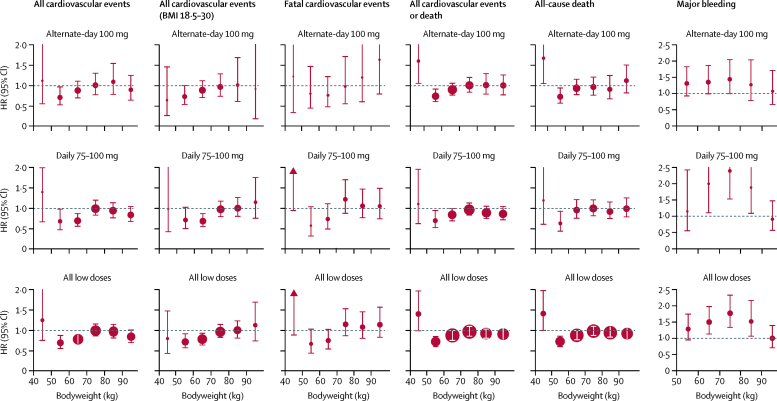
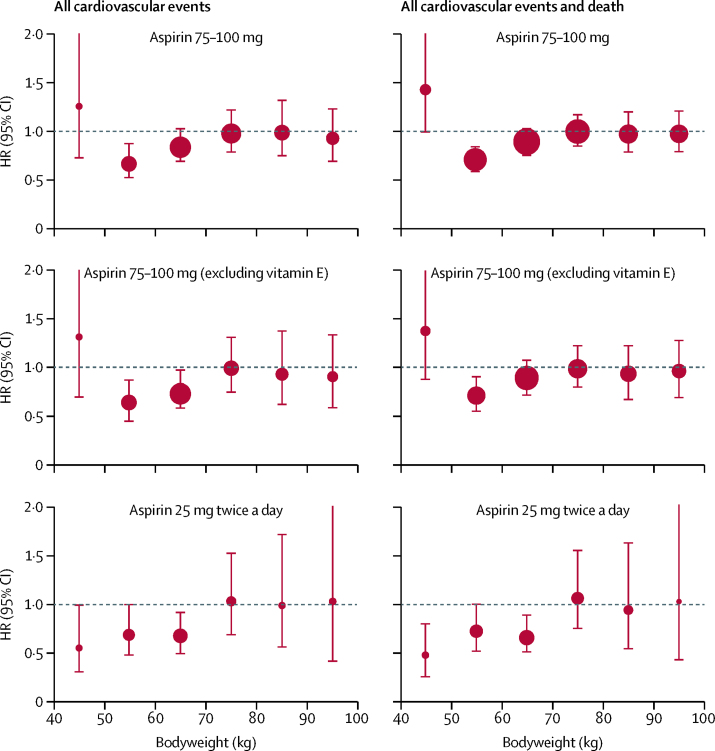
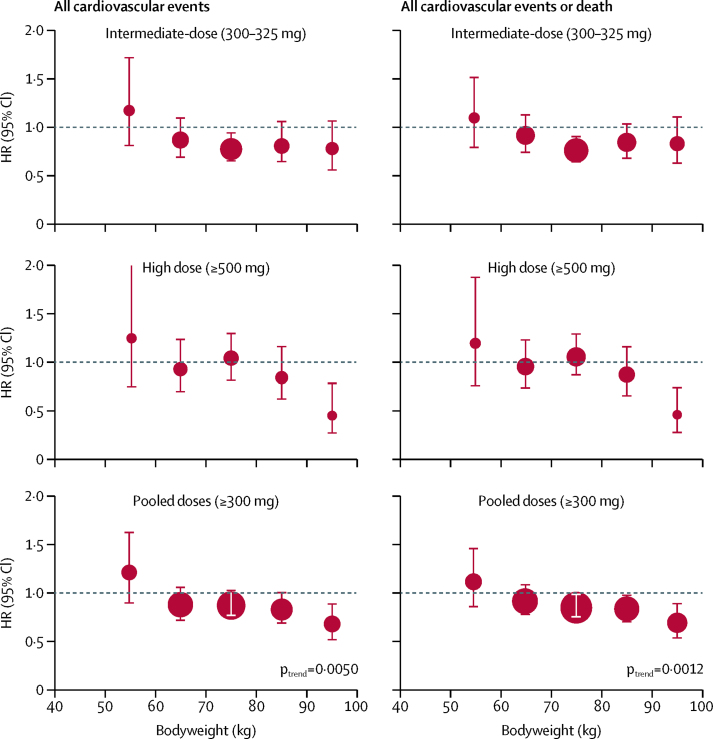
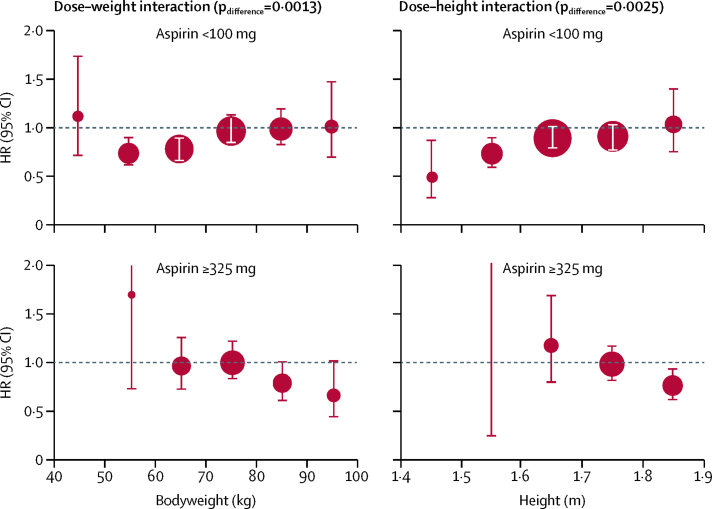
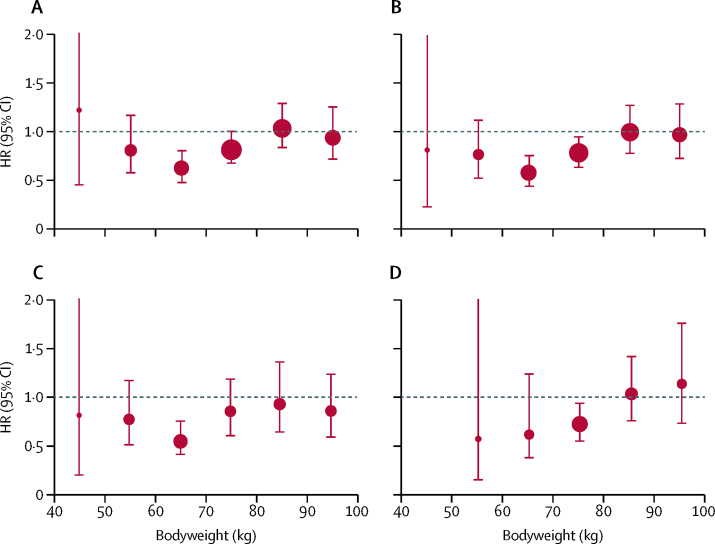
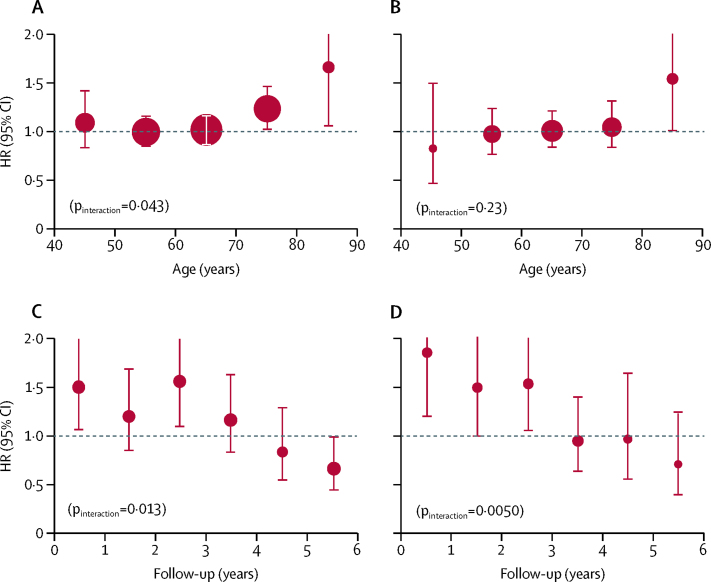
Verification
Claims the paper makes
The claims and statistics of this paper haven’t been checked yet.
Free: it reads the open-access text and checks the first 5 claims that cite a source we can check. Create a free account to check every claim.
Claims other papers make about this one
Each is checked against this paper’s own text: does it say what the citing paper says it does?
The cited source says what the claim attributes to it.
In the citing paper
“A recent analysis suggesting a greater benefit of low-dose aspirin use on the incidence of vascular events among persons with a body weight of less than 70 kg was not confirmed in exploratory subgroup analyses (and, indeed, a trend in the opposite direction was observed).”
From Effects of aspirin for primary prevention in persons with diabetes mellitus (2018) · cites this paper as [19]
The cited source says what the claim attributes to it.
In the citing paper
“Another meta-analysis raised the hypothesis that low-dose aspirin efficacy is reduced in those weighing >70 kg (196); however, the ASCEND trial found benefit of low-dose aspirin in those in this weight range, which would not validate this suggested hypothesis (179).”
From 10. Cardiovascular Disease and Risk Management: Standards of Care in Diabetes—2025 (2025) · cites this paper as [196]
In the citing paper
“Another meta-analysis raised the hypothesis that low-dose aspirin ef fi cacy is reduced in those weighing > 70 kg (161); however, the ASCEND trial found bene fi t of low-dose aspirin in those in this weight range, which would thus not validate this suggested hypothesis (144).”
From 10. Cardiovascular Disease and Risk Management: Standards of Care in Diabetes—2023 (2023) · cites this paper as [161]
Self-check
Percentages, sums and reported differences re-computed from the paper’s own numbers.
The self-check needs the paper’s full text.
Citations
Cites
Zhang, Q., Wang, C., Zheng, M., Li, Y., Li, J., Zhang, L., Shang, X., & Yan, C. (2015) · Cerebrovascular Diseases · doi:10.1159/000369778 · Cited by 11,533
Collaboration, A. T. (2002) · BMJ · doi:10.1136/bmj.324.7329.71 · Cited by 6,943
Hansson, L., Zanchetti, A., Carruthers, S. G., Dahlöf, B., Elmfeldt, D., Julius, S., Ménard, J., Rahn, K. H., Wedel, H., & Westerling, S. (1998) · The Lancet · doi:10.1016/s0140-6736(98)04311-6 · Cited by 5,728
Final Report on the Aspirin Component of the Ongoing Physicians' Health Study
Steering Committee of the Physicians' Health Study Research Group* (1989) · New England Journal of Medicine · doi:10.1056/nejm198907203210301 · Cited by 2,264
A Randomized Trial of Low-Dose Aspirin in the Primary Prevention of Cardiovascular Disease in Women
Ridker, P. M., Cook, N. R., Lee, I.-M., Gordon, D., Gaziano, J. M., Manson, J. E., Hennekens, C. H., & Buring, J. E. (2005) · New England Journal of Medicine · doi:10.1056/nejmoa050613 · Cited by 1,945
Self-citationEAFT (European Atrial Fibrillation Trial) Study Group (1993) · The Lancet · doi:10.1016/0140-6736(93)92358-z · Cited by 1,741
Rothwell, P. M., Fowkes, F. G. R., Belch, J. F., Ogawa, H., Warlow, C. P., & Meade, T. W. (2011) · The Lancet · doi:10.1016/s0140-6736(10)62110-1 · Cited by 1,497
Self-citationRothwell, P. M., Wilson, M., Elwin, C.-E., Norrving, B., Algra, A., Warlow, C. P., & Meade, T. W. (2010) · The Lancet · doi:10.1016/s0140-6736(10)61543-7 · Cited by 1,351
Self-citationThe United Kingdom transient ischaemic attack (UK-TIA) aspirin trial: final results.
Farrell, B., Godwin, J., Richards, S., & Warlow, C. (1991) · Journal of Neurology, Neurosurgery & Psychiatry · doi:10.1136/jnnp.54.12.1044 · Cited by 1,203
Research works printed but not linked: 1
- Schrör K Acetylsalicylic acid 2nd edn. 2016 Wiley-VCH Weinheim
Cited by
Items 301–350 of 350
Harveian Oration 2019: Prediction and prevention in the genomic era
Burn, J. (2020) · Clinical Medicine · doi:10.7861/clinmed.ed.20.1.harv
Larina, V. N., Gaydina, T. A., Mkrtychev, D. S., Кузнецова, В. А., & Snezhko, Z. (2020) · Kardiologiia · doi:10.18087/cardio.2020.3.n928
Sekundärprophylaxe der zerebralen Ischämie
Ringleb, P. A., & Reiff, T. (2020) · Nervenheilkunde · doi:10.1055/a-1239-0344
Xi, Z., Gong, X., Li, B., Zhang, L., Pu, J. Y., Li, Y., Xu, Y., & Zhang, M. (2020) · PubMed Central · doi:10.7507/1001-5515.202008001 · Cited by 1
Secondary Stroke Prevention and Management for the Neuro-Ophthalmologist
Rahman, L. A., Wabnitz, A., & Turan, T. N. (2020) · Journal of Neuro-Ophthalmology · doi:10.1097/wno.0000000000001133
ASS in der Primär- und Sekundärprävention kardiovaskulärer Erkrankungen
Hach, A., Sauter, M., & Langer, H. F. (2020) · Kardiologie up2date · doi:10.1055/a-0917-8604
“Lebensdekade an (HR: 1,45; 95%-KI 1,01–2,10; p = 0,04) [24].”
BackgroundInfluentialLong-term Antithrombotic Therapy for Large and Small Artery Occlusive Disease
Hankey, G. J. (2020) · Cambridge University Press eBooks · doi:10.1017/9781316286234.020
Some characteristics of patients with myelodysplastic syndrome
Lipilkin, P. V., Shatokhin, Y. V., & Мацуга, А. А. (2020) · Medical Herald of the South of Russia · doi:10.21886/2219-8075-2020-11-4-32-42
The 70/30 Rule Between Men and Women—Disparity or Opportunity?—Reply
Chandrasekhar, J., Morice, M., & Mehran, R. (2020) · JAMA Cardiology · doi:10.1001/jamacardio.2020.6136
Antiplatelet therapy in secondary prevention of non‑embolic ischaemic stroke
Alusik, S., & Palúch, Z. (2020) · Vnitřní lékařství · doi:10.36290/vnl.2020.147
“Standardně používaná dávka ASA v USA je 325 mg 1× denně, v nových britských doporučených postupech je dávka ASA 300 mg/denně, což je v souladu s výsledky studie publikované nedávno (5).”
Wijland, Y. (2021) · Australasian Journal of Paramedicine · doi:10.33151/ajp.18.890
“Individualised pharmacotherapy has already demonstrated its benefit in a range of other clinical contexts, such as with analgesia, antiplatelet therapy and psychotherapy (6-8).”
BackgroundZhou, G., Wang, P., Lu, S., Wang, C., Xie, Z., Cao, W., Shi, J., Zhu, W., Wang, R., Zhou, G., et al. (2021) · SSRN Electronic Journal · doi:10.2139/ssrn.3911102
Sibon, I., & Liegey, J.-S. (2021) · Revue Neurologique · doi:10.1016/j.neurol.2021.07.021
Zhou, P., Liu, R.-L., Zhang, K.-B., Liu, D., & Deng, Z. (2020) · doi:10.21203/rs.3.rs-33002/v1
(2018) · British journal of surgery · doi:10.1002/bjs.10998
Four recommendations for aspirin use to reduce ASCVD risk: An evidence-based review
Castelli, G., & Wilson, S. A. (2022) · Evidence-Based Practice · doi:10.1097/ebp.0000000000001451
Current approaches to the selection of acetylsalicylic acid dosage forms in cardiology
Gilyarevskiy, S. R., Golshmid, M. V., Георгиевна, Б. Н., & Kuzmina, I. M. (2022) · Aterotromboz = Atherothrombosis · doi:10.21518/2307-1109-2022-12-1-8-18 · Cited by 1
4 Clinical applications of aspirin
Schrör, K. (2022) · De Gruyter eBooks · doi:10.1515/9783110746419-004
Gaussem, P., Jourdi, G., & Ajzenberg, N. (2022) · EMC - Tratado de Medicina · doi:10.1016/s1636-5410(22)47171-6
Atherosclerotic Cardiovascular Disease Prevention in the Older Adult: Part 1
Murphy, E., Cooney, M. T., & McEvoy, J. W. (2023) · Contemporary cardiology · doi:10.1007/978-3-031-16594-8_1
Fall, M., Grenet, G., Le, H.-H., Kassaï, B., Lega, J., Boussageon, R., Mainbourg, S., Marchant, I., Gafsi, J., Dièye, A. M., et al. (2023) · Therapies · doi:10.1016/j.therap.2023.01.011
Devall, M. A. M., Drew, D. A., Dampier, C. H., Plummer, S. J., Eaton, S., Bryant, J., Díez‐Obrero, V., Mo, J., Kedrin, D., Zerjav, D. C., et al. (2023) · doi:10.1158/1940-6207.22533661
Herszényi, L., Aradi, D., Békássy, S., Járai, Z., Juhász, M. F., Kiss, R. G., Kolossváry, E., Nardai, S., Simonyi, G., Szőnyi, M., et al. (2023) · Cardiologia Hungarica · doi:10.26430/chungarica.2023.53.2.150 · Cited by 1
Allen, A. J., Gelinne, A. M., Quig, N., Reed, S., Shastri, D. N., Ho, J. P., & Yap, E. (2023) · Neurosurgical FOCUS · doi:10.3171/2023.7.focus23373
Sekundärprophylaxe des ischämischen Schlaganfalls
Schmidbauer, M. L., Wischmann, J., Dimitriadis, K. A., & Kellert, L. (2023) · Die Innere Medizin · doi:10.1007/s00108-023-01615-w · Cited by 1
NSAID-induced gastropathy in a comorbid patient in a multidisciplinary hospital
Starikova, D. D., Sedyakina, Y. V., Shamuilova, M. M., Sarvanets, G. D., & Artamkina, A. M. (2024) · Spravočnik vrača obŝej praktiki (Journal of Family Medicine) · doi:10.33920/med-10-2402-05
Acetylsalicylic acid in primary prevention: a review
Campanini, M., Rizzi, E., Fleetwood, T., Pinna, G., & Giacomini, G. M. (2024) · Italian Journal of Medicine · doi:10.4081/itjm.2024.1770
Luque-Esparza, L. E., Delgadillo‐Guzmán, D., Mata-Vidal, R. C., Carranza-Almaguer, D., Aispuro, C. E. C., & Maldonado, I. C. (2024) · Journal of Generic Medicines The Business Journal for the Generic Medicines Sector · doi:10.1177/17411343241286994
Lim, S. T., Stephen, M., Smith, D. R., Collins, R., Coughlan, T., Murphy, S. M., McCarthy, A., Egan, B. M., Lim, S., Cox, D. M., et al. (2024) · Research Square · doi:10.21203/rs.3.rs-5257134/v1
Detection and Treatment of Chronic Complications
Soe, K. K., & Gunasekaran, U. (2020) · American Diabetes Association eBooks · doi:10.2337/9781580406314.ch05
Chen, M., Xu, S., & Yan, X. (2025) · Current Problems in Surgery · doi:10.1016/j.cpsurg.2025.101889
Santilli, F., & Simeone, P. (2025) · Springer eBooks · doi:10.1007/978-3-031-96352-0_7
Cardiovascular Disease and Risk Management
(2025) · American Diabetes Association eBooks · doi:10.2337/9781580408462-ch17
Semedo, L., Lifford, K., Edwards, A., Seddon, K., Brain, K., Smits, S., & Dolwani, S. (2021) · Figshare · doi:10.6084/m9.figshare.14633987
Jiang, T., Sun, H., Xue, S., Xu, T., Xia, W., Wang, Y., Guo, L., & Lin, H. (2024) · Figshare · doi:10.6084/m9.figshare.26157367
Jiang, T., Sun, H., Xue, S., Xu, T., Xia, W., Wang, Y., Guo, L., & Lin, H. (2024) · Figshare · doi:10.6084/m9.figshare.26157056
Jiang, T., Sun, H., Xue, S., Xu, T., Xia, W., Wang, Y., Guo, L., & Lin, H. (2024) · Figshare · doi:10.6084/m9.figshare.26741825
Semedo, L., Lifford, K., Edwards, A., Seddon, K., Brain, K., Smits, S., & Dolwani, S. (2021) · Figshare · doi:10.6084/m9.figshare.14633990
Haemostasis and the Need for Antithrombotics: An Introduction
Hogwood, J., & Gray, E. (2026) · Handbook of experimental pharmacology · doi:10.1007/164_2026_796
Inflammation and breast cancer risk in the EPIC cohort
Cairat, M. (2020) · theses.fr (ABES) · doi:10.70675/aea491a7ze801z435dz8077z985f060327e4
Post-Acute and Long-Term Care Medical Association Adds 5 New Choosing Wisely Statements
Cai, C. Y., Gleason, L. J., & Palat, S. T. (2026) · Journal of the American Medical Directors Association · doi:10.1016/j.jamda.2026.106158
Mahmoud, A. A., & Kouides, P. A. (2026) · Springer eBooks · doi:10.1007/978-3-032-13858-3_46
Qureshi, A. I., Huang, Y., Ranjini, N. J., Zahoor, K., Suri, M. F. K., French, B. R., & Gomez, C. R. (2026) · Journal of Stroke and Cerebrovascular Diseases · doi:10.1016/j.jstrokecerebrovasdis.2026.108664
Souto, L. G., Teng, F. S., Vieira, S. E., & Takahira, R. K. (2026) · Veterinary Medicine International · doi:10.1155/vmi/1271185
“In a study by Borsig et al. [21], human patients who used aspirin for cardio-vascular diseases presented a reduced risk of metastasis.”
Hernandez-Garcia, E., Edkins, A., Chrysikou, E. G., Ordóñez-Mena, J. M., Nekhlyudov, L., Kim, J. B., McLean, G. R., Frost, H., & Panigrahy, D. (2026) · BMJ Open · doi:10.1136/bmjopen-2025-111748 · Cited by 1
Ghoneim, M. M., Alqumaizi, G. K., Alkhalil, W. A., Alhulaili, M. F., Alhamdan, R. J., & Mannasaheb, B. A. (2026) · Advanced Health Science and Technology Journal · doi:10.4103/ahstj.ahstj_33_25
Zviahina, O. V. (2026) · Український медичний часопис · doi:10.32471/umj.1680-3051.278238
Platelet Reactivity and Sex Differences: Clinical Implications for Women
Aggarwal, A., Barrett, T. J., Mehta, P. K., Honigberg, M. C., Cosemans, J. M. E. M., Goodman, W. A., Aggarwal, N. R., Holinstat, M. A., Cho, L., & Cameron, S. J. (2026) · Circulation Research · doi:10.1161/circresaha.126.328602
Can we optimize the efficacy of aspirin for cardiovascular prevention?
Cattaneo, M. (2026) · Journal of Thrombosis and Haemostasis · doi:10.1016/j.jtha.2026.07.011
Metadata
- Authors
- Rothwell, P. M., Cook, N. R., Gaziano, J. M., Price, J. F., Belch, J. F. F., Roncaglioni, M. C., Morimoto, T., & Mehta, Z.
- Affiliations
- University of Oxford (GB)
- Brigham and Women's Hospital (US)
- Harvard University (US)
- University of Edinburgh (GB)
- Mario Negri Institute for Pharmacological Research (IT)
- Hyogo Medical University (JP)
- Corresponding author
- Rothwell, Peter M
- Venue
- The Lancet
- Publisher
- Elsevier BV
- Published
- 2018-08
- Volume
- 392
- Issue
- 10145
- Pages
- 387-399
- ISSN
- 0099-5355 (ISSN-L)
- 0140-6736
- PMC
- PMC6083400
- OpenAlex
- W2884727639
- Semantic Scholar
- d4f7edcdedb2392c6f3b8fa34ca8008d79665e3b
- Cited by
- 353
- References
- 49
- Citations by year
- 2026: 12 · 2025: 22 · 2024: 29 · 2023: 32 · 2022: 46 · 2021: 51 · 2020: 57 · 2019: 68 · 2018: 36
- FWCI
- 40.10
- Type
- journal article
- Language
- en
- Open access
- hybrid
- doi.org
- Licence
- cc-by
- www.elsevier.com/tdm/userlicense/1.0/ (tdm)
- creativecommons.org/licenses/by/4.0/ (vor)
- Locations
- The Lancet (publishedVersion, cc-by)
- Europe PMC (PubMed Central) (publishedVersion, cc-by)
- PubMed Central (publishedVersion, cc-by)
- PubMed (publishedVersion)
- Discovery Research Portal (University of Dundee) (publishedVersion, cc-by)
- Edinburgh Research Explorer (University of Edinburgh) (submittedVersion, cc-by)
- Funders
- Wellcome Trust
- National Institute for Health and Care Research
- Japan Society for the Promotion of Science (18H03032)
- Topics
- Health Sciences › Medicine › Cardiology and Cardiovascular Medicine › Antiplatelet Therapy and Cardiovascular Diseases
- Health Sciences › Medicine › Pharmacology (medical) › Inflammatory mediators and NSAID effects
- Health Sciences › Medicine › Cardiology and Cardiovascular Medicine › Lipoproteins and Cardiovascular Health
- Keywords
- aspirin, body weight, aspirin dose, cardiovascular events, cancer risk, colorectal cancer, vascular death, case fatality, primary prevention, secondary stroke prevention, dose-response interaction, individual patient data, height, individualized dosing, vascular risk factors, diabetes mellitus, sex differences, cardiovascular mortality, cancer mortality, myocardial infarction
- MeSH terms
- Age Factors, Aged, Aspirin, Body Height, Body Weight, Cardiovascular Diseases, Death, Sudden, Female, Humans, Male, Platelet Aggregation Inhibitors, Risk Factors, Sex Factors, Colorectal Neoplasms, Proportional Hazards Models, Randomized Controlled Trials as Topic, Stroke, Kaplan-Meier Estimate
About these checks
Registry, retraction, Cites and statistics results are computed, not judged, with one exception: a printed reference that no index lists is read once by a model before it counts as a citation error. Claims are extracted by a model and kept only when their quote appears verbatim in the text; each cited source is then checked, with a model’s help, for whether it says what the claim relies on. Those verdicts can be wrong — read the claim’s quote and the cited source before relying on one.
Statistics and arithmetic are recomputed, not judged.
Confidence bands are shown only for fields calibrated on our annotated test set. None is calibrated yet, so no band is shown.
What counts as a claim ›How we measure confidence ›How we check this ›
Are you an author, or do you see a problem with this page? Request a review
Data sources
Bibliographic data: Semantic Scholar, OpenAlex, Crossref.
Contains information from the Semantic Scholar Academic Graph Datasets, made available under the ODC Attribution License (ODC-BY 1.0).
Semantic Scholar’s data is described in: Kinney, R., et al. (2023). The Semantic Scholar Open Data Platform. arXiv:2301.10140.
