

Relationship between clinic and ambulatory blood pressure and mortality: an observational cohort study in 59 124 patients
Open accessThe DOI matches its Crossref record; 48 of the 48 references it cites were found in a registry or an index; 6 of the 23 sources its claims cite were checked for support.
Abstract
BACKGROUND: Ambulatory blood pressure provides a more comprehensive assessment than clinic blood pressure, and has been reported to better predict health outcomes than clinic or home pressure. We aimed to examine associations of clinic and 24-h ambulatory blood pressure with all-cause and cardiovascular mortality in a large cohort of primary care patients referred for assessment of hypertension. METHODS: We did an observational cohort study using clinic and ambulatory blood pressure data obtained from March 1, 2004, to Dec 31, 2014, from the Spanish Ambulatory Blood Pressure Registry. This registry included patients from 223 primary care centres from the Spanish National Health System in all 17 regions of Spain. Mortality data (date and cause) were ascertained by a computerised search of the vital registry of the Spanish National Institute of Statistics. Complete data were available for age, sex, all blood pressure measures, and BMI. For each study participant, follow-up was from the date of their recruitment to the date of death or Dec 31, 2019, whichever occurred first. Cox models were used to estimate associations between usual clinic or ambulatory blood pressure and mortality, adjusted for confounders and additionally for alternative measures of blood pressure. For each measure of blood pressure, we created five groups (ie, fifths) defined by quintiles of that measure among those who subsequently died. FINDINGS: During a median follow-up of 9·7 years, 7174 (12·1%) of 59 124 patients died, including 2361 (4·0%) from cardiovascular causes. J-shaped associations were observed for several blood pressure measures. Among the top four baseline-defined fifths, 24-h systolic blood pressure was more strongly associated with all-cause death (hazard ratio [HR] 1·41 per 1 - SD increment [95% CI 1·36-1·47]) than clinic systolic blood pressure (1·18 [1·13-1·23]). After adjustment for clinic blood pressure, 24-h blood pressure remained strongly associated with all-cause deaths (HR 1·43 [95% CI 1·37-1·49]), but the association between clinic blood pressure and all-cause death was attenuated when adjusted for 24-h blood pressure (1·04 [1·00-1·09]). Compared with the informativeness of clinic systolic blood pressure (100%), night-time systolic blood pressure was most informative about risk of all-cause death (591%) and cardiovascular death (604%). Relative to blood pressure within the normal range, elevated all-cause mortality risks were observed for masked hypertension (HR 1·24 [95% CI 1·12-1·37]) and sustained hypertension (1·24 [1·15-1·32]), but not white-coat hypertension, and elevated cardiovascular mortality risks were observed for masked hypertension (1·37 [1·15-1·63]) and sustained hypertension (1·38 [1·22-1·55]), but not white-coat hypertension. INTERPRETATION: Ambulatory blood pressure, particularly night-time blood pressure, was more informative about the risk of all-cause death and cardiovascular death than clinic blood pressure. FUNDING: Spanish Society of Hypertension, Lacer Laboratories, UK Medical Research Council, Health Data Research UK, National Institute for Health and Care Research Biomedical Research Centres (Oxford and University College London Hospitals), and British Heart Foundation Centre for Research Excellence.
Overview
CoChat Summary
## TL;DR
In this observational cohort of 59,124 primary-care patients, ambulatory blood pressure—especially nighttime systolic blood pressure—predicted all-cause and cardiovascular mortality better than clinic blood pressure. Masked and sustained hypertension were linked to higher mortality risk, while white-coat hypertension was not clearly associated with increased risk.
## Key findings
- Over a median follow-up of 9.7 years, 7,174 of 59,124 patients died (12.1%), including 2,361 cardiovascular deaths (4.0%).
- Among top four fifths of usual blood pressure values, 24-h systolic blood pressure was more strongly associated with all-cause death than clinic systolic blood pressure: HR 1.41 (95% CI 1.36–1.47) vs 1.18 (1.13–1.23) per 1-SD increment.
- After mutual adjustment, 24-h blood pressure remained strongly associated with death (HR 1.43 [1.37–1.49]), whereas clinic blood pressure was attenuated (HR 1.04 [1.00–1.09]).
- Night-time systolic blood pressure was the most informative measure: 591% of clinic systolic blood pressure’s informativeness for all-cause death and 604% for cardiovascular death.
- Compared with blood pressure in the normal range, masked hypertension and sustained hypertension were associated with higher mortality: all-cause death HR 1.24 (1.12–1.37) and 1.24 (1.15–1.32), and cardiovascular death HR 1.37 (1.15–1.63) and 1.38 (1.22–1.55), respectively.
- White-coat hypertension was not associated with increased mortality in the main analysis (all-cause death HR 0.90 [0.84–0.97]; cardiovascular death HR 0.89 [0.77–1.01]).
## Methods
- Observational cohort study using the Spanish Ambulatory Blood Pressure Registry, including patients aged 18+ from 223 primary care centres in all 17 regions of Spain; data were collected from March 1, 2004, to Dec 31, 2014.
- Sample: 59,124 patients with complete demographic/clinical data and linked mortality data from the Spanish National Institute of Statistics; 35,128 (59.4%) were treated for hypertension at baseline.
- Main analysis: Cox regression for all-cause and cardiovascular mortality, comparing clinic, 24-h, daytime, and nighttime blood pressure; models adjusted for age, sex, smoking, BMI, diabetes, dyslipidaemia, prior cardiovascular disease, and number of antihypertensive drugs, with additional mutual adjustment between clinic and ambulatory measures and analysis of hypertension phenotypes.
## Limitations
- The paper states that clinic blood pressure was based on only two readings, which could overestimate the mean clinic blood pressure.
- The paper states medication data were only available at baseline, not during follow-up.
- The paper states there may have been selection bias because ambulatory monitoring was ordered for guideline-based clinical indications.
- The paper states it was an observational study, so no direct inference can be made about benefit from basing treatment on ambulatory blood pressure.
- The paper states it did not assess nonfatal events, only deaths.
- The paper states the cohort was predominantly White, so results might not apply to other races.
- Evident from the text: some prior cardiovascular disease may have been missed because an unchecked box on the case report form could mean either no disease or missing response.
Model-written summary. Check it against the paper before relying on it.
Integrity signals
Registry
Cites
Statistics
Figures
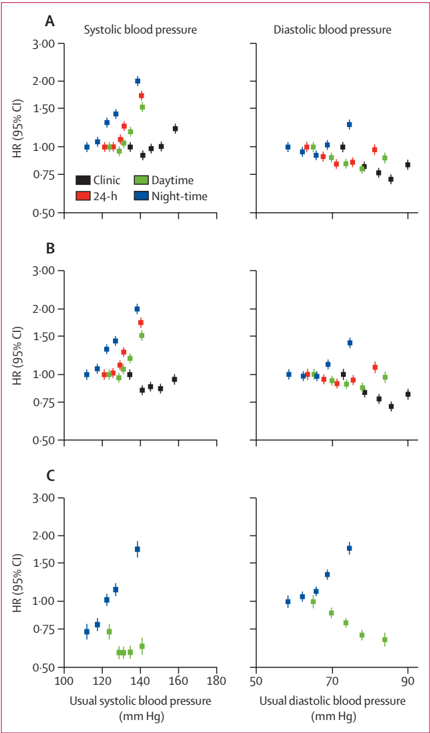
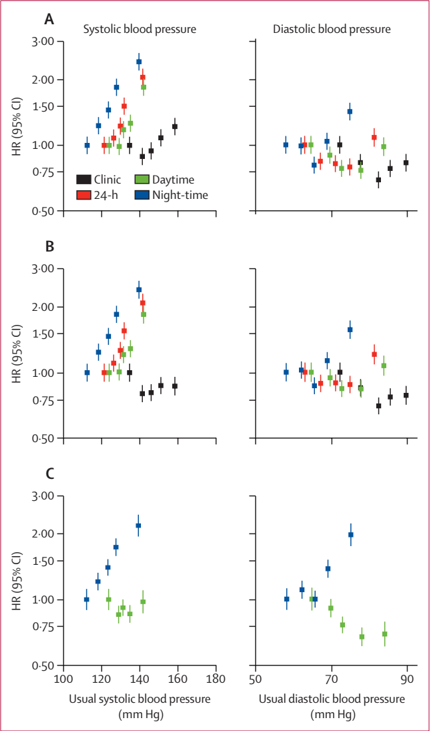
Verification
Claims the paper makes
4 Valid · 0 Not valid · 6 Not checked · 83 Own results and interpretations
The sources with a verdict support this claim; the rest weren’t checked yet, have no full text we could read, or their verdicts aren’t rated yet.
In the paper
“Moreover, studies including a larger number of participants were mainly obtained by pooling databases from previous small studies.4,8”
§ Relationship between clinic and ambulatory blood pressure and mortality: an observational cohort study in 59 124 patients > Introduction
What the sources say
- Supportedcites [4] 4. Yang WY, Melgarejo JD, Thijs L, et al. Association of office and ambulatory blood pressure with mortality and cardiovascular outcomes. JAMA 2019; 322: 409-20. source
Our copy shows the cited paper IS such a study: the Study Participants section states that 'All population studies included in the International Database on Ambulatory Blood Pressure in Relation to Cardiovascular Outcome (IDACO)' were assembled into a database constructed and updated at the Studies Coordinating Centre in Leuven, and that of 13 111 people in that database 11 135 were statistically analyzed (Study Participants; Baseline Characteristics of Participants). The constituent cohorts are individually small — eTable 1 lists 13 cohorts with 159 to 2 148 participants analyzed (Study Participants / Other Measurements) — and the Statistical Analysis section describes pooling participants across cohorts and assessing 'the weight of cohorts in the overall pooled results,' with a sensitivity analysis labelled 'Small cohorts.' So the paraphrase that large-participant studies were obtained mainly by pooling databases of previous smaller studies is exemplified by this source, which is the only thing the attached citation is offered for. (LLM, conf=0.82)
- Not checked — no full text of the sourcecites [8] 8. Hansen TW, Jeppesen J, Rasmussen S, Ibsen H, TorpPedersen C. Ambulatory blood pressure and mortality. Hypertension 2005; 45: 499-504. source
plain- Asserted: passes — The authors put it forward as true.
- Checkable: passes — It can be checked against evidence.
- Load-bearing: passes — The paper’s conclusions depend on it.
- Based: passes — The paper gives a reason why it holds.
- Supported
The cited sources support only part of this claim — read each source’s verdict below.
In the paper
“The increased risk of death at lower values of diastolic blood pressure is likely to reflect, at least in part, reverse causation due to the effects of arterial ageing, stiffening, and subclinical disease, all of which are associated with a widened pulse pressure and lower diastolic pressure.39”
§ Relationship between clinic and ambulatory blood pressure and mortality: an observational cohort study in 59 124 patients > Discussion
What the sources say
- Partly supportedcites [39] 39. Webb AJS. Progression of arterial stiffness is associated with midlife diastolic blood pressure and transition to latelife hypertensive phenotypes. J Am Heart Assoc 2020; 9: e014547. sourceExperimental — accuracy not yet measured
Split into 2 atoms — 0 confirmed, 2 partially supported, 0 disputed, 0 misattributed, 0 unverifiable. Expand the claim to see per-atom verdicts.
hedgedstates a possible cause- Asserted: passes — The authors put it forward as true.
- Checkable: passes — It can be checked against evidence.
- Load-bearing: unclear — It is unclear whether the paper’s conclusions depend on it.
- Based: passes — The paper gives a reason why it holds.
- Partly supported
A result the paper reports from its own data — it cites no other source for it, so there is none to check. The quote shows it is in the paper.
In the paper
“after adjustment for nighttime systolic blood pressure, daytime systolic blood pressure was only weakly associated with allcause death (HR 1•07 [95% CI 1•01-1•14])”
§ Relationship between clinic and ambulatory blood pressure and mortality: an observational cohort study in 59 124 patients > Results
plainstates an association- Asserted: passes — The authors put it forward as true.
- Checkable: passes — It can be checked against evidence.
- Load-bearing: passes — The paper’s conclusions depend on it.
- Based: passes — The paper gives a reason why it holds.
A result the paper reports from its own data — it cites no other source for it, so there is none to check. The quote shows it is in the paper.
In the paper
“In the confounderadjusted model, allcause death was greater in patients with masked hypertension (normal clinic but elevated 24h blood pressure; HR 1•24 [95% CI 1•12-1•37])”
§ Relationship between clinic and ambulatory blood pressure and mortality: an observational cohort study in 59 124 patients > Results
plainstates an association- Asserted: passes — The authors put it forward as true.
- Checkable: passes — It can be checked against evidence.
- Load-bearing: passes — The paper’s conclusions depend on it.
- Based: passes — The paper gives a reason why it holds.
A result the paper reports from its own data — it cites no other source for it, so there is none to check. The quote shows it is in the paper.
In the paper
“Substantial variability was observed in clinic and ambulatory blood pressure monitoring measurements taken at two different visits (regression dilution ratios for measurements an average of 18 months apart were 0•46 for clinic systolic blood pressure and 0•48 for 24h systolic blood pressure; appendix pp 14-15).”
§ Relationship between clinic and ambulatory blood pressure and mortality: an observational cohort study in 59 124 patients > Results
plain- Asserted: passes — The authors put it forward as true.
- Checkable: passes — It can be checked against evidence.
- Load-bearing: passes — The paper’s conclusions depend on it.
- Based: passes — The paper gives a reason why it holds.
56 more claims
Create a free account to see all 93 claims and to verify the 4 references still open.
- Probably not a substantial claim. 18
- It may state two separate claims as one. 19
- The quote only partly states this claim. 2
Citations
Cites
2018 ESC/ESH Guidelines for the management of arterial hypertension
Williams, B., Mancia, G., Spiering, W., Agabiti Rosei, E., Azizi, M., Burnier, M., Clement, D. L., Coca, A., de Simone, G., Dominiczak, A., et al. (2018) · European Heart Journal · doi:10.1093/eurheartj/ehy339 · Cited by 10,286
Self-citationWhelton, P. K., Carey, R. M., Aronow, W. S., Casey, D. E., Collins, K. J., Dennison Himmelfarb, C., DePalma, S. M., Gidding, S., Jamerson, K. A., Jones, D. W., et al. (2018) · Hypertension · doi:10.1161/hyp.0000000000000066 · Cited by 4,347
O'Brien, E., Asmar, R., Beilin, L., Imai, Y., Mallion, J.-M., Mancia, G., Mengden, T., Myers, M., Padfield, P., Palatini, P., et al. (2003) · Journal of Hypertension · doi:10.1097/00004872-200305000-00001 · Cited by 1,655
Staessen, J. A. (1999) · JAMA · doi:10.1001/jama.282.6.539 · Cited by 1,592
European Society of hypertension position paper on ambulatory blood pressure monitoring
O’Brien, E., Parati, G., Stergiou, G., Asmar, R., Beilin, L., Bilo, G., Clement, D., de la Sierra, A., de Leeuw, P., Dolan, E., et al. (2013) · Journal of Hypertension · doi:10.1097/hjh.0b013e328363e964 · Cited by 1,419
Self-citationDolan, E., Stanton, A., Thijs, L., Hinedi, K., Atkins, N., McClory, S., Hond, E. D., McCormack, P., Staessen, J. A., & O’Brien, E. (2005) · Hypertension · doi:10.1161/01.hyp.0000170138.56903.7a · Cited by 1,227
Prognostic Value of Ambulatory Blood-Pressure Recordings in Patients with Treated Hypertension
Clement, D. L., De Buyzere, M. L., De Bacquer, D. A., de Leeuw, P. W., Duprez, D. A., Fagard, R. H., Gheeraert, P. J., Missault, L. H., Braun, J. J., Six, R. O., et al. (2003) · New England Journal of Medicine · doi:10.1056/nejmoa022273 · Cited by 1,085
European Society of Hypertension practice guidelines for ambulatory blood pressure monitoring
Parati, G., Stergiou, G., O’Brien, E., Asmar, R., Beilin, L., Bilo, G., Clement, D., de la Sierra, A., de Leeuw, P., Dolan, E., et al. (2014) · Journal of Hypertension · doi:10.1097/hjh.0000000000000221 · Cited by 1,021
Self-citationSega, R., Facchetti, R., Bombelli, M., Cesana, G., Corrao, G., Grassi, G., & Mancia, G. (2005) · Circulation · doi:10.1161/01.cir.0000160923.04524.5b · Cited by 1,009
Whelton, P. K., Carey, R. M., Aronow, W. S., Casey, D. E., Collins, K. J., Dennison Himmelfarb, C., DePalma, S. M., Gidding, S., Jamerson, K. A., Jones, D. W., et al. (2018) · Circulation · doi:10.1161/cir.0000000000000597 · Cited by 902
Prognostic accuracy of day versus night ambulatory blood pressure: a cohort study
Boggia, J., Li, Y., Thijs, L., Hansen, T. W., Kikuya, M., Björklund-Bodegård, K., Richart, T., Ohkubo, T., Kuznetsova, T., Torp-Pedersen, C., et al. (2007) · The Lancet · doi:10.1016/s0140-6736(07)61538-4 · Cited by 887
Ambulatory Blood-Pressure Monitoring
Pickering, T. G., Shimbo, D., & Haas, D. (2006) · New England Journal of Medicine · doi:10.1056/nejmra060433 · Cited by 778
Fagard, R. H., Celis, H., Thijs, L., Staessen, J. A., Clement, D. L., De Buyzere, M. L., & De Bacquer, D. A. (2008) · Hypertension · doi:10.1161/hypertensionaha.107.100727 · Cited by 742
Mancia, G., Facchetti, R., Bombelli, M., Grassi, G., & Sega, R. (2006) · Hypertension · doi:10.1161/01.hyp.0000215363.69793.bb · Cited by 691
Rosner, B., Willett, W. C., & Spiegelman, D. (1989) · Statistics in Medicine · doi:10.1002/sim.4780080905 · Cited by 645
Predictive Role of the Nighttime Blood Pressure
Hansen, T. W., Li, Y., Boggia, J., Thijs, L., Richart, T., & Staessen, J. A. (2011) · Hypertension · doi:10.1161/hypertensionaha.109.133900 · Cited by 597
Ohkubo, T., Kikuya, M., Metoki, H., Asayama, K., Obara, T., Hashimoto, J., Totsune, K., Hoshi, H., Satoh, H., & Imai, Y. (2005) · Journal of the American College of Cardiology · doi:10.1016/j.jacc.2005.03.070 · Cited by 575
Williams, B., Mancia, G., Spiering, W., Rosei, E. A., Azizi, M., Burnier, M., Clement, D. L., Coca, A., de Simone, G., Dominiczak, A., et al. (2018) · Giornale Italiano di Cardiologia · doi:10.1714/3026.30245 · Cited by 528
Self-citationAssociation of office and ambulatory blood pressure with mortality and cardiovascular outcomes
Yang, W.-Y., Melgarejo, J. D., Thijs, L., Zhang, Z.-Y., Boggia, J., Wei, F.-F., Hansen, T. W., Asayama, K., Ohkubo, T., Jeppesen, J., et al. (2019) · JAMA · doi:10.1001/jama.2019.9811 · Cited by 491
Fagard, R. H., & Cornelissen, V. A. (2007) · Journal of Hypertension · doi:10.1097/hjh.0b013e3282ef6185 · Cited by 480
Kikuya, M., Ohkubo, T., Asayama, K., Metoki, H., Obara, T., Saito, S., Hashimoto, J., Totsune, K., Hoshi, H., Satoh, H., et al. (2005) · Hypertension · doi:10.1161/01.hyp.0000152079.04553.2c · Cited by 417
Ben-Dov, I. Z., Kark, J. D., Ben-Ishay, D., Mekler, J., Ben-Arie, L., & Bursztyn, M. (2007) · Hypertension · doi:10.1161/hypertensionaha.107.087262 · Cited by 367
Pierdomenico, S. D., & Cuccurullo, F. (2011) · American Journal of Hypertension · doi:10.1038/ajh.2010.203 · Cited by 349
Kario, K., Hoshide, S., Mizuno, H., Kabutoya, T., Nishizawa, M., Yoshida, T., Abe, H., Katsuya, T., Fujita, Y., Okazaki, O., et al. (2020) · Circulation · doi:10.1161/circulationaha.120.049730 · Cited by 324
Fagard, R. H., Van Den Broeke, C., & De Cort, P. (2005) · Journal of Human Hypertension · doi:10.1038/sj.jhh.1001903 · Cited by 323
Ambulatory Blood Pressure and Mortality: A Population-Based Study
Hansen, T. W., Jeppesen, J., Rasmussen, S., Ibsen, H., & Torp-Pedersen, C. (2005) · Hypertension · doi:10.1161/01.hyp.0000160402.39597.3b · Cited by 317
White-Coat Hypertension: New Insights From Recent Studies
Franklin, S. S., Thijs, L., Hansen, T. W., O’Brien, E., & Staessen, J. A. (2013) · Hypertension · doi:10.1161/hypertensionaha.113.01275 · Cited by 274
Improved estimates of floating absolute risk
Plummer, M. (2004) · Statistics in Medicine · doi:10.1002/sim.1485 · Cited by 265
High prevalence of masked uncontrolled hypertension in people with treated hypertension
Banegas, J. R., Ruilope, L. M., de la Sierra, A., de la Cruz, J. J., Gorostidi, M., Segura, J., Martell, N., Garcia-Puig, J., Deanfield, J., & Williams, B. (2014) · European Heart Journal · doi:10.1093/eurheartj/ehu016 · Cited by 223
Self-citationClinical Value of Ambulatory Blood Pressure: Evidence and Limits
Mancia, G., & Verdecchia, P. (2015) · Circulation Research · doi:10.1161/circresaha.116.303755 · Cited by 211
Franklin, S. S., Thijs, L., Hansen, T. W., Li, Y., Boggia, J., Kikuya, M., Björklund-Bodegård, K., Ohkubo, T., Jeppesen, J., Torp-Pedersen, C., et al. (2012) · Hypertension · doi:10.1161/hypertensionaha.111.180653 · Cited by 184
The Cardiovascular Risk of White-Coat Hypertension
Franklin, S. S., Thijs, L., Asayama, K., Li, Y., Hansen, T. W., Boggia, J. G., Jacobs, L., Zhang, Z., Kikuya, M., Björklund‐Bodegârd, K., et al. (2016) · Journal of the American College of Cardiology · doi:10.1016/j.jacc.2016.08.035 · Cited by 170
European Society of Hypertension Position Paper on Ambulatory Blood Pressure Monitoring
O'Brien, E. T., Parati, G., Stergiou, G., Asmar, R. G., Beilin, L., & Bilo, G. (2013) · Journal of Hypertension · doi:10.1097/hjh.0000000000000017 · Cited by 160
White-coat hypertension and cardiovascular events: a meta-analysis
Briasoulis, A., Androulakis, E., Palla, M., Papageorgiou, N., & Tousoulis, D. (2016) · Journal of Hypertension · doi:10.1097/hjh.0000000000000832 · Cited by 159
de la Sierra, A., Banegas, J. R., Segura, J., Gorostidi, M., & Ruilope, L. M. (2012) · Journal of Hypertension · doi:10.1097/hjh.0b013e328350bb40 · Cited by 109
Self-citationBlood Pressure Measurement Anno 2016
Staessen, J. A., Li, Y., Hara, A., Asayama, K., Dolan, E., & O’Brien, E. (2017) · American Journal of Hypertension · doi:10.1093/ajh/hpw148 · Cited by 76
The clinical significance of white-coat and masked hypertension
Verdecchia, P., Angeli, F., Gattobigio, R., Borgioni, C., Castellani, C., Sardone, M., & Reboldi, G. (2007) · Blood Pressure Monitoring · doi:10.1097/mbp.0b013e32824958e5 · Cited by 52
Webb, A. J. S. (2020) · Journal of the American Heart Association · doi:10.1161/jaha.119.014547 · Cited by 47
Ben-Dov, I. Z., Kark, J. D., Mekler, J., Shaked, E., & Bursztyn, M. (2008) · Journal of Hypertension · doi:10.1097/hjh.0b013e3282f4b3bf · Cited by 47
Gorostidi, M., Banegas, J. R., de la Sierra, A., Vinyoles, E., Segura, J., & Ruilope, L. M. (2016) · European Journal of Clinical Investigation · doi:10.1111/eci.12565 · Cited by 45
Self-citationKanno, A., Kikuya, M., Asayama, K., Satoh, M., Inoue, R., Hosaka, M., Metoki, H., Obara, T., Hoshi, H., Totsune, K., et al. (2013) · Journal of Hypertension · doi:10.1097/hjh.0b013e328364dd0f · Cited by 43
The Heterogeneous Nature of White-Coat Hypertension ∗
Mancia, G., & Grassi, G. M. (2016) · Journal of the American College of Cardiology · doi:10.1016/j.jacc.2016.08.043 · Cited by 34
THE PREDICTIVE ROLE OF THE NIGHTTIME BLOOD PRESSURE: 4A.02
Hansen, T. W., Li, Y., Boggia, J. G., Thijs, L., Richart, T., & Staessen, J. A. (2010) · Journal of Hypertension · doi:10.1097/01.hjh.0000378840.37740.21 · Cited by 16
Staessen, J. A., Thijs, L., Fagard, R., et al. (1999) · Blood Pressure Monitoring · doi:10.1097/00126097-199905000-00011 · Cited by 12
Fagard, R. H., Decort, P., & Broeke, C. V. D. (2004) · Journal of Hypertension · doi:10.1097/00004872-200406002-00995 · Cited by 4
P797Association of office and ambulatory blood pressure with mortality and cardiovascular endpoints
Yang, W., Melgarejo, J. D., Thijs, L., Zhang, Z.-Y., Wei, F., Hansen, T. W., Asayama, K., & Staessen, J. A. (2019) · European Heart Journal · doi:10.1093/eurheartj/ehz747.0396 · Cited by 2
Fagard, R. H. (2008) · European Cardiology Review · doi:10.15420/ecr.2008.4.2.59
Cited by
Mancia, G., Kreutz, R., Brunström, M., Burnier, M., Grassi, G., Januszewicz, A., Muiesan, M. L., Tsioufis, K., Agabiti-Rosei, E., Algharably, E. A. E., et al. (2023) · Journal of Hypertension · doi:10.1097/hjh.0000000000003480 · Cited by 3,473
Self-citationMartin, S. S., Aday, A. W., Allen, N. B., Almarzooq, Z. I., Anderson, C. A. M., Arora, P., Avery, C. L., Baker-Smith, C. M., Bansal, N., Beaton, A. Z., et al. (2025) · Circulation · doi:10.1161/cir.0000000000001303 · Cited by 1,080
Palaniappan, L. P., Allen, N. B., Almarzooq, Z. I., Anderson, C. A. M., Arora, P., Avery, C. L., Baker-Smith, C. M., Bansal, N., Currie, M. E., Earlie, R. S., et al. (2026) · Circulation · doi:10.1161/cir.0000000000001412 · Cited by 242
Safety and Efficacy of Renal Denervation in Patients Taking Antihypertensive Medications
Kandzari, D. E., Townsend, R. R., Kario, K., Mahfoud, F., Weber, M. A., Schmieder, R. E., Pocock, S., Tsioufis, K., Konstantinidis, D., Choi, J., et al. (2023) · Journal of the American College of Cardiology · doi:10.1016/j.jacc.2023.08.045 · Cited by 124
Isometric Exercise Training and Arterial Hypertension: An Updated Review
Edwards, J. J., Coleman, D. A., Ritti‐Dias, R. M., Farah, B. Q., Stensel, D. J., Lucas, S. J. E., Millar, P. J., Gordon, B. D., Cornelissen, V., Smart, N. A., et al. (2024) · Sports Medicine · doi:10.1007/s40279-024-02036-x · Cited by 115
Metadata
- Authors
- Staplin, N., de la Sierra, A., Ruilope, L. M., Emberson, J. R., Vinyoles, E., Gorostidi, M., Ruiz-Hurtado, G., Segura, J., Baigent, C., & Williams, B.
- Affiliations
- University of Oxford (GB)
- Research Institute Hospital 12 de Octubre (ES)
- Hospital Universitario Central de Asturias (ES)
- National Institute for Health and Care Research (GB)
- Corresponding author
- Williams, Bryan
- ORCID
- Venue
- The Lancet
- Publisher
- Elsevier BV
- Published
- 2023-06
- Volume
- 401
- Issue
- 10393
- Pages
- 2041-2050
- ISSN
- 0099-5355 (ISSN-L)
- 0140-6736
- OpenAlex
- W4372211782
- Cited by
- 290
- References
- 41
- Citations by year
- 2026: 65 · 2025: 87 · 2024: 108 · 2023: 30
- FWCI
- 56.98
- Type
- journal article
- Language
- en
- Open access
- hybrid
- doi.org
- Licence
- cc-by
- www.elsevier.com/tdm/userlicense/1.0/ (tdm)
- www.elsevier.com/legal/tdmrep-license (tdm)
- creativecommons.org/licenses/by/4.0/ (vor)
- Locations
- The Lancet (publishedVersion, cc-by)
- PubMed (publishedVersion)
- UCL Discovery (University College London) (submittedVersion, cc-by)
- Hispana (submittedVersion, cc-by)
- Biblos-e Archivo (Universidad Autónoma de Madrid) (submittedVersion, public-domain)
- Funders
- National Institute for Health and Care Research
- British Heart Foundation
- University College London
- University of Oxford
- Medical Research Council (MC_UU_00017/2)
- Health Data Research UK
- Topics
- Health Sciences › Medicine › Cardiology and Cardiovascular Medicine › Blood Pressure and Hypertension Studies
- Health Sciences › Medicine › Cardiology and Cardiovascular Medicine › Cardiovascular Health and Disease Prevention
- Health Sciences › Nursing › Nutrition and Dietetics › Sodium Intake and Health
- Keywords
- ambulatory blood pressure, office blood pressure, hypertension, all-cause mortality, cardiovascular mortality, 24-hour ambulatory blood pressure, systolic blood pressure, J-shaped association, primary care patients, blood pressure measurement, cardiovascular risk stratification, home blood pressure monitoring, ambulatory blood pressure monitoring
- MeSH terms
- Blood Pressure, Humans, Hypertension, Cohort Studies, Blood Pressure Monitoring, Ambulatory, Masked Hypertension
About these checks
Registry, retraction, Cites and statistics results are computed, not judged, with one exception: a printed reference that no index lists is read once by a model before it counts as a citation error. Claims are extracted by a model and kept only when their quote appears verbatim in the text; each cited source is then checked, with a model’s help, for whether it says what the claim relies on. Those verdicts can be wrong — read the claim’s quote and the cited source before relying on one.
The claim verdicts this report counts are experimental: their accuracy is not yet measured.
A language model drew the claims from the paper on 2026-10-10, under version 3 of the claim definition (model deepseek-v4.1-flash, prompt extract-v3).
A second model labelled each claim on 2026-10-10 (model jev-1.13-20260917, definition revision gold-guideline-v0.2).
Cited sources are checked with a language model’s help (qwen3.8-omni-flash and gpt-6-sol).
Statistics and arithmetic are recomputed, not judged.
Confidence bands are shown only for fields calibrated on our annotated test set. None is calibrated yet, so no band is shown.
What counts as a claim ›How we measure confidence ›How we check this ›
Are you an author, or do you see a problem with this page? Request a review
Data sources
Bibliographic data: Semantic Scholar, OpenAlex, Crossref.
Contains information from the Semantic Scholar Academic Graph Datasets, made available under the ODC Attribution License (ODC-BY 1.0).
Semantic Scholar’s data is described in: Kinney, R., et al. (2023). The Semantic Scholar Open Data Platform. arXiv:2301.10140.
