

Baseline startle amplitude and prepulse inhibition in Vietnam veterans with posttraumatic stress disorder
Open accessThe DOI matches its Crossref record; 39 of the 39 references it cites were found in a registry or an index.
Abstract
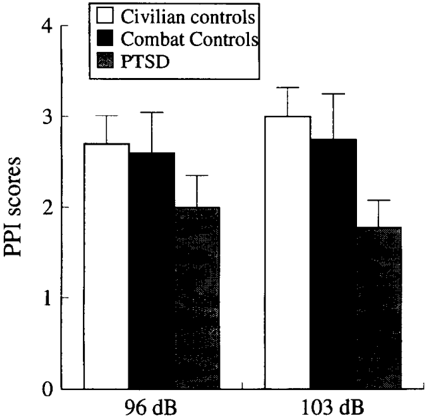
Although an exaggerated startle response is a symptom of posttraumatic stress disorder (PTSD), empirical support for elevated baseline startle in PTSD has been weak. The present study investigated the eyeblink component of the acoustic startle reflex and prepulse inhibition (PPI) in 21 unmedicated Vietnam veterans with PTSD and in 17 civilian and 10 combat veteran comparison subjects. Patients with PTSD exhibited normal acoustic startle amplitude, but showed a significant reduction in PPI relative to the civilian subjects. There was only a trend toward a reduction in PPI in the PTSD group compared with the combat control group. The study does not support the hypothesis of exaggerated baseline startle in Vietnam veterans with PTSD but suggests abnormal startle modulation by a prepulse (i.e., PPI). Discrepancies between studies concerning the amplitude of startle in PTSD are discussed.
Overview
The claims and statistics of this paper haven’t been checked yet.
Free: it reads the open-access text and checks the first 5 claims that cite a source we can check. Create a free account to check every claim.
Integrity signals
Registry
Cites
Statistics
Figures
Verification
Claims the paper makes
The claims and statistics of this paper haven’t been checked yet.
Free: it reads the open-access text and checks the first 5 claims that cite a source we can check. Create a free account to check every claim.
Claims other papers make about this one
Each is checked against this paper’s own text: does it say what the citing paper says it does?
The cited source says what the claim attributes to it.
In the citing paper
“Similar results have been reported in PTSD (Grillon et al, 1996; Morgan et al, 1995a, b).”
From Phasic vs Sustained Fear in Rats and Humans: Role of the Extended Amygdala in Fear vs Anxiety (2010) · cites this paper as Grillon et al, 1996
Self-check
Percentages, sums and reported differences re-computed from the paper’s own numbers.
The self-check needs the paper’s full text.
Citations
Cites
(1970) · Cited by 24,983
Differential contribution of amygdala and hippocampus to cued and contextual fear conditioning.
Phillips, R. G., & LeDoux, J. E. (1992) · Behavioral Neuroscience · doi:10.1037/0735-7044.106.2.274 · Cited by 3,292 · cited 1×
“We have suggested elsewhere that exaggerated startle in Vietnam veterans with PTSD is a reflection of their increased sensitivity to an unfamiliar and/or threatening environment and may involve deficits at the level of the hippocampus (Caine et al., 1992; Morgan et al., 1995a) because this structure has been shown to…”
BackgroundDSM-IV: Diagnostic and Statistical Manual of Mental Disorders
Bell, C. C. (1994) · JAMA: The Journal of the American Medical Association · doi:10.1001/jama.1994.03520100096046 · Cited by 2,610
Modality-Specific Retrograde Amnesia of Fear
Kim, J. J., & Fanselow, M. S. (1992) · Science · doi:10.1126/science.1585183 · Cited by 2,483
Emotion, attention, and the startle reflex
Lang, P. J., Bradley, M. M., & Cuthbert, B. N. (1990) · Psychological Review · doi:10.1037/0033-295x.97.3.377 · Cited by 2,205 · cited 1×
“It is well known that startle can be elevated when presented in association with emotionally significant stimuli ( Lang et al., 1990 ).”
BackgroundThe amygdala: Neurobiological aspects of emotion, memory, and mental dysfunction.
Aggleton, J. P. (1992) · Wiley-Liss eBooks · Cited by 1,536
Keane, T. M., Caddell, J. M., & Taylor, K. L. (1988) · Journal of Consulting and Clinical Psychology · doi:10.1037//0022-006x.56.1.85 · Cited by 1,323 · cited 1×
“Each veteran subject (PTSD and combat control) was also given the Mississippi Scale for Combat-Related PTSD to assess the intensity of the PTSD symptoms ( Keane et al., 1988 ) and the Combat Exposure Scale (CES) to evaluate the level of combat exposure (Lund et al., 1984) (Table 1). The scores on the Mississippi Scale…”
MethodInfluentialSensorimotor Gating and Schizophrenia: Human and Animal Model Studies
Braff, D. L. (1990) · Archives of General Psychiatry · doi:10.1001/archpsyc.1990.01810140081011 · Cited by 1,309
The amygdala: Neurobiological aspects of emotion, memory and mental dysfunction
Scheel-Krüger, J. (1993) · Journal of Chemical Neuroanatomy · doi:10.1016/0891-0618(93)90037-5 · Cited by 1,267
Prestimulus Effects on Human Startle Reflex in Normals and Schizophrenics
Braff, D., Stone, C., Callaway, E., Geyer, M., Glick, I., & Bali, L. (1978) · Psychophysiology · doi:10.1111/j.1469-8986.1978.tb01390.x · Cited by 1,170 · cited 1×
“PPI deficits in schizophrenic patients ( Braff et al., 1978, 1992; Grillon et al., 19921, obsessive-compulsive patients (Swerdlow et al., 19931, and individuals at-risk for schizophrenia (Simons and Giardina, 1992) have been interpreted according to this view.”
BackgroundInternal consistencies of the original and revised beck depression inventory
Beck, A. T., & Steer, R. A. (1984) · Journal of Clinical Psychology · doi:10.1002/1097-4679(198411)40:6<1365::aid-jclp2270400615>3.0.co;2-d · Cited by 1,146
Gating and Habituation of the Startle Reflex in Schizophrenic Patients
Braff, D. L. (1992) · Archives of General Psychiatry · doi:10.1001/archpsyc.1992.01820030038005 · Cited by 1,027
Self-citation(1992) · Cited by 626
Self-citationSwerdlow, N. R., Caine, S. B., Braff, D. L., & Geyer, M. A. (1992) · Journal of Psychopharmacology · doi:10.1177/026988119200600210 · Cited by 388 · cited 1×
“Medication status could also have affected the PPI data in the study of Butler et al. For example, treatment with dopamine agonists could be expected to increase or normalize PPI ( Swerdlow et al., 1992 ).”
A preliminary assessment of sensorimotor gating in patients with obsessive compulsive disorder
Swerdlow, N. R., Benbow, C. H., Zisook, S., Geyer, M. A., & Braff, D. L. (1993) · Biological Psychiatry · doi:10.1016/0006-3223(93)90300-3 · Cited by 351 · cited 1×
“Patients with obsessivecompulsive disorder were also excluded because loss of prepulse inhibition has been documented in such patients (Swerdlow et al., 1993).”
BackgroundStartle gating deficits occur across prepulse intensities in schizophrenic patients
Grillon, C., Ameli, R., Charney, D. S., Krystal, J., & Braff, D. (1992) · Biological Psychiatry · doi:10.1016/0006-3223(92)90183-z · Cited by 331
Self-citation(1990) · American Journal of Psychiatry · doi:10.1176/ajp.147.10.1308 · Cited by 273 · cited 6×
“This would be consistent with findings of reduced PPI in PTSD patients versus subjects who have not been exposed to trauma (Ornitz and Pynoos, 1989), but normal PPI compared to subjects who have been exposed to trauma (Butler et al., 1990).”
BackgroundResultInfluentialStartle modulation in children with posttraumatic stress disorder
(1989) · American Journal of Psychiatry · doi:10.1176/ajp.146.7.866 · Cited by 245
Fear-potentiated startle in posttraumatic stress disorder
Morgan, C. A., Grillon, C., Southwick, S. M., Davis, M., & Charney, D. S. (1995) · Biological Psychiatry · doi:10.1016/0006-3223(94)00321-s · Cited by 242 · cited 6×
“The finding of normal startle response in Vietnam veterans with PTSD in the present study, together with results from two separate studies with PTSD veterans from the same cohort indicating increased startle in stressful situations (i.e., threat of aversive shock [ Morgan et al., 1995a ] and yohimbine injection [Morga…”
BackgroundMethodResultInfluentialSelf-citationPhysiologic Responses to Loud Tones in Israeli Patients With Posttraumatic Stress Disorder
Shalev, A. Y. (1992) · Archives of General Psychiatry · doi:10.1001/archpsyc.1992.01820110034005 · Cited by 236
Filion, D. L., Dawson, M. E., & Schell, A. M. (1993) · Biological Psychology · doi:10.1016/0301-0511(93)90001-o · Cited by 230
Sensitization of the acoustic startle reflex by footshock.
Davis, M. (1989) · Behavioral Neuroscience · doi:10.1037//0735-7044.103.3.495 · Cited by 229 · cited 1×
“On the other hand, a brief period of electric footshock can cause a pronounced increase in startle amplitude in rats (Davis, 1989; Krase et al., 1994) and in humans (Hamm et al.”
BackgroundSelf-citationPhysiologic responses to loud tones in Vietnam veterans with posttraumatic stress disorder.
Orr, S. P., Lasko, N. B., Shalev, A. Y., & Pitman, R. K. (1995) · Journal of Abnormal Psychology · doi:10.1037//0021-843x.104.1.75 · Cited by 213
Abnormal stimulus processing in posttraumatic stress disorder.
McFarlane, A. C., Lee Weber, D., & Clark, C. R. (1993) · Biological Psychiatry · doi:10.1016/0006-3223(93)90088-u · Cited by 206 · cited 1×
“Reduced responsivity to nonstartling stimuli in PTSD has also been reported in evoked-potential studies (Paige et al., 1990; McFarlane et al., 1993 ).”
BackgroundExaggerated acoustic startle reflex in Gulf War veterans with posttraumatic stress disorder
(1996) · American Journal of Psychiatry · doi:10.1176/ajp.153.1.64 · Cited by 206
Self-citationEmotional learning, hedonic change, and the startle probe.
Hamm, A. O., Greenwald, M. K., Bradley, M. M., & Lang, P. J. (1993) · Journal of Abnormal Psychology · doi:10.1037//0021-843x.102.3.453 · Cited by 196
The combat exposure scale: A systematic assessment of trauma in the vietnam war
Lund, M., Foy, D., Sipprelle, C., & Strachan, A. (1984) · Journal of Clinical Psychology · doi:10.1002/1097-4679(198411)40:6<1323::aid-jclp2270400607>3.0.co;2-i · Cited by 151 · cited 1×
“Each veteran subject (PTSD and combat control) was also given the Mississippi Scale for Combat-Related PTSD to assess the intensity of the PTSD symptoms (Keane et al., 1988) and the Combat Exposure Scale (CES) to evaluate the level of combat exposure ( Lund et al., 1984 ) (Table 1). The scores on the Mississippi Scale…”
MethodInfluentialHippocampal modulation of acoustic startle and prepulse inhibition in the rat
Caine, S. B., Geyer, M. A., & Swerdlow, N. R. (1992) · Pharmacology Biochemistry and Behavior · doi:10.1016/0091-3057(92)90503-8 · Cited by 131
Psychophysiological correlates of posttraumatic stress disorder in Vietnam veterans
Paige, S. R., Reid, G. M., Allen, M. G., & Newton, J. E. O. (1990) · Biological Psychiatry · doi:10.1016/0006-3223(90)90552-d · Cited by 130 · cited 2×
“Paige et al. (1990) noted reduced evoked potentials to intense stimuli in PTSD subjects and suggested that these individuals entered a state of protective inhibition to reduce the impact of intense stimulation.”
BackgroundHackley, S. A., & Graham, F. K. (1987) · Journal of Experimental Psychology: Human Perception and Performance · doi:10.1037//0096-1523.13.3.411 · Cited by 125 · cited 1×
“PPI is increased in concert with increased attention to the prepulse ( Hackley and Graham, 1987; Filion et al., 1993).”
BackgroundMaturation of Startle Modulation
Ornitz, E. M., Guthrie, D., Kaplan, A. R., Lane, S. J., & Norman, R. J. (1986) · Psychophysiology · doi:10.1111/j.1469-8986.1986.tb00681.x · Cited by 103
Yohimbine facilitated acoustic startle in combat veterans with post-traumatic stress disorder
Morgan, C. A., Grillon, C., Southwick, S. M., Nagy, L. M., Davis, M., Krystal, J. H., & Charney, D. S. (1995) · Psychopharmacology · doi:10.1007/bf02246220 · Cited by 96
Self-citationPhysiologic responses to loud tones in israeli veterans of the 1973 yom kippur war
Orr, S. P., Solomon, Z., Peri, T., Pitman, R. K., & Shalev, A. Y. (1997) · Biological Psychiatry · doi:10.1016/s0006-3223(95)00671-0 · Cited by 88 · cited 1×
“It is unlikely that methodological differences are the main source of the discrepancies because three studies used the same paradigm and found three different results (Shalev et al., 1992; Orr et al., 1995, 1996 ).”
ResultSubstance P is involved in the sensitization of the acoustic startle response by footshocks in rats
Krase, W., Koch, M., & Schnitzler, H. (1994) · Behavioural Brain Research · doi:10.1016/0166-4328(94)90053-1 · Cited by 86 · cited 1×
“On the other hand, a brief period of electric footshock can cause a pronounced increase in startle amplitude in rats (Davis, 1989; Krase et al., 1994 ) and in humans (Hamm et al., 1993; Hamm and Stark, 1993), although this effect only seems to last for an hour or so. Stronger, more prolonged footshock can increase sta…”
BackgroundPersistent stress-induced sensitization of adrenocortical and startle responses
Servatius, R. J., Ottenweller, J. E., Bergen, M. T., Soldan, S. A., & Natelson, B. H. (1994) · Physiology & Behavior · doi:10.1016/0031-9384(94)90328-x · Cited by 74 · cited 1×
“Stronger, more prolonged footshock can increase startle for longer periods of time, but again the time course is still relatively short, lasting for 4 but not 10 days (Servatius et al., 1994).”
BackgroundReflex Modification in Psychosis‐Prone Young Adults
Simons, R. F., & Giardina, B. D. (1992) · Psychophysiology · doi:10.1111/j.1469-8986.1992.tb02004.x · Cited by 70 · cited 1×
“PPI deficits in schizophrenic patients (Braff et al., 1978, 1992; Grillon et al., 19921, obsessive-compulsive patients (Swerdlow et al., 19931, and individuals at-risk for schizophrenia ( Simons and Giardina, 1992 ) have been interpreted according to this view.”
BackgroundSensitization and aversive conditioning: Effects on the startle reflex and electrodermal responding
Hamm, A. O., & Stark, R. M. (1993) · Integrative Psychological and Behavioral Science · doi:10.1007/bf02691223 · Cited by 32 · cited 1×
“On the other hand, a brief period of electric footshock can cause a pronounced increase in startle amplitude in rats (Davis, 1989; Krase et al., 1994) and in humans (Hamm et al., 1993; Hamm and Stark, 1993 ), although this effect only seems to last for an hour or so. Stronger, more prolonged footshock can increase sta…”
BackgroundLeitner, D. S. (1986) · Annals of the New York Academy of Sciences · doi:10.1111/j.1749-6632.1986.tb14620.x · Cited by 24 · cited 1×
“For example, PPI is reduced in the rat following immersion in cold water ( Leitner, 1986 ).”
BackgroundMaturation of Startle Facilitation by Sustained Prestimulation
Ornitz, E. M., Guthrie, D., Lane, S. J., & Sugiyama, T. (1990) · Psychophysiology · doi:10.1111/j.1469-8986.1990.tb00385.x · Cited by 20
Research works printed but not linked: 6
- 1. American Psychiatric Association. (1994) DSh4-N: Diagnosric and Statistical Manual of Mental Disorder. 4th edn. Ameri- can Psychiatric Press, Washington, DC.
- 7. Cuthbert, B.N., Drobes, D.J., Patrick, C.J. and Lang, P.J. (1994) Autonomic and startle responding during affective imagery among anxious patients (abstract). Psychophysi- ology 31, s35.
- 10. Davis, M., Gewirtz, J.C., McNish, K.A. and Kim, M. (2995) The role of the amygdala and bed nucleus of the stria terminalis (BNSTI in the acquisition of fear potentiated startle using both explicit and contextual cues. Sot Neurosci Abst 21, 1224.
- 36. Southwick, S.M., Morgan, A., Nagy, L.M., Bremner, D., Nicolaou, A., Johnson, D.R., Rosenheck, R. and Chamey, D.S. (1993) Trauma-related symptoms in veterans of Oper- ation Desert Storm: An interim report. Am J Psychiatry 150, 1525-1528.
- 37. Spielberger, C.D. (1983) Manual for the State-Trait Amiety Inuentoty. Consulting Psychologist Press, Palo Alto, CA.
- 38. Spitzer, R.L., Williams, J.B., Gibbon, M. and First, M.B. (1990) Structured Clinical Interview for DSM-III-R. Ameri- can Psychiatric Press, Washington, DC.
Cited by
Braff, D. L., Geyer, M. A., & Swerdlow, N. R. (2001) · Psychopharmacology · doi:10.1007/s002130100810 · Cited by 1,705
“Conflicting results have been published with reports of diminished (Ornitz and Pynoos 1989), normal (Grillon et al. 1996), and increased startle magnitude (Butler et al. 1990; Morgan et al. 1996; Grillon et al. 1998) and of normal (Butler et al. 1990; Grillon et al. 1998) and deficient PPI (Ornitz and Pynoos 1989; Gri…”
BackgroundResultInfluentialPhasic vs Sustained Fear in Rats and Humans: Role of the Extended Amygdala in Fear vs Anxiety
Davis, M., Walker, D. L., Miles, L., & Grillon, C. (2010) · Neuropsychopharmacology · doi:10.1038/npp.2009.109 · Cited by 1,513
Self-citationKoch, M. (1999) · Progress in Neurobiology · doi:10.1016/s0301-0082(98)00098-7 · Cited by 1,287
“The ASR is also enhanced in human patients suffering from anxiety disorders (Grillon et al., 1994b, 1996), in humans anticipating shock (Grillon et al., 1991), in the presence of an unpleasant odor (Ehrlichman et al., 1995), or while viewing aversive pictures (Lang et al., 1990; Patrick et al.,…”
BackgroundThe impact of anxiety upon cognition: perspectives from human threat of shock studies
Robinson, O. J., Vytal, K., Cornwell, B. R., & Grillon, C. (2013) · Frontiers in Human Neuroscience · doi:10.3389/fnhum.2013.00203 · Cited by 613
“Auditory MMN amplitudes have been shown to be abnormally increased in two independent samples of unmedicated patients with PTSD (Morgan III and Grillon, 1999; Ge et al., 2011) and dispositional anxiety has also been shown to positively correlate with MMN amplitudes (Hansenne et al., 2003).”
BackgroundInfluentialSelf-citationThe psychophysiology of posttraumatic stress disorder: a meta-analysis
Pole, N. (2007) · Psychological Bulletin · doi:10.1037/0033-2909.133.5.725 · Cited by 582
Metadata
- Authors
- Grillon, C., Morgan, C. A., Southwick, S. M., Davis, M., & Charney, D. S.
- Affiliations
- United States Department of Veterans Affairs (US)
- Yale University (US)
- Corresponding author
- Grillon, Christian
- Venue
- Psychiatry Research
- Publisher
- Elsevier BV
- Published
- 1996-10
- Volume
- 64
- Issue
- 3
- Pages
- 169-178
- ISSN
- 0165-1781 (ISSN-L)
- OpenAlex
- W2031260481
- Cited by
- 221
- References
- 39
- Citations by year
- 2026: 2 · 2025: 5 · 2024: 6 · 2023: 6 · 2022: 4 · 2021: 7 · 2020: 6 · 2019: 5 · 2018: 8 · 2017: 5 · 2016: 6 · 2015: 7 · 2014: 8 · 2013: 10 · 2012: 8
- FWCI
- 9.47
- Type
- journal article
- Language
- en
- Open access
- hybrid
- doi.org
- Licence
- cc-by-nc-nd
- www.elsevier.com/tdm/userlicense/1.0/ (tdm)
- www.elsevier.com/legal/tdmrep-license (tdm)
- creativecommons.org/licenses/by-nc-nd/4.0/ (vor, 899 d)
- Locations
- Psychiatry Research (publishedVersion, cc-by-nc-nd)
- PubMed (publishedVersion)
- Funders
- National Institutes of Health (5r29mh050720-05)
- National Center for PTSD, U.S. Department of Veterans Affairs
- National Institute of Mental Health (1 R29 MH-50720, MH-50720)
- Topics
- Social Sciences › Psychology › Clinical Psychology › Posttraumatic Stress Disorder Research
- Health Sciences › Medicine › Clinical Neurology › Traumatic Brain Injury Research
- Social Sciences › Psychology › Clinical Psychology › Psychoanalysis and Psychopathology Research
- Keywords
- post-traumatic stress disorder, acoustic startle response, prepulse inhibition, Vietnam War veterans, combat veterans, startle modulation, civilian comparison
- MeSH terms
- Acoustic Stimulation, Adult, Arousal, Blinking, Combat Disorders, Habituation, Psychophysiologic, Humans, Inhibition, Psychological, Male, Middle Aged, Personality Inventory, Reflex, Startle, Veterans, Vietnam
About these checks
Registry, retraction, Cites and statistics results are computed, not judged, with one exception: a printed reference that no index lists is read once by a model before it counts as a citation error. Claims are extracted by a model and kept only when their quote appears verbatim in the text; each cited source is then checked, with a model’s help, for whether it says what the claim relies on. Those verdicts can be wrong — read the claim’s quote and the cited source before relying on one.
Statistics and arithmetic are recomputed, not judged.
Confidence bands are shown only for fields calibrated on our annotated test set. None is calibrated yet, so no band is shown.
What counts as a claim ›How we measure confidence ›How we check this ›
Are you an author, or do you see a problem with this page? Request a review
Data sources
Bibliographic data: Semantic Scholar, OpenAlex, Crossref.
Contains information from the Semantic Scholar Academic Graph Datasets, made available under the ODC Attribution License (ODC-BY 1.0).
Semantic Scholar’s data is described in: Kinney, R., et al. (2023). The Semantic Scholar Open Data Platform. arXiv:2301.10140.
