

Baseline startle amplitude and prepulse inhibition in Vietnam veterans with posttraumatic stress disorder
Open accessThe DOI matches its Crossref record; 39 of the 39 references it cites were found in a registry or an index.
Abstract
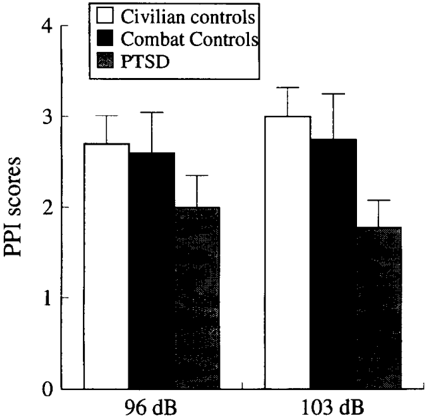
Although an exaggerated startle response is a symptom of posttraumatic stress disorder (PTSD), empirical support for elevated baseline startle in PTSD has been weak. The present study investigated the eyeblink component of the acoustic startle reflex and prepulse inhibition (PPI) in 21 unmedicated Vietnam veterans with PTSD and in 17 civilian and 10 combat veteran comparison subjects. Patients with PTSD exhibited normal acoustic startle amplitude, but showed a significant reduction in PPI relative to the civilian subjects. There was only a trend toward a reduction in PPI in the PTSD group compared with the combat control group. The study does not support the hypothesis of exaggerated baseline startle in Vietnam veterans with PTSD but suggests abnormal startle modulation by a prepulse (i.e., PPI). Discrepancies between studies concerning the amplitude of startle in PTSD are discussed.
Overview
The claims and statistics of this paper haven’t been checked yet.
Free: it reads the open-access text and checks the first 5 claims that cite a source we can check. Create a free account to check every claim.
Integrity signals
Registry
Cites
Statistics
Figures
Verification
Claims the paper makes
The claims and statistics of this paper haven’t been checked yet.
Free: it reads the open-access text and checks the first 5 claims that cite a source we can check. Create a free account to check every claim.
Claims other papers make about this one
Each is checked against this paper’s own text: does it say what the citing paper says it does?
The cited source says what the claim attributes to it.
In the citing paper
“Similar results have been reported in PTSD (Grillon et al, 1996; Morgan et al, 1995a, b).”
From Phasic vs Sustained Fear in Rats and Humans: Role of the Extended Amygdala in Fear vs Anxiety (2010) · cites this paper as Grillon et al, 1996
Self-check
Percentages, sums and reported differences re-computed from the paper’s own numbers.
The self-check needs the paper’s full text.
Citations
Cites
(1970) · Cited by 24,983
Differential contribution of amygdala and hippocampus to cued and contextual fear conditioning.
Phillips, R. G., & LeDoux, J. E. (1992) · Behavioral Neuroscience · doi:10.1037/0735-7044.106.2.274 · Cited by 3,292 · cited 1×
“We have suggested elsewhere that exaggerated startle in Vietnam veterans with PTSD is a reflection of their increased sensitivity to an unfamiliar and/or threatening environment and may involve deficits at the level of the hippocampus (Caine et al., 1992; Morgan et al., 1995a) because this structure has been shown to…”
BackgroundDSM-IV: Diagnostic and Statistical Manual of Mental Disorders
Bell, C. C. (1994) · JAMA: The Journal of the American Medical Association · doi:10.1001/jama.1994.03520100096046 · Cited by 2,610
Modality-Specific Retrograde Amnesia of Fear
Kim, J. J., & Fanselow, M. S. (1992) · Science · doi:10.1126/science.1585183 · Cited by 2,483
Emotion, attention, and the startle reflex
Lang, P. J., Bradley, M. M., & Cuthbert, B. N. (1990) · Psychological Review · doi:10.1037/0033-295x.97.3.377 · Cited by 2,205 · cited 1×
“It is well known that startle can be elevated when presented in association with emotionally significant stimuli ( Lang et al., 1990 ).”
BackgroundThe amygdala: Neurobiological aspects of emotion, memory, and mental dysfunction.
Aggleton, J. P. (1992) · Wiley-Liss eBooks · Cited by 1,536
Keane, T. M., Caddell, J. M., & Taylor, K. L. (1988) · Journal of Consulting and Clinical Psychology · doi:10.1037//0022-006x.56.1.85 · Cited by 1,323 · cited 1×
“Each veteran subject (PTSD and combat control) was also given the Mississippi Scale for Combat-Related PTSD to assess the intensity of the PTSD symptoms ( Keane et al., 1988 ) and the Combat Exposure Scale (CES) to evaluate the level of combat exposure (Lund et al., 1984) (Table 1). The scores on the Mississippi Scale…”
MethodInfluentialSensorimotor Gating and Schizophrenia: Human and Animal Model Studies
Braff, D. L. (1990) · Archives of General Psychiatry · doi:10.1001/archpsyc.1990.01810140081011 · Cited by 1,309
The amygdala: Neurobiological aspects of emotion, memory and mental dysfunction
Scheel-Krüger, J. (1993) · Journal of Chemical Neuroanatomy · doi:10.1016/0891-0618(93)90037-5 · Cited by 1,267
Prestimulus Effects on Human Startle Reflex in Normals and Schizophrenics
Braff, D., Stone, C., Callaway, E., Geyer, M., Glick, I., & Bali, L. (1978) · Psychophysiology · doi:10.1111/j.1469-8986.1978.tb01390.x · Cited by 1,170 · cited 1×
“PPI deficits in schizophrenic patients ( Braff et al., 1978, 1992; Grillon et al., 19921, obsessive-compulsive patients (Swerdlow et al., 19931, and individuals at-risk for schizophrenia (Simons and Giardina, 1992) have been interpreted according to this view.”
Background
Research works printed but not linked: 6
- 1. American Psychiatric Association. (1994) DSh4-N: Diagnosric and Statistical Manual of Mental Disorder. 4th edn. Ameri- can Psychiatric Press, Washington, DC.
- 7. Cuthbert, B.N., Drobes, D.J., Patrick, C.J. and Lang, P.J. (1994) Autonomic and startle responding during affective imagery among anxious patients (abstract). Psychophysi- ology 31, s35.
- 10. Davis, M., Gewirtz, J.C., McNish, K.A. and Kim, M. (2995) The role of the amygdala and bed nucleus of the stria terminalis (BNSTI in the acquisition of fear potentiated startle using both explicit and contextual cues. Sot Neurosci Abst 21, 1224.
- 36. Southwick, S.M., Morgan, A., Nagy, L.M., Bremner, D., Nicolaou, A., Johnson, D.R., Rosenheck, R. and Chamey, D.S. (1993) Trauma-related symptoms in veterans of Oper- ation Desert Storm: An interim report. Am J Psychiatry 150, 1525-1528.
- 37. Spielberger, C.D. (1983) Manual for the State-Trait Amiety Inuentoty. Consulting Psychologist Press, Palo Alto, CA.
- 38. Spitzer, R.L., Williams, J.B., Gibbon, M. and First, M.B. (1990) Structured Clinical Interview for DSM-III-R. Ameri- can Psychiatric Press, Washington, DC.
Cited by
Braff, D. L., Geyer, M. A., & Swerdlow, N. R. (2001) · Psychopharmacology · doi:10.1007/s002130100810 · Cited by 1,705
“Conflicting results have been published with reports of diminished (Ornitz and Pynoos 1989), normal (Grillon et al. 1996), and increased startle magnitude (Butler et al. 1990; Morgan et al. 1996; Grillon et al. 1998) and of normal (Butler et al. 1990; Grillon et al. 1998) and deficient PPI (Ornitz and Pynoos 1989; Gri…”
BackgroundResultInfluentialPhasic vs Sustained Fear in Rats and Humans: Role of the Extended Amygdala in Fear vs Anxiety
Davis, M., Walker, D. L., Miles, L., & Grillon, C. (2010) · Neuropsychopharmacology · doi:10.1038/npp.2009.109 · Cited by 1,513
Self-citationKoch, M. (1999) · Progress in Neurobiology · doi:10.1016/s0301-0082(98)00098-7 · Cited by 1,287
“The ASR is also enhanced in human patients suffering from anxiety disorders (Grillon et al., 1994b, 1996), in humans anticipating shock (Grillon et al., 1991), in the presence of an unpleasant odor (Ehrlichman et al., 1995), or while viewing aversive pictures (Lang et al., 1990; Patrick et al.,…”
BackgroundThe impact of anxiety upon cognition: perspectives from human threat of shock studies
Robinson, O. J., Vytal, K., Cornwell, B. R., & Grillon, C. (2013) · Frontiers in Human Neuroscience · doi:10.3389/fnhum.2013.00203 · Cited by 613
“Auditory MMN amplitudes have been shown to be abnormally increased in two independent samples of unmedicated patients with PTSD (Morgan III and Grillon, 1999; Ge et al., 2011) and dispositional anxiety has also been shown to positively correlate with MMN amplitudes (Hansenne et al., 2003).”
BackgroundInfluentialSelf-citationThe psychophysiology of posttraumatic stress disorder: a meta-analysis
Pole, N. (2007) · Psychological Bulletin · doi:10.1037/0033-2909.133.5.725 · Cited by 582
Grillon, C., & Baas, J. (2003) · Clinical Neurophysiology · doi:10.1016/s1388-2457(03)00202-5 · Cited by 563
Self-citationHauger, R., Risbrough, V., Brauns, O., & Dautzenberg, F. (2006) · CNS & Neurological Disorders - Drug Targets · doi:10.2174/187152706777950684 · Cited by 343
Grillon, C., & Morgan, C. A. (1999) · Journal of Abnormal Psychology · doi:10.1037/0021-843x.108.1.134 · Cited by 331
Self-citationAttention Moderates the Fearlessness of Psychopathic Offenders
Newman, J. P., Curtin, J. J., Bertsch, J. D., & Baskin-Sommers, A. R. (2010) · Biological Psychiatry · doi:10.1016/j.biopsych.2009.07.035 · Cited by 314
Borrell, J. (2002) · Neuropsychopharmacology · doi:10.1016/s0893-133x(01)00360-8 · Cited by 307
“…Gating 205 Tourette’s syndrome (Castellanos et al. 1996)), where inability to control attentional and cognitive processes is involved (obsessive-compulsive disorder (Swerdlow et al. 1993)), or where anxiety and exaggerated startle occur (posttraumatic stress disorder (Grillon et al. 1996)).”
Zoladz, P. R., & Diamond, D. M. (2013) · Neuroscience & Biobehavioral Reviews · doi:10.1016/j.neubiorev.2013.03.024 · Cited by 305
“In a related study, Grillon et al. (1996) examined the baseline tartle response of Vietnam veterans with PTSD in a familiar envionment, the VA hospital from which they had been recruited. n this work, the investigators found no differences between the iobehavioral Reviews 37 (2013) 860– 895 startle…”
InfluentialPrepulse inhibition in psychiatric disorders – Apart from schizophrenia
Kohl, S., Heekeren, K., Klosterkötter, J., & Kuhn, J. (2013) · Journal of Psychiatric Research · doi:10.1016/j.jpsychires.2012.11.018 · Cited by 298
“2005), whereas others report altered PPI in PTSD patients (Grillon et al., 1998b; Grillon et al., 1996; Ornitz and Pynoos, 1989).”
BackgroundThe effects of an early stressful life event on sensorimotor gating in adult rats
Ellenbroek, B. A., van den Kroonenberg, P. T. J. M., & Cools, A. R. (1998) · Schizophrenia Research · doi:10.1016/s0920-9964(97)00149-7 · Cited by 264
Grillon, C., Morgan, C. A., Davis, M., & Southwick, S. M. (1998) · Biological Psychiatry · doi:10.1016/s0006-3223(98)00034-1 · Cited by 263
“Whereas some studies have reported exaggerated baseline startle (Orr et al 1995; Butler et al 1990), others have found a normal (Orr et al 1997; Grillon et al 1996) or reduced response (Ornitz and Pynoos 1989).”
BackgroundMethodResultInfluentialSelf-citationRole of corticotropin releasing factor in anxiety disorders: A translational research perspective
Risbrough, V. B., & Stein, M. B. (2006) · Hormones and Behavior · doi:10.1016/j.yhbeh.2006.06.019 · Cited by 236
“PPI performance and baseline startle appeared to be the most disrupted in panic disorder patients that were not undergoing treatment during the study, while patients receiving treatment appeared to have relatively milder PPI impairments and normalized startle (Ludewig et al., 2005,2002).”
BackgroundInfluentialGRILLON, C., & DAVIS, M. (1997) · Psychophysiology · doi:10.1111/j.1469-8986.1997.tb02389.x · Cited by 220
Self-citationPsychophysiology of post-traumatic stress disorder
Orr, S. P., Metzger, L. J., & Pitman, R. K. (2002) · Psychiatric Clinics of North America · doi:10.1016/s0193-953x(01)00007-7 · Cited by 187
“[52] Grillon C, Morgan CA, Southwick SM, et al.”
BackgroundResultThe therapeutic potential of CRF1 antagonists for anxiety
Zorrilla, E. P., & Koob, G. F. (2004) · Expert Opinion on Investigational Drugs · doi:10.1517/13543784.13.7.799 · Cited by 176
Fournier, P., & Hébert, S. (2012) · Hearing Research · doi:10.1016/j.heares.2012.05.011 · Cited by 188
“, 1995), post-traumatic stress disorder (Grillon et al., 1996), and primary insomnia (Frau et al.”
BackgroundPissiota, A., Frans, Ö., Michelgård, Å., Appel, L., Långström, B., Flaten, M. A., & Fredrikson, M. (2003) · European Journal of Neuroscience · doi:10.1046/j.1460-9568.2003.02855.x · Cited by 165
Pole, N., Neylan, T. C., Otte, C., Henn-Hasse, C., Metzler, T. J., & Marmar, C. R. (2009) · Biological Psychiatry · doi:10.1016/j.biopsych.2008.07.015 · Cited by 164
“However, in the absence of contextual threat, exaggerated eyeblink findings in PTSD have been less consistent (6,14).”
Dissociation of the morphological correlates of stress‐induced anxiety and fear
Pêgo, J. M., Morgado, P., Pinto, L. G., Cerqueira, J. J., Almeida, O. F. X., & Sousa, N. (2008) · European Journal of Neuroscience · doi:10.1111/j.1460-9568.2008.06112.x · Cited by 151
“This response is also enhanced in humans who suffer from anxiety disorders (Grillon et al., 1994, 1996) and is considered a diagnostic criterion for post-traumatic stress disorder (American Psychiatric Association, 1994).”
BackgroundDrug induced nightmares—an etiology based review
Pagel, J. F., & Helfter, P. (2003) · Human Psychopharmacology: Clinical and Experimental · doi:10.1002/hup.465 · Cited by 152
“The nightmares of PTSD are often associated with disturbed sleep and altered daytime behavior that is best described as hyperarousability (Grillon et al., 1996).”
BackgroundFear-potentiated startle in adolescent offspring of parents with anxiety disordersf
Grillon, C., Dierker, L., & Merikangas, K. R. (1998) · Biological Psychiatry · doi:10.1016/s0006-3223(98)00188-7 · Cited by 151
Self-citationPharmacologic Reduction of CNS Noradrenergic Activity in PTSD: The Case for Clonidine and Prazosin
BOEHNLEIN, J. K., & KINZIE, J. D. (2007) · Journal of Psychiatric Practice · doi:10.1097/01.pra.0000265763.79753.c1 · Cited by 140
Smith, K. L., Kassem, M. S., Clarke, D. J., Kuligowski, M. P., Bedoya-Pérez, M. A., Todd, S. M., Lagopoulos, J., Bennett, M. R., & Arnold, J. C. (2019) · Brain, Behavior, and Immunity · doi:10.1016/j.bbi.2019.05.042 · Cited by 124
Vaidyanathan, U., Patrick, C. J., & Cuthbert, B. N. (2009) · Psychological Bulletin · doi:10.1037/a0017222 · Cited by 129
Physiologic reactivity to startling tones in women with posttraumatic stress disorder.
Metzger, L. J., Orr, S. P., Berry, N. J., Ahern, C. E., Lasko, N. B., & Pitman, R. K. (1999) · Journal of Abnormal Psychology · doi:10.1037//0021-843x.108.2.347 · Cited by 127
Childhood abuse is associated with increased startle reactivity in adulthood
Jovanovic, T., Blanding, N. Q., Norrholm, S. D., Duncan, E., Bradley, B., & Ressler, K. J. (2009) · Depression and Anxiety · doi:10.1002/da.20599 · Cited by 120
“found exaggerated startle compared to non-PTSD veterans,([9]) whereas Vietnam veterans with PTSD did not show increased startle([27]) unless they were subjected to a threatening context.”
Prepulse inhibition of startle and the neurobiology of primary nocturnal enuresis
Ornitz, E. M., RUSSELL, A. T., Hanna, G. L., Gabikian, P., Gehricke, J.-G., Song, D., & Guthrie, D. (1999) · Biological Psychiatry · doi:10.1016/s0006-3223(98)00205-4 · Cited by 140
Prepulse Inhibition of the Startle Reflex: A Window on the Brain in Schizophrenia
BRAFF, D. L. (2010) · Current topics in behavioral neurosciences · doi:10.1007/7854_2010_61 · Cited by 135
Risbrough, V. B., Hauger, R. L., Roberts, A. L., Vale, W. W., & Geyer, M. A. (2004) · The Journal of Neuroscience · doi:10.1523/jneurosci.5760-03.2004 · Cited by 123
“, 2002) and PTSD (Grillon et al., 1996; Gillette et al., 1997).”
Neurobiological adaptations to violence across development
Mead, H. K., Beauchaine, T. P., & Shannon, K. E. (2010) · Development and Psychopathology · doi:10.1017/s0954579409990228 · Cited by 121
“Several authors have noted that exaggerated startle could be either a short- or long-term adaptation to threatening environments, or alternatively, a vulnerability factor for the development of anxiety problems (e.g., Grillon et al., 1996).”
BackgroundStartle response in Generalized Anxiety Disorder
Ray, W. J., Molnar, C., Aikins, D., Yamasaki, A., Newman, M. G., Castonguay, L., & Borkovec, T. D. (2009) · Depression and Anxiety · doi:10.1002/da.20479 · Cited by 117
Effect of Darkness on Acoustic Startle in Vietnam Veterans With PTSD
Grillon, C., Morgan, C. A., Davis, M., & Southwick, S. M. (1998) · American Journal of Psychiatry · doi:10.1176/ajp.155.6.812 · Cited by 115
Self-citationRestless ‘rest’: intrinsic sensory hyperactivity and disinhibition in post-traumatic stress disorder
Clancy, K. J., Ding, M., Bernat, E. M., Schmidt, N. B., & Li, W. (2017) · Brain · doi:10.1093/brain/awx116 · Cited by 119
Lebow, M., Neufeld-Cohen, A., Kuperman, Y., Tsoory, M., Gil, S., & Chen, A. (2012) · The Journal of Neuroscience · doi:10.1523/jneurosci.4012-11.2012 · Cited by 109
“While the DSM IV (American Psychiatric Association, 1994) for PTSD includes exaggerated startle, Grillon et al. (1996) reports normal acoustic startle in the response of Vietnam veterans, but abnormally low ppi compared with civilian controls.”
Modulation of physiological reflexes by pain: role of the locus coeruleus
Szabadi, E. (2012) · Frontiers in Integrative Neuroscience · doi:10.3389/fnint.2012.00094 · Cited by 100
“However, it should be noted that exaggerated startle responses have not been reported in every study in which PTSD patients were compared with healthy controls (Grillon et al., 1996; Siegelaar et al., 2006).”
BackgroundPineles, S. L., Nillni, Y. I., Pinna, G., Irvine, J., Webb, A., Arditte Hall, K. A., Hauger, R., Miller, M. W., Resick, P. A., Orr, S. P., et al. (2018) · Psychoneuroendocrinology · doi:10.1016/j.psyneuen.2018.04.024 · Cited by 106
Heldt, S. A., Elberger, A. J., Deng, Y., Guley, N., Mar, N. D., Rogers, J. T., Choi, G. W., Ferrell, J. M., Rex, T. S., Honig, M. G., et al. (2014) · Frontiers in Neurology · doi:10.3389/fneur.2014.00002 · Cited by 112
Current Concepts in Pharmacotherapy for Posttraumatic Stress Disorder
Schoenfeld, F. B., Marmar, C. R., & Neylan, T. C. (2004) · Psychiatric Services · doi:10.1176/appi.ps.55.5.519 · Cited by 107
Biomarkers in Posttraumatic Stress Disorder: Overview and Implications for Future Research
Schmidt, U., Kaltwasser, S. F., & Wotjak, C. T. (2013) · Disease Markers · doi:10.1155/2013/835876 · Cited by 103
The heterozygous reeler mouse: behavioural phenotype
Podhorná, J., & Didriksen, M. (2003) · Behavioural Brain Research · doi:10.1016/j.bbr.2003.10.033 · Cited by 109
Altered resting psychophysiology and startle response in Croatian combat veterans with PTSD
Jovanovic, T., Norrholm, S. D., Sakoman, A. J., Esterajher, S., & Kozarić-Kovačić, D. (2009) · International Journal of Psychophysiology · doi:10.1016/j.ijpsycho.2008.10.007 · Cited by 100
“On the other hand, Vietnam veterans with PTSD did not show increased startle (Grillon et al., 1996), unless they were subjected to a threatening context (Grillon et al.”
BackgroundPooley, A. E., Benjamin, R. C., Sreedhar, S., Eagle, A. L., Robison, A. J., Mazei‐Robison, M. S., Breedlove, S. M., & Jordan, C. L. (2018) · Biology of Sex Differences · doi:10.1186/s13293-018-0191-9 · Cited by 112
“can be detected by comparing changes between preand post-test [33, 34].”
Sink, K. S., Walker, D. L., Yang, Y., & Davis, M. (2011) · The Journal of Neuroscience · doi:10.1523/jneurosci.5274-10.2011 · Cited by 99
“Interestingly, it is these more sustained types of fear responses that appear to be selectively increased in posttraumatic stress and panic disorder patients, and selectively attenuated by established anxiolytics in healthy controls (Grillon et al., 1996).”
BackgroundSelf-citationVanMeter, F., & Cicchetti, D. (2020) · Handbook of clinical neurology · doi:10.1016/b978-0-444-64150-2.00008-3 · Cited by 109
Smoking withdrawal, nicotine dependence and prepulse inhibition of the acoustic startle reflex
Kumari, V., & Gray, J. A. (1999) · Psychopharmacology · doi:10.1007/s002130050800 · Cited by 95
“However, there are also reports indicating deÞcient PPI in disorders other than schizophrenia, for example, in patients with post-traumatic stress (Grillon et al. 1996) and obsessive-compulsive (Swerdlow et al.”
BackgroundAyers, L. W., Missig, G., Schulkin, J. A., & Rosen, J. B. (2011) · Neuropsychopharmacology · doi:10.1038/npp.2011.138 · Cited by 94
“In this regard, combat veterans with PTSD also display disruptions in PPI (Grillon et al, 1998, 1996), a nonlearned measure of sensorimotor gating (Braff et al, 2001), and oxytocin and an oxytocin receptor agonist reverse drug-induced disruption in PPI in rodents (Feifel and Reza, 1999; Ring et al,…”
BackgroundGolub, Y., Mauch, C. P., Dahlhoff, M., & Wotjak, C. T. (2009) · Behavioural Brain Research · doi:10.1016/j.bbr.2009.08.019 · Cited by 99
Startle reflex abnormalities in women with sexual assault-related posttraumatic stress disorder
(1997) · American Journal of Psychiatry · doi:10.1176/ajp.154.8.1076 · Cited by 80
Self-citationBiomarkers for Psychiatric Disorders: Where Are We Standing?
Martins-de-Souza, D. (2013) · Disease Markers · doi:10.1155/2013/321071 · Cited by 34
Fear-potentiated startle and posttraumatic stress symptoms in urban police officers
Pole, N., Neylan, T. C., Best, S. R., Orr, S. P., & Marmar, C. R. (2003) · Journal of Traumatic Stress · doi:10.1023/a:1025758411370 · Cited by 79
“( Grillon, Morgan, Southwick, Davis, & Charney, 1996; Shalev, Orr, Peri, Schreiber, & Pitman, 1992).”
Oxytocin Reduces Background Anxiety in a Fear-Potentiated Startle Paradigm
Missig, G., Ayers, L. W., Schulkin, J., & Rosen, J. B. (2010) · Neuropsychopharmacology · doi:10.1038/npp.2010.155 · Cited by 79
Serova, L. I., Lauková, M., Alaluf, L. G., & Sabban, E. L. (2013) · Behavioural Brain Research · doi:10.1016/j.bbr.2013.05.006 · Cited by 78
Campbell, L., Hughes, M. E., Budd, T. W., Cooper, G. J., Fulham, W. R., Karayanidis, F., Hanlon, M., Stojanov, W., Johnston, P., Case, V., et al. (2007) · European Journal of Neuroscience · doi:10.1111/j.1460-9568.2007.05858.x · Cited by 83
“, 2003) or psychological trauma (e.g. post-traumatic stress disorder; Grillon et al., 1996) for which promising PPI-based animal models already exist (e.”
BackgroundThe effects of early maternal deprivation on auditory information processing in adult wistar rats
Ellenbroek, B. A., de Bruin, N. M. W. J., Kroonenburg, P. T. J. M. V. D., van Luijtelaar, E. L. J. M., & Cools, A. R. (2004) · Biological Psychiatry · doi:10.1016/j.biopsych.2003.10.024 · Cited by 84
“…deprivation, we might consider this an animal model of posttraumatic stress disorder (PTSD), especially as some papers have described deficits in prepulse inhibition (Grillon et al 1996) and P50 (Gillette et al 1997) in these patients; however, there are several arguments against this relationship.”
BackgroundIndividuals with Autism Spectrum Disorder Show Normal Responses to a Fear Potential Startle Paradigm
Bernier, R., Dawson, G., Panagiotides, H., & Webb, S. J. (2005) · Journal of Autism and Developmental Disorders · doi:10.1007/s10803-005-0002-0 · Cited by 83
Luteal-Phase Accentuation of Acoustic Startle Response in Women with Premenstrual Dysphoric Disorder
Epperson, C. N., Pittman, B. P., Czarkowski, K. A., Stiklus, S. M., Krystal, J. H., & Grillon, C. (2007) · Neuropsychopharmacology · doi:10.1038/sj.npp.1301351 · Cited by 82
“Although exaggerated startle response is one of the symptoms of PTSD, a number of studies have found a normal (Grillon et al, 1996; Orr et al, 1997) baseline startle when individuals with PTSD are studied in ‘safe’ conditions.”
BackgroundResultSelf-citationGeneralized fear after acute stress is caused by change in neuronal cotransmitter identity
Li, H.-Q., Jiang, W., Ling, L., Pratelli, M., Chen, C., Gupta, V., Godavarthi, S. K., & Spitzer, N. C. (2024) · Science · doi:10.1126/science.adj5996 · Cited by 68
Taubenfeld, S. M., Riceberg, J. S., New, A. S., & Alberini, C. M. (2009) · Biological Psychiatry · doi:10.1016/j.biopsych.2008.07.005 · Cited by 71
“In fact, fear conditioning appears to be critically involved in the development of a variety of anxiety disorders, PTSD and panic disorders (7-9).”
Rajbhandari, A. K., Baldo, B. A., & Bakshi, V. P. (2015) · The Journal of Neuroscience · doi:10.1523/jneurosci.5080-14.2015 · Cited by 68
“These deficits can be quantified using prepulse inhibition (PPI), a paradigm in which startle responses are inhibited by the presentation of a weak prestimulus immediately before the startling event (Hoffman and Ison, 1980; Grillon et al., 1996; Braff et al., 2001).”
BackgroundPrepulse Inhibition of Startle Response: Recent Advances in Human Studies of Psychiatric Disease
Takahashi, H., Hashimoto, R., Iwase, M., Ishii, R., Kamio, Y., & Takeda, M. (2011) · Clinical Psychopharmacology and Neuroscience · doi:10.9758/cpn.2011.9.3.102 · Cited by 81
Levin, R., Heresco-Levy, U., Bachner-Melman, R., Israel, S., Shalev, I., & Ebstein, R. P. (2009) · Psychoneuroendocrinology · doi:10.1016/j.psyneuen.2008.12.014 · Cited by 68
“, 2005), PTSD (Grillon et al., 1996) and autism (Perry et al.”
BackgroundStartle reactivity and PTSD symptoms in a community sample of women
Medina, A. M., Mejia, V. Y., Schell, A. M., Dawson, M. E., & Margolin, G. (2001) · Psychiatry Research · doi:10.1016/s0165-1781(01)00221-9 · Cited by 73
“Notably, though, a subsequent study using the same Vietnam veteran cohort without threat of Ž .shock in the paradigm Grillon et al., 1996 failed to obtain results supporting the hypothesis of exaggerated baseline startle in PTSD patients.”
BackgroundMethodResultInfluentialZoladz, P. R., Park, C. R., Fleshner, M., & Diamond, D. M. (2015) · Physiology & Behavior · doi:10.1016/j.physbeh.2015.04.032 · Cited by 68
“It might also suggest that, over time, greater variability in the startle response develops, whichmeans an exaggerated startle responsewould bemore difficult to detect in individuals having PTSD for a longer period of time [22,23].”
BackgroundBrain mechanisms for prepulse inhibition in adults with Tourette syndrome: Initial findings
Zebardast, N., Crowley, M. J., Bloch, M. H., Mayes, L. C., Wyk, B. V., Leckman, J. F., Pelphrey, K. A., & Swain, J. E. (2013) · Psychiatry Research Neuroimaging · doi:10.1016/j.pscychresns.2013.05.009 · Cited by 69
Issues in the Developmental Neurobiology of Traumatic Stress
Pynoos, R. S., Steinberg, A. M., Ornitz, E. M., & Goenjian, A. K. (1997) · Annals of the New York Academy of Sciences · doi:10.1111/j.1749-6632.1997.tb48278.x · Cited by 75
Holstein, D. H., Vollenweider, F. X., Jäncke, L., Schopper, C., & Csomor, P. (2010) · Journal of Affective Disorders · doi:10.1016/j.jad.2010.02.122 · Cited by 68
“That numerous studies failed to detect differences in startle reactivity between patients and controls (Carson et al., 2007; Grillon et al., 1996; Jovanovic et al., 2008; Metzger et al., 1999; Orr et al., 1997; Orr et al., 2003; Siegelaar et al., 2006), or even reported decreased startle (Ornitz and Pynoos, 1989) seem…”
BackgroundKorem, N., & Akirav, I. (2014) · Neuropsychopharmacology · doi:10.1038/npp.2014.132 · Cited by 64
Poli, E., & Angrilli, A. (2015) · Frontiers in Behavioral Neuroscience · doi:10.3389/fnbeh.2015.00010 · Cited by 70
“For example, different authors reported an enhanced general startle reflex in war veterans with PTSD (Butler et al., 1990; Orr et al., 1995; Grillon et al., 1996; Morgan et al., 1996; Grillon and Morgan, 1999).”
BackgroundInfluentialAnimal Models of Relevance to PTSD
Rasmusson, A. M., & Charney, D. S. (1997) · Annals of the New York Academy of Sciences · doi:10.1111/j.1749-6632.1997.tb48290.x · Cited by 75
Self-citationJones, C. K., & Shannon, H. E. (2000) · European Journal of Pharmacology · doi:10.1016/s0014-2999(00)00055-8 · Cited by 67
Bakshi, V. P., Alsene, K. M., Roseboom, P. H., & Connors, E. E. (2011) · Neuropharmacology · doi:10.1016/j.neuropharm.2011.01.040 · Cited by 61
“Thus, a stressor that may represent an ethologically valid animal model for psychological trauma (protected predator exposure) elicited a delayed-onset post-trauma disruption in sensorimotor gating, a fundamental form of information-processing that has been reported deficient in PTSD patients (Braff et al., 2001; Gril…”
InfluentialPersonality-guided therapy for posttraumatic stress disorder.
Everly, G. S., & Lating, J. M. (2004) · American Psychological Association eBooks · doi:10.1037/10649-000 · Cited by 67
Long‐term consequences of neonatal fluoxetine exposure in adult rats
Ko, M., Lee, L. J., Li, Y., & Lee, L. (2014) · Developmental Neurobiology · doi:10.1002/dneu.22185 · Cited by 54
“…disorders, such as schizophrenia (Braff and Geyer, 1990; Braff et al., 2001), obsessive- compul- sive disorder (Swerdlow et al., 1993), attentiondeficit hyperactivity disorder (Ornitz et al., 1992; Castellanos et al., 1996) and post-traumatic stress dis- order (Grillon et al., 1996).”
BackgroundA prospective assessment of auditory startle alterations in rape and physical assault survivors
Griffin, M. G. (2008) · Journal of Traumatic Stress · doi:10.1002/jts.20300 · Cited by 54
Discrete Forebrain Neuronal Networks Supporting Noradrenergic Regulation of Sensorimotor Gating
Alsene, K. M., Rajbhandari, A. K., Ramaker, M. J., & Bakshi, V. P. (2011) · Neuropsychopharmacology · doi:10.1038/npp.2010.238 · Cited by 57
Shoji, H., & Miyakawa, T. (2018) · Molecular Brain · doi:10.1186/s13041-018-0382-7 · Cited by 63
Albrechet‐Souza, L., Schratz, C. L., & Gilpin, N. W. (2020) · Biology of Sex Differences · doi:10.1186/s13293-020-00303-w · Cited by 54
Pre-attentive processing and schizophrenia: animal studies
Ellenbroek, B. A. (2003) · Psychopharmacology · doi:10.1007/s00213-003-1684-7 · Cited by 55
“In addition reductions in prepulse inhibition have been reported in patients with post-traumatic stress disorder (PTSD) (Grillon et al. 1996), although other studies have failed to confirm this (Butler et al.”
ResultInfluentialBaisley, S. K., Cloninger, C. L., & Bakshi, V. P. (2011) · Physiology & Behavior · doi:10.1016/j.physbeh.2011.08.001 · Cited by 49
Prepulse inhibition deficits in women with PTSD
Pineles, S. L., Blumenthal, T. D., Curreri, A. J., Nillni, Y. I., Putnam, K. M., Resick, P. A., Rasmusson, A. M., & Orr, S. P. (2016) · Psychophysiology · doi:10.1111/psyp.12679 · Cited by 46
Lipschitz, D. S., Mayes, L. M., Rasmusson, A. M., Anyan, W. R., Billingslea, E., Gueorguieva, R. V., & Southwick, S. M. (2005) · Journal of the American Academy of Child & Adolescent Psychiatry · doi:10.1097/01.chi.0000166379.60769.b6 · Cited by 53
Self-citationSensory filtering phenomenology in PTSD
Stewart, L. P., & White, P. M. (2007) · Depression and Anxiety · doi:10.1002/da.20255 · Cited by 50
Lin, C.-H., Lee, C.-C., Huang, Y.-C., Wang, S.-J., & Gean, P.-W. (2005) · Learning & Memory · doi:10.1101/lm.85304 · Cited by 45
Physiologic responses to non-startling tones in Vietnam veterans with post-traumatic stress disorder
Orr, S. P., Lasko, N. B., Metzger, L. J., & Pitman, R. K. (1997) · Psychiatry Research · doi:10.1016/s0165-1781(97)00110-8 · Cited by 43
Physiologic reactivity to startling tones in female vietnam nurse veterans with PTSD
Carson, M. A., Metzger, L. J., Lasko, N. B., Paulus, L. A., Morse, A. E., Pitman, R. K., & Orr, S. P. (2007) · Journal of Traumatic Stress · doi:10.1002/jts.20218 · Cited by 42
Prepulse inhibition of acoustic startle in aromatase knock‐out mice: effects of age and gender
Van Den Buuse, M., Simpson, E. R., & Jones, M. E. E. (2003) · Genes, Brain and Behavior · doi:10.1034/j.1601-183x.2003.00014.x · Cited by 43
“1995), posttraumatic stress disorder (Grillon et al. 1996), Huntington’s disease (Swerdlow et al.”
BackgroundAnxiogenic treatments do not increase fear-potentiated startle in mice
Risbrough, V. B., & Geyer, M. A. (2004) · Biological Psychiatry · doi:10.1016/j.biopsych.2004.10.006 · Cited by 42
Analysis of Startle Responses in Patients with Panic Disorder and Social Phobia
Larsen, D. K., Norton, G. R., Walker, J. R., & Stein, M. B. (2002) · Cognitive Behaviour Therapy · doi:10.1080/165060702321138555 · Cited by 45
“, 1995), but not during “non-threatening” experiments (Grillon et al., 1996).”
BackgroundMethodInfluentialVermetten, E. H. G. J. M., & Bremner, J. D. (2004) · International Journal of Clinical and Experimental Hypnosis · doi:10.1080/0020714049052352 · Cited by 46
Ventral pallidum mediates amygdala-evoked deficits in prepulse inhibition.
Forcelli, P. A., West, E. A., Murnen, A. T., & Málková, L. (2012) · Behavioral Neuroscience · doi:10.1037/a0026898 · Cited by 44
Impaired sensorimotor gating in patients with non-epileptic seizures
Pouretemad, H. R., Thompson, P. J., & Fenwick, P. B. C. (1998) · Epilepsy Research · doi:10.1016/s0920-1211(98)00014-x · Cited by 44
Immediate and long-lasting effects of chronic stress in the prepubertal age on the startle reflex
Maslova, L. N., Bulygina, V. V., & Popova, N. K. (2002) · Physiology & Behavior · doi:10.1016/s0031-9384(01)00648-5 · Cited by 45
Effect of stress and attention on startle response and prepulse inhibition
la Casa, L. G. D., Mena, A., & Ruiz-Salas, J. C. (2016) · Physiology & Behavior · doi:10.1016/j.physbeh.2016.07.022 · Cited by 42
“Previous evidence evaluating the effect of stress on PPI makes it difficult to anticipate a result, but based on the results from rats and from PTSD patients, we expect a reduced PPI effect for those participants in the stress condition as compared to those participants in the control condition [29, 30,49].”
InfluentialUncontrollable voices and their relationship to gating deficits in schizophrenia
Kumari, V., Peters, E. R., Fannon, D., Premkumar, P., Aasen, I., Cooke, M. A., Anilkumar, A. P., & Kuipers, E. (2008) · Schizophrenia Research · doi:10.1016/j.schres.2007.12.481 · Cited by 39
“, 2006), cognitive (e.g. obsessive compulsive disorder, Swerdlow et al., 1993; post-traumatic stress disorder, Ornitz and Pynoos, 1989; Grillon et al., 1996) or motor information (e.”
InfluentialCano, J. C., Huang, W., & Fénelon, K. (2021) · BMC Biology · doi:10.1186/s12915-021-01050-z · Cited by 44
“Although PPI deficits are a hallmark of schizophrenia [1, 3], they also occur in other psychiatric disorders, such as obsessive-compulsive disorder [5, 6], Gilles de la Tourette syndrome [7], Huntington’s disease [10–12], and post-traumatic stress disorder [8] and other neurological disorders such as seizure disorders…”
BackgroundCortisol rapidly disrupts prepulse inhibition in healthy men
Richter, S., Schulz, A., Zech, C. M., Oitzl, M. S., Daskalakis, N. P., Blumenthal, T. D., & Schächinger, H. (2010) · Psychoneuroendocrinology · doi:10.1016/j.psyneuen.2010.07.002 · Cited by 42
“Deficits in PPI can be seen in healthy participants in threat-of-shock conditions (Grillon and Davis, 1997) and in adults (Grillon et al., 1996) and children (Ornitz and Pynoos, 1989) with posttraumatic stress disorder (PTSD).”
Knudson, I. M., & Melcher, J. R. (2016) · Journal of the Association for Research in Otolaryngology · doi:10.1007/s10162-016-0555-y · Cited by 38
“…measuring prepulse inhibition) have been a mainstay of studies on a range of brain-based disorders in human and non-human animals (e.g., Geyer and Braff 1987; Davis et al. 1993; Grillon et al. 1996; Grillon 2002; Meincke et al. 2004; Ludewig et al. 2005; Gallo et al. 2008; Madsen et al. 2014).”
Background
Metadata
- Authors
- Grillon, C., Morgan, C. A., Southwick, S. M., Davis, M., & Charney, D. S.
- Affiliations
- United States Department of Veterans Affairs (US)
- Yale University (US)
- Corresponding author
- Grillon, Christian
- Venue
- Psychiatry Research
- Publisher
- Elsevier BV
- Published
- 1996-10
- Volume
- 64
- Issue
- 3
- Pages
- 169-178
- ISSN
- 0165-1781 (ISSN-L)
- OpenAlex
- W2031260481
- Cited by
- 221
- References
- 39
- Citations by year
- 2026: 2 · 2025: 5 · 2024: 6 · 2023: 6 · 2022: 4 · 2021: 7 · 2020: 6 · 2019: 5 · 2018: 8 · 2017: 5 · 2016: 6 · 2015: 7 · 2014: 8 · 2013: 10 · 2012: 8
- FWCI
- 9.47
- Type
- journal article
- Language
- en
- Open access
- hybrid
- doi.org
- Licence
- cc-by-nc-nd
- www.elsevier.com/tdm/userlicense/1.0/ (tdm)
- www.elsevier.com/legal/tdmrep-license (tdm)
- creativecommons.org/licenses/by-nc-nd/4.0/ (vor, 899 d)
- Locations
- Psychiatry Research (publishedVersion, cc-by-nc-nd)
- PubMed (publishedVersion)
- Funders
- National Institutes of Health (5r29mh050720-05)
- National Center for PTSD, U.S. Department of Veterans Affairs
- National Institute of Mental Health (1 R29 MH-50720, MH-50720)
- Topics
- Social Sciences › Psychology › Clinical Psychology › Posttraumatic Stress Disorder Research
- Health Sciences › Medicine › Clinical Neurology › Traumatic Brain Injury Research
- Social Sciences › Psychology › Clinical Psychology › Psychoanalysis and Psychopathology Research
- Keywords
- post-traumatic stress disorder, acoustic startle response, prepulse inhibition, Vietnam War veterans, combat veterans, startle modulation, civilian comparison
- MeSH terms
- Acoustic Stimulation, Adult, Arousal, Blinking, Combat Disorders, Habituation, Psychophysiologic, Humans, Inhibition, Psychological, Male, Middle Aged, Personality Inventory, Reflex, Startle, Veterans, Vietnam
About these checks
Registry, retraction, Cites and statistics results are computed, not judged, with one exception: a printed reference that no index lists is read once by a model before it counts as a citation error. Claims are extracted by a model and kept only when their quote appears verbatim in the text; each cited source is then checked, with a model’s help, for whether it says what the claim relies on. Those verdicts can be wrong — read the claim’s quote and the cited source before relying on one.
Statistics and arithmetic are recomputed, not judged.
Confidence bands are shown only for fields calibrated on our annotated test set. None is calibrated yet, so no band is shown.
What counts as a claim ›How we measure confidence ›How we check this ›
Are you an author, or do you see a problem with this page? Request a review
Data sources
Bibliographic data: Semantic Scholar, OpenAlex, Crossref.
Contains information from the Semantic Scholar Academic Graph Datasets, made available under the ODC Attribution License (ODC-BY 1.0).
Semantic Scholar’s data is described in: Kinney, R., et al. (2023). The Semantic Scholar Open Data Platform. arXiv:2301.10140.
