

The DOI matches its Crossref record; 40 of the 41 references it cites were found in a registry or an index.
How conscious experience and working memory interact
Abstract
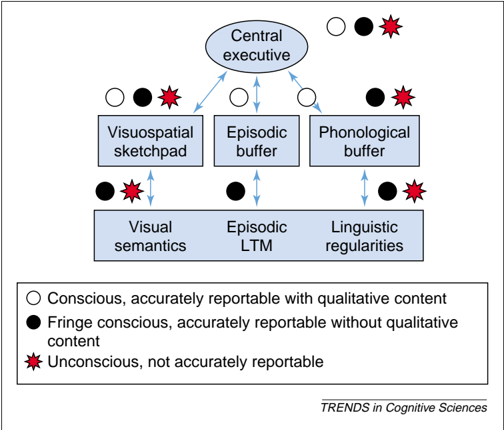
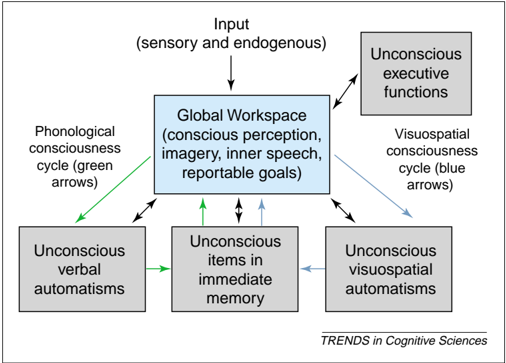
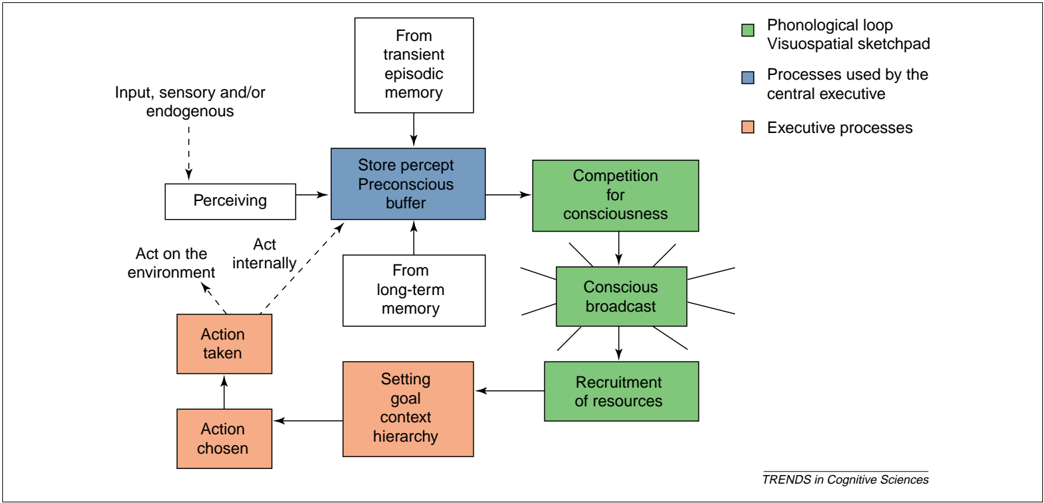
Active components of classical working memory are conscious, but traditional theory does not account for this fact. Global Workspace theory suggests that consciousness is needed to recruit unconscious specialized networks that carry out detailed working memory functions. The IDA model provides a fine-grained analysis of this process, specifically of two classical working-memory tasks, verbal rehearsal and the utilization of a visual image. In the process, new light is shed on the interactions between conscious and unconscious aspects of working memory.
Overview
The claims and statistics of this paper haven’t been checked yet.
Free: it reads the open-access text and checks the first 5 claims that cite a source we can check. Create a free account to check every claim.
Integrity signals
Registry
Cites
Statistics
Figures
Verification
Claims the paper makes
The claims and statistics of this paper haven’t been checked yet.
Free: it reads the open-access text and checks the first 5 claims that cite a source we can check. Create a free account to check every claim.
Claims other papers make about this one
Each is checked against this paper’s own text: does it say what the citing paper says it does?
The source backs part of the claim, not all of it — or backs it for a different population, condition or comparison.
In the citing paper
“Baars and Franklin (2003) suggest that all working memory tasks are consciously mediated – inner rehearsal, executive control, and other WM elements are all claimed to require a conscious cue to execute.”
From Global Workspace Dynamics: Cortical “Binding and Propagation” Enables Conscious Contents (2013) · cites this paper as Baars and Franklin (2003)
Experimental — accuracy not yet measuredThe cited source says what the claim attributes to it.
In the citing paper
“Baars and Franklin (2003) used GW theory to propose that consciousness enables access between otherwise separate knowledge sources.”
From Global Workspace Dynamics: Cortical “Binding and Propagation” Enables Conscious Contents (2013) · cites this paper as Baars and Franklin (2003)
The cited source says what the claim attributes to it.
In the citing paper
“when automatic capabilities fail, there follows a call recruiting additional collaborative conscious support ~Baars & Franklin, 2003!”
From AT THE INTERFACE: DYNAMIC INTERACTIONS OF EXPLICIT AND IMPLICIT LANGUAGE KNOWLEDGE (2005) · cites this paper as Baars & Franklin, 2003!
In the citing paper
“Working memory lies at the interface of perception and action (7) and requires the integration of large-scale neural circuits (8–11).”
From Dynamic reconfiguration of frontal brain networks during executive cognition in humans (2015) · cites this paper as [11]
Self-check
Percentages, sums and reported differences re-computed from the paper’s own numbers.
The self-check needs the paper’s full text.
Citations
Cites
James, W. (1913) · Henry Holt and Company eBooks · doi:10.1037/11059-000 · Cited by 25,226
Baddeley, A. D., & Hitch, G. (1974) · Psychology of Learning and Motivation · doi:10.1016/s0079-7421(08)60452-1 · Cited by 9,860
Barsalou, L. W. (1999) · Behavioral and Brain Sciences · doi:10.1017/s0140525x99002149 · Cited by 6,887
(1988) · Cited by 3,656
Self-citationEricsson, K. A., & Kintsch, W. (1995) · Psychological Review · doi:10.1037/0033-295x.102.2.211 · Cited by 3,498 · cited 1×
“Working memory Working memory [16] Long-term working memory [ 28 ] Emotions Neural networks [29] [30,31]”
Background(2012) · Encyclopedia of the Sciences of Learning · doi:10.1007/978-1-4419-1428-6_5794 · Cited by 2,562
Common regions of the human frontal lobe recruited by diverse cognitive demands
Duncan, J., & Owen, A. M. (2000) · Trends in Neurosciences · doi:10.1016/s0166-2236(00)01633-7 · Cited by 2,498
Towards a cognitive neuroscience of consciousness: basic evidence and a workspace framework
Dehaene, S. (2001) · Cognition · doi:10.1016/s0010-0277(00)00123-2 · Cited by 2,498
Is It an agent, or just a program?: A taxonomy for autonomous agents
Franklin, S., & Graesser, A. (1997) · Lecture Notes in Computer Science · doi:10.1007/bfb0013570 · Cited by 2,286
Self-citationRolls, E. T. (1998) · doi:10.1093/oso/9780198524649.001.0001 · Cited by 1,257
Cited by
Dual-Processing Accounts of Reasoning, Judgment, and Social Cognition
Evans, J. S. B. T. (2008) · Annual Review of Psychology · doi:10.1146/annurev.psych.59.103006.093629 · Cited by 5,137
Consciousness, accessibility, and the mesh between psychology and neuroscience
Block, N. (2007) · Behavioral and Brain Sciences · doi:10.1017/s0140525x07002786 · Cited by 1,146
Global workspace theory of consciousness: toward a cognitive neuroscience of human experience
Baars, B. J. (2005) · Progress in Brain Research · doi:10.1016/s0079-6123(05)50004-9 · Cited by 888
Self-citationAT THE INTERFACE: DYNAMIC INTERACTIONS OF EXPLICIT AND IMPLICIT LANGUAGE KNOWLEDGE
Ellis, N. C. (2005) · Studies in Second Language Acquisition · doi:10.1017/s027226310505014x · Cited by 893
Dynamic reconfiguration of frontal brain networks during executive cognition in humans
Braun, U., Schäfer, A., Walter, H., Erk, S., Romanczuk-Seiferth, N., Haddad, L., Schweiger, J. I., Grimm, O., Heinz, A., Tost, H., et al. (2015) · Proceedings of the National Academy of Sciences · doi:10.1073/pnas.1422487112 · Cited by 791
Metadata
- Authors
- Baars, B. J., & Franklin, S.
- Affiliations
- Neurosciences Institute (US)
- University of Memphis (US)
- Corresponding author
- Baars, Bernard J.
- Venue
- Trends in Cognitive Sciences
- Publisher
- Elsevier BV
- Published
- 2003-04
- Volume
- 7
- Issue
- 4
- Pages
- 166-172
- ISSN
- 1364-6613 (ISSN-L)
- OpenAlex
- W2170468585
- Cited by
- 541
- References
- 41
- Citations by year
- 2026: 36 · 2025: 36 · 2024: 18 · 2023: 28 · 2022: 16 · 2021: 17 · 2020: 19 · 2019: 21 · 2018: 24 · 2017: 25 · 2016: 18 · 2015: 22 · 2014: 30 · 2013: 38 · 2012: 30
- FWCI
- 2.61
- Type
- journal article
- Language
- en
- Open access
- closed
- Licence
- www.elsevier.com/tdm/userlicense/1.0/ (tdm)
- www.elsevier.com/legal/tdmrep-license (tdm)
- Locations
- Trends in Cognitive Sciences (publishedVersion)
- PubMed (publishedVersion)
- CogPrints (University of Southampton) (submittedVersion)
- Funders
- Field Neurosciences Institute
- Neurosciences Research Foundation
- Topics
- Social Sciences › Arts and Humanities › Philosophy › Philosophy and Theoretical Science
- Social Sciences › Psychology › Experimental and Cognitive Psychology › Cognitive Abilities and Testing
- Life Sciences › Neuroscience › Cognitive Neuroscience › Neural dynamics and brain function
- Keywords
- subjective experience, working memory, global workspace theory, unconscious processes, verbal rehearsal, visual imagery
About these checks
Registry, retraction, Cites and statistics results are computed, not judged, with one exception: a printed reference that no index lists is read once by a model before it counts as a citation error. Claims are extracted by a model and kept only when their quote appears verbatim in the text; each cited source is then checked, with a model’s help, for whether it says what the claim relies on. Those verdicts can be wrong — read the claim’s quote and the cited source before relying on one.
Statistics and arithmetic are recomputed, not judged.
Confidence bands are shown only for fields calibrated on our annotated test set. None is calibrated yet, so no band is shown.
What counts as a claim ›How we measure confidence ›How we check this ›
Are you an author, or do you see a problem with this page? Request a review
How to cite
Cite CoChat for the checks on this page, and the paper for its own findings.
- This page
- CoChat. (2026). Citation check: How conscious experience and working memory interact. https://app.cochat.ai/papers/10.1016/s1364-6613(03)00056-1
- The paper
- Baars, B. J., & Franklin, S. (2003). How conscious experience and working memory interact. Trends in Cognitive Sciences. https://doi.org/10.1016/s1364-6613(03)00056-1
Data sources
Bibliographic data: Semantic Scholar, OpenAlex, Crossref.
Contains information from the Semantic Scholar Academic Graph Datasets, made available under the ODC Attribution License (ODC-BY 1.0).
Semantic Scholar’s data is described in: Kinney, R., et al. (2023). The Semantic Scholar Open Data Platform. arXiv:2301.10140.
