

How conscious experience and working memory interact
The DOI matches its Crossref record; 40 of the 41 references it cites were found in a registry or an index.
Abstract
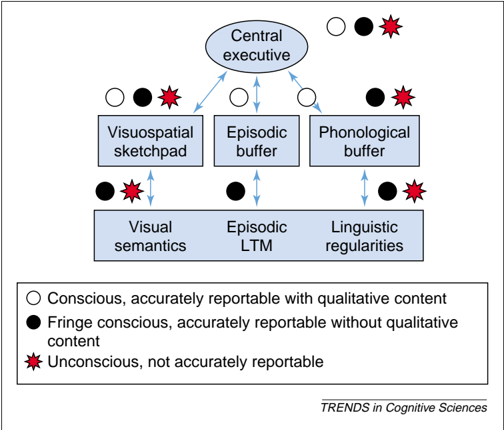
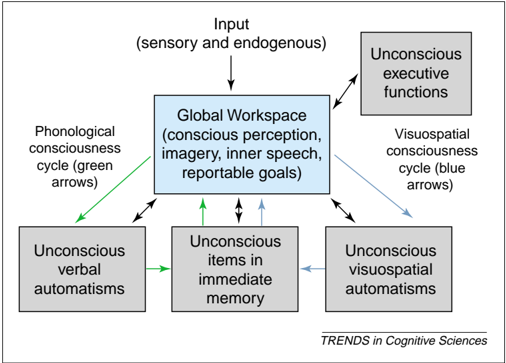
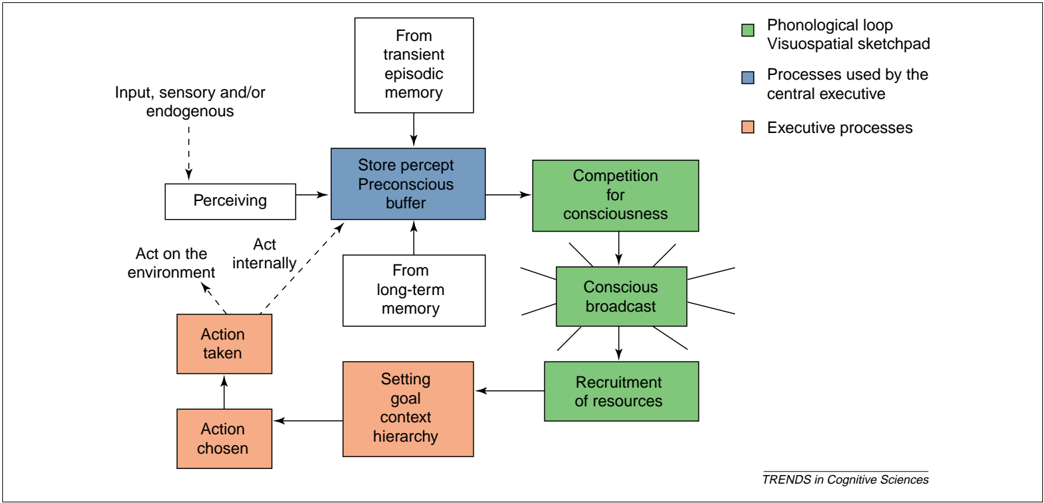
Active components of classical working memory are conscious, but traditional theory does not account for this fact. Global Workspace theory suggests that consciousness is needed to recruit unconscious specialized networks that carry out detailed working memory functions. The IDA model provides a fine-grained analysis of this process, specifically of two classical working-memory tasks, verbal rehearsal and the utilization of a visual image. In the process, new light is shed on the interactions between conscious and unconscious aspects of working memory.
Overview
The claims and statistics of this paper haven’t been checked yet.
Free: it reads the open-access text and checks the first 5 claims that cite a source we can check. Create a free account to check every claim.
Integrity signals
Registry
Cites
Statistics
Figures
Verification
Claims the paper makes
The claims and statistics of this paper haven’t been checked yet.
Free: it reads the open-access text and checks the first 5 claims that cite a source we can check. Create a free account to check every claim.
Claims other papers make about this one
Each is checked against this paper’s own text: does it say what the citing paper says it does?
The source backs part of the claim, not all of it — or backs it for a different population, condition or comparison.
In the citing paper
“Baars and Franklin (2003) suggest that all working memory tasks are consciously mediated – inner rehearsal, executive control, and other WM elements are all claimed to require a conscious cue to execute.”
From Global Workspace Dynamics: Cortical “Binding and Propagation” Enables Conscious Contents (2013) · cites this paper as Baars and Franklin (2003)
Experimental — accuracy not yet measuredThe cited source says what the claim attributes to it.
In the citing paper
“Baars and Franklin (2003) used GW theory to propose that consciousness enables access between otherwise separate knowledge sources.”
From Global Workspace Dynamics: Cortical “Binding and Propagation” Enables Conscious Contents (2013) · cites this paper as Baars and Franklin (2003)
The cited source says what the claim attributes to it.
In the citing paper
“when automatic capabilities fail, there follows a call recruiting additional collaborative conscious support ~Baars & Franklin, 2003!”
From AT THE INTERFACE: DYNAMIC INTERACTIONS OF EXPLICIT AND IMPLICIT LANGUAGE KNOWLEDGE (2005) · cites this paper as Baars & Franklin, 2003!
In the citing paper
“Working memory lies at the interface of perception and action (7) and requires the integration of large-scale neural circuits (8–11).”
From Dynamic reconfiguration of frontal brain networks during executive cognition in humans (2015) · cites this paper as [11]
Self-check
Percentages, sums and reported differences re-computed from the paper’s own numbers.
The self-check needs the paper’s full text.
Citations
Cites
James, W. (1913) · Henry Holt and Company eBooks · doi:10.1037/11059-000 · Cited by 25,226
Baddeley, A. D., & Hitch, G. (1974) · Psychology of Learning and Motivation · doi:10.1016/s0079-7421(08)60452-1 · Cited by 15,284
Barsalou, L. W. (1999) · Behavioral and Brain Sciences · doi:10.1017/s0140525x99002149 · Cited by 6,887
(1988) · Cited by 3,656
Self-citationEricsson, K. A., & Kintsch, W. (1995) · Psychological Review · doi:10.1037/0033-295x.102.2.211 · Cited by 3,498 · cited 1×
“Working memory Working memory [16] Long-term working memory [ 28 ] Emotions Neural networks [29] [30,31]”
Background(2012) · Encyclopedia of the Sciences of Learning · doi:10.1007/978-1-4419-1428-6_5794 · Cited by 2,562
Common regions of the human frontal lobe recruited by diverse cognitive demands
Duncan, J., & Owen, A. M. (2000) · Trends in Neurosciences · doi:10.1016/s0166-2236(00)01633-7 · Cited by 2,498
Towards a cognitive neuroscience of consciousness: basic evidence and a workspace framework
Dehaene, S. (2001) · Cognition · doi:10.1016/s0010-0277(00)00123-2 · Cited by 2,498
Is It an agent, or just a program?: A taxonomy for autonomous agents
Franklin, S., & Graesser, A. (1997) · Lecture Notes in Computer Science · doi:10.1007/bfb0013570 · Cited by 2,286 · cited 1×
“The IDA implementation of GW theory IDA (Intelligent Distribution Agent) is an autonomous software agent [ 18 ] that automates the entire set of tasks of a human personnel agent who assigns sailors to new tours of duty [19].”
MethodSelf-citationRolls, E. T. (1998) · doi:10.1093/oso/9780198524649.001.0001 · Cited by 1,257
Research works printed but not linked: 1
- 7 Baars, B.J. (1993) How does a serial, integrated and very limited stream of consciousness emerge from a nervous system that is mostly unconscious, distributed, and of enormous capacity? In CIBA SymposiumonExperimental and Theoretical Studies of Consciousness (Bock, G.R. and Marsh, J., eds) pp. 282-290, John Wiley & Sons
Cited by
Dual-Processing Accounts of Reasoning, Judgment, and Social Cognition
Evans, J. S. B. T. (2008) · Annual Review of Psychology · doi:10.1146/annurev.psych.59.103006.093629 · Cited by 5,137
“(Consciousness is also closely associated with working memory in global workspace theory—see Baars & Franklin 2003.)”
BackgroundConsciousness, accessibility, and the mesh between psychology and neuroscience
Block, N. (2007) · Behavioral and Brain Sciences · doi:10.1017/s0140525x07002786 · Cited by 1,146
AT THE INTERFACE: DYNAMIC INTERACTIONS OF EXPLICIT AND IMPLICIT LANGUAGE KNOWLEDGE
Ellis, N. C. (2005) · Studies in Second Language Acquisition · doi:10.1017/s027226310505014x · Cited by 893
“…differences in SLA also lends support to theories of the role of conscious processing and explicit learning in SLA+ The British working memory model ~Baars & Franklin, 2003; Baddeley, 1986; Baddeley, Gathercole, & Papagno, 1998; Baddeley & Hitch, 1974; Gathercole & Baddeley, 1993! comprises a…”
BackgroundGlobal workspace theory of consciousness: toward a cognitive neuroscience of human experience
Baars, B. J. (2005) · Progress in Brain Research · doi:10.1016/s0079-6123(05)50004-9 · Cited by 888
“approximately 100ms time cycles (Baars and Franklin, 2003) QA :1 .”
BackgroundSelf-citationDynamic reconfiguration of frontal brain networks during executive cognition in humans
Braun, U., Schäfer, A., Walter, H., Erk, S., Romanczuk-Seiferth, N., Haddad, L., Schweiger, J. I., Grimm, O., Heinz, A., Tost, H., et al. (2015) · Proceedings of the National Academy of Sciences · doi:10.1073/pnas.1422487112 · Cited by 791
A higher-order theory of emotional consciousness
LeDoux, J. E., & Brown, R. (2017) · Proceedings of the National Academy of Sciences · doi:10.1073/pnas.1619316114 · Cited by 690
“Included implicitly or explicitly are cognitive processes that are key to other theories of consciousness, such as working memory (54, 55, 57, 103, 104, 182), attention amplification (105, 109), and reentrant processing (87).”
BackgroundGoals, Attention, and (Un)Consciousness
Dijksterhuis, A., & Aarts, H. (2010) · Annual Review of Psychology · doi:10.1146/annurev.psych.093008.100445 · Cited by 527
“Importantly, these cortical areas are believed to be part of a network for conscious processes, and hence are implicated in volitional behavior (Baars & Franklin 2003, Baddeley 1993, Haggard 2008, Smith & Jonides 1999).”
BackgroundWorking Memory From the Psychological and Neurosciences Perspectives: A Review
Chai, W. J., Abd Hamid, A. I., & Abdullah, J. M. (2018) · Frontiers in Psychology · doi:10.3389/fpsyg.2018.00401 · Cited by 517
“…one describes working memory, the multicomponent working memory model is undeniably one of the most prominent working memory models that is widely cited in literatures (Baars and Franklin, 2003; Cowan, 2005; Chein et al., 2011; Ashkenazi et al., 2013; D’Esposito and Postle, 2015; Kim et al., 2015).”
MethodUnresponsiveness ≠ unconsciousness
Sanders, R. D., Tononi, G., Laureys, S., Sleigh, J. W., & Warner, D. S. (2012) · Anesthesiology · doi:10.1097/aln.0b013e318249d0a7 · Cited by 474
Brain, conscious experience and the observing self
Baars, B. J., Ramsøy, T. Z., & Laureys, S. (2003) · Trends in Neurosciences · doi:10.1016/j.tins.2003.09.015 · Cited by 404
Self-citationDe Dreu, C. K. W., Nijstad, B. A., Baas, M., Wolsink, I., & Roskes, M. (2012) · Personality and Social Psychology Bulletin · doi:10.1177/0146167211435795 · Cited by 368
“It has been explicitly implied in conscious, controlled, and deliberate information processing: “What we are aware of at a given time is represented in this working memory, through which conscious thinking flows in a sequential manner” (Evans, 2008, p. 259; also see Baars & Franklin, 2003).”
BackgroundTop-down activation of shape-specific population codes in visual cortex during mental imagery
Stokes, M., Thompson, R., Cusack, R., & Duncan, J. (2009) · The Journal of Neuroscience · doi:10.1523/jneurosci.4657-08.2009 · Cited by 323
“In particular, interactions between perceptual representations coded within posterior cortical regions and anterior control systems in prefrontal cortex are thought to underlie goal-directed attention (Desimone and Duncan, 1995), working memory (Ranganath and D’Esposito, 2005), and, more generally, executive control (…”
BackgroundWorking Memory and Academic Learning: Assessment and Intervention
Dehn, M. J. (2008) · Cited by 511
Global Workspace Dynamics: Cortical “Binding and Propagation” Enables Conscious Contents
Baars, B. J., Franklin, S., & Ramsoy, T. Z. (2013) · Frontiers in Psychology · doi:10.3389/fpsyg.2013.00200 · Cited by 294
“As evidence for higher level binding has built up, it is now also applied to the integrationof cortex and thalamus (Baars, 1988, 2002; Dehaene and Naccache, 2001; Baars and Franklin, 2003, 2007; Dehaene et al., 2006; Shanahan, 2010, 2012; Dehaene and Changeux, 2011; etc.).”
BackgroundMethodSelf-citationConsciousness in humans and non-human animals: recent advances and future directions
Boly, M., Seth, A. K., Wilke, M., Ingmundson, P., Baars, B., Laureys, S., Edelman, D. B., & Tsuchiya, N. (2013) · Frontiers in Psychology · doi:10.3389/fpsyg.2013.00625 · Cited by 291
Self-citationWalczyk, J. J., Harris, L. L., Duck, T. K., & Mulay, D. (2014) · New Ideas in Psychology · doi:10.1016/j.newideapsych.2014.03.001 · Cited by 285
Yes It Can: On the Functional Abilities of the Human Unconscious
Hassin, R. R. (2013) · Perspectives on Psychological Science · doi:10.1177/1745691612460684 · Cited by 263
“…1: Cognitive Control Traditionally, cognitive control and working memory (WM) were closely associated with conscious awareness (e.g., Baars & Franklin, 2003; Baddeley, 2000; Kintsch, Healy, Hegarety, Pennington, & Salthouse, 1999; for a more elaborate discussion, see Hassin, 2005;…”
LIDA: A Systems-level Architecture for Cognition, Emotion, and Learning
Franklin, S., Madl, T., D'Mello, S., & Snaider, J. (2014) · IEEE Transactions on Autonomous Mental Development · doi:10.1109/tamd.2013.2277589 · Cited by 261
Self-citationThe neural basis of one's own conscious and unconscious emotional states
Smith, R., & Lane, R. D. (2015) · Neuroscience & Biobehavioral Reviews · doi:10.1016/j.neubiorev.2015.08.003 · Cited by 241
Working memory without consciousness
Soto, D., Mäntylä, T., & Silvanto, J. (2011) · Current Biology · doi:10.1016/j.cub.2011.09.049 · Cited by 233
“Current psychological theories (for example, Baddeley’s influential model of working memory) [1], computational models [2] and neurobiological accounts of working memory are based on the assumption that working memory operates on consciously represented information.”
A theory of working memory without consciousness or sustained activity
Trübutschek, D., Marti, S., Ojeda, A., King, J.-R., Mi, Y., Tsodyks, M., & Dehaene, S. (2017) · eLife · doi:10.7554/elife.23871 · Cited by 219
Information Manipulation Theory 2: A Propositional Theory of Deceptive Discourse Production
McCornack, S. A., Morrison, K., Paik, J. E., Wisner, A. M., & Zhu, X. (2014) · Journal of Language and Social Psychology · doi:10.1177/0261927x14534656 · Cited by 209
“These rapid routines are called cognitive cycles (Baars & Franklin, 2003; Franklin, Baars, Ramamurthy, & Ventura, 2005) and often endure for no more than a few milliseconds (Baars & Franklin, 2007).”
BackgroundWyart, V., & Tallon-Baudry, C. (2009) · Journal of Neuroscience · doi:10.1523/jneurosci.0962-09.2009 · Cited by 207
“Such a mnesic trace could potentially explain the perceived continuity of visual consciousness—i.e., its link with a form of brief sensory memory (Atkinson et al., 2000; Baars and Franklin, 2003).”
BackgroundMultiple neural states of representation in short-term memory? It’s a matter of attention
LaRocque, J. J., Lewis-Peacock, J. A., & Postle, B. R. (2014) · Frontiers in Human Neuroscience · doi:10.3389/fnhum.2014.00005 · Cited by 199
“STM items in the FoA can be considered to be isomorphic with the contents of consciousness (Baars and Franklin, 2003; Buchsbaum, 2013).”
BackgroundDesire: The New Hot Spot in Self-Control Research
Hofmann, W., & Van Dillen, L. (2012) · Current Directions in Psychological Science · doi:10.1177/0963721412453587 · Cited by 197
“…we integrated the research on iterative processing of evaluation (Cunningham & Zelazo, 2007), theories of competitive access to working memory (Baars & Franklin, 2003; Kavanagh et al., 2005), and research on automatic and reflective behavior determination in self-regulation (Hofmann et al.,…”
BackgroundMethodA cognitive architecture that combines internal simulation with a global workspace
Shanahan, M. (2006) · Consciousness and Cognition · doi:10.1016/j.concog.2005.11.005 · Cited by 197
“This serial procession of states, which includes the unfolding of conscious content in human working memory ( Baars & Franklin, 2003 ), facilitates anticipation and planning and enables a cognitively enhanced form of action selection.”
BackgroundNeural blackboard architectures of combinatorial structures in cognition
van der Velde, F., & de Kamps, M. (2006) · Behavioral and Brain Sciences · doi:10.1017/s0140525x06009022 · Cited by 196
The role of consciousness in cognitive control and decision making
van Gaal, S., de Lange, F. P., & Cohen, M. X. (2012) · Frontiers in Human Neuroscience · doi:10.3389/fnhum.2012.00121 · Cited by 182
“Although consciousness and (working) memory seem intimately related (Dehaene and Naccache, 2001; Baars and Franklin, 2003), recent studies suggest that at least some components of memory might also operate outside of consciousness.”
Unconscious goal activation and the hijacking of the executive function.
Marien, H., Custers, R., Hassin, R. R., & Aarts, H. (2012) · Journal of Personality and Social Psychology · doi:10.1037/a0028955 · Cited by 173
(2011) · Choice Reviews Online · doi:10.5860/choice.48-6736 · Cited by 156
An architectural model of conscious and unconscious brain functions: Global Workspace Theory and IDA
Baars, B. J., & Franklin, S. (2007) · Neural Networks · doi:10.1016/j.neunet.2007.09.013 · Cited by 175
Self-citationCONSCIOUSNESS IS COMPUTATIONAL: THE LIDA MODEL OF GLOBAL WORKSPACE THEORY
BAARS, B. J., & FRANKLIN, S. (2009) · International Journal of Machine Consciousness · doi:10.1142/s1793843009000050 · Cited by 151
“More detailed descriptions are available elsewhere (Baars and Franklin 2003, Franklin et al. 2005).”
MethodSelf-citationde Guinea, A. O., & Webster, J. (2013) · MIS Quarterly · doi:10.25300/misq/2013/37.4.08 · Cited by 150
Applying global workspace theory to the frame problem
Shanahan, M., & Baars, B. (2005) · Cognition · doi:10.1016/j.cognition.2004.11.007 · Cited by 149
“26 Assuming rehearsal in working memory is a form of conscious information processing (Baars & Franklin, 2003), this suggests an explanation for the fact that, while some aspects of analogical reasoning are undoubtedly carried out unconsciously, others plainly are not. propositions in LISA’s…”
BackgroundSelf-citationHassin, R. R., Bargh, J. A., Engell, A. D., & McCulloch, K. C. (2009) · Consciousness and Cognition · doi:10.1016/j.concog.2009.04.003 · Cited by 146
“The conception of WM grew out of the literature on short-term memory (STM) in the mid 1970s (Baddeley & Hitch, 1974), and soon became what Baars and Franklin (2003) described as “the most influential empirical model of cognitive functions to date” (p.”
BackgroundBrain drain: The cognitive neuroscience of foreign language processing in multinational corporations
Volk, S., Köhler, T., & Pudelko, M. (2014) · Journal of International Business Studies · doi:10.1057/jibs.2014.26 · Cited by 153
“Working memory is intimately related to consciousness in that only information that is in the focus of working memory attention is available to consciousness (Baars & Franklin, 2003).”
BackgroundAarts, H. (2007) · Health Psychology Review · doi:10.1080/17437190701485852 · Cited by 142
“Taking this position one step further, Baars and Franklin ( 2003 , p.”
BackgroundA Conceptual and Computational Model of Moral Decision Making in Human and Artificial Agents
Wallach, W., Franklin, S., & Allen, C. (2010) · Topics in Cognitive Science · doi:10.1111/j.1756-8765.2010.01095.x · Cited by 127
Self-citationAbstraction and analogy‐making in artificial intelligence
Mitchell, M. (2021) · Annals of the New York Academy of Sciences · doi:10.1111/nyas.14619 · Cited by 125
Working memory and insight in verbal problems: analysis of compound remote associates
Chein, J. M., & Weisberg, R. W. (2013) · Memory & Cognition · doi:10.3758/s13421-013-0343-4 · Cited by 132
Angular default mode network connectivity across working memory load
Vatansever, D., Manktelow, A. E., Sahakian, B. J., Menon, D. K., & Stamatakis, E. A. (2016) · Human Brain Mapping · doi:10.1002/hbm.23341 · Cited by 132
“Such results concur with the hypothesized episodic buffer component of the working memory model (Baars and Franklin, 2003; Baddeley, 2000).”
ResultLiu, X., Lauer, K. K., Ward, B. D., Rao, S. M., Li, S., & Hudetz, A. G. (2012) · Human Brain Mapping · doi:10.1002/hbm.21385 · Cited by 118
“From a theoretical perspective, neural processes giving rise to conscious perception and memory require sufficient complexity of neuronal information processing and adequate integration among distributed neural systems in the global workspace [Baars and Franklin, 2003; Tononi, 2004, 2008].”
BackgroundThe timing of the cognitive cycle
Madl, T., Baars, B. J., & Franklin, S. (2011) · PLoS ONE · doi:10.1371/journal.pone.0014803 · Cited by 116
Self-citationEducating the Developing Mind: Towards an Overarching Paradigm
Demetriou, A., Spanoudis, G., & Mouyi, A. (2011) · Educational Psychology Review · doi:10.1007/s10648-011-9178-3 · Cited by 113
“…aspects of consciousness develop systematically from birth to maturity (Demetriou and Kazi 2001, 2006; Demetriou and Bakracevic 2009; Zelazo 2004), improving the quality of subjective experience, the resolution and refinement of mental processing, and executive control (Baars and Franklin 2003).”
BackgroundTransition of the functional brain network related to increasing cognitive demands
Finc, K., Bonna, K., Lewandowska, M., Wolak, T. P., Nikadon, J., Dreszer, J., Duch, W., & Kühn, S. (2017) · Human Brain Mapping · doi:10.1002/hbm.23621 · Cited by 125
“Is the DMN engagement in integration processes specific to working memory tasks? Working memory requires an interplay of multiple cognitive components such as perception, rehearsal, recall, and selecting an appropriate motor response; therefore, it requires an integration of many brain subnetworks [Baars and Franklin,…”
BackgroundWhat's next? New evidence for prediction in human vision
Enns, J. T., & Lleras, A. (2008) · Trends in Cognitive Sciences · doi:10.1016/j.tics.2008.06.001 · Cited by 138
“visual working memory, executive attention [ 57 ,58]) might not be involved in the on-line control of the activate and predict phases of perception.”
BackgroundThe Relation Between Attention and Memory
Cowan, N., Bao, C., Bishop-Chrzanowski, B. M., Costa, A. N., Greene, N. R., Guitard, D., Li, C., Musich, M. L., & Ünal, Z. E. (2023) · Annual Review of Psychology · doi:10.1146/annurev-psych-040723-012736 · Cited by 167
Consciousness, crosstalk, and the mereological fallacy: An evolutionary perspective
Wallace, R. (2012) · Physics of Life Reviews · doi:10.1016/j.plrev.2012.08.002 · Cited by 107
van Nooijen, C. C. A., de Koning, B. B., Bramer, W. M., Isahakyan, A., Asoodar, M., Kok, E., van Merrienboer, J. J. G., & Paas, F. (2024) · Educational Psychology Review · doi:10.1007/s10648-024-09848-3 · Cited by 104
“For information to become consciously accessible in the working memory, it must first be attended to (Baars & Franklin, 2003).”
Rademaker, R. L., Tredway, C. H., & Tong, F. (2012) · Journal of Vision · doi:10.1167/12.13.21 · Cited by 99
“These findings are consistent with the proposal that the contents of working memory appear to be immediately accessible to consciousness ( Baars & Franklin , 2003 ; Baddeley , 2000 ) .”
ResultSpontaneous repetitive thoughts can be adaptive: Postscript on “mind wandering”.
Baars, B. J. (2010) · Psychological Bulletin · doi:10.1037/a0018726 · Cited by 99
Self-citationSamaha, J., Barrett, J. J., Sheldon, A. D., LaRocque, J. J., & Postle, B. R. (2016) · Frontiers in Psychology · doi:10.3389/fpsyg.2016.00851 · Cited by 99
“These results challenge the claim that the degree of conscious perception influences the extent to which information gains access to WM (Dehaene and Naccache, 2001; Baars, 2003; Baars and Franklin, 2003).”
BackgroundResultSerafini, E. J., & Sanz, C. (2016) · Studies in Second Language Acquisition · doi:10.1017/s0272263115000327 · Cited by 94
“This is expected, at least theoretically, given the involvement of EF in regulating actions under controlled, conscious processing (e.g., Baars, 2003 ; Baars & Franklin, 2003 ; N. C. Ellis, 2005 ).”
BackgroundMinimal physicalism as a scale-free substrate for cognition and consciousness
Fields, C., Glazebrook, J. F., & Levin, M. (2021) · Neuroscience of Consciousness · doi:10.1093/nc/niab013 · Cited by 90
“2020), in particular, implement state-broadcasting functions analogous, at the cellular level, to the broadcasting functions of long-distance connections between network hubs in global neuronal workspace (GNW) models (Dehaene and Naccache 2001; Baars and Franklin 2003; Wallace 2005; Baars et al. 2013; Dehaene et al. 2…”
BackgroundHow does mindfulness transform suffering? II: the transformation of dukkha
Teasdale, J. D., & Chaskalson (Kulananda), M. (2011) · Contemporary Buddhism · doi:10.1080/14639947.2011.564826 · Cited by 92
“How can we arrange this or know that it is the case? This is where mindfulness enters the picture; psychologists have repeatedly suggested an association between working memory and conscious awareness (Baddeley 2000 ; Baars and Franklin 2003 ).”
BackgroundToward a brain theory of meditation
Raffone, A., Marzetti, L., Del Gratta, C., Perrucci, M. G., Romani, G. L., & Pizzella, V. (2019) · Progress in Brain Research · doi:10.1016/bs.pbr.2018.10.028 · Cited by 90
Probing the limits of activity-silent non-conscious working memory
Trübutschek, D., Marti, S., Ueberschär, H., & Dehaene, S. (2019) · Proceedings of the National Academy of Sciences · doi:10.1073/pnas.1820730116 · Cited by 88
“Task and visibility influenced the rate of correct responding [main and interaction effects: all Fs (1, 29) > 4.”
BackgroundMethodInfluentialComplex and Adaptive Dynamical Systems: A Primer
Gros, C. (2008) · doi:10.48550/arxiv.0807.4838 · Cited by 101
“3See Dehaene and Naccache (2003) and Baars and Franklin (2003).”
BackgroundThe Role of Consciousness in MemoryPreprint
Franklin, S., Baars, B. J., Ramamurthy, U., & Ventura, M. (2005) · CogPrints (University of Southampton) · Cited by 93
Self-citationSchmidt, T. T., Ostwald, D., & Blankenburg, F. (2014) · NeuroImage · doi:10.1016/j.neuroimage.2014.05.014 · Cited by 101
“Conceptually an involvement of WM in imagery is plausible because the mental representation has to be maintained for conscious access and deliberate content processing (Baars and Franklin, 2003; Likova, 2012).”
BackgroundA LIDA cognitive model tutorial
Franklin, S., Madl, T., Strain, S., Faghihi, U., Dong, D., Kugele, S., Snaider, J., Agrawal, P., & Chen, S. (2016) · Biologically Inspired Cognitive Architectures · doi:10.1016/j.bica.2016.04.003 · Cited by 102
Self-citationComplex and Adaptive Dynamical Systems: A Primer
Gros, C. (2015) · Springer eBooks · doi:10.1007/978-3-319-16265-2 · Cited by 89
“3See Dehaene and Naccache (2003) and Baars and Franklin (2003).”
BackgroundRaffone, A., Srinivasan, N., & van Leeuwen, C. (2014) · Philosophical Transactions of the Royal Society B Biological Sciences · doi:10.1098/rstb.2013.0215 · Cited by 92
“(i) The executive routers: higher-order representations in the global workspace TAC endorses the notion of GW from earlier theories and models [5,7,10–13,15–19].”
BackgroundMethodInfluentialAccurate Metacognition for Visual Sensory Memory Representations
Vandenbroucke, A. R. E., Sligte, I. G., Barrett, A. B., Seth, A. K., Fahrenfort, J. J., & Lamme, V. A. F. (2014) · Psychological Science · doi:10.1177/0956797613516146 · Cited by 81
Roelfsema, P. R. (2023) · Neuron · doi:10.1016/j.neuron.2023.03.016 · Cited by 114
“103,150 154 Workspace theories propose that perceptual objects reach awareness if their representations are amplified and broadcasted to processors across the brain.”
BackgroundWorking memory biasing of visual perception without awareness
Pan, Y., Lin, B., Zhao, Y., & Soto, D. (2013) · Attention Perception & Psychophysics · doi:10.3758/s13414-013-0566-2 · Cited by 92
“This account, albeit controversial in light of the conceptualization of WM and consciousness as tightly coupled (Baars & Franklin, 2003; Baddeley, 1986, 2003), is however consistent with emerging evidence indicating that WM-like processes such as reading, doingmathematic, delayed cue–target visual…”
ResultUnfulfilled goals interfere with tasks that require executive functions
Masicampo, E. J., & Baumeister, R. F. (2010) · Journal of Experimental Social Psychology · doi:10.1016/j.jesp.2010.10.011 · Cited by 92
Aarts, H., Custers, R., & Marien, H. (2009) · Journal of Personality and Social Psychology · doi:10.1037/a0015000 · Cited by 88
“However, working memory and consciousness are often considered to be synonymous terms (Baars & Franklin, 2003; Baddeley, 1993; Smith & Jonides, 1999), and hence, the functionality and structure of working memory are examined by presenting participants explicitly with materials that they explicitly…”
BackgroundNetwork structure and dynamics of the mental workspace
Schlegel, A., Kohler, P. J., Fogelson, S. V., Alexander, P., Konuthula, D., & Tse, P. U. (2013) · Proceedings of the National Academy of Sciences · doi:10.1073/pnas.1311149110 · Cited by 75
“Multivariate pattern analysis (MVPA) was carried out using PyMVPA (35).”
BackgroundMethodCognitive Computation with Autonomously Active Neural Networks: An Emerging Field
Gros, C. (2009) · Cognitive Computation · doi:10.1007/s12559-008-9000-9 · Cited by 81
“There is an interesting similarity, on a functional level, of reservoir computing with the notion of a ‘global workspace’ [27,28].”
BackgroundA little history goes a long way toward understanding why we study consciousness the way we do today
LeDoux, J. E., Michel, M., & Lau, H. C. (2020) · Proceedings of the National Academy of Sciences · doi:10.1073/pnas.1921623117 · Cited by 94
LIM, H., & GODFROID, A. (2015) · Applied Psycholinguistics · doi:10.1017/s0142716414000137 · Cited by 72
“However, because automatic processing may be interrupted when individuals encounter something unexpected or problematic (Baars & Franklin, 2003; N. C. Ellis, 2005), it could be argued that the correct rejections do not reflect automatic processing but a (correct) reversion to attention-controlled…”
BackgroundRothman, J., Cabrelli, J., & de Bot, K. (2012) · Cambridge University Press eBooks · doi:10.1017/cbo9781139051729.023 · Cited by 100
Modeling anxiety in healthy humans: a key intermediate bridge between basic and clinical sciences
Grillon, C., Robinson, O. J., Cornwell, B., & Ernst, M. (2019) · Neuropsychopharmacology · doi:10.1038/s41386-019-0445-1 · Cited by 82
The LIDA Framework as a General Tool for AGI
Snaider, J., McCall, R. J., & Franklin, S. (2011) · Lecture notes in computer science · doi:10.1007/978-3-642-22887-2_14 · Cited by 69
“More detailed descriptions are available elsewhere [ 13 , 14].”
MethodSelf-citationConsciousness and Control Not Identical Twins
Hommel, B. (2007) · Journal of Consciousness Studies · Cited by 82
Overflow, access, and attention
Block, N. (2007) · Behavioral and Brain Sciences · doi:10.1017/s0140525x07003111 · Cited by 66
“I use the term ‘working memory’ to mean what Baars & Franklin call “active working memory” ( Baars & Franklin, 2003 ).”
MethodConsciousness: converging insights from connectionist modeling and neuroscience
Maia, T. V., & Cleeremans, A. (2005) · Trends in Cognitive Sciences · doi:10.1016/j.tics.2005.06.016 · Cited by 64
“Finally, consciousness is also closely related to working memory (e.g. [40, 41 ]).”
BackgroundNeural basis of non-conscious visual working memory
Dutta, A., Shah, K., Silvanto, J., & Soto, D. (2014) · NeuroImage · doi:10.1016/j.neuroimage.2014.01.016 · Cited by 73
“Workingmemory (WM) processes, for example, themaintenance of information for later use in decision-making, are classically thought to operate on the contents of conscious awareness (Baars and Franklin, 2003; Baddeley, 2003).”
Neurodynamical approaches to consciousness
Cosmelli, D. J., Lachaux, J.-P., & Thompson, E. T. (2007) · Cambridge University Press eBooks · doi:10.1017/cbo9780511816789.027 · Cited by 65
Can working memory be non-conscious?
Stein, T., Kaiser, D., & Hesselmann, G. (2016) · Neuroscience of Consciousness · doi:10.1093/nc/niv011 · Cited by 61
“This dissociation between the objective and the subjective measure was taken to imply that observers encoded a non-conscious input in WM for later use in the memory test, thereby challenging the notion that inputs to WM need to be conscious (Baars and Franklin, 2003).”
BackgroundInfluentialDual-process theory, conflict processing, and delusional belief
Bronstein, M. V., Pennycook, G., Joormann, J., Corlett, P. R., & Cannon, T. D. (2019) · Clinical Psychology Review · doi:10.1016/j.cpr.2019.101748 · Cited by 71
Culture and inattentional blindness: A global workspace perspective
Wallace, R. (2006) · Journal of Theoretical Biology · doi:10.1016/j.jtbi.2006.10.006 · Cited by 73
Formal models of appraisal: Theory, specification, and computational model
Broekens, J., DeGroot, D., & Kosters, W. A. (2007) · Cognitive Systems Research · doi:10.1016/j.cogsys.2007.06.007 · Cited by 80
Comparing theories of consciousness: why it matters and how to do it
Del Pin, S. H., Skóra, Z., Sandberg, K., Overgaard, M., & Wierzchoń, M. (2021) · Neuroscience of Consciousness · doi:10.1093/nc/niab019 · Cited by 58
How Do Living Systems Create Meaning?
Fields, C., & Levin, M. G. (2020) · Philosophies · doi:10.3390/philosophies5040036 · Cited by 74
Unconscious Goal Pursuit: Nonconscious Goal Regulation and Motivation
Aarts, H., & Custers, R. (2012) · Oxford University Press eBooks · doi:10.1093/oxfordhb/9780195399820.013.0014 · Cited by 69
Meneguzzo, P., Tsakiris, M., Schiöth, H. B., Stein, D. J., & Brooks, S. J. (2014) · BMC Psychology · doi:10.1186/s40359-014-0052-1 · Cited by 65
“, is achieved by attention mechanisms in prefrontal cortical systems, such as the ACC, being directed from 'backstage' signals that are represented by distinct neural signatures in the mesolimbic brain regions, such as the striatum (Baars & Franklin 2003) and primary visual areas for mental imagery.”
BackgroundConsciousness and working memory: Current trends and research perspectives
Velichkovsky, B. B. (2017) · Consciousness and Cognition · doi:10.1016/j.concog.2017.07.005 · Cited by 64
Erçetin, G., & Alptekin, C. (2012) · Applied Psycholinguistics · doi:10.1017/s0142716411000932 · Cited by 72
“In a way, the conscious components of WM help mobilize and guide unconscious routines that carry out automatic processing of implicit tasks (Baars & Franklin, 2003) while they sustain controlled attentional processing and temporary storage for complex explicit tasks.”
BackgroundMethodInfluentialThe Global Workspace Theory of Consciousness
Baars, B. J. (2007) · Blackwell Publishing Ltd eBooks · doi:10.1002/9780470751466.ch19 · Cited by 72
Self-citationA COMPUTATIONAL MODEL OF MACHINE CONSCIOUSNESS
Starzyk, J. A., & Prasad, D. K. (2011) · International Journal of Machine Consciousness · doi:10.1142/s1793843011000819 · Cited by 64
“Mental saccades constitute an alternative solution to the idea of attention codelets competing for consciousness as presented in the LIDA model [Baars & Franklin, 2003].”
Modeling Ideational Creativity in Groups: Connecting Cognitive, Neural, and Computational Approaches
Paulus, P. B., Levine, D. S., Brown, V. R., Minai, A. A., & Doboli, S. (2010) · Small Group Research · doi:10.1177/1046496410369561 · Cited by 58
“There is a significant body of work on agent models of cognition (e.g., Anderson & Lebiere, 1998; Baars & Franklin, 2003; Sun, 2002), focused mainly on modeling individual cognition and only recently extended to social networks at the human level (e.g., Sun, 2007).”
BackgroundZedelius, C. M., Veling, H., & Aarts, H. (2010) · Consciousness and Cognition · doi:10.1016/j.concog.2010.05.001 · Cited by 61
“Active maintenance is typically ascribed to working memory (e.g., Baddeley, 1986), a theoretical construct that encompasses the temporary retention and inhibition of selected information in order to perform operations (e.g., Baars & Franklin, 2003; Baddeley, 1986; Jonides et al., 2008).”
A Foundational Architecture for Artificial General Intelligence
Franklin, S. (2007) · Artificial General Intelligence · Cited by 69
Self-citationBijleveld, E., Custers, R., & Aarts, H. (2011) · Journal of Experimental Social Psychology · doi:10.1016/j.jesp.2011.03.002 · Cited by 65
“Whereas such higher-order processes are traditionally thought to require conscious intention and awareness to occur (Baars & Franklin, 2003; Baddeley, 1993), the interconnected nature of the subcortical reward center and frontal-cortical areas suggests the possibility that rewards can facilitate…”
BackgroundLIDA: A Computational Model of Global Workspace Theory and Developmental Learning.
Franklin, S., Ramamurthy, U., D’Mello, S. K., McCauley, L., Negatu, A., Silva, L. R., & Datla, V. V. (2007) · National Conference on Artificial Intelligence · Cited by 69
Self-citationLIDA: A Working Model of Cognition
Ramamurthy, U., Baars, B. J., D’Mello, S. K., & Franklin, S. (2006) · CogPrints (University of Southampton) · Cited by 50
Self-citationBona, S., & Silvanto, J. (2014) · PLoS ONE · doi:10.1371/journal.pone.0090808 · Cited by 48
“This is inconsistent with current models of working memory which posit that memory contents are highly accessible to conscious inspection [23,24], as this would predict that VSTM and confidence should not be dissociated in this manner.”
BackgroundResultRate Distortion Manifolds as Model Spaces for Cognitive Information
Glazebrook, J. F., & Wallace, R. (2009) · Informatica · Cited by 79
Metadata
- Authors
- Baars, B. J., & Franklin, S.
- Affiliations
- Neurosciences Institute (US)
- University of Memphis (US)
- Corresponding author
- Baars, Bernard J.
- Venue
- Trends in Cognitive Sciences
- Publisher
- Elsevier BV
- Published
- 2003-04
- Volume
- 7
- Issue
- 4
- Pages
- 166-172
- ISSN
- 1364-6613 (ISSN-L)
- OpenAlex
- W2170468585
- Semantic Scholar
- 59210192d31d570d83532e24b6908f57fae8747a
- Cited by
- 541
- References
- 41
- Citations by year
- 2026: 36 · 2025: 36 · 2024: 18 · 2023: 28 · 2022: 16 · 2021: 17 · 2020: 19 · 2019: 21 · 2018: 24 · 2017: 25 · 2016: 18 · 2015: 22 · 2014: 30 · 2013: 38 · 2012: 30
- FWCI
- 2.61
- Type
- journal article
- Language
- en
- Open access
- closed
- Licence
- www.elsevier.com/tdm/userlicense/1.0/ (tdm)
- www.elsevier.com/legal/tdmrep-license (tdm)
- Locations
- Trends in Cognitive Sciences (publishedVersion)
- PubMed (publishedVersion)
- CogPrints (University of Southampton) (submittedVersion)
- Funders
- Field Neurosciences Institute
- Neurosciences Research Foundation
- Topics
- Social Sciences › Arts and Humanities › Philosophy › Philosophy and Theoretical Science
- Social Sciences › Psychology › Experimental and Cognitive Psychology › Cognitive Abilities and Testing
- Life Sciences › Neuroscience › Cognitive Neuroscience › Neural dynamics and brain function
- Keywords
- subjective experience, working memory, global workspace theory, unconscious processes, verbal rehearsal, visual imagery
About these checks
Registry, retraction, Cites and statistics results are computed, not judged, with one exception: a printed reference that no index lists is read once by a model before it counts as a citation error. Claims are extracted by a model and kept only when their quote appears verbatim in the text; each cited source is then checked, with a model’s help, for whether it says what the claim relies on. Those verdicts can be wrong — read the claim’s quote and the cited source before relying on one.
Statistics and arithmetic are recomputed, not judged.
Confidence bands are shown only for fields calibrated on our annotated test set. None is calibrated yet, so no band is shown.
What counts as a claim ›How we measure confidence ›How we check this ›
Are you an author, or do you see a problem with this page? Request a review
Data sources
Bibliographic data: Semantic Scholar, OpenAlex, Crossref.
Contains information from the Semantic Scholar Academic Graph Datasets, made available under the ODC Attribution License (ODC-BY 1.0).
Semantic Scholar’s data is described in: Kinney, R., et al. (2023). The Semantic Scholar Open Data Platform. arXiv:2301.10140.
