

Cognitive behavioural treatment for women who have menopausal symptoms after breast cancer treatment (MENOS 1): a randomised controlled trial
Open accessThe DOI matches its Crossref record; 35 of the 35 references it cites were found in a registry or an index.
Abstract
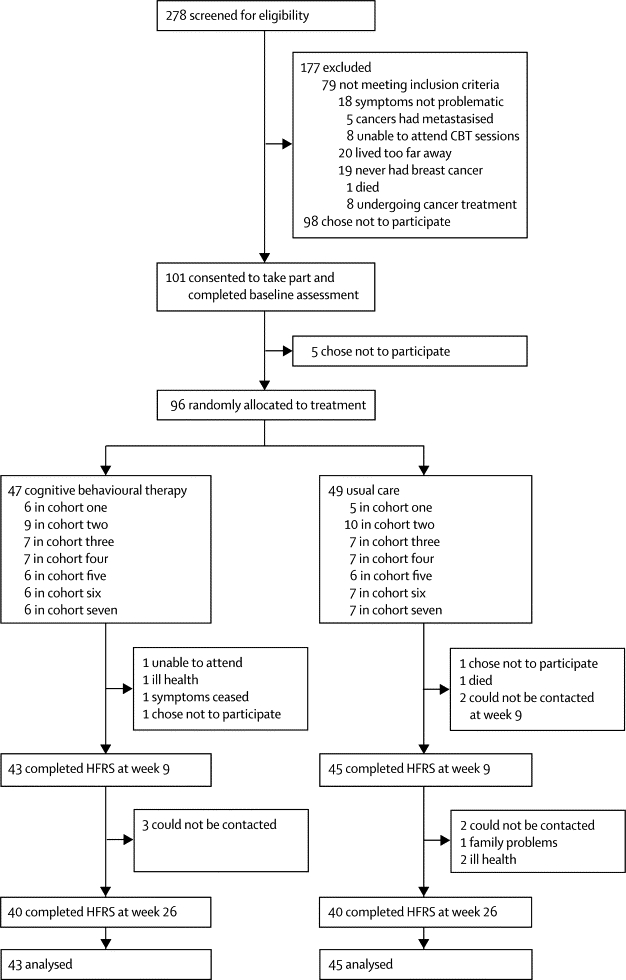
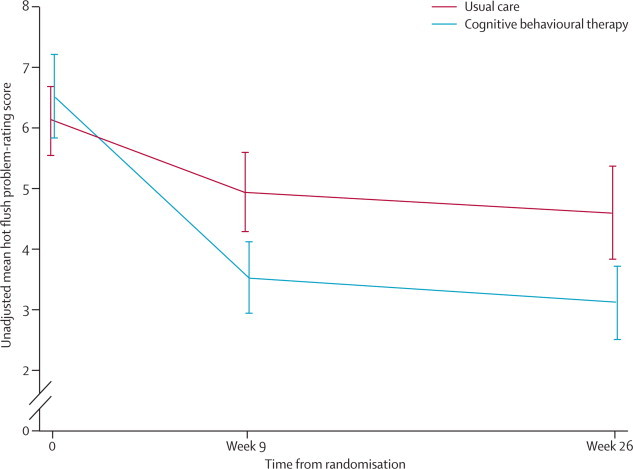
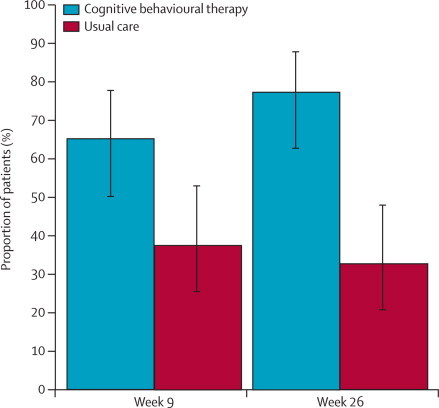
BACKGROUND: Hot flushes and night sweats (HFNS) affect 65-85% of women after breast cancer treatment; they are distressing, causing sleep problems and decreased quality of life. Hormone replacement therapy is often either undesirable or contraindicated. Safe, effective non-hormonal treatments are needed. We investigated whether cognitive behavioural therapy (CBT) can help breast cancer survivors to effectively manage HFNS. METHODS: In this randomised controlled trial, we recruited women from breast clinics in London, UK, who had problematic HFNS (minimum ten problematic episodes a week) after breast-cancer treatment. Participants were randomly allocated to receive either usual care or usual care plus group CBT (1:1). Randomisation was done in blocks of 12-20 participants, stratifying by age (younger than 50 years, 50 years or older), and was done with a computer-generated sequence. The trial statistician and researchers collecting outcome measures were masked to group allocation. Group CBT comprised one 90 min session a week for 6 weeks, and included psycho-education, paced breathing, and cognitive and behavioural strategies to manage HFNS. Assessments were done at baseline, 9 weeks, and 26 weeks after randomisation. The primary outcome was the adjusted mean difference in HFNS problem rating (1-10) between CBT and usual care groups at 9 weeks after randomisation. Analysis of the primary endpoint was done by modified intention to treat. The trial is registered, ISRCTN13771934, and was closed March 15, 2011. FINDINGS: Between May 5, 2009, and Aug 27, 2010, 96 women were randomly allocated to group CBT (n=47) or usual care (n=49). Group CBT significantly reduced HFNS problem rating at 9 weeks after randomisation compared with usual care (mean difference -1·67, 95% CI -2·43 to -0·91; p<0·0001) and improvements were maintained at 26 weeks (mean difference -1·76, -2·54 to -0·99; p<0·0001). We recorded no CBT-related adverse events. INTERPRETATION: Group CBT seems to be a safe and effective treatment for women who have problematic HFNS after breast cancer treatment with additional benefits to mood, sleep, and quality of life. The treatment could be incorporated into breast cancer survivorship programmes and delivered by trained breast cancer nurses. FUNDING: Cancer Research UK.
Overview
The claims and statistics of this paper haven’t been checked yet.
Free: it reads the open-access text and checks the first 5 claims that cite a source we can check. Create a free account to check every claim.
Integrity signals
Registry
Cites
Statistics
Figures
Verification
Claims the paper makes
The claims and statistics of this paper haven’t been checked yet.
Free: it reads the open-access text and checks the first 5 claims that cite a source we can check. Create a free account to check every claim.
Claims other papers make about this one
Each is checked against this paper’s own text: does it say what the citing paper says it does?
The source backs part of the claim, not all of it — or backs it for a different population, condition or comparison.
In the citing paper
“For menopausal symptoms in general, mind-body interventions, physical training and cognitive behavioural therapy should be recommended as effective non-pharmacological treatment options.113, 114, 115, 116, 117”
From 5th ESO-ESMO international consensus guidelines for advanced breast cancer (ABC 5) (2020) · cites this paper as [114]
Experimental — accuracy not yet measuredThe cited source says what the claim attributes to it.
In the citing paper
“Three studies (Ayers et al., 2012; Kalmbach et al., 2019; Mann et al., 2012) found evidence for the effectiveness of CBT on the outcomes of the 36 Item Short Form Health Survey (SF-36, Ware & Sherbourne, 1992).”
From The effectiveness of psychosocial interventions on non-physiological symptoms of menopause: A systematic review and meta-analysis (2024) · cites this paper as Mann et al., 2012
Self-check
Percentages, sums and reported differences re-computed from the paper’s own numbers.
The self-check needs the paper’s full text.
Citations
Cites
SF-36 health survey: Manual and interpretation guide
Ware, J. (2003) · Medical Entomology and Zoology · Cited by 11,424
The ATAC (Arimidex, T. A. O. I. C. T. G. (2003) · Cancer · doi:10.1002/cncr.11745 · Cited by 861
Loprinzi, C. L., Kugler, J. W., Sloan, J. A., Mailliard, J. A., LaVasseur, B. I., Barton, D. L., Novotny, P. J., Dakhil, S. R., Rodger, K., Rummans, T. A., et al. (2000) · The Lancet · doi:10.1016/s0140-6736(00)03403-6 · Cited by 737
Pradhan, A. D., Manson, J. E., Rossouw, J. E., Siscovick, D. S., Mouton, C. P., Rifai, N., Wallace, R. B., Jackson, R. D., Pettinger, M. B., & Ridker, P. M. (2002) · JAMA · doi:10.1001/jama.288.8.980 · Cited by 680
Wampold, B. E., & Brown, G. S. (. (2005) · Journal of Consulting and Clinical Psychology · doi:10.1037/0022-006x.73.5.914 · Cited by 476
Adherence to tamoxifen over the five-year course
Lash, T. L., Fox, M. P., Westrup, J. L., Fink, A. K., & Silliman, R. A. (2006) · Breast Cancer Research and Treatment · doi:10.1007/s10549-006-9193-0 · Cited by 320
Cella, D., & Fallowfield, L. J. (2008) · Breast Cancer Research and Treatment · doi:10.1007/s10549-007-9548-1 · Cited by 286
Gupta, P., Sturdee, D. W., Palin, S. L., Majumder, K., Fear, R., Marshall, T., & Paterson, I. (2006) · Climacteric · doi:10.1080/13697130500487224 · Cited by 217
Ayers, B., Smith, M., Hellier, J., Mann, E., & Hunter, M. S. (2012) · Menopause · doi:10.1097/gme.0b013e31823fe835 · Cited by 207
Self-citation
Cited by
Items 201–300 of 335
Virtual reality for menopause symptom management: opportunities, challenges, and next steps
Safwan, N., Suchak, K. K., Liran, O., Kingsberg, S. A., Spiegel, B. M. R., SHUFELT, C. L., & Faubion, S. S. (2025) · Menopause The Journal of The North American Menopause Society · doi:10.1097/gme.0000000000002529 · Cited by 4
“12,15 In addition, the therapy incorporates relaxation techniques, paced breathing, and developing problem solving and behavioral strategies to effectively manage VMS. 11,12 Existing evidence shows that CBT not only reduces night sweats but also improves mood, quality of life, and overall well-being, addressing the va…”
InfluentialLi, H., Liu, C., Ke, S., Cui, L., Sun, M., Bian, Y., Song, Y., & Lü, Q. (2025) · Asia-Pacific Journal of Oncology Nursing · doi:10.1016/j.apjon.2025.100701 · Cited by 4
“41 It is recommended that a multidisciplinary rehabilitation team led by breast cancer specialist nurses should be established to provide professional symptom management measures for patients with breast cancer undergoing endocrine therapy.”
Likely, N., & Switzer, V. (2016) · Irish Journal of Psychological Medicine · doi:10.1017/ipm.2016.20 · Cited by 4
“…therapy (CBT) interventions and stress management techniques such asmindfulness and relaxation (Penedo et al. 2006; Espie et al. 2008; Mann et al. 2012; Piet et al. 2012) as well as psychoeducational approaches (Scheier et al. 2005; Stanton et al. 2005; Meneses et al. 2007; Dolbeault…”
Psychological Aspects of the Menopause
Hunter, M. S. (2020) · Cambridge University Press eBooks · doi:10.1017/9781108869102.009 · Cited by 4
Self-citationShabani, F., Farvareshi, M., Hamdi, K., Oskouei, B. S., Montazeri, M., & Mirghafourvand, M. (2022) · Post Reproductive Health · doi:10.1177/20533691221136309 · Cited by 4
Cruickshank, S. (2014) · Edinburgh Napier Research Repository (Edinburgh Napier University) · doi:10.17869/enu.176494 · Cited by 4
Schäfer, A., Wendel, J., Franke, I., Bauer, A., Baumeister, H., Bendig, E., Brucker, S. Y., Deutsch, T. M., Garatva, P., Haas, K., et al. (2024) · Trials · doi:10.1186/s13063-024-08614-8 · Cited by 3
“Based on other studies with breast cancer survivors, we assume a dropout rate of 10% [49, 50].”
Hunter, M. S., Sharpley, C. F., Stefanopoulou, E., Yousaf, O., Bitsika, V., & Christie, D. R. H. (2014) · Maturitas · doi:10.1016/j.maturitas.2014.09.014 · Cited by 3
Self-citationStefanopoulou, E., Chapelle, S., Lewis, D., Larkin, J., & Hunter, M. S. (2025) · Post Reproductive Health · doi:10.1177/20533691251352044 · Cited by 3
“8 – 10 Findings from this study, therefore, suggest that iCBT may also be an acceptable and effective intervention for working menopausal women experiencing HFNS.”
Self-citationSpotts, E. K., & Geers, A. L. (2025) · Social and Personality Psychology Compass · doi:10.1111/spc3.70094 · Cited by 3
Mexican breast cancer consensus. Multidisciplinary care in breast cancer
Soto‐Pérez‐de‐Celis, E., Aguilar-y-Méndez, D., Allende‐Pérez, S., Álvarez-Gómez, R. M., Cedillo-Compeán, V., Cervantes-Díaz, M. T. D. J., Chávez‐MacGregor, M., Mabiani-Céspedes, M., Monreal-Carrillo, E. A., Núñez-Martínez, M. P., et al. (2024) · Gaceta Mexicana de Oncología · doi:10.24875/j.gamo.m24000263 · Cited by 3
Wanchai, A., & Armer, J. M. (2021) · Pacific Rim International Journal of Nursing Research · Cited by 3
Razmpoosh, E., Mazloom, M., Bassiri, M., Montazeri, A., Sajadian, A. S., Zarrati, M., & Salehi-Abargoueil, A. (2020) · International Journal of Cancer Management · doi:10.5812/ijcm.103647 · Cited by 3
“Further, cognitive-behavioral therapy has been shown to have additional benefits to patients’ mood and quality of life (18).”
BackgroundNon-hormonal management for menopause
Mehedințu, C., Carp-Velişcu, A., Edu, A., Plotogea, M., Petca, A. T., Andreescu, C. V., SECARA, D. C., Dumitrașcu, M. C., & Rotaru, A.-M. (2021) · Romanian Journal of Medical Practice · doi:10.37897/rjmp.2021.s6.17 · Cited by 3
Levin, A. O. (2013) · OhioLink ETD Center (Ohio Library and Information Network) · Cited by 3
Mexican Consensus on diagnosis and treatment of breast cancer
Poitevin‐Chacón, A., Maffuz‐Aziz, A., Erazo-Valle-Solís, A. A., Flores-Balcázar, C. H., Salas-González, E., Cárdenas-Sánchez, J., Bargalló-Rocha, J. E., Torrecillas-Torres, L., Cervantes-Sánchez, M. G., Bautista‐Piña, V., et al. (2018) · Gaceta Mexicana de Oncología · doi:10.24875/j.gamo.m18000154 · Cited by 3
Brennan, A., & Hickey, M. (2020) · Seminars in Reproductive Medicine · doi:10.1055/s-0041-1726467 · Cited by 4
Chapter 18. Trauma and Reproductive Health
Gopalan, P. R., Albertini, E., Amin, P., Curley, M., Glance, J. B., Kalia, S., & Shenai, N. (2021) · American Psychiatric Association Publishing eBooks · doi:10.1176/appi.books.9781615379545.lg18 · Cited by 3
Alternativas al tratamiento hormonal de la menopausia
Boutet, G., Raccah-Tebeka, B., Bernard, V., Hocké, C., & Plu‐Bureau, G. (2025) · EMC - Ginecología-Obstetricia · doi:10.1016/s1283-081x(24)49930-x · Cited by 2
Pourshahrokhi, N., Hunter, M. S., Bazrafshan, F., & Ahmadian, L. (2025) · European Journal of Obstetrics & Gynecology and Reproductive Biology · doi:10.1016/j.ejogrb.2025.114662 · Cited by 2
Self-citationProctor, D., Hunter, M. S., He, L., & Spector, A. E. (2026) · Menopause The Journal of The North American Menopause Society · doi:10.1097/gme.0000000000002796 · Cited by 2
Self-citationRedefining menopausal care: a randomized trial of group CBT for vasomotor symptoms in Korean women
Jung, D., Park, J. Y., Chung, K., & Kim, M.-R. (2026) · Climacteric · doi:10.1080/13697137.2026.2661353 · Cited by 2
“…menopause-specific CBT interventions, including those using the MENOS protocol, have demonstrated efficacy across a range of formats, including brief interventions lasting four to eight sessions, existing programs vary considerably in their content, structure and therapeutic emphasis [26,27].”
Gil‐Ibáñez, B., Aznar, A. L., Barretina-Ginesta, M.-P., Quer, N., & Ramirez, P. T. (2026) · International Journal of Gynecological Cancer · doi:10.1016/j.ijgc.2026.104881 · Cited by 2
Vasomotor Symptoms: Clinical Management
Osório-Wender, M. C., & Dall’Agno, M. L. (2019) · Springer eBooks · doi:10.1007/978-3-030-13936-0_19 · Cited by 2
Non-hormonal treatments of menopausal symptoms
Jan, R., & Rosie, A. (2023) · InnovAiT Education and inspiration for general practice · doi:10.1177/17557380231153677 · Cited by 2
“There is evidence that this can provide significant improvements to these symptoms compared with no treatment (Mann et al., 2012).”
BackgroundMind over menopausal symptoms in women with breast cancer
Prigerson, H. G. (2012) · The Lancet Oncology · doi:10.1016/s1470-2045(11)70381-3 · Cited by 2
Sleep problems in cancer: effective psychological interventions – a systematic review
Venables, H. E. (2014) · Res Medica · doi:10.2218/resmedica.v22i1.776 · Cited by 2
Description of an Audio-Based Paced Respiration Intervention for Vasomotor Symptoms
Burns, D. S., Drews, M. R., & Carpenter, J. S. (2013) · Music and Medicine · doi:10.1177/1943862112470461 · Cited by 2
Mettler, L. (2012) · gynäkologie + geburtshilfe · doi:10.1007/s15013-012-0209-z · Cited by 2
Premature Ovarian Insufficiency
Goetsch, A. L., Kimelman, D., & Woodruff, T. K. (2017) · Springer eBooks · doi:10.1007/978-3-319-52316-3_11 · Cited by 2
Challenges of Endocrine Therapy in Breast Cancer
Mansouri, S., Teymourzadeh, A., Farahmand, L., & Majidzadeh‐A, K. (2017) · Springer eBooks · doi:10.1007/978-3-319-64550-6_17 · Cited by 2
Єфименко, О. О. (2020) · Reproductive Endocrinology · doi:10.18370/2309-4117.2020.51.72-88 · Cited by 2
Noble, N., & Holloway, D. (2019) · Springer eBooks · doi:10.1007/978-3-030-16115-6_10 · Cited by 2
Balabanovic, J. (2017) · London Met Repository (London Metropolitan University) · Cited by 2
Self-citationMaheu, C., Lebel, S., Courbasson, C. M. A., Lefèbvre, M., Singh, M. D., Bernstein, L. J., Muraca, L., Benea, A., Jolicoeur, L. J. A., Harris, C., et al. (2021) · doi:10.32920/14639010.v1 · Cited by 2
Chapter 1. The Reproductive Life Cycle
Lighten, A., Zein, M., Olgun, M., & Catapano, L. A. (2021) · American Psychiatric Association Publishing eBooks · doi:10.1176/appi.books.9781615379545.lg01 · Cited by 1
Fawson, S., Moon, Z., Rattue, M., Moss-Morris, R. E., & Hughes, L. D. (2025) · British Journal of Health Psychology · doi:10.1111/bjhp.70012 · Cited by 1
“Successful cognitive behavioural interventions have been developed for specific symptoms such as hot flushes and night sweats (Fenlon et al., 2020; Mann et al., 2012), but it may be that more support for the global burden of ongoing symptoms in survivorship is also important.”
Investigation of Trends in Research on Menopausal Symptoms: A Descriptive Study
Balmumcu, A. (2025) · Turkiye Klinikleri Journal of Health Sciences · doi:10.5336/healthsci.2025-108996 · Cited by 1
Menopause care: alternatives to hormone replacement therapy
Mullin, S., & Manley, K. (2025) · The Obstetrician & Gynaecologist · doi:10.1111/tog.70010 · Cited by 1
Cognitive Behavioral Therapy for Menopause Symptoms
Wilkins, V. M. (2025) · Current Obstetrics and Gynecology Reports · doi:10.1007/s13669-025-00452-y · Cited by 1
“In breast cancer patients, CBT for menopause symptoms has been significantly effective at reducing VMS problem ratings in comparison to wait list and usual care [17, 18].”
Chang, Y.-C., Sayar, S., Ahmadzadeh, A., Ghazanfarpour, M., Asgari, M. R., & Babakhanian, M. (2026) · International Journal of Cancer Management · doi:10.5812/ijcm-162733 · Cited by 1
Breitinger-Blatt, D., Lee, J., Pereira, S. I. R., Smith, C., Gavriloff, D., & Sekaran, S. (2026) · Cochrane Database of Systematic Reviews · doi:10.1002/14651858.cd016349 · Cited by 1
Robinson, K., Hardy, R., Melville, M., Saidel, S., Desai, R., & Spector, A. E. (2026) · BMC Women s Health · doi:10.1186/s12905-026-04563-3 · Cited by 1
Pagliuca, M., Buonaiuto, R., Verrazzo, A., Parola, S., Tafuro, M., Calderaio, C., Martinelli, C., Rienzo, R. D., Pirolo, M., Zurlo, C., et al. (2026) · Frontiers in Oncology · doi:10.3389/fonc.2026.1840152 · Cited by 1
“On the non-pharmacological side, CBT incorporating psychoeducation, paced breathing, and cognitive restructuring has demonstrated meaningful reductions in hot fl ash frequency and problem rating in women treated for breast cancer, supported by randomized evidence from the MENOS trial program (74).”
Pinkerton, J. V., Simon, J. A., Panay, N., Nappi, R. E., Brennan, D. J., Donders, G. G. G., Soares, C. N., Maki, P. M., Caetano, C., Haberland, C., et al. (2026) · Maturitas · doi:10.1016/j.maturitas.2026.109075 · Cited by 1
Integrative Medicine Approaches for Menopause
Patel, J., Patil, R. G., & Millstine, D. M. (2026) · Obstetrics and Gynecology · doi:10.1097/aog.0000000000006388 · Cited by 1
Abernethy, K. (2013) · Independent Nurse · doi:10.12968/indn.2013.21.1.96390 · Cited by 1
Fear vs. faith: how a 46 year old woman beat breast cancer
Kapoor, A., Harris, S. T., & Baker, E. A. (2017) · Spiritual Care · doi:10.1515/spircare-2017-0037 · Cited by 1
Farsi, Z., Shokri, K., & Aliyari, S. (2017) · Annals of Military and Health Sciences Research · doi:10.5812/amh.62956 · Cited by 1
“For example, in another study showed that the use of medication (such as sertraline) has a significant effect on reducing depression while CBT has no significant effect on depression in patients (11).”
ResultBeliefs about hot flashes drive treatment benefit
Weber, M. T., & Maki, P. M. (2014) · Menopause The Journal of The North American Menopause Society · doi:10.1097/gme.0000000000000255 · Cited by 1
Non-hormonal treatments for menopausal symptoms
Sassarini, J. (2015) · Cambridge University Press eBooks · doi:10.1017/cbo9781316091821.021 · Cited by 1
Behandlungsstrategien für Patientinnen mit klimakterischen Beschwerden
Schaudig, K., & Schwenkhagen, A. (2018) · Der Gynäkologe · doi:10.1007/s00129-018-4322-5 · Cited by 1
Barton, D. L. (2018) · Springer eBooks · doi:10.1007/978-3-319-90990-5_18 · Cited by 1
Non-hormonal Treatments for Menopausal Symptoms
Sassarini, J. (2020) · Cambridge University Press eBooks · doi:10.1017/9781108869102.026 · Cited by 1
Givrad, S., Paul, J. J., Wittmann, C., Nadal-Vicens, M. F., & John‐Larkin, C. S. (2021) · American Psychiatric Association Publishing eBooks · doi:10.1176/appi.books.9781615379545.lg12 · Cited by 1
Chapter 11. Stress in Pregnancy: Impacts on Mother and Child
Takács, L., Babineau, V., & Monk, C. E. (2021) · American Psychiatric Association Publishing eBooks · doi:10.1176/appi.books.9781615379545.lg11 · Cited by 1
Rehabilitation for cancer survivors: cost-effectiveness and budget impact
Mewes, J. C. (2015) · doi:10.3990/1.9789036540285 · Cited by 1
Developing an evidence-based intervention for cognitive symptoms of the menopause
Proctor, D. (2025) · UCL Discovery (University College London) · Cited by 1
Villanueva, M. T. (2012) · Nature Reviews Clinical Oncology · doi:10.1038/nrclinonc.2012.30
Recommending treatments that don't work patronises women
Hunter, M. S., Bewley, S., Bick, D., & McCartney, M. (2013) · The Obstetrician & Gynaecologist · doi:10.1111/tog.12037_5
Self-citationUsing One's Head to Treat Menopausal Symptoms
Barton, D. L., & Loprinzi, C. L. (2012) · Journal of Clinical Oncology · doi:10.1200/jco.2012.44.9652
What are the Experiences of Young Women Following Breast Cancer Diagnosis/Treatment?Preprint
Abwanzo, B. N. (2015) · SSRN Electronic Journal · doi:10.2139/ssrn.2641335
Verhaltenstherapie dämpft Hitzewallungen
Müller, T. H. (2012) · gynäkologie + geburtshilfe · doi:10.1007/s15013-012-0201-7
Cognitive behavior therapy and hot flushes.
Pines, A. (2014) · PubMed
Pines, A. (2014) · Climacteric · doi:10.3109/13697137.2014.867119
Pines, A. (2012) · Climacteric · doi:10.3109/13697137.2012.699403
Zimmermann, L. (2017) · eDiss (Georg-August-Universität Göttingen) · doi:10.53846/goediss-6159
Cognitive-Behavioral Therapy for Hot Flashes in Breast Cancer Survivors
Judge, A. C. D. E. (2012) · Journal watch · doi:10.1056/wh201203080000007
Complications of ADT for Prostate Cancer: Hot Flashes
Sakai, H., & Hakariya, T. (2018) · Springer eBooks · doi:10.1007/978-981-10-7013-6_15
Sex therapy and psychotherapy as part of a holistic plan for breast cancer patients
Marais, V. (2017) · Unisa Institutional Repository (University of South Africa)
Hormone Replacement Therapy and its Risks and Benefits for Women
Laura, R. S. (2018) · Women s Health - Open Journal · doi:10.17140/whoj-4-e017
Hot Flashes in Palliative Care, Part 3 #263
Lefkowits, C. C., & Arnold, R. M. (2013) · Journal of Palliative Medicine · doi:10.1089/jpm.2013.9528
Non-hormonal treatments of menopausal symptoms
Taylor, A. (2019) · InnovAiT Education and inspiration for general practice · doi:10.1177/1755738019874829
“Some evidence also suggests a role for CBT in reducing hot flushes and night sweats (Mann et al., 2012).”
BackgroundPrescribing for Women with Breast Cancer in Their Survivorship Phase for Menopausal Symptoms
Tanna, N. K., Kadoglou, N., & Fusi, L. (2020) · European Journal of Breast Health · doi:10.5152/ejbh.2020.5339
Villarejo, L. M. (2019) · LA Referencia (Red Federada de Repositorios Institucionales de Publicaciones Científicas)
dos Santos, J. C. (2020) · Digital Library of Theses and Dissertations (Universidade de São Paulo) · doi:10.11606/t.17.2020.tde-20112018-110709
Davidson, R. D., & Zhou, E. S. (2021) · Springer eBooks · doi:10.1007/978-3-030-75377-1_11
Sadeghijoola, N., Afshari, P., Jofreh, M. G., Tadayon, M., & Haghighizadeh, M. H. (2020) · Research Square · doi:10.21203/rs.3.rs-32208/v1
“Astrand et al found that relaxation techniques are signi cantly associated with the reduced hot ashes (17).”
BackgroundVerhaltenstherapie dämpft Hitzewallungen
Müller, T. H. (2012) · Im Focus Onkologie · doi:10.1007/s15015-012-0363-0
Quality of Life Among Perimenopausal Women Attending Selected Hospitals in UAE
Alhefeiti, A. (2022) · Interventions in Gynaecology and Women’s Healthcare · doi:10.32474/igwhc.2022.05.000217
Consenso mexicano de cáncer mamario. Cuidados multidisciplinarios en cáncer de mama
Soto‐Pérez‐de‐Celis, E., Aguilar-y-Méndez, D., Allende‐Pérez, S., Álvarez-Gómez, R. M., Cedillo-Compeán, V., Cervantes-Díaz, M. T. D. J., Chávez‐MacGregor, M., Mabiani-Céspedes, M., Monreal-Carrillo, E. A., Núñez-Martínez, M. P., et al. (2024) · Gaceta Mexicana de Oncología · doi:10.24875/j.gamo.23000101
Gupta, D., & Biswal, S. S. (2024) · Springer eBooks · doi:10.1007/978-981-99-0984-1_21
Hormone Therapy and Contraception Management
Donohoe, F., Brennan, D. J., & Hickey, M. (2024) · Cambridge University Press eBooks · doi:10.1017/9781009279864.006
Chapter 17. Schizophrenia and Related Disorders
Nagle-Yang, S. M., Friedman, S. H., Hasser, C., Mulvihill, A., Novick, A. M., Jones, A. K., Reed, E., & Sabhapathy, S. (2021) · American Psychiatric Association Publishing eBooks · doi:10.1176/appi.books.9781615379545.lg17
Valpey, R., Sachdeva, J., & Moel, J. E. (2021) · American Psychiatric Association Publishing eBooks · doi:10.1176/appi.books.9781615379545.lg22
Chapter 14. Integrative Approaches to Perinatal Depression
Becker, M. A., Hoffman, M. C., Ballone, N. T., & Shah, R. N. (2021) · American Psychiatric Association Publishing eBooks · doi:10.1176/appi.books.9781615379545.lg14
Chapter 20. Obsessive-Compulsive Disorder
Hudepohl, N. S., Leistikow, N., Levine, M., & Osborne, L. M. (2021) · American Psychiatric Association Publishing eBooks · doi:10.1176/appi.books.9781615379545.lg20
Chapter 10. A Treatment Approach to Psychiatric Emergencies in the Perinatal Period
Martinovic, J., Lakshmin, P., Zein, M., Olgun, M., & Hutner, L. A. (2021) · American Psychiatric Association Publishing eBooks · doi:10.1176/appi.books.9781615379545.lg10
Chapter 16. Postpartum Psychosis
Hasser, C., Martinovic, J., Lakshmin, P., Zein, M., Olgun, M., Hutner, L. A., Nagle-Yang, S. M., & Osborne, L. M. (2021) · American Psychiatric Association Publishing eBooks · doi:10.1176/appi.books.9781615379545.lg16
Chapter 19. Anxiety Disorders and Insomnia in the Perinatal Period
Hutner, L. A., MacLean, J. V., Guerrieri, G. M., Olgun, M., & Frew, J. R. (2021) · American Psychiatric Association Publishing eBooks · doi:10.1176/appi.books.9781615379545.lg19
Chapter 24. Forensic Issues in Perinatal Psychiatry
Friedman, S. H., Kaempf, A., Landess, J. S., & Kauffman, S. M. (2021) · American Psychiatric Association Publishing eBooks · doi:10.1176/appi.books.9781615379545.lg24
Leistikow, N., Smith, M. H., Williams, K. E., & Epperson, C. N. (2021) · American Psychiatric Association Publishing eBooks · doi:10.1176/appi.books.9781615379545.lg07
Self-citation(2021) · American Psychiatric Association Publishing eBooks · doi:10.1176/appi.books.9781615379545.fm01
Chapter 8. A Clinical Approach to Psychiatric Diagnosis and Treatment During Pregnancy
Fitelson, E. M., Osborne, L. M., & Payne, J. L. (2021) · American Psychiatric Association Publishing eBooks · doi:10.1176/appi.books.9781615379545.lg08
Chapter 3. Female Sexual Dysfunctions and Reproductive Psychiatry
Kelley, E. L., Bastow, B., Lakshmin, P., & Kingsberg, S. A. (2021) · American Psychiatric Association Publishing eBooks · doi:10.1176/appi.books.9781615379545.lg03
Chapter 6. Premenstrual Mood Syndromes
Barzilay, E. M., Unverferth, K., & Obler, L. (2021) · American Psychiatric Association Publishing eBooks · doi:10.1176/appi.books.9781615379545.lg06
Appendix. Pregnancy and Lactation Considerations for Psychotropic Medications
(2021) · American Psychiatric Association Publishing eBooks · doi:10.1176/appi.books.9781615379545.bm01
Chapter 5. Infertility and Perinatal Loss
Hudepohl, N. S., Coker, J. L., Shivanekar, S. P., Nagalla, M.-L., Givrad, S., Standeven, L. R., Erdly, C., Jones, P., & Williams, K. E. (2021) · American Psychiatric Association Publishing eBooks · doi:10.1176/appi.books.9781615379545.lg05
(2021) · American Psychiatric Association Publishing eBooks · doi:10.1176/appi.books.9781615379545.index
Chapter 13. Depressive Disorders
Osborne, L. M., & Birndorf, C. A. (2021) · American Psychiatric Association Publishing eBooks · doi:10.1176/appi.books.9781615379545.lg13
Metadata
- Authors
- Mann, E., Smith, M. J., Hellier, J., Balabanovic, J. A., Hamed, H., Grunfeld, E. A., & Hunter, M. S.
- Affiliations
- King's College London (GB)
- Guy's and St Thomas' NHS Foundation Trust (GB)
- University of Birmingham (GB)
- Corresponding author
- Hunter, Myra S
- ORCID
- Venue
- The Lancet Oncology
- Publisher
- Elsevier BV
- Published
- 2012-03
- Volume
- 13
- Issue
- 3
- Pages
- 309-318
- ISSN
- 1470-2045 (ISSN-L)
- PMC
- PMC3314999
- OpenAlex
- W2122368260
- Semantic Scholar
- a302805f51bc3382e9ea9526fdce6b1d0381431d
- Cited by
- 307
- References
- 35
- Citations by year
- 2026: 19 · 2025: 27 · 2024: 15 · 2023: 14 · 2022: 13 · 2021: 45 · 2020: 30 · 2019: 16 · 2018: 19 · 2017: 16 · 2016: 21 · 2015: 15 · 2014: 19 · 2013: 21 · 2012: 16
- FWCI
- 11.23
- Type
- journal article
- Language
- en
- Open access
- hybrid
- doi.org
- Licence
- cc-by
- www.elsevier.com/tdm/userlicense/1.0/ (tdm)
- www.elsevier.com/legal/tdmrep-license (tdm)
- creativecommons.org/licenses/by/4.0/ (vor, 649 d)
- Locations
- The Lancet Oncology (publishedVersion, cc-by)
- PubMed Central (publishedVersion, cc-by)
- PubMed (publishedVersion)
- BIROn (Birkbeck, University of London) (acceptedVersion)
- Research Portal (King's College London) (submittedVersion, other-oa)
- University of Birmingham Research Portal (University of Birmingham) (submittedVersion)
- Funders
- Cancer Research UK (grant C8303/A6130)
- Topics
- Health Sciences › Medicine › Oncology › Cancer survivorship and care
- Health Sciences › Medicine › Endocrinology, Diabetes and Metabolism › Menopause: Health Impacts and Treatments
- Health Sciences › Medicine › Psychiatry and Mental health › Sexual function and dysfunction studies
- Keywords
- cognitive behavioral therapy, hot flashes, night sweats, menopausal symptoms, breast cancer survivors, non-hormonal therapy, group therapy, mood, quality of life, sleep disorders, psychoeducation, paced breathing, long-term follow-up
- MeSH terms
- Affect, Antineoplastic Agents, Breast Neoplasms, Female, Humans, London, Mastectomy, Menopause, Middle Aged, Quality of Life, Surveys and Questionnaires, Sleep, Sweating, Time Factors, Cognitive Behavioral Therapy, Linear Models, Treatment Outcome, Chemotherapy, Adjuvant, Radiotherapy, Adjuvant, Hot Flashes
About these checks
Registry, retraction, Cites and statistics results are computed, not judged, with one exception: a printed reference that no index lists is read once by a model before it counts as a citation error. Claims are extracted by a model and kept only when their quote appears verbatim in the text; each cited source is then checked, with a model’s help, for whether it says what the claim relies on. Those verdicts can be wrong — read the claim’s quote and the cited source before relying on one.
Statistics and arithmetic are recomputed, not judged.
Confidence bands are shown only for fields calibrated on our annotated test set. None is calibrated yet, so no band is shown.
What counts as a claim ›How we measure confidence ›How we check this ›
Are you an author, or do you see a problem with this page? Request a review
Data sources
Bibliographic data: Semantic Scholar, OpenAlex, Crossref.
Contains information from the Semantic Scholar Academic Graph Datasets, made available under the ODC Attribution License (ODC-BY 1.0).
Semantic Scholar’s data is described in: Kinney, R., et al. (2023). The Semantic Scholar Open Data Platform. arXiv:2301.10140.
