

National and regional under-5 mortality rate by economic status for low-income and middle-income countries: a systematic assessment
Open accessThe DOI matches its Crossref record; 35 of the 38 references it cites were found in a registry or an index.
Abstract
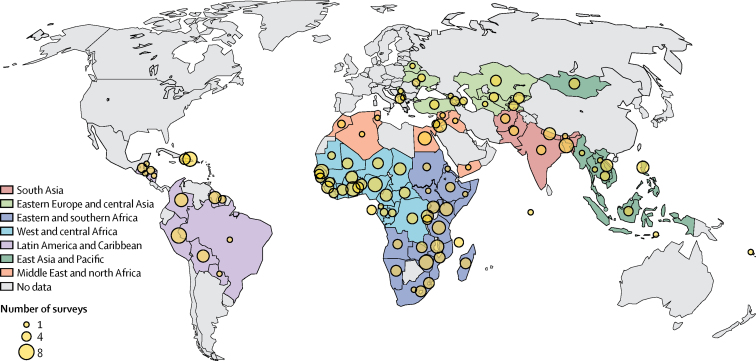
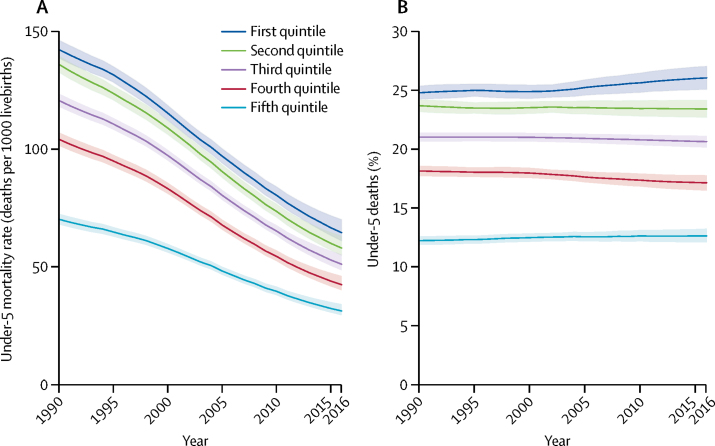
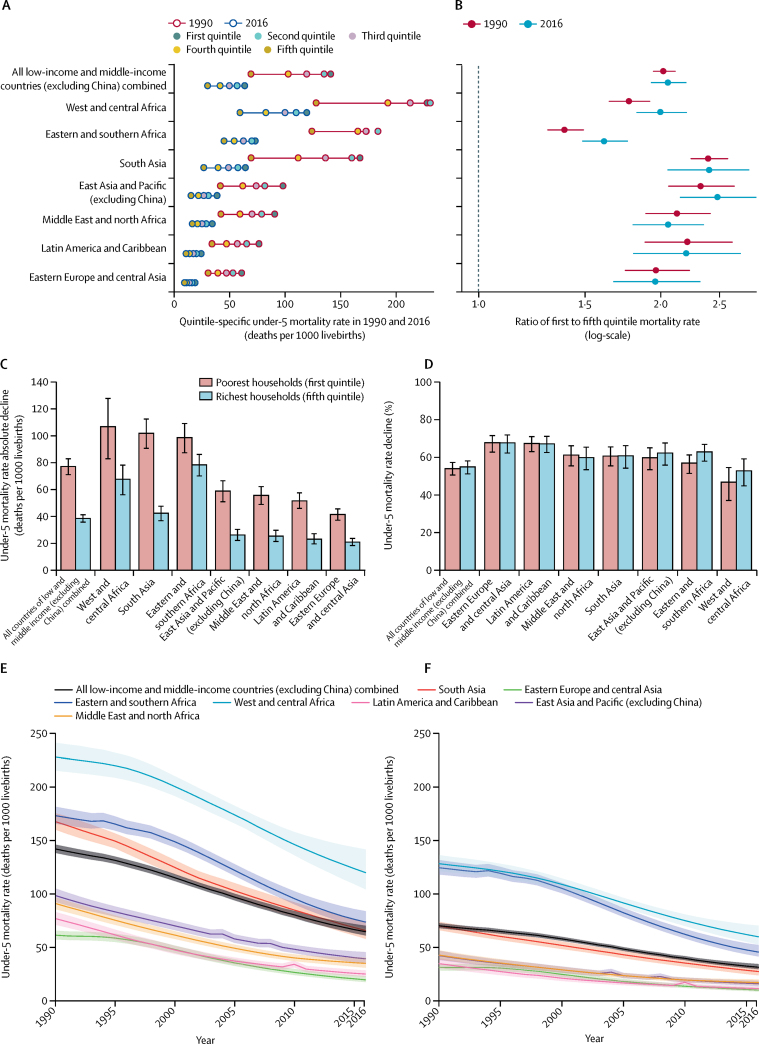
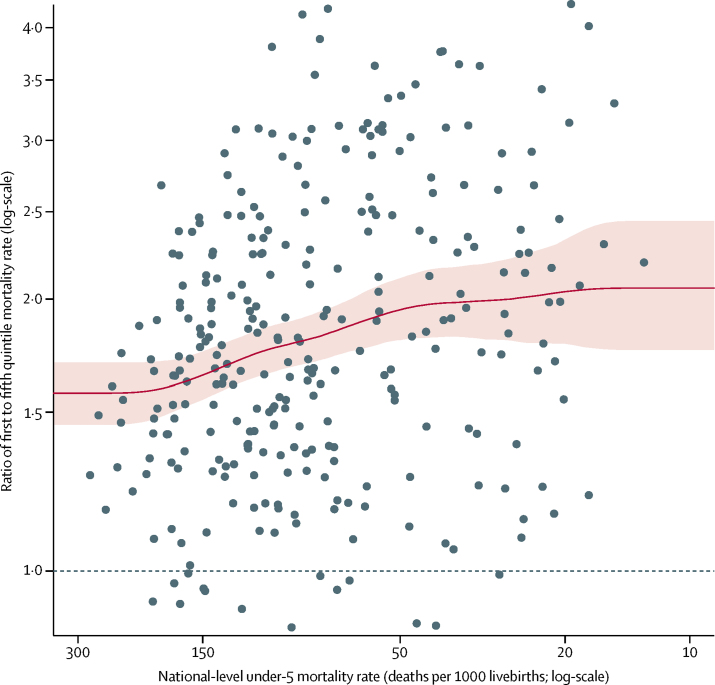
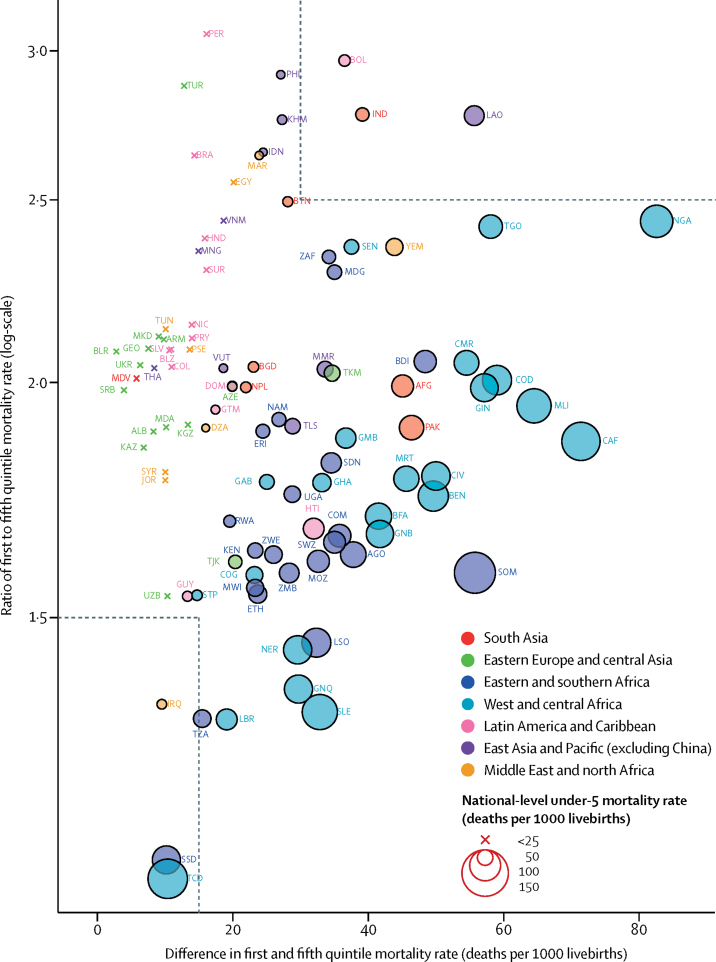
BACKGROUND: The progress to achieve the fourth Millennium Development Goal in reducing mortality rate in children younger than 5 years since 1990 has been remarkable. However, work remains to be done in the Sustainable Development Goal era. Estimates of under-5 mortality rates at the national level can hide disparities within countries. We assessed disparities in under-5 mortality rates by household economic status in low-income and middle-income countries (LMICs). METHOD: We estimated country-year-specific under-5 mortality rates by wealth quintile on the basis of household wealth indices for 137 LMICs from 1990 to 2016, using a Bayesian statistical model. We estimated the association between quintile-specific and national-level under-5 mortality rates. We assessed the levels and trends of absolute and relative disparity in under-5 mortality rate between the poorest and richest quintiles, and among all quintiles. FINDINGS: In 2016, for all LMICs (excluding China), the aggregated under-5 mortality rate was 64·6 (90% uncertainty interval [UI] 61·1-70·1) deaths per 1000 livebirths in the poorest households (first quintile), 31·3 (29·5-34·2) deaths per 1000 livebirths in the richest households (fifth quintile), and in between those outcomes for the middle quintiles. Between 1990 and 2016, the largest absolute decline in under-5 mortality rate occurred in the two poorest quintiles: 77·6 (90% UI 71·2-82·6) deaths per 1000 livebirths in the poorest quintile and 77·9 (72·0-82·2) deaths per 1000 livebirths in the second poorest quintile. The difference in under-5 mortality rate between the poorest and richest quintiles decreased significantly by 38·8 (90% UI 32·9-43·8) deaths per 1000 livebirths between 1990 and 2016. The poorest to richest under-5 mortality rate ratio, however, remained similar (2·03 [90% UI 1·94-2·11] in 1990, 1·99 [1·91-2·08] in 2000, and 2·06 [1·92-2·20] in 2016). During 1990-2016, around half of the total under-5 deaths occurred in the poorest two quintiles (48·5% in 1990 and 2000, 49·5% in 2016) and less than a third were in the richest two quintiles (30·4% in 1990, 30·5% in 2000, 29·9% in 2016). For all regions, differences in the under-5 mortality rate between the first and fifth quintiles decreased significantly, ranging from 20·6 (90% UI 15·9-25·1) deaths per 1000 livebirths in eastern Europe and central Asia to 59·5 (48·5-70·4) deaths per 1000 livebirths in south Asia. In 2016, the ratios of under-5 mortality rate in the first quintile to under-5 mortality rate in the fifth quintile were significantly above 2·00 in two regions, with 2·49 (90% UI 2·15-2·87) in east Asia and Pacific (excluding China) and 2·41 (2·05-2·80) in south Asia. Eastern and southern Africa had the smallest ratio in 2016 at 1·62 (90% UI 1·48-1·76). Our model suggested that the expected ratio of under-5 mortality rate in the first quintile to under-5 mortality rate in the fifth quintile increases as national-level under-5 mortality rate decreases. INTERPRETATION: For all LMICs (excluding China) combined, the absolute disparities in under-5 mortality rate between the poorest and richest households have narrowed significantly since 1990, whereas the relative differences have remained stable. To further narrow the rich-and-poor gap in under-5 mortality rate on the relative scale, targeted interventions that focus on the poorest populations are needed. FUNDING: National University of Singapore, UN Children's Fund, United States Agency for International Development, and the Bill & Melinda Gates Foundation.
Overview
The claims and statistics of this paper haven’t been checked yet.
Free: it reads the open-access text and checks the first 5 claims that cite a source we can check. Create a free account to check every claim.
Integrity signals
Registry
Cites
Statistics
Figures
Verification
Claims the paper makes
The claims and statistics of this paper haven’t been checked yet.
Free: it reads the open-access text and checks the first 5 claims that cite a source we can check. Create a free account to check every claim.
Claims other papers make about this one
Each is checked against this paper’s own text: does it say what the citing paper says it does?
In the citing paper
“Chao et al estimated that in 2016 the under-5 mortality rates were twice as high in the poorest households than the richest in low- and middle-income countries (excluding China). 72”
From Global health 2050: the path to halving premature death by mid-century (2024) · cites this paper as [72]
In the citing paper
“Despite significant absolute reductions in the gap since 1990, the relative gap remained similar.”
From Global health 2050: the path to halving premature death by mid-century (2024) · cites this paper as [72]
Self-check
Percentages, sums and reported differences re-computed from the paper’s own numbers.
The self-check needs the paper’s full text.
Citations
Cites
Transforming Our World: The 2030 Agenda for Sustainable Development
(2018) · A New Era in Global Health · doi:10.1891/9780826190123.ap02 · Cited by 19,351
Sampling-based approaches to calculating marginal densities
Gelfand, A. E., & Smith, A. F. M. (1990) · Journal of the American Statistical Association · doi:10.1080/01621459.1990.10476213 · Cited by 6,606
JAGS: A program for analysis of Bayesian graphical models using Gibbs sampling
Plummer, M. (2003) · Cited by 4,720
Cutler, D., Deaton, A., & Lleras-Muney, A. (2006) · Journal of Economic Perspectives · doi:10.1257/jep.20.3.97 · Cited by 1,555
Socioeconomic inequalities in health: Measurement, computation, and statistical inference
Kakwani, N., Wagstaff, A., & van Doorslaer, E. (1997) · Journal of Econometrics · doi:10.1016/s0304-4076(96)01807-6 · Cited by 1,378
Mackenbach, J. P., & Kunst, A. E. (1997) · Social Science & Medicine · doi:10.1016/s0277-9536(96)00073-1 · Cited by 1,343
Rutstein, S. O., & Johnson, K. (2004) · doi:10.13140/2.1.2806.4809 · Cited by 977
Levels and Trends in Child Mortality : Report 2018
Hug, L., Dharrow, D., Zhong, K., & You, D. (2017) · Cited by 848
Self-citationYou, D., Hug, L., Ejdemyr, S., Idele, P., Hogan, D., Mathers, C., Gerland, P., New, J. R., & Alkema, L. (2015) · The Lancet · doi:10.1016/s0140-6736(15)00120-8 · Cited by 830
Self-citationExplaining trends in inequities: evidence from Brazilian child health studies
Victora, C. G., Vaughan, J. P., Barros, F. C., Silva, A. C., & Tomasi, E. (2000) · The Lancet · doi:10.1016/s0140-6736(00)02741-0 · Cited by 768
Research works printed but not linked: 1
- Mohammad KA Tabassum T The impact of socio-economic and demographic factors on under-five child mortality in Bangladesh Imp J Interdiscip Res 2 2016 626 631
Cited by
Items 101–174 of 174
Kaulu, B., Kapilili, E. M., Kaulu, P., & Kaulu, G. (2025) · Egyptian Pediatric Association Gazette · doi:10.1186/s43054-025-00354-x · Cited by 3
“However, there is some evidence that the gap between the rich and poor in terms of child mortality is becoming narrower [15].”
Dhakad, M., & Saikia, N. (2023) · Sustainable development goals series · doi:10.1007/978-981-99-0002-2_7 · Cited by 3
Blanchard, A. K., Jacobs, C. N., Musukuma, M., Chooye, O., Sikapande, B., Michelo, C., Boerma, T., & Wehrmeister, F. C. (2023) · International Journal for Equity in Health · doi:10.1186/s12939-023-01901-x · Cited by 2
Exavery, A., Kirigiti, P. J., Balan, R. T., & Charles, J. (2024) · Child Indicators Research · doi:10.1007/s12187-024-10133-6 · Cited by 2
“There has been a colossal reliance on household-owned materials or assets such as houses, cars, farms, livestock, radios etc. as standard benchmarks for assessing household wealth or economic status in numerous surveys, including the Demographic and Health Surveys (DHS) and Multiple Indicator Cluster Surveys (MICS) (C…”
The Health and Human Rights Impact Assessment: The Preeminent Value of Equity.
Gostin, L. O., & Friedman, E. (2024) · PubMed Central · Cited by 2
Determinants of under-five mortality in informal settlements in Nairobi, Kenya from 2002 to 2018
Iddi, S., Akeyo, D., Sanya, R. E., Wamukoya, M., & Asiki, G. (2024) · BMC Public Health · doi:10.1186/s12889-024-20073-z · Cited by 3
“Like many other health indicators, the burden of under-five mortality is heaviest among the poor and especially the informal settlements [7, 15, 16].”
BackgroundStatistical models for predicting the number of under-five mortality in Nepal
Bhusal, M. K., & Khanal, S. P. (2025) · PLoS ONE · doi:10.1371/journal.pone.0324321 · Cited by 5
“It is considered an outcome of the combination of nutritional status, immunization rates, maternal health, and other healthcare services received by mothers during pregnancy and after birth, and hence it is a marker to judge the health status of the community [3,4].”
Arias-Montes, J. D. (2024) · Geográfica digital · doi:10.30972/geo.21427826 · Cited by 4
Space-time smoothing of mortality estimates in children aged 5-14 in Sub-Saharan Africa
Schlüter, B.-S., & Masquelier, B. (2021) · PLoS ONE · doi:10.1371/journal.pone.0245596 · Cited by 2
Odjidja, E. N., Hakizimana, S., Gatasi, G., Masabo, J.-B., Irakoze, G., Muzungu, H., Murorunkwere, H., Ngabirano, L. R., Elkasabi, M., & de Courten, B. V. (2020) · BMC Nutrition · doi:10.1186/s40795-020-00372-5 · Cited by 2
Hassan, S. N. U., Bhutta, G. A., & Farva, K. (2021) · The Professional Medical Journal · doi:10.29309/tpmj/2021.28.07.5902 · Cited by 1
Mortality Rate in Pakistan - among Low and Middle-Income Countries
Bacha, U., & Munir, N. (2022) · IntechOpen eBooks · doi:10.5772/intechopen.105770 · Cited by 2
Influence of socio-demographic and environmental factors on child mortality in India
Panda, S., & Sarangi, P. K. (2023) · International Journal of Community Medicine and Public Health · doi:10.18203/2394-6040.ijcmph20232037 · Cited by 1
Freeman, T., Gesesew, H. A., Bambra, C. L., Brown, H., Ullah, S., Popay, J., & Baum, F. E. (2025) · International Journal of Social Determinants of Health and Health Services · doi:10.1177/27551938251345969 · Cited by 4
“34 Improvements in health care systems over time and the progress towards universal health coverage are also likely to improve child mortality and inequities in child mortality.”
InfluentialRamos, A. P., Caldieraro, F., Nascimento, M. L., & Saldanha, R. D. F. (2025) · Population Health Metrics · doi:10.1186/s12963-025-00420-x · Cited by 1
“International agencies and local policymakers have recognized these disparities between subgroups [6, 7].”
Garba, M. A., Giwa, F. J., Adelaiye, H., Olorukooba, A. A., Abdullahi, F., Makarfi, H. U., Löwensteyn, Y. N., Bont, L., Abdurraheem, F., Uudu, E., et al. (2023) · Journal of Pediatric Infectious Diseases · doi:10.1055/s-0042-1760446 · Cited by 1
Temesgen, T., & Figa, Z. (2023) · Current Women s Health Reviews · doi:10.2174/1573404819666230120122906 · Cited by 1
Monamo, T. T., Navaneetham, K., & Keetile, M. (2023) · Journal of Public Health · doi:10.1007/s10389-023-01980-8 · Cited by 1
Akinmoladun, J., Atalabi, O. M., Falade, A. G., Mortimer, K. J., & Ogunniyi, A. O. (2024) · Journal of the Pan African Thoracic Society · doi:10.25259/jpats_16_2023 · Cited by 1
Patrick, T., Somaiya, N., & Sheik, A. A. (2024) · NEWPORT INTERNATIONAL JOURNAL OF PUBLIC HEALTH AND PHARMACY · doi:10.59298/nijpp/2024/51192818 · Cited by 2
Karoui, H., Rwandarwacu, V. P., Niyonzima, J., Makuza, A., Nkuranga, J. B., D’Acremont, V., & Kulinkina, A. V. (2025) · PLoS ONE · doi:10.1371/journal.pone.0318284 · Cited by 1
“Children in sub-Saharan Africa experience significant morbidity due to infectious diseases [1,2], with the vast majority of childhood illnesses being addressed at the primary care level.”
Dagdanpurev, S., Tsogzolmaa, U., Sun, G., Choimaa, L., Abe, S., & Matsui, T. (2019) · Annual International Conference of the IEEE Engineering in Medicine and Biology Society (EMBC) · doi:10.1109/embc.2019.8857689 · Cited by 1
“This high mortality rate is related to inadequate clinical facilities and low household income, leading to delayed diagnosis and treatment [3,4].”
BackgroundNóbrega, M. D. F., Medeiros, L. M. N., & Sáfadi, M. A. P. (2021) · Research Society and Development · doi:10.33448/rsd-v10i2.12438 · Cited by 1
“In 2017, the overall Human Development Index (HDI) was around 0.754 (Chao et al., 2018).”
BackgroundInfluentialChao, F., Wazir, M. A., & Ombao, H. (2022) · International Journal of Population Studies · doi:10.36922/ijps.v8i2.332 · Cited by 4
“This technique of validation exercise is used to reduce the correlation of validation results within each province and has been used in validation exercises in the previous studies (Alkema et al., 2014; Chao et al., 2018a; You et al., 2015).”
MethodSelf-citationOdjidja, E. N., Hakizimana, S., Gatasi, G., Masabo, J.-B., Irakoze, G., Muzungu, H., Murorunkwere, H., & Elkasabi, M. (2019) · doi:10.21203/rs.2.16855/v1 · Cited by 1
“Children in households of the poorest wealth quintile are two times likely to die compared to those in the richest quintile [4] and children in rural areas are 1.”
BackgroundThakur, B., & Pathak, M. (2022) · Frontiers in Pediatrics · doi:10.3389/fped.2022.1014775 · Cited by 1
Haq, Z. U., Naeem, A., Zaeem, D., Sohail, M., & Ain, N. U. (2023) · medRxiv · doi:10.1101/2023.04.06.23288277 · Cited by 1
“Within-country disparities are also alarming, with disadvantaged populations living in slum areas having much higher mortality [16].”
BackgroundAge Distribution, Trends, and Forecasts of Under-5 Mortality in Sub-Saharan AfricaPreprint
Mejía‐Guevara, I., Zuo, W., Bendavid, E., Li, N., & Tuljapurkar, S. D. (2018) · bioRxiv (Cold Spring Harbor Laboratory) · doi:10.1101/405258
Análise da evitabilidade do óbito infantil e fetal em um município de médio porte no Brasil
Pereira, L. K. M., de Melo, R. H. V., da Silva, J. A., Barbosa, M. H. P. A., Rosendo, T. M. S. D. S., & Amorim, K. P. C. (2021) · Research Society and Development · doi:10.33448/rsd-v10i8.17120 · Cited by 6
Sessions, K. L., Smith, A., Holmberg, P. J., Mvalo, T., Chisti, M. J., Carroll, R. W., & McCollum, E. D. (2021) · medRxiv · doi:10.1101/2021.07.27.21261207
“BMJ evidence-based medicine 2018; 23(2): 60-3.”
InfluentialUnder Age Five Children Survival Times in Nigeria: A Bayesian Spatial Modelling ApproachPreprint
Egbon, O. A., Bogoni, M. A., Babalola, B. T., & Louzada, F. (2021) · Research Square · doi:10.21203/rs.3.rs-1042906/v1
Public health priorities in countries undergoing economic transition: The middle-income countries
Tollman, S. M., & Price, J. E. (2021) · doi:10.1093/med/9780198816805.003.0004 · Cited by 2
Fakunle, A. G., Jafta, N., Smit, L. A. M., & Naidoo, R. N. (2022) · Research Square · doi:10.21203/rs.3.rs-850398/v1
Chaurasia, A. R. (2019) · Springer eBooks · doi:10.1007/978-981-32-9212-3_1
Mugo, N. S., Mya, K. S., & Raynes‐Greenow, C. H. (2019) · Journal of Global Health Reports · doi:10.29392//001c.12018
Análise espaço-temporal da mortalidade infantil no município do Rio de Janeiro, 2010–2019
Dutra, V. G. P., Cavalcante, J. R., Caputo, C. D. S., & Guimarães, R. M. (2022) · Revista Paulista de Pediatria · doi:10.1590/1984-0462/2022/40/2021061
Spatio-temporal analysis of infant mortality in the city of Rio de Janeiro, 2010–2019
Dutra, V. G. P., Cavalcante, J. R., Caputo, C. D. S., & Guimarães, R. M. (2022) · Revista Paulista de Pediatria · doi:10.1590/1984-0462/2022/40/2021061in
Temesgen, T., Figa, Z., Gido, R., Mahamed, A. A., Sefa, A., Tarekegn, D., Amanu, G., Bekele, E., Gugsa, T., Sisay, D., et al. (2023) · Current Medical Research and Opinion · doi:10.1080/03007995.2023.2181779
Tetanus Neonatorum: its Associated Risk Factors and Mortality Rate in Khyber Pakhtunkhwa
Ullah, F., Ullah, F., Naz, R., Muhammad, T., Ali, M., & Jabeen, N. (2023) · Pakistan Journal of Medical and Health Sciences · doi:10.53350/pjmhs2023171551
Wealth Effects of the Decrease in Under-five Mortality in India, 2005-2021Preprint
Chaurasia, A. R. (2023) · medRxiv · doi:10.1101/2023.04.11.23288395
“Introduction Wealth effects of under-five mortality are well-known (Biradar et al, 2018; Chao et al, 2018; Lartey et al, 2016).”
BackgroundMeasuring and valuing health outcomes
Alfonso, Y. N., Verguet, S., & Pandya, A. (2023) · Oxford University Press eBooks · doi:10.1093/oso/9780192896087.003.0017
Mortalidade materna no estado de Minas Gerais: análise do período de 2010 a 2019
Santos, H. G. N. D., Dias, A. L. S. S., Rodrigues, A. C., Santos, W. M. S., Santos, J. S., Andrade, R. D., & Maia, M. A. C. (2023) · Brazilian Journal of Health Review · doi:10.34119/bjhrv6n3-137
International Development and Public Health
Turner, G., & Amery, J. (2023) · Cambridge University Press eBooks · doi:10.1017/9781009378260.021
Contexts for Public Health Practice
Watson, K., Yates, J., & Gillam, S. (2023) · Cambridge University Press eBooks · doi:10.1017/9781009378260.014
Borba, M. F. (2023) · Digital Library of Theses and Dissertations (Universidade de São Paulo) · doi:10.11606/t.6.2023.tde-05022024-163230 · Cited by 4
Decomposition of the Change in Child Mortality by Income Groups in India, 2005–2021
Chaurasia, A. R. (2024) · Journal of Asian and African Studies · doi:10.1177/00219096241235298
“The income inequality in child mortality is well-known (Biradar et al., 2019; Chao et al., 2018; Lartey et al., 2016).”
Soleimani, S., Mirzaasgari, Z., Mahdizadeh, P., Shakiba, B., & Maghsoudi, R. (2024) · Archives of Epilepsy · doi:10.4274/archepilepsy.2024.23107
The Health and Human Rights Impact Assessment: The Preeminent Value of EquityPreprint
Gostin, L. O., & Friedman, E. (2024) · SSRN Electronic Journal · doi:10.2139/ssrn.4867888
Isah, H. M., Zakari, Y., & Abdu, M. (2024) · UMYU Scientifica · doi:10.56919/2433.021
gebregergis, C. M. (2024) · Child Indicators Research · doi:10.1007/s12187-024-10193-8
“Therefore, continued effort must be excreted to maintain a reduction in the inequalities of child health outcomes (Chao et al., 2018).”
Trends in global mortality rates and causes of death among children under five, 2000–2021
Li, C., Li, J., Vinturache, A., & Ding, G. (2025) · Pediatric Research · doi:10.1038/s41390-025-04061-6
Daka, D. W., Wordofa, M. A., & Woldie, M. K. (2025) · BMC Health Services Research · doi:10.1186/s12913-025-12863-x
“The sub-Saharan Africa region disproportionately had high a burden of under-five mortality [2, 3].”
Asefa, A., Gebremedhin, S., Marthias, T., Nababan, H. Y., Christou, A., Semaan, A. T., Banke-Thomas, A. O., Tabana, H., Al-beity, F. M. A., Dossou, J.-P., et al. (2024) · Figshare · doi:10.6084/m9.figshare.26621599
Asefa, A., Gebremedhin, S., Marthias, T., Nababan, H. Y., Christou, A., Semaan, A. T., Banke-Thomas, A. O., Tabana, H., Al-beity, F. M. A., Dossou, J.-P., et al. (2024) · Figshare · doi:10.6084/m9.figshare.26621596
Blanchard, A. K., Jacobs, C., Musukuma, M., Chooye, O., Sikapande, B., Michelo, C., Boerma, T., & Wehrmeister, F. C. (2024) · Figshare · doi:10.6084/m9.figshare.26593526
Li, Z., Karlsson, O., Kim, R., & Subramanian, S. V. (2021) · Figshare · doi:10.6084/m9.figshare.14490182
Estimate Under-5 Mortality Rate by Household Economic Status
Chao, F., You, D., Pedersen, J., Hug, L., & Alkema, L. (2018) · Figshare · doi:10.6084/m9.figshare.12403868
Self-citationAsefa, A., Gebremedhin, S., Marthias, T., Nababan, H. Y., Christou, A., Semaan, A. T., Banke-Thomas, A. O., Tabana, H., Al-beity, F. M. A., Dossou, J.-P., et al. (2024) · Figshare · doi:10.6084/m9.figshare.24234289
Osei, C. K., & Nketiah-Amponsah, E. (2022) · Research Square · doi:10.21203/rs.3.rs-1810683/v1
Osei, C. K., & Nketiah‐Amponsah, E. (2024) · Figshare · doi:10.6084/m9.figshare.26733696
Estimation of Under-5 Mortality by Wealth Quintile (poster for PAA 2017)
Chao, F., You, D., Pedersen, J., Hug, L., & Alkema, L. (2017) · Figshare · doi:10.6084/m9.figshare.12401297
Self-citationAmegbor, P. M., & Addae, A. (2024) · Figshare · doi:10.6084/m9.figshare.26586972
Sheikh, M. R., Khan, S. U., Ahmed, M., Ahmad, R., Abbas, A., & Ullah, I. (2023) · Figshare · doi:10.6084/m9.figshare.24022681
Pieterse, P., Matthews, A., Walsh, A., & Chirwa, E. (2020) · Figshare · doi:10.6084/m9.figshare.13077489
Asefa, A., Gebremedhin, S., Marthias, T., Nababan, H. Y., Christou, A., Semaan, A. T., Banke-Thomas, A. O., Tabana, H., Al-beity, F. M. A., Dossou, J.-P., et al. (2023) · Figshare · doi:10.6084/m9.figshare.24234104
Asefa, A., Gebremedhin, S., Marthias, T., Nababan, H. Y., Christou, A., Semaan, A. T., Banke-Thomas, A. O., Tabana, H., Al-beity, F. M. A., Dossou, J.-P., et al. (2024) · Figshare · doi:10.6084/m9.figshare.26621593
Gender and Economic Inequality in under-5 Mortality in India from 2000 to 2022
Pradhan, S. K., Pradhan, P., Nayak, U. S., Panda, B., Tripathy, S. S., & Mishra, S. K. (2025) · International Journal of Preventive Medicine · doi:10.4103/ijpvm.ijpvm_371_24 · Cited by 1
“[19] in their study reported that the disparity in U5MR in low‑income and middle‑income countries across all quintiles of economic dimension, that is, poorest to wealthiest, decreased significantly on the absolute scale but remained approximately constant on the relative scale during 1990 and 2016.”
An Investigation into India’s Experience in Reducing Child Mortality: A Gender Perspective
Ram, U., Kumar, P., & Ananya, K. V. (2025) · Sustainable development goals series · doi:10.1007/978-981-95-1719-0_3
Dani, A., Gudeshian, M., Haidar, G. H. A., Halajian, C., & Charafeddine, L. (2026) · BMJ Paediatrics Open · doi:10.1136/bmjpo-2025-003991
Patiño-Benavidez, A. F., Ávila-Garzón, L. C., Sánchez‐Santiesteban, D., Mantilla, W., Castillo, J. S., Muñoz, V., & Buitrago, G. (2026) · JCO Global Oncology · doi:10.1200/go-25-00344
Jain, A., Kim, R., & Subramanian, S. V. (2026) · Social Science & Medicine · doi:10.1016/j.socscimed.2026.119559
Ou, L.-Y., Zhang, Y., & Zhang, Y.-T. (2026) · World Journal of Pediatrics · doi:10.1007/s12519-026-01100-y
“It is precisely through the erosion of healthcare access that socioeconomic disadvantage, low levels of education, and urban–rural development gaps convert inequalities in the distribution of social resources into disparities in health outcomes [19, 20].”
Christie, A. C., Rafee, A. R., Whitley, K., Balkhdhar, M., Udayan, U., Baek, S. I., & Facey, M. (2026) · Journal of Global Health · doi:10.7189/jogh.16.04361
“…global study reported that in 2016, the average U5MR of children from the poorest wealth quintile in low-and middle-income countries (LMICs) was 64.6 per 1,000 live births – more than twice as high as that of children from the richest wealth quintile, which stood at 31.3 per 1,000 [ 17 ].”
Influential
Metadata
- Authors
- Chao, F., You, D., Pedersen, J., Hug, L., & Alkema, L.
- Affiliations
- National University of Singapore (SG)
- United Nations Children's Fund (US)
- Fafo Foundation (NO)
- University of Massachusetts Amherst (US)
- Corresponding author
- Chao, Fengqing
- Venue
- The Lancet Global Health
- Publisher
- Elsevier BV
- Published
- 2018-05
- Volume
- 6
- Issue
- 5
- Pages
- e535-e547
- ISSN
- 2214-109X (ISSN-L)
- PMC
- PMC5905403
- OpenAlex
- W2798210555
- Semantic Scholar
- 454364baf3569be9f9a577da9ddee62f175bdd75
- Cited by
- 174
- References
- 38
- Citations by year
- 2026: 5 · 2025: 17 · 2024: 27 · 2023: 30 · 2022: 22 · 2021: 28 · 2020: 23 · 2019: 16 · 2018: 5
- FWCI
- 19.86
- Type
- journal article
- Language
- en
- Open access
- gold
- doi.org
- Licence
- cc-by
- www.elsevier.com/tdm/userlicense/1.0/ (tdm)
- www.elsevier.com/legal/tdmrep-license (tdm)
- creativecommons.org/licenses/by/4.0/ (vor)
- Locations
- The Lancet Global Health (publishedVersion, cc-by)
- Europe PMC (PubMed Central) (publishedVersion, cc-by)
- PubMed Central (publishedVersion, cc-by)
- PubMed (publishedVersion)
- National University of Singapore (submittedVersion, cc-by-nc-nd)
- DOAJ (DOAJ: Directory of Open Access Journals) (submittedVersion, cc-by-sa)
- Funders
- National University of Singapore
- Bill and Melinda Gates Foundation (OPP1135440)
- United States Agency for International Development
- Topics
- Health Sciences › Medicine › Pediatrics, Perinatology and Child Health › Global Maternal and Child Health
- Health Sciences › Nursing › Nutrition and Dietetics › Child Nutrition and Water Access
- Social Sciences › Development › Poverty, Education, and Child Welfare
- Keywords
- under-five mortality, child mortality, household wealth inequality, wealth quintiles, household wealth index, low- and middle-income countries, mortality disparities, Millennium Development Goal 4, Sustainable Development Goal 3, mortality trends, poverty and health, child health equity, maternal and child health policy
- MeSH terms
- Child, Preschool, Developing Countries, Goals, Humans, Infant, Infant Mortality, Infant, Newborn, Social Class, Child Mortality, Health Status Disparities
About these checks
Registry, retraction, Cites and statistics results are computed, not judged, with one exception: a printed reference that no index lists is read once by a model before it counts as a citation error. Claims are extracted by a model and kept only when their quote appears verbatim in the text; each cited source is then checked, with a model’s help, for whether it says what the claim relies on. Those verdicts can be wrong — read the claim’s quote and the cited source before relying on one.
Statistics and arithmetic are recomputed, not judged.
Confidence bands are shown only for fields calibrated on our annotated test set. None is calibrated yet, so no band is shown.
What counts as a claim ›How we measure confidence ›How we check this ›
Are you an author, or do you see a problem with this page? Request a review
Data sources
Bibliographic data: Semantic Scholar, OpenAlex, Crossref.
Contains information from the Semantic Scholar Academic Graph Datasets, made available under the ODC Attribution License (ODC-BY 1.0).
Semantic Scholar’s data is described in: Kinney, R., et al. (2023). The Semantic Scholar Open Data Platform. arXiv:2301.10140.
