

Psychological and pharmacological interventions for social anxiety disorder in adults: a systematic review and network meta-analysis
Open accessThe DOI matches its Crossref record; 37 of the 37 references it cites were found in a registry or an index; 3 of the 15 sources its claims cite were checked for support.
Abstract
BACKGROUND: Social anxiety disorder-a chronic and naturally unremitting disease that causes substantial impairment-can be treated with pharmacological, psychological, and self-help interventions. We aimed to compare these interventions and to identify which are most effective for the acute treatment of social anxiety disorder in adults. METHODS: We did a systematic review and network meta-analysis of interventions for adults with social anxiety disorder, identified from published and unpublished sources between 1988 and Sept 13, 2013. We analysed interventions by class and individually. Outcomes were validated measures of social anxiety, reported as standardised mean differences (SMDs) compared with a waitlist reference. This study is registered with PROSPERO, number CRD42012003146. FINDINGS: We included 101 trials (13 164 participants) of 41 interventions or control conditions (17 classes) in the analyses. Classes of pharmacological interventions that had greater effects on outcomes compared with waitlist were monoamine oxidase inhibitors (SMD -1·01, 95% credible interval [CrI] -1·56 to -0·45), benzodiazepines (-0·96, -1·56 to -0·36), selective serotonin-reuptake inhibitors and serotonin-norepinephrine reuptake inhibitors (SSRIs and SNRIs; -0·91, -1·23 to -0·60), and anticonvulsants (-0·81, -1·36 to -0·28). Compared with waitlist, efficacious classes of psychological interventions were individual cognitive-behavioural therapy (CBT; SMD -1·19, 95% CrI -1·56 to -0·81), group CBT (-0·92, -1·33 to -0·51), exposure and social skills (-0·86, -1·42 to -0·29), self-help with support (-0·86, -1·36 to -0·36), self-help without support (-0·75, -1·25 to -0·26), and psychodynamic psychotherapy (-0·62, -0·93 to -0·31). Individual CBT compared with psychological placebo (SMD -0·56, 95% CrI -1·00 to -0·11), and SSRIs and SNRIs compared with pill placebo (-0·44, -0·67 to -0·22) were the only classes of interventions that had greater effects on outcomes than appropriate placebo. Individual CBT also had a greater effect than psychodynamic psychotherapy (SMD -0·56, 95% CrI -1·03 to -0·11) and interpersonal psychotherapy, mindfulness, and supportive therapy (-0·82, -1·41 to -0·24). INTERPRETATION: Individual CBT (which other studies have shown to have a lower risk of side-effects than pharmacotherapy) is associated with large effect sizes. Thus, it should be regarded as the best intervention for the initial treatment of social anxiety disorder. For individuals who decline psychological intervention, SSRIs show the most consistent evidence of benefit. FUNDING: National Institute for Health and Care Excellence.
Overview
CoChat Summary
## TL;DR
This systematic review and network meta-analysis found that both psychological and pharmacological treatments improve acute outcomes for adult social anxiety disorder, with individual CBT showing the largest and most consistent effects. The authors conclude that individual CBT should be the initial treatment of choice, while SSRIs are the most consistent drug option for people who decline psychological treatment.
## Key findings
- The review included 101 trials with 13,164 participants and 41 interventions or control conditions grouped into 17 classes.
- Compared with waitlist, the largest class-level effects were for individual CBT (SMD −1.19, 95% CrI −1.56 to −0.81), group CBT (−0.92, −1.33 to −0.51), and pharmacological classes including MAOIs (−1.01, −1.56 to −0.45), benzodiazepines (−0.96, −1.56 to −0.36), and SSRIs/SNRIs (−0.91, −1.23 to −0.60).
- Against appropriate placebo, only individual CBT versus psychological placebo (SMD −0.56, 95% CrI −1.00 to −0.11) and SSRIs/SNRIs versus pill placebo (−0.44, −0.67 to −0.22) showed clear benefit.
- Individual CBT outperformed several other psychological interventions, including psychodynamic psychotherapy (SMD −0.56, 95% CrI −1.03 to −0.11) and interpersonal psychotherapy, mindfulness, and supportive therapy (−0.82, −1.41 to −0.24).
## Methods
- Systematic review and Bayesian random-effects network meta-analysis of adult randomized clinical trials for social anxiety disorder, using waitlist as the main reference condition.
- Searched published and unpublished sources from 1988 to Sept 13, 2013, with no language limits; included adults aged at least 18 years who met diagnostic criteria for social anxiety disorder.
- Outcomes were validated measures of social anxiety, analyzed as standardised mean differences (SMDs); the paper also estimated recovery where reported and compared interventions both by class and individually.
## Limitations
- The paper states that only a few studies of moderate size were available for several interventions, and some had been tested by only one or two research groups.
- Control conditions were heterogeneous and rarely described in detail, and the authors note that better reporting of what was intended and received is needed.
- The study included only end-of-treatment outcomes; the authors say they could not assess whether effects persist long term because most trials stopped at the end of treatment.
- Evident from the text: there was substantial risk of bias/reporting bias in the evidence base, including many unregistered trials, incomplete outcome data in some trials, and only 28 trials at low risk of bias for all non-masking domains.
Model-written summary. Check it against the paper before relying on it.
Integrity signals
Registry
Cites
Statistics
Figures
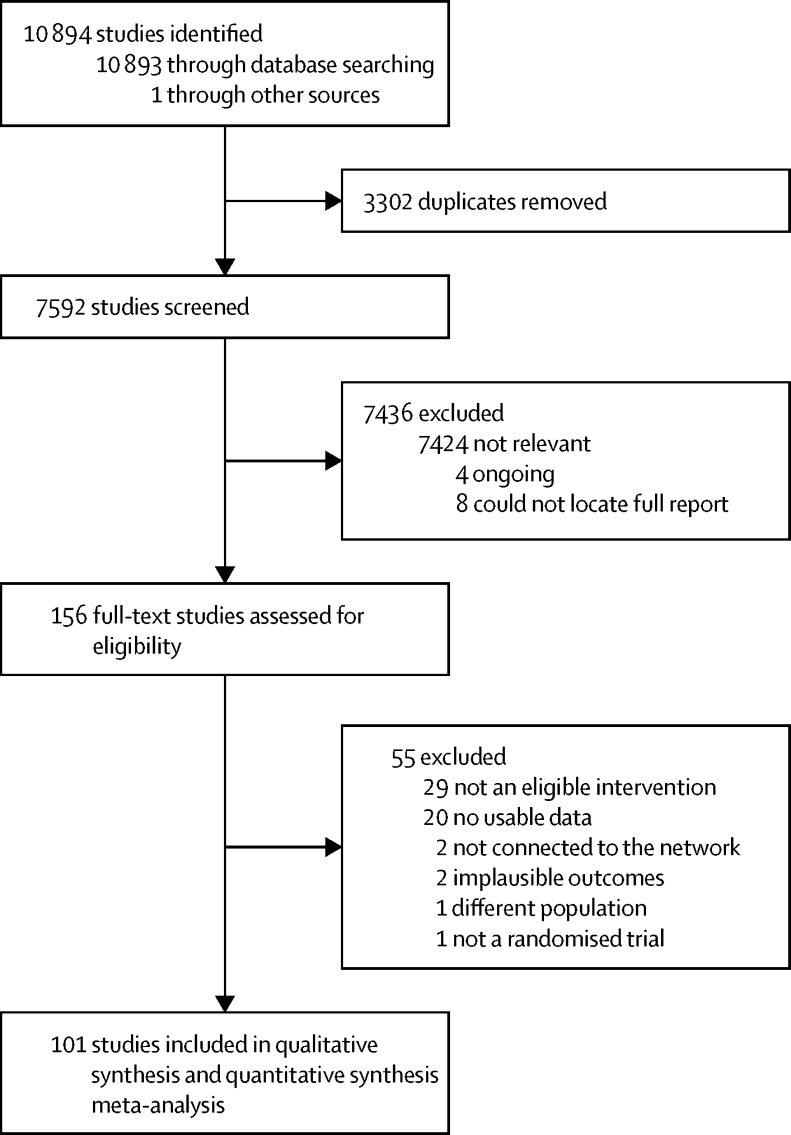
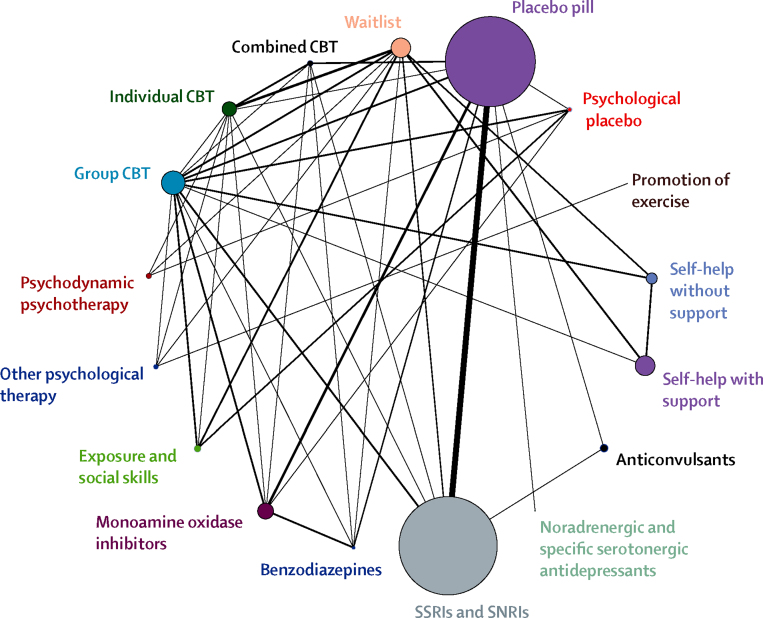
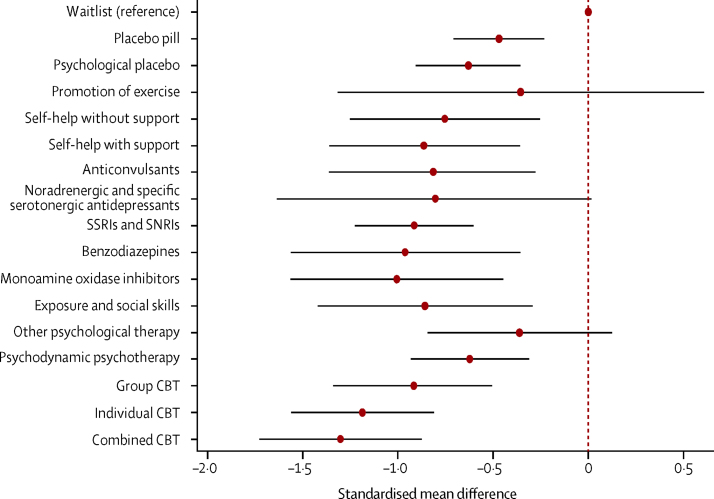
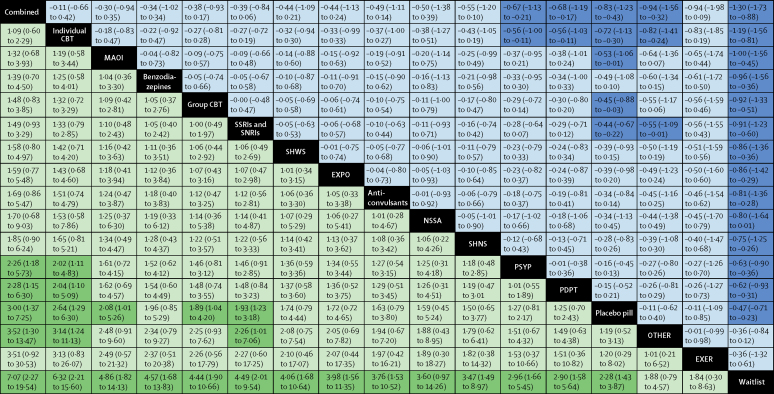
Verification
Claims the paper makes
2 Valid · 1 Not valid · 8 Not checked · 78 Own results and interpretations
The cited sources support only part of this claim — read each source’s verdict below.
In the paper
“the effects of psychological interventions are generally well maintained at follow-up,23”
§ Psychological and pharmacological interventions for social anxiety disorder in adults: a systematic review and network meta-analysis > Discussion
What the sources say
- Partly supportedcites [23] Haug TTB Exposure therapy and sertraline in social phobia: 1-year follow-up of a randomised controlled trial Br J Psychiatry 182 2003 312 318 12668406 sourceExperimental — accuracy not yet measured
The Clinical Implications section says exposure therapy alone for social phobia appeared to produce further improvement after treatment, supporting maintenance at follow-up for that intervention. The paper does not establish that psychological interventions generally have well-maintained effects; its finding concerns exposure therapy in this population, and the combined sertraline-plus-exposure group fared less well. (LLM, conf=0.86)
plainstates a cause- Asserted: passes — The authors put it forward as true.
- Checkable: passes — It can be checked against evidence.
- Load-bearing: passes — The paper’s conclusions depend on it.
- Based: passes — The paper gives a reason why it holds.
- Partly supported
The cited sources support only part of this claim — read each source’s verdict below.
In the paper
“SSRIs and SNRIs with a short half-life (eg, paroxetine and venlafaxine) are associated with the greatest risk of discontinuation effects, including effects during the treatment period and after the end of treatment.18, 19”
§ Psychological and pharmacological interventions for social anxiety disorder in adults: a systematic review and network meta-analysis > Discussion
What the sources say
- Not checked yetcites [18] Rosenbaum JF Fava M Hoog SL Ascroft RC Krebs WB Selective serotonin reuptake inhibitor discontinuation syndrome: a randomized clinical trial Biol Psychiatry 44 1998 77 87 9646889 source
- Partly supportedcites [19] Sir A D'Souza RF Uguz S Randomized trial of sertraline versus venlafaxine XR in major depression: efficacy and discontinuation symptoms J Clin Psychiatry 66 2005 1312 1320 16259546 sourceExperimental — accuracy not yet measured
Our copy supports only the venlafaxine half of the claim and only partially: the Discussion (post hoc analyses, p-values unadjusted) reports 'sertraline was associated with a lower burden of discontinuation symptoms compared with venlafaxine XR' and 'early reports suggesting the possibility of a clinically relevant discontinuation syndrome with venlafaxine XR and a relatively benign one with sertraline,' and Signs and Symptoms of Discontinuation / Table 4 list more discontinuation-emergent symptoms (dizziness, fatigue, vertigo, vivid dreams; tremor, confusion, impaired coordination) in the venlafaxine XR group, with the Safety and Tolerability section also noting 13 vs 3 treatment-related discontinuations in the first calendar week of treatment. The rest of the claim is not in this paper: no passage mentions paroxetine, no passage discusses elimination half-life or attributes discontinuation risk to short half-life, and the study compares only two agents (sertraline vs venlafaxine XR) so it never ranks them as carrying the 'greatest risk' among SSRIs/SNRIs, nor does it assess symptoms after the end of the taper (assessment ran only to week 10). The citing sentence also states as established fact what the paper hedges ('may be associated with a lower symptom burden'; a priori analyses showed no difference). (LLM, conf=0.68)
plainstates an association- Asserted: passes — The authors put it forward as true.
- Checkable: passes — It can be checked against evidence.
- Load-bearing: passes — The paper’s conclusions depend on it.
- Based: passes — The paper gives a reason why it holds.
The cited sources that could be checked couldn’t confirm or dispute this claim.
In the paper
“suggesting the network better estimates treatment effects than pairwise analyses alone with no evidence of inconsistency.9”
§ Psychological and pharmacological interventions for social anxiety disorder in adults: a systematic review and network meta-analysis > Results
What the sources say
- Could not verifycites [9] Dias S Sutton AJ Ades AE Welton NJ Evidence synthesis for decision making 2: a generalized linear ehaviour framework for pairwise and network meta-analysis of randomized controlled trials Med Decis Making 33 2013 607 617 23104435 PMC3704203 sourceExperimental — accuracy not yet measured
The ‘Extension to NMA’ section says that evidence consistency needs to be checked in all networks, but does not report a finding of no inconsistency in the citing authors’ network. A search for ‘no evidence of inconsistency’ found no such result in our copy. Page numbers were not provided. (LLM, conf=0.76)
hedgedn = 148- Asserted: passes — The authors put it forward as true.
- Checkable: passes — It can be checked against evidence.
- Load-bearing: passes — The paper’s conclusions depend on it.
- Based: passes — The paper gives a reason why it holds.
- Could not verify
A result the paper reports from its own data — it cites no other source for it, so there is none to check. The quote shows it is in the paper.
In the paper
“The largest effects were for MAOIs (class effect SMD −1·01, 95% CrI −1·56 to −0·45)”
§ Psychological and pharmacological interventions for social anxiety disorder in adults: a systematic review and network meta-analysis > Results
plainstates a cause- Asserted: passes — The authors put it forward as true.
- Checkable: passes — It can be checked against evidence.
- Load-bearing: passes — The paper’s conclusions depend on it.
- Based: passes — The paper gives a reason why it holds.
- Rests on 5 assumptions not shown here.
A result the paper reports from its own data — it cites no other source for it, so there is none to check. The quote shows it is in the paper.
In the paper
“Of the psychological interventions, only individual CBT had a greater effect on outcomes than psychological placebo (SMD −0·56, 95% CrI −1·00 to −0·11).”
§ Psychological and pharmacological interventions for social anxiety disorder in adults: a systematic review and network meta-analysis > Results
plainstates a cause- Asserted: passes — The authors put it forward as true.
- Checkable: passes — It can be checked against evidence.
- Load-bearing: passes — The paper’s conclusions depend on it.
- Based: passes — The paper gives a reason why it holds.
- Rests on 5 assumptions not shown here.
50 more claims
Create a free account to see all 89 claims and to verify the 12 references still open.
- It may state two separate claims as one. 26
- The quote only partly states this claim. 3
- Probably not a substantial claim. 12
Claims other papers make about this one
Each is checked against this paper’s own text: does it say what the citing paper says it does?
The cited source doesn’t support the claim as written.
In the citing paper
“The efficacy of pharmacotherapies also appears dependent on continued adherence to medication, with as many as 25% of people reporting relapse after discontinuation of the drug.”
From MDMA-Assisted Therapy as a Means to Alter Affective, Cognitive, Behavioral, and Neurological Systems Underlying Social Dysfunction in Social Anxiety Disorder (2021) · cites this paper as [15]
Checked by a reasoning model — may be wrong.
Experimental — accuracy not yet measuredThe source backs part of the claim, not all of it — or backs it for a different population, condition or comparison.
In the citing paper
“In terms of psychotherapies, cognitive-behavioral therapy has shown strong evidence for treatment efficacy and superior longevity to pharmacotherapy (15).”
From MDMA-Assisted Therapy as a Means to Alter Affective, Cognitive, Behavioral, and Neurological Systems Underlying Social Dysfunction in Social Anxiety Disorder (2021) · cites this paper as [15]
Experimental — accuracy not yet measuredThe source backs part of the claim, not all of it — or backs it for a different population, condition or comparison.
In the citing paper
“Yet, in the case of both medication and psychotherapy a significant proportion of patients remain considerably symptomatic at the end of treatment (15), with social anxiety often assuming a chronic course in spite of intervention (16).”
From MDMA-Assisted Therapy as a Means to Alter Affective, Cognitive, Behavioral, and Neurological Systems Underlying Social Dysfunction in Social Anxiety Disorder (2021) · cites this paper as [15]
Experimental — accuracy not yet measuredThe source backs part of the claim, not all of it — or backs it for a different population, condition or comparison.
In the citing paper
“Meta-analytic data on medication-based therapies suggests that SSRIs and SNRIs are associated favorable outcomes compared to placebo yet are also associated with higher dropout rates over the treatment course (14, 15).”
From MDMA-Assisted Therapy as a Means to Alter Affective, Cognitive, Behavioral, and Neurological Systems Underlying Social Dysfunction in Social Anxiety Disorder (2021) · cites this paper as [15]
Experimental — accuracy not yet measuredThe source backs part of the claim, not all of it — or backs it for a different population, condition or comparison.
In the citing paper
“for many common mental health conditions, particularly anxiety disorders, evidence-based psychological treatments are both the best treatment option2 and the preference of patients.3”
From Automated psychological therapy using immersive virtual reality for treatment of fear of heights: A single-blind, parallel-group, randomised controlled trial (2018) · cites this paper as [2]
Experimental — accuracy not yet measured
7 more claims about this paper
Create a free account to see every claim other papers make about this one.
Citations
Cites
Preferred Reporting Items for Systematic Reviews and Meta-Analyses: the PRISMA statement
Moher, D., Liberati, A., Tetzlaff, J., Altman, D. G., & for the PRISMA Group (2009) · BMJ · doi:10.1136/bmj.b2535 · Cited by 83,823
Preferred reporting items for systematic reviews and meta-analyses: the PRISMA Statement.
(2009) · PubMed Central · Cited by 44,859
Cochrane Handbook for Systematic Reviews of Interventions: Cochrane Book Series
(2008) · doi:10.1002/9780470712184 · Cited by 25,048
Cochrane Handbook for Systematic Reviews of Interventions Version 5.0.1. The Cochrane Collaboration
Higgins, J. P. T., Green, S. R., & Higgins, J. P. T. (2008) · Cited by 7,247
WinBUGS - A Bayesian modelling framework: Concepts, structure, and extensibility
Lunn, D. J., Thomas, A., Best, N., & Spiegelhalter, D. (2000) · Statistics and Computing · doi:10.1023/a:1008929526011 · Cited by 5,368
A cognitive-behavioral model of anxiety in social phobia
Rapee, R. M., & Heimberg, R. G. (1997) · Behaviour Research and Therapy · doi:10.1016/s0005-7967(97)00022-3 · Cited by 2,987
A cognitive model of social phobia
Adrian Wells, A. (1995) · Research Explorer (The University of Manchester) · Cited by 2,701
Social Phobia: Diagnosis, Assessment, and Treatment
Amada, G. (1996) · American Journal of Psychotherapy · doi:10.1176/appi.psychotherapy.1996.50.3.373 · Cited by 1,248
Dias, S., Sutton, A. J., Ades, A. E., & Welton, N. J. (2013) · Medical Decision Making · doi:10.1177/0272989x12458724 · Cited by 1,207
Self-citationStein, M. B., & Stein, D. J. (2008) · The Lancet · doi:10.1016/s0140-6736(08)60488-2 · Cited by 1,137
Cited by
Items 401–500 of 676
The road to improvement in obsessive-compulsive disorder
Torres, A. R. (2016) · The Lancet Psychiatry · doi:10.1016/s2215-0366(16)30118-3 · Cited by 4
Morbid Anxiety: Identification and Treatment
Goddard, A. W. (2017) · FOCUS The Journal of Lifelong Learning in Psychiatry · doi:10.1176/appi.focus.20160046 · Cited by 5
Development of a graphic medicine‐enabled social media‐based intervention for youth social anxiety
Rice, S., O’Bree, B., Wilson, M., McEnery, C., Lim, M. H., Hamilton, M. P., Gleeson, J., Bendall, S., D’Alfonso, S., Russon, P., et al. (2020) · Clinical Psychologist · doi:10.1111/cp.12222 · Cited by 4
Shirotsuki, K., Uehara, S., Adachi, S., & Nakao, M. (2019) · Psych · doi:10.3390/psych1010025 · Cited by 4
“Treatments utilizing the CBT technique for the treatment of generalized anxiety disorder, panic disorder, obsessive–compulsive disorder, and social anxiety disorder have demonstrated that anxiety symptoms can be significantly reduced [2,3].”
BackgroundAssessing Change in Intervention Research: The Benefits of Composite OutcomesPreprint
Moreau, D., & Wiebels, K. (2020) · PsyArXiv (OSF Preprints) · doi:10.31234/osf.io/t9hw3 · Cited by 7
Boudjafad, Z., Lguensat, A., Elmardadi, K., Dahi, A., Bennis, M., Ba-M’hamed, S., & Garcia, R. (2022) · Learning & Memory · doi:10.1101/lm.053627.122 · Cited by 3
Borgdorf, K. S. A., Aguilar‐Raab, C., & Holt, D. V. (2025) · Internet Interventions · doi:10.1016/j.invent.2025.100870 · Cited by 5
“…et al., 2024; Galloway et al., 2022; Suh et al., 2019), and various psychological treatments show efficacy for social anxiety disorders (e.g., Mayo-Wilson et al., 2014; Wolitzky-Taylor and LeBeau, 2023), systematic examination of alternative approaches remains limited (Shafran et al., 2023;…”
Strony, J. T., Moyal, A. J., Adelstein, J. M., Burkhart, R. J., Imbrogno, A. M., Abid, R., Gillespie, R. J., & Chen, R. E. (2026) · Archives of Orthopaedic and Trauma Surgery · doi:10.1007/s00402-026-06254-y · Cited by 3
Cognitive Behavioral Therapy for Kleptomania: A Case Study
Biomy, S. R. E. (2020) · International Neuropsychiatric Disease Journal · doi:10.9734/indj/2020/v14i330133 · Cited by 5
Arai, H., Ishikawa, S., Okawa, S., Kishida, K., Korte, K. J., & Schmidt, N. B. (2022) · Current Psychology · doi:10.1007/s12144-022-02981-8 · Cited by 5
Schittenhelm, J. M., von Borell, C., Clément, C. C., Schüller, J. S., Stangier, U., & Hoyer, J. (2023) · Trials · doi:10.1186/s13063-023-07168-5 · Cited by 7
“The therapists will be trained in Cognitive Therapy based on the model of Clark and Wells [4], which has been proven to be effective in face-to-face therapy [5] and in ICBT [15].”
BackgroundMethodResultChapter 2. Techniques of Psychodynamic Psychotherapy
Gabbard, G. O., & Crisp-Han, H. (2022) · American Psychiatric Association Publishing eBooks · doi:10.1176/appi.books.9781615375233.gg02 · Cited by 4
Winter, H. R., Norton, A. R., & Wootton, B. M. (2023) · Contemporary Clinical Trials · doi:10.1016/j.cct.2023.107298 · Cited by 3
Heightened risk of false positives in a network meta-analysis of social anxiety
Keefe, J. R. (2015) · The Lancet Psychiatry · doi:10.1016/s2215-0366(15)00043-7 · Cited by 3
Chaudhury, S., Samantaray, N. N., Kar, N., Singh, P., Swain, S. P., Singh, A., & Mahapatra, J. (2019) · Industrial Psychiatry Journal · doi:10.4103/ipj.ipj_13_19 · Cited by 3
“,[6] that although large effect sizes were seen with such combined treatment, there was no strong evidence that it was more efficacious than the leading pharmacological monotherapy in acute stages of treatment.”
BackgroundMethodInfluentialNihei, M., Hojo, D., & Sawa, K. (2021) · Learning and Motivation · doi:10.1016/j.lmot.2021.101725 · Cited by 4
Shin, J., Grossman, J. T., Rodriguez, C. R., & Rodebaugh, T. L. (2021) · Elsevier eBooks · doi:10.1016/b978-0-12-818697-8.00228-4 · Cited by 3
Fehm, L., & Knappe, S. (2020) · Springer eBooks · doi:10.1007/978-3-662-61814-1_49 · Cited by 4
Die soziale Angststörung – ein Update
Plag, J., & Hoyer, J. (2022) · Fortschritte der Neurologie · Psychiatrie · doi:10.1055/a-1803-8526 · Cited by 3
“Gemäß der deutschen S3-Leitlinie liegt die breiteste Evidenz für die kognitive Verhaltensthe-rapie (KVT) vor, sie erreicht für soziale Angststörung je-weils die Evidenzkategorie 1a und den Empfehlungsgrad A + [10] (vgl. auch [11]).”
BackgroundVagos, P., Figueiredo, D. V., Ganho-Ávila, A., Mayr, A. J., & Rijo, D. (2023) · Frontiers in Psychology · doi:10.3389/fpsyg.2022.915677 · Cited by 6
“Moreover, cognitive therapy for SAD (CT-SAD; based on Clark and Wells’ cognitive model of social anxiety), has been found to be highly efficacious (Mayo-Wilson et al., 2014) and cost-effective for adults (Mavranezouli et al.”
MethodKäll, A., Lynch, C. O., Sundling, K., Furmark, T., Carlbring, P., & Andersson, G. (2023) · Clinical Psychology in Europe · doi:10.32872/cpe.11379 · Cited by 5
“Cognitive behavioral therapy (CBT) is often seen as the gold standard among these treatments, producing large effect sizes (Mayo-Wilson et al., 2014) and lasting effects that are maintained years after therapy termination (van Dis et al., 2020).”
BackgroundWilson, A. C. (2024) · Autism in Adulthood · doi:10.1089/aut.2024.0009 · Cited by 4
Clément, C. C., Lin, J., & Stangier, U. (2019) · Trials · doi:10.1186/s13063-019-3905-3 · Cited by 3
“Several previous studies have shown the overall efficacy of CT including BE [7], but the incremental efficacy of BE as an additive intervention has yet to be verified.”
BackgroundInfluentialCarpenter, J. K., Conroy, K., & Hofmann, S. G. (2018) · Cambridge University Press eBooks · doi:10.1017/9781108140416.029 · Cited by 5
Wortzel, J. R., Turner, B. E., Weeks, B. T., Fragassi, C., Ramos, V., Truong, T., Li, D., Sahak, O., & O’Connor, T. G. (2021) · PLoS ONE · doi:10.1371/journal.pone.0248898 · Cited by 3
Treatment of anxiety disorders
Baldwin, D. S., & Huneke, N. T. M. (2020) · doi:10.1093/med/9780198713005.003.0092 · Cited by 3
Leichsenring, F., Salzer, S., & Leibing, E. (2015) · American Journal of Psychiatry · doi:10.1176/appi.ajp.2015.14101347r · Cited by 4
Modern Meta-Analytic Methods in Prevention Science: Introduction to the Special Issue
Tanner‐Smith, E. E., Grant, S., & Mayo‐Wilson, E. (2022) · Prevention Science · doi:10.1007/s11121-022-01354-8 · Cited by 3
“, 2017), or when estimating the effects of both intervention classes and their constituent interventions (Mayo-Wilson et al., 2014).”
BackgroundSelf-citationAndreoli, G., Kasch, C., Lindsay, C. E., & Hofmann, S. G. (2026) · Expert Review of Neurotherapeutics · doi:10.1080/14737175.2025.2604303 · Cited by 2
“Therefore, consistent with previous literature [29], SSRIs show the clearest efficacy and represent the most extensively studied drug class in the last years.”
Nishikawa, Y., Fracalanza, K., Rector, N. A., & Laposa, J. M. (2022) · Cognitive Therapy and Research · doi:10.1007/s10608-022-10322-z · Cited by 2
“CBT is a well-established efficacious and effective treatment among individuals with SAD (e.g., Barkowski et al., 2016; Mayo-Wilson et al., 2014) and is a recommended firstline treatment for SAD (e.”
BackgroundCaldiroli, A., Capuzzi, E., Tagliabue, I., Ledda, L., Clerici, M., & Buoli, M. (2023) · Expert Opinion on Pharmacotherapy · doi:10.1080/14656566.2022.2159373 · Cited by 2
“Another aspect to be considered in the choice of pharmacotherapy is the side-effect profile [16,17].”
BackgroundO'Brien, K. A., Sukovieff, A., & Johnson, E. A. (2021) · Journal of Social and Clinical Psychology · doi:10.1521/jscp.2021.40.6.534 · Cited by 3
Nihei, M., Hojo, D., Matsumoto, N., & Sawa, K. (2023) · Learning and Motivation · doi:10.1016/j.lmot.2023.101935 · Cited by 4
Shalom, J. G., Prihar, A., Strauss, A. Y., Huppert, J. D., Andersson, G., & Aderka, I. M. (2025) · Behavior Therapy · doi:10.1016/j.beth.2025.01.002 · Cited by 3
Leigh, E., Clark, D. M., & Chiu, K. (2025) · Journal of Behavior Therapy and Experimental Psychiatry · doi:10.1016/j.jbtep.2025.102020 · Cited by 3
Self-citationEliasson, E. T., Vigna, E., Bò, E. D., Cecchetto, C., Zurlo, L., Gentili, C., Scilingo, E. P., Greco, A., Francesco, F. D., Citi, L., et al. (2025) · Scientific Reports · doi:10.1038/s41598-025-18246-w · Cited by 2
Schade, E., White, P. T., & Maramaldi, P. (2025) · Biological Psychology · doi:10.1016/j.biopsycho.2025.109137 · Cited by 4
Network Meta-Analysis with Class Effects: A Practical Guide and Model Selection Algorithm
Perren, S. J., Pedder, H., Welton, N. J., & Phillippo, D. (2025) · Medical Decision Making · doi:10.1177/0272989x251389887 · Cited by 2
“We follow Mayo-Wil-son et al. 17 by analyzing results as standardized mean differences (SMDs), allowing comparison despite the diversity of outcome scales across studies.”
InfluentialCui, L.-C., Pi, Y., Cao, Y., Deng, J.-Q., Yu, M., & Tang, X.-F. (2025) · Acta Psychologica · doi:10.1016/j.actpsy.2025.105916 · Cited by 2
Schittenhelm, J. M., von Rechenberg, R., Schäfer, L., Weber, L., Schüller, J. S., Stangier, U., & Hoyer, J. (2026) · Behaviour Research and Therapy · doi:10.1016/j.brat.2026.104983 · Cited by 3
Social identities reduce self-focused attention in social anxiety
Donaldson, J. L., Cruwys, T., Dawel, A., Stevens, M. V. A., & Chen, J. (2026) · Behaviour Research and Therapy · doi:10.1016/j.brat.2026.105010 · Cited by 2
Cui, L., & Tang, X. (2026) · Behaviour Research and Therapy · doi:10.1016/j.brat.2026.105008 · Cited by 3
Schmidt-Peter, T., Mühlberger, A., & Wechsler, T. F. (2026) · Frontiers in Virtual Reality · doi:10.3389/frvir.2026.1787939 · Cited by 2
Neurowissenschaftliche Befunde zur Psychotherapie von Angststörungen
Brühl, A. B., Herwig, U., Rufer, M., & Weidt, S. (2015) · Zeitschrift für Psychiatrie Psychologie und Psychotherapie · doi:10.1024/1661-4747/a000229 · Cited by 4
Anxiété sociale et phobie sociale
Pélissolo, A. (2016) · Time to knit · doi:10.1016/s0246-1072(16)69634-7 · Cited by 2
Lau, K. C., & Sündermann, O. (2018) · Clinical Case Studies · doi:10.1177/1534650118819854 · Cited by 2
False safety behaviour elimination therapy for social anxiety disorder in Japanese men
Arai, H., Seki, Y., Okawa, S., Shimizu, E., Korte, K. J., & Schmidt, N. B. (2022) · Clinical Psychologist · doi:10.1080/13284207.2022.2057218 · Cited by 3
Gilboa‐Schechtman, E., & Azoulay, R. (2022) · Clinical Psychology and Special Education · doi:10.17759/cpse.2022110201 · Cited by 4
“Importantly, the efficacy of CBT has been demonstrated in individuals [2; 21; 78], groups [113], in virtual reality exposure [20; 22] and in internet-delivered interventions [61; 88].”
BackgroundWinkler, C., Koval, P., Phillips, L., & Felmingham, K. L. (2022) · Frontiers in Psychiatry · doi:10.3389/fpsyt.2022.1000686 · Cited by 4
Xu, W., Margraf, J., Qian, M., Berger, T., Zhao, N., Gou, M., & Wei, S. (2023) · Internet Interventions · doi:10.1016/j.invent.2023.100691 · Cited by 4
Caudle, M. M., Hunt, C., Stout, D. M., Ball, T. M., Dugas, N. N., & Bomyea, J. A. (2024) · Journal of Affective Disorders Reports · doi:10.1016/j.jadr.2024.100719 · Cited by 3
Roberto, I., & Busseri, M. A. (2024) · Cognitive Therapy and Research · doi:10.1007/s10608-024-10531-8 · Cited by 2
Bakali, J. V., Solbakken, O. A., Hoffart, A., Brækhus, H., Kvarstein, E. H., & Johnson, S. U. (2024) · Psychotherapy Research · doi:10.1080/10503307.2024.2443499 · Cited by 2
A case report of cognitive behavioral therapy for social anxiety
Xu, F., & Zhang, H. (2025) · Frontiers in Psychology · doi:10.3389/fpsyg.2025.1520581 · Cited by 3
Franz Anton Mesmer (1734–1815) als Pionier der Psychotherapie
Boerner, R. J. (2016) · Nervenheilkunde · doi:10.1055/s-0037-1616386 · Cited by 2
Anxiety Disorders: From Bench to Bedside and Beyond
Starke, J., Fineberg, N. A., & Stein, D. J. (2018) · Springer eBooks · doi:10.1007/978-3-319-70554-5_2 · Cited by 4
Anxiety and Fear-Related Disorders: Social Anxiety Disorder and Specific Phobia
McCabe, R. E., Capobianco, L., & Antony, M. M. (2023) · Springer eBooks · doi:10.1007/978-3-030-42825-9_61-1 · Cited by 2
Boettcher, J., Weinbrecht, A., Heinrich, M., & Renneberg, B. (2019) · Verhaltenstherapie · doi:10.1159/000497620 · Cited by 2
Chapter 35. Combining Medications and Psychotherapy
Mintz, D. L. (2022) · American Psychiatric Association Publishing eBooks · doi:10.1176/appi.books.9781615375233.gg35 · Cited by 5
A Review of Anxiety Disorders—Reply
Szuhany, K. L., & Simon, N. M. (2023) · JAMA · doi:10.1001/jama.2023.2431 · Cited by 2
Garvert, M. M., Linke, S., McCloud, T. L., Meyer, S. S., Sobanska, S., Long, A., Huys, Q. J. M., & Ahmadi, M. (2023) · medRxiv · doi:10.1101/2023.05.30.23288513 · Cited by 3
“CBT has demonstrated moderate to large effects on social anxiety symptoms (Acarturk et al., 2009; Mayo-Wilson et al., 2014; Powell et al., 2020).”
BackgroundFurmark, T., Wahlstedt, K., & Faria, V. (2025) · Frontiers in Psychology · doi:10.3389/fpsyg.2025.1531725 · Cited by 1
Dalrymple, K. L., Wahrer, K. S., Walsh, E., Rosenstein, L., & Zimmerman, M. (2023) · Journal of Cognitive Psychotherapy · doi:10.1891/jcp-2022-0014 · Cited by 1
Hoyer, J., & Knappe, S. (2020) · Springer eBooks · doi:10.1007/978-3-662-61814-1_14 · Cited by 3
Chapter 21. Theories and Techniques of Group Therapy
Bhatt-Mackin, S. M., & Leszcz, M. (2022) · American Psychiatric Association Publishing eBooks · doi:10.1176/appi.books.9781615375233.gg21 · Cited by 2
Chapter 32. Professional Boundaries and Ethics in Psychotherapy
Gabbard, G. O., & Crisp-Han, H. (2022) · American Psychiatric Association Publishing eBooks · doi:10.1176/appi.books.9781615375233.gg32 · Cited by 1
Ezawa, I. D., & Hollon, S. D. (2023) · Oxford University Press eBooks · doi:10.1093/oso/9780197611012.003.0022 · Cited by 1
Matsumoto, M., & Ogata, A. (2024) · JAPANESE JOURNAL OF RESEARCH ON EMOTIONS · doi:10.4092/jsre.31.2_41 · Cited by 1
Shapiro, I., Boyd, J. E., McCabe, R. E., & Rowa, K. (2025) · Behavioural and Cognitive Psychotherapy · doi:10.1017/s1352465825000013 · Cited by 4
Schmidt-Peter, T., Wechsler, T. F., Kroczek, L. O. H., & Mühlberger, A. (2025) · Frontiers in Virtual Reality · doi:10.3389/frvir.2025.1556898 · Cited by 1
Arnfred, B. T., Zeka, F., Hjorthøj, C. R., Winding, C., Moeller, K. S., Pedersen, M. Ø., Rosenberg, N., Clemmensen, L., Glenthøj, L. B., & Nordentoft, M. (2025) · JMIR Mental Health · doi:10.2196/73815 · Cited by 4
“In clinical settings, CBT for anxiety disorders is often conducted in groups, as group-based CBT has shown efficacy comparable to individually delivered CBT therapy for both SAD [15,34] and panic disorder with or without agorapho-bia [35], while being considered more cost-effective.”
von Cederwald, A. F., Salomonsson, S., Isacsson, N. H., & Kaldo, V. (2025) · BMC Health Services Research · doi:10.1186/s12913-025-13232-4 · Cited by 1
Moscovitch, D. A., & Huppert, J. D. (2025) · Elsevier eBooks · doi:10.1016/b978-0-443-14146-1.00010-3 · Cited by 2
Psychosocial interventions for anxiety disorders in adults: evidence mapping and guideline appraisal
Huang, C., Liu, X., Liu, Y., Luo, C., Cai, J., Wang, Y., Chen, J., Shi, Z., & Jin, X. (2025) · Frontiers in Psychiatry · doi:10.3389/fpsyt.2025.1677705 · Cited by 2
Velthuizen, S. L. M., Miers, A. C., van den Bos, E., Hagen, A., & Westenberg, P. M. (2025) · Journal of Child and Family Studies · doi:10.1007/s10826-025-03187-9 · Cited by 3
“First, the advantages of group versus individual CBT have been considered in several meta-analyses on adult SAD populations with some showing slightly higher effect sizes for individual CBT (Mayo-Wilson et al., 2014) and others favoring group CBT (de Ponti et al., 2024), while still others observe no difference (Kindr…”
InfluentialLee, A. D. Y., Yang, L., & Vickers, K. (2025) · Journal of College Student Mental Health · doi:10.1080/28367138.2025.2566916 · Cited by 1
“As previously mentioned in the introduction, the literature has validated the effectiveness of interventions to alleviate social anxiety (Mayo-Wilson et al., 2014) and improve resilience (Liu, Ein, et al., 2020).”
Maffly‐Kipp, J., Nagel, K. M., & Fournier, J. C. (2026) · Journal of Clinical Psychology · doi:10.1002/jclp.70155 · Cited by 1
Sun, J., Yao, G., Zhou, N., Liu, Y., Li, X., Zhang, R., Lu, N., Wang, G., Zhang, B., Guo, Y., et al. (2026) · Computers in Human Behavior Reports · doi:10.1016/j.chbr.2026.101173 · Cited by 1
Dynamic changes in interpretation bias as predictors of social anxiety symptom change during CBT
Ginat‐Frolich, R., Duken, S. B., Kivity, Y., Salemink, E., & Huppert, J. D. (2026) · Journal of Anxiety Disorders · doi:10.1016/j.janxdis.2026.103212 · Cited by 1
Hjärnan formas av psykologisk behandling
Månsson, K. N. T. (2016) · Linköping studies in behavioural science · doi:10.3384/diss.diva-132637 · Cited by 1
“000 individuals) on both pharmacological and psychological treatments for SAD concluded that CBT and pharmacological treatment with selective serotonin reuptake inhibitors (SSRIs) and serotonin and norepinephrine reuptake inhibitors (SNRIs) were most effective to alleviate social anxiety symptoms (Mayo-Wilson et al.,…”
BackgroundWoolf, B. A. R., Williams, J. V. A., Lavorato, D. H., Bulloch, A. G. M., & Patten, S. B. (2017) · BMC Psychiatry · doi:10.1186/s12888-017-1316-0 · Cited by 1
Hunger‐Schoppe, C. (2018) · InTech eBooks · doi:10.5772/intechopen.74302 · Cited by 2
Han, A., Kim, J. M., & Kang, S. A. (2018) · Korean Journal of Human Ecology · doi:10.5934/kjhe.2018.27.2.103 · Cited by 3
Treatment Resistance in Anxiety Disorder: Generalized Anxiety Disorder and Social Anxiety Disorder
Lee, K. S., & Lee, S. (2018) · Springer eBooks · doi:10.1007/978-981-10-4358-1_14 · Cited by 1
Stedile, C. G. S., Fleury, G. S., & Ribeiro, M. W. D. S. (2019) · Symposium on Virtual and Augmented Reality (SVR) · doi:10.5753/svr_estendido.2019.8469 · Cited by 1
Yang, L., Yan, M., Du, L., Hu, S., & Zhang, Z. (2020) · Medicine · doi:10.1097/md.0000000000022280 · Cited by 1
“Anxiety disorder is the most prevalent psychiatric disorder; it refers to a constant state of nervousness or episodic panic.([5]) Compared with patients without comorbid anxiety disorders, patients with BD comorbid anxiety disorders have an earlier age of illness onset and generally have more severe symptoms,([6]) hig…”
BackgroundJones, B. D. M., & Husain, M. I. (2021) · Springer eBooks · doi:10.1007/978-3-319-56015-1_407-1 · Cited by 2
Philosophy Revalued in Mental Healthcare
Raabe, P. (2020) · Synthesis philosophica · doi:10.21464/sp35207 · Cited by 1
Tang, X., Sun, J., Xia, H., & Dong, M. (2021) · American Journal of Translational Research · Cited by 4
Gasperetti, C. E., & Hong, J. J. (2021) · Clinical Case Studies · doi:10.1177/15346501211041388 · Cited by 1
“In particular, CBT can be highly effective in reducing SAD symptoms (Mayo-Wilson et al., 2014) and can improve the quality of life, including social functioning, occupational functioning, and standard of living (Eng et al.”
BackgroundCBT for Social Anxiety Disorder
Nordahl, H., & Wells, A. (2021) · Cambridge University Press eBooks · doi:10.1017/9781108355605.008 · Cited by 6
Cognitive Behavioral Therapy for Anxiety Disorders
Todd, G., & Branch, R. (2021) · Cambridge University Press eBooks · doi:10.1017/9781108355605.003 · Cited by 1
A poszttraumás stressz szindróma (PTSD) történeti áttekintése, a trauma feloldásának lehetőségei
Fejes, C., & Révay, R. (2021) · Lélektan és hadviselés · doi:10.35404/lh.2021.2.63 · Cited by 1
Stravynski, A., & Lachance, L. (2022) · Psychiatry and Clinical Psychopharmacology · doi:10.5152/pcp.2022.21246 · Cited by 1
Regen, F., & Benkert, O. (2016) · Springer eBooks · doi:10.1007/978-3-662-50333-1_1 · Cited by 2
Chapter 13. Theories of Interpersonal Therapy
Lipsitz‐Odess, I., Lipsitz, J. D., & Markowitz, J. C. (2022) · American Psychiatric Association Publishing eBooks · doi:10.1176/appi.books.9781615375233.gg13 · Cited by 1
Chapter 6. Applications of Psychodynamic Psychotherapy to Specific Disorders
Leichsenring, F., & Steinert, C. (2022) · American Psychiatric Association Publishing eBooks · doi:10.1176/appi.books.9781615375233.gg06 · Cited by 3
Chapter 26. How Our Mind Becomes Racialized: Implications for the Therapeutic Encounter
Stoute, B. J. (2022) · American Psychiatric Association Publishing eBooks · doi:10.1176/appi.books.9781615375233.gg26 · Cited by 2
Fear Conditioning Biases in Anxiety Disorders: A Matter of Interpretation?
Scheveneels, S., & Boddez, Y. (2023) · CBT: science into practice · doi:10.1007/978-3-031-23650-1_7 · Cited by 1
Verma, P., & Shukla, A. (2023) · Mind and Society · doi:10.56011/mind-mri-122-20239 · Cited by 1
Metadata
- Authors
- Mayo-Wilson, E., Dias, S., Mavranezouli, I., Kew, K., Clark, D. M., Ades, A. E., & Pilling, S.
- Affiliations
- University of Bristol (GB)
- University College London (GB)
- University of London (GB)
- University of Oxford (GB)
- Venue
- The Lancet Psychiatry
- Publisher
- Elsevier BV
- Published
- 2014-10
- Volume
- 1
- Issue
- 5
- Pages
- 368-376
- ISSN
- 2215-0366 (ISSN-L)
- PMC
- PMC4287862
- OpenAlex
- W2151428461
- Cited by
- 680
- References
- 36
- Citations by year
- 2026: 41 · 2025: 50 · 2024: 61 · 2023: 65 · 2022: 97 · 2021: 84 · 2020: 58 · 2019: 49 · 2018: 62 · 2017: 44 · 2016: 45 · 2015: 23 · 2014: 1
- FWCI
- 5.06
- Type
- journal article
- Language
- en
- Open access
- hybrid
- doi.org
- Licence
- cc-by
- www.elsevier.com/tdm/userlicense/1.0/ (tdm)
- creativecommons.org/licenses/by/3.0/ (vor)
- Locations
- The Lancet Psychiatry (publishedVersion, cc-by)
- PubMed Central (publishedVersion, cc-by)
- PubMed (publishedVersion)
- UCL Discovery (University College London) (submittedVersion)
- Bristol Research (University of Bristol) (submittedVersion)
- Funders
- Wellcome Trust (069777)
- Topics
- Social Sciences › Psychology › Experimental and Cognitive Psychology › Anxiety, Depression, Psychometrics, Treatment, Cognitive Processes
- Social Sciences › Psychology › Clinical Psychology › Psychological Treatments and Assessments
- Social Sciences › Psychology › Clinical Psychology › Psychotherapy Techniques and Applications
- Keywords
- social anxiety disorder, adults, pharmacological interventions, psychological intervention, cognitive behavioral therapy, group cognitive behavioral therapy, exposure therapy, social skills training, self-help, psychodynamic psychotherapy, monoamine oxidase inhibitors, benzodiazepines, selective serotonin reuptake inhibitors, serotonin-norepinephrine reuptake inhibitors, antiepileptic drugs, treatment efficacy comparison
About these checks
Registry, retraction, Cites and statistics results are computed, not judged, with one exception: a printed reference that no index lists is read once by a model before it counts as a citation error. Claims are extracted by a model and kept only when their quote appears verbatim in the text; each cited source is then checked, with a model’s help, for whether it says what the claim relies on. Those verdicts can be wrong — read the claim’s quote and the cited source before relying on one.
The claim verdicts this report counts are experimental: their accuracy is not yet measured.
A language model drew the claims from the paper on 2026-10-11, under version 3 of the claim definition (model deepseek-v4.1-flash, prompt extract-v3).
A second model labelled each claim on 2026-10-11 (model jev-1.13-20260917, definition revision gold-guideline-v0.2).
Cited sources are checked with a language model’s help (gpt-6-sol and qwen3.8-omni-flash).
Statistics and arithmetic are recomputed, not judged.
Confidence bands are shown only for fields calibrated on our annotated test set. None is calibrated yet, so no band is shown.
What counts as a claim ›How we measure confidence ›How we check this ›
Are you an author, or do you see a problem with this page? Request a review
Data sources
Bibliographic data: Semantic Scholar, OpenAlex, Crossref.
Contains information from the Semantic Scholar Academic Graph Datasets, made available under the ODC Attribution License (ODC-BY 1.0).
Semantic Scholar’s data is described in: Kinney, R., et al. (2023). The Semantic Scholar Open Data Platform. arXiv:2301.10140.
