

Psychological and pharmacological interventions for social anxiety disorder in adults: a systematic review and network meta-analysis
Open accessThe DOI matches its Crossref record; 37 of the 37 references it cites were found in a registry or an index; 3 of the 15 sources its claims cite were checked for support.
Abstract
BACKGROUND: Social anxiety disorder-a chronic and naturally unremitting disease that causes substantial impairment-can be treated with pharmacological, psychological, and self-help interventions. We aimed to compare these interventions and to identify which are most effective for the acute treatment of social anxiety disorder in adults. METHODS: We did a systematic review and network meta-analysis of interventions for adults with social anxiety disorder, identified from published and unpublished sources between 1988 and Sept 13, 2013. We analysed interventions by class and individually. Outcomes were validated measures of social anxiety, reported as standardised mean differences (SMDs) compared with a waitlist reference. This study is registered with PROSPERO, number CRD42012003146. FINDINGS: We included 101 trials (13 164 participants) of 41 interventions or control conditions (17 classes) in the analyses. Classes of pharmacological interventions that had greater effects on outcomes compared with waitlist were monoamine oxidase inhibitors (SMD -1·01, 95% credible interval [CrI] -1·56 to -0·45), benzodiazepines (-0·96, -1·56 to -0·36), selective serotonin-reuptake inhibitors and serotonin-norepinephrine reuptake inhibitors (SSRIs and SNRIs; -0·91, -1·23 to -0·60), and anticonvulsants (-0·81, -1·36 to -0·28). Compared with waitlist, efficacious classes of psychological interventions were individual cognitive-behavioural therapy (CBT; SMD -1·19, 95% CrI -1·56 to -0·81), group CBT (-0·92, -1·33 to -0·51), exposure and social skills (-0·86, -1·42 to -0·29), self-help with support (-0·86, -1·36 to -0·36), self-help without support (-0·75, -1·25 to -0·26), and psychodynamic psychotherapy (-0·62, -0·93 to -0·31). Individual CBT compared with psychological placebo (SMD -0·56, 95% CrI -1·00 to -0·11), and SSRIs and SNRIs compared with pill placebo (-0·44, -0·67 to -0·22) were the only classes of interventions that had greater effects on outcomes than appropriate placebo. Individual CBT also had a greater effect than psychodynamic psychotherapy (SMD -0·56, 95% CrI -1·03 to -0·11) and interpersonal psychotherapy, mindfulness, and supportive therapy (-0·82, -1·41 to -0·24). INTERPRETATION: Individual CBT (which other studies have shown to have a lower risk of side-effects than pharmacotherapy) is associated with large effect sizes. Thus, it should be regarded as the best intervention for the initial treatment of social anxiety disorder. For individuals who decline psychological intervention, SSRIs show the most consistent evidence of benefit. FUNDING: National Institute for Health and Care Excellence.
Overview
CoChat Summary
## TL;DR
This systematic review and network meta-analysis found that both psychological and pharmacological treatments improve acute outcomes for adult social anxiety disorder, with individual CBT showing the largest and most consistent effects. The authors conclude that individual CBT should be the initial treatment of choice, while SSRIs are the most consistent drug option for people who decline psychological treatment.
## Key findings
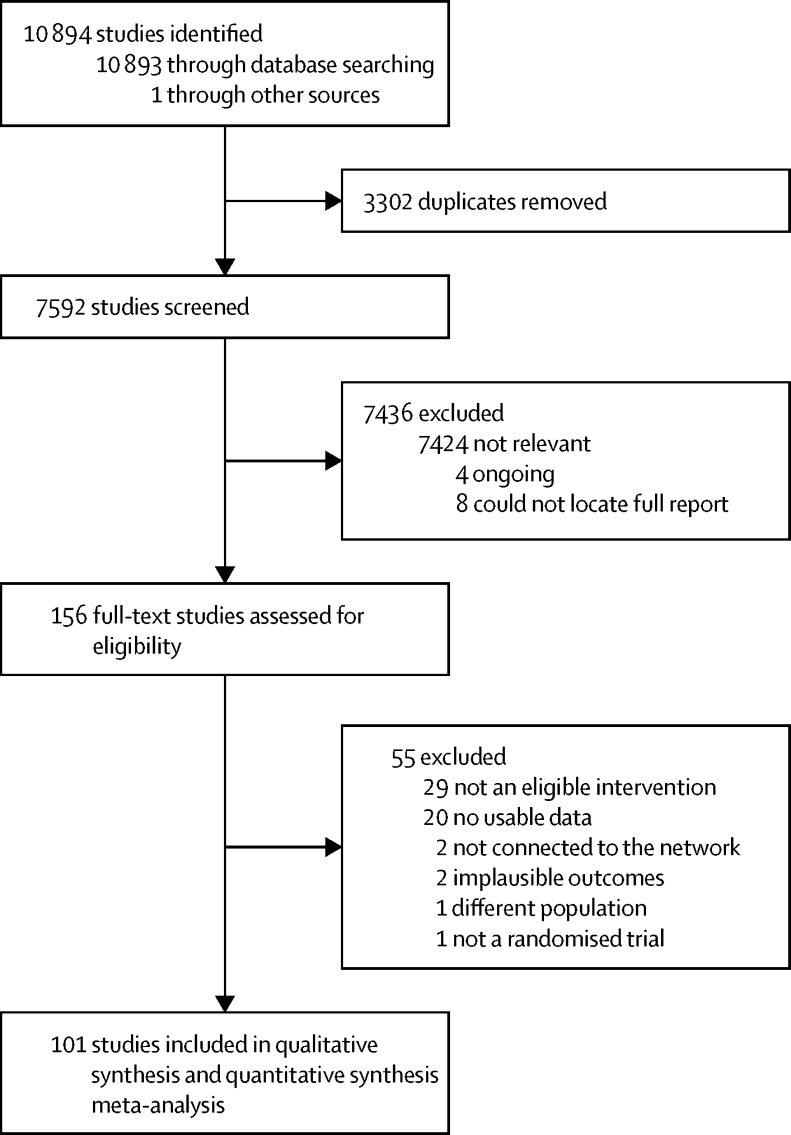
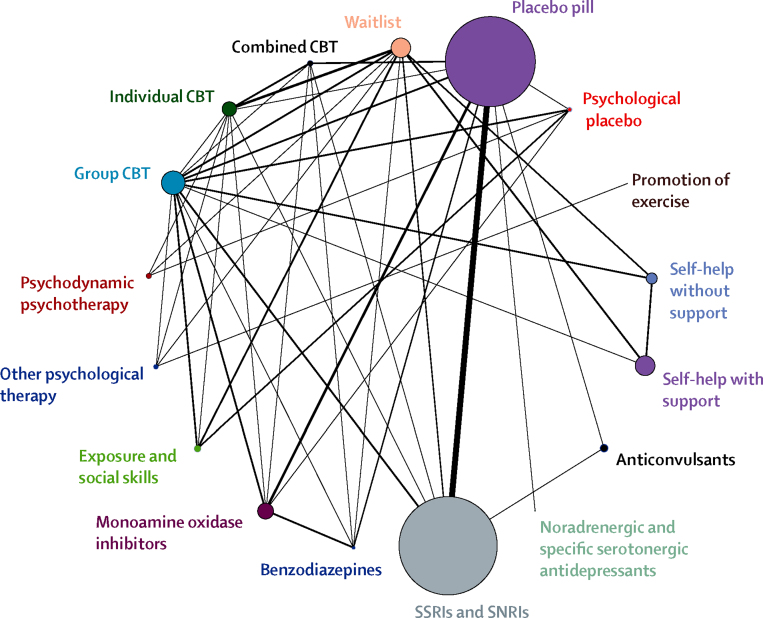
- The review included 101 trials with 13,164 participants and 41 interventions or control conditions grouped into 17 classes.
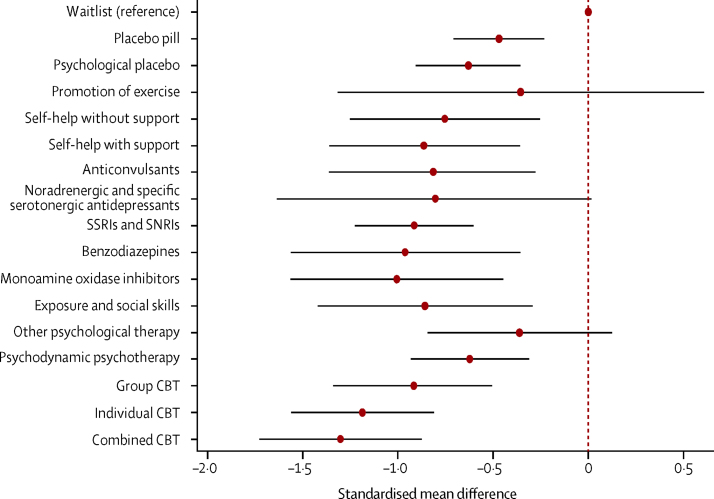
- Compared with waitlist, the largest class-level effects were for individual CBT (SMD −1.19, 95% CrI −1.56 to −0.81), group CBT (−0.92, −1.33 to −0.51), and pharmacological classes including MAOIs (−1.01, −1.56 to −0.45), benzodiazepines (−0.96, −1.56 to −0.36), and SSRIs/SNRIs (−0.91, −1.23 to −0.60).
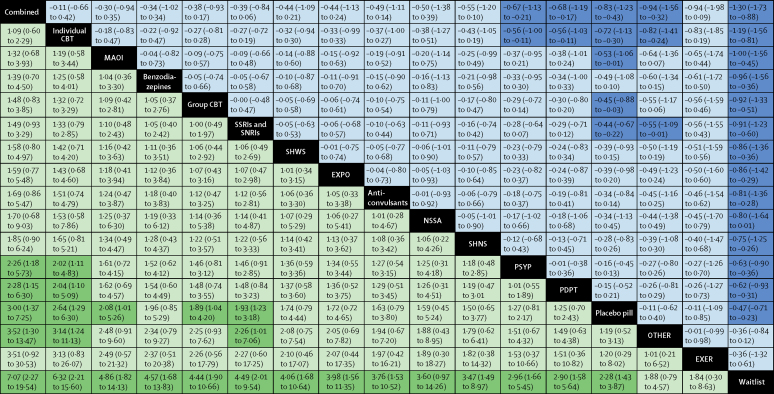
- Against appropriate placebo, only individual CBT versus psychological placebo (SMD −0.56, 95% CrI −1.00 to −0.11) and SSRIs/SNRIs versus pill placebo (−0.44, −0.67 to −0.22) showed clear benefit.
- Individual CBT outperformed several other psychological interventions, including psychodynamic psychotherapy (SMD −0.56, 95% CrI −1.03 to −0.11) and interpersonal psychotherapy, mindfulness, and supportive therapy (−0.82, −1.41 to −0.24).
## Methods
- Systematic review and Bayesian random-effects network meta-analysis of adult randomized clinical trials for social anxiety disorder, using waitlist as the main reference condition.
- Searched published and unpublished sources from 1988 to Sept 13, 2013, with no language limits; included adults aged at least 18 years who met diagnostic criteria for social anxiety disorder.
- Outcomes were validated measures of social anxiety, analyzed as standardised mean differences (SMDs); the paper also estimated recovery where reported and compared interventions both by class and individually.
## Limitations
- The paper states that only a few studies of moderate size were available for several interventions, and some had been tested by only one or two research groups.
- Control conditions were heterogeneous and rarely described in detail, and the authors note that better reporting of what was intended and received is needed.
- The study included only end-of-treatment outcomes; the authors say they could not assess whether effects persist long term because most trials stopped at the end of treatment.
- Evident from the text: there was substantial risk of bias/reporting bias in the evidence base, including many unregistered trials, incomplete outcome data in some trials, and only 28 trials at low risk of bias for all non-masking domains.
Model-written summary. Check it against the paper before relying on it.
Integrity signals
Registry
Cites
Statistics
Figures
Verification
Claims the paper makes
2 Valid · 1 Not valid · 8 Not checked · 78 Own results and interpretations
The cited sources support only part of this claim — read each source’s verdict below.
In the paper
“the effects of psychological interventions are generally well maintained at follow-up,23”
§ Psychological and pharmacological interventions for social anxiety disorder in adults: a systematic review and network meta-analysis > Discussion
What the sources say
- Partly supportedcites [23] Haug TTB Exposure therapy and sertraline in social phobia: 1-year follow-up of a randomised controlled trial Br J Psychiatry 182 2003 312 318 12668406 sourceExperimental — accuracy not yet measured
The Clinical Implications section says exposure therapy alone for social phobia appeared to produce further improvement after treatment, supporting maintenance at follow-up for that intervention. The paper does not establish that psychological interventions generally have well-maintained effects; its finding concerns exposure therapy in this population, and the combined sertraline-plus-exposure group fared less well. (LLM, conf=0.86)
plainstates a cause- Asserted: passes — The authors put it forward as true.
- Checkable: passes — It can be checked against evidence.
- Load-bearing: passes — The paper’s conclusions depend on it.
- Based: passes — The paper gives a reason why it holds.
- Partly supported
The cited sources support only part of this claim — read each source’s verdict below.
In the paper
“SSRIs and SNRIs with a short half-life (eg, paroxetine and venlafaxine) are associated with the greatest risk of discontinuation effects, including effects during the treatment period and after the end of treatment.18, 19”
§ Psychological and pharmacological interventions for social anxiety disorder in adults: a systematic review and network meta-analysis > Discussion
What the sources say
- Not checked yetcites [18] Rosenbaum JF Fava M Hoog SL Ascroft RC Krebs WB Selective serotonin reuptake inhibitor discontinuation syndrome: a randomized clinical trial Biol Psychiatry 44 1998 77 87 9646889 source
- Partly supportedcites [19] Sir A D'Souza RF Uguz S Randomized trial of sertraline versus venlafaxine XR in major depression: efficacy and discontinuation symptoms J Clin Psychiatry 66 2005 1312 1320 16259546 sourceExperimental — accuracy not yet measured
Our copy supports only the venlafaxine half of the claim and only partially: the Discussion (post hoc analyses, p-values unadjusted) reports 'sertraline was associated with a lower burden of discontinuation symptoms compared with venlafaxine XR' and 'early reports suggesting the possibility of a clinically relevant discontinuation syndrome with venlafaxine XR and a relatively benign one with sertraline,' and Signs and Symptoms of Discontinuation / Table 4 list more discontinuation-emergent symptoms (dizziness, fatigue, vertigo, vivid dreams; tremor, confusion, impaired coordination) in the venlafaxine XR group, with the Safety and Tolerability section also noting 13 vs 3 treatment-related discontinuations in the first calendar week of treatment. The rest of the claim is not in this paper: no passage mentions paroxetine, no passage discusses elimination half-life or attributes discontinuation risk to short half-life, and the study compares only two agents (sertraline vs venlafaxine XR) so it never ranks them as carrying the 'greatest risk' among SSRIs/SNRIs, nor does it assess symptoms after the end of the taper (assessment ran only to week 10). The citing sentence also states as established fact what the paper hedges ('may be associated with a lower symptom burden'; a priori analyses showed no difference). (LLM, conf=0.68)
plainstates an association- Asserted: passes — The authors put it forward as true.
- Checkable: passes — It can be checked against evidence.
- Load-bearing: passes — The paper’s conclusions depend on it.
- Based: passes — The paper gives a reason why it holds.
The cited sources that could be checked couldn’t confirm or dispute this claim.
In the paper
“suggesting the network better estimates treatment effects than pairwise analyses alone with no evidence of inconsistency.9”
§ Psychological and pharmacological interventions for social anxiety disorder in adults: a systematic review and network meta-analysis > Results
What the sources say
- Could not verifycites [9] Dias S Sutton AJ Ades AE Welton NJ Evidence synthesis for decision making 2: a generalized linear ehaviour framework for pairwise and network meta-analysis of randomized controlled trials Med Decis Making 33 2013 607 617 23104435 PMC3704203 sourceExperimental — accuracy not yet measured
The ‘Extension to NMA’ section says that evidence consistency needs to be checked in all networks, but does not report a finding of no inconsistency in the citing authors’ network. A search for ‘no evidence of inconsistency’ found no such result in our copy. Page numbers were not provided. (LLM, conf=0.76)
hedgedn = 148- Asserted: passes — The authors put it forward as true.
- Checkable: passes — It can be checked against evidence.
- Load-bearing: passes — The paper’s conclusions depend on it.
- Based: passes — The paper gives a reason why it holds.
- Could not verify
A result the paper reports from its own data — it cites no other source for it, so there is none to check. The quote shows it is in the paper.
In the paper
“The largest effects were for MAOIs (class effect SMD −1·01, 95% CrI −1·56 to −0·45)”
§ Psychological and pharmacological interventions for social anxiety disorder in adults: a systematic review and network meta-analysis > Results
plainstates a cause- Asserted: passes — The authors put it forward as true.
- Checkable: passes — It can be checked against evidence.
- Load-bearing: passes — The paper’s conclusions depend on it.
- Based: passes — The paper gives a reason why it holds.
- Rests on 5 assumptions not shown here.
A result the paper reports from its own data — it cites no other source for it, so there is none to check. The quote shows it is in the paper.
In the paper
“Of the psychological interventions, only individual CBT had a greater effect on outcomes than psychological placebo (SMD −0·56, 95% CrI −1·00 to −0·11).”
§ Psychological and pharmacological interventions for social anxiety disorder in adults: a systematic review and network meta-analysis > Results
plainstates a cause- Asserted: passes — The authors put it forward as true.
- Checkable: passes — It can be checked against evidence.
- Load-bearing: passes — The paper’s conclusions depend on it.
- Based: passes — The paper gives a reason why it holds.
- Rests on 5 assumptions not shown here.
50 more claims
Create a free account to see all 89 claims and to verify the 12 references still open.
- It may state two separate claims as one. 26
- The quote only partly states this claim. 3
- Probably not a substantial claim. 12
Claims other papers make about this one
Each is checked against this paper’s own text: does it say what the citing paper says it does?
The cited source doesn’t support the claim as written.
In the citing paper
“The efficacy of pharmacotherapies also appears dependent on continued adherence to medication, with as many as 25% of people reporting relapse after discontinuation of the drug.”
From MDMA-Assisted Therapy as a Means to Alter Affective, Cognitive, Behavioral, and Neurological Systems Underlying Social Dysfunction in Social Anxiety Disorder (2021) · cites this paper as [15]
Checked by a reasoning model — may be wrong.
Experimental — accuracy not yet measuredThe source backs part of the claim, not all of it — or backs it for a different population, condition or comparison.
In the citing paper
“In terms of psychotherapies, cognitive-behavioral therapy has shown strong evidence for treatment efficacy and superior longevity to pharmacotherapy (15).”
From MDMA-Assisted Therapy as a Means to Alter Affective, Cognitive, Behavioral, and Neurological Systems Underlying Social Dysfunction in Social Anxiety Disorder (2021) · cites this paper as [15]
Experimental — accuracy not yet measuredThe source backs part of the claim, not all of it — or backs it for a different population, condition or comparison.
In the citing paper
“Yet, in the case of both medication and psychotherapy a significant proportion of patients remain considerably symptomatic at the end of treatment (15), with social anxiety often assuming a chronic course in spite of intervention (16).”
From MDMA-Assisted Therapy as a Means to Alter Affective, Cognitive, Behavioral, and Neurological Systems Underlying Social Dysfunction in Social Anxiety Disorder (2021) · cites this paper as [15]
Experimental — accuracy not yet measuredThe source backs part of the claim, not all of it — or backs it for a different population, condition or comparison.
In the citing paper
“Meta-analytic data on medication-based therapies suggests that SSRIs and SNRIs are associated favorable outcomes compared to placebo yet are also associated with higher dropout rates over the treatment course (14, 15).”
From MDMA-Assisted Therapy as a Means to Alter Affective, Cognitive, Behavioral, and Neurological Systems Underlying Social Dysfunction in Social Anxiety Disorder (2021) · cites this paper as [15]
Experimental — accuracy not yet measuredThe source backs part of the claim, not all of it — or backs it for a different population, condition or comparison.
In the citing paper
“for many common mental health conditions, particularly anxiety disorders, evidence-based psychological treatments are both the best treatment option2 and the preference of patients.3”
From Automated psychological therapy using immersive virtual reality for treatment of fear of heights: A single-blind, parallel-group, randomised controlled trial (2018) · cites this paper as [2]
Experimental — accuracy not yet measured
7 more claims about this paper
Create a free account to see every claim other papers make about this one.
Citations
Cites
Preferred Reporting Items for Systematic Reviews and Meta-Analyses: the PRISMA statement
Moher, D., Liberati, A., Tetzlaff, J., Altman, D. G., & for the PRISMA Group (2009) · BMJ · doi:10.1136/bmj.b2535 · Cited by 83,823
Preferred reporting items for systematic reviews and meta-analyses: the PRISMA Statement.
(2009) · PubMed Central · Cited by 44,859
Cochrane Handbook for Systematic Reviews of Interventions: Cochrane Book Series
(2008) · doi:10.1002/9780470712184 · Cited by 25,048
Cochrane Handbook for Systematic Reviews of Interventions Version 5.0.1. The Cochrane Collaboration
Higgins, J. P. T., Green, S. R., & Higgins, J. P. T. (2008) · Cited by 7,247
WinBUGS - A Bayesian modelling framework: Concepts, structure, and extensibility
Lunn, D. J., Thomas, A., Best, N., & Spiegelhalter, D. (2000) · Statistics and Computing · doi:10.1023/a:1008929526011 · Cited by 5,368
A cognitive-behavioral model of anxiety in social phobia
Rapee, R. M., & Heimberg, R. G. (1997) · Behaviour Research and Therapy · doi:10.1016/s0005-7967(97)00022-3 · Cited by 2,987
A cognitive model of social phobia
Adrian Wells, A. (1995) · Research Explorer (The University of Manchester) · Cited by 2,701
Social Phobia: Diagnosis, Assessment, and Treatment
Amada, G. (1996) · American Journal of Psychotherapy · doi:10.1176/appi.psychotherapy.1996.50.3.373 · Cited by 1,248
Dias, S., Sutton, A. J., Ades, A. E., & Welton, N. J. (2013) · Medical Decision Making · doi:10.1177/0272989x12458724 · Cited by 1,207
Self-citationStein, M. B., & Stein, D. J. (2008) · The Lancet · doi:10.1016/s0140-6736(08)60488-2 · Cited by 1,137
Cited by
Items 501–600 of 676
Azevedo, J. D. S., & Guerra, A. D. S. (2024) · Research Society and Development · doi:10.33448/rsd-v13i4.44932
Sosyal Kaygı Bozukluğunun Bilişsel Davranışçı Terapisi: Kapsamlı Bir Gözden Geçirme
Akkuş, K. (2024) · Mediterranean Journal of Humanities · doi:10.13114/mjh.1476738 · Cited by 2
Institutional quarantine and economic preferences: Experimental evidence from China
Zhang, Y., Li, J., Cao, Q., & Niu, X. (2024) · China Economic Review · doi:10.1016/j.chieco.2024.102251 · Cited by 1
Kanai, Y. (2015) · Anxiety Disorder Research · doi:10.14389/jsad.7.1_40 · Cited by 1
An Integrated Model for Counseling a College Student with High Social Anxiety: A Case Study
张, 李. (2020) · Advances in Psychology · doi:10.12677/ap.2020.105077 · Cited by 1
Die soziale Angststörung – ein Update
Plag, J., & Hoyer, J. (2022) · PSYCH up2date · doi:10.1055/a-1403-5075 · Cited by 1
Fydrich, T. (2018) · Springer eBooks · doi:10.1007/978-3-662-54909-4_3 · Cited by 1
Autism Spectrum Disorder Versus Anxiety Disorders
South, M., Brewe, A. M., Kerns, C. M., & White, S. (2022) · Oxford University Press eBooks · doi:10.1093/med-psych/9780197516881.003.0006 · Cited by 2
Chapter 8. Techniques of Cognitive-Behavioral Therapy
Wright, J. H., Reis, J., & Casey, D. (2022) · American Psychiatric Association Publishing eBooks · doi:10.1176/appi.books.9781615375233.gg08 · Cited by 4
Measuring, Understanding, and Evoking Fear of Positive Evaluation in Social Anxiety
Barber, K. C. (2015) · UWSpace (University of Waterloo) · Cited by 2
Caetano, K. A. D. S. (2017) · Digital Library of Theses and Dissertations (Universidade de São Paulo) · doi:10.11606/t.59.2017.tde-26062017-233129 · Cited by 1
Daniels, H. (2018) · Lincoln Repository (University of Lincoln) · doi:10.24385/lincoln.24325957 · Cited by 1
Four Examples of PseudosciencePreprint
Villavicencio, M. (2019) · PhilSci-Archive (University of Pittsburgh) · Cited by 2
Andersson, E., & Sjökvist, T. (2019) · Uppsala University Publications (Uppsala University) · Cited by 1
Seltzer-Eade, S. (2017) · Cited by 3
Health Equity Impact Evaluation of New Treatments – Evidence Synthesis Methods to Overcome Data GapsPreprint
Jansen, J. P. (2021) · Research Square · doi:10.21203/rs.3.rs-951925/v1 · Cited by 1
Haitani, T., Sakai, N., Mori, K., & Houjou, T. (2021) · PsyArXiv (OSF Preprints) · doi:10.31234/osf.io/h3957 · Cited by 3
Depression and Anxiety Disorders
(2021) · Wiley eBooks · doi:10.1002/9781119870203.mpg003 · Cited by 1
Leigh, E. (2022) · Journal of the American Academy of Child & Adolescent Psychiatry · doi:10.1016/j.jaac.2022.12.002 · Cited by 3
Ghosh, A., Cohen, K. A., Jans, L. K., Busch, C. A., McDanal, R., Yang, Y., Cooper, K. M., & Schleider, J. L. (2023) · doi:10.31234/osf.io/km7wt · Cited by 1
Yoshinaga, N., Thew, G. R., Hayashi, Y., Tanoue, H., Nakai, M., & Clark, D. M. (2024) · Trials · doi:10.1186/s13063-024-08303-6
“Individual face-to-face cognitive therapy for SAD (CT-SAD) based on the Clark and Wells model [2] has extensive empirical support [3] and as a result is recommended in national guidelines in both the UK [4] and Japan [5].”
MethodSelf-citationTreatments for Social Anxiety Disorder: Considerations Regarding Psychodynamic Therapy Findings
Hofmann, S. G., Barlow, D. H., Clark, D. M., Hollon, S. D., & Mayo‐Wilson, E. (2015) · American Journal of Psychiatry · doi:10.1176/appi.ajp.2015.14101347
Self-citationHeightened risk of false positives in a network meta-analysis of social anxiety–Author's reply
Mayo‐Wilson, E., Dias, S., Mavranezouli, I., Kew, K. M., Clark, D. M., Ades, A. E., & Pilling, S. (2015) · The Lancet Psychiatry · doi:10.1016/s2215-0366(15)00090-5
Self-citationGute Hinweise zur Behandlung sozialer Ängste
Kress, I. U. (2015) · InFo Neurologie + Psychiatrie · doi:10.1007/s15005-015-1348-2
Scientific Underpinnings and Evidence Pertaining to Mindfulness
Dobkin, P. L., & Hassed, C. S. (2016) · Springer eBooks · doi:10.1007/978-3-319-31066-4_2
Davine, T. P. (2016) · UWM Digital Commons (University of Wisconsin–Milwaukee)
Trauma and Mental Health: The Development, Treatment, and Future of
Wheeler, J. (2016) · doi:10.15760/honors.331 · Cited by 1
“Commonly prescribed medications are SSRI’s, SNRI’s, TCA’s, and benzodiazepines (Medication, n.d.; Mayo-Wilson et al, 2014).”
BackgroundPsychoanalyse, psychoanalytische psychotherapie en wetenschappelijke evidentie
Draijer, N., & Langeland, W. (2017) · Tijdschrift voor Psychotherapie · doi:10.1007/s12485-016-0170-8
McEvoy, P. M. (2016) · Journal of Experimental Psychopathology · doi:10.1177/204380871600700401
“…and group formats, is associated with large effect sizes and restores a significant proportion of people to normative function, thereby earning its status as a recommended treatment (Mayo-Wilson et al., 2014; McEvoy, Rapee, & Heimberg, 2016; National Institute for Health and Care Excellence, 2013).”
BackgroundThreshold analysis in NICE Guideline Development
Phillippo, D., Dias, S., Welton, N. J., & Ades, A. E. (2016) · Bristol Research (University of Bristol) · Cited by 2
Self-citationFear of emotion: Association with anxiety and depressive disorders and response to treatment
Campbell, B. N. C. (2017) · Murdoch University Research Portal
Muse, M. D., & Stahl, S. M. (2017) · Wiley eBooks · doi:10.1002/9781119152606.ch6 · Cited by 1
Naderi, Z. (2017) · International journal of advance research and innovative ideas in education
Smith, K., Cipriani, A., & Geddes, J. R. (2016) · BJPsych Advances · doi:10.1192/s2056467800002826
The Effectiveness of self-Monitoring Strategy on Students ' Social Anxiety Disorder
Samadi, Z., Mirnasab, M. M., & Fathiazar, E. (2018) · Rāhburdhā-yi āmūzish dar ̒ulūm-i pizishkī · doi:10.29252/edcbmj.11.01.12
Knuppertz, H. (2018) · Psychotherapeut · doi:10.1007/s00278-018-0284-2
“Die Behandlungseffekte klassischer Expositionsverfahren und kognitiv-verhaltenstherapeutischerBehandlungsansätze der sozialen Angststörung sind sehr gut (Mayo-Wilson et al. 2014).”
BackgroundComplex Cases of Social Anxiety Disorder (SAD)
Kawaguchi, A., & Watanabe, N. (2018) · Springer eBooks · doi:10.1007/978-3-319-70311-4_20
Livesey, S. (2018) · NORMA · Cited by 1
Brakoulias, V. (2018) · Australian & New Zealand Journal of Psychiatry · doi:10.1177/0004867418810177
Robles, V. A. G. (2019) · Tesis Doctorals en Xarxa (Consorci de Serveis Universitaris de Catalunya) · doi:10.6035/14109.2019.233592
Experimental Medicine Models in Generalized Anxiety Disorder and Social Anxiety Disorder
Baldwin, D. S., & Abou-Aisha, A. (2019) · Handbook of behavioral neuroscience · doi:10.1016/b978-0-12-803161-2.00025-4 · Cited by 1
Lewis, E. M. (2019) · Louisiana State University · doi:10.31390/gradschool_theses.5122
“The gold standard for treatment of clinically elevated social anxiety is cognitive behavioral therapy (CBT), which includes exposure-based techniques (e.g., Heimberg, 6 Brozovich, & Rapee, 2014; Hofmann, Asnaani, Vonk, Sawyer, & Fang, 2012; Leichsenring et al., 2013; Mayo-Wilson et al., 2014).”
Background摂食障害とパーソナリティ障害 : 過食,嗜癖,そしてプロトタイプアプローチ (特集 児童・青年期における行動嗜癖)
永田, 利. (2019) · 児童青年精神医学とその近接領域 · doi:10.20615/jscap.60.2_169
Network Meta-analysis Application in Comparison of Clinical Trial Studies
Ghasemi, K., Mansourian, M., & Vaseghi, G. (2020) · DOAJ (DOAJ: Directory of Open Access Journals) · Cited by 1
Arai, H., Okawa, S., Seki, Y., Shimizu, E., Takahashi, S., Korte, K. J., & Schmidt, N. B. (2020) · Research Square · doi:10.21203/rs.3.rs-107578/v1
“Studies have shown that CBT has consistently been effective in reducing social anxiety in randomized controlled trials (RCTs; Mayo-Wilson et al., 2014).”
MethodFodstad, J. C., Grant, L., Butler, M. A., Lagges, A. M., Rodriguez, G. M., & Blake, H. S. (2021) · Autism and child psychopathology series · doi:10.1007/978-3-030-66270-7_7
Die Familie der kognitiv-verhaltenstherapeutischen Verfahren
Hoyer, J., & Brockmeyer, T. (2021) · Elsevier eBooks · doi:10.1016/b978-3-437-21352-6.00032-8
Variation, selection and retention: the evolution of process of change
Hollon, S. D. (2021) · World Psychiatry · doi:10.1002/wps.20886 · Cited by 1
Käll, A. (2021) · Linköping studies in behavioural science · doi:10.3384/9789179290580 · Cited by 1
An Overview of Group Cognitive Behavioral Therapy: Science and Practice
Nowakowski, M. E., & Bieling, P. (2021) · Elsevier eBooks · doi:10.1016/b978-0-12-818697-8.00205-3 · Cited by 1
Patologias do Vazio e Abordagens Psicanalíticas para seu Tratamento: Uma Revisão Integrativa
Tagliapietra, K. D. R., Villwock, C. A. D. S., Salvador, E. Z., & Cardoso, N. D. O. (2021) · Revista de Psicologia da IMED · doi:10.18256/2175-5027.2021.v13i2.4240
Beligeanu, M. (2021) · Studia Doctoralia · doi:10.47040/sdpsych.v12i2.131
Jansen, J. P. (2021) · Research Square · doi:10.21203/rs.3.rs-951925/v3
Jansen, J. P. (2021) · Research Square · doi:10.21203/rs.3.rs-951925/v2
“…for which results are reported relevant for the equity relevant subgroups but are uncertain due to a limited number of studies and small sample sizes in each of the subgroups, borrowing strength from other interventions or subgroups by deriving a shrinkage estimate may be useful [16,23,43,44,45].”
BackgroundSOCIAL ANXIETY DISORDER: COGNITIVE-BEHAVIORAL THERAPY AS A THERAPEUTIC APPROACH
Cativo, C., & Barata, V. A. (2021) · Psicologia Saúde & Doenças · doi:10.15309/21psd220307 · Cited by 1
Cognitive Behavioral Therapy for Social Anxiety Disorder
Swee, M. B., Dryman, M. T., & Heimberg, R. G. (2021) · Cambridge University Press eBooks · doi:10.1017/9781108355605.007 · Cited by 1
Matsumoto, K., Yoshino, K., & Shimizu, E. (2021) · Anxiety Disorder Research · doi:10.14389/jsad.13.1_46
Stangier, U. (2021) · Psychotherapie: Praxis · doi:10.1007/978-3-662-62298-8_98
Ebenezer, I. S. (2015) · Wiley eBooks · doi:10.1002/9781118385777.refs
Dias, S., Ades, A. E., Welton, N. J., Jansen, J. P., & Sutton, A. J. (2018) · Wiley eBooks · doi:10.1002/9781118951651.refs
Self-citationMargraf, J., & Pittig, A. (2021) · Elsevier eBooks · doi:10.1016/b978-3-437-21352-6.00012-2 · Cited by 1
Arai, H., Seki, Y., Okawa, S., Shimizu, E., Takahashi, S., Ishikawa, S., Korte, K. J., & Schmidt, N. B. (2021) · Japanese Psychological Research · doi:10.1111/jpr.12366
Cognitieve therapie bij sociale angststoornis
Voncken, M. J., & Allart, E. (2019) · Bohn Stafleu van Loghum eBooks · doi:10.1007/978-90-368-2021-9_7
Ren, Z., Ma, G. X., Franken, I. H. A., van der Heiden, C., Hoyt, W. T., & Zhao, L. (2017) · doi:10.2196/preprints.9624
(2018) · Elsevier eBooks · doi:10.1016/b978-0-12-811351-6.00026-7
Matu, S. A. (2017) · Wiley eBooks · doi:10.1002/9781119375395.ch3
Don’t overlook monoamine oxidase inhibitors in psychiatric practice
Fenton, C., & Lee, A. (2022) · Drugs & Therapy Perspectives · doi:10.1007/s40267-022-00917-7
“serotonin-noradrenaline reuptake inhibitors (SNRIs) vs placebo], MAOIs had the largest pharmacological effect size in this meta-analysis [25].”
BackgroundA multilevel meta-analysis on effects of psychological interventions for adults who stutterPreprint
Haitani, T. (2022) · PsyArXiv (OSF Preprints) · doi:10.31234/osf.io/5kc62 · Cited by 1
Eficácia dos benzodiazepínicos no tratamento de transtornos ansiosos: uma revisão de literatura
Ribeiro, G. L. D. J., & Brito, J. D. S. (2022) · Revista de Medicina · doi:10.11606/issn.1679-9836.v101i6e-194499 · Cited by 2
Jones, B. D. M., & Husain, M. I. (2022) · Springer eBooks · doi:10.1007/978-3-030-62059-2_407
Raj, P., & Sharma, N. R. (2018) · International Journal of Indian Psychology · doi:10.25215/0603.68
Evidence-Based Treatments for Anxiety Disorders
Azab, M. (2022) · Springer eBooks · doi:10.1007/978-3-031-19362-0_5
Does psychoanalysis have scientific potential? Testing psychoanalytic hypotheses
Jevtic, S. (2022) · Theoria Beograd · doi:10.2298/theo2203095j
du Toit, S. A., Schweizer, S., & Wong, Q. J. J. (2023) · PsyArXiv (OSF Preprints) · doi:10.31234/osf.io/yp6qd
Chapter 14. Techniques of Individual Interpersonal Psychotherapy
Swartz, H. A. (2022) · American Psychiatric Association Publishing eBooks · doi:10.1176/appi.books.9781615375233.gg14 · Cited by 1
Chapter 17. Techniques of Individual Supportive Psychotherapy
Rosenthal, R. N., Urmanche, A. A., & Muran, J. C. (2022) · American Psychiatric Association Publishing eBooks · doi:10.1176/appi.books.9781615375233.gg17 · Cited by 2
Chapter 36. Supervision and Consultation in Psychotherapy
Crisp-Han, H., & Gabbard, G. O. (2022) · American Psychiatric Association Publishing eBooks · doi:10.1176/appi.books.9781615375233.gg36
Chapter 15. Efficacy, Indications, and Applications of Individual Interpersonal Psychotherapy
Markowitz, J. C. (2022) · American Psychiatric Association Publishing eBooks · doi:10.1176/appi.books.9781615375233.gg15
Chapter 20. Theories and Techniques of Couple Therapy
Lebow, J. L., & Garcia, R. (2022) · American Psychiatric Association Publishing eBooks · doi:10.1176/appi.books.9781615375233.gg20
Chapter 34. Psychotherapy and Cyberspace
Yellowlees, P., & Shore, J. H. (2022) · American Psychiatric Association Publishing eBooks · doi:10.1176/appi.books.9781615375233.gg34
Chapter 12. Dialectical Behavior Therapy: Efficacy, Applications, and Adaptations
Sonley, A. K. I., Boritz, T. Z., & McMain, S. (2022) · American Psychiatric Association Publishing eBooks · doi:10.1176/appi.books.9781615375233.gg12
Chapter 10. Theory in Dialectical Behavior Therapy
Chapman, A. L., & Kaufman, E. A. (2022) · American Psychiatric Association Publishing eBooks · doi:10.1176/appi.books.9781615375233.gg10
Chapter 31. Psychotherapy With Trans and Gender Diverse People
McIntosh, C., & Brown, N. (2022) · American Psychiatric Association Publishing eBooks · doi:10.1176/appi.books.9781615375233.gg31
Winston, A., & Punko, D. (2022) · American Psychiatric Association Publishing eBooks · doi:10.1176/appi.books.9781615375233.gg18
Chapter 30. Psychotherapy With Bisexual Patients
Marcus, B. F. (2022) · American Psychiatric Association Publishing eBooks · doi:10.1176/appi.books.9781615375233.gg30
Chapter 24. South Asian Americans
Tummala–Narra, P., & Kanwal, G. S. (2022) · American Psychiatric Association Publishing eBooks · doi:10.1176/appi.books.9781615375233.gg24 · Cited by 1
Chapter 19. Family Therapy: Systemic Concepts and Methods
Rolland, J. S., & Walsh, F. W. (2022) · American Psychiatric Association Publishing eBooks · doi:10.1176/appi.books.9781615375233.gg19
Chapter 11. Treatment Techniques in Dialectical Behavior Therapy
Swenson, C. (2022) · American Psychiatric Association Publishing eBooks · doi:10.1176/appi.books.9781615375233.gg11
Gaztambide, D. J. (2022) · American Psychiatric Association Publishing eBooks · doi:10.1176/appi.books.9781615375233.gg25 · Cited by 1
Chapter 16. Theory of Individual Supportive Psychotherapy
Lippert, C. N., Roberts, L. W., Winston, A., & Goldstein, M. (2022) · American Psychiatric Association Publishing eBooks · doi:10.1176/appi.books.9781615375233.gg16 · Cited by 1
Chapter 3. Techniques of Brief Psychodynamic Psychotherapy
Dewan, M. J., Weerasekera, P., Stormon, L., & Jackson, D. J. (2022) · American Psychiatric Association Publishing eBooks · doi:10.1176/appi.books.9781615375233.gg03
Ueng-McHale, J. Y., & Chin, C. R. (2022) · American Psychiatric Association Publishing eBooks · doi:10.1176/appi.books.9781615375233.gg23 · Cited by 3
Chapter 27. Issues Arising in Psychotherapy With LGBTQ+ Patients
Drescher, J., & Fadus, M. C. (2022) · American Psychiatric Association Publishing eBooks · doi:10.1176/appi.books.9781615375233.gg27
Chapter 28. Psychotherapy With Lesbians
Moga, D. E., & Reading, R. A. (2022) · American Psychiatric Association Publishing eBooks · doi:10.1176/appi.books.9781615375233.gg28
Chapter 22. African Americans and Psychotherapeutic Treatment: Challenges and Opportunities
Powell, D. R., & Hart, A. (2022) · American Psychiatric Association Publishing eBooks · doi:10.1176/appi.books.9781615375233.gg22 · Cited by 1
Chapter 29. Psychotherapy With Gay Men
McCommon, B. (2022) · American Psychiatric Association Publishing eBooks · doi:10.1176/appi.books.9781615375233.gg29
Bhatt-Mackin, S. M., McEpplan, A., Dobson, K. S., & Cottraux, J. A. (2022) · American Psychiatric Association Publishing eBooks · doi:10.1176/appi.books.9781615375233.gg09
Metadata
- Authors
- Mayo-Wilson, E., Dias, S., Mavranezouli, I., Kew, K., Clark, D. M., Ades, A. E., & Pilling, S.
- Affiliations
- University of Bristol (GB)
- University College London (GB)
- University of London (GB)
- University of Oxford (GB)
- Venue
- The Lancet Psychiatry
- Publisher
- Elsevier BV
- Published
- 2014-10
- Volume
- 1
- Issue
- 5
- Pages
- 368-376
- ISSN
- 2215-0366 (ISSN-L)
- PMC
- PMC4287862
- OpenAlex
- W2151428461
- Cited by
- 680
- References
- 36
- Citations by year
- 2026: 41 · 2025: 50 · 2024: 61 · 2023: 65 · 2022: 97 · 2021: 84 · 2020: 58 · 2019: 49 · 2018: 62 · 2017: 44 · 2016: 45 · 2015: 23 · 2014: 1
- FWCI
- 5.06
- Type
- journal article
- Language
- en
- Open access
- hybrid
- doi.org
- Licence
- cc-by
- www.elsevier.com/tdm/userlicense/1.0/ (tdm)
- creativecommons.org/licenses/by/3.0/ (vor)
- Locations
- The Lancet Psychiatry (publishedVersion, cc-by)
- PubMed Central (publishedVersion, cc-by)
- PubMed (publishedVersion)
- UCL Discovery (University College London) (submittedVersion)
- Bristol Research (University of Bristol) (submittedVersion)
- Funders
- Wellcome Trust (069777)
- Topics
- Social Sciences › Psychology › Experimental and Cognitive Psychology › Anxiety, Depression, Psychometrics, Treatment, Cognitive Processes
- Social Sciences › Psychology › Clinical Psychology › Psychological Treatments and Assessments
- Social Sciences › Psychology › Clinical Psychology › Psychotherapy Techniques and Applications
- Keywords
- social anxiety disorder, adults, pharmacological interventions, psychological intervention, cognitive behavioral therapy, group cognitive behavioral therapy, exposure therapy, social skills training, self-help, psychodynamic psychotherapy, monoamine oxidase inhibitors, benzodiazepines, selective serotonin reuptake inhibitors, serotonin-norepinephrine reuptake inhibitors, antiepileptic drugs, treatment efficacy comparison
About these checks
Registry, retraction, Cites and statistics results are computed, not judged, with one exception: a printed reference that no index lists is read once by a model before it counts as a citation error. Claims are extracted by a model and kept only when their quote appears verbatim in the text; each cited source is then checked, with a model’s help, for whether it says what the claim relies on. Those verdicts can be wrong — read the claim’s quote and the cited source before relying on one.
The claim verdicts this report counts are experimental: their accuracy is not yet measured.
A language model drew the claims from the paper on 2026-10-11, under version 3 of the claim definition (model deepseek-v4.1-flash, prompt extract-v3).
A second model labelled each claim on 2026-10-11 (model jev-1.13-20260917, definition revision gold-guideline-v0.2).
Cited sources are checked with a language model’s help (gpt-6-sol and qwen3.8-omni-flash).
Statistics and arithmetic are recomputed, not judged.
Confidence bands are shown only for fields calibrated on our annotated test set. None is calibrated yet, so no band is shown.
What counts as a claim ›How we measure confidence ›How we check this ›
Are you an author, or do you see a problem with this page? Request a review
Data sources
Bibliographic data: Semantic Scholar, OpenAlex, Crossref.
Contains information from the Semantic Scholar Academic Graph Datasets, made available under the ODC Attribution License (ODC-BY 1.0).
Semantic Scholar’s data is described in: Kinney, R., et al. (2023). The Semantic Scholar Open Data Platform. arXiv:2301.10140.
