

Psychological and pharmacological interventions for social anxiety disorder in adults: a systematic review and network meta-analysis
Open accessThe DOI matches its Crossref record; 37 of the 37 references it cites were found in a registry or an index; 3 of the 15 sources its claims cite were checked for support.
Abstract
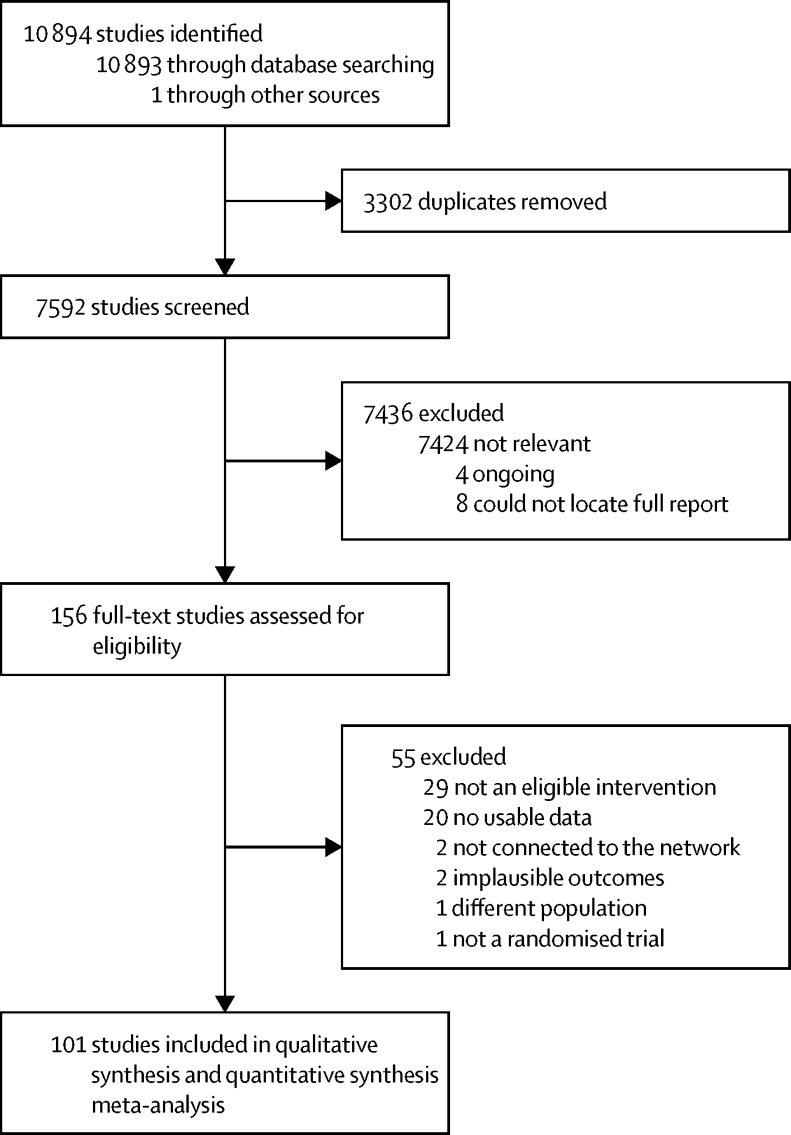
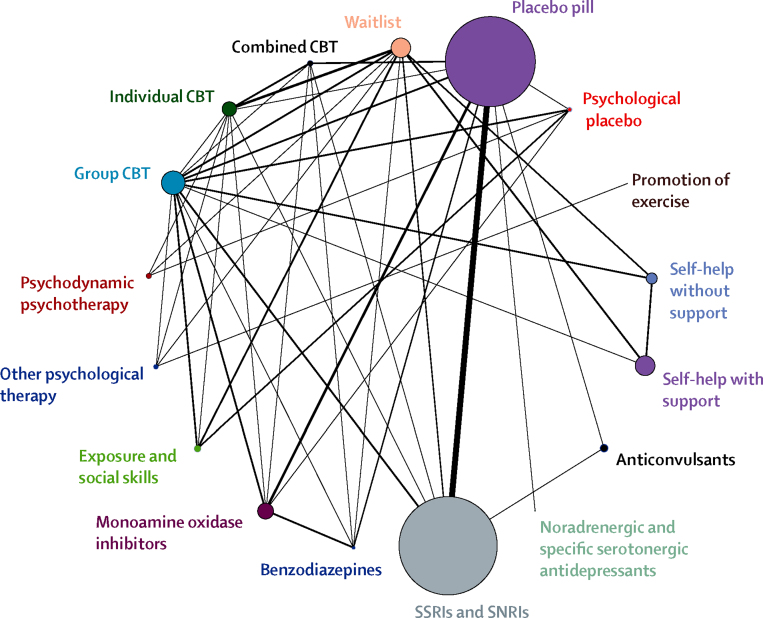
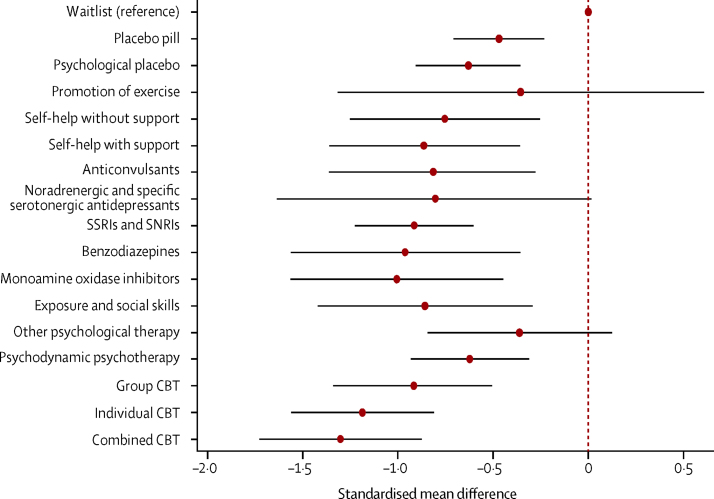
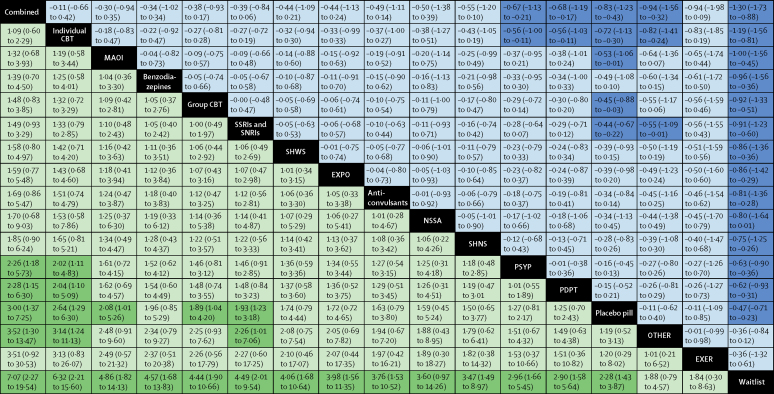
BACKGROUND: Social anxiety disorder-a chronic and naturally unremitting disease that causes substantial impairment-can be treated with pharmacological, psychological, and self-help interventions. We aimed to compare these interventions and to identify which are most effective for the acute treatment of social anxiety disorder in adults. METHODS: We did a systematic review and network meta-analysis of interventions for adults with social anxiety disorder, identified from published and unpublished sources between 1988 and Sept 13, 2013. We analysed interventions by class and individually. Outcomes were validated measures of social anxiety, reported as standardised mean differences (SMDs) compared with a waitlist reference. This study is registered with PROSPERO, number CRD42012003146. FINDINGS: We included 101 trials (13 164 participants) of 41 interventions or control conditions (17 classes) in the analyses. Classes of pharmacological interventions that had greater effects on outcomes compared with waitlist were monoamine oxidase inhibitors (SMD -1·01, 95% credible interval [CrI] -1·56 to -0·45), benzodiazepines (-0·96, -1·56 to -0·36), selective serotonin-reuptake inhibitors and serotonin-norepinephrine reuptake inhibitors (SSRIs and SNRIs; -0·91, -1·23 to -0·60), and anticonvulsants (-0·81, -1·36 to -0·28). Compared with waitlist, efficacious classes of psychological interventions were individual cognitive-behavioural therapy (CBT; SMD -1·19, 95% CrI -1·56 to -0·81), group CBT (-0·92, -1·33 to -0·51), exposure and social skills (-0·86, -1·42 to -0·29), self-help with support (-0·86, -1·36 to -0·36), self-help without support (-0·75, -1·25 to -0·26), and psychodynamic psychotherapy (-0·62, -0·93 to -0·31). Individual CBT compared with psychological placebo (SMD -0·56, 95% CrI -1·00 to -0·11), and SSRIs and SNRIs compared with pill placebo (-0·44, -0·67 to -0·22) were the only classes of interventions that had greater effects on outcomes than appropriate placebo. Individual CBT also had a greater effect than psychodynamic psychotherapy (SMD -0·56, 95% CrI -1·03 to -0·11) and interpersonal psychotherapy, mindfulness, and supportive therapy (-0·82, -1·41 to -0·24). INTERPRETATION: Individual CBT (which other studies have shown to have a lower risk of side-effects than pharmacotherapy) is associated with large effect sizes. Thus, it should be regarded as the best intervention for the initial treatment of social anxiety disorder. For individuals who decline psychological intervention, SSRIs show the most consistent evidence of benefit. FUNDING: National Institute for Health and Care Excellence.
Overview
CoChat Summary
## TL;DR
This systematic review and network meta-analysis found that both psychological and pharmacological treatments improve acute outcomes for adult social anxiety disorder, with individual CBT showing the largest and most consistent effects. The authors conclude that individual CBT should be the initial treatment of choice, while SSRIs are the most consistent drug option for people who decline psychological treatment.
## Key findings
- The review included 101 trials with 13,164 participants and 41 interventions or control conditions grouped into 17 classes.
- Compared with waitlist, the largest class-level effects were for individual CBT (SMD −1.19, 95% CrI −1.56 to −0.81), group CBT (−0.92, −1.33 to −0.51), and pharmacological classes including MAOIs (−1.01, −1.56 to −0.45), benzodiazepines (−0.96, −1.56 to −0.36), and SSRIs/SNRIs (−0.91, −1.23 to −0.60).
- Against appropriate placebo, only individual CBT versus psychological placebo (SMD −0.56, 95% CrI −1.00 to −0.11) and SSRIs/SNRIs versus pill placebo (−0.44, −0.67 to −0.22) showed clear benefit.
- Individual CBT outperformed several other psychological interventions, including psychodynamic psychotherapy (SMD −0.56, 95% CrI −1.03 to −0.11) and interpersonal psychotherapy, mindfulness, and supportive therapy (−0.82, −1.41 to −0.24).
## Methods
- Systematic review and Bayesian random-effects network meta-analysis of adult randomized clinical trials for social anxiety disorder, using waitlist as the main reference condition.
- Searched published and unpublished sources from 1988 to Sept 13, 2013, with no language limits; included adults aged at least 18 years who met diagnostic criteria for social anxiety disorder.
- Outcomes were validated measures of social anxiety, analyzed as standardised mean differences (SMDs); the paper also estimated recovery where reported and compared interventions both by class and individually.
## Limitations
- The paper states that only a few studies of moderate size were available for several interventions, and some had been tested by only one or two research groups.
- Control conditions were heterogeneous and rarely described in detail, and the authors note that better reporting of what was intended and received is needed.
- The study included only end-of-treatment outcomes; the authors say they could not assess whether effects persist long term because most trials stopped at the end of treatment.
- Evident from the text: there was substantial risk of bias/reporting bias in the evidence base, including many unregistered trials, incomplete outcome data in some trials, and only 28 trials at low risk of bias for all non-masking domains.
Model-written summary. Check it against the paper before relying on it.
Integrity signals
Registry
Cites
Statistics
Figures
Verification
Claims the paper makes
2 Valid · 1 Not valid · 8 Not checked · 78 Own results and interpretations
The cited sources support only part of this claim — read each source’s verdict below.
In the paper
“the effects of psychological interventions are generally well maintained at follow-up,23”
§ Psychological and pharmacological interventions for social anxiety disorder in adults: a systematic review and network meta-analysis > Discussion
What the sources say
- Partly supportedcites [23] Haug TTB Exposure therapy and sertraline in social phobia: 1-year follow-up of a randomised controlled trial Br J Psychiatry 182 2003 312 318 12668406 sourceExperimental — accuracy not yet measured
The Clinical Implications section says exposure therapy alone for social phobia appeared to produce further improvement after treatment, supporting maintenance at follow-up for that intervention. The paper does not establish that psychological interventions generally have well-maintained effects; its finding concerns exposure therapy in this population, and the combined sertraline-plus-exposure group fared less well. (LLM, conf=0.86)
plainstates a cause- Asserted: passes — The authors put it forward as true.
- Checkable: passes — It can be checked against evidence.
- Load-bearing: passes — The paper’s conclusions depend on it.
- Based: passes — The paper gives a reason why it holds.
- Partly supported
The cited sources support only part of this claim — read each source’s verdict below.
In the paper
“SSRIs and SNRIs with a short half-life (eg, paroxetine and venlafaxine) are associated with the greatest risk of discontinuation effects, including effects during the treatment period and after the end of treatment.18, 19”
§ Psychological and pharmacological interventions for social anxiety disorder in adults: a systematic review and network meta-analysis > Discussion
What the sources say
- Not checked yetcites [18] Rosenbaum JF Fava M Hoog SL Ascroft RC Krebs WB Selective serotonin reuptake inhibitor discontinuation syndrome: a randomized clinical trial Biol Psychiatry 44 1998 77 87 9646889 source
- Partly supportedcites [19] Sir A D'Souza RF Uguz S Randomized trial of sertraline versus venlafaxine XR in major depression: efficacy and discontinuation symptoms J Clin Psychiatry 66 2005 1312 1320 16259546 sourceExperimental — accuracy not yet measured
Our copy supports only the venlafaxine half of the claim and only partially: the Discussion (post hoc analyses, p-values unadjusted) reports 'sertraline was associated with a lower burden of discontinuation symptoms compared with venlafaxine XR' and 'early reports suggesting the possibility of a clinically relevant discontinuation syndrome with venlafaxine XR and a relatively benign one with sertraline,' and Signs and Symptoms of Discontinuation / Table 4 list more discontinuation-emergent symptoms (dizziness, fatigue, vertigo, vivid dreams; tremor, confusion, impaired coordination) in the venlafaxine XR group, with the Safety and Tolerability section also noting 13 vs 3 treatment-related discontinuations in the first calendar week of treatment. The rest of the claim is not in this paper: no passage mentions paroxetine, no passage discusses elimination half-life or attributes discontinuation risk to short half-life, and the study compares only two agents (sertraline vs venlafaxine XR) so it never ranks them as carrying the 'greatest risk' among SSRIs/SNRIs, nor does it assess symptoms after the end of the taper (assessment ran only to week 10). The citing sentence also states as established fact what the paper hedges ('may be associated with a lower symptom burden'; a priori analyses showed no difference). (LLM, conf=0.68)
plainstates an association- Asserted: passes — The authors put it forward as true.
- Checkable: passes — It can be checked against evidence.
- Load-bearing: passes — The paper’s conclusions depend on it.
- Based: passes — The paper gives a reason why it holds.
The cited sources that could be checked couldn’t confirm or dispute this claim.
In the paper
“suggesting the network better estimates treatment effects than pairwise analyses alone with no evidence of inconsistency.9”
§ Psychological and pharmacological interventions for social anxiety disorder in adults: a systematic review and network meta-analysis > Results
What the sources say
- Could not verifycites [9] Dias S Sutton AJ Ades AE Welton NJ Evidence synthesis for decision making 2: a generalized linear ehaviour framework for pairwise and network meta-analysis of randomized controlled trials Med Decis Making 33 2013 607 617 23104435 PMC3704203 sourceExperimental — accuracy not yet measured
The ‘Extension to NMA’ section says that evidence consistency needs to be checked in all networks, but does not report a finding of no inconsistency in the citing authors’ network. A search for ‘no evidence of inconsistency’ found no such result in our copy. Page numbers were not provided. (LLM, conf=0.76)
hedgedn = 148- Asserted: passes — The authors put it forward as true.
- Checkable: passes — It can be checked against evidence.
- Load-bearing: passes — The paper’s conclusions depend on it.
- Based: passes — The paper gives a reason why it holds.
- Could not verify
A result the paper reports from its own data — it cites no other source for it, so there is none to check. The quote shows it is in the paper.
In the paper
“The largest effects were for MAOIs (class effect SMD −1·01, 95% CrI −1·56 to −0·45)”
§ Psychological and pharmacological interventions for social anxiety disorder in adults: a systematic review and network meta-analysis > Results
plainstates a cause- Asserted: passes — The authors put it forward as true.
- Checkable: passes — It can be checked against evidence.
- Load-bearing: passes — The paper’s conclusions depend on it.
- Based: passes — The paper gives a reason why it holds.
- Rests on 5 assumptions not shown here.
A result the paper reports from its own data — it cites no other source for it, so there is none to check. The quote shows it is in the paper.
In the paper
“Of the psychological interventions, only individual CBT had a greater effect on outcomes than psychological placebo (SMD −0·56, 95% CrI −1·00 to −0·11).”
§ Psychological and pharmacological interventions for social anxiety disorder in adults: a systematic review and network meta-analysis > Results
plainstates a cause- Asserted: passes — The authors put it forward as true.
- Checkable: passes — It can be checked against evidence.
- Load-bearing: passes — The paper’s conclusions depend on it.
- Based: passes — The paper gives a reason why it holds.
- Rests on 5 assumptions not shown here.
50 more claims
Create a free account to see all 89 claims and to verify the 12 references still open.
- It may state two separate claims as one. 26
- The quote only partly states this claim. 3
- Probably not a substantial claim. 12
Claims other papers make about this one
Each is checked against this paper’s own text: does it say what the citing paper says it does?
The cited source doesn’t support the claim as written.
In the citing paper
“The efficacy of pharmacotherapies also appears dependent on continued adherence to medication, with as many as 25% of people reporting relapse after discontinuation of the drug.”
From MDMA-Assisted Therapy as a Means to Alter Affective, Cognitive, Behavioral, and Neurological Systems Underlying Social Dysfunction in Social Anxiety Disorder (2021) · cites this paper as [15]
Checked by a reasoning model — may be wrong.
Experimental — accuracy not yet measuredThe source backs part of the claim, not all of it — or backs it for a different population, condition or comparison.
In the citing paper
“In terms of psychotherapies, cognitive-behavioral therapy has shown strong evidence for treatment efficacy and superior longevity to pharmacotherapy (15).”
From MDMA-Assisted Therapy as a Means to Alter Affective, Cognitive, Behavioral, and Neurological Systems Underlying Social Dysfunction in Social Anxiety Disorder (2021) · cites this paper as [15]
Experimental — accuracy not yet measuredThe source backs part of the claim, not all of it — or backs it for a different population, condition or comparison.
In the citing paper
“Yet, in the case of both medication and psychotherapy a significant proportion of patients remain considerably symptomatic at the end of treatment (15), with social anxiety often assuming a chronic course in spite of intervention (16).”
From MDMA-Assisted Therapy as a Means to Alter Affective, Cognitive, Behavioral, and Neurological Systems Underlying Social Dysfunction in Social Anxiety Disorder (2021) · cites this paper as [15]
Experimental — accuracy not yet measuredThe source backs part of the claim, not all of it — or backs it for a different population, condition or comparison.
In the citing paper
“Meta-analytic data on medication-based therapies suggests that SSRIs and SNRIs are associated favorable outcomes compared to placebo yet are also associated with higher dropout rates over the treatment course (14, 15).”
From MDMA-Assisted Therapy as a Means to Alter Affective, Cognitive, Behavioral, and Neurological Systems Underlying Social Dysfunction in Social Anxiety Disorder (2021) · cites this paper as [15]
Experimental — accuracy not yet measuredThe source backs part of the claim, not all of it — or backs it for a different population, condition or comparison.
In the citing paper
“for many common mental health conditions, particularly anxiety disorders, evidence-based psychological treatments are both the best treatment option2 and the preference of patients.3”
From Automated psychological therapy using immersive virtual reality for treatment of fear of heights: A single-blind, parallel-group, randomised controlled trial (2018) · cites this paper as [2]
Experimental — accuracy not yet measured
7 more claims about this paper
Create a free account to see every claim other papers make about this one.
Citations
Cites
Preferred Reporting Items for Systematic Reviews and Meta-Analyses: the PRISMA statement
Moher, D., Liberati, A., Tetzlaff, J., Altman, D. G., & for the PRISMA Group (2009) · BMJ · doi:10.1136/bmj.b2535 · Cited by 83,823
Preferred reporting items for systematic reviews and meta-analyses: the PRISMA Statement.
(2009) · PubMed Central · Cited by 44,859
Cochrane Handbook for Systematic Reviews of Interventions: Cochrane Book Series
(2008) · doi:10.1002/9780470712184 · Cited by 25,048
Cochrane Handbook for Systematic Reviews of Interventions Version 5.0.1. The Cochrane Collaboration
Higgins, J. P. T., Green, S. R., & Higgins, J. P. T. (2008) · Cited by 7,247
WinBUGS - A Bayesian modelling framework: Concepts, structure, and extensibility
Lunn, D. J., Thomas, A., Best, N., & Spiegelhalter, D. (2000) · Statistics and Computing · doi:10.1023/a:1008929526011 · Cited by 5,368
A cognitive-behavioral model of anxiety in social phobia
Rapee, R. M., & Heimberg, R. G. (1997) · Behaviour Research and Therapy · doi:10.1016/s0005-7967(97)00022-3 · Cited by 2,987
A cognitive model of social phobia
Adrian Wells, A. (1995) · Research Explorer (The University of Manchester) · Cited by 2,701
Social Phobia: Diagnosis, Assessment, and Treatment
Amada, G. (1996) · American Journal of Psychotherapy · doi:10.1176/appi.psychotherapy.1996.50.3.373 · Cited by 1,248
Dias, S., Sutton, A. J., Ades, A. E., & Welton, N. J. (2013) · Medical Decision Making · doi:10.1177/0272989x12458724 · Cited by 1,207
Self-citationStein, M. B., & Stein, D. J. (2008) · The Lancet · doi:10.1016/s0140-6736(08)60488-2 · Cited by 1,137
Cited by
Items 601–676 of 676
Cognitive-Behavioral Therapy for Social Anxiety Disorder
Huguenel, B. M., Ander, I., & Cohen, J. N. (2023) · Current clinical psychiatry · doi:10.1007/978-3-031-29368-9_5 · Cited by 1
Social Exclusion and Social Anxiety Disorder: The Temporal Need-threat Model of Ostracism
Chen, Z. (2024) · Lecture Notes in Education Psychology and Public Media · doi:10.54254/2753-7048/38/20240623
“For non-pharmacological treatment, Cognitive Behavioural Therapy (CBT) could teach individuals the cognitive and behavioural competencies needed to take adaptive behaviour in the interpersonal and intrapersonal realities [55].”
Chivu, A. C., & Vlad, T. (2023) · Revista de Pedagogie - Journal of Pedagogy · doi:10.26755/revped/2023.2/121
Piccoli, E., Vanzetto, S., Cerolini, L., Conti, D., Celebre, L., & Dell’Osso, B. M. (2024) · Cambridge University Press eBooks · doi:10.1017/9781009067287.019 · Cited by 2
INTEGRAÇÃO DE ABORDAGENS FARMACOLÓGICAS E TERAPIAS COGNITIVAS NO TRATAMENTO DE TRANSTORNOS MENTAIS
Meira, R. A., dos Santos, I. J., de Melo, D. A., Romeiro, E. T., Rossato, R. L., dos Santos, L. B. D., Ceccarelli, I. R., de Sousa, E. B. P. L., Ferreira, T. M. R. L., & dos Santos, C. V. F. (2024) · Revista Ibero-Americana de Humanidades, Ciências e Educação · doi:10.51891/rease.v10i1.13106
ОСОБЛИВОСТІ КОРЕКЦІЇ ТРИВОЖНИХ СТАНІВ ОСОБИСТОСТІ ЗАСОБАМИ ГРУПОВОЇ ТЕРАПІЇ
Малиш, В. (2024) · Наукові перспективи (Naukovì perspektivi) · doi:10.52058/2708-7530-2024-3(45)-1202-1213
The application and prospects of artificial intelligence in the treatment of anxiety disorders
Wang, Y. C., Hu, M., & Wan, Q. (2023) · International Symposium on Artificial Intelligence for Medicine Sciences (ISAIMS) · doi:10.1145/3644116.3644274
“Among them, cognitive-behavioral therapy (CBT) is an effective psychological intervention that aims to assist individuals in identifying and modifying irrational patterns of thinking and behavior, thereby alleviating symptoms of anxiety and enhancing overall quality of life [7-8].”
BackgroundSocial Anxiety Disorder, Public Speaking Anxiety and Virtual Reality Exposure Therapy
Konstantinou, T., & Panayiotou, G. (2024) · Springer eBooks · doi:10.1007/978-3-031-56798-8_6
Cognitive-Behavioral Therapy, Behavioral Therapy, and Cognitive Therapy
Huguenel, B. M., Miyares, P. E., Wilhelm, S., & Sprich, S. E. (2024) · Elsevier eBooks · doi:10.1016/b978-0-443-11844-9.00015-1 · Cited by 1
Social Anxiety, Negative Affect, and Hearing Difficulties in AdultsPreprint
McClannahan, K., McConkey, S. M., Levitan, J. A., Rodebaugh, T. L., & Peelle, J. E. (2024) · doi:10.31234/osf.io/pw9jk
Group Cognitive-Behavioral Therapy for Reducing Anxiety in Middle-Aged Women
Rinaldi, M. R., & Musawwamah, Q. A. (2024) · Tazkiya Journal of Psychology · doi:10.15408/tazkiya.v12i1.32225 · Cited by 1
Social anxiety disorder and COVID-19: Treatment with cognitive behavioral therapy
Samantaray, N. N., & Dolly, S. K. (2024) · Elsevier eBooks · doi:10.1016/b978-0-323-95650-5.00040-9
Aunjitsakul, W., Jongbovonwiwat, K., Lambe, S., Freeman, D. H., McLeod, H. J., & Gumley, A. I. (2024) · Behavioural and Cognitive Psychotherapy · doi:10.1017/s1352465824000225 · Cited by 1
Anxiety and Fear-Related Disorders: Social Anxiety Disorder and Specific Phobia
McCabe, R. E., Capobianco, L., & Antony, M. M. (2024) · Springer eBooks · doi:10.1007/978-3-030-51366-5_61 · Cited by 1
(2024) · Elsevier eBooks · doi:10.1016/b978-0-443-23565-8.09996-8
Anisman, H., Hayley, S. P., & Kusnecov, A. W. (2024) · Elsevier eBooks · doi:10.1016/b978-0-443-23565-8.00001-6
Fernández‐Castilla, B., & Noortgate, W. V. D. (2023) · Bulletin of pioneering researches of medical and clinical science · doi:10.51847/vtz6kk3cer
Lee, M., Park, S., An, N., & Jeong, H. C. (2024) · Journal of Korean Academy of Fundamentals of Nursing · doi:10.7739/jkafn.2024.31.4.382
“These treatments are effective in reducing anxiety and physiological arousal [7].”
Ghajarzadeh, M. (2024) · Elsevier eBooks · doi:10.1016/b978-0-443-13428-9.00015-x
Can attentional biases predict outcome of CBT in children with social anxiety disorder?
Schmidtendorf, S., Asbrand, J., Tuschen‐Caffier, B., & Heinrichs, N. (2025) · Journal of Behavior Therapy and Experimental Psychiatry · doi:10.1016/j.jbtep.2025.102029 · Cited by 1
Transtornos de ansiedade: fatores genéticos, ambientais e suas implicações clínicas
Oliveira, C. W. D. M., da Silva, J. C. P., Bertazo, M. M., Oliveira, D. F., Nunes, R. L. S., Roma, T. M., del Corsso, C., Rigo, E. M., da Silva, V. B., Alvis, L. B., et al. (2025) · Caderno Pedagógico · doi:10.54033/cadpedv22n6-225 · Cited by 1
The Effect of Bibliotherapy on Social Anxiety
Güler, H., & Kurtoğlu, M. B. (2025) · OPUS Toplum Araştırmaları Dergisi · doi:10.26466/opusjsr.1617141
“Some positive effects of cognitive behavioral therapy and psycho-pharmacological treatments have already been proven (Heimberg, 2002; Mayo-Wilson et al., 2014; Blanco et al., 2002).”
Febrianthi, A. N. A., & Yudiarso, A. (2025) · Journal Psikogenesis · doi:10.24854/jps.v13i1.4615
Exposure Therapy for Anxiety or Obsessive-Compulsive Disorders Adapted for Autism Spectrum Disorder
D’Souza, J. M., Townsend, A. N., Erps, K. H., Berry, L. N., Schneider, S. C., Guzick, A. G., & Storch, E. A. (2025) · Oxford University Press eBooks · doi:10.1093/oso/9780197635841.003.0020
Zabag, R., Mouadeb, D., Haim‐Nachum, S., Levy‐Gigi, E., & Gilboa‐Schechtman, E. (2025) · Depression and Anxiety · doi:10.1155/da/3055803 · Cited by 2
“However, a signi fi cant percentage of patients receiving empirically-validated treatments for SA continue to experience signi fi cant symptoms even after completing therapy [59].”
Shyness, social anxiety, and social anxiety disorder: comparing and contrasting
Poole, K. L., Hassan, R., & Schmidt, L. A. (2025) · Elsevier eBooks · doi:10.1016/b978-0-443-14146-1.00007-3
Martins, E. M., Pascoal, P. M., Pereira, M., & Andersson, G. (2025) · Trials · doi:10.1186/s13063-025-09103-2
“Cognitive behavioral therapy (CBT) is considered the first-line psychological intervention for SAD [10], with its efficacy proven in several randomized controlled trials [RCT] [11].”
Handley, R. (2025) · Cambridge University Press eBooks · doi:10.1017/9781009090940.014
Eli, M., Sara, M., Lindsay, M., Shannon, K. C., & Eden, B. K. (2023) · Emerald Group Publishing Limited eBooks · doi:10.1108/979-8-88730-186-020251005 · Cited by 1
Noda, S., Shirotsuki, K., Kodama, Y., Nakao, M., & Kaiya, H. (2025) · Psychiatry and Clinical Neurosciences Reports · doi:10.1002/pcn5.70264
“Meta ‐ analytic findings reported by Mayo ‐ Wilson et al. 5 indicate a large effect size for individual CBT (SMD = 1.”
Reddit posts reveal how natural environments affect social anxiety in young peoplePreprint
O’Connor, K., Hernandez, S., Schmidt, A. L., Shirey, P. D., & Gonzalez‐Hernandez, G. (2025) · medRxiv · doi:10.64898/2025.12.10.25341922
“Evidence-based treatment options are available for alleviating social anxiety symptoms, including psychotherapy approaches, such as cognitive behavioral therapy, or pharmacotherapy interventions, including antidepressants or anti-anxiety medications 11,12 .”
Bravo, M. A., Binette, M.-A., Lepage, M., Abdel‐Baki, A., Villeneuve, M., & Lecomte, T. (2025) · Journal of Affective Disorders · doi:10.1016/j.jad.2025.120898 · Cited by 1
Noda, S., Shirotsuki, K., & Nakao, M. (2024) · Figshare · doi:10.6084/m9.figshare.26690303
Bafkar, N., Zeraattalab-Motlagh, S., Jayedi, A., & Shab-Bidar, S. (2024) · Figshare · doi:10.6084/m9.figshare.26736075
Noda, S., Shirotsuki, K., & Nakao, M. (2024) · Figshare · doi:10.6084/m9.figshare.26690297
Noda, S., Shirotsuki, K., & Nakao, M. (2024) · Figshare · doi:10.6084/m9.figshare.26690306
Noda, S., Shirotsuki, K., & Nakao, M. (2024) · Figshare · doi:10.6084/m9.figshare.26690300
Social anxiety, gender, and sexuality
Hart, T. A., Kirschbaum, A. L., & Zahran, A. (2025) · Elsevier eBooks · doi:10.1016/b978-0-443-14146-1.00003-6
Gomez, R., & Houghton, S. (2025) · Personality Science · doi:10.1177/27000710251386009 · Cited by 1
“…model provides the foundation for a theoretical basis for the use of Beck ’ s cognitive behavior therapy model for treating social anxiety, for which there is now ample support (Heimberg, 2002; Hofmann, 2005; Liu et al., 2017; Mayo-Wilson et al., 2014; Rodebaugh et al., 2004; Scaini et al., 2016).”
Ranta, K., MARTTUNEN, M. J., Lampela, S., Noreen, S., & Granö, N. (2026) · Nordic Journal of Psychiatry · doi:10.1080/08039488.2025.2604654 · Cited by 1
“A cognitive therapy model based on the cognitive model, the CT-SAD, has proven highly effective for adults [20].”
Störungsspezifische Behandlung von Angsterkrankungen: Eine aktuelle Betrachtung
Rausch, M., Pyrkosch, L., & Wehrheim, A. (2026) · Die Psychotherapie · doi:10.1007/s00278-025-00822-0
Haitani, T., Aoki, M., & Iimura, D. (2026) · The Japanese journal of psychology · doi:10.4992/jjpsy.97.24402
Schüller, J. S., Kujat, J., Schittenhelm, J. M., von Rechenberg, R., Čerič, A., Hoyer, J., & Stangier, U. (2026) · Clinical Psychology in Europe · doi:10.32872/cpe.15687
“Well-established treatments are available, with cognitive behavioural therapy (CBT) based on the Clark and Wells model (CT-SAD) demonstrating the greatest effectiveness (Mayo-Wilson et al., 2014), including in uncontrolled routine clinical practice (Hoyer et al., 2017).”
Right DLPFC stimulation attenuates negative evaluation in social anxiety: An rTMS study
Zhang, H., Wu, S., Cao, M., Zhang, L., Jin, Y., Zhou, Z., Peng, W., & Lei, Y. (2026) · Journal of Affective Disorders · doi:10.1016/j.jad.2026.121636
Interpersonal Profiles in Social Anxiety Disorder: Different Settings, Different Outcomes?
Babl, A., Berger, T., Keller, A., Penedo, J. M. G., Eubanks, C. F., Baggenstos, A., Holtforth, M. G., Boettcher, J., Schulz, A., Stolz, T., et al. (2026) · Journal of Clinical Psychology · doi:10.1002/jclp.70132
Meades, R., O’Mahen, H., Davey, A. F., & Ayers, S. (2026) · Cambridge University Press eBooks · doi:10.1017/9781911623496.014
Kneubühler, A., Possehl, A., Schulz, A., & Berger, T. (2026) · Internet Interventions · doi:10.1016/j.invent.2026.100936
Halicka, M., Spiga, F., Freeman, T. P., Nielsen, S., Savović, J., Higgins, J. P. T., & Caldwell, D. M. (2026) · Addiction · doi:10.1111/add.70399 · Cited by 1
Streit, H., Merkt, L., Reindl, M., Zeder, J., & Berking, M. (2026) · Journal of Behavior Therapy and Experimental Psychiatry · doi:10.1016/j.jbtep.2026.102107
Jin, Y., Chen, X., Chen, L., Yin, N., Liu, M., Wilson, A. D., Luo, X., Zhang, X., & Wang, Y. (2026) · Brain Science and Child Development · doi:10.1016/j.bscd.2026.100011
Hyde, J., Huneke, N. T. M., Baldwin, D. S., & Garner, M. J. (2026) · Psychiatry Research · doi:10.1016/j.psychres.2026.117218
Nair, S. K. R., & Madhavi Priyanka, K. (2026) · Homœopathic Links · doi:10.1055/s-0045-1805059
Azimisefat, P., Ravanbod, S., de Jongh, A., AdliHamzehkhanlou, M., Jamshidi, F., Dehghani, Y., Yazdani, F., & Herzog, P. (2026) · Depression and Anxiety · doi:10.1155/da/9956436
(2024) · American Psychiatric Association Publishing eBooks · doi:10.1176/appi.books.9798894550732.bm01
Wang, Z., Cai, Y., Zhong, X., Wang, J., Lin, B., Liu, L., Li, S., Sun, J., & Zhang, Q. (2026) · Discover Mental Health · doi:10.1007/s44192-026-00509-1
“Taken together, these findings suggest that anxiety disorder burden is sensitive to major societal disruption and that younger populations may represent a particularly important target for mental health promotion, screening, and early intervention [30, 31].”
Beeston, O., O’Young, A., Considine, K., & Wong, Q. J. J. (2026) · Journal of Psychopathology and Behavioral Assessment · doi:10.1007/s10862-026-10301-8
“…beneficial to consider aetiological beliefs as part of the assessment of individuals seeking treatment for social anxiety, and the outcomes of existing psychological and pharmacological treatments for social anxiety (see Mayo-Wilson et al., 2014) may be enhanced by addressing aetiological beliefs.”
Li, Y., Zhang, Z., He, L.-P., Zhou, X.-Q., Yu, B., Huang, X.-M., Yang, D., Xia, D., & Wang, D. (2026) · Frontiers in Psychiatry · doi:10.3389/fpsyt.2026.1883150
Franco-Jimenez, R. A., Campos-Rosas, R. M., & Baños-Chaparro, J. (2026) · Frontiers in Education · doi:10.3389/feduc.2026.1886912
Pirke, J., Schürmann‐Vengels, J., Leibing, E., Margraf, J., Odyniec, P., Schulte, D., Teismann, T., & Willutzki, U. (2026) · Journal of Anxiety Disorders · doi:10.1016/j.janxdis.2026.103209
CBT & ACT Virtual Reality Innovative Solutions in Treating Social Anxiety Disorder: A Pilot Study
Profir, A., GHEORGHIU, R., & David, D. (2026) · Cognitive Behaviour Therapy · doi:10.1080/16506073.2026.2688124
Parkinson, S. A., Scott, A. M., Rowa, K., & McCabe, R. E. (2026) · Behavioural and Cognitive Psychotherapy · doi:10.1017/s1352465826101374
Cho, J., Kim, H., Cho, C.-Y., Kim, G., Ji, H.-G., Jeon, M., Jung, D., Lee, H., Hur, J., & Cho, C. (2026) · Digital Health · doi:10.1177/20552076261471339
Yamasato, A., Takayama, C., Eitoku, S.-I., Ishii, Y., Ishii, R., Andarini, L., Matsuo, K., Otsuka, A., Sha, S., Tamura, J., et al. (2026) · PLoS ONE · doi:10.1371/journal.pone.0353835
“Conventional treatments, such as exposure-based cognitive behavioral therapy, are effective [5–7], and a combined approach with video feedback is more favorable because of the reduction in psychological burden.”
Stoliarov, A. S., Wichert, F., Melzig, C. A., & Benke, C. (2026) · Behaviour Research and Therapy · doi:10.1016/j.brat.2026.105138
Efficacy of three virtual reality interventions for social anxiety disorder: A meta-analysis
He, X., Liu, Z., Ji, Y., Zou, C., & Liu, J. (2026) · Acta Psychologica · doi:10.1016/j.actpsy.2026.107811
Long, W., Luo, Y., Du, J., & Tang, Y. (2026) · Frontiers in Psychology · doi:10.3389/fpsyg.2026.1953607
Endhoven, B., Vlaeyen, J. W. S., Cort, K. D., Matthijssen, S. J. M. A., de Jongh, A., van Minnen, A., Duits, P., Schruers, K. R. J., & Engelhard, I. M. (2026) · Journal of Behavior Therapy and Experimental Psychiatry · doi:10.1016/j.jbtep.2026.102136
Amiri, S., AlBlooshi, A. M., Alshehhi, M., Alshaka, H. M., & Khan, M. A. (2026) · Journal of Education and Health Promotion · doi:10.4103/jehp.jehp_983_25
Neurovisceral model of social anxiety disorder: An integrative review
Eriksson, M. J., & Schmidt, L. A. (2026) · Neuroscience & Biobehavioral Reviews · doi:10.1016/j.neubiorev.2026.107030 · Cited by 1
Social pressure: stress responses to virtual humans in immersive virtual job interviews
Kessassi, C., Dumas, C., Cao, C. G. L., & Chollet, M. (2026) · Journal on Multimodal User Interfaces · doi:10.1007/s12193-026-00489-0
Pharmacotherapy for social anxiety disorder: An evidence-based treatment review
Strawn, J. R., Stahl, S. M., Nasser, A. F., Cutler, A. J., & Bernik, M. (2026) · CNS Spectrums · doi:10.1017/s1092852926101254
“36,37 Collectively, these studies helped establish SSRIs as first-line pharmacologic treatments for SAD and provide insights into treatment response, relapse risk, and dosing strategies.”
Ohi, K., Ukisu, T., Inada, K., Shimizu, Y., & Fujikane, D. (2026) · European Child & Adolescent Psychiatry · doi:10.1007/s00787-026-03236-8
Hesslow, T., & Nilsson, M. (2015) · DiVA (Stockholm University)
Metadata
- Authors
- Mayo-Wilson, E., Dias, S., Mavranezouli, I., Kew, K., Clark, D. M., Ades, A. E., & Pilling, S.
- Affiliations
- University of Bristol (GB)
- University College London (GB)
- University of London (GB)
- University of Oxford (GB)
- Venue
- The Lancet Psychiatry
- Publisher
- Elsevier BV
- Published
- 2014-10
- Volume
- 1
- Issue
- 5
- Pages
- 368-376
- ISSN
- 2215-0366 (ISSN-L)
- PMC
- PMC4287862
- OpenAlex
- W2151428461
- Cited by
- 680
- References
- 36
- Citations by year
- 2026: 41 · 2025: 50 · 2024: 61 · 2023: 65 · 2022: 97 · 2021: 84 · 2020: 58 · 2019: 49 · 2018: 62 · 2017: 44 · 2016: 45 · 2015: 23 · 2014: 1
- FWCI
- 5.06
- Type
- journal article
- Language
- en
- Open access
- hybrid
- doi.org
- Licence
- cc-by
- www.elsevier.com/tdm/userlicense/1.0/ (tdm)
- creativecommons.org/licenses/by/3.0/ (vor)
- Locations
- The Lancet Psychiatry (publishedVersion, cc-by)
- PubMed Central (publishedVersion, cc-by)
- PubMed (publishedVersion)
- UCL Discovery (University College London) (submittedVersion)
- Bristol Research (University of Bristol) (submittedVersion)
- Funders
- Wellcome Trust (069777)
- Topics
- Social Sciences › Psychology › Experimental and Cognitive Psychology › Anxiety, Depression, Psychometrics, Treatment, Cognitive Processes
- Social Sciences › Psychology › Clinical Psychology › Psychological Treatments and Assessments
- Social Sciences › Psychology › Clinical Psychology › Psychotherapy Techniques and Applications
- Keywords
- social anxiety disorder, adults, pharmacological interventions, psychological intervention, cognitive behavioral therapy, group cognitive behavioral therapy, exposure therapy, social skills training, self-help, psychodynamic psychotherapy, monoamine oxidase inhibitors, benzodiazepines, selective serotonin reuptake inhibitors, serotonin-norepinephrine reuptake inhibitors, antiepileptic drugs, treatment efficacy comparison
About these checks
Registry, retraction, Cites and statistics results are computed, not judged, with one exception: a printed reference that no index lists is read once by a model before it counts as a citation error. Claims are extracted by a model and kept only when their quote appears verbatim in the text; each cited source is then checked, with a model’s help, for whether it says what the claim relies on. Those verdicts can be wrong — read the claim’s quote and the cited source before relying on one.
The claim verdicts this report counts are experimental: their accuracy is not yet measured.
A language model drew the claims from the paper on 2026-10-11, under version 3 of the claim definition (model deepseek-v4.1-flash, prompt extract-v3).
A second model labelled each claim on 2026-10-11 (model jev-1.13-20260917, definition revision gold-guideline-v0.2).
Cited sources are checked with a language model’s help (gpt-6-sol and qwen3.8-omni-flash).
Statistics and arithmetic are recomputed, not judged.
Confidence bands are shown only for fields calibrated on our annotated test set. None is calibrated yet, so no band is shown.
What counts as a claim ›How we measure confidence ›How we check this ›
Are you an author, or do you see a problem with this page? Request a review
Data sources
Bibliographic data: Semantic Scholar, OpenAlex, Crossref.
Contains information from the Semantic Scholar Academic Graph Datasets, made available under the ODC Attribution License (ODC-BY 1.0).
Semantic Scholar’s data is described in: Kinney, R., et al. (2023). The Semantic Scholar Open Data Platform. arXiv:2301.10140.
