

Clinical outcomes and cost-effectiveness of brief guided parent-delivered cognitive behavioural therapy and solution-focused brief therapy for treatment of childhood anxiety disorders: a randomised controlled trial
Open accessThe DOI matches its Crossref record; 28 of the 29 references it cites were found in a registry or an index.
Abstract
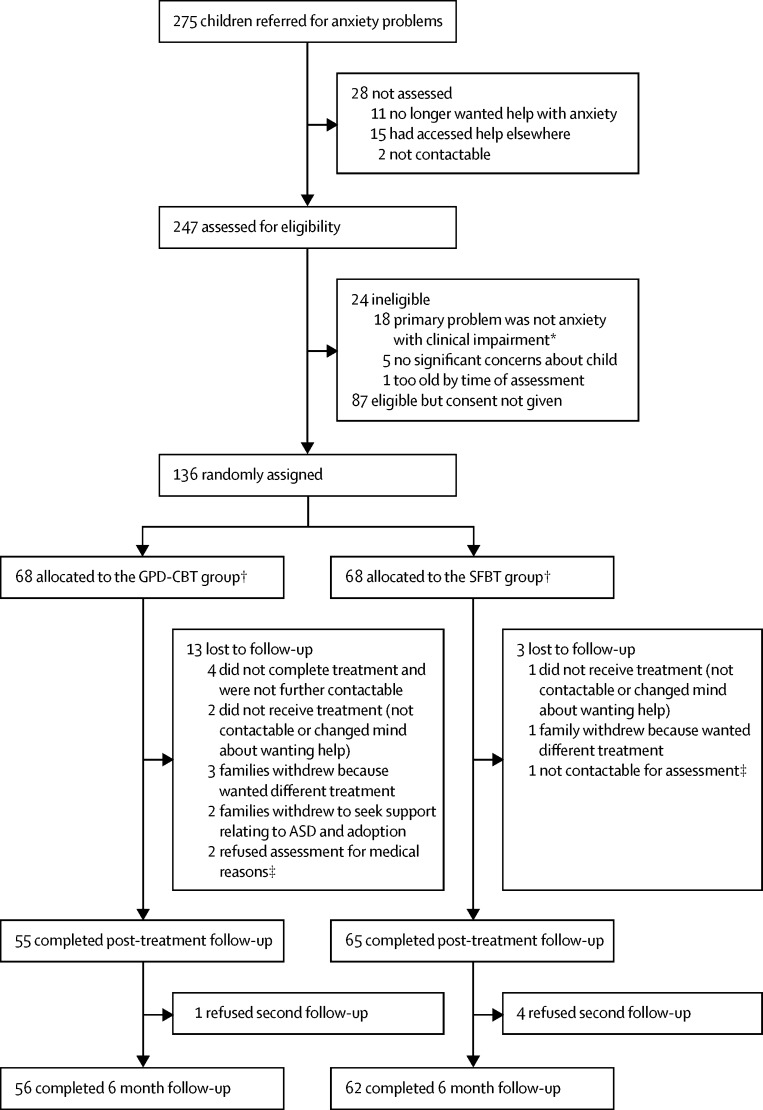
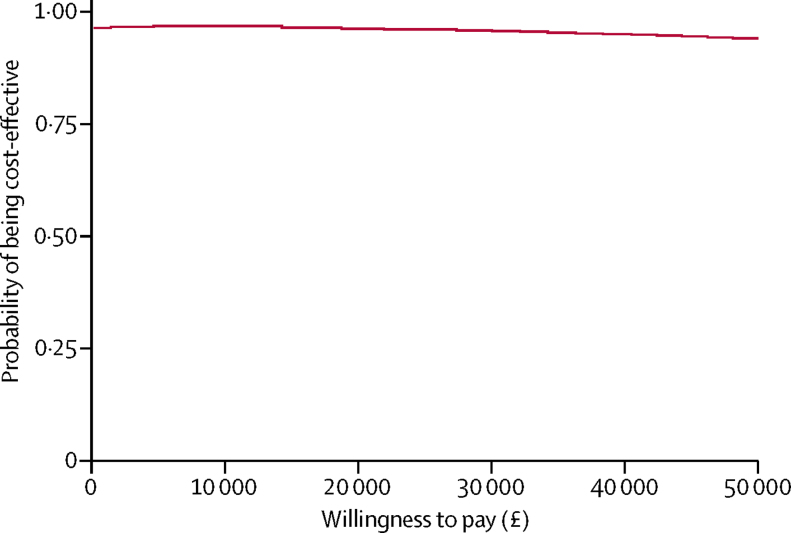
BACKGROUND: Half of all lifetime anxiety disorders emerge before age 12 years; however, access to evidence-based psychological therapies for affected children is poor. We aimed to compare the clinical outcomes and cost-effectiveness of two brief psychological treatments for children with anxiety referred to routine child mental health settings. We hypothesised that brief guided parent-delivered cognitive behavioural therapy (CBT) would be associated with better clinical outcomes than solution-focused brief therapy and would be cost-effective. METHODS: We did this randomised controlled trial at four National Health Service primary child and mental health services in Oxfordshire, UK. Children aged 5-12 years referred for anxiety difficulties were randomly allocated (1:1), via a secure online minimisation tool, to receive brief guided parent-delivered CBT or solution-focused brief therapy, with minimisation for age, sex, anxiety severity, and level of parental anxiety. The allocation sequence was not accessible to the researcher enrolling participants or to study assessors. Research staff who obtained outcome measurements were masked to group allocation and clinical staff who delivered the intervention did not measure outcomes. The primary outcome was recovery, on the basis of Clinical Global Impressions of Improvement (CGI-I). Parents recorded patient-level resource use. Quality-adjusted life-years (QALYs) for use in cost-utility analysis were derived from the Child Health Utility 9D. Assessments were done at baseline (before randomisation), after treatment (primary endpoint), and 6 months after treatment completion. We did analysis by intention to treat. This trial is registered with the ISCRTN registry, number ISRCTN07627865. FINDINGS: Between March 23, 2012, and March 31, 2014, we randomly assigned 136 patients to receive brief guided parent-delivered CBT (n=68) or solution-focused brief therapy (n=68). At the primary endpoint assessment (June, 2012, to September, 2014), 40 (59%) children in the brief guided parent-delivered CBT group versus 47 (69%) children in the solution-focused brief therapy group had an improvement of much or very much in CGI-I score, with no significant differences between groups in either clinical (CGI-I: relative risk 1·01, 95% CI 0·86-1·19; p=0·95) or economic (QALY: mean difference 0·006, -0·009 to 0·02; p=0·42) outcome measures. However, brief guided parent-delivered CBT was associated with lower costs (mean difference -£448; 95% CI -934 to 37; p=0·070) and, taking into account sampling uncertainty, was likely to represent a cost-effective use of resources compared with solution-focused brief therapy. No treatment-related or trial-related adverse events were reported in either group. INTERPRETATION: Our findings show no evidence of clinical superiority of brief guided parent-delivered CBT. However, guided parent-delivered CBT is likely to be a cost-effective alternative to solution-focused brief therapy and might be considered as a first-line treatment for children with anxiety problems. FUNDING: National Institute for Health Research.
Overview
The claims and statistics of this paper haven’t been checked yet.
Free: it reads the open-access text and checks the first 5 claims that cite a source we can check. Create a free account to check every claim.
Integrity signals
Registry
Cites
Statistics
Figures
Verification
Claims the paper makes
The claims and statistics of this paper haven’t been checked yet.
Free: it reads the open-access text and checks the first 5 claims that cite a source we can check. Create a free account to check every claim.
Claims other papers make about this one
Each is checked against this paper’s own text: does it say what the citing paper says it does?
The cited source doesn’t support the claim as written.
In the citing paper
“Self-help interventions including bibliotherapy99 and computerized therapy100 have shown a moderate positive effect size when compared to control groups although they are generally less effective than face to face therapies.101”
From Rapid Systematic Review: The Impact of Social Isolation and Loneliness on the Mental Health of Children and Adolescents in the Context of COVID-19 (2020) · cites this paper as [99]
Checked by a reasoning model — may be wrong.
Experimental — accuracy not yet measuredThe source backs part of the claim, not all of it — or backs it for a different population, condition or comparison.
In the citing paper
“Following treatment, 59% of the children howed much improvement in clinician-rated anxiety severity.”
From Developing a primary care-based cognitive behavioral intervention for anxiety in children through a participatory approach: a qualitative study. (2026) · cites this paper as [11]
Experimental — accuracy not yet measuredThe source backs part of the claim, not all of it — or backs it for a different population, condition or comparison.
In the citing paper
“However, few CBT protocols have been specifically developed and evaluated for use in primary care.”
From Developing a primary care-based cognitive behavioral intervention for anxiety in children through a participatory approach: a qualitative study. (2026) · cites this paper as [11]
Experimental — accuracy not yet measured
Self-check
Percentages, sums and reported differences re-computed from the paper’s own numbers.
The self-check needs the paper’s full text.
Citations
Cites
Kessler, R. C., Berglund, P., Demler, O., Jin, R., Merikangas, K. R., & Walters, E. E. (2005) · Archives of General Psychiatry · doi:10.1001/archpsyc.62.6.593 · Cited by 20,391
(1995) · Cited by 6,909
A measure of anxiety symptoms among children
Spence, S. H. (1998) · Behaviour Research and Therapy · doi:10.1016/s0005-7967(98)00034-5 · Cited by 1,928 · cited 2×
“…they typically worked with in their routine practice with children with anxiety problems (work with children, parents, or both: sometimes, three [17%], five [28%], two [11%]; frequently, eight [44%], nine [50%], eleven [61%]; or always, seven [39%], four [22%], five [28%], respectively [data…”
Cognitive behavioural therapy for anxiety disorders in children and adolescents
James, A. C., James, G., Cowdrey, F. A., Soler, A., & Choke, A. (2015) · Cochrane Database of Systematic Reviews · doi:10.1002/14651858.cd004690.pub4 · Cited by 876
Development of the EQ-5D-Y: a child-friendly version of the EQ-5D
Wille, N., Badia, X., Bonsel, G., Burström, K., Cavrini, G., Devlin, N., Egmar, A.-C., Greiner, W., Gusi, N., Herdman, M., et al. (2010) · Quality of Life Research · doi:10.1007/s11136-010-9648-y · Cited by 872 · cited 1×
“24 We used the Euroqol-5D-Youth version 25 in sensitivity analyses.”
Nauta, M. H., Scholing, A., Rapee, R. M., Abbott, M., Spence, S. H., & Waters, A. (2004) · Behaviour Research and Therapy · doi:10.1016/s0005-7967(03)00200-6 · Cited by 763
Faria, R., Gomes, M., Epstein, D., & White, I. R. (2014) · PharmacoEconomics · doi:10.1007/s40273-014-0193-3 · Cited by 673 · cited 2×
“…worked with in their routine practice with children with anxiety problems (work with children, parents, or both: sometimes, three [17%], five [28%], two [11%]; frequently, eight [44%], nine [50%], eleven [61%]; or always, seven [39%], four [22%], five [28%], respectively [data missing for…”
Effects of psychotherapy for anxiety in children and adolescents: A meta-analytic review
Reynolds, S., Wilson, C., Austin, J., & Hooper, L. (2012) · Clinical Psychology Review · doi:10.1016/j.cpr.2012.01.005 · Cited by 483 · cited 1×
“7 Although good evidence exists for the efficacy of CBT compared with waiting-list controls, few studies have compared this therapy with an active comparator and, when this has been done, the comparator has most commonly been an attention control condition rather than an established treatment.”
Child anxiety in primary care: Prevalent but untreated
Chavira, D. A., Stein, M. B., Bailey, K., & Stein, M. T. (2004) · Depression and Anxiety · doi:10.1002/da.20039 · Cited by 416
Valuation of the Child Health Utility 9D Index
Stevens, K. (2012) · PharmacoEconomics · doi:10.2165/11599120-000000000-00000 · Cited by 416
Cited by
Items 101–126 of 126
Wolf, R. T., Jeppesen, P., Pedersen, M. M. A., Puggaard, L. B., Thastum, M., Bilenberg, N., Thomsen, P. H., Silverman, W. K., Plessen, K. J., Neumer, S., et al. (2021) · Research Square · doi:10.21203/rs.3.rs-1072243/v1
Using peer support to strengthen mental health during the COVID-19 pandemic: a review (Preprint)Preprint
Suresh, R., Alam, A., & Karkossa, Z. (2021) · doi:10.2196/preprints.30585
Stallard, P. N. (2020) · Wiley eBooks · doi:10.1002/9781119396307.refs
Jin, J., Smith‐MacDonald, L., Al-Shamali, H. F., Reeson, M., Pazderka, H., Li, X., Polzin, W., Wei, Y., Silverstone, P. H., & Greenshaw, A. J. (2022) · doi:10.2196/preprints.39629
Taylor, L. M. W., Giles, S., Howitt, S., Ryan, Z. J., Brooks, E., Radley, L., Thompson, A., Whitaker, E., Knight, F., Hill, C., et al. (2022) · Research Square · doi:10.21203/rs.3.rs-1895178/v1
Self-citationLow intensity interventions for anxiety disorders in children and adolescents
Creswell, C., Chessell, C., Hill, C., & Waite, P. (2022) · Oxford University Press eBooks · doi:10.1093/med-psych/9780198867791.003.0010
Self-citationReardon, T. C., Ukoumunne, O. C., Violato, M., Ball, S., Brown, P., Ford, T. J., Gray, A. M., Hill, C., Jasper, B., Larkin, M., et al. (2022) · Research Square · doi:10.21203/rs.3.rs-2021089/v1
Self-citationManaging risk in qualitative interviews
Chessell, C. (2020) · PsyPag Quarterly · doi:10.53841/bpspag.2020.1.116.14
Ball, S., Reardon, T. C., Creswell, C., Taylor, L. M. W., Brown, P., Ford, T. J., Gray, A. M., Hill, C., Jasper, B., Larkin, M., et al. (2023) · Research Square · doi:10.21203/rs.3.rs-3389278/v1
Self-citationCost-Effectiveness of Brief Cognitive Behaviour Therapy
Wang, H. (2024) · CBT: science into practice · doi:10.1007/978-3-031-60746-2_3
Dewan, M. J., Steenbarger, B. N., Greenberg, R. P., & Antshel, K. M. (2024) · Springer eBooks · doi:10.1007/978-3-030-51366-5_39
Hunger‐Schoppe, C., & Retzlaff, R. (2024) · Springer eBooks · doi:10.1007/978-3-662-64728-8_17 · Cited by 1
Parent-only Interventions for Anxiety Disorders in Children and Adolescents
Peng, S., & Zhong, Y. (2025) · Journal of Contemporary Medical Practice · doi:10.53469/jcmp.2025.07(01).09
Ahangar, A., Ahmadi, S., Asadpour, E., & Moghadasin, M. (2024) · Journal of Psychological Science · doi:10.61186/jps.23.142.33
Gee, B., Teague, B., Wilson, J., Chessell, C., Wrigley, L., Koda, T., Mickleburgh, E., Brown, N., McGuire, R., & Clarke, T. (2025) · Emotional and Behavioural Difficulties · doi:10.1080/13632752.2025.2557663
Waite, P., Sutton, R. S., Percy, R., Clark, D. M., Maratchi, L., Jeavons, M., Shipp, L., Violato, M., & the PANDA team (2026) · Behavioural and Cognitive Psychotherapy · doi:10.1017/s1352465826101349
Self-citationBall, S., Reardon, T. C., Creswell, C., Taylor, L. M. W., Brown, P., Ford, T. J., Gray, A., Hill, C., Jasper, B., Larkin, M., et al. (2024) · Figshare · doi:10.6084/m9.figshare.26668779
Self-citationJiang, M., Ma, Y., Li, M., Meng, R., Aixia, M., & Chen, P. (2021) · Figshare · doi:10.6084/m9.figshare.13725033
Polášková, M., Fišerová, M., & Kågström, A. (2026) · Implementation Science Communications · doi:10.1186/s43058-026-00862-w
Okawa, S., Blackwell, S. E., Violato, M., Creswell, C., Ishikawa, S.-I., Obikane, E., Takahashi, T., Arai, H., Nakamura, H., Ishitsuka, K., et al. (2026) · BMJ Open · doi:10.1136/bmjopen-2025-114705
Self-citationButton, R., McFarlane, F. A., Farrington, A., & Hotton, M. (2026) · The Cleft Palate-Craniofacial Journal · doi:10.1177/10556656261422883
Isaksson, A., Elfström, S., Engelbrektsson, J., van Leuven, L., Hasson, H., Eriksson, L., Hedman‐Lagerlöf, E., & Åhlén, J. (2026) · Child & Youth Care Forum · doi:10.1007/s10566-026-09948-x
Nowland, R. A., Aspinall, G., Christian, D. L., Berzins, K. M., Crook, D. J., Khalid, S., Ahuja, S., Gallagher, L., Gee, B., Mickleburgh, E., et al. (2026) · European Child & Adolescent Psychiatry · doi:10.1007/s00787-026-03187-0
Yu, S., Reardon, T. C., Ukoumunne, O. C., Njuguna, R. G., Dodd, H. F., Halliday, G., Hill, C., Jasper, B., Jones, B., Lawrence, P. J., et al. (2026) · Journal of Medical Internet Research · doi:10.2196/87123 · Cited by 1
Self-citationUnderstanding the bidirectional associations between parenting and child anxiety
Yap, M. B. H., Cardamone-Breen, M. C., & Rapee, R. M. (2026) · Nature Reviews Psychology · doi:10.1038/s44159-026-00618-2
Metadata
- Authors
- Creswell, C., Violato, M., Fairbanks, H., White, E., Parkinson, M., Abitabile, G., Leidi, A., & Cooper, P. J.
- Affiliations
- University of Reading (GB)
- University of Oxford (GB)
- Oxford Health NHS Foundation Trust (GB)
- University of Cape Town (ZA)
- Corresponding author
- Creswell, Cathy
- Venue
- The Lancet Psychiatry
- Publisher
- Elsevier BV
- Published
- 2017-07
- Volume
- 4
- Issue
- 7
- Pages
- 529-539
- ISSN
- 2215-0366 (ISSN-L)
- PMC
- PMC5483485
- OpenAlex
- W2615820797
- Cited by
- 126
- References
- 29
- Citations by year
- 2026: 12 · 2025: 10 · 2024: 12 · 2023: 16 · 2022: 21 · 2021: 19 · 2020: 16 · 2019: 9 · 2018: 8 · 2017: 3
- FWCI
- 12.73
- Type
- journal article
- Language
- en
- Open access
- hybrid
- doi.org
- Licence
- cc-by
- www.elsevier.com/tdm/userlicense/1.0/ (tdm)
- creativecommons.org/licenses/by/4.0/ (vor)
- Locations
- The Lancet Psychiatry (publishedVersion, cc-by)
- PubMed Central (publishedVersion, cc-by)
- PubMed (publishedVersion)
- CentAUR (University of Reading) (submittedVersion)
- Funders
- National Institute of Health Research (NIHR), Research for Patient Benefit Programme (reference number PB-PG-0110-21190)
- NIHR Research Professorship (RP_2014-04-018)
- Topics
- Social Sciences › Psychology › Experimental and Cognitive Psychology › Anxiety, Depression, Psychometrics, Treatment, Cognitive Processes
- Social Sciences › Psychology › Clinical Psychology › Child and Adolescent Psychosocial and Emotional Development
- Social Sciences › Psychology › Applied Psychology › Digital Mental Health Interventions
- Keywords
- childhood anxiety disorders, solution-focused therapy, brief psychological intervention, cost-effectiveness, child mental health services, quality-adjusted life years, resource utilization (health care)
- MeSH terms
- Anxiety Disorders, Child, Child, Preschool, Cost-Benefit Analysis, Female, United Kingdom, Humans, Male, Parents, Professional-Family Relations, Psychotherapy, Brief, Cognitive Behavioral Therapy, Treatment Outcome, Quality-Adjusted Life Years
About these checks
Registry, retraction, Cites and statistics results are computed, not judged, with one exception: a printed reference that no index lists is read once by a model before it counts as a citation error. Claims are extracted by a model and kept only when their quote appears verbatim in the text; each cited source is then checked, with a model’s help, for whether it says what the claim relies on. Those verdicts can be wrong — read the claim’s quote and the cited source before relying on one.
Statistics and arithmetic are recomputed, not judged.
Confidence bands are shown only for fields calibrated on our annotated test set. None is calibrated yet, so no band is shown.
What counts as a claim ›How we measure confidence ›How we check this ›
Are you an author, or do you see a problem with this page? Request a review
Data sources
Bibliographic data: Semantic Scholar, OpenAlex, Crossref.
Contains information from the Semantic Scholar Academic Graph Datasets, made available under the ODC Attribution License (ODC-BY 1.0).
Semantic Scholar’s data is described in: Kinney, R., et al. (2023). The Semantic Scholar Open Data Platform. arXiv:2301.10140.
