

Clinical outcomes and cost-effectiveness of brief guided parent-delivered cognitive behavioural therapy and solution-focused brief therapy for treatment of childhood anxiety disorders: a randomised controlled trial
Open accessThe DOI matches its Crossref record; 28 of the 29 references it cites were found in a registry or an index.
Abstract
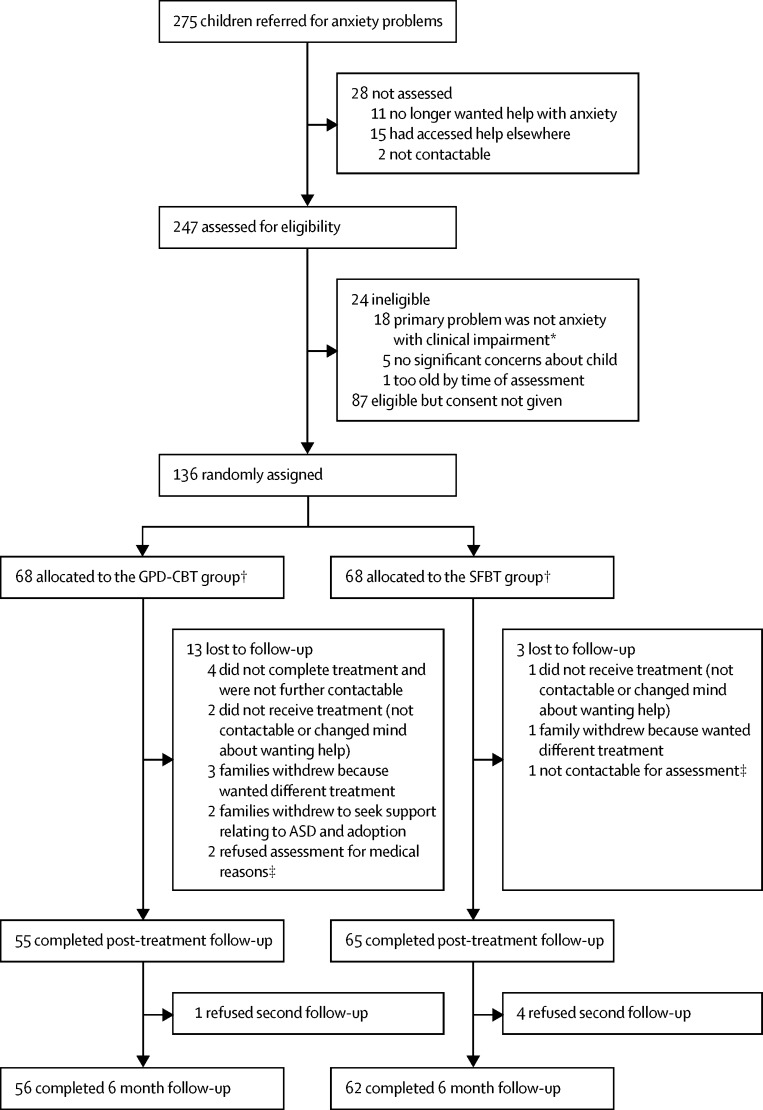
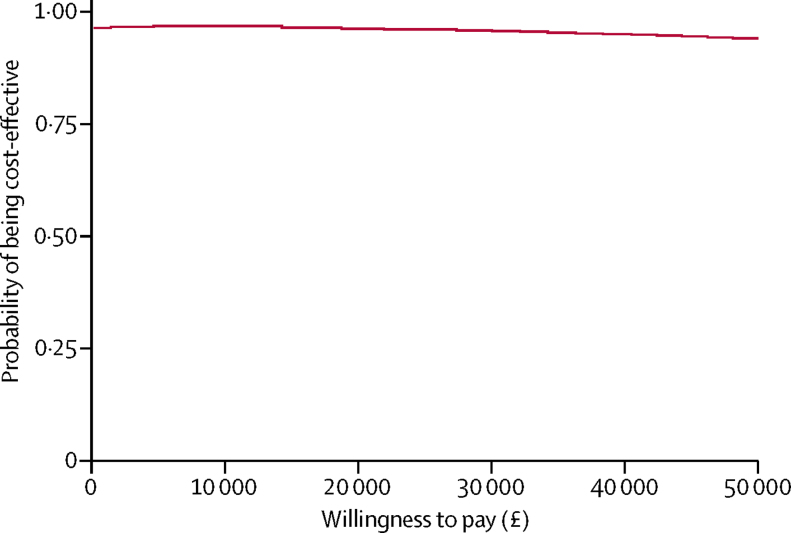
BACKGROUND: Half of all lifetime anxiety disorders emerge before age 12 years; however, access to evidence-based psychological therapies for affected children is poor. We aimed to compare the clinical outcomes and cost-effectiveness of two brief psychological treatments for children with anxiety referred to routine child mental health settings. We hypothesised that brief guided parent-delivered cognitive behavioural therapy (CBT) would be associated with better clinical outcomes than solution-focused brief therapy and would be cost-effective. METHODS: We did this randomised controlled trial at four National Health Service primary child and mental health services in Oxfordshire, UK. Children aged 5-12 years referred for anxiety difficulties were randomly allocated (1:1), via a secure online minimisation tool, to receive brief guided parent-delivered CBT or solution-focused brief therapy, with minimisation for age, sex, anxiety severity, and level of parental anxiety. The allocation sequence was not accessible to the researcher enrolling participants or to study assessors. Research staff who obtained outcome measurements were masked to group allocation and clinical staff who delivered the intervention did not measure outcomes. The primary outcome was recovery, on the basis of Clinical Global Impressions of Improvement (CGI-I). Parents recorded patient-level resource use. Quality-adjusted life-years (QALYs) for use in cost-utility analysis were derived from the Child Health Utility 9D. Assessments were done at baseline (before randomisation), after treatment (primary endpoint), and 6 months after treatment completion. We did analysis by intention to treat. This trial is registered with the ISCRTN registry, number ISRCTN07627865. FINDINGS: Between March 23, 2012, and March 31, 2014, we randomly assigned 136 patients to receive brief guided parent-delivered CBT (n=68) or solution-focused brief therapy (n=68). At the primary endpoint assessment (June, 2012, to September, 2014), 40 (59%) children in the brief guided parent-delivered CBT group versus 47 (69%) children in the solution-focused brief therapy group had an improvement of much or very much in CGI-I score, with no significant differences between groups in either clinical (CGI-I: relative risk 1·01, 95% CI 0·86-1·19; p=0·95) or economic (QALY: mean difference 0·006, -0·009 to 0·02; p=0·42) outcome measures. However, brief guided parent-delivered CBT was associated with lower costs (mean difference -£448; 95% CI -934 to 37; p=0·070) and, taking into account sampling uncertainty, was likely to represent a cost-effective use of resources compared with solution-focused brief therapy. No treatment-related or trial-related adverse events were reported in either group. INTERPRETATION: Our findings show no evidence of clinical superiority of brief guided parent-delivered CBT. However, guided parent-delivered CBT is likely to be a cost-effective alternative to solution-focused brief therapy and might be considered as a first-line treatment for children with anxiety problems. FUNDING: National Institute for Health Research.
Overview
The claims and statistics of this paper haven’t been checked yet.
Free: it reads the open-access text and checks the first 5 claims that cite a source we can check. Create a free account to check every claim.
Integrity signals
Registry
Cites
Statistics
Figures
Verification
Claims the paper makes
The claims and statistics of this paper haven’t been checked yet.
Free: it reads the open-access text and checks the first 5 claims that cite a source we can check. Create a free account to check every claim.
Claims other papers make about this one
Each is checked against this paper’s own text: does it say what the citing paper says it does?
The cited source doesn’t support the claim as written.
In the citing paper
“Self-help interventions including bibliotherapy99 and computerized therapy100 have shown a moderate positive effect size when compared to control groups although they are generally less effective than face to face therapies.101”
From Rapid Systematic Review: The Impact of Social Isolation and Loneliness on the Mental Health of Children and Adolescents in the Context of COVID-19 (2020) · cites this paper as [99]
Checked by a reasoning model — may be wrong.
Experimental — accuracy not yet measuredThe source backs part of the claim, not all of it — or backs it for a different population, condition or comparison.
In the citing paper
“Following treatment, 59% of the children howed much improvement in clinician-rated anxiety severity.”
From Developing a primary care-based cognitive behavioral intervention for anxiety in children through a participatory approach: a qualitative study. (2026) · cites this paper as [11]
Experimental — accuracy not yet measuredThe source backs part of the claim, not all of it — or backs it for a different population, condition or comparison.
In the citing paper
“However, few CBT protocols have been specifically developed and evaluated for use in primary care.”
From Developing a primary care-based cognitive behavioral intervention for anxiety in children through a participatory approach: a qualitative study. (2026) · cites this paper as [11]
Experimental — accuracy not yet measured
Self-check
Percentages, sums and reported differences re-computed from the paper’s own numbers.
The self-check needs the paper’s full text.
Citations
Cites
Kessler, R. C., Berglund, P., Demler, O., Jin, R., Merikangas, K. R., & Walters, E. E. (2005) · Archives of General Psychiatry · doi:10.1001/archpsyc.62.6.593 · Cited by 20,391
(1995) · Cited by 6,909
A measure of anxiety symptoms among children
Spence, S. H. (1998) · Behaviour Research and Therapy · doi:10.1016/s0005-7967(98)00034-5 · Cited by 1,928 · cited 2×
“…they typically worked with in their routine practice with children with anxiety problems (work with children, parents, or both: sometimes, three [17%], five [28%], two [11%]; frequently, eight [44%], nine [50%], eleven [61%]; or always, seven [39%], four [22%], five [28%], respectively [data…”
Cognitive behavioural therapy for anxiety disorders in children and adolescents
James, A. C., James, G., Cowdrey, F. A., Soler, A., & Choke, A. (2015) · Cochrane Database of Systematic Reviews · doi:10.1002/14651858.cd004690.pub4 · Cited by 876
Development of the EQ-5D-Y: a child-friendly version of the EQ-5D
Wille, N., Badia, X., Bonsel, G., Burström, K., Cavrini, G., Devlin, N., Egmar, A.-C., Greiner, W., Gusi, N., Herdman, M., et al. (2010) · Quality of Life Research · doi:10.1007/s11136-010-9648-y · Cited by 872 · cited 1×
“24 We used the Euroqol-5D-Youth version 25 in sensitivity analyses.”
Nauta, M. H., Scholing, A., Rapee, R. M., Abbott, M., Spence, S. H., & Waters, A. (2004) · Behaviour Research and Therapy · doi:10.1016/s0005-7967(03)00200-6 · Cited by 763
Faria, R., Gomes, M., Epstein, D., & White, I. R. (2014) · PharmacoEconomics · doi:10.1007/s40273-014-0193-3 · Cited by 673 · cited 2×
“…worked with in their routine practice with children with anxiety problems (work with children, parents, or both: sometimes, three [17%], five [28%], two [11%]; frequently, eight [44%], nine [50%], eleven [61%]; or always, seven [39%], four [22%], five [28%], respectively [data missing for…”
Effects of psychotherapy for anxiety in children and adolescents: A meta-analytic review
Reynolds, S., Wilson, C., Austin, J., & Hooper, L. (2012) · Clinical Psychology Review · doi:10.1016/j.cpr.2012.01.005 · Cited by 483 · cited 1×
“7 Although good evidence exists for the efficacy of CBT compared with waiting-list controls, few studies have compared this therapy with an active comparator and, when this has been done, the comparator has most commonly been an attention control condition rather than an established treatment.”
Child anxiety in primary care: Prevalent but untreated
Chavira, D. A., Stein, M. B., Bailey, K., & Stein, M. T. (2004) · Depression and Anxiety · doi:10.1002/da.20039 · Cited by 416
Valuation of the Child Health Utility 9D Index
Stevens, K. (2012) · PharmacoEconomics · doi:10.2165/11599120-000000000-00000 · Cited by 416
Cited by
Loades, M. E., Chatburn, E., Higson-Sweeney, N., Reynolds, S., Shafran, R., Brigden, A., Linney, C., McManus, M. N., Borwick, C., & Crawley, E. (2020) · Journal of the American Academy of Child & Adolescent Psychiatry · doi:10.1016/j.jaac.2020.05.009 · Cited by 2,906
Penninx, B. W., Pine, D. S., Holmes, E. A., & Reif, A. (2021) · The Lancet · doi:10.1016/s0140-6736(21)00359-7 · Cited by 740
Cognitive behavioural therapy for anxiety disorders in children and adolescents
James, A. C., Reardon, T., Soler, A., James, G., & Creswell, C. (2020) · Cochrane Database of Systematic Reviews · doi:10.1002/14651858.cd013162.pub2 · Cited by 344
Self-citationAnxiety disorders in children and adolescents: A summary and overview of the literature
Rapee, R. M., Creswell, C., Kendall, P. C., Pine, D. S., & Waters, A. M. (2023) · Behaviour Research and Therapy · doi:10.1016/j.brat.2023.104376 · Cited by 174
Self-citationResearch Review: Pediatric Anxiety Disorders—What Have We Learnt in the Last 10 Years?
Strawn, J. R., Lu, L., Peris, T. S., Levine, A., & Walkup, J. T. (2021) · Journal of Child Psychology and Psychiatry · doi:10.1111/jcpp.13262 · Cited by 168
Bennett, S. D., Cuijpers, P., Ebert, D. D., McKenzie Smith, M., Coughtrey, A. E., Heyman, I., Manzotti, G., & Shafran, R. (2019) · Journal of Child Psychology and Psychiatry · doi:10.1111/jcpp.13010 · Cited by 162
Practitioner Review: Anxiety disorders in children and young people – assessment and treatment
Creswell, C., Waite, P., & Hudson, J. (2020) · Journal of Child Psychology and Psychiatry · doi:10.1111/jcpp.13186 · Cited by 140
Self-citationJuul, S., Gluud, C., Simonsen, S., Frandsen, F. W., Kirsch, I., & Jakobsen, J. C. (2021) · BMJ Evidence-Based Medicine · doi:10.1136/bmjebm-2020-111407 · Cited by 135
Using Peer Support to Strengthen Mental Health During the COVID-19 Pandemic: A Review
Suresh, R., Alam, A., & Karkossa, Z. (2021) · Frontiers in Psychiatry · doi:10.3389/fpsyt.2021.714181 · Cited by 183
The concept and definition of low intensity cognitive behaviour therapy
Shafran, R., Myles-Hooton, P., Bennett, S., & Öst, L.-G. (2021) · Behaviour Research and Therapy · doi:10.1016/j.brat.2021.103803 · Cited by 104
Haig-Ferguson, A., Cooper, K., Cartwright, E., Loades, M. E., & Daniels, J. (2021) · Behavioural and Cognitive Psychotherapy · doi:10.1017/s1352465820000636 · Cited by 84
“, 2019), whilst other studies report that for children aged 4–12 years, parent-led CBT is effective in treating anxiety (Cartwright-Hatton et al., 2011; Creswell et al., 2017; Waters et al., 2009).”
BackgroundResultKhanna, D., Khadka, J., Mpundu‐Kaambwa, C., Lay, K., Russo, R. N., Ratcliffe, J., The Quality of Life in Kids: Key Evidence to Strengthen Decisions in Australia (QUOKKA) Project Team, Devlin, N. J., Norman, R., Viney, R. C., et al. (2022) · PharmacoEconomics · doi:10.1007/s40273-022-01177-z · Cited by 98
Catanzano, M., Bennett, S. D., Sanderson, C., Patel, M., Manzotti, G., Kerry, E., Coughtrey, A. E., Liang, H., Heyman, I., & Shafran, R. (2020) · Journal of Psychosomatic Research · doi:10.1016/j.jpsychores.2020.110187 · Cited by 68
Pollard, J., Reardon, T. C., Williams, C., Creswell, C., Ford, T. J., Gray, A. M., Roberts, N. W., Stallard, P. N., Ukoumunne, O. C., & Violato, M. (2023) · JCPP Advances · doi:10.1002/jcv2.12149 · Cited by 78
Self-citationDisparities in access to care in marginalized populations
Silberholz, E. A., Brodie, N., Spector, N. D., & Pattishall, A. E. (2017) · Current Opinion in Pediatrics · doi:10.1097/mop.0000000000000549 · Cited by 63
Evans, R., Clark, D. M., & Leigh, E. (2021) · Behavioural and Cognitive Psychotherapy · doi:10.1017/s135246582000079x · Cited by 52
Wahlund, T., Andersson, E., Jolstedt, M., Perrin, S., Vigerland, S., & Serlachius, E. (2020) · Cognitive and Behavioral Practice · doi:10.1016/j.cbpra.2019.06.002 · Cited by 49
Evidence-based practice in cognitive–behavioural therapy
Stallard, P. (2022) · Archives of Disease in Childhood · doi:10.1136/archdischild-2020-321249 · Cited by 46
Creswell, C., Taylor, L., Giles, S., Howitt, S., Radley, L., Whitaker, E., Brooks, E., Knight, F., Raymont, V., Hill, C., et al. (2024) · The Lancet Psychiatry · doi:10.1016/s2215-0366(23)00429-7 · Cited by 45
Self-citationOnline Support and Intervention for Child Anxiety (OSI): Development and Usability Testing
Hill, C., Reardon, T., Taylor, L., & Creswell, C. (2022) · JMIR Formative Research · doi:10.2196/29846 · Cited by 43
Self-citationMcKinnon, A., Keers, R., Coleman, J. R. I., Lester, K. J., Roberts, S., Arendt, K., Bögels, S. M., Cooper, P., Creswell, C., Hartman, C. A., et al. (2018) · Journal of Child Psychology and Psychiatry · doi:10.1111/jcpp.12872 · Cited by 40
Self-citationJiang, M., Ma, Y., Li, M., Meng, R., Ma, A., & Chen, P. (2021) · Health and Quality of Life Outcomes · doi:10.1186/s12955-021-01677-0 · Cited by 39
The Global Outcomes of Solution-Focused Brief Therapy: A Revision
López, M. D. C. N., & Beyebach, M. (2022) · American Journal of Family Therapy · doi:10.1080/01926187.2022.2069175 · Cited by 67
Ludlow, C., Hurn, R., & Lansdell, S. (2020) · Adolescent Health Medicine and Therapeutics · doi:10.2147/ahmt.s196492 · Cited by 75
Beyebach, M., Neipp, M.-C., Solanes-Puchol, Á., & Martín-del-Río, B. (2021) · Frontiers in Psychology · doi:10.3389/fpsyg.2021.754885 · Cited by 35
Sampaio, F., Nystrand, C., Feldman, I., & Mihalopoulos, C. (2022) · European Child & Adolescent Psychiatry · doi:10.1007/s00787-022-01969-w · Cited by 44
Psychosocial interventions for internalizing disorders in youth and adults with ASD
Keefer, A. J., White, S. W., Vasa, R. A., & Reaven, J. (2018) · International Review of Psychiatry · doi:10.1080/09540261.2018.1432575 · Cited by 39
Ollendick, T. H., Öst, L., & Farrell, L. J. (2018) · Evidence-Based Mental Health · doi:10.1136/eb-2018-102892 · Cited by 50
Stoll, R. D., Piña, A., & Schleider, J. L. (2020) · Journal of Clinical Child & Adolescent Psychology · doi:10.1080/15374416.2020.1738237 · Cited by 32
Creswell, C., Violato, M., Cruddace, S., Gerry, S., Murray, L., Shafran, R., Stein, A. L., Willetts, L., McIntosh, E., & Cooper, P. (2019) · Journal of Child Psychology and Psychiatry · doi:10.1111/jcpp.13089 · Cited by 29
Self-citationWilliamson, V., Larkin, M., Reardon, T. C., Pearcey, S., Hill, C., Stallard, P. N., Spence, S. H., Breen, M. A., Macdonald, I., Ukoumunne, O. C., et al. (2021) · BMJ Open · doi:10.1136/bmjopen-2020-044852 · Cited by 27
Self-citationLawrence, P. J., Parkinson, M., Jasper, B., Creswell, C., & Halligan, S. L. (2021) · The Lancet Psychiatry · doi:10.1016/s2215-0366(20)30315-1 · Cited by 37
Self-citationEffects of emotionally oriented parental interventions: a systematic review and meta-analysis
Zahl‐Olsen, R., Severinsen, L., Stiegler, J. R., Fernee, C. R., Simhan, I., Rekdal, S. S., & Bertelsen, T. B. (2023) · Frontiers in Psychology · doi:10.3389/fpsyg.2023.1159892 · Cited by 34
Creswell, C., Chessell, C., & Halliday, G. (2022) · Behavioural and Cognitive Psychotherapy · doi:10.1017/s1352465822000546 · Cited by 39
Self-citationWuthrich, V. M., Zagic, D., Dickson, S. J., McLellan, L. F., Chen, J. T.-H., Jones, M. P., & Rapee, R. M. (2023) · Clinical Child and Family Psychology Review · doi:10.1007/s10567-023-00433-8 · Cited by 28
Wang, M., Zhang, H., Zhang, X., Zhao, Q., Chen, J., Hu, C., Feng, R., Liu, D., Fu, P., Zhang, C., et al. (2023) · Journal of Psychiatric Research · doi:10.1016/j.jpsychires.2023.03.009 · Cited by 21
Problematic cost–utility analysis of interventions for behavior problems in children and adolescents
van IJzendoorn, M. H., & Bakermans‐Kranenburg, M. J. (2020) · New Directions for Child and Adolescent Development · doi:10.1002/cad.20360 · Cited by 24
The process of co‐design for a new anxiety intervention for autistic children
Cullingham, T., Rennard, U., Creswell, C., Milton, D. E. M., Buckle, K. L., Godber, L., Gordon, K., Larkin, M., & Green, J. (2024) · JCPP Advances · doi:10.1002/jcv2.12255 · Cited by 30
Self-citationGuzick, A. G., Schneider, S. C., Kook, M., Iacono, J. R., Weinzimmer, S. A., Quast, T. C., Olsen, S. M., Hughes, K. R., Jellinek, E. R., Garcia, A. B. P., et al. (2023) · Behavior Therapy · doi:10.1016/j.beth.2023.08.008 · Cited by 22
Blair, K., Topitzes, J., & Mersky, J. P. (2019) · Children and Youth Services Review · doi:10.1016/j.childyouth.2019.104463 · Cited by 20
Cost-effectiveness of Brief Behavioral Therapy for Pediatric Anxiety and Depression in Primary Care
Lynch, F. L., Dickerson, J. F., Rozenman, M. S., González, A., Schwartz, K. T. G., Porta, G., O'Keeffe-Rosetti, M. C., Brent, D. A., & Weersing, V. R. (2021) · JAMA Network Open · doi:10.1001/jamanetworkopen.2021.1778 · Cited by 35
Karadag, M., Topal, Z., Ezer, R. N., & Gokcen, C. (2021) · Journal of EMDR Practice and Research · doi:10.1891/emdr-d-20-00054 · Cited by 15
Hill, C., Chessell, C., Percy, R., & Creswell, C. (2022) · Behavioural and Cognitive Psychotherapy · doi:10.1017/s1352465822000157 · Cited by 19
Self-citationMcGuire, R., Hiller, R. M., Cobham, V. E., Haag, K., & Halligan, S. L. (2019) · European Journal of Psychotraumatology · doi:10.1080/20008198.2019.1644127 · Cited by 15
School-based screening for childhood anxiety problems and intervention delivery: a codesign approach
Williamson, V., Larkin, M., Reardon, T. C., Pearcey, S., Button, R., Green, I., Hill, C., Stallard, P. N., Spence, S. H., Breen, M. A., et al. (2022) · BMJ Open · doi:10.1136/bmjopen-2021-058089 · Cited by 15
Self-citationA guide for self-help guides: best practice implementation
Shafran, R., Egan, S. J., de Valle, M. K., Davey, E., Carlbring, P., Creswell, C., & Wade, T. D. (2024) · Cognitive Behaviour Therapy · doi:10.1080/16506073.2024.2369637 · Cited by 17
Self-citationReardon, T. C., Dodd, H. F., Hill, C., Jasper, B., Lawrence, P. J., Morgan, F., Rapee, R. M., Ukoumunne, O. C., Violato, M., Davey, E., et al. (2022) · Trials · doi:10.1186/s13063-022-06010-8 · Cited by 17
Self-citationRienks, K., Salemink, E., Sigurðardóttir, L. B. L., Meléndez‐Torres, G. J., Staaks, J. P. C., & Leijten, P. H. O. (2025) · Behaviour Research and Therapy · doi:10.1016/j.brat.2025.104692 · Cited by 14
Evans, R., Hill, C., O'Brien, D., & Creswell, C. (2019) · Child and Adolescent Mental Health · doi:10.1111/camh.12274 · Cited by 10
Self-citationNewham, J. J., McLean, K., Ginja, S., Hurt, L. S., Molloy, C. S., Lingam, R., & Goldfeld, S. R. (2020) · BMC Public Health · doi:10.1186/s12889-020-09104-7 · Cited by 12
Reardon, T. C., Ball, S., Breen, M. A., Brown, P., Day, E., Ford, T. J., Gray, A. M., Green, I., Hill, C., Jasper, B., et al. (2022) · Pilot and Feasibility Studies · doi:10.1186/s40814-022-01140-x · Cited by 12
Self-citationCognitive behavior therapy for child and adolescent anxiety disorders: an update on recent evidence
Heiervang, E. R., Villabø, M. A., & Wergeland, G. J. (2018) · Current Opinion in Psychiatry · doi:10.1097/yco.0000000000000457 · Cited by 12
Omkarappa, D. B., Rentala, S., & Nattala, P. (2021) · Journal of Child and Adolescent Psychiatric Nursing · doi:10.1111/jcap.12329 · Cited by 9
Emotion‐focused skills training for parents with anxious children. A pilot study
Zahl‐Olsen, R., Severinsen, L., Shahar, B., Stiegler, J. R., & Bertelsen, T. B. (2023) · Journal of Marital and Family Therapy · doi:10.1111/jmft.12643 · Cited by 9
Thai, T. T. H., Engel, L., Perez, J. K., Tan, E. J., Eades, S., Sanci, L. A., & Mihalopoulos, C. (2023) · Quality of Life Research · doi:10.1007/s11136-023-03441-x · Cited by 8
Badesha, K., Wilde, S., & Dawson, D. L. (2022) · Psychology and Psychotherapy Theory Research and Practice · doi:10.1111/papt.12436 · Cited by 15
Assessing Anxiety-Related Impairment in Children and Adolescents
Etkin, R. G., Lebowitz, E. R., & Silverman, W. K. (2023) · Assessment · doi:10.1177/10731911231194972 · Cited by 11
Allard, C., Thirlwall, K., Cooper, P., Brown, A., O’Brien, D., & Creswell, C. (2022) · Journal of Emotional and Behavioral Disorders · doi:10.1177/10634266211028199 · Cited by 7
Self-citationLow-intensity interventions for anxiety disorders
Stallard, P. N. (2017) · The Lancet Psychiatry · doi:10.1016/s2215-0366(17)30186-4 · Cited by 7
Ramírez, A. C., Grebe, S. C., McNeel, M. M., Limon, D. L., Schneider, S. C., Berry, L. N., Goin‐Kochel, R. P., Cepeda, S. L., Voigt, R. G., Salloum, A., et al. (2020) · Brazilian Journal of Psychiatry · doi:10.1590/1516-4446-2020-0897 · Cited by 8
Nadai, A. S. D., Quast, T. C., Little, T. B., Westerberg, K., Patyk, K. C., Monahan, M. F., Storch, E. A., & Gregory, S. T. (2021) · Journal of Affective Disorders · doi:10.1016/j.jad.2021.10.127 · Cited by 7
Breinholst, S., Walczak, M., Christiansen, B., & Esbjørn, B. H. (2021) · Journal of Behavioral and Cognitive Therapy · doi:10.1016/j.jbct.2020.11.008 · Cited by 10
Treatment of Anxiety in Children and Adolescents
Dowell, T. L., Donovan, C. L., Farrell, L. J., & Waters, A. M. (2018) · Current Treatment Options in Psychiatry · doi:10.1007/s40501-018-0136-2 · Cited by 7
Waite, P. (2022) · Pilot and Feasibility Studies · doi:10.1186/s40814-022-01009-z · Cited by 6
Reardon, T. C., Ukoumunne, O. C., Violato, M., Ball, S., Brown, P., Ford, T. J., Gray, A. M., Hill, C., Jasper, B., Larkin, M., et al. (2022) · Trials · doi:10.1186/s13063-022-06773-0 · Cited by 6
Self-citationBraus, N., Flückiger, C., Wichmann, J., Frankman, C., Gräfenkämper, R., Zemp, M., & Hunger‐Schoppe, C. (2025) · Psychotherapy Research · doi:10.1080/10503307.2025.2565236 · Cited by 6
Chessell, C., Halldorsson, B., Walters, S., Farrington, A., Harvey, K., & Creswell, C. (2023) · Behavioural and Cognitive Psychotherapy · doi:10.1017/s1352465823000450 · Cited by 6
Self-citationOkawa, S., Arai, H., Nakamura, H., Ishikawa, S., Creswell, C., Shiko, Y., Ozawa, Y., Kawasaki, Y., & Shimizu, E. (2023) · Behavioural and Cognitive Psychotherapy · doi:10.1017/s1352465822000704 · Cited by 5
Self-citationCo-production of a Neurodiversity-Affirmative Anxiety Intervention for Autistic ChildrenPreprint
Cullingham, T., Rennard, U., Creswell, C., Milton, D. E. M., Buckle, K. L., Godber, L., Gordon, K., Larkin, M., & Green, J. (2023) · medRxiv · doi:10.1101/2023.07.05.23292219 · Cited by 5
Self-citationSolution-Focused Group Counseling on Mental States in Hemodialysis Patients with Anxiety
Chen, P., & Lin, D. (2024) · Actas Españolas de Psiquiatría · doi:10.62641/aep.v52i2.1562 · Cited by 4
Ziebold, C., McDaid, D., King, D., Romeo, R., Ribeiro, W. S., Pan, P. M., Miguel, E. C., Bressan, R. A., Rohde, L. A., Salum, G. A., et al. (2024) · Value in Health · doi:10.1016/j.jval.2024.10.3802 · Cited by 5
Esbjørn, B. H., Breinholst, S., Christiansen, B. M., Bukh, L., & Walczak, M. (2019) · Scandinavian Journal of Psychology · doi:10.1111/sjop.12544 · Cited by 6
Dimensions of coping and anxiety symptoms in a community sample of young children
Quy, K., Gibb, J., Neil, L., Owen, C., & SMITH, M. A. (2018) · Emotional and Behavioural Difficulties · doi:10.1080/13632752.2018.1461456 · Cited by 6
Wolf, R. T., Jeppesen, P., Pedersen, M. M. A., Puggaard, L. B., Thastum, M., Bilenberg, N., Thomsen, P. H., Silverman, W. K., Plessen, K. J., Neumer, S., et al. (2022) · BMC Health Services Research · doi:10.1186/s12913-022-08187-9 · Cited by 6
Taylor, L. M. W., Giles, S., Howitt, S., Ryan, Z. J., Brooks, E., Radley, L., Thomson, A. C., Whitaker, E., Knight, F., Hill, C., et al. (2022) · Trials · doi:10.1186/s13063-022-06833-5 · Cited by 6
Self-citationTaylor, L. M. W., Waite, P., Halldorsson, B., Percy, R., Violato, M., & Creswell, C. (2019) · Trials · doi:10.1186/s13063-019-3295-6 · Cited by 5
Self-citationLippert, M. W., Sommer, K., Flasinski, T., Schomberg, J., Pflug, V., Christiansen, H., In‐Albon, T., Knappe, S., Romanos, M., Tuschen‐Caffier, B., et al. (2023) · PLoS ONE · doi:10.1371/journal.pone.0279658 · Cited by 6
Reardon, T. C., Dodd, H. F., Hill, C., Jasper, B., Lawrence, P. J., Morgan, F., Rapee, R. M., Ukoumunne, O. C., Violato, M., Davey, E., et al. (2022) · Research Square · doi:10.21203/rs.3.rs-970695/v1 · Cited by 3
Self-citationMapping the Landscape of Solution-Focused Brief Therapy: A Bibliometric Analysis
Fernandez, J. A., & Fernandez, J. A. (2025) · American Journal of Family Therapy · doi:10.1080/01926187.2025.2472775 · Cited by 2
Parent-Centered Interventions for Childhood Anxiety
Creswell, C., Tu, E.-N., & Merriam, E. (2025) · Annual Review of Developmental Psychology · doi:10.1146/annurev-devpsych-111323-112637 · Cited by 4
Self-citationStewart, S. L., Brock, B., Withers, A., Guerville, R., Morris, J. N., & Poss, J. W. (2025) · European Journal of Investigation in Health Psychology and Education · doi:10.3390/ejihpe15100212 · Cited by 2
Dewan, M. J., Steenbarger, B. N., Greenberg, R. P., & Antshel, K. M. (2023) · Springer eBooks · doi:10.1007/978-3-030-42825-9_39-1 · Cited by 4
Takahashi, T., Ishikawa, S., Aiboshi, T., & Miyauchi, M. (2023) · Clinical Child Psychology and Psychiatry · doi:10.1177/13591045231194104 · Cited by 3
Ball, S., Reardon, T. C., Creswell, C., Taylor, L. M. W., Brown, P., Ford, T. J., Gray, A. M., Hill, C., Jasper, B., Larkin, M., et al. (2024) · Trials · doi:10.1186/s13063-023-07898-6 · Cited by 3
Self-citationTransdiagnostic Approaches to the Treatment of Anxiety Disorders in Children and Adolescents
Newby, J. M., & McKinnon, A. (2019) · Cambridge University Press eBooks · doi:10.1017/9781108235655.011 · Cited by 5
Okul Öncesi Öğretmen Adaylarının Alan Gezisine Yönelik Görüşleri
Uysal, H., GÜNGÖR, M. M., & KÜÇÜK, E. (2022) · Uluslararası Karamanoğlu Mehmetbey Eğitim Araştırmaları Dergisi · doi:10.47770/ukmead.1080470 · Cited by 1
Parent-led Interventions for Anxiety Problems in Children and Young People in the Real World
Whitaker, E., Chessell, C., Vesey, T., & Creswell, C. (2025) · Psychiatric Clinics of North America · doi:10.1016/j.psc.2025.07.003 · Cited by 2
Self-citationMcCabe, R., O’Keeffe, S., & Long, M. (2026) · Healthcare · doi:10.3390/healthcare14020168 · Cited by 2
Reardon, T. C., Ukoumunne, O. C., Dodd, H. F., Halliday, G., Hill, C., Jasper, B., Jones, B., Lawrence, P. J., Morgan, F., Placzek, A., et al. (2026) · Journal of Child Psychology and Psychiatry · doi:10.1111/jcpp.70119 · Cited by 3
Self-citationWade, T. D., Egan, S. J., Jabs, M., de Valle, M. K., & Shafran, R. (2026) · European Child & Adolescent Psychiatry · doi:10.1007/s00787-026-03131-2 · Cited by 1
Frederick, R. M., Smárason, O., Boedeker, P., Spencer, S. D., Guzick, A. G., & Storch, E. A. (2024) · Journal of Autism and Developmental Disorders · doi:10.1007/s10803-024-06680-0 · Cited by 1
Belfield, C., Blanchard, L., Drake, K. L., & Ginsburg, G. S. (2025) · Administration and Policy in Mental Health and Mental Health Services Research · doi:10.1007/s10488-025-01453-y · Cited by 18
Trennungsängste und Schulvermeidung
In‐Albon, T., & Walter, D. (2020) · Psychotherapie: Praxis · doi:10.1007/978-3-662-58980-9_62 · Cited by 2
Low intensity psychological interventions for children and young people: the economic case thus far
Knapp, M. R. J., & Wong, G. H. Y. (2022) · Oxford University Press eBooks · doi:10.1093/med-psych/9780198867791.003.0005 · Cited by 2
Rast, C. E., Guzick, A. G., Soileau, K. J., Smárason, O., Berry, L. N., Goin‐Kochel, R. P., Goodman, W. K., Schneider, S. C., Salloum, A., & Storch, E. A. (2025) · American Journal on Intellectual and Developmental Disabilities · doi:10.1352/1944-7558-130.3.228 · Cited by 2
Isaksson, A., Åhlén, J., Hasson, H., & Eriksson, L. (2026) · BMC Primary Care · doi:10.1186/s12875-026-03191-y
Monga, S. (2018) · Evidence-Based Mental Health · doi:10.1136/eb-2017-102826
حنور, ق. ع. خ. (2019) · مجلة كلية التربية جامعة بنها · doi:10.21608/jfeb.2018.61548
Reardon, T. C., Ball, S., Breen, M. A., Brown, P., Day, E., Ford, T. J., Gray, A., Green, I., Hill, C., Jasper, B., et al. (2021) · Research Square · doi:10.21203/rs.3.rs-637552/v1
Self-citationUnderstanding Service Gaps and Support Opportunities in the Treatment of Childhood Anxiety
Masson, C. (2021) · Scholarship@Western (Western University)
Metadata
- Authors
- Creswell, C., Violato, M., Fairbanks, H., White, E., Parkinson, M., Abitabile, G., Leidi, A., & Cooper, P. J.
- Affiliations
- University of Reading (GB)
- University of Oxford (GB)
- Oxford Health NHS Foundation Trust (GB)
- University of Cape Town (ZA)
- Corresponding author
- Creswell, Cathy
- Venue
- The Lancet Psychiatry
- Publisher
- Elsevier BV
- Published
- 2017-07
- Volume
- 4
- Issue
- 7
- Pages
- 529-539
- ISSN
- 2215-0366 (ISSN-L)
- PMC
- PMC5483485
- OpenAlex
- W2615820797
- Cited by
- 126
- References
- 29
- Citations by year
- 2026: 12 · 2025: 10 · 2024: 12 · 2023: 16 · 2022: 21 · 2021: 19 · 2020: 16 · 2019: 9 · 2018: 8 · 2017: 3
- FWCI
- 12.73
- Type
- journal article
- Language
- en
- Open access
- hybrid
- doi.org
- Licence
- cc-by
- www.elsevier.com/tdm/userlicense/1.0/ (tdm)
- creativecommons.org/licenses/by/4.0/ (vor)
- Locations
- The Lancet Psychiatry (publishedVersion, cc-by)
- PubMed Central (publishedVersion, cc-by)
- PubMed (publishedVersion)
- CentAUR (University of Reading) (submittedVersion)
- Funders
- National Institute of Health Research (NIHR), Research for Patient Benefit Programme (reference number PB-PG-0110-21190)
- NIHR Research Professorship (RP_2014-04-018)
- Topics
- Social Sciences › Psychology › Experimental and Cognitive Psychology › Anxiety, Depression, Psychometrics, Treatment, Cognitive Processes
- Social Sciences › Psychology › Clinical Psychology › Child and Adolescent Psychosocial and Emotional Development
- Social Sciences › Psychology › Applied Psychology › Digital Mental Health Interventions
- Keywords
- childhood anxiety disorders, solution-focused therapy, brief psychological intervention, cost-effectiveness, child mental health services, quality-adjusted life years, resource utilization (health care)
- MeSH terms
- Anxiety Disorders, Child, Child, Preschool, Cost-Benefit Analysis, Female, United Kingdom, Humans, Male, Parents, Professional-Family Relations, Psychotherapy, Brief, Cognitive Behavioral Therapy, Treatment Outcome, Quality-Adjusted Life Years
About these checks
Registry, retraction, Cites and statistics results are computed, not judged, with one exception: a printed reference that no index lists is read once by a model before it counts as a citation error. Claims are extracted by a model and kept only when their quote appears verbatim in the text; each cited source is then checked, with a model’s help, for whether it says what the claim relies on. Those verdicts can be wrong — read the claim’s quote and the cited source before relying on one.
Statistics and arithmetic are recomputed, not judged.
Confidence bands are shown only for fields calibrated on our annotated test set. None is calibrated yet, so no band is shown.
What counts as a claim ›How we measure confidence ›How we check this ›
Are you an author, or do you see a problem with this page? Request a review
Data sources
Bibliographic data: Semantic Scholar, OpenAlex, Crossref.
Contains information from the Semantic Scholar Academic Graph Datasets, made available under the ODC Attribution License (ODC-BY 1.0).
Semantic Scholar’s data is described in: Kinney, R., et al. (2023). The Semantic Scholar Open Data Platform. arXiv:2301.10140.
