

The epidemiology of trauma and post-traumatic stress disorder in a representative cohort of young people in England and Wales
Open accessThe DOI matches its Crossref record; 31 of the 33 references it cites were found in a registry or an index.
Abstract
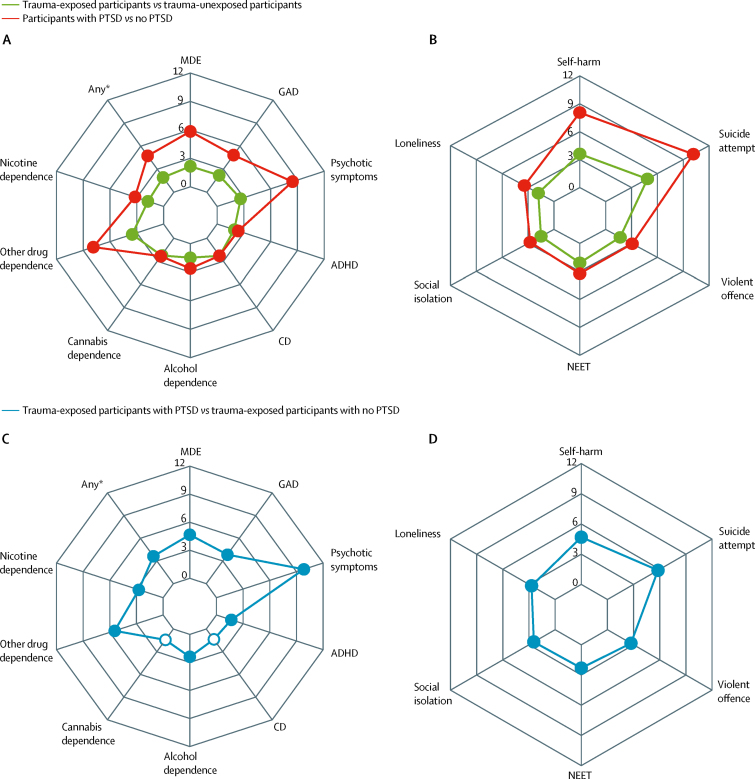
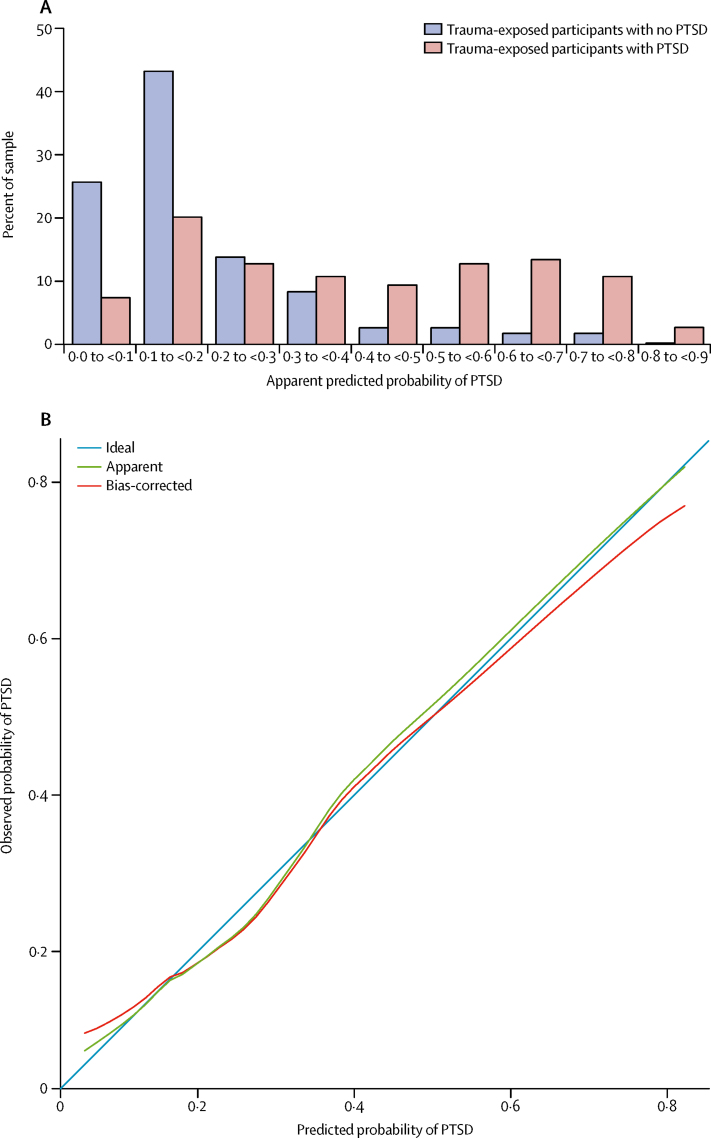
BACKGROUND: Despite the emphasis placed on childhood trauma in psychiatry, comparatively little is known about the epidemiology of trauma and trauma-related psychopathology in young people. We therefore aimed to evaluate the prevalence, clinical features, and risk factors associated with trauma exposure and post-traumatic stress disorder (PTSD) in young people. METHODS: We carried out a comprehensive epidemiological study based on participants from the Environmental Risk Longitudinal Twin Study, a population-representative birth-cohort of 2232 children born in England and Wales in 1994-95. At the follow-up home visit at age 18 years, participants were assessed with structured interviews for trauma exposure, PTSD, other psychopathology, risk events, functional impairment, and service use. Risk factors for PTSD were measured prospectively over four previous assessments between age 5 and 12 years. The key outcomes were the prevalence, clinical features, and risk factors associated with trauma exposure and PTSD. We also derived and tested the internal validity of a PTSD risk calculator. FINDINGS: We found that 642 (31·1%) of 2064 participants reported trauma exposure and 160 (7·8%) of 2063 experienced PTSD by age 18 years. Trauma-exposed participants had high rates of psychopathology (187 [29·2%] of 641 for major depressive episode, 146 [22·9%] of 638 for conduct disorder, and 102 [15·9%] of 641 for alcohol dependence), risk events (160 [25·0%] of 641 for self-harm, 53 [8·3%] of 640 for suicide attempt, and 42 [6·6%] of 640 for violent offence), and functional impairment. Participants with lifetime PTSD had even higher rates of psychopathology (87 [54·7%] of 159 for major depressive episode, 43 [27·0%] of 159 for conduct disorder, and 41 [25·6%] of 160 for alcohol dependence), risk events (78 [48·8%] of 160 for self-harm, 32 [20·1%] of 159 for suicide attempt, and 19 [11·9%] of 159 for violent offence), and functional impairment. However, only 33 (20·6%) of 160 participants with PTSD received help from mental health professionals. The PTSD risk calculator had an internally validated area under the receiver operating characteristic curve of 0·74, indicating adequate discrimination of trauma-exposed participants with and without PTSD, and internally validated calibration-in-the-large of -0·10 and calibration slope of 0·90, indicating adequate calibration. INTERPRETATION: Trauma exposure and PTSD are associated with complex psychiatric presentations, high risk, and significant impairment in young people. Improved screening, reduced barriers to care provision, and comprehensive clinical assessment are needed to ensure that trauma-exposed young people and those with PTSD receive appropriate treatment. FUNDING: The Medical Research Council, the National Institute of Child Health and Development, the Jacobs Foundation, the Nuffield Foundation, the National Society for Prevention of Cruelty to Children, the Economic and Social Research Council, the National Institute for Health Research, MQ, and Canadian Institutes for Advanced Research.
Overview
The claims and statistics of this paper haven’t been checked yet.
Free: it reads the open-access text and checks the first 5 claims that cite a source we can check. Create a free account to check every claim.
Integrity signals
Registry
Cites
Statistics
Figures
Verification
Claims the paper makes
The claims and statistics of this paper haven’t been checked yet.
Free: it reads the open-access text and checks the first 5 claims that cite a source we can check. Create a free account to check every claim.
Claims other papers make about this one
Each is checked against this paper’s own text: does it say what the citing paper says it does?
The source backs part of the claim, not all of it — or backs it for a different population, condition or comparison.
In the citing paper
“the significant association between childhood trauma and the later occurrence of psychiatric disorders such as major depressive disorder (MDD), bipolar affective disorder (BD) and psychosis (2, 14, 15).”
From Childhood Trauma, the HPA Axis and Psychiatric Illnesses: A Targeted Literature Synthesis (2022) · cites this paper as [15]
Experimental — accuracy not yet measured
Self-check
Percentages, sums and reported differences re-computed from the paper’s own numbers.
The self-check needs the paper’s full text.
Citations
Cites
Diagnostic and Statistical Manual of Mental Disorders
Williams, J. B. W., & First, M. (2013) · Encyclopedia of Social Work · doi:10.1093/acrefore/9780199975839.013.104 · Cited by 109,519
Genetics of Food Intake Self-Regulation in Childhood: Literature Review and Research Opportunities
Faith, M. S., Carnell, S., & Kral, T. V. E. (2013) · Human Heredity · doi:10.1159/000353879 · Cited by 7,601
Effects of stress throughout the lifespan on the brain, behaviour and cognition
Lupien, S. J., McEwen, B. S., Gunnar, M. R., & Heim, C. (2009) · Nature Reviews Neuroscience · doi:10.1038/nrn2639 · Cited by 6,256
Meta-analysis of risk factors for posttraumatic stress disorder in trauma-exposed adults
Brewin, C. R., Andrews, B., & Valentine, J. D. (2000) · Journal of Consulting and Clinical Psychology · doi:10.1037/0022-006x.68.5.748 · Cited by 5,243
Trauma and Posttraumatic Stress Disorder in the Community: The 1996 Detroit Area Survey of Trauma
Breslau, N., Kessler, R. C., Chilcoat, H. D., Schultz, L. R., Davis, G. C., & Andreski, P. (1998) · Archives of General Psychiatry · doi:10.1001/archpsyc.55.7.626 · Cited by 2,407
Kilpatrick, D. G., Ruggiero, K. J., Acierno, R., Saunders, B. E., Resnick, H. S., & Best, C. L. (2003) · Journal of Consulting and Clinical Psychology · doi:10.1037/0022-006x.71.4.692 · Cited by 1,590
Traumatic Events and Posttraumatic Stress in Childhood
Copeland, W. E., Keeler, G., Angold, A., & Costello, E. J. (2007) · Archives of General Psychiatry · doi:10.1001/archpsyc.64.5.577 · Cited by 1,544
Prognosis and prognostic research: what, why, and how?
Moons, K. G. M., Royston, P., Vergouwe, Y., Grobbee, D. E., & Altman, D. G. (2009) · BMJ · doi:10.1136/bmj.b375 · Cited by 1,337
Avenevoli, S. (2012) · Archives of General Psychiatry · doi:10.1001/archgenpsychiatry.2011.160 · Cited by 1,149
Perkonigg, A., Kessler, R. C., Storz, S., & Wittchen, H. (2000) · Acta Psychiatrica Scandinavica · doi:10.1034/j.1600-0447.2000.101001046.x · Cited by 970
Cited by
Items 401–500 of 583
Hugh‐Jones, S., Farahar, C., Allder, L., Foster, A., Williams, E., Bhui, K. S., & Shaughnessy, N. (2026) · medRxiv · doi:10.64898/2026.07.30.26359340 · Cited by 1
Garcia-Guerrero, S. (2019) · Arrow@dit (Dublin Institute of Technology) · doi:10.13025/16467
Lest we forget: towards therapeutic amnesia
Greener, M. (2019) · Progress in Neurology and Psychiatry · doi:10.1002/pnp.553
Trauma-Related Mental Illness in Children and Adolescents
Lewis, S. J., & Danese, A. (2020) · Mental health and illness worldwide · doi:10.1007/978-981-10-0753-8_64-1
Self-citationHammond, L. L. (2020) · UEA Digital Repository (University of East Anglia)
Maltreated and delinquent juveniles: Recommendations for effective treatment programs
Newman, L. E. (2020) · Minds at UW (University of Wisconsin)
Hammond, L. L., Meiser‐Stedman, R., McKinnon, A., Dalgleish, T., Smith, P., & Teague, B. (2021) · PsyArXiv (OSF Preprints) · doi:10.31234/osf.io/e657k · Cited by 1
Zhao, Q., He, H., Gu, H., Zhao, J., Chi, P., & Li, X. (2021) · International Journal of Environmental Research and Public Health · doi:10.3390/ijerph18199995
School Shootings and Trauma-Sensitive School Environment
Ildırım, E. (2021) · Advances in educational marketing, administration, and leadership book series · doi:10.4018/978-1-7998-5200-1.ch009
Preconception parental predator stress induces brain and behavioral changes in offspring
Bhattacharya, S. (2021) · Memorial University Research Repository (Memorial University) · doi:10.48336/yfms-s652
Assessing and Intervening with Children who have been Traumatized
Feifer, S. G., & Johnson, W. L. B. (2022) · Wiley eBooks · doi:10.1002/9781119790563.ch22
Allen, L. R., Ashford, P., Beeson, E., Byford, S., Chow, J., Dalgleish, T., Danese, A., Finn, J., Goodall, B., Grainger, L., et al. (2021) · PsyArXiv (OSF Preprints) · doi:10.31234/osf.io/wntj5
Self-citationNeuner, F., Ruf‐Leuschner, M., & Catani, C. (2021) · Psychotherapie: Praxis · doi:10.1007/978-3-662-61160-9_23
Allen, B., Desir, M. P., & Shenk, C. E. (2021) · Wiley eBooks · doi:10.1002/9781118686089.ch14
(2022) · Emerald Group Publishing Limited eBooks · doi:10.1108/978-1-80382-149-820221004
Roberts, A. B., Roberts, N. P., & Bisson, J. I. (2022) · Oxford University Press eBooks · doi:10.1093/med/9780198861478.003.0019
Does Trauma Cause Posttraumatic Stress Disorder?
Paris, J. (2022) · Oxford University Press eBooks · doi:10.1093/med/9780197615768.003.0001
Trauma in Historical and Social Perspective
Paris, J. (2022) · Oxford University Press eBooks · doi:10.1093/med/9780197615768.003.0003
Trauma and the Science of Memory
Paris, J. (2022) · Oxford University Press eBooks · doi:10.1093/med/9780197615768.003.0006
Paris, J. (2022) · Oxford University Press eBooks · doi:10.1093/med/9780197615768.003.0009
(2022) · Oxford University Press eBooks · doi:10.1093/med/9780197615768.002.0005
Treatment for Posttraumatic Stress Disorder
Paris, J. (2022) · Oxford University Press eBooks · doi:10.1093/med/9780197615768.003.0008
Paris, J. (2022) · Oxford University Press eBooks · doi:10.1093/med/9780197615768.003.0004
(2022) · Oxford University Press eBooks · doi:10.1093/med/9780197615768.002.0006
(2022) · Oxford University Press eBooks · doi:10.1093/med/9780197615768.002.0003
O’Brien-Venus, B., & Haines, C. (2022) · The Cognitive Behaviour Therapist · doi:10.1017/s1754470x2200054x
Modelling the risk ecosystem of depression using machine learning in a population of young adultsPreprint
Fraser, H., Kwong, A. S. F., Brooks, M., Davidson, B. I., McConville, R., & Pearson, R. M. (2023) · medRxiv · doi:10.1101/2023.08.15.23294062 · Cited by 1
“A recent UK based cohort study found that 31.3% of participants had reported childhood trauma, with 7.8% going on to experience PTSD by age 18 25 .”
MethodInfluentialHas Your Child Been Traumatized? How to Know and What to Do to Promote Healing and Recovery
Brogan, L. A., Greenspan, M., & Cagande, C. C. (2023) · Journal of the American Academy of Child & Adolescent Psychiatry · doi:10.1016/j.jaac.2023.08.010
Leroy, A., Warembourg, F., Duhem, S., Fovet, T., Pierres, N. G.-L., Porte, A., Veerapa, É., D’Hondt, F., & Vaïva, G. (2023) · Annales Médico-psychologiques revue psychiatrique · doi:10.1016/j.amp.2023.06.010 · Cited by 1
Kasparik, B., Eilers, R., & Rosner, R. (2023) · Die Psychotherapie · doi:10.1007/s00278-023-00688-0
Konietzko, R. A. A., & Dreßing, H. R. (2023) · Der Nervenarzt · doi:10.1007/s00115-023-01588-z
Costa, E. C. V., Simões, J., Correia, P., McIntyre, T. M., & Pereira, M. (2024) · Journal of Sexual Aggression · doi:10.1080/13552600.2023.2300478
“…other studies that found women sufferers of childhood abuse and adulthood rape to show an increased risk of developing depression and PTSD symptoms (Costa et al., 2019; Dhamayanti et al., 2020; Lewis et al., 2019; Neilson et al., 2017; Oshodi et al., 2020; Powers et al., 2015; Zinzow et al., 2012).”
Patel, H., Pelham, W. E., & Davis, I. S. (2024) · OSF Preprints (OSF Preprints) · doi:10.31219/osf.io/r7uzd
The Approach to Diagnostic Ambiguity
Goldberg, J. F., & Stahl, S. M. (2024) · Cambridge University Press eBooks · doi:10.1017/9781009181549.004
Rahmawati, R., Alfiani, F., & Latifah, R. A. (2023) · Jurnal Medisci · doi:10.62885/medisci.v1i1.22
Budiarto, E., Kusuma, N. I., Aktifah, N., & Rahayu, R. (2024) · Advances in Social Science, Education and Humanities Research/Advances in social science, education and humanities research · doi:10.2991/978-2-38476-273-6_122
Çocuklarda Travma Sonrası Stres Bozukluğu ve Hemşirenin Rolü
Küçük, S., & Gözen, D. (2024) · Hemşirelik Bilimi Dergisi · doi:10.54189/hbd.1371468
Ross, D., McCallum, N., Butt, A., Truuvert, A. K., Rojas, D., Soklaridis, S., & Vigod, S. N. (2024) · Journal of Interprofessional Care · doi:10.1080/13561820.2024.2395989
“Despite the high prevalence of childhood trauma (Lewis et al., 2019; Merrick et al., 2018), there are not enough services offering treatment for individuals suffering from the ongoing effects of CIT (Alcalá et al., 2018; Damian et al., 2018; Maercker et al., 2022).”
Posttraumatische Belastungsstörungen
Ries, L. (2024) · Elsevier eBooks · doi:10.1016/b978-3-437-21024-2.00019-6
Cano‐Escalera, G., Graa, M., MacDowell, K. S., Leza, J. C., Zorrilla, I., & Gonzlez-Pinto, A. (2024) · Lecture notes in computer science · doi:10.1007/978-3-031-74183-8_4
Trauma and Crisis Counseling: An Overview for Emerging Professionals
Hoppe, K. B., & Taylor, M. K. (2025) · Routledge eBooks · doi:10.4324/9781003463009 · Cited by 4
Leroy, A., Genon, M., Baubet, T., & Vaïva, G. (2022) · HAL · doi:10.1016/s0246-1072(22)87543-x · Cited by 2
Interventions in Medical Settings
Marsac, M. L., Hildenbrand, A. K., & Kassam‐Adams, N. (2024) · Springer eBooks · doi:10.1007/978-3-031-77215-3_23
Westerveld, M. M., van der Mheen, M., Knipschild, R., Maijer, K., de Keizer-Altink, M., Albisser, N., Hoekstra, M., Timmermans-Jansen, A., Zijp, R., Krabbendam, A. A., et al. (2025) · JMIR Research Protocols · doi:10.2196/66115
“Adolescents with PTSD have been found to show high rates of psychopathology at the age of 18 years, including 48.8% engaging in self-harm, 20.1% attempting suicide, 54.7% diagnosed with major depressive disorder, 23.8% with generalized anxiety disorder, and 27% with conduct disorder [8].”
InfluentialLambert, A., Doherty, A. J., & Harrison, J. (2025) · Journal of family & child health. · doi:10.12968/jfch.2025.2.2.66
“Young people who have been exposed to trauma also have double the risk of developing a mental health condition, and an increased risk of future self-harm and suicide (Lewis et al., 2019).”
Trauma- and Stress-Related Disorders
Reichert, R. A., Fidalgo, T. M., Reichert, N. C. M., Legal, E. J., de MICHELI, D., & da Silveira, D. X. (2025) · Springer eBooks · doi:10.1007/978-3-031-82614-6_21
Child sexual abuse and post-traumatic stress disorder: Implications for social work practice
Cleece, K., & Hill, J. E. (2025) · Journal of family & child health. · doi:10.12968/jfch.2025.2.3.112
“It can result in the individual being at higher risk to develop further complex psychiatric presentations and significant impairment (Lewis et al., 2019).”
InfluentialPrescribing in Children and Adolescents
(2025) · Wiley eBooks · doi:10.1002/9781119870203.mpg005.pub2
Pinciotti, C. M., Cervin, M., Drummond, K. N., Shahidullah, J. D., Rousseau, J. F., Dodd, C. G., Ramírez, M., Hettema, J. M., Richmond, R., Taylor, L. K., et al. (2025) · Journal of Mood and Anxiety Disorders · doi:10.1016/j.xjmad.2025.100135
“Research suggests that up to 8 % of youth will experience PTSD by age 18 [33].”
Suprani, F., Paribello, P., Mancini, G. F., Morena, M., Pinna, M., Pinna, F., Contu, M., Visioli, C., Medas, F., Canu, G. L., et al. (2025) · Frontiers in Psychiatry · doi:10.3389/fpsyt.2025.1584583
Raines, A. M., Boffa, J. W., Ennis, C. R., Goodson, J. T., & McDermott, M. J. (2025) · European Journal of Trauma & Dissociation · doi:10.1016/j.ejtd.2025.100587
Working-Through: Reconciliation Efforts of Trauma in Novel A Monster Calls, By Patrick Ness
Arifin, A. (2025) · Riwayat Educational Journal of History and Humanities · doi:10.24815/jr.v8i3.48577
The Nature of Trauma-Informed Practice in Work with Men Convicted of a Sexual Offence
Pawson, C., Senker, S., & Eason, A. L. (2025) · Palgrave Studies in Risk, Crime and Society · doi:10.1007/978-3-031-93634-0_8
Kasparek, S. W., Cikara, M., Hatzenbuehler, M. L., & McLaughlin, K. A. (2025) · PsyArXiv (OSF Preprints) · doi:10.31234/osf.io/ujgp2_v2
Barroca, I., Pinto, I., & Carvalho, P. S. (2025) · Brain and Behavior · doi:10.1002/brb3.70805
“According to epidemiological studies, between 30% and 70% of children who experience physical or sexual abuse develop PTSD (McLaughlin et al. 2013; Lewis et al. 2019).”
Trauma Interventions in Schools: Assessing the Evidence Base
Cosgrove, J., Masiakowski, N. P., Scott, E., Hoey, T., Marshall, T., Ghose, S. S., & Patel, N. A. (2025) · Psychiatric Services · doi:10.1176/appi.ps.20250163
Haggerty, D. K., Zheng, S., Tompkins, L. M., Finegood, E. D., Hall, J., Jones, N., & Hanna, M. (2025) · Disaster Medicine and Public Health Preparedness · doi:10.1017/dmp.2025.10193
“46 Estimates of post-traumatic stress disorder among children by age 18 were estimated to be around 7.8% in an English and Welsh cohort.”
InfluentialMental Health Literacy in Adults: Turkish Mothers’ Knowledge of Posttraumatic Stress Disorder
Ergin, D. A., Morgül, E., & Essau, C. A. (2025) · Kindheit und Entwicklung · doi:10.1026/0942-5403/a000497
Adverse Childhood Experience: A Deprivation of Safety
Walsh, C. (2025) · Palgrave's Frontiers in Criminology Theory · doi:10.1007/978-3-031-99414-2_2
Psychological Trauma: A Deprivation of Safety
Walsh, C. (2025) · Palgrave's Frontiers in Criminology Theory · doi:10.1007/978-3-031-99414-2_3
Do We Need a Psychology of Education?
Carr‐Fanning, K. (2025) · IGI Global eBooks · doi:10.4018/979-8-3693-1293-3.ch001
Children’s and Neurodevelopmental Aspects of Mental Health
Dahoun, T., & Danese, A. (2025) · Cambridge University Press eBooks · doi:10.1017/9781009028967.012
Self-citationChoi, J. W., & Cohen, J. R. (2025) · Journal of Child & Adolescent Trauma · doi:10.1007/s40653-025-00767-1 · Cited by 1
Želvienė, P., Geležėlytė, O., Elklit, A., Løkkegaard, S. S., & Kazlauskas, E. (2025) · Clinical Child Psychology and Psychiatry · doi:10.1177/13591045251398101
“Large numbers of young children are exposed to potentially traumatic events (PTE) (Briggs-Gowan et al., 2010a, 2010b; Lewis et al., 2019; Scheeringa, 2011) from various settings, e.g., neglect, physical and sexual abuse in foster care (Vasileva & Petermann, 2018), natural disasters (Scheeringa &…”
Kasparek, S. W., Cikara, M., Hatzenbuehler, M. L., & McLaughin, K. A. (2025) · Clinical Psychological Science · doi:10.1177/21677026251386411
Schwartz, L., Sijbrandij, M., van der Ven, E., Alözkan, C., & Lane, H. (2025) · International Journal of Mental Health · doi:10.1080/00207411.2025.2595363 · Cited by 1
“Children and adolescents are particularly vulnerable to developing mental health symptoms due to their ongoing emotional and social development (Lewis et al., 2019).”
Attachment, Anxiety Disorders and Experience of Trauma in Children and Adolescents
Williams, E. P., & Gallagher, B. (2025) · Cambridge University Press eBooks · doi:10.1017/9781009110266.011
The cost of caring: professional differences in the burden of trauma-related work
van der Meer, A. S., Christiansen, H., Fuchs, J. M., & Szota, K. (2025) · European Journal of Psychotraumatology · doi:10.1080/20008066.2025.2591564
“The awareness of the burden experienced by children and adolescents exposed to potentially traumatizing life events is steadily rising (Lewis et al., 2019; McLaughlin et al., 2013).”
The effect of parental trauma on child well-being in Trinidad and Tobago: A mixed-methods study
Mottley, J. (2023) · LSHTM Research Online (London School of Hygiene and Tropical Medicine) · doi:10.17037/pubs.04671213
Childhood Trauma and Self-Concept Clarity
Taylor, M. (2025) · Lancaster EPrints (Lancaster University) · doi:10.17635/lancaster/thesis/2666
Ho, F. K., Celis-Morales, C., Gray, S. R., Petermann-Rocha, F., Lyall, D., Mackay, D., Sattar, N. A., Minnis, H., & Pell, J. P. (2020) · Figshare · doi:10.6084/m9.figshare.12470696
Guo, W., Zhao, Y., Chen, H., Liu, J., Chen, X., Tang, H., Zhou, J., & Wang, X. (2023) · Figshare · doi:10.6084/m9.figshare.23625423
Elliston, J. (2023) · Oxford University Research Archive (ORA) (University of Oxford) · doi:10.5287/ora-nobgxyg8e
Evidence-based trauma treatment for unaccompanied young refugees
Kasparik, B. (2025) · doi:10.17904/ku.opus-991
Athanassiou, U. (2023) · UNSWorks (UNSW Sydney) · doi:10.26190/unsworks/25568
King, L. (2024) · White Rose eTheses Online (University of Leeds, The University of Sheffield, University of York)
A comprehensive approach to heightened stress-sensitivity as a psychosis-proneness mechanism
Gizdić, A. (2023) · Tesis Doctorals en Xarxa (Consorci de Serveis Universitaris de Catalunya)
Stroud, D. (2024) · UEA Digital Repository (University of East Anglia) · Cited by 1
Fraser, H. (2024) · UEA Digital Repository (University of East Anglia)
Ask the experts: how should we measure vicarious trauma
Strange, H. (2021) · Nottingham ePrints (University of Nottingham) · Cited by 2
A discourse analysis of how Educational Psychologists talk about Trauma-informed Practice
Hopkins, A. (2021) · Open Access at Essex (University of Essex) · Cited by 3
Psychosocial distress of adolescents in families during the COVID-19 pandemic
Štraus, Š. (2022) · Repository of the University of Ljubljana (University of Ljubljana)
Experiences of posttraumatic growth in women following birth trauma
Evans, I. E. M. (2023) · University of Birmingham Institutional Research Archive (University of Birmingham)
Alejandro Monago, M. Y., & Huamani Gonzales, Y. R. (2023) · renati
Psychological Trauma and Affective Processing: Neural Insights From Childhood to Adulthood
Webber, E. C. R. (2024) · UCL Discovery (University College London)
Rogerson, O. (2024) · White Rose eTheses Online (University of Leeds, The University of Sheffield, University of York)
Guðmarsdóttir, G. J. (2020) · Skemman
Willgoose, A. (2023) · White Rose eTheses Online (University of Leeds, The University of Sheffield, University of York)
Guðmundsdóttir, T. L. (2024) · Skemman
Exploring the psychosocial needs of adults with haematological cancer under watch-and-wait
Russell, K. (2023) · Nottingham ePrints (University of Nottingham)
Peganc, D. (2023) · Repository of the University of Ljubljana (University of Ljubljana)
Rodríguez, J. V. (2024) · Universidad de Córdoba Insitutional Repository (Universidad de Córdoba) · Cited by 1
Siponen, R. (2024) · DiVA - Örebro University (Örebro universitet) · Cited by 3
Davey, E. G. (2025) · Mental Health and Social Inclusion · doi:10.1108/mhsi-10-2025-0269
Adolescent mental health: influences of early life adversity, pubertal timing, and sleep
Sadikova, E. (2023) · Digital Access to Scholarship at Harvard (DASH) (Harvard University)
The impact of childhood trauma on mental illness in adulthood : A literature review
Almquist, L., & Andersson, T. (2023) · Dalarna University College Electronic Archive
Adverse Experiences, Psychopathology, and Brain Morphology in Longitudinal Cohort Studies
Kim, H. H. (2023) · Digital Access to Scholarship at Harvard (DASH) (Harvard University)
Improving wellbeing in student paramedics: targeting risk factors and predictors of PTSD
Lorenz, H. S. (2020) · Oxford University Research Archive (ORA) (University of Oxford) · doi:10.5287/ora-wrvzmj1vx · Cited by 2
Metadata
- Authors
- Lewis, S. J., Arseneault, L., Caspi, A., Fisher, H. L., Matthews, T., Moffitt, T. E., Odgers, C. L., Stahl, D., Teng, J. Y., & Danese, A.
- Affiliations
- King's College London (GB)
- Duke University (US)
- University of California, Irvine (US)
- National University of Singapore (SG)
- National Health Service (GB)
- Corresponding author
- Danese, Andrea
- ORCID
- Venue
- The Lancet Psychiatry
- Publisher
- Elsevier BV
- Published
- 2019-03
- Volume
- 6
- Issue
- 3
- Pages
- 247-256
- ISSN
- 2215-0366 (ISSN-L)
- PMC
- PMC6384243
- OpenAlex
- W2916625049
- Semantic Scholar
- fcc7c89382d0d3ce33fe52adf6e0a28517eba29d
- Cited by
- 512
- References
- 33
- Citations by year
- 2026: 74 · 2025: 74 · 2024: 90 · 2023: 66 · 2022: 84 · 2021: 60 · 2020: 44 · 2019: 19
- FWCI
- 60.44
- Type
- journal article
- Language
- en
- Open access
- hybrid
- doi.org
- Licence
- cc-by
- www.elsevier.com/tdm/userlicense/1.0/ (tdm)
- creativecommons.org/licenses/by/4.0/ (vor)
- Locations
- The Lancet Psychiatry (publishedVersion, cc-by)
- Europe PMC (PubMed Central) (publishedVersion, other-oa)
- PubMed Central (publishedVersion, cc-by)
- PubMed (publishedVersion)
- Research Portal (King's College London) (submittedVersion, cc-by)
- Funders
- Medical Research Council (G1002190)
- National Institute of Child Health and Development (HD077482)
- MQ Fellows Award (MQ14F40)
- Topics
- Social Sciences › Psychology › Clinical Psychology › Posttraumatic Stress Disorder Research
- Social Sciences › Psychology › Clinical Psychology › Child Abuse and Trauma
- Social Sciences › Psychology › Clinical Psychology › Child and Adolescent Psychosocial and Emotional Development
- Keywords
- post-traumatic stress disorder, childhood trauma, trauma exposure, youth, prevalence, risk factors, psychopathology, major depressive episode, conduct disorder, alcoholism, self-harm, suicide attempts, functional disability, mental health service utilization, Environmental Risk Longitudinal Twin Study, birth cohort, internal validity, England and Wales
- MeSH terms
- Adolescent, Alcoholism, Child, Major Depressive Disorder, Depressive Disorder, Major, England, Female, Humans, Life Change Events, Longitudinal Studies, Male, Risk Factors, Stress Disorders, Post-Traumatic, Suicide, Attempted, Violence, Wales, Prevalence, Multivariate Analysis, Logistic Models
About these checks
Registry, retraction, Cites and statistics results are computed, not judged, with one exception: a printed reference that no index lists is read once by a model before it counts as a citation error. Claims are extracted by a model and kept only when their quote appears verbatim in the text; each cited source is then checked, with a model’s help, for whether it says what the claim relies on. Those verdicts can be wrong — read the claim’s quote and the cited source before relying on one.
Statistics and arithmetic are recomputed, not judged.
Confidence bands are shown only for fields calibrated on our annotated test set. None is calibrated yet, so no band is shown.
What counts as a claim ›How we measure confidence ›How we check this ›
Are you an author, or do you see a problem with this page? Request a review
Data sources
Bibliographic data: Semantic Scholar, OpenAlex, Crossref.
Contains information from the Semantic Scholar Academic Graph Datasets, made available under the ODC Attribution License (ODC-BY 1.0).
Semantic Scholar’s data is described in: Kinney, R., et al. (2023). The Semantic Scholar Open Data Platform. arXiv:2301.10140.
