

The effect of multiple adverse childhood experiences on health: a systematic review and meta-analysis.
Open accessThe DOI matches its Crossref record; 66 of the 70 references it cites were found in a registry or an index; 23 of the 40 sources its claims cite were checked for support.
Abstract
BACKGROUND: A growing body of research identifies the harmful effects that adverse childhood experiences (ACEs; occurring during childhood or adolescence; eg, child maltreatment or exposure to domestic violence) have on health throughout life. Studies have quantified such effects for individual ACEs. However, ACEs frequently co-occur and no synthesis of findings from studies measuring the effect of multiple ACE types has been done. METHODS: In this systematic review and meta-analysis, we searched five electronic databases for cross-sectional, case-control, or cohort studies published up to May 6, 2016, reporting risks of health outcomes, consisting of substance use, sexual health, mental health, weight and physical exercise, violence, and physical health status and conditions, associated with multiple ACEs. We selected articles that presented risk estimates for individuals with at least four ACEs compared with those with none for outcomes with sufficient data for meta-analysis (at least four populations). Included studies also focused on adults aged at least 18 years with a sample size of at least 100. We excluded studies based on high-risk or clinical populations. We extracted data from published reports. We calculated pooled odds ratios (ORs) using a random-effects model. FINDINGS: of >75%) between estimates for almost half of the outcomes. INTERPRETATION: To have multiple ACEs is a major risk factor for many health conditions. The outcomes most strongly associated with multiple ACEs represent ACE risks for the next generation (eg, violence, mental illness, and substance use). To sustain improvements in public health requires a shift in focus to include prevention of ACEs, resilience building, and ACE-informed service provision. The Sustainable Development Goals provide a global platform to reduce ACEs and their life-course effect on health. FUNDING: Public Health Wales.
Overview
CoChat Summary
TL;DR
This systematic review and meta-analysis of 37 studies and 253,719 participants found that adults with at least four adverse childhood experiences (ACEs) had increased odds of all 23 health outcomes compared with those with no ACEs. The strongest associations were for problematic drug use and interpersonal and self-directed violence, while physical inactivity, overweight or obesity, and diabetes showed weaker associations.
Key findings
- Across 37 included studies providing risk estimates for 23 outcomes, 57% of 252,467 participants reported at least one ACE and 13% of 244,979 reported at least four.
- Pooled odds ratios (ORs) were weak or modest for physical inactivity (1·25, 95% CI 1·03–1·52), overweight or obesity (1·39, 1·13–1·71), and diabetes (1·52, 1·23–1·89); moderate for smoking (2·82, 2·38–3·34), heavy alcohol use (2·20, 1·74–2·78), poor self-rated health (2·24, 1·97–2·54), cancer (2·31, 1·82–2·95), cardiovascular disease (2·07, 1·66–2·59), and respiratory disease (3·05, 2·47–3·77).
- Stronger associations included multiple sexual partners (3·64, 3·02–4·40), anxiety (3·70, 2·62–5·22), early sexual initiation (3·72, 2·88–4·80), teenage pregnancy (4·20, 2·98–5·92), low life satisfaction (4·36, 3·72–5·10), depression (4·40, 3·54–5·46), illicit drug use (5·62, 4·46–7·07), problematic alcohol use (5·84, 3·99–8·56), and sexually transmitted infections (5·92, 3·21–10·92).
- The strongest pooled ORs were for violence victimisation (7·51, 5·60–10·08), violence perpetration (8·10, 5·87–11·18), problematic drug use (10·22, 7·62–13·71), and suicide attempt (30·14, 14·73–61·67); considerable heterogeneity (I² >75%) was identified for almost half of outcomes.
Methods
- Systematic review and meta-analysis searching five electronic databases for cross-sectional, case-control, or cohort studies published up to May 6, 2016, reporting health outcomes associated with multiple ACEs; included studies focused predominantly on adults aged at least 18 years, had sample sizes of at least 100, used a cumulative measure of at least four ACEs spanning direct and indirect types, and reported risk estimates for at least four ACEs versus none.
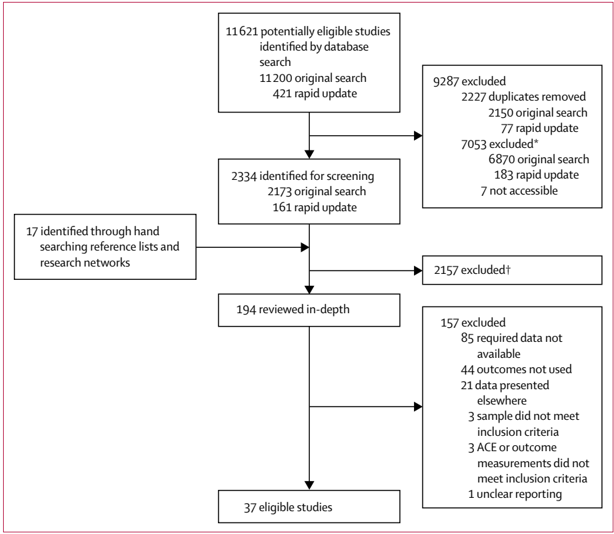
- From 11,621 references, 37 studies were included, providing risk estimates for 23 outcomes and 253,719 participants; most studies were from high-income countries, with nine samples from middle-income countries and none from low-income countries; 26 articles used cross-sectional data and 11 used cohort data, and all used retrospective, self-reported ACEs.
- Pooled ORs with 95% CIs were calculated using a random-effects model in StatsDirect; heterogeneity was assessed with I², publication bias with Begg-Mazumdar and Egger tests and funnel plots where at least ten samples were available, and sensitivity analyses and meta-regression were done in Stata.
Limitations
- The paper states that all included studies used retrospective ACE reports, which could be affected by recall or reporting bias; the number and types of ACEs varied, and summing ACEs does not account for different combinations or for variation in age at or length of exposure; confounding factors varied and some studies included no adjustments; genetic and environmental risks were largely unmeasured.
- The paper states that focusing on community settings likely excluded those with the most complex health problems (eg, homeless populations) and those who had already had ACE-related premature mortality; outcome measurement varied, rarer outcomes were less well covered by population surveys, and the study could only measure associations rather than establish causality.
- Evident from the text: most included samples came from high-income countries, with nine middle-income samples and none from low-income countries; heterogeneity was high for many outcomes; and visual funnel-plot assessment suggested possible missing small studies for smoking and early sexual initiation, although statistical tests for smoking were nonsignificant.
Model-written summary. Check it against the paper before relying on it.
Integrity signals
Registry
Cites
Statistics
Figures
Verification
Claims the paper makes
18 Valid · 0 Not valid · 4 Not checked · 126 Own results and interpretations
The sources with a verdict support this claim; the rest weren’t checked yet, have no full text we could read, or their verdicts aren’t rated yet.
In the paper
“However, five of the seven samples comprised students aged 18-25; 13 pooling of the remaining two samples 8,18 resulted in an OR of 12·53 (6·71-23·37; appendix).”
What the sources say
- Not checked — no full text of the sourcecites [8] 8 Ramiro LS, Madrid BJ, Brown DW. Adverse childhood experiences (ACE) and health-risk behaviors among adults in a developing country setting. Child Abuse Negl 2010; 34: 842-55. source
- Supportedcites [18] 18 Dube SR, Felitti VJ, Dong M, Giles WH, Anda RF. The impact of adverse childhood experiences on health problems: evidence from four birth cohorts dating back to 1900. Prev Med 2003; 37: 268-77 . source
The citation follows “the remaining two samples,” identifying studies used in the citing authors’ pooling rather than attributing the pooled estimate to either study. The cited paper’s Abstract describes a study of 17,337 adult HMO members that examined suicide attempts; its Methods identify the population as adult Kaiser Health Plan members. The OR of 12.53 is presented as the citing authors’ pooled result, not a result attributed to this source. (LLM, conf=0.85)
plainstates an associationn = 2- Asserted: passes — The authors put it forward as true.
- Checkable: passes — It can be checked against evidence.
- Load-bearing: unclear — It is unclear whether the paper’s conclusions depend on it.
- Based: passes — The paper gives a reason why it holds.
Every source the paper cites for this claim was checked and supports it.
In the paper
“However, five of the seven samples comprised students aged 18-25; 13 pooling of the remaining two samples 8,18 resulted in an OR of 12·53 (6·71-23·37; appendix).”
What the sources say
- Supportedcites [13] 13 Bellis MA, Hughes K, Leckenby N, et al. Adverse childhood experiences and associations with health-harming behaviours in young adults: surveys in eight eastern European countries. Bull World Health Organ 2014; 92: 641-55. source
The Attempted suicide section says respondents in seven of the eight countries were asked about suicide attempts. The Methods describe classroom surveys of students and state that the multi-study analyses were limited to respondents aged 18–25, supporting this paper's inclusion among the student samples described in the citing sentence. (LLM, conf=0.90)
plainn = 5- Asserted: passes — The authors put it forward as true.
- Checkable: passes — It can be checked against evidence.
- Load-bearing: unclear — It is unclear whether the paper’s conclusions depend on it.
- Based: passes — The paper gives a reason why it holds.
- Supported
The sources with a verdict support this claim; the rest weren’t checked yet, have no full text we could read, or their verdicts aren’t rated yet.
In the paper
“Supported by international work to standardise measurement of ACEs and their effects on health, these findings have since been replicated in studies from low-income and middle-income 7,8 and high-income 2,9 countries.”
What the sources say
- Not checked — no full text of the sourcecites [7] 7 Almuneef M, Qayad M, Aleissa M, Albuhairan F. Adverse childhood experiences, chronic diseases, and risky health behaviors in Saudi Arabian adults: a pilot study. Child Abuse Negl 2014; 38: 1787-93. source
- Not checked — no full text of the sourcecites [8] 8 Ramiro LS, Madrid BJ, Brown DW. Adverse childhood experiences (ACE) and health-risk behaviors among adults in a developing country setting. Child Abuse Negl 2010; 34: 842-55. source
- Supportedcites [2] 2 Bellis MA, Hughes K, Leckenby N, Hardcastle KA, Perkins C, Lowey H. Measuring mortality and the burden of adult disease associated with adverse childhood experiences in England: a national survey. J Public Health 2015; 37: 445-54. source
The citation to this paper supports the high-income-country part of the sentence: its English national survey found a strong association between ACEs and adult morbidity and premature mortality. The low- and middle-income-country studies are attributed to other citations. The decisive passage is in “What this study adds”; no page number is supplied in our copy. (LLM, conf=0.90)
- Supportedcites [9] 9 Bellis MA, Hughes K, Leckenby N, Perkins C, Lowey H. National household survey of adverse childhood experiences and their relationship with resilience to health-harming behaviors in England. BMC Med 2014; 12: 72. source
Citation 9 is attached to the high-income-country portion of the sentence. The Methods describe a national household survey in England, and the Results report that adverse childhood experiences were associated with multiple health-harming behaviors after adjustment for deprivation and other demographics. The indexed copy does not provide page numbers. (LLM, conf=0.91)
plainstates an association- Asserted: passes — The authors put it forward as true.
- Checkable: passes — It can be checked against evidence.
- Load-bearing: unclear — It is unclear whether the paper’s conclusions depend on it.
- Based: passes — The paper gives a reason why it holds.
The cited sources support only part of this claim — read each source’s verdict below.
In the paper
“For teenage pregnancy, four studies 9,33-35 had measured unintended teenage pregnancy and these studies reported higher estimates than did those measuring any teenage pregnancy 8,14,21 (appendix).”
What the sources say
- Supportedcites [9] 9 Bellis MA, Hughes K, Leckenby N, Perkins C, Lowey H. National household survey of adverse childhood experiences and their relationship with resilience to health-harming behaviors in England. BMC Med 2014; 12: 72. source
The paper is one of the studies identified in the citing sentence as measuring unintended teenage pregnancy. Its Results report an adjusted odds ratio of 5.86 for that outcome among respondents with four or more ACEs versus none. The comparison with studies measuring any teenage pregnancy is the citing authors’ cross-study synthesis, not a comparison attributed to this individual paper. (LLM, conf=0.88)
- Not checked — no full text of the sourcecites [33] 33 Bellis MA, Lowey H, Leckenby N, Hughes K, Harrison D. Adverse childhood experiences: retrospective study to determine their impact on adult health behaviours and health outcomes in a UK population. J Public Health 2014; 36: 81-91. source
- Partly supportedcites [34] 34 Bellis MA, Ashton K, Hughes K, Ford K, Bishop J, Paranjothy S. Adverse childhood experiences and their impact on health-harming behaviours in the Welsh adult population. Cardiff: Public Health Wales, 2015. sourceExperimental — accuracy not yet measured
The section ‘ACEs and their association with unintended teenage pregnancy’ reports an estimate for unintended teenage pregnancy, so this paper supports its identification as a study measuring that outcome. It does not compare its estimate with studies measuring any teenage pregnancy or establish that four studies reported higher estimates. (LLM, conf=0.83)
- Not matchedcites [35] 35 Ford K, Butler N, Hughes K, Quigg Z, Bellis MA. Adverse childhood experiences (ACEs) in Hertfordshire, Luton and Northamptonshire. Liverpool: Liverpool John Moores University, 2016.
Its entry has no title and year that we can search by.
- Not checked — no full text of the sourcecites [8] 8 Ramiro LS, Madrid BJ, Brown DW. Adverse childhood experiences (ACE) and health-risk behaviors among adults in a developing country setting. Child Abuse Negl 2010; 34: 842-55. source
- Not checked yetcites [14] 14 Anda RF, Chapman DP, Felitti VJ, et al. Adverse childhood experiences and risk of paternity in teen pregnancy. Obstet Gynecol 2002; 100: 37-45. source
Checked before — its earlier verdict is held back until a new check runs.
- Not checked — no full text of the sourcecites [21] 21 Hillis SD, Anda RF, Dube SR, Felitti VJ, Marchbanks PA, Marks JS. The association between adverse childhood experiences and adolescent pregnancy, long-term psychosocial consequences, and fetal death. Pediatrics 2004; 113: 320-27 . source
plainstates an association- Asserted: passes — The authors put it forward as true.
- Checkable: passes — It can be checked against evidence.
- Load-bearing: unclear — It is unclear whether the paper’s conclusions depend on it.
- Based: passes — The paper gives a reason why it holds.
- Supported
Every source the paper cites for this claim was checked and supports it.
In the paper
“However, our criteria also meant that studies were excluded because of alternative data analysis methods (eg, analysis of the World Mental Health Surveys 51 ).”
What the sources say
- Supportedcites [51] 51 Kessler RC, McLaughlin KA, Green JG, et al. Childhood adversities and adult psychopathology in the WHO World Mental Health Surveys. Br J Psychiatry 2010; 97: 378-85. source
The Analysis methods section identifies this paper as an analysis of the World Mental Health Surveys and describes its discrete-time survival analysis using person-years. The statement that the citing review excluded it under its own criteria is the citing authors’ decision, not a claim the source needs to make. (LLM, conf=0.88)
plainstates a cause- Asserted: passes — The authors put it forward as true.
- Checkable: passes — It can be checked against evidence.
- Load-bearing: unclear — It is unclear whether the paper’s conclusions depend on it.
- Based: passes — The paper gives a reason why it holds.
- Supported
53 more claims · 2 with their cited sources checked
Create a free account to see all 148 claims and to verify the 1 reference still open.
- It may state two separate claims as one. 44
- Probably not a substantial claim. 27
- The quote only partly states this claim. 31
Claims other papers make about this one
Each is checked against this paper’s own text: does it say what the citing paper says it does?
The source backs part of the claim, not all of it — or backs it for a different population, condition or comparison.
In the citing paper
“Early adverse life experiences, negative affectivity, neuroticism, depression, and anxiety have been identified as psycho logical predisposing conditions for persistent physical symptoms”
From Persistent physical symptoms: definition, genesis, and management (2024) · cites this paper as [64]
Experimental — accuracy not yet measuredThe source backs part of the claim, not all of it — or backs it for a different population, condition or comparison.
In the citing paper
“The impact of childhood abuse, neglect, and violence exposure on adult physical and emotional health and behaviors is significant and well documented”
From Intergenerational effects of childhood maltreatment: A systematic review of the parenting practices of adult survivors of childhood abuse, neglect, and violence. (2020) · cites this paper as Hughes et al., 2017
Experimental — accuracy not yet measuredThe source backs part of the claim, not all of it — or backs it for a different population, condition or comparison.
In the citing paper
“Early institutional rearing is associated with adverse biological and health outcomes in later life, including accelerated cellular aging as measured by telomere length.”
From Telomere trajectories from early adolescence to adulthood following early institutionalization: Protective effects of foster care in the Bucharest Early Intervention Project (2026) · cites this paper as Hughes et al., 2017
Experimental — accuracy not yet measuredThe source backs part of the claim, not all of it — or backs it for a different population, condition or comparison.
In the citing paper
“Individuals exposed to early life adversity are at increased risk of developing a broad spectrum of age-related illnesses at a young age, resulting in shorter health span, referring to the period of life free from chronic disease (Chandan et al., 2020; Hughes et al., 2017).”
From Telomere trajectories from early adolescence to adulthood following early institutionalization: Protective effects of foster care in the Bucharest Early Intervention Project (2026) · cites this paper as Hughes et al., 2017
Experimental — accuracy not yet measuredThe source backs part of the claim, not all of it — or backs it for a different population, condition or comparison.
In the citing paper
“This aligns with findings that ACEs are linked not only with SUD onset, but also with broader emotional and interpersonal dysregulation [4, 6].”
From The link of adverse childhood experiences and attachment to maladaptive personality traits in adults diagnosed with substance use disorder (2025) · cites this paper as [4]
Experimental — accuracy not yet measured
7 more claims about this paper
Create a free account to see every claim other papers make about this one.
Self-check
Percentages, sums and reported differences re-computed from the paper’s own numbers.
Each contradiction between two passages listed here was confirmed by an independent check.
Rated minor: it would not touch a result — a value no result rests on, a p-value that stays on the same side of the significance level, or a conflict that is clerical, resolved elsewhere in the paper, or outside its own findings.
In the paper
§ Summary
“respiratory disease (ORs of two to three)”
§ Discussion
“| Respiratory disease | 3·05 (2·47-3·77)”
Citations
Cites
Felitti, V. J., Anda, R. F., Nordenberg, D., Williamson, D. F., Spitz, A. M., Edwards, V., Koss, M. P., & Marks, J. S. (1998) · American Journal of Preventive Medicine · doi:10.1016/s0749-3797(98)00017-8 · Cited by 18,943
Global status report on noncommunicable diseases 2010.
Alwan, A. (2011) · Cited by 8,494
Forouzanfar, M. H., Afshin, A., Alexander, L. T., Anderson, H. R., Bhutta, Z. A., Biryukov, S., Brauer, M., Burnett, R., Cercy, K., Charlson, F. J., et al. (2016) · The Lancet · doi:10.1016/s0140-6736(16)31679-8 · Cited by 7,698
Wang, H., Naghavi, M., Allen, C., Barber, R. M., Bhutta, Z. A., Carter, A., Casey, D. C., Charlson, F. J., Chen, A. Z., Coates, M. M., et al. (2016) · The Lancet · doi:10.1016/s0140-6736(16)31012-1 · Cited by 6,596
Anda, R. F., Felitti, V. J., Bremner, J. D., Walker, J. D., Whitfield, C., Perry, B. D., Dube, S. R., & Giles, W. H. (2006) · European archives of psychiatry and clinical neuroscience · doi:10.1007/s00406-005-0624-4 · Cited by 4,292
Norman, R. E., Byambaa, M., De, R., Butchart, A., Scott, J., & Vos, T. (2012) · PLoS Medicine · doi:10.1371/journal.pmed.1001349 · Cited by 3,387
Self-citationValidity of adult retrospective reports of adverse childhood experiences: review of the evidence
Hardt, J., & Rutter, M. (2004) · Journal of Child Psychology and Psychiatry · doi:10.1111/j.1469-7610.2004.00218.x · Cited by 2,827
Childhood adversities and adult psychopathology in the WHO World Mental Health Surveys
Kessler, R. C., McLaughlin, K. A., Green, J. G., Gruber, M. J., Sampson, N. A., Zaslavsky, A. M., Aguilar-Gaxiola, S., Alhamzawi, A. O., Alonso, J., Angermeyer, M., et al. (2010) · British Journal of Psychiatry · doi:10.1192/bjp.bp.110.080499 · Cited by 2,640
Impact of child sexual abuse: A review of the research.
Browne, A., & Finkelhor, D. (1986) · Psychological Bulletin · doi:10.1037/0033-2909.99.1.66 · Cited by 2,590
Adverse childhood experiences, allostasis, allostatic load and age-related disease
Danese, A., & McEwen, B. S. (2012) · Physiology & Behavior · doi:10.1016/j.physbeh.2011.08.019 · Cited by 2,140
Cited by
Items 2,101–2,200 of 5,221
Robson, E., Norris, T., Hamer, M., Costa, S., Hardy, R., & Johnson, W. (2021) · Psychoneuroendocrinology · doi:10.1016/j.psyneuen.2021.105362 · Cited by 8
“…are linked to increased risk for obesity and related non-communicable diseases (i.e., ischemic heart disease and type 2 diabetes mellitus (T2DM) (Hughes et al., 2017) and increased risk of mortality (Rod et al., 2020). o A recent paper from our group demonstrated that the relationship between…”
BackgroundKotah, J. M., Hoeijmakers, L., Nutma, E., Lucassen, P. J., & Kőrösi, A. (2021) · Neurobiology of Stress · doi:10.1016/j.ynstr.2021.100379 · Cited by 9
“Individuals with a history of early-life stress (ES) are at increased risk to develop psychopathologies and negative mental health outcomes later in life (Bellis et al., 2019; Ferraro et al., 2016; Hughes et al., 2017; Schafer and Ferraro, 2012).”
Greene, H. M., Maguire‐Jack, K., Malthaner, L., Truelove, A. J., & Leonard, J. C. (2022) · Child Abuse & Neglect · doi:10.1016/j.chiabu.2022.105482 · Cited by 8
Dai, Q., Zhou, Y., Liu, R., Wei, S., Zhou, H., Tian, Y., Xia, L., Cervenka, G., Wu, H. E., Wang, L., et al. (2022) · Suicide and Life-Threatening Behavior · doi:10.1111/sltb.12855 · Cited by 7
Montoro, I., Moreno-Samaniego, L., Mulet, P., Miró, C., Leunda, A., Llaurador-Coll, M., Muntané, G., Teicher, M. H., Vilella, E., & Gutiérrez‐Zotes, A. (2022) · Journal of Interpersonal Violence · doi:10.1177/08862605221106128 · Cited by 13
“…influence health and well-being throughout the lifespan (Felitti, 2002) with devastating consequences for both the short- and long-term health of affected individuals (Hughes et al., 2017), resulting in substantial and avoidable health-care costs throughout the life course (Bellis et al., 2017).”
BackgroundStalgaitis, C. A., Jordan, J. W., Djakaria, M., Saggese, D. J., & Bruce, H. R. (2022) · Frontiers in Public Health · doi:10.3389/fpubh.2022.871864 · Cited by 8
Gender differences in progression to crack-cocaine use and the role of sexual and physical violence
Rebelatto, F. P., Ornell, F. R., Roglio, V. S., Sanvicente‐Vieira, B., Grassi‐Oliveira, R., Pechansky, F., Kessler, F. H. P., Schuch, J. B., & DIEMEN, L. V. (2022) · Brazilian Journal of Psychiatry · doi:10.47626/1516-4446-2021-2248 · Cited by 10
“10,27 Also, violent experiences – especially those earlier in life – arise as an impactful aspect associated with susceptibility to several psychiatric disorders, 16 and men and women may respond to such events differently, with distinct repercussions.”
Zhu, F., Zhu, G., Jia, B., Wang, P., Zhao, T., Ma, Y., & Dong, B. (2022) · Children · doi:10.3390/children9081201 · Cited by 7
“These results were in line with the studies on the relationship between family environment and adolescents’ cognition and behavior [26,27].”
ResultExperiences of Trauma-Informed Care in a Family Drug Treatment Court
Tach, L., Morrissey, M. B., Day, E., Vescia, F., & Mihalec-Adkins, B. P. (2022) · Social Service Review · doi:10.1086/721234 · Cited by 9
Adverse adult experiences and health outcomes: Racial and ethnic differences in a low‐income sample
Mersky, J. P., Lee, C. P., & Janczewski, C. E. (2022) · Stress and Health · doi:10.1002/smi.3212 · Cited by 9
de Waal, M. M., Lok, A., van Zuiden, M., Galenkamp, H., & Goudriaan, A. E. (2022) · Epidemiology and Psychiatric Sciences · doi:10.1017/s2045796022000695 · Cited by 8
“Numerous studies have identified the harmful effects of adverse childhood experiences, such as child maltreatment, on adult physical and mental health and problematic substance use (Kessler et al., 1997; Hughes et al., 2017; Sunley et al., 2020).”
BackgroundDepression and the risk of type 2 diabetes
Lemogne, C., & Chauvet‐Gélinier, J. (2022) · Journal of Psychosomatic Research · doi:10.1016/j.jpsychores.2022.111116 · Cited by 8
Lorenzo, F. D., Barge, L., Thackeray, L. A., Peter, S., & Vainieri, I. (2023) · Journal of Child Psychotherapy · doi:10.1080/0075417x.2022.2129733 · Cited by 7
“…and Wales (DfE, 2019), and early abuse is associated with an increased risk of developing mental health difficulties, physical health conditions and neurocognitive impairments throughout the lifespan (Hughes et al., 2017; Kavanaugh et al., 2016; McCrory et al., 2017; Petruccelli et al., 2019).”
BackgroundHartwell, M. L., Hendrix-Dicken, A., Terry, R. M., Schiffmacher, S., Conway, L., & Croff, J. M. (2023) · Journal of Osteopathic Medicine · doi:10.1515/jom-2022-0221 · Cited by 8
“…research indicating four or more ACEs as the high-risk threshold for population-level disparities in comorbid diseases and health outcomes including, but not limited to, pulmonary disease, cardiovascular disease, cancer, depression, substance use, and suicide [18], and disrupted education [12].”
Salmon, S., Pappas, K. V., Taillieu, T., Stewart-Tufescu, A., Sareen, J., MacMillan, H. L., Tonmyr, L., Brownell, M. D., Nickel, N. C., & Afifi, T. O. (2023) · International Journal of Mental Health and Addiction · doi:10.1007/s11469-023-01062-6 · Cited by 7
“…illness are risk factors for many harmful outcomes across the lifes - pan (e.g., Copeland et al., 2013; Copeland et al., 2015; Erskine et al., 2015; Hughes et al., 2017; Merrick et al., 2017; Moore et al., 2017 ), including substance use (Afifi et al., 2020a, b; Duke, 2018; Fortier et al., 2022;…”
Pediatric Primary-Care Integrated Behavioral Health
Arrojo, M. J., Bromberg, J., Walter, H. J., & Vernacchio, L. (2023) · Pediatric Clinics of North America · doi:10.1016/j.pcl.2023.04.004 · Cited by 13
Chang, R., Li, C., Wei, M., Jiang, Y., & Zhang, J. (2023) · Child Care Health and Development · doi:10.1111/cch.13145 · Cited by 15
Nguyen, K. A., MYERS, B. J., Abrahams, N., Jewkes, R. K., Mhlongo, S., Seedat, S., Lombard, C. J., García‐Moreno, C., Chirwa, E. D., Kengne, A. P., et al. (2023) · Substance Abuse Treatment Prevention and Policy · doi:10.1186/s13011-023-00549-8 · Cited by 12
“Our finding of significant associations between exposure to multiple CM types and alcohol misuse is in keeping with those of a systematic review that showed greater odds of problem alcohol use among participants with multiple adverse childhood experiences (≥ 4 types) [43].”
ResultHolleman, A., Upenieks, L., & Eagle, D. E. (2023) · Journal of Psychology and Theology · doi:10.1177/00916471231206361 · Cited by 9
“…suicidality, alcoholism, substance use disorder, and low life satisfaction (Brodsky & Stanley, 2008; Chapman et al., 2004; Danese et al., 2009; Dasgupta et al., 2018; Dube et al., 2001; Felitti et al., 1998; Hughes et al., 2017; Merrick et al., 2017; Pilowsky et al., 2009; Sareen et al., 2013).”
BackgroundLansing, A. E., Park, J., & Beck, A. N. (2023) · Journal of Traumatic Stress · doi:10.1002/jts.22981 · Cited by 9
Using self-reported health as a social determinants of health outcome: a scoping review of reviews
Wind, K., Poland, B. D., HakemZadeh, F., Jackson, S. F., TOMLINSON, G. A., & Jadad, A. R. (2023) · Health Promotion International · doi:10.1093/heapro/daad165 · Cited by 12
Role of Adverse Childhood Experiences in the Onset of Overweight/Obesity
Koball, A. M., Ames, G. E., & Grothe, K. B. (2024) · Current Obesity Reports · doi:10.1007/s13679-024-00563-2 · Cited by 7
“Another large-scale meta-analysis documented a fourfold increase in the experience of depression and a threefold increase in anxiety [5].”
InfluentialTaouk, Y., LaMontagne, A. D., Spittal, M. J., & Milner, A. J. (2020) · Occupational and Environmental Medicine · doi:10.1136/oemed-2019-106001 · Cited by 7
Condon, L., Driscoll, T., Merrell, J. A., Storey, M., Thomas, A., Mansel, B., & Snelgrove, S. R. (2020) · BMC Health Services Research · doi:10.1186/s12913-020-5015-z · Cited by 15
“It is increasingly recognised that adverse childhood experiences (ACEs) have an impact on children’s health and wellbeing throughout the life course [6].”
BackgroundRelationship Between Adverse Childhood Experiences and the Risk of Lifetime Suicide Attempts
Kim, J., & Son, S. (2020) · Korean Journal of Child Studies · doi:10.5723/kjcs.2020.41.2.27 · Cited by 7
“(2017)이 아동기 역경경험의 누적에 따른 부정적 영향에 대하여 37개 연 구에 포함된 총 253,719명에 대한 체계적 문헌고찰 및 메타분석 결과 최소 4개 이상 경험한 대상자들의 자살경향성 등의 위험 이 확연히 증가함을 검증하였다(Hughes et al., 2017).”
Brown, B. J. (2019) · Journal of issues in intercollegiate athletics · Cited by 15
Tenuta, F., Bartolo, M. G., Diano, D., & Costabile, A. (2020) · MALTRATTAMENTO E ABUSO ALL INFANZIA · doi:10.3280/mal2020-002005 · Cited by 7
Nuttall, D., Rea, D., Bennett, V., Hollén, L., Mullen, S., Maguire, S., Emond, A. M., Kemp, A., & Deave, T. (2020) · Child Abuse Review · doi:10.1002/car.2641 · Cited by 8
Louw, J. G., van Heerden, A. C., Olivier, L., Lambrechts, T., Broodryk, M., Bunge, L., Vosloo, M., & Tomlinson, M. (2021) · JMIR Formative Research · doi:10.2196/20658 · Cited by 8
Syer, S., Clarke, M. C., Healy, C., O’Donnell, L., Cole, J. C., Cannon, M. D., & McKay, M. T. (2021) · Addictive Behaviors · doi:10.1016/j.addbeh.2021.106936 · Cited by 9
Concurrent Childhood Experiences Impact Underage Substance Use
Broadbent, E., Miller, J., Cheung, A., Rollins, E. M., Novilla, L. K. B., Stanfill, M., & Crandall, A. (2021) · Child Maltreatment · doi:10.1177/10775595211012480 · Cited by 7
Kalla, C., Goltser‐Dubner, T., Pevzner, D., Canetti, L., Mirman, A., Ben-Yehuda, A., Itzhar, N., Benarroch, F., Shalev, A., Giesser, R., et al. (2021) · Molecular Psychiatry · doi:10.1038/s41380-021-01107-z · Cited by 9
“focus on persisting health burden that follows severe CA levels [4], recent interest has extended to study the impact of milder CA levels [6], and the potential of CA levels that do not overwhelm coping abilities to induce post-traumatic growth and resilience [7–9].”
BackgroundChildhood Abuse–Related Weight Gain: An Investigation of Potential Resilience Factors
Mason, S. M., Frazier, P. A., Renner, L. M., Fulkerson, J. A., & Rich-Edwards, J. W. (2021) · American Journal of Preventive Medicine · doi:10.1016/j.amepre.2021.07.011 · Cited by 12
The role of adverse childhood experience and social support type in postpartum depression in Turkey
Bahadur, E. İ., Asena, M., Yavuz, Y., Karabulut, E., & Özmert, E. N. (2021) · Journal of obstetrics and gynaecology research · doi:10.1111/jog.15049 · Cited by 8
Wang, D., & Zhao, Y. (2021) · Social Work in Public Health · doi:10.1080/19371918.2021.2013384 · Cited by 8
“Concerning the effect of AFES on physical health, scholars have found that the number of AFEs is a predictor of adult health, meaning that adults with multiple AFEs face higher health risks than individuals without AFEs (Dube, Felitti, Dong, Giles, & Anda, 2003; Hughes et al., 2017).”
BackgroundTravers, Á., McDonagh, T., McLafferty, M., Armour, C., Cunningham, T., & Hansen, M. (2022) · Child Abuse & Neglect · doi:10.1016/j.chiabu.2021.105455 · Cited by 9
Schmidtke, C., Geene, R., Hölling, H., & Lampert, T. (2021) · PubMed Central · doi:10.25646/8865 · Cited by 7
Schnarrs, P. W., Bond, M. A., Stone, A. L., Salcido, R., Young, L. E., Dean, J. A., & Grigsby, T. J. (2022) · AIDS and Behavior · doi:10.1007/s10461-022-03690-w · Cited by 8
Adverse Childhood Experiences, Mindfulness, and Grit in College Students in China
Cheung, S., Tu, B., & Huang, C. (2022) · Frontiers in Psychology · doi:10.3389/fpsyg.2022.891532 · Cited by 10
Trauma-informed care: what does it mean for general practice?
Gopal, D. P., Hunter, M., Butler, D., O’Donovan, D. T., Hart, N. D., Kearney, G. P., & Blane, D. (2023) · British Journal of General Practice · doi:10.3399/bjgp23x732837 · Cited by 11
The Adverse Childhood Experiences of Methamphetamine Users in Aotearoa/New Zealand
Bax, T. M. (2021) · International Journal of Criminology and Sociology · doi:10.6000/1929-4409.2021.10.164 · Cited by 8
“…to childhood adversity and adult health risk behaviours, such as frequent substance use (Felitti et al ., 1998; Dube et al ., 2003; Mersky, Topitzes and Reynolds, 2013); with the greater the number of ACEs the higher the risk of poor health outcomes (Anda et al ., 2006; Hughes et al ., 2017).”
BackgroundRepositioning Social Work Practice in Mental Health in Nova Scotia
Brown, C. G., Johnstone, M., & Ross, N. (2021) · DalSpace (Dalhousie University) · Cited by 11
Roos, L. E., Salisbury, M. R., Penner‐Goeke, L., Cameron, E. E., Protudjer, J. L. P., Giuliano, R. J., Afifi, T. O., & Reynolds, K. (2020) · PsyArXiv (OSF Preprints) · doi:10.31234/osf.io/u5xzw · Cited by 10
Burack, J. A., Bombay, A., & Kirmayer, L. J. (2024) · Transcultural Psychiatry · doi:10.1177/13634615241257349 · Cited by 14
“Although a vast body of work in developmental psychology has been focused on the impact of adverse childhood experiences (ACEs; Hughes et al., 2017), Herman et al. (2024) use the construct of bene fi cial childhood experience (BCE) as an approach to strengths-based research in Indigenous populations…”
Khanal, P., Ståhlberg, T., Upadhyaya, S., Heinonen, E., Ortin-Peralta, A., & Sourander, A. (2025) · Journal of Affective Disorders · doi:10.1016/j.jad.2024.09.046 · Cited by 7
Increased cardiometabolic risk in healthy young adults with early life stress
Kulak, M. J., los Angeles, W. L.-D., Daniels, T. E., Mathis, K. J., Gobin, A. P., Laumann, L. E., Beck, Q., & Tyrka, A. R. (2024) · Psychosomatic Medicine · doi:10.1097/psy.0000000000001273 · Cited by 6
Barger, S. D., & Oláis, J. A. (2024) · AJPM Focus · doi:10.1016/j.focus.2024.100192 · Cited by 6
“Overweight/obesity is weakly linked to cumulative ACE exposure 4,11,16 and was included for discriminant validity.”
BackgroundProtective factors for adverse childhood experiences: Scoping review and evidence gap map.
Valrie, C. R., Kliewer, W. L., Gary, K. W., Cyrus, J. W. W., Hood, K. B., Williams, C. D., Lytle, L., & Shipman-Lacewell, J. R. (2025) · Psychological Trauma Theory Research Practice and Policy · doi:10.1037/tra0001676 · Cited by 10
Andresen, J. B., Graugaard, C. L., Andersson, M., Bahnsen, M. K., & Frisch, M. (2024) · Child Abuse & Neglect · doi:10.1016/j.chiabu.2024.106720 · Cited by 11
Racial/Ethnic Differences in Adverse Childhood Experiences and Mental Health
Canady, M. T., Barrington‐Trimis, J. L., & Harlow, A. F. (2024) · American Journal of Preventive Medicine · doi:10.1016/j.amepre.2024.04.013 · Cited by 10
Disability, Offense, and the Expressivist Objection to Medical Aid in Dying
Kious, B. M. (2024) · The Journal of Medicine and Philosophy A Forum for Bioethics and Philosophy of Medicine · doi:10.1093/jmp/jhae031 · Cited by 6
“This is not even to consider the fact that both acute and chronic distress have been shown to have negative effects on physical health (Hughes et al., 2017; Shonkoff, Slopen, and Williams, 2021); the claim here is that to inflict emotional distress itself is to harm.”
Xu, H., Cai, J., Li, M., Yuan, Y., Qin, H., Liu, J., & Wang, W. (2024) · Stress and Health · doi:10.1002/smi.3511 · Cited by 9
Nichol, M. R., Curley, L. J., & Sime, P. J. (2025) · Behavioral Sciences · doi:10.3390/bs15020161 · Cited by 15
“Case studies comprised one parent and two siblings, allowing the ITT to be demonstrated and sibling resilience to be explored.”
InfluentialAdverse childhood experiences, anger, and violence among justice-involved youth: A network analysis
Li, N., Shelton, M. D., & Grigorenko, E. L. (2025) · Child Abuse & Neglect · doi:10.1016/j.chiabu.2025.107301 · Cited by 7
Chipalo, E., Nkwanzi, V., Odii, I. O., & Malele, K. P. (2025) · Journal of Interpersonal Violence · doi:10.1177/08862605251315774 · Cited by 11
“…mental illness, economic hardship, parental or guardian imprisonment, maltreatment, abuse, neglect, and household dysfunction, which are often categorized into physical, sexual, and emotional violence (Brown et al., 2023; Hughes et al., 2017; Negriff, 2021; Chipalo, 2024; Chipalo & Jeong, 2024).”
den Camp, S. O., Schulkens, J. E. M., van Alphen, S. P. J., Gielkens, E. M. J., Licher, S., van Amelsvoort, T., & Sobczak, S. (2025) · Clinical Gerontologist · doi:10.1080/07317115.2025.2487673 · Cited by 8
“ACEs are associated with poor mental and somatic health outcomes in adults (Hughes et al., 2017), hypothetically mediated by increased risky behaviors (Hughes et al., 2017) and changes in biological systems such as the immune, metabolic, and neuroendocrine system (Coelho et al., 2013; Danese et…”
Association between Adverse Childhood Experiences and Child Homelessness in the United States
Chipalo, E., & Odii, I. O. (2025) · Child Indicators Research · doi:10.1007/s12187-025-10245-7 · Cited by 7
“…reviews have often excluded individuals experiencing homelessness, thus limiting our understanding of ACEs within this vulnerable population (Hughes et al., 2017), particularly among children in the U.S. Additionally, some studies have utilized relatively small sample sizes that are not…”
Akpanekpo, E. I., Butler, T. G., Srasuebkul, P., Trollor, J. N., Kasinathan, J. G., Greenberg, D., Schofield, P. W., Kenny, D. T., Gaskin, C., Simpson, M., et al. (2025) · International Journal of Law and Psychiatry · doi:10.1016/j.ijlp.2025.102099 · Cited by 7
Joffe, A. R., & Robertson, C. M. T. (2025) · Journal of Intensive Care Medicine · doi:10.1177/08850666251340646 · Cited by 9
“21,22 Indeed, ACEs cause increased risk for many adult health outcomes in a dose-dependent manner, causing pervasive harm on health throughout the life-course.”
InfluentialBuabang, E. K., Köster, M., Hogarth, L., & Moors, A. (2025) · Current Addiction Reports · doi:10.1007/s40429-025-00651-w · Cited by 11
“For instance, individuals are more likely to develop substance use problems if they face adverse childhood experiences [90, 91], housing insecurity [92], and neighborhoods with high levels of poverty and violence [80, 93, 94].”
Azagba, S., de Silva, G. S. R., & Ebling, T. (2025) · Journal of Primary Care & Community Health · doi:10.1177/21501319251346102 · Cited by 10
Phillips, A., Williams, R. M., Okuoimose, V., Hiller, R. M., McCrory, E. J. P., Viding, E. M., & Pezzoli, P. (2025) · European Journal of Psychotraumatology · doi:10.1080/20008066.2025.2524922 · Cited by 7
“Furthermore, experiencing interpersonal trauma in both childhood and adulthood, often referred to as ‘revic-timization’ or ‘repeat victimization’, is associated with cumulative detrimental effects upon physical and mental health across the lifespan (Hughes et al., 2017; Schumm et al., 2006).”
Quigg, Z., Bellis, M. A., Butler, N., Wilson, C., Harris, J., Hearne, E., & Millings, M. (2025) · BMC Medicine · doi:10.1186/s12916-025-04459-3 · Cited by 7
Self-citationThe magnitude of multimorbidity in childhood: a global systematic review
Pradhan, S. K., Murmu, J., Nayak, U. S., Sinha, A., van den Akker, M., Hussain, M. A., Sahoo, K. C., Bhattacharya, D., Kshatri, J. S., Satapathy, D. M., et al. (2026) · Systematic Reviews · doi:10.1186/s13643-026-03087-z · Cited by 9
“This disruption can have significant implications for a child’s quality of life, education, social interactions, and future health trajectories [2].”
Associations between Adverse Childhood Experiences and Sexual Risk among Postpartum Women
Thomas, J. L., Lewis, J. B., Ickovics, J. R., & Cunningham, S. D. (2021) · International Journal of Environmental Research and Public Health · doi:10.3390/ijerph18073848 · Cited by 7
“While much research has identified the health consequences of ACEs more broadly [1,2], a burgeoning body of work has focused specifically on documenting the effects of these exposures among perinatal populations, and increasing evidence suggests adverse impacts for maternal and child health.”
BackgroundEmerging into the daylight after Covid: How can clinical psychology be effective?
Bender, M., & Wainwright, T. W. (2021) · Clinical Psychology Forum · doi:10.53841/bpscpf.2021.1.342.53 · Cited by 10
Tabone, J. K., Rishel, C. W., Hartnett, H. P., Szafran, K. F., & Royse, R. (2022) · Journal of Child & Adolescent Trauma · doi:10.1007/s40653-022-00456-3 · Cited by 13
“Moreover, studies reported that persons with a total ACEs score of 4 or higher are at significantly greater risk of suicide attempt (Hughes et al., 2017), and those with a total ACEs score of 6 or higher are at risk of shortening their lifespan by 20 years (Felitti et al., 1998).”
BackgroundUsing network analysis to illuminate the intergenerational transmission of adversity
Hemady, C. L., Speyer, L. G., Kwok, J., Meinck, F., Meléndez‐Torres, G. J., Fry, D. A., Auyeung, B., & Murray, A. L. (2022) · European Journal of Psychotraumatology · doi:10.1080/20008198.2022.2101347 · Cited by 7
“This was done for comparison with previous research that commonly takes this approach to defining ACE exposure (35).”
BackgroundResultInfluentialReeson, M., Polzin, W., Pazderka, H., Agyapong, V. I. O., Greenshaw, A. J., Hnatko, G., Wei, Y., Szymanski, L., & Silverstone, P. H. (2022) · Child Abuse & Neglect · doi:10.1016/j.chiabu.2022.105926 · Cited by 7
The Shadow of Childhood Harm Behind Prison Walls: Theory, Evidence, and Treatment
Wolff, N. (2022) · doi:10.1093/oso/9780197653135.001.0001 · Cited by 10
Nova, F. F., Pfafman, R., Kardys, K., Kerrigan, C., Guha, S., & Pater, J. A. (2022) · Proceedings of the ACM on Human-Computer Interaction · doi:10.1145/3555605 · Cited by 8
The “long arm” of adverse childhood experiences on adult health depreciation in China
Fan, Q., & Chen, H. (2023) · Child Abuse & Neglect · doi:10.1016/j.chiabu.2023.106234 · Cited by 8
Kerr-Davis, A., Hillman, S., Anderson, K., & Cross, R. (2023) · Journal of Child & Adolescent Trauma · doi:10.1007/s40653-023-00559-5 · Cited by 11
“…inter-nalised and embodied are still under investigation (Bucci et al., 2016; van der Kolk, 2005), robust associations have been consistently found between the experience of neglect and abuse and poor emotional and behavioural wellbeing in childhood (Cheong et al., 2017; Hughes et al., 2017).”
BackgroundInfluentialEdwards, K. M., Waterman, E. A., Mullet, N. D., Herrington, R., Cornelius, S., Hopfauf, S. L., Trujillo, P., Wheeler, L. A., & Deusch, A. R. (2023) · Journal of Racial and Ethnic Health Disparities · doi:10.1007/s40615-023-01795-z · Cited by 14
Linking coastal environmental and health observations for human wellbeing
Sandifer, P. A. (2023) · Frontiers in Public Health · doi:10.3389/fpubh.2023.1202118 · Cited by 11
Webster, E. M., Hodges, H. R., & Corcoran, F. (2024) · Early Childhood Education Journal · doi:10.1007/s10643-024-01635-7 · Cited by 10
“However, for the purposes of this analysis, it was included within the overall ACE count to maintain consistency in measurement with other research that measures ACEs as a count variable (Hughes et al., 2017).”
Töpfer, P., Siewert‐Markus, U., Klinger-König, J., Grabe, H. J., Stracke, S., Dörr, M., Völzke, H., Ittermann, T., & Markus, M. R. P. (2024) · Child Abuse & Neglect · doi:10.1016/j.chiabu.2024.106704 · Cited by 8
Drusko, A., Renz, M. P., Schmidt, H., Rosin, M., Simon, J. J., Beiner, E., Charalambides, M., Meyer‐Lindenberg, A., Treede, R., Tost, H., et al. (2024) · Journal of Psychosomatic Research · doi:10.1016/j.jpsychores.2024.111626 · Cited by 6
Adverse childhood experiences screening in healthcare settings: A focus on pediatric primary care
Negriff, S. L., Sidell, M. A., & DiGangi, M. J. (2024) · Child Abuse & Neglect · doi:10.1016/j.chiabu.2024.106709 · Cited by 8
Generational differences in latent classes of exposure to adverse childhood experiences
Hughes, P. M., & Thomas, K. C. (2024) · Children and Youth Services Review · doi:10.1016/j.childyouth.2024.107598 · Cited by 8
Liu, W., Sun, W., Yang, L., Huang, Y., Zhu, S., Xiao, W., Cheng, S., Hao, J., Ying, J., Chen, H., et al. (2024) · BMC Public Health · doi:10.1186/s12889-024-18477-y · Cited by 8
“The number of experienced types of ACEs was used to represent the extent of individuals’ adverse experiences, in which overall ACEs and intra-familial ACEs were further classified into five levels: 0, 1, 2, 3, and ≥ 4, while extra-familial ACEs were classified into 3 levels: 0, 1, and ≥ 2 [12].”
MethodMustika, D., Nishimura, Y., Ueno, S., Tominaga, S., Shimizu, T., Tajiri, N., Jung, C., & Hida, H. (2024) · Frontiers in Nutrition · doi:10.3389/fnut.2024.1356189 · Cited by 8
Codjoe, P. M., Tawiah, N. A., & Alhassan, D. (2024) · Behavioral Sciences · doi:10.3390/bs14060487 · Cited by 8
“These experiences have been linked to a wide array of negative outcomes, such as increased risk of mental health disorders, substance abuse, chronic diseases, and socio-economic challenges [9,10].”
BackgroundSiewert‐Markus, U., Ittermann, T., Klinger-König, J., Grabe, H. J., Stracke, S., Völzke, H., Targher, G., Dörr, M., Markus, M. R. P., & Töpfer, P. (2024) · Journal of Psychosomatic Research · doi:10.1016/j.jpsychores.2024.111829 · Cited by 7
Wang, Y., Liu, F., Li, Y., & Lin, D. (2024) · Current Opinion in Behavioral Sciences · doi:10.1016/j.cobeha.2024.101432 · Cited by 13
Child Maltreatment and Metabolic Syndrome: A Systematic Review
Osode, E., Cook, E., & Tomlin, A. (2024) · Diabetes Metabolic Syndrome and Obesity · doi:10.2147/dmso.s460058 · Cited by 11
A systematic review of non-clinician trauma-based interventions for school-age youth
Avery, F., Kennedy, N., James, M., Jones, H., Amos, R., Bellis, M. A., Hughes, K. E., & Brophy, S. T. (2024) · PLoS ONE · doi:10.1371/journal.pone.0293248 · Cited by 14
“Promoting awareness of ACEs and the potentially traumatic effects of these experiences is increasingly recommended both in healthcare [5] and educational [6] settings.”
BackgroundSelf-citationYang, R., Beck, A. N., & Lansing, A. E. (2024) · Journal of Child Sexual Abuse · doi:10.1080/10538712.2024.2403990 · Cited by 9
“We combined trauma and loss events to capture expanded adverse childhood experiences (E-ACES; Hughes et al., 2017; Lansing et al., 2023) and queried the age, in years, when the first trauma or loss event occurred.”
Schmitz, N., Doorn, K. A., & Békés, V. (2024) · Trauma Care · doi:10.3390/traumacare4030021 · Cited by 6
“Further, the measure itself also has limitations.”
Liu, Q., Peng, S., Jiang, W., He, Y., Lu, C., Wang, W., Li, Y., & Guo, L. (2024) · Journal of Affective Disorders · doi:10.1016/j.jad.2024.10.008 · Cited by 8
Åsen, M. E., Schalinski, I., Lehmann, S., Lydersen, S., von Oertzen, T., & Greger, H. K. (2024) · Child Abuse & Neglect · doi:10.1016/j.chiabu.2024.107074 · Cited by 9
Kim, L. Y., Rose, S. M. S., Mengelkoch, S., Moriarity, D. P., Gassen, J., Alley, J. C., Roos, L. G., Jiang, T., Alavi, A., Thota, D. D., et al. (2024) · Stress · doi:10.1080/10253890.2024.2401788 · Cited by 8
“…revealed that individuals with four or more aces also have an increased risk of problematic drug and alcohol use, violence, and sexual risk taking (hughes et al., 2017). additionally, aces have moderately strong associations with risk for cancer, heart disease, and respiratory disease (hughes et…”
Sharratt, L., & Ridout, N. (2024) · British Journal of Clinical Psychology · doi:10.1111/bjc.12523 · Cited by 10
“Aversive childhood experiences (ACEs), such as abuse, neglect, or unstable home-life, have a negative impact on physical and psychological wellbeing that endures into adult life (Hughes et al., 2017; Kessler et al., 2010; Martins et al., 2011).”
DiMarzio, K., Hare, M. M., Sisitsky, M. D., Cadet, G., Satoba, S., & Parent, J. M. (2024) · Child Abuse & Neglect · doi:10.1016/j.chiabu.2024.107174 · Cited by 9
Chipalo, E. (2024) · International Journal on Child Maltreatment Research Policy and Practice · doi:10.1007/s42448-024-00219-7 · Cited by 9
“This has enabled advanced conversations around the diversity of ACEs and how they can impact everyone differently (Amos et al., 2023; Bruner, 2017; Cave et al., 2020; Hughes et al., 2017).”
Poulsen, H. S., Georgi, R. D., & Niclasen, B. V.-L. (2025) · International Journal of Circumpolar Health · doi:10.1080/22423982.2024.2439122 · Cited by 5
“Studies of Alcohol Use Disorder (AUD) have even suggested a dose–response relationship between the number of different ACE and the risk of developing AUD later in life [1,2,4,5].”
InfluentialCo-occurring Early Adolescent ACEs and Associations With Later Peer Relationships
Wang, J. H., Merrin, G. J., Wang, X., Liu, Q., & Kiefer, S. M. (2025) · Journal of Youth and Adolescence · doi:10.1007/s10964-025-02157-0 · Cited by 7
“ACEs have an enduring impact on human development across life domains, including physical health (e.g., cancer), mental health (e.g., depression), life opportunities (e.g., education), and interpersonal relationships (Hughes et al., 2017; Met-zler et al., 2017).”
Joss, D. (2025) · Mindfulness · doi:10.1007/s12671-025-02585-w · Cited by 7
“…(odds ratio (OR) = 4.40), anxiety (OR = 3.70), illicit drug use (OR = 5.62), alcohol abuse (OR = 5.84), respiratory disease (OR = 3.05), cardiovascular disease (OR = 2.07), liver or digestive diseases (OR = 2.76), cancer (OR = 2.31), and suicidal attempts (OR = 30.14) ( Hughes et al., 2017).”
InfluentialZong, X., Simmons, C., & Yang, L. (2025) · Journal of Affective Disorders · doi:10.1016/j.jad.2025.119649 · Cited by 7
Calling HCI professionals into health research: patient safety and health equity at stake
Gotsis, M., & Jordan‐Marsh, M. (2018) · Panhellenic Conference on Informatics · doi:10.1145/3291533.3291562 · Cited by 8
“In the past decade, health researchers are increasingly using games, virtual reality, and social media in bespoke interventions for changing health behavior [24, 26, 33, 36, 39, 61].”
Background
Metadata
- Authors
- Hughes, K., Bellis, M. A., Hardcastle, K. A., Sethi, D., Butchart, A., Mikton, C., Jones, L., & Dunne, M. P.
- Affiliations
- Bangor University (GB)
- Public Health Wales (GB)
- World Health Organization Regional Office for Europe (DK)
- World Health Organization (CH)
- University of the West of England (GB)
- Liverpool John Moores University (GB)
- Queensland University of Technology (AU)
- Corresponding author
- Bellis, Mark A
- Venue
- The Lancet Public Health
- Publisher
- Elsevier BV
- Published
- 2017-08
- Volume
- 2
- Issue
- 8
- Pages
- e356-e366
- ISSN
- 2468-2667 (ISSN-L)
- OpenAlex
- W2740726397
- Semantic Scholar
- cdd633b48c3e902b5a7a012711d868cf5745c677
- Cited by
- 5,255
- References
- 70
- Citations by year
- 2026: 750 · 2025: 849 · 2024: 817 · 2023: 711 · 2022: 698 · 2021: 626 · 2020: 464 · 2019: 232 · 2018: 97 · 2017: 7
- FWCI
- 33.48
- Type
- journal article
- Language
- en
- Open access
- gold
- doi.org
- Licence
- cc-by-nc-nd
- www.elsevier.com/tdm/userlicense/1.0/ (tdm)
- creativecommons.org/licenses/by-nc-nd/4.0/ (vor)
- Locations
- The Lancet Public Health (publishedVersion, cc-by-nc-nd)
- PubMed (publishedVersion)
- Liverpool John Moores University (acceptedVersion)
- QUT ePrints (Queensland University of Technology) (submittedVersion, cc-by-nc-nd)
- UWE Research Repository (UWE Bristol) (submittedVersion, cc-by-nc-nd)
- DOAJ (DOAJ: Directory of Open Access Journals) (submittedVersion, cc-by-sa)
- Funders
- World Health Organization
- Public Health Wales
- Topics
- Social Sciences › Psychology › Clinical Psychology › Child Abuse and Trauma
- Social Sciences › Sociology and Political Science › Child Welfare and Adoption
- Social Sciences › Health › Intimate Partner and Family Violence
- Keywords
- adverse childhood experiences, child abuse, domestic violence exposure, substance use, sexual health, mental health, violence, physical health, physical activity, weight, resilience
- MeSH terms
- Health Status, Humans, Life Change Events
About these checks
Registry, retraction, Cites and statistics results are computed, not judged, with one exception: a printed reference that no index lists is read once by a model before it counts as a citation error. Claims are extracted by a model and kept only when their quote appears verbatim in the text; each cited source is then checked, with a model’s help, for whether it says what the claim relies on. Those verdicts can be wrong — read the claim’s quote and the cited source before relying on one.
The claim verdicts this report counts are experimental: their accuracy is not yet measured.
A language model drew the claims from the paper on 2026-09-28, under version 3 of the claim definition (prompt extract-v3).
A second model labelled each claim on 2026-09-28 (model jev-1.13-20260917, definition revision gold-guideline-v0.2).
Cited sources are checked with a language model’s help (gpt-6-sol).
Statistics and arithmetic are recomputed, not judged.
Confidence bands are shown only for fields calibrated on our annotated test set. None is calibrated yet, so no band is shown.
What counts as a claim ›How we measure confidence ›How we check this ›
Are you an author, or do you see a problem with this page? Request a review
Data sources
Bibliographic data: Semantic Scholar, OpenAlex, Crossref.
Contains information from the Semantic Scholar Academic Graph Datasets, made available under the ODC Attribution License (ODC-BY 1.0).
Semantic Scholar’s data is described in: Kinney, R., et al. (2023). The Semantic Scholar Open Data Platform. arXiv:2301.10140.
