

The effect of multiple adverse childhood experiences on health: a systematic review and meta-analysis.
Open accessThe DOI matches its Crossref record; 66 of the 70 references it cites were found in a registry or an index; 23 of the 40 sources its claims cite were checked for support.
Abstract
BACKGROUND: A growing body of research identifies the harmful effects that adverse childhood experiences (ACEs; occurring during childhood or adolescence; eg, child maltreatment or exposure to domestic violence) have on health throughout life. Studies have quantified such effects for individual ACEs. However, ACEs frequently co-occur and no synthesis of findings from studies measuring the effect of multiple ACE types has been done. METHODS: In this systematic review and meta-analysis, we searched five electronic databases for cross-sectional, case-control, or cohort studies published up to May 6, 2016, reporting risks of health outcomes, consisting of substance use, sexual health, mental health, weight and physical exercise, violence, and physical health status and conditions, associated with multiple ACEs. We selected articles that presented risk estimates for individuals with at least four ACEs compared with those with none for outcomes with sufficient data for meta-analysis (at least four populations). Included studies also focused on adults aged at least 18 years with a sample size of at least 100. We excluded studies based on high-risk or clinical populations. We extracted data from published reports. We calculated pooled odds ratios (ORs) using a random-effects model. FINDINGS: of >75%) between estimates for almost half of the outcomes. INTERPRETATION: To have multiple ACEs is a major risk factor for many health conditions. The outcomes most strongly associated with multiple ACEs represent ACE risks for the next generation (eg, violence, mental illness, and substance use). To sustain improvements in public health requires a shift in focus to include prevention of ACEs, resilience building, and ACE-informed service provision. The Sustainable Development Goals provide a global platform to reduce ACEs and their life-course effect on health. FUNDING: Public Health Wales.
Overview
CoChat Summary
TL;DR
This systematic review and meta-analysis of 37 studies and 253,719 participants found that adults with at least four adverse childhood experiences (ACEs) had increased odds of all 23 health outcomes compared with those with no ACEs. The strongest associations were for problematic drug use and interpersonal and self-directed violence, while physical inactivity, overweight or obesity, and diabetes showed weaker associations.
Key findings
- Across 37 included studies providing risk estimates for 23 outcomes, 57% of 252,467 participants reported at least one ACE and 13% of 244,979 reported at least four.
- Pooled odds ratios (ORs) were weak or modest for physical inactivity (1·25, 95% CI 1·03–1·52), overweight or obesity (1·39, 1·13–1·71), and diabetes (1·52, 1·23–1·89); moderate for smoking (2·82, 2·38–3·34), heavy alcohol use (2·20, 1·74–2·78), poor self-rated health (2·24, 1·97–2·54), cancer (2·31, 1·82–2·95), cardiovascular disease (2·07, 1·66–2·59), and respiratory disease (3·05, 2·47–3·77).
- Stronger associations included multiple sexual partners (3·64, 3·02–4·40), anxiety (3·70, 2·62–5·22), early sexual initiation (3·72, 2·88–4·80), teenage pregnancy (4·20, 2·98–5·92), low life satisfaction (4·36, 3·72–5·10), depression (4·40, 3·54–5·46), illicit drug use (5·62, 4·46–7·07), problematic alcohol use (5·84, 3·99–8·56), and sexually transmitted infections (5·92, 3·21–10·92).
- The strongest pooled ORs were for violence victimisation (7·51, 5·60–10·08), violence perpetration (8·10, 5·87–11·18), problematic drug use (10·22, 7·62–13·71), and suicide attempt (30·14, 14·73–61·67); considerable heterogeneity (I² >75%) was identified for almost half of outcomes.
Methods
- Systematic review and meta-analysis searching five electronic databases for cross-sectional, case-control, or cohort studies published up to May 6, 2016, reporting health outcomes associated with multiple ACEs; included studies focused predominantly on adults aged at least 18 years, had sample sizes of at least 100, used a cumulative measure of at least four ACEs spanning direct and indirect types, and reported risk estimates for at least four ACEs versus none.
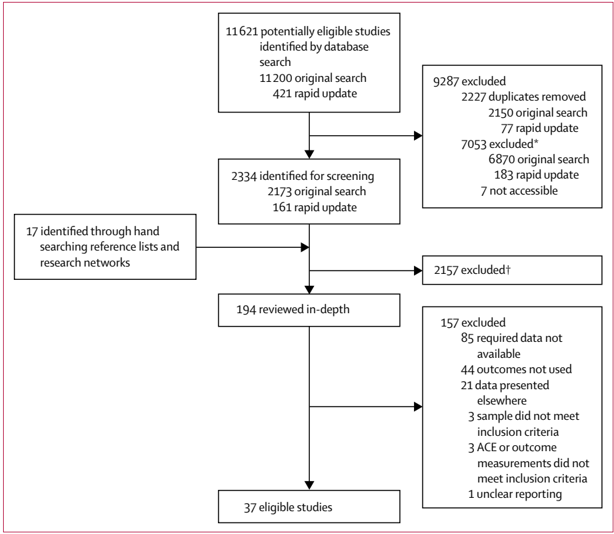
- From 11,621 references, 37 studies were included, providing risk estimates for 23 outcomes and 253,719 participants; most studies were from high-income countries, with nine samples from middle-income countries and none from low-income countries; 26 articles used cross-sectional data and 11 used cohort data, and all used retrospective, self-reported ACEs.
- Pooled ORs with 95% CIs were calculated using a random-effects model in StatsDirect; heterogeneity was assessed with I², publication bias with Begg-Mazumdar and Egger tests and funnel plots where at least ten samples were available, and sensitivity analyses and meta-regression were done in Stata.
Limitations
- The paper states that all included studies used retrospective ACE reports, which could be affected by recall or reporting bias; the number and types of ACEs varied, and summing ACEs does not account for different combinations or for variation in age at or length of exposure; confounding factors varied and some studies included no adjustments; genetic and environmental risks were largely unmeasured.
- The paper states that focusing on community settings likely excluded those with the most complex health problems (eg, homeless populations) and those who had already had ACE-related premature mortality; outcome measurement varied, rarer outcomes were less well covered by population surveys, and the study could only measure associations rather than establish causality.
- Evident from the text: most included samples came from high-income countries, with nine middle-income samples and none from low-income countries; heterogeneity was high for many outcomes; and visual funnel-plot assessment suggested possible missing small studies for smoking and early sexual initiation, although statistical tests for smoking were nonsignificant.
Model-written summary. Check it against the paper before relying on it.
Integrity signals
Registry
Cites
Statistics
Figures
Verification
Claims the paper makes
18 Valid · 0 Not valid · 4 Not checked · 126 Own results and interpretations
The sources with a verdict support this claim; the rest weren’t checked yet, have no full text we could read, or their verdicts aren’t rated yet.
In the paper
“However, five of the seven samples comprised students aged 18-25; 13 pooling of the remaining two samples 8,18 resulted in an OR of 12·53 (6·71-23·37; appendix).”
What the sources say
- Not checked — no full text of the sourcecites [8] 8 Ramiro LS, Madrid BJ, Brown DW. Adverse childhood experiences (ACE) and health-risk behaviors among adults in a developing country setting. Child Abuse Negl 2010; 34: 842-55. source
- Supportedcites [18] 18 Dube SR, Felitti VJ, Dong M, Giles WH, Anda RF. The impact of adverse childhood experiences on health problems: evidence from four birth cohorts dating back to 1900. Prev Med 2003; 37: 268-77 . source
The citation follows “the remaining two samples,” identifying studies used in the citing authors’ pooling rather than attributing the pooled estimate to either study. The cited paper’s Abstract describes a study of 17,337 adult HMO members that examined suicide attempts; its Methods identify the population as adult Kaiser Health Plan members. The OR of 12.53 is presented as the citing authors’ pooled result, not a result attributed to this source. (LLM, conf=0.85)
plainstates an associationn = 2- Asserted: passes — The authors put it forward as true.
- Checkable: passes — It can be checked against evidence.
- Load-bearing: unclear — It is unclear whether the paper’s conclusions depend on it.
- Based: passes — The paper gives a reason why it holds.
Every source the paper cites for this claim was checked and supports it.
In the paper
“However, five of the seven samples comprised students aged 18-25; 13 pooling of the remaining two samples 8,18 resulted in an OR of 12·53 (6·71-23·37; appendix).”
What the sources say
- Supportedcites [13] 13 Bellis MA, Hughes K, Leckenby N, et al. Adverse childhood experiences and associations with health-harming behaviours in young adults: surveys in eight eastern European countries. Bull World Health Organ 2014; 92: 641-55. source
The Attempted suicide section says respondents in seven of the eight countries were asked about suicide attempts. The Methods describe classroom surveys of students and state that the multi-study analyses were limited to respondents aged 18–25, supporting this paper's inclusion among the student samples described in the citing sentence. (LLM, conf=0.90)
plainn = 5- Asserted: passes — The authors put it forward as true.
- Checkable: passes — It can be checked against evidence.
- Load-bearing: unclear — It is unclear whether the paper’s conclusions depend on it.
- Based: passes — The paper gives a reason why it holds.
- Supported
The sources with a verdict support this claim; the rest weren’t checked yet, have no full text we could read, or their verdicts aren’t rated yet.
In the paper
“Supported by international work to standardise measurement of ACEs and their effects on health, these findings have since been replicated in studies from low-income and middle-income 7,8 and high-income 2,9 countries.”
What the sources say
- Not checked — no full text of the sourcecites [7] 7 Almuneef M, Qayad M, Aleissa M, Albuhairan F. Adverse childhood experiences, chronic diseases, and risky health behaviors in Saudi Arabian adults: a pilot study. Child Abuse Negl 2014; 38: 1787-93. source
- Not checked — no full text of the sourcecites [8] 8 Ramiro LS, Madrid BJ, Brown DW. Adverse childhood experiences (ACE) and health-risk behaviors among adults in a developing country setting. Child Abuse Negl 2010; 34: 842-55. source
- Supportedcites [2] 2 Bellis MA, Hughes K, Leckenby N, Hardcastle KA, Perkins C, Lowey H. Measuring mortality and the burden of adult disease associated with adverse childhood experiences in England: a national survey. J Public Health 2015; 37: 445-54. source
The citation to this paper supports the high-income-country part of the sentence: its English national survey found a strong association between ACEs and adult morbidity and premature mortality. The low- and middle-income-country studies are attributed to other citations. The decisive passage is in “What this study adds”; no page number is supplied in our copy. (LLM, conf=0.90)
- Supportedcites [9] 9 Bellis MA, Hughes K, Leckenby N, Perkins C, Lowey H. National household survey of adverse childhood experiences and their relationship with resilience to health-harming behaviors in England. BMC Med 2014; 12: 72. source
Citation 9 is attached to the high-income-country portion of the sentence. The Methods describe a national household survey in England, and the Results report that adverse childhood experiences were associated with multiple health-harming behaviors after adjustment for deprivation and other demographics. The indexed copy does not provide page numbers. (LLM, conf=0.91)
plainstates an association- Asserted: passes — The authors put it forward as true.
- Checkable: passes — It can be checked against evidence.
- Load-bearing: unclear — It is unclear whether the paper’s conclusions depend on it.
- Based: passes — The paper gives a reason why it holds.
The cited sources support only part of this claim — read each source’s verdict below.
In the paper
“For teenage pregnancy, four studies 9,33-35 had measured unintended teenage pregnancy and these studies reported higher estimates than did those measuring any teenage pregnancy 8,14,21 (appendix).”
What the sources say
- Supportedcites [9] 9 Bellis MA, Hughes K, Leckenby N, Perkins C, Lowey H. National household survey of adverse childhood experiences and their relationship with resilience to health-harming behaviors in England. BMC Med 2014; 12: 72. source
The paper is one of the studies identified in the citing sentence as measuring unintended teenage pregnancy. Its Results report an adjusted odds ratio of 5.86 for that outcome among respondents with four or more ACEs versus none. The comparison with studies measuring any teenage pregnancy is the citing authors’ cross-study synthesis, not a comparison attributed to this individual paper. (LLM, conf=0.88)
- Not checked — no full text of the sourcecites [33] 33 Bellis MA, Lowey H, Leckenby N, Hughes K, Harrison D. Adverse childhood experiences: retrospective study to determine their impact on adult health behaviours and health outcomes in a UK population. J Public Health 2014; 36: 81-91. source
- Partly supportedcites [34] 34 Bellis MA, Ashton K, Hughes K, Ford K, Bishop J, Paranjothy S. Adverse childhood experiences and their impact on health-harming behaviours in the Welsh adult population. Cardiff: Public Health Wales, 2015. sourceExperimental — accuracy not yet measured
The section ‘ACEs and their association with unintended teenage pregnancy’ reports an estimate for unintended teenage pregnancy, so this paper supports its identification as a study measuring that outcome. It does not compare its estimate with studies measuring any teenage pregnancy or establish that four studies reported higher estimates. (LLM, conf=0.83)
- Not matchedcites [35] 35 Ford K, Butler N, Hughes K, Quigg Z, Bellis MA. Adverse childhood experiences (ACEs) in Hertfordshire, Luton and Northamptonshire. Liverpool: Liverpool John Moores University, 2016.
Its entry has no title and year that we can search by.
- Not checked — no full text of the sourcecites [8] 8 Ramiro LS, Madrid BJ, Brown DW. Adverse childhood experiences (ACE) and health-risk behaviors among adults in a developing country setting. Child Abuse Negl 2010; 34: 842-55. source
- Not checked yetcites [14] 14 Anda RF, Chapman DP, Felitti VJ, et al. Adverse childhood experiences and risk of paternity in teen pregnancy. Obstet Gynecol 2002; 100: 37-45. source
Checked before — its earlier verdict is held back until a new check runs.
- Not checked — no full text of the sourcecites [21] 21 Hillis SD, Anda RF, Dube SR, Felitti VJ, Marchbanks PA, Marks JS. The association between adverse childhood experiences and adolescent pregnancy, long-term psychosocial consequences, and fetal death. Pediatrics 2004; 113: 320-27 . source
plainstates an association- Asserted: passes — The authors put it forward as true.
- Checkable: passes — It can be checked against evidence.
- Load-bearing: unclear — It is unclear whether the paper’s conclusions depend on it.
- Based: passes — The paper gives a reason why it holds.
- Supported
Every source the paper cites for this claim was checked and supports it.
In the paper
“However, our criteria also meant that studies were excluded because of alternative data analysis methods (eg, analysis of the World Mental Health Surveys 51 ).”
What the sources say
- Supportedcites [51] 51 Kessler RC, McLaughlin KA, Green JG, et al. Childhood adversities and adult psychopathology in the WHO World Mental Health Surveys. Br J Psychiatry 2010; 97: 378-85. source
The Analysis methods section identifies this paper as an analysis of the World Mental Health Surveys and describes its discrete-time survival analysis using person-years. The statement that the citing review excluded it under its own criteria is the citing authors’ decision, not a claim the source needs to make. (LLM, conf=0.88)
plainstates a cause- Asserted: passes — The authors put it forward as true.
- Checkable: passes — It can be checked against evidence.
- Load-bearing: unclear — It is unclear whether the paper’s conclusions depend on it.
- Based: passes — The paper gives a reason why it holds.
- Supported
53 more claims · 2 with their cited sources checked
Create a free account to see all 148 claims and to verify the 1 reference still open.
- It may state two separate claims as one. 44
- Probably not a substantial claim. 27
- The quote only partly states this claim. 31
Claims other papers make about this one
Each is checked against this paper’s own text: does it say what the citing paper says it does?
The source backs part of the claim, not all of it — or backs it for a different population, condition or comparison.
In the citing paper
“Early adverse life experiences, negative affectivity, neuroticism, depression, and anxiety have been identified as psycho logical predisposing conditions for persistent physical symptoms”
From Persistent physical symptoms: definition, genesis, and management (2024) · cites this paper as [64]
Experimental — accuracy not yet measuredThe source backs part of the claim, not all of it — or backs it for a different population, condition or comparison.
In the citing paper
“The impact of childhood abuse, neglect, and violence exposure on adult physical and emotional health and behaviors is significant and well documented”
From Intergenerational effects of childhood maltreatment: A systematic review of the parenting practices of adult survivors of childhood abuse, neglect, and violence. (2020) · cites this paper as Hughes et al., 2017
Experimental — accuracy not yet measuredThe source backs part of the claim, not all of it — or backs it for a different population, condition or comparison.
In the citing paper
“Early institutional rearing is associated with adverse biological and health outcomes in later life, including accelerated cellular aging as measured by telomere length.”
From Telomere trajectories from early adolescence to adulthood following early institutionalization: Protective effects of foster care in the Bucharest Early Intervention Project (2026) · cites this paper as Hughes et al., 2017
Experimental — accuracy not yet measuredThe source backs part of the claim, not all of it — or backs it for a different population, condition or comparison.
In the citing paper
“Individuals exposed to early life adversity are at increased risk of developing a broad spectrum of age-related illnesses at a young age, resulting in shorter health span, referring to the period of life free from chronic disease (Chandan et al., 2020; Hughes et al., 2017).”
From Telomere trajectories from early adolescence to adulthood following early institutionalization: Protective effects of foster care in the Bucharest Early Intervention Project (2026) · cites this paper as Hughes et al., 2017
Experimental — accuracy not yet measuredThe source backs part of the claim, not all of it — or backs it for a different population, condition or comparison.
In the citing paper
“This aligns with findings that ACEs are linked not only with SUD onset, but also with broader emotional and interpersonal dysregulation [4, 6].”
From The link of adverse childhood experiences and attachment to maladaptive personality traits in adults diagnosed with substance use disorder (2025) · cites this paper as [4]
Experimental — accuracy not yet measured
7 more claims about this paper
Create a free account to see every claim other papers make about this one.
Self-check
Percentages, sums and reported differences re-computed from the paper’s own numbers.
Each contradiction between two passages listed here was confirmed by an independent check.
Rated minor: it would not touch a result — a value no result rests on, a p-value that stays on the same side of the significance level, or a conflict that is clerical, resolved elsewhere in the paper, or outside its own findings.
In the paper
§ Summary
“respiratory disease (ORs of two to three)”
§ Discussion
“| Respiratory disease | 3·05 (2·47-3·77)”
Citations
Cites
Felitti, V. J., Anda, R. F., Nordenberg, D., Williamson, D. F., Spitz, A. M., Edwards, V., Koss, M. P., & Marks, J. S. (1998) · American Journal of Preventive Medicine · doi:10.1016/s0749-3797(98)00017-8 · Cited by 18,943
Global status report on noncommunicable diseases 2010.
Alwan, A. (2011) · Cited by 8,494
Forouzanfar, M. H., Afshin, A., Alexander, L. T., Anderson, H. R., Bhutta, Z. A., Biryukov, S., Brauer, M., Burnett, R., Cercy, K., Charlson, F. J., et al. (2016) · The Lancet · doi:10.1016/s0140-6736(16)31679-8 · Cited by 7,698
Wang, H., Naghavi, M., Allen, C., Barber, R. M., Bhutta, Z. A., Carter, A., Casey, D. C., Charlson, F. J., Chen, A. Z., Coates, M. M., et al. (2016) · The Lancet · doi:10.1016/s0140-6736(16)31012-1 · Cited by 6,596
Anda, R. F., Felitti, V. J., Bremner, J. D., Walker, J. D., Whitfield, C., Perry, B. D., Dube, S. R., & Giles, W. H. (2006) · European archives of psychiatry and clinical neuroscience · doi:10.1007/s00406-005-0624-4 · Cited by 4,292
Norman, R. E., Byambaa, M., De, R., Butchart, A., Scott, J., & Vos, T. (2012) · PLoS Medicine · doi:10.1371/journal.pmed.1001349 · Cited by 3,387
Self-citationValidity of adult retrospective reports of adverse childhood experiences: review of the evidence
Hardt, J., & Rutter, M. (2004) · Journal of Child Psychology and Psychiatry · doi:10.1111/j.1469-7610.2004.00218.x · Cited by 2,827
Childhood adversities and adult psychopathology in the WHO World Mental Health Surveys
Kessler, R. C., McLaughlin, K. A., Green, J. G., Gruber, M. J., Sampson, N. A., Zaslavsky, A. M., Aguilar-Gaxiola, S., Alhamzawi, A. O., Alonso, J., Angermeyer, M., et al. (2010) · British Journal of Psychiatry · doi:10.1192/bjp.bp.110.080499 · Cited by 2,640
Impact of child sexual abuse: A review of the research.
Browne, A., & Finkelhor, D. (1986) · Psychological Bulletin · doi:10.1037/0033-2909.99.1.66 · Cited by 2,590
Adverse childhood experiences, allostasis, allostatic load and age-related disease
Danese, A., & McEwen, B. S. (2012) · Physiology & Behavior · doi:10.1016/j.physbeh.2011.08.019 · Cited by 2,140
Cited by
Items 3,301–3,400 of 5,221
Heritability and polygenic load for combined anxiety and depressionPreprint
Tabrizi, F. F., Rosén, J., Grönvall, H., William-Olsson, V. R., Arner, E., Magnusson, P. K. E., Palm, C., Larsson, H., Viktorin, A., Bernhardsson, J., et al. (2024) · medRxiv · doi:10.1101/2024.01.31.24302045 · Cited by 2
Zhang, Z., Wang, X., Qiu, H., Wang, Y., Li, J., Ju, Y., & Luo, Q. (2024) · Research Square · doi:10.21203/rs.3.rs-3909957/v1 · Cited by 2
Mental Health: Morbidity and Impact
Oladeji, B. D., Oladele, O. O., & Gureje, O. (2024) · Elsevier eBooks · doi:10.1016/b978-0-323-99967-0.00188-5 · Cited by 2
Marmet, S., Bötschi, S. I. R., Vetsch, N., Stallmann, L., & Brodbeck, J. (2024) · doi:10.31234/osf.io/hq2vy · Cited by 2
Functional Limitations and Mental Health: Relationship and Well-Being Strategies
Zhang, H., & Chen, S. (2024) · Springer eBooks · doi:10.1007/978-3-031-40858-8_54-1 · Cited by 3
The Hidden Value of Adult Informal Care in EuropePreprint
Costa‐Font, J., & Vilaplana‐Prieto, C. (2024) · SSRN Electronic Journal · doi:10.2139/ssrn.5054305 · Cited by 3
Lashani, E., Fonagy, P., Riedl, D., Kampling, H., Kruse, J., Lampe, A., Engert, V., Montague, P. R., Brähler, E., Fegert, J. M., et al. (2025) · medRxiv · doi:10.1101/2025.06.30.25330584 · Cited by 2
(2020) · doi:10.2196/preprints.22368 · Cited by 2
Kallman, J., Mamey, M. R., Vanderbilt, D. L., Imagawa, K. K., Schonfeld, D. J., & Deavenport-Saman, A. (2025) · Child Psychiatry & Human Development · doi:10.1007/s10578-023-01655-1 · Cited by 1
“Adverse Childhood Experiences (ACEs) include several stressors in childhood which can negatively impact one’s neurodevelopmental, physical, mental, and social-emotional health [1, 2].”
Hong, S.-J., Vu, M. H., Vanderbilt, D., Yin, L., Imagawa, K. K., & Deavenport-Saman, A. (2025) · Journal of Developmental & Behavioral Pediatrics · doi:10.1097/dbp.0000000000001395 · Cited by 1
Lazzaro, G., Didino, D., Fucà, E., Sperandini, V., Falvo, S., Passarini, S., Bergonzini, P., D'Aiello, B., De Rossi, P., De Rose, P., et al. (2025) · Child Abuse & Neglect · doi:10.1016/j.chiabu.2025.107561 · Cited by 1
Designing Retrospective Measures on Childhood for Older African American Adults
Greenfield, E. A. (2019) · The International Journal of Aging and Human Development · doi:10.1177/0091415019887683 · Cited by 1
“For example, a meta-analysis of 37 studies found that exposure to four or more ACEs was associated with heightened risk for many types of health problems, including diabetes, cancer, mental illness, and problematic drug use (Hughes et al., 2017).”
Refugee Children and their Families: The Bigger Picture
Harkensee, C., & Walpole, S. C. (2021) · Springer eBooks · doi:10.1007/978-3-030-74906-4_1 · Cited by 1
Cropp, C., Kuchinke, L., & Streeck-Fischer, A. (2021) · Praxis der Kinderpsychologie und Kinderpsychiatrie · doi:10.13109/prkk.2021.70.6.520 · Cited by 1
McFarlane, L. R., & Hawes, D. J. (2021) · Clinical Psychology & Psychotherapy · doi:10.1002/cpp.2679 · Cited by 2
Posljedice ranog traumatskog iskustva
Kosić, R., Vrančić, L., & Čačić, L. (2022) · Medicina Fluminensis · doi:10.21860/medflum2022_271152 · Cited by 2
Just a Bottle in the Park: Alcohol Use in Vulnerable Children
Alderson, H., & Lingam, R. (2022) · Emerald Group Publishing Limited eBooks · doi:10.1108/978-1-80262-709-120221012 · Cited by 1
Piontek, K., Ittermann, T., Wiesmann, U., Arnold, A., Grabe, H. J., Völzke, H., & Apfelbacher, C. (2022) · Journal of the European Academy of Dermatology and Venereology · doi:10.1111/jdv.18480 · Cited by 1
McKay, M. T., Healy, C., Chambers, D., Dodd, P. C., O’Donnell, L., Cannon, M. D., & Clarke, M. C. (2022) · Assessment · doi:10.1177/10731911221116573 · Cited by 1
“, 2021) and can negatively impact health and well-being into adulthood (Agnew-Blais & Danese, 2016; Anda et al., 2009; Hughes et al., 2017).”
BackgroundObikane, E., Watanabe, K., Nishi, D., & Kawakami, N. (2022) · Pediatrics International · doi:10.1111/ped.15370 · Cited by 1
“15– 18 However, no study has examined the impact of ACEs on victimized children's values, as well as how the impact may differ among different types of ACEs.”
BackgroundKapfhammer, H. (2022) · Springer eBooks · doi:10.1007/978-3-662-65873-4_2 · Cited by 1
Kapfhammer, H. (2022) · Springer eBooks · doi:10.1007/978-3-662-65873-4_1 · Cited by 1
Childhood family risks and mental health of older adults in China: The moderating effect of age
Wang, X. (2023) · Frontiers in Psychology · doi:10.3389/fpsyg.2023.994872 · Cited by 1
“Negative experiences in childhood—physical and psychological alike—are widely acknowledged to have long-arm effects on health long before any symptoms of illness emerge (Hughes et al., 2017; Copeland et al., 2018).”
BackgroundResultInfluentialCoulton, S., Nizalova, O. Y., Pellatt‐Higgins, T., Stevens, A., Hendrie, N., Marchand, C., Vass, R., Deluca, P., Drummond, C., Ferguson, J., et al. (2023) · Public Health Research · doi:10.3310/fkpy6814 · Cited by 3
Peck, A., Hutchinson, M., & Provost, S. (2023) · Frontiers in Child and Adolescent Psychiatry · doi:10.3389/frcha.2023.1074861 · Cited by 16
Napier, T. R., Howell, K. H., Thomsen, K. N., Park, J. E., & Miller‐Graff, L. E. (2023) · International Journal on Child Maltreatment Research Policy and Practice · doi:10.1007/s42448-023-00180-x · Cited by 1
“This measure has been widely used to assess CM and has shown convergent validity (e.g., Hughes et al., 2017; 1 3 Examining the Moderating Effects of Therapy Attendance on… Murphy et al., 2014).”
Use of Metaphor as an Explanation Tool in Adverse Childhood Experiences Simulation Training
Ha, M., Rowe, A., Hendrix, K., Anwar, S., Mang, K., Wen, F. K., Coon, K. A., Bragg, J. E., Foulks, K., Miller‐Cribbs, J., et al. (2023) · The Permanente Journal · doi:10.7812/tpp/22.159 · Cited by 3
Promoting a More Sustainable and Inclusive World: Wellbeing in a World of Crises
Guðjohnsen, R. Þ., Jónsson, Ó. P., & Aðalbjarnardóttir, S. (2023) · Springer international handbooks of education · doi:10.1007/978-3-031-24420-9_15 · Cited by 1
Stevenson, J. (2023) · Springer eBooks · doi:10.1007/978-3-031-45787-6_7 · Cited by 1
Systematic Reviews to Inform Practice, November/December 2023
Harris, N. R., & Howe‐Heyman, A. (2023) · Journal of Midwifery & Women s Health · doi:10.1111/jmwh.13595 · Cited by 1
Udoh, K., Wessel, C. R., Branch, R., Mahler, J., Holland, J., Coleman, B., Alluri, S., Jordan, S., Ahmed, A., Polzin, B., et al. (2023) · The American Surgeon · doi:10.1177/00031348231220595 · Cited by 1
Belastung, Fürsorge und Entwicklung
Zimmermann, J., & Kindler, H. (2023) · Springer eBooks · doi:10.1007/978-3-662-66900-6_12 · Cited by 1
Mental Health Help-Seeking Patterns Among Early Adolescents Across Indicators of Adversity
DuPont‐Reyes, M. J., Datzman, J., Villatoro, A. P., Phelan, J. C., & Link, B. G. (2024) · School Mental Health · doi:10.1007/s12310-023-09628-4 · Cited by 1
“…defined as traumatic, stressful events endured from birth to age seventeen, is conceptualized by types of abuse (e.g., physical, sexual, and/or emotional), homelife circumstances (e.g., household poverty), and neglect (e.g., parental abandonment) (Hughes et al., 2017; Petruccelli et al., 2019).”
Schepan, M. L., Jungmann, T., Kliem, S., Siegert, C., Sandner, M., & Brand, T. (2024) · Frontiers in Health Services · doi:10.3389/frhs.2023.1159976 · Cited by 1
Takemura, Y., Sato, K., Liang, R., Isobe, M., Kondo, N., & Inoue, K. (2024) · BMJ Mental Health · doi:10.1136/bmjment-2023-300859 · Cited by 2
Professional Perspectives on Children’s Health Assets: A Delphi Study
Vidal-Sánchez, M. I., Garlito, P. A. C., & Gasch‐Gallén, À. (2024) · Healthcare · doi:10.3390/healthcare12050506 · Cited by 1
Mika Kivimaki, B., & Batty, G. D. (2024) · The Lancet · doi:10.1016/s0140-6736(24)00458-6 · Cited by 2
Stress from early life to adulthood: Is there a protective role of cognitive control?
Larra, M. F., Gajewski, P. D., Getzmann, S., Wascher, E., & Metzler, Y. A. (2024) · Brain and Cognition · doi:10.1016/j.bandc.2024.106165 · Cited by 2
“This comparably weak correlation might seem surprising given that previous studies suggest that compared to the general population a 2 – 4 fold higher incidence of depression is found in people subjected to early life adversity (Hughes et al., 2017; Scott et al., 2010).”
A validation study of the Colorado Family Support Assessment 2.0
Richmond, M. K., Bayless, S. D., & Haymond, T. M. (2024) · Children and Youth Services Review · doi:10.1016/j.childyouth.2024.107730 · Cited by 1
Childhood Adversities and the ATTACHTM Program’s Influence on Immune Cell Gene Expression
Yu, Z., Cole, S. W., Ross, K. M., Hart, M. J., Anis, L., & Letourneau, N. L. (2024) · International Journal of Environmental Research and Public Health · doi:10.3390/ijerph21060776 · Cited by 2
Estrada‐Prat, X., Estrada, E., Tor, J., Mezzatesta, M., Aranbarri, A., Aizpitarte, A., Butjosa, A., Albiac, N., Fàbrega, M. G. I., Haro, J. M., et al. (2024) · Pediatric Research · doi:10.1038/s41390-024-03364-4 · Cited by 1
Behdinan, T., Truuvert, A. K., Adekunte, A., McCallum, N., Vigod, S. N., Butt, A., Rojas, D., Soklaridis, S., & Ross, D. (2024) · Telemedicine Reports · doi:10.1089/tmr.2024.0020 · Cited by 2
“34”
Adults’ recollections of anger and fear during adolescence amidst interparental conflicts
Groper, G., Mehlhausen-Hassoen, D., & Winstok, Z. (2024) · Journal of Family Trauma Child Custody & Child Development · doi:10.1080/26904586.2024.2380448 · Cited by 1
Alemu, Y., Bautista, E. C., Vinson, S. Y., Ohiomoba, P., Melecio, N., Amare, H., Vivian, J., & Karippara, H. (2024) · Telehealth and Medicine Today · doi:10.30953/thmt.v9.506 · Cited by 3
THE IMPACT OF EARLY CHILDHOOD ADVERSITY ON MENTAL HEALTH OUTCOMES
Alsughier, N. A. (2024) · ASEAN Journal of Psychiatry · doi:10.54615/2231-7805.47360 · Cited by 3
“Adverse Childhood Experiences (ACEs) are linked with adjustments in strain response structures and brain development, which can predispose individuals to despair [16].”
BackgroundYang, F., Lin, J., Chen, R., Gao, C., Cui, M., & Yin, K. (2024) · International Journal of Mental Health Promotion · doi:10.32604/ijmhp.2024.049922 · Cited by 1
Adverse Childhood Experiences in the Post-COVID Era
Sirhan, N. J., Mufarreh, A. J., Lee, Y., Mishreky, C., Hunt, B., Anderson, T. C., & Bailey, B. A. (2024) · Journal of Aggression Maltreatment & Trauma · doi:10.1080/10926771.2024.2404002 · Cited by 1
Mental Disorders Among Terrorists and Mass Murderers: A Comparative Study
Trimbur, M., Witrant, E., & Belet, B. (2024) · Springer eBooks · doi:10.1007/978-3-031-67791-5_10 · Cited by 1
Svensson, M. (2024) · European Journal of Social Work · doi:10.1080/13691457.2024.2405846 · Cited by 1
“Children exposed to domestic violence, substance abuse, or mental illness in the home are one such vulnerable group, with a higher prevalence of negative impacts on their well-being (Hughes et al., 2017; Reupert et al., 2015).”
Blackmon, K., Evans, R., Mohammed, L., Burgen, K. S., Ingraham, E., Punch, B., Isaac, R., Murray, T., Noel, J., Belmar-Roberts, C., et al. (2024) · Journal of the International Neuropsychological Society · doi:10.1017/s1355617724000481 · Cited by 1
“Stressors include malnutrition (Abubakar et al., 2010; Razzaq et al., 2023), poverty (Noble et al., 2015), adverse experiences (Hughes et al., 2017), and infections (Laughton et al., 2013), all contributing to a high burden of neurodevelopmental disorders in low-and middle-income countries (LMICs)…”
Bettale, C. M., Pomales, M., Boy, A., Moran, T. P., Agarwal, M., & Powers, A. D. (2024) · Medical Care · doi:10.1097/mlr.0000000000002065 · Cited by 1
Liu, L., Wu, K. C. H., Cai, A., Xu, A., & Cheung, B. M. Y. (2024) · The British Journal of Psychiatry · doi:10.1192/bjp.2024.133 · Cited by 2
Bissa, M. B., Haley, P. N., Wells, A. C., LaBelle, J. L., Nhem, M. K., Fulp, D. C., & Rioux, C. (2024) · Adolescent Research Review · doi:10.1007/s40894-024-00249-9 · Cited by 4
“Early adversity is a major risk factor for externalizing problems and substance use (Hughes et al., 2017).”
Osibogun, O. I. (2024) · American Journal of Health Promotion · doi:10.1177/08901171241293412 · Cited by 3
“10,44 The causal mechanisms of ACEs are multifaceted, involving policy-related factors such as socioeconomic inequalities, inadequate social support, and community-level stressors.”
InfluentialChildhood Adversity and Engagement in Adulthood: The Role of Attachment as a Mediator
Aquilina, S., Meredith, P. J., Harnett, P. H., & Kerley, L. (2024) · American Journal of Occupational Therapy · doi:10.5014/ajot.2024.050770 · Cited by 2
“CA can have enduring and negative effects on health, well-being, and life opportunities and is associated with poorer academic and vocational outcomes and with higher risks of cancer, suicide, and heart disease (Hughes et al., 2017).”
Victory, E. J., Druskin, L. R., Phillips, S. T., Han, R. C., Jean, A., Keen, K. R., Aman, E., Stokes, J. O., Kirby, J., & McNeil, C. B. (2024) · Child & Youth Care Forum · doi:10.1007/s10566-024-09831-7 · Cited by 3
“…are potentially traumatizing events that children are exposed to, including caregiver substance use and mental illness, abuse, neglect, and separation from caregivers through parental incarceration or displacement from the home (Cronholm et al., 2015; Felitti et al., 1998; Hughes et al., 2017).”
Minelli, A., Meloni, A., Bortolomasi, M., Pisanu, C., Zampieri, E., Congiu, D., Lana, B., Manchia, M., Meattini, M., Paribello, P., et al. (2024) · Neuroscience Applied · doi:10.1016/j.nsa.2024.104095 · Cited by 3
“…and traumatic stress events, have been widely recognized as significant factors associated with poor physical and mental health outcomes, including major depressive disorder (MDD), being linked to a greater risk for treatment-resistant depression (TRD) (Hughes et al., 2017) (Kraus et al., 2019).”
Ruiz-Rodríguez, I., Sosa-Reina, M. D., Ruiz-Zaragoza, D., Vargas-Sánchez, V., Fernández-Martínez, Á., López‐Bueno, R., Morales, C. R., & Villafañe, J. H. (2024) · Healthcare · doi:10.3390/healthcare12212118 · Cited by 1
“This approach avoids oversimplifying the relationship, captures gradual associations more accurately, increases statistical power, and aligns with previous literature that shows cumulative ACEs are linked to worse health outcomes [24].”
ResultColley, D., Seidler, J., Rasch, L., Gahr, B., Küppers, L., Mayatepek, E., & Bock, F. D. (2024) · BMJ Open · doi:10.1136/bmjopen-2023-079537 · Cited by 1
“4–6 9–11 13 However, to our knowledge only few studies have investigated the impact of moderating and/or mediating variables on the relationship between CM and multiple adverse outcomes.”
BackgroundThe Comprehensive Adversity Measure (CAM): A measure of early adversity and its severity
Schlechter, P., Lutz, N. M., Morina, N., Grant, J. E., Löchner, C., Chamberlain, S. R., Wilkinson, P. O., & Fritz, J. (2024) · Child Abuse & Neglect · doi:10.1016/j.chiabu.2024.107117 · Cited by 1
Snook, L., Minhas, S., Nadda, V., Hammond, B., Gokhale, K. M., Taylor, J. S., Bradbury‐Jones, C., Bandyopadhyay, S., Nirantharakumar, K., Adderley, N. J., et al. (2024) · Heliyon · doi:10.1016/j.heliyon.2024.e40493 · Cited by 1
Zhou, Y., Huang, C., Lin, R., Jiang, F., Liu, Y., Qin, G., Li, X., Zhang, Y., & Yu, Y. (2024) · Journal of Affective Disorders · doi:10.1016/j.jad.2024.11.074 · Cited by 3
Ramos, B., Emond, M., Pudelko, A. H., Vaillancourt‐Morel, M., & Daspe, M. (2024) · Journal of Family Violence · doi:10.1007/s10896-024-00788-8 · Cited by 1
“Highlighting the co-occurrence of various forms of abuse and neglect, past research recommends examining cumulative childhood trauma (CCT) for a more comprehensive understanding of victims’ experiences and long-term consequences (Dugal et al., 2020; Hughes et al., 2017).”
Jakubovic, R. J., & Drabick, D. A. G. (2024) · Development and Psychopathology · doi:10.1017/s095457942400124x · Cited by 2
Kersey, B., Thomsen, K. N., Bartelli, D., & Howell, K. (2024) · American Journal of Undergraduate Research · doi:10.33697/ajur.2024.122 · Cited by 2
“2, 3 ACEs have been linked to short-and long-term mental health difficulties, such as behavior problems, depression, and anxiety, 4 as well as physical health problems in youth.”
Birthing parent adverse childhood experiences and risk of atopic diseases in 5-year-old children
Freeman, M., MacKinnon, A., Anselmo, M. A., Tough, S., & Tomfohr‐Madsen, L. M. (2025) · Frontiers in Allergy · doi:10.3389/falgy.2024.1483911 · Cited by 6
Senaratne, D. N. S., Smith, B. H., Hales, T. G., Marryat, L., & Colvin, L. (2025) · BMJ Open · doi:10.1136/bmjopen-2024-091053 · Cited by 1
Choi, C., & Mersky, J. P. (2025) · Children and Youth Services Review · doi:10.1016/j.childyouth.2025.108158 · Cited by 1
Zhang, C., Chen, J., & Lai, Y. (2025) · Child Abuse & Neglect · doi:10.1016/j.chiabu.2025.107292 · Cited by 3
‘Health equity and trauma-informed care: a humanistic approach’
Bonne, S., & Dicker, R. A. (2025) · Trauma Surgery & Acute Care Open · doi:10.1136/tsaco-2024-001719 · Cited by 1
Lin, C.-T., Wang, T., Tsai, T.-Y., Tseng, H., Chen, K. C., Lee, I. H., Chen, P. S., Yang, Y. K., & Lu, R. (2025) · Clinical Psychopharmacology and Neuroscience · doi:10.9758/cpn.24.1248 · Cited by 2
“Childhood adversities are associated with several poor health conditions, including physical inactivity, overweight, diabetes, smoking, poor self-rated health, poor mental health, and problematic alcohol use [19].”
Scott, J., & Babb, K. A. (2025) · Journal of Aggression Maltreatment & Trauma · doi:10.1080/10926771.2025.2468242 · Cited by 2
“In a meta-analysis conducted by Hughes et al. (2017), detrimental outcomes were associated with having multiple ACEs.”
Health professionals' practice experiences of infant mental health
Phillips, S., & Davenport, C. (2025) · Journal of family & child health. · doi:10.12968/jfch.2025.2.2.72 · Cited by 1
Baiden, P., LaBrenz, C. A., & Sellers, C. M. (2025) · Public Health · doi:10.1016/j.puhe.2025.02.013 · Cited by 2
Zhu, S., Liu, N., Wang, Y., Song, H., Tang, K., & Zhang, X. (2025) · Journal of Affective Disorders · doi:10.1016/j.jad.2025.03.067 · Cited by 1
Ramaiya, A., Li, M., Yu, C.-Y., Lulebo, A. M., Pinandari, A. W., Gupta, J., Kaufman, M. R., Sabri, B., Fine, S. L., & Beckwith, S. (2025) · Journal of Interpersonal Violence · doi:10.1177/08862605251324966 · Cited by 1
“Adverse childhood experiences (ACEs), which include child maltreatment, have shown strong associations with sexual risk-taking, mental ill health, alcohol use, and peer/self-directed violence (Hughes et al., 2017).”
Fung, H. W., Yuan, G. F., Liu, C., Ling, H. W.-H., Ross, C. A., Lee, V. W. P., Lam, S. K. K., & Wong, J. Y. H. (2025) · Journal of Interpersonal Violence · doi:10.1177/08862605251325933 · Cited by 2
“…behaviors, such as substance abuse (Halpern et al., 2018; Herron & Venner, 2022; Petruccelli et al., 2019), alcohol misuse (Devries et al., 2014; Hughes et al., 2017; Ogden et al., 2022), gambling (Lane et al., 2016), problematic smartphone use (Geng et al., 2022) and smoking (Taha et al.,…”
Early Childhood Education Interventions for Racially Minoritized Children: A Systematic Review
Iruka, I. U., Morgan, J., & Musa, T. (2025) · Journal of Education · doi:10.1177/00220574251329037 · Cited by 3
“…looking at the impact of ECE on child outcomes (McCoy et al., 2017; van Huizen & Plantenga, 2018), with several showing speci fi c bene fi ts for some subgroups, such as children with two or fewer adverse childhood experiences (Hughes et al., 2017) and emergent bilinguals (Lowe et al., 2021).”
Rahim, R. A., Pilkington, R. M., D’Onise, K., & Lynch, J. (2025) · Journal of Paediatrics and Child Health · doi:10.1111/jpc.70036 · Cited by 1
Benthroldo, R. S., Verly, E., Rezende, L. F. M., Azeredo, C. M., & Marques, E. S. (2025) · Ciência & Saúde Coletiva · doi:10.1590/1413-81232025303.11582023 · Cited by 2
Jones, L., Bellis, M. A., Butler, N., Hughes, K. E., McManus, S., & Quigg, Z. (2025) · BMJ Open · doi:10.1136/bmjopen-2024-091865 · Cited by 2
Self-citationOgundiyun, I., & Katus, L. (2025) · Journal of Child & Adolescent Trauma · doi:10.1007/s40653-025-00704-2 · Cited by 1
“Outcomes associated with ACE exposure appear to exhibit relative consistency across diverse backgrounds (Hughes et al., 2017; Massetti et al., 2020).”
Çağlayan, Ş., Høye, A., Thimm, J. C., Wang, C. E. A., & Grønli, O. (2025) · European Journal of Public Health · doi:10.1093/eurpub/ckaf031 · Cited by 5
Engstrom, A., Moore, M., Jones, K. V., Bulger, E. M., Nehra, D., Russo, J. E., Wang, J., Shoyer, J., & Zatzick, D. (2024) · Injury · doi:10.1016/j.injury.2025.112344 · Cited by 1
Exploring the causal link between childhood maltreatment and asthma: a Mendelian randomization study
Zhang, Z., Wang, Y., Li, J., Ren, H., Wang, X., Qiu, H., Luo, H., Wang, X., Li, J., Hu, R., et al. (2025) · European Journal of Psychotraumatology · doi:10.1080/20008066.2024.2383127 · Cited by 2
“Notably, few studies in existing reviews have examined CM, including abuse and neglect, among these psychological stressors (Hughes et al., 2017; Norman et al., 2012).”
A life course approach to mental health and well-being
Keyes, K. M., & Martínez‐Alés, G. (2025) · Oxford University Press eBooks · doi:10.1093/oso/9780198895961.003.0012 · Cited by 2
Bailey, M., Fairchild, G. F., Hammerton, G., Santos, I. S., Tovo‐Rodrigues, L., Murray, J., Matijasevich, A., & Halligan, S. L. (2025) · Journal of Child Psychology and Psychiatry · doi:10.1111/jcpp.14173 · Cited by 1
Troxel, W., Seelam, R., Perez, L. G., Davis, J. P., & D’Amico, E. J. (2025) · Journal of Community Psychology · doi:10.1002/jcop.70011 · Cited by 2
Girard, C., & Almeida, T. C. (2025) · Crime & Delinquency · doi:10.1177/00111287251335006 · Cited by 5
“ACEs increase the likelihood that a child will engage in SU if they experience at least one of these adverse experiences (Hughes et al., 2017), and the risk of developing SU in adulthood is even higher if the parents have a history of SU (Owais et al., 2021).”
Zhang, M., He, J., Young, J. M., You, J., & Li, J. (2025) · Frontiers in Public Health · doi:10.3389/fpubh.2025.1518607 · Cited by 1
Adverse Childhood Experiences and Cardiovascular Outcomes in Adult Congenital Heart Disease
Harrison, D. J., Mekary, R. A., Vijayakumar, S., Lake, E., Kay, J., Jacobsen, R. M., Londono-Obregon, C., Yeung, E., Kelly, S., Poteet, A., et al. (2025) · JACC Advances · doi:10.1016/j.jacadv.2025.101809 · Cited by 1
Sutin, A. R., Luchetti, M., Stéphan, Y., & Terracciano, A. (2025) · Current Opinion in Psychology · doi:10.1016/j.copsyc.2025.102051 · Cited by 4
Godbout, N., Vaillancourt, S.-E., Ledoux-Labelle, M.-J., Gewirtz‐Meydan, A., Vaillancourt‐Morel, M., Brassard, A., & Hébert, M. (2025) · Child Abuse & Neglect · doi:10.1016/j.chiabu.2025.107485 · Cited by 4
Hermes, M., Wieland, S., & Tesarz, J. (2025) · Der Schmerz · doi:10.1007/s00482-025-00883-9 · Cited by 1
Stoll, N., Kayn, S., Lempp, H. K., & Hatch, S. L. (2025) · International Journal of Qualitative Studies on Health and Well-Being · doi:10.1080/17482631.2025.2507754 · Cited by 7
“…historical trauma, witnessing violence) can have a dose-dependent impact on health behaviours and health, neurodeve-lopment, and social, emotional and cognitive functioning, heightening the risk of mental and physical illness (Centers for Disease Control and Prevention, 2021; Hughes et al., 2017).”
Household dysfunction and child outcomes in the Nordic countries: A bibliometric analysis
Radlick, R. L., Milivinti, A., Rydland, H. T., Lundeberg, I. R., & Askeland, K. G. (2025) · Scandinavian Journal of Public Health · doi:10.1177/14034948251336851 · Cited by 1
“As most ACE research has been conducted in the united states [3,7,22] with no literature studies focusing exclusively on household dysfunction in the nordic region, our analysis aims to address this research gap. given the prevalence of and well-established relationship between childhood…”
Stelson, E., Sorensen, G., Berkman, L. F., Ballou, S., Hashimoto, D. M., Kubzansky, L. D., & Sabbath, E. L. (2025) · Journal of Occupational and Environmental Medicine · doi:10.1097/jom.0000000000003432 · Cited by 1
“20,21 With this body of work, researchers have identified multiple pathways by which trauma and stressor exposure may affect physical health, not only via influences on mental health problems, but also via direct biological effects (e.g., activation of the central nervous system mediated through…”
Hormesis and brain metabolism in aging and neurodegeneration
Pereira, R. M., Albernaz-Mariano, K. A., Jucá, P. M., Juliano, V. A. L., Sampaio, L. L., & Munhoz, C. D. (2025) · Progress in brain research · doi:10.1016/bs.pbr.2025.05.005 · Cited by 1
Pitkänen, J., Sariaslan, A., Bishop, L., & Martikainen, P. (2025) · International Journal of Epidemiology · doi:10.1093/ije/dyaf074 · Cited by 2
Lane, B. L., Millender, E., Harris, R. M., Nowak, A. L., Josiah, N., Hall, C. D. X., Pfeiffer, F., Wong, F. Y., Crusto, C. A., Potts‐Thompson, S., et al. (2025) · Journal of Racial and Ethnic Health Disparities · doi:10.1007/s40615-025-02498-3 · Cited by 1
“Trauma exposure has been linked to an increased risk of depression, post-traumatic stress disorder (PTSD), and other mental health issues [31, 32].”
Metadata
- Authors
- Hughes, K., Bellis, M. A., Hardcastle, K. A., Sethi, D., Butchart, A., Mikton, C., Jones, L., & Dunne, M. P.
- Affiliations
- Bangor University (GB)
- Public Health Wales (GB)
- World Health Organization Regional Office for Europe (DK)
- World Health Organization (CH)
- University of the West of England (GB)
- Liverpool John Moores University (GB)
- Queensland University of Technology (AU)
- Corresponding author
- Bellis, Mark A
- Venue
- The Lancet Public Health
- Publisher
- Elsevier BV
- Published
- 2017-08
- Volume
- 2
- Issue
- 8
- Pages
- e356-e366
- ISSN
- 2468-2667 (ISSN-L)
- OpenAlex
- W2740726397
- Semantic Scholar
- cdd633b48c3e902b5a7a012711d868cf5745c677
- Cited by
- 5,255
- References
- 70
- Citations by year
- 2026: 750 · 2025: 849 · 2024: 817 · 2023: 711 · 2022: 698 · 2021: 626 · 2020: 464 · 2019: 232 · 2018: 97 · 2017: 7
- FWCI
- 33.48
- Type
- journal article
- Language
- en
- Open access
- gold
- doi.org
- Licence
- cc-by-nc-nd
- www.elsevier.com/tdm/userlicense/1.0/ (tdm)
- creativecommons.org/licenses/by-nc-nd/4.0/ (vor)
- Locations
- The Lancet Public Health (publishedVersion, cc-by-nc-nd)
- PubMed (publishedVersion)
- Liverpool John Moores University (acceptedVersion)
- QUT ePrints (Queensland University of Technology) (submittedVersion, cc-by-nc-nd)
- UWE Research Repository (UWE Bristol) (submittedVersion, cc-by-nc-nd)
- DOAJ (DOAJ: Directory of Open Access Journals) (submittedVersion, cc-by-sa)
- Funders
- World Health Organization
- Public Health Wales
- Topics
- Social Sciences › Psychology › Clinical Psychology › Child Abuse and Trauma
- Social Sciences › Sociology and Political Science › Child Welfare and Adoption
- Social Sciences › Health › Intimate Partner and Family Violence
- Keywords
- adverse childhood experiences, child abuse, domestic violence exposure, substance use, sexual health, mental health, violence, physical health, physical activity, weight, resilience
- MeSH terms
- Health Status, Humans, Life Change Events
About these checks
Registry, retraction, Cites and statistics results are computed, not judged, with one exception: a printed reference that no index lists is read once by a model before it counts as a citation error. Claims are extracted by a model and kept only when their quote appears verbatim in the text; each cited source is then checked, with a model’s help, for whether it says what the claim relies on. Those verdicts can be wrong — read the claim’s quote and the cited source before relying on one.
The claim verdicts this report counts are experimental: their accuracy is not yet measured.
A language model drew the claims from the paper on 2026-09-28, under version 3 of the claim definition (prompt extract-v3).
A second model labelled each claim on 2026-09-28 (model jev-1.13-20260917, definition revision gold-guideline-v0.2).
Cited sources are checked with a language model’s help (gpt-6-sol).
Statistics and arithmetic are recomputed, not judged.
Confidence bands are shown only for fields calibrated on our annotated test set. None is calibrated yet, so no band is shown.
What counts as a claim ›How we measure confidence ›How we check this ›
Are you an author, or do you see a problem with this page? Request a review
Data sources
Bibliographic data: Semantic Scholar, OpenAlex, Crossref.
Contains information from the Semantic Scholar Academic Graph Datasets, made available under the ODC Attribution License (ODC-BY 1.0).
Semantic Scholar’s data is described in: Kinney, R., et al. (2023). The Semantic Scholar Open Data Platform. arXiv:2301.10140.
