

The effect of multiple adverse childhood experiences on health: a systematic review and meta-analysis.
Open accessThe DOI matches its Crossref record; 66 of the 70 references it cites were found in a registry or an index; 23 of the 40 sources its claims cite were checked for support.
Abstract
BACKGROUND: A growing body of research identifies the harmful effects that adverse childhood experiences (ACEs; occurring during childhood or adolescence; eg, child maltreatment or exposure to domestic violence) have on health throughout life. Studies have quantified such effects for individual ACEs. However, ACEs frequently co-occur and no synthesis of findings from studies measuring the effect of multiple ACE types has been done. METHODS: In this systematic review and meta-analysis, we searched five electronic databases for cross-sectional, case-control, or cohort studies published up to May 6, 2016, reporting risks of health outcomes, consisting of substance use, sexual health, mental health, weight and physical exercise, violence, and physical health status and conditions, associated with multiple ACEs. We selected articles that presented risk estimates for individuals with at least four ACEs compared with those with none for outcomes with sufficient data for meta-analysis (at least four populations). Included studies also focused on adults aged at least 18 years with a sample size of at least 100. We excluded studies based on high-risk or clinical populations. We extracted data from published reports. We calculated pooled odds ratios (ORs) using a random-effects model. FINDINGS: of >75%) between estimates for almost half of the outcomes. INTERPRETATION: To have multiple ACEs is a major risk factor for many health conditions. The outcomes most strongly associated with multiple ACEs represent ACE risks for the next generation (eg, violence, mental illness, and substance use). To sustain improvements in public health requires a shift in focus to include prevention of ACEs, resilience building, and ACE-informed service provision. The Sustainable Development Goals provide a global platform to reduce ACEs and their life-course effect on health. FUNDING: Public Health Wales.
Overview
CoChat Summary
TL;DR
This systematic review and meta-analysis of 37 studies and 253,719 participants found that adults with at least four adverse childhood experiences (ACEs) had increased odds of all 23 health outcomes compared with those with no ACEs. The strongest associations were for problematic drug use and interpersonal and self-directed violence, while physical inactivity, overweight or obesity, and diabetes showed weaker associations.
Key findings
- Across 37 included studies providing risk estimates for 23 outcomes, 57% of 252,467 participants reported at least one ACE and 13% of 244,979 reported at least four.
- Pooled odds ratios (ORs) were weak or modest for physical inactivity (1·25, 95% CI 1·03–1·52), overweight or obesity (1·39, 1·13–1·71), and diabetes (1·52, 1·23–1·89); moderate for smoking (2·82, 2·38–3·34), heavy alcohol use (2·20, 1·74–2·78), poor self-rated health (2·24, 1·97–2·54), cancer (2·31, 1·82–2·95), cardiovascular disease (2·07, 1·66–2·59), and respiratory disease (3·05, 2·47–3·77).
- Stronger associations included multiple sexual partners (3·64, 3·02–4·40), anxiety (3·70, 2·62–5·22), early sexual initiation (3·72, 2·88–4·80), teenage pregnancy (4·20, 2·98–5·92), low life satisfaction (4·36, 3·72–5·10), depression (4·40, 3·54–5·46), illicit drug use (5·62, 4·46–7·07), problematic alcohol use (5·84, 3·99–8·56), and sexually transmitted infections (5·92, 3·21–10·92).
- The strongest pooled ORs were for violence victimisation (7·51, 5·60–10·08), violence perpetration (8·10, 5·87–11·18), problematic drug use (10·22, 7·62–13·71), and suicide attempt (30·14, 14·73–61·67); considerable heterogeneity (I² >75%) was identified for almost half of outcomes.
Methods
- Systematic review and meta-analysis searching five electronic databases for cross-sectional, case-control, or cohort studies published up to May 6, 2016, reporting health outcomes associated with multiple ACEs; included studies focused predominantly on adults aged at least 18 years, had sample sizes of at least 100, used a cumulative measure of at least four ACEs spanning direct and indirect types, and reported risk estimates for at least four ACEs versus none.
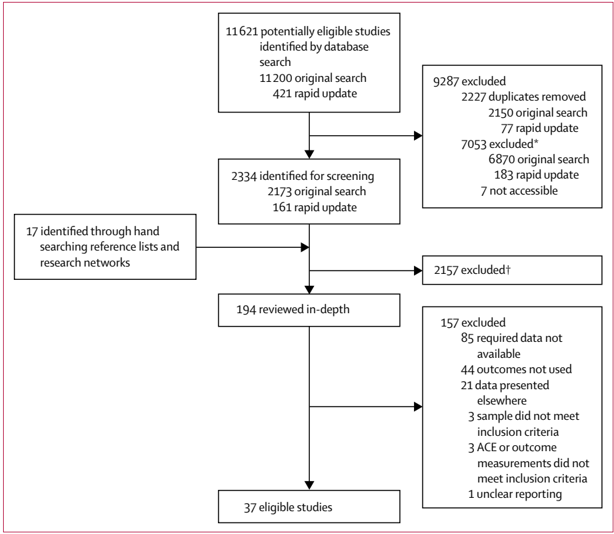
- From 11,621 references, 37 studies were included, providing risk estimates for 23 outcomes and 253,719 participants; most studies were from high-income countries, with nine samples from middle-income countries and none from low-income countries; 26 articles used cross-sectional data and 11 used cohort data, and all used retrospective, self-reported ACEs.
- Pooled ORs with 95% CIs were calculated using a random-effects model in StatsDirect; heterogeneity was assessed with I², publication bias with Begg-Mazumdar and Egger tests and funnel plots where at least ten samples were available, and sensitivity analyses and meta-regression were done in Stata.
Limitations
- The paper states that all included studies used retrospective ACE reports, which could be affected by recall or reporting bias; the number and types of ACEs varied, and summing ACEs does not account for different combinations or for variation in age at or length of exposure; confounding factors varied and some studies included no adjustments; genetic and environmental risks were largely unmeasured.
- The paper states that focusing on community settings likely excluded those with the most complex health problems (eg, homeless populations) and those who had already had ACE-related premature mortality; outcome measurement varied, rarer outcomes were less well covered by population surveys, and the study could only measure associations rather than establish causality.
- Evident from the text: most included samples came from high-income countries, with nine middle-income samples and none from low-income countries; heterogeneity was high for many outcomes; and visual funnel-plot assessment suggested possible missing small studies for smoking and early sexual initiation, although statistical tests for smoking were nonsignificant.
Model-written summary. Check it against the paper before relying on it.
Integrity signals
Registry
Cites
Statistics
Figures
Verification
Claims the paper makes
18 Valid · 0 Not valid · 4 Not checked · 126 Own results and interpretations
The sources with a verdict support this claim; the rest weren’t checked yet, have no full text we could read, or their verdicts aren’t rated yet.
In the paper
“However, five of the seven samples comprised students aged 18-25; 13 pooling of the remaining two samples 8,18 resulted in an OR of 12·53 (6·71-23·37; appendix).”
What the sources say
- Not checked — no full text of the sourcecites [8] 8 Ramiro LS, Madrid BJ, Brown DW. Adverse childhood experiences (ACE) and health-risk behaviors among adults in a developing country setting. Child Abuse Negl 2010; 34: 842-55. source
- Supportedcites [18] 18 Dube SR, Felitti VJ, Dong M, Giles WH, Anda RF. The impact of adverse childhood experiences on health problems: evidence from four birth cohorts dating back to 1900. Prev Med 2003; 37: 268-77 . source
The citation follows “the remaining two samples,” identifying studies used in the citing authors’ pooling rather than attributing the pooled estimate to either study. The cited paper’s Abstract describes a study of 17,337 adult HMO members that examined suicide attempts; its Methods identify the population as adult Kaiser Health Plan members. The OR of 12.53 is presented as the citing authors’ pooled result, not a result attributed to this source. (LLM, conf=0.85)
plainstates an associationn = 2- Asserted: passes — The authors put it forward as true.
- Checkable: passes — It can be checked against evidence.
- Load-bearing: unclear — It is unclear whether the paper’s conclusions depend on it.
- Based: passes — The paper gives a reason why it holds.
Every source the paper cites for this claim was checked and supports it.
In the paper
“However, five of the seven samples comprised students aged 18-25; 13 pooling of the remaining two samples 8,18 resulted in an OR of 12·53 (6·71-23·37; appendix).”
What the sources say
- Supportedcites [13] 13 Bellis MA, Hughes K, Leckenby N, et al. Adverse childhood experiences and associations with health-harming behaviours in young adults: surveys in eight eastern European countries. Bull World Health Organ 2014; 92: 641-55. source
The Attempted suicide section says respondents in seven of the eight countries were asked about suicide attempts. The Methods describe classroom surveys of students and state that the multi-study analyses were limited to respondents aged 18–25, supporting this paper's inclusion among the student samples described in the citing sentence. (LLM, conf=0.90)
plainn = 5- Asserted: passes — The authors put it forward as true.
- Checkable: passes — It can be checked against evidence.
- Load-bearing: unclear — It is unclear whether the paper’s conclusions depend on it.
- Based: passes — The paper gives a reason why it holds.
- Supported
The sources with a verdict support this claim; the rest weren’t checked yet, have no full text we could read, or their verdicts aren’t rated yet.
In the paper
“Supported by international work to standardise measurement of ACEs and their effects on health, these findings have since been replicated in studies from low-income and middle-income 7,8 and high-income 2,9 countries.”
What the sources say
- Not checked — no full text of the sourcecites [7] 7 Almuneef M, Qayad M, Aleissa M, Albuhairan F. Adverse childhood experiences, chronic diseases, and risky health behaviors in Saudi Arabian adults: a pilot study. Child Abuse Negl 2014; 38: 1787-93. source
- Not checked — no full text of the sourcecites [8] 8 Ramiro LS, Madrid BJ, Brown DW. Adverse childhood experiences (ACE) and health-risk behaviors among adults in a developing country setting. Child Abuse Negl 2010; 34: 842-55. source
- Supportedcites [2] 2 Bellis MA, Hughes K, Leckenby N, Hardcastle KA, Perkins C, Lowey H. Measuring mortality and the burden of adult disease associated with adverse childhood experiences in England: a national survey. J Public Health 2015; 37: 445-54. source
The citation to this paper supports the high-income-country part of the sentence: its English national survey found a strong association between ACEs and adult morbidity and premature mortality. The low- and middle-income-country studies are attributed to other citations. The decisive passage is in “What this study adds”; no page number is supplied in our copy. (LLM, conf=0.90)
- Supportedcites [9] 9 Bellis MA, Hughes K, Leckenby N, Perkins C, Lowey H. National household survey of adverse childhood experiences and their relationship with resilience to health-harming behaviors in England. BMC Med 2014; 12: 72. source
Citation 9 is attached to the high-income-country portion of the sentence. The Methods describe a national household survey in England, and the Results report that adverse childhood experiences were associated with multiple health-harming behaviors after adjustment for deprivation and other demographics. The indexed copy does not provide page numbers. (LLM, conf=0.91)
plainstates an association- Asserted: passes — The authors put it forward as true.
- Checkable: passes — It can be checked against evidence.
- Load-bearing: unclear — It is unclear whether the paper’s conclusions depend on it.
- Based: passes — The paper gives a reason why it holds.
The cited sources support only part of this claim — read each source’s verdict below.
In the paper
“For teenage pregnancy, four studies 9,33-35 had measured unintended teenage pregnancy and these studies reported higher estimates than did those measuring any teenage pregnancy 8,14,21 (appendix).”
What the sources say
- Supportedcites [9] 9 Bellis MA, Hughes K, Leckenby N, Perkins C, Lowey H. National household survey of adverse childhood experiences and their relationship with resilience to health-harming behaviors in England. BMC Med 2014; 12: 72. source
The paper is one of the studies identified in the citing sentence as measuring unintended teenage pregnancy. Its Results report an adjusted odds ratio of 5.86 for that outcome among respondents with four or more ACEs versus none. The comparison with studies measuring any teenage pregnancy is the citing authors’ cross-study synthesis, not a comparison attributed to this individual paper. (LLM, conf=0.88)
- Not checked — no full text of the sourcecites [33] 33 Bellis MA, Lowey H, Leckenby N, Hughes K, Harrison D. Adverse childhood experiences: retrospective study to determine their impact on adult health behaviours and health outcomes in a UK population. J Public Health 2014; 36: 81-91. source
- Partly supportedcites [34] 34 Bellis MA, Ashton K, Hughes K, Ford K, Bishop J, Paranjothy S. Adverse childhood experiences and their impact on health-harming behaviours in the Welsh adult population. Cardiff: Public Health Wales, 2015. sourceExperimental — accuracy not yet measured
The section ‘ACEs and their association with unintended teenage pregnancy’ reports an estimate for unintended teenage pregnancy, so this paper supports its identification as a study measuring that outcome. It does not compare its estimate with studies measuring any teenage pregnancy or establish that four studies reported higher estimates. (LLM, conf=0.83)
- Not matchedcites [35] 35 Ford K, Butler N, Hughes K, Quigg Z, Bellis MA. Adverse childhood experiences (ACEs) in Hertfordshire, Luton and Northamptonshire. Liverpool: Liverpool John Moores University, 2016.
Its entry has no title and year that we can search by.
- Not checked — no full text of the sourcecites [8] 8 Ramiro LS, Madrid BJ, Brown DW. Adverse childhood experiences (ACE) and health-risk behaviors among adults in a developing country setting. Child Abuse Negl 2010; 34: 842-55. source
- Not checked yetcites [14] 14 Anda RF, Chapman DP, Felitti VJ, et al. Adverse childhood experiences and risk of paternity in teen pregnancy. Obstet Gynecol 2002; 100: 37-45. source
Checked before — its earlier verdict is held back until a new check runs.
- Not checked — no full text of the sourcecites [21] 21 Hillis SD, Anda RF, Dube SR, Felitti VJ, Marchbanks PA, Marks JS. The association between adverse childhood experiences and adolescent pregnancy, long-term psychosocial consequences, and fetal death. Pediatrics 2004; 113: 320-27 . source
plainstates an association- Asserted: passes — The authors put it forward as true.
- Checkable: passes — It can be checked against evidence.
- Load-bearing: unclear — It is unclear whether the paper’s conclusions depend on it.
- Based: passes — The paper gives a reason why it holds.
- Supported
Every source the paper cites for this claim was checked and supports it.
In the paper
“However, our criteria also meant that studies were excluded because of alternative data analysis methods (eg, analysis of the World Mental Health Surveys 51 ).”
What the sources say
- Supportedcites [51] 51 Kessler RC, McLaughlin KA, Green JG, et al. Childhood adversities and adult psychopathology in the WHO World Mental Health Surveys. Br J Psychiatry 2010; 97: 378-85. source
The Analysis methods section identifies this paper as an analysis of the World Mental Health Surveys and describes its discrete-time survival analysis using person-years. The statement that the citing review excluded it under its own criteria is the citing authors’ decision, not a claim the source needs to make. (LLM, conf=0.88)
plainstates a cause- Asserted: passes — The authors put it forward as true.
- Checkable: passes — It can be checked against evidence.
- Load-bearing: unclear — It is unclear whether the paper’s conclusions depend on it.
- Based: passes — The paper gives a reason why it holds.
- Supported
53 more claims · 2 with their cited sources checked
Create a free account to see all 148 claims and to verify the 1 reference still open.
- It may state two separate claims as one. 44
- Probably not a substantial claim. 27
- The quote only partly states this claim. 31
Claims other papers make about this one
Each is checked against this paper’s own text: does it say what the citing paper says it does?
The source backs part of the claim, not all of it — or backs it for a different population, condition or comparison.
In the citing paper
“Early adverse life experiences, negative affectivity, neuroticism, depression, and anxiety have been identified as psycho logical predisposing conditions for persistent physical symptoms”
From Persistent physical symptoms: definition, genesis, and management (2024) · cites this paper as [64]
Experimental — accuracy not yet measuredThe source backs part of the claim, not all of it — or backs it for a different population, condition or comparison.
In the citing paper
“The impact of childhood abuse, neglect, and violence exposure on adult physical and emotional health and behaviors is significant and well documented”
From Intergenerational effects of childhood maltreatment: A systematic review of the parenting practices of adult survivors of childhood abuse, neglect, and violence. (2020) · cites this paper as Hughes et al., 2017
Experimental — accuracy not yet measuredThe source backs part of the claim, not all of it — or backs it for a different population, condition or comparison.
In the citing paper
“Early institutional rearing is associated with adverse biological and health outcomes in later life, including accelerated cellular aging as measured by telomere length.”
From Telomere trajectories from early adolescence to adulthood following early institutionalization: Protective effects of foster care in the Bucharest Early Intervention Project (2026) · cites this paper as Hughes et al., 2017
Experimental — accuracy not yet measuredThe source backs part of the claim, not all of it — or backs it for a different population, condition or comparison.
In the citing paper
“Individuals exposed to early life adversity are at increased risk of developing a broad spectrum of age-related illnesses at a young age, resulting in shorter health span, referring to the period of life free from chronic disease (Chandan et al., 2020; Hughes et al., 2017).”
From Telomere trajectories from early adolescence to adulthood following early institutionalization: Protective effects of foster care in the Bucharest Early Intervention Project (2026) · cites this paper as Hughes et al., 2017
Experimental — accuracy not yet measuredThe source backs part of the claim, not all of it — or backs it for a different population, condition or comparison.
In the citing paper
“This aligns with findings that ACEs are linked not only with SUD onset, but also with broader emotional and interpersonal dysregulation [4, 6].”
From The link of adverse childhood experiences and attachment to maladaptive personality traits in adults diagnosed with substance use disorder (2025) · cites this paper as [4]
Experimental — accuracy not yet measured
7 more claims about this paper
Create a free account to see every claim other papers make about this one.
Self-check
Percentages, sums and reported differences re-computed from the paper’s own numbers.
Each contradiction between two passages listed here was confirmed by an independent check.
Rated minor: it would not touch a result — a value no result rests on, a p-value that stays on the same side of the significance level, or a conflict that is clerical, resolved elsewhere in the paper, or outside its own findings.
In the paper
§ Summary
“respiratory disease (ORs of two to three)”
§ Discussion
“| Respiratory disease | 3·05 (2·47-3·77)”
Citations
Cites
Felitti, V. J., Anda, R. F., Nordenberg, D., Williamson, D. F., Spitz, A. M., Edwards, V., Koss, M. P., & Marks, J. S. (1998) · American Journal of Preventive Medicine · doi:10.1016/s0749-3797(98)00017-8 · Cited by 18,943
Global status report on noncommunicable diseases 2010.
Alwan, A. (2011) · Cited by 8,494
Forouzanfar, M. H., Afshin, A., Alexander, L. T., Anderson, H. R., Bhutta, Z. A., Biryukov, S., Brauer, M., Burnett, R., Cercy, K., Charlson, F. J., et al. (2016) · The Lancet · doi:10.1016/s0140-6736(16)31679-8 · Cited by 7,698
Wang, H., Naghavi, M., Allen, C., Barber, R. M., Bhutta, Z. A., Carter, A., Casey, D. C., Charlson, F. J., Chen, A. Z., Coates, M. M., et al. (2016) · The Lancet · doi:10.1016/s0140-6736(16)31012-1 · Cited by 6,596
Anda, R. F., Felitti, V. J., Bremner, J. D., Walker, J. D., Whitfield, C., Perry, B. D., Dube, S. R., & Giles, W. H. (2006) · European archives of psychiatry and clinical neuroscience · doi:10.1007/s00406-005-0624-4 · Cited by 4,292
Norman, R. E., Byambaa, M., De, R., Butchart, A., Scott, J., & Vos, T. (2012) · PLoS Medicine · doi:10.1371/journal.pmed.1001349 · Cited by 3,387
Self-citationValidity of adult retrospective reports of adverse childhood experiences: review of the evidence
Hardt, J., & Rutter, M. (2004) · Journal of Child Psychology and Psychiatry · doi:10.1111/j.1469-7610.2004.00218.x · Cited by 2,827
Childhood adversities and adult psychopathology in the WHO World Mental Health Surveys
Kessler, R. C., McLaughlin, K. A., Green, J. G., Gruber, M. J., Sampson, N. A., Zaslavsky, A. M., Aguilar-Gaxiola, S., Alhamzawi, A. O., Alonso, J., Angermeyer, M., et al. (2010) · British Journal of Psychiatry · doi:10.1192/bjp.bp.110.080499 · Cited by 2,640
Impact of child sexual abuse: A review of the research.
Browne, A., & Finkelhor, D. (1986) · Psychological Bulletin · doi:10.1037/0033-2909.99.1.66 · Cited by 2,590
Adverse childhood experiences, allostasis, allostatic load and age-related disease
Danese, A., & McEwen, B. S. (2012) · Physiology & Behavior · doi:10.1016/j.physbeh.2011.08.019 · Cited by 2,140
Cited by
Items 4,001–4,100 of 5,221
CONTEXTOS DOMICILIARES E ESCOLARES DE CRIANÇAS E ADOLESCENTES NO PERÍODO DA PANDEMIA
Alves, M. L., & Morais, A. C. (2023) · Anais dos Seminários de Iniciação Científica · doi:10.13102/semic.vi26.9534
Resilience’s awareness building strategy in early childhood
Zuama, S. N., Sumardjoko, B., Harsono, H., & Muhibbin, A. (2023) · AIP conference proceedings · doi:10.1063/5.0142021 · Cited by 1
Развитие ненасильственного взаимодействия педагога и детей в дошкольной образовательной организации
Гейда, Д. В. (2023) · ТЕНДЕНЦИИ РАЗВИТИЯ НАУКИ И ОБРАЗОВАНИЯ · doi:10.18411/trnio-04-2023-20
You, Y., Yu, S., Guo, J., Xuan, Z., & Hao, X. (2023) · doi:10.2196/preprints.49736
Combined Psychotherapy and Somatic Treatments
Teo, D. C. L., Silvio, J. R., Condemarín, R., Nair, S. S., Alfonso, C. A., & Tasman, A. (2023) · Springer eBooks · doi:10.1007/978-3-030-42825-9_95-1
Assessment Tools and the Young People Project
King–Hill, S., McCartan, K., Gilsenan, A., et al. (2023) · Springer eBooks · doi:10.1007/978-3-031-34010-9_4
Health Determinants Cumulate Over the Life Course
McDowell, I. (2023) · Springer eBooks · doi:10.1007/978-3-031-28986-6_5 · Cited by 1
Economics of Adverse Childhood Treatment
Brugiavini, A., Buia, R. E., & Orso, C. E. (2023) · Springer eBooks · doi:10.1007/978-3-319-57365-6_384-1
Life stress and adiposity in mothers: A 14‐year follow‐up in the general population
Hoepel, S. J. W., Schuurmans, I. K., Cecil, C. A. M., Jaddoe, V. W. V., & Luik, A. I. (2023) · Stress and Health · doi:10.1002/smi.3290 · Cited by 1
CHILDHOOD ADVERSITIES AND FIRST ONSET OF DEPRESSION IN A GENERAL HOSPITAL PSYCHIATRY UNIT.
Girish Babu, D. S., Sattar, F. A., & Kumar, K. (2023) · PARIPEX-INDIAN JOURNAL OF RESEARCH · doi:10.36106/paripex/8105114
Diabetes mellitus und Extrembelastungen in der Kindheit
Kruse, J., Zara, S., & Kampling, H. (2023) · Ärztliche Psychotherapie · doi:10.21706/aep-18-3-171
A Life Course Approach to Cardiovascular Disease
Masoli, J. A. H., & Hardy, R. (2023) · Oxford University Press eBooks · doi:10.1093/oso/9780192864642.003.0005
Zhang, M., He, J., Lu, T., Luo, O., You, J., & Li, J. (2023) · Research Square · doi:10.21203/rs.3.rs-3196422/v1
Effects of adverse childhood experiences on the Charlson comorbidity index in US adults
Wang, Y., Sun, M., Yao, N., Guo, R., Liu, Y., Wang, X., Li, J., Xie, Z., Yang, Y., Li, X., et al. (2023) · Public Health · doi:10.1016/j.puhe.2023.07.012
Deniz, E., Humphrey, N., Demkowicz, O., et al. (2023) · doi:10.31219/osf.io/krdtv
The effects of ACE on intimate relationships
Rokach, A., & Clayton, S. (2023) · Elsevier eBooks · doi:10.1016/b978-0-323-85853-3.00007-0
Johnsen, H. L., Juhl, M., Rydahl, E., Karentius, S. M., Rath, S. M., Friis-Alstrup, M., Backhausen, M. G., Røhder, K., Schiøtz, M. L., Broberg, L., et al. (2023) · International Journal of Environmental Research and Public Health · doi:10.3390/ijerph20166601 · Cited by 2
“This questionnaire has been widely used in research [3,29].”
BackgroundMethodInfluentialKidman, R. C., Mwera, J., Rui, Y., et al. (2023) · doi:10.31235/osf.io/gru6e
Integrating a trauma-informed approach into preregistration nurse education
Miller, R., & Deering, K. (2023) · Mental Health Practice · doi:10.7748/mhp.2023.e1668 · Cited by 2
Stress Prevention Measures in the Workplace
Erskine, J., & Fauquet-Alekhine, P. (2023) · Springer eBooks · doi:10.1007/978-3-031-27349-0_20
Linking Trauma-Exposure with Violent Offending: Narrative Review and Clinical Implications
Møeller, S. B., Bo, S., & Arendt, I. T. P. (2023) · Springer eBooks · doi:10.1007/978-3-031-31547-3_42
Inflammation and traumatic stress
Hori, H., & Hakamata, Y. (2023) · Elsevier eBooks · doi:10.1016/b978-0-12-817558-3.00015-9 · Cited by 1
Wang, Y., Ge, F., Aspelund, T., Ask, H., Hauksdóttir, A., Hu, K., Jakobsdóttir, J., Zoëga, H., Shen, Q., Whalley, H. C., et al. (2023) · medRxiv · doi:10.1101/2023.09.12.23295354
“23 In our study, we generated three types of exposure variables: (1) a binary variable indicating any childhood maltreatment, coded as ‘0’ (no) or ‘1’ (yes); (2) a cumulative variable indicating the number of childhood maltreatment types (range from 0 to 5), which was coded as ‘0’, ‘1’, ‘2’, or ‘≥3’ childhood maltreat…”
MethodBowes, M., Forshaw, M. J., & Tarling, R. (2023) · Emotional and Behavioural Difficulties · doi:10.1080/13632752.2023.2230708 · Cited by 2
“Hughes et al. (2017) found moderate associations between ACEs and smoking and heavy alcohol consumption, strong associations for sexual risk taking, poor mental health and problematic alcohol consumption.”
BackgroundBamps, E., Achterhof, R., Lafit, G., Hagemann, N., Hermans, K. S. F. M., Hiekkaranta, A. P., Lecei, A., Kirtley, O. J., & Myin‐Germeys, I. (2023) · PsyArXiv (OSF Preprints) · doi:10.31234/osf.io/45d9w · Cited by 1
Hollar, D. (2023) · Children s Health Care · doi:10.1080/02739615.2023.2259302
“Hughes et al. (2017) identified lifelong ACE risks to include violence, mental illness, and substance use.”
Childhood trauma: Unfolding the lifelong impact on mental health
Kuzminskaite, E. (2023) · doi:10.5463/thesis.371 · Cited by 5
Adverse childhood experience chronicity and timing: a study of UK Black and minority ethnic parentsPreprint
Ogundiyun, I., & Katus, L. (2023) · doi:10.31234/osf.io/739be
The complexity of mental healthcare and its consequences for doing good
Smit, E. H. (2023) · Utrecht University Repository (Utrecht University) · doi:10.33540/1907
Buimer, E. E. L. (2023) · Utrecht University Repository (Utrecht University) · doi:10.33540/1936
When Can Causal-Analytic Methods Inform Design-Based Research?
Hejazi, N. S. (2023) · JAMA Network Open · doi:10.1001/jamanetworkopen.2023.36338
Villagrán, A., Lund, C., Duncan, R., & Lossius, M. I. (2023) · Epilepsy & Behavior · doi:10.1016/j.yebeh.2023.109456
“Adverse experiences in childhood have been associated with increased risk of physical and mental illness and premature mortality [1].”
BackgroundAvery, F., Kennedy, N., James, M., Jones, H. E., Amos, R., Bellis, M. A., Hughes, K. E., & Brophy, S. T. (2023) · medRxiv · doi:10.1101/2023.10.10.23296823
Self-citationAntkowiak, L., Boynton‐Jarrett, R., Chiang, S. S., Castellon, D., Gilbert, P. B., Juraska, M., Sox, C. M., & Huang, C.-C. (2023) · Violence and Victims · doi:10.1891/vv-2021-0002
Negative Kindheitserfahrungen von Müttern und generationenübergreifende familiäre Gewalt
Ahmling, M. K., Lorenz, S., Eickhorst, A., Menrath, I., & Liel, C. (2023) · Praxis der Kinderpsychologie und Kinderpsychiatrie · doi:10.13109/prkk.2023.72.6.483
Testa, A. M., Jackson, D. B., Crawford, A. D., Mungia, R., Ganson, K. T., & Nagata, J. M. (2023) · Research Square · doi:10.21203/rs.3.rs-3452502/v1
Balakrishnan, K. (2023) · Elsevier eBooks · doi:10.1016/b978-0-443-10714-6.00009-2
Developing Bhutan: Nurturing Youth
Dorji, N. (2023) · Springer eBooks · doi:10.1007/978-981-99-4969-4_4 · Cited by 1
Stress and Resilience Education in the Top 50 U.S. Medical SchoolsPreprint
Roos, L. G., Lee, J. H., Thyne, S. M., Bhushan, D., & Slavich, G. M. (2023) · Research Square · doi:10.21203/rs.3.rs-3462547/v1
Goldstein, L. B. (2023) · Archives of Medical Case Reports and Case Study · doi:10.31579/2692-9392/167
Intertwined development of ADHD symptoms and physical conditions
Hogendoorn, E., van der Ziel, S., van Vliet, M. J., & Rosmalen, J. G. M. (2023) · The Lancet Child & Adolescent Health · doi:10.1016/s2352-4642(23)00286-9
Olabarria, A., Burgués, A., de Aguileta, A. L., Zubiri-Esnaola, H., Torras-Gómez, E., Joanpere, M., de Aguileta, G. L., Álvarez-Guerrero, G., Aiello, E., Pulido, C., et al. (2023) · Children · doi:10.3390/children10121857
“Therefore, addressing, preventing, and overcoming CSA from an early age is essential to provide children with opportunities to have a healthy and happy future [20,28,29].”
BackgroundDzedone, D., & Miltuze, A. (2023) · Human, Technologies and Quality of Education · doi:10.22364/htqe.2023.03
“It is found, that adverse childhood experiences are associated with a variety of physical, social, emotional, and behavioral problems (Hughes et al., 2017).”
BackgroundHaslam, S. K., Munroe, A., Hamilton-Hinch, B., Torres, S., Grant, T., Ross, N., & Gilbert, R. W. (2023) · PubMed Central
“Precious beyond measure”: rethinking the current approach to diversity
Mattheiss, S. R. (2023) · Frontiers in Psychology · doi:10.3389/fpsyg.2023.1336590
Driscoll, D. J. O., Kiely, E., Keeffe, L. M. O., et al. (2023) · medRxiv · doi:10.1101/2023.12.07.23299656
Paine, S., Walker, R., Lee, A. C.-L., Loring, B., & Signal, T. L. (2023) · Kōtuitui New Zealand Journal of Social Sciences Online · doi:10.1080/1177083x.2023.2292262
Pharris, A. B., Havig, K. K., & Goodwin, B. (2023) · doi:10.1093/oso/9780197694732.003.0023
Torres, M., Karpman, H. E., Francis, A. L.-A., & Leibowitz, G. S. (2023) · Oxford University Press eBooks · doi:10.1093/oso/9780197694732.003.0009
The God of the Child: Encouraging Children’s Spiritual Development During Times of Trauma
Zimmerman, E. (2023) · Theological Reflections Eastern European Journal of Theology · doi:10.29357/2789-1577.2023.21.2.6
Preferred Parenting Style Among University Students
Baloria, A. S., ., M., Prasad, N., et al. (2023) · Journal Of Advanced Zoology · doi:10.53555/jaz.v44i5.3005
Resilienz bei Kindern und Jugendlichen
Witt, A. (2021) · Springer Reference Medizin · doi:10.1007/978-3-662-49289-5_49-1
Diagnosis and Management of Perimenstrual Cycloid Motility Psychosis
Weyhaupt, M., Hardcastle, S., Jesse, N. J., Almeida, M., & Ward, H. B. (2024) · Harvard Review of Psychiatry · doi:10.1097/hrp.0000000000000386
Racine, N. M., Barriault, S., Motz, M., Leslie, M., Poole, N., Premji, S., Andrews, N. C. Z., Penaloza, D., & Pepler, D. J. (2024) · BMC Psychology · doi:10.1186/s40359-023-01484-w · Cited by 2
“%) experience at least one ACE in their childhood [8]; however, children exposed to cumulative adversity are at highest risk of poor long-term health and mental health outcomes [1].”
BackgroundCOVID-19 Impact, Medical Insurance System, and Health EquityPreprint
Qin, C., Zhu, Y., Lu, M., & Fang, X. (2024) · Research Square · doi:10.21203/rs.3.rs-3852241/v1
Batty, G. D., Mika Kivimaki, B., Almquist, Y. B., Eriksson, J. G., Gissler, M., Gnanamanickam, E. S., Hamer, M., Jackisch, J., Juon, H., Keski‐Säntti, M., et al. (2024) · medRxiv · doi:10.1101/2024.01.26.24301814
Kapfhammer, H. (2023) · Springer eBooks · doi:10.1007/978-3-662-68309-5_1
Adipositaschirurgie (Bariatrische Chirurgie)
Kapfhammer, H. (2023) · Springer eBooks · doi:10.1007/978-3-662-68309-5_6
Prevention and Control of Violence and Intentional Injuries
Bowman, B., & Matzopoulos, R. (2024) · Elsevier eBooks · doi:10.1016/b978-0-323-99967-0.00164-2
Somatische en psychische gevolgen van kindermishandeling
Teeuw, A. H., & Lindauer, R. (2024) · Bohn Stafleu van Loghum eBooks · doi:10.1007/978-90-368-2960-1_44
Gross, D. A., Yu, Z., Wyatt, K., Cunningham, E., Hoppe, E. R., Chen, W., Plesko, C. M., Bower, K. M., & Bettencourt, A. F. (2024) · doi:10.31234/osf.io/gydwp
Barry, J. A., & Liddon, L. (2021) · Wiley eBooks · doi:10.1002/9781119685340.refs
Cannabis Use and Adverse Childhood Experiences Among Connecticut High School Students
King, J., Codner, A., & Poulin, S. (2024) · International Journal of Mental Health and Addiction · doi:10.1007/s11469-023-01236-2
“…experiences (ACEs) are potentially traumatic events during childhood and adolescence that may increase the risk of a variety of negative health outcomes and health risk behaviors including cannabis use (Afifi et al., 2020; Felitti et al., 1998; Hughes et al., 2017; Scheidell et al., 2018).”
Cramer, A. F. (2023) · ResearchSpace (University of KwaZulu-Natal) · doi:10.29086/10413/22682
Horváth, D., Kovács-Tóth, B., Oláh, B., et al. (2024) · SSRN Electronic Journal · doi:10.2139/ssrn.4718499
Current Literature in Pediatric Psychosomatics (CLiPPs)
Samsel, C. B. (2020) · JAACAP Connect · doi:10.62414/001c.92392
Lesiones proliferativas ginecológicas y victimización sexual en Córdoba, Argentina
de Córdoba, U. N., Bruera, J., Bobbio, A., et al. (2024) · Revista Facultad Nacional de Salud Pública · doi:10.17533/udea.rfnsp.e352073
“Se ha repor-tado que las mujeres que sufren experiencias de victimi-zación, como el abuso sexual durante la infancia, com-parten los mismos factores de riesgo para las neoplasias ginecológicas en la adultez [5].”
BackgroundAdolescent Mental Health Care: Time for Revolution
Marini, S., D’Agostino, L., Ciamarra, C., LenaMara, R. D., Giacomodonato, M., Molinero, M., Corsi, L., Gentile, A., & Acciavatti, T. (2024) · Juniper Online Journal of Case Studies · doi:10.19080/jojcs.2024.14.555891
Early adversity and prosocial behavior in adolescents from Bogotá: a cross-sectional studyPreprint
Alarcón, A. C. C., Arenas, N. M., Ávila, K. A. V., et al. (2024) · Research Square · doi:10.21203/rs.3.rs-4103840/v1
Pirmosios 1000 vaiko gyvenimo dienų kaip viešosios politikos problemos pateiktis
Tamutienė, I., & Auglytė, V. (2024) · Public Policy And Administration · doi:10.5755/j01.ppaa.53.1.34281
“Remiantis 2017 m. atlikta Hughes et al. (2017) sistemine literatūros apžvalga ir metaanalize, patvirtin-ta, kad ŽVP yra daugelio sveikatos būklių rizikos veiksnys, ypač stipriai koreliuojantis su žalingų patirčių perdavimu ateities kartoms per smurtą, psichinius sutrikimus bei priklausomybes.”
BackgroundStudents With Adverse Childhood Experiences
Powell, T. M., & Muller, J. (2024) · doi:10.1093/oso/9780197603413.003.0009
Adverse Childhood Experiences Association with Health: Perceived Stress and Depression Mediators
(2023) · Archives of Health Science · doi:10.31829/10.31829/2641-7456/ahs2023-7(1)-022
Allik, M., Gedeon, E., Leyland, A. H., et al. (2024) · SSRN Electronic Journal · doi:10.2139/ssrn.4773138
Infante, T. R. (2024) · ARS MEDICA Revista de Ciencias Médicas · doi:10.11565/arsmed.v49i1.2000 · Cited by 2
夏, 苏. (2024) · Advances in Psychology · doi:10.12677/ap.2024.144190
McLean, A. (2024) · Policy Press eBooks · doi:10.51952/9781447372011.bm002
Hou, X., Wan, J., Peng, L., Sheng, J., Long, N., & Mao, P. (2024) · PubMed Central · doi:10.11817/j.issn.1672-7347.2024.230333 · Cited by 2
“PTSD [20] ,遭遇的不良经历越多,其 PTSD 症状越严 重 [21] ,且可影响儿童和青少年的人格特征及社会功 能 [22] 。英国一项纳入 32 项研究的荟萃分析 [23] 显示 TF-CBT [28] 也显示 青少年的心理健康 [29] 。儿童时期暴露在慢性压力之 下,会影响个体神经、内分泌和免疫系统的正常发 育,以致情绪功能受损 [30] 。 Dorsey 等 [31] 对肯尼亚和坦 桑尼亚经历父母离世的 640 名儿童进行 TF-CBT 治疗 冲动控制能力 [34-35] ,从而导致情绪的不稳定和冲动行 为 [36] 。已有充分的研究 [37-38] 证明, CHD…”
Association of trauma informed service learning with students’ knowledge, attitudes and confidence
Cabey, W. V., Tristani, K., Strand, N. K., Jones, N. L., Sagin, H., Wright, S., & Reeves, K. A. (2024) · SN Social Sciences · doi:10.1007/s43545-024-00887-9
“Trauma increases a person’s lifetime potential for engaging in health-risk behaviors, negatively impacts physical and behavioral health, and interferes with access to or use of health services (Hughes et al. 2017).”
Keynejad, R. C., Boardman‐Pretty, T., Barber, S., Tweed, J. A., Forshall, E., Edwards, A., Shotton, J., & Wilson, C. A. (2024) · BJPsych Bulletin · doi:10.1192/bjb.2024.34
The Comprehensive Adversity Measure (CAM): A measure of early adversity and its severity.Preprint
Schlechter, P., Lutz, N. M., Morina, N., Grant, J. E., Lochner, C., Chamberlain, S., Wilkinson, P. O., & Fritz, J. (2024) · International Journal of Child Abuse & Neglect · doi:10.31219/osf.io/nq7dc · Cited by 1
Homelessness and solution-oriented pathways and recommendations
Yadawa, S. K. (2024) · Elsevier eBooks · doi:10.1016/b978-0-443-14052-5.00023-9 · Cited by 1
Editorial perspective: protective factors following cumulative childhood adversity
Parker, C. H., Minnis, H., & Ougrin, D. (2024) · BJPsych Open · doi:10.1192/bjo.2024.31
Psychiatry in the General Hospital
Ramanuj, P., & Ashby, A. (2024) · Cambridge University Press eBooks · doi:10.1017/9781911623861.034
von Wendorff, C. (2024) · SSRN Electronic Journal · doi:10.2139/ssrn.4779130
Megumi, Kentaro, Takahiro, T., Ryo, Takuya, Shingo, Aoi, Kentaro, Tomohiro, T., Izuhara, M., et al. (2024) · Research Square · doi:10.21203/rs.3.rs-4314857/v1
Mazhak, I., Maltseva, K., & Sudyn, D. (2024) · SSRN Electronic Journal · doi:10.2139/ssrn.4812978
Τόγκας, Κ. (2024) · Koinōnikī Ergasia · doi:10.12681/socialwork-rss.37548
“Στη μετα-ανάλυση των Hughes et al. (2017) οι συσχετίσεις ήταν αδύναμες ή μέτριες για τη σωματική αδράνεια, το υπερβολικό βάρος ή την παχυσαρκία και τον σακχαρώδη διαβήτη και μέτριες για το κάπνισμα, την κατάχρηση αλκοόλ, την κακή αυτοαξιολογούμενη κατάσταση υγείας, τον καρκίνο, τα καρδιαγγειακά…”
InfluentialZur Versorgungs- und Begutachtungssituation von delinquenten Kindern und Jugendlichen in Deutschland
Barra, S., Häßler, F., Wunsch, K., Reis, O., Weirich, S., & Allroggen, M. (2024) · Forensische Psychiatrie Psychologie Kriminologie · doi:10.1007/s11757-024-00830-x
“…Umfeldfaktoren) erhöhen nicht nur das Risiko für das Auftreten von psychischen Erkrankungen, sondern auch für delinquentes Verhalten (Hughes et al. 2017; Folk et al. 2021; Pires und Almeida 2023), wobei unklar ist, ob diese direkt die Delinquenz begründen oder bestimm-te kriminogene…”
Buchanan, M., Newton‐Howes, G., Cunningham, R., & Boden, J. M. (2024) · SSRN Electronic Journal · doi:10.2139/ssrn.4830031
Dalton, L. J., Aukland, L., Lloyd‐Newman, E., Buechner, H., McCall, A., & Rapa, E. (2024) · The Curriculum Journal · doi:10.1002/curj.270 · Cited by 1
Metadata
- Authors
- Hughes, K., Bellis, M. A., Hardcastle, K. A., Sethi, D., Butchart, A., Mikton, C., Jones, L., & Dunne, M. P.
- Affiliations
- Bangor University (GB)
- Public Health Wales (GB)
- World Health Organization Regional Office for Europe (DK)
- World Health Organization (CH)
- University of the West of England (GB)
- Liverpool John Moores University (GB)
- Queensland University of Technology (AU)
- Corresponding author
- Bellis, Mark A
- Venue
- The Lancet Public Health
- Publisher
- Elsevier BV
- Published
- 2017-08
- Volume
- 2
- Issue
- 8
- Pages
- e356-e366
- ISSN
- 2468-2667 (ISSN-L)
- OpenAlex
- W2740726397
- Semantic Scholar
- cdd633b48c3e902b5a7a012711d868cf5745c677
- Cited by
- 5,255
- References
- 70
- Citations by year
- 2026: 750 · 2025: 849 · 2024: 817 · 2023: 711 · 2022: 698 · 2021: 626 · 2020: 464 · 2019: 232 · 2018: 97 · 2017: 7
- FWCI
- 33.48
- Type
- journal article
- Language
- en
- Open access
- gold
- doi.org
- Licence
- cc-by-nc-nd
- www.elsevier.com/tdm/userlicense/1.0/ (tdm)
- creativecommons.org/licenses/by-nc-nd/4.0/ (vor)
- Locations
- The Lancet Public Health (publishedVersion, cc-by-nc-nd)
- PubMed (publishedVersion)
- Liverpool John Moores University (acceptedVersion)
- QUT ePrints (Queensland University of Technology) (submittedVersion, cc-by-nc-nd)
- UWE Research Repository (UWE Bristol) (submittedVersion, cc-by-nc-nd)
- DOAJ (DOAJ: Directory of Open Access Journals) (submittedVersion, cc-by-sa)
- Funders
- World Health Organization
- Public Health Wales
- Topics
- Social Sciences › Psychology › Clinical Psychology › Child Abuse and Trauma
- Social Sciences › Sociology and Political Science › Child Welfare and Adoption
- Social Sciences › Health › Intimate Partner and Family Violence
- Keywords
- adverse childhood experiences, child abuse, domestic violence exposure, substance use, sexual health, mental health, violence, physical health, physical activity, weight, resilience
- MeSH terms
- Health Status, Humans, Life Change Events
About these checks
Registry, retraction, Cites and statistics results are computed, not judged, with one exception: a printed reference that no index lists is read once by a model before it counts as a citation error. Claims are extracted by a model and kept only when their quote appears verbatim in the text; each cited source is then checked, with a model’s help, for whether it says what the claim relies on. Those verdicts can be wrong — read the claim’s quote and the cited source before relying on one.
The claim verdicts this report counts are experimental: their accuracy is not yet measured.
A language model drew the claims from the paper on 2026-09-28, under version 3 of the claim definition (prompt extract-v3).
A second model labelled each claim on 2026-09-28 (model jev-1.13-20260917, definition revision gold-guideline-v0.2).
Cited sources are checked with a language model’s help (gpt-6-sol).
Statistics and arithmetic are recomputed, not judged.
Confidence bands are shown only for fields calibrated on our annotated test set. None is calibrated yet, so no band is shown.
What counts as a claim ›How we measure confidence ›How we check this ›
Are you an author, or do you see a problem with this page? Request a review
Data sources
Bibliographic data: Semantic Scholar, OpenAlex, Crossref.
Contains information from the Semantic Scholar Academic Graph Datasets, made available under the ODC Attribution License (ODC-BY 1.0).
Semantic Scholar’s data is described in: Kinney, R., et al. (2023). The Semantic Scholar Open Data Platform. arXiv:2301.10140.
