

The effect of multiple adverse childhood experiences on health: a systematic review and meta-analysis.
Open accessThe DOI matches its Crossref record; 66 of the 70 references it cites were found in a registry or an index; 23 of the 40 sources its claims cite were checked for support.
Abstract
BACKGROUND: A growing body of research identifies the harmful effects that adverse childhood experiences (ACEs; occurring during childhood or adolescence; eg, child maltreatment or exposure to domestic violence) have on health throughout life. Studies have quantified such effects for individual ACEs. However, ACEs frequently co-occur and no synthesis of findings from studies measuring the effect of multiple ACE types has been done. METHODS: In this systematic review and meta-analysis, we searched five electronic databases for cross-sectional, case-control, or cohort studies published up to May 6, 2016, reporting risks of health outcomes, consisting of substance use, sexual health, mental health, weight and physical exercise, violence, and physical health status and conditions, associated with multiple ACEs. We selected articles that presented risk estimates for individuals with at least four ACEs compared with those with none for outcomes with sufficient data for meta-analysis (at least four populations). Included studies also focused on adults aged at least 18 years with a sample size of at least 100. We excluded studies based on high-risk or clinical populations. We extracted data from published reports. We calculated pooled odds ratios (ORs) using a random-effects model. FINDINGS: of >75%) between estimates for almost half of the outcomes. INTERPRETATION: To have multiple ACEs is a major risk factor for many health conditions. The outcomes most strongly associated with multiple ACEs represent ACE risks for the next generation (eg, violence, mental illness, and substance use). To sustain improvements in public health requires a shift in focus to include prevention of ACEs, resilience building, and ACE-informed service provision. The Sustainable Development Goals provide a global platform to reduce ACEs and their life-course effect on health. FUNDING: Public Health Wales.
Overview
CoChat Summary
TL;DR
This systematic review and meta-analysis of 37 studies and 253,719 participants found that adults with at least four adverse childhood experiences (ACEs) had increased odds of all 23 health outcomes compared with those with no ACEs. The strongest associations were for problematic drug use and interpersonal and self-directed violence, while physical inactivity, overweight or obesity, and diabetes showed weaker associations.
Key findings
- Across 37 included studies providing risk estimates for 23 outcomes, 57% of 252,467 participants reported at least one ACE and 13% of 244,979 reported at least four.
- Pooled odds ratios (ORs) were weak or modest for physical inactivity (1·25, 95% CI 1·03–1·52), overweight or obesity (1·39, 1·13–1·71), and diabetes (1·52, 1·23–1·89); moderate for smoking (2·82, 2·38–3·34), heavy alcohol use (2·20, 1·74–2·78), poor self-rated health (2·24, 1·97–2·54), cancer (2·31, 1·82–2·95), cardiovascular disease (2·07, 1·66–2·59), and respiratory disease (3·05, 2·47–3·77).
- Stronger associations included multiple sexual partners (3·64, 3·02–4·40), anxiety (3·70, 2·62–5·22), early sexual initiation (3·72, 2·88–4·80), teenage pregnancy (4·20, 2·98–5·92), low life satisfaction (4·36, 3·72–5·10), depression (4·40, 3·54–5·46), illicit drug use (5·62, 4·46–7·07), problematic alcohol use (5·84, 3·99–8·56), and sexually transmitted infections (5·92, 3·21–10·92).
- The strongest pooled ORs were for violence victimisation (7·51, 5·60–10·08), violence perpetration (8·10, 5·87–11·18), problematic drug use (10·22, 7·62–13·71), and suicide attempt (30·14, 14·73–61·67); considerable heterogeneity (I² >75%) was identified for almost half of outcomes.
Methods
- Systematic review and meta-analysis searching five electronic databases for cross-sectional, case-control, or cohort studies published up to May 6, 2016, reporting health outcomes associated with multiple ACEs; included studies focused predominantly on adults aged at least 18 years, had sample sizes of at least 100, used a cumulative measure of at least four ACEs spanning direct and indirect types, and reported risk estimates for at least four ACEs versus none.
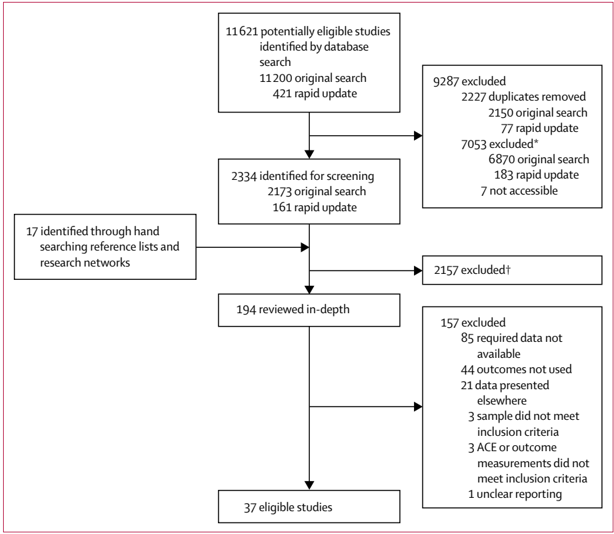
- From 11,621 references, 37 studies were included, providing risk estimates for 23 outcomes and 253,719 participants; most studies were from high-income countries, with nine samples from middle-income countries and none from low-income countries; 26 articles used cross-sectional data and 11 used cohort data, and all used retrospective, self-reported ACEs.
- Pooled ORs with 95% CIs were calculated using a random-effects model in StatsDirect; heterogeneity was assessed with I², publication bias with Begg-Mazumdar and Egger tests and funnel plots where at least ten samples were available, and sensitivity analyses and meta-regression were done in Stata.
Limitations
- The paper states that all included studies used retrospective ACE reports, which could be affected by recall or reporting bias; the number and types of ACEs varied, and summing ACEs does not account for different combinations or for variation in age at or length of exposure; confounding factors varied and some studies included no adjustments; genetic and environmental risks were largely unmeasured.
- The paper states that focusing on community settings likely excluded those with the most complex health problems (eg, homeless populations) and those who had already had ACE-related premature mortality; outcome measurement varied, rarer outcomes were less well covered by population surveys, and the study could only measure associations rather than establish causality.
- Evident from the text: most included samples came from high-income countries, with nine middle-income samples and none from low-income countries; heterogeneity was high for many outcomes; and visual funnel-plot assessment suggested possible missing small studies for smoking and early sexual initiation, although statistical tests for smoking were nonsignificant.
Model-written summary. Check it against the paper before relying on it.
Integrity signals
Registry
Cites
Statistics
Figures
Verification
Claims the paper makes
18 Valid · 0 Not valid · 4 Not checked · 126 Own results and interpretations
The sources with a verdict support this claim; the rest weren’t checked yet, have no full text we could read, or their verdicts aren’t rated yet.
In the paper
“However, five of the seven samples comprised students aged 18-25; 13 pooling of the remaining two samples 8,18 resulted in an OR of 12·53 (6·71-23·37; appendix).”
What the sources say
- Not checked — no full text of the sourcecites [8] 8 Ramiro LS, Madrid BJ, Brown DW. Adverse childhood experiences (ACE) and health-risk behaviors among adults in a developing country setting. Child Abuse Negl 2010; 34: 842-55. source
- Supportedcites [18] 18 Dube SR, Felitti VJ, Dong M, Giles WH, Anda RF. The impact of adverse childhood experiences on health problems: evidence from four birth cohorts dating back to 1900. Prev Med 2003; 37: 268-77 . source
The citation follows “the remaining two samples,” identifying studies used in the citing authors’ pooling rather than attributing the pooled estimate to either study. The cited paper’s Abstract describes a study of 17,337 adult HMO members that examined suicide attempts; its Methods identify the population as adult Kaiser Health Plan members. The OR of 12.53 is presented as the citing authors’ pooled result, not a result attributed to this source. (LLM, conf=0.85)
plainstates an associationn = 2- Asserted: passes — The authors put it forward as true.
- Checkable: passes — It can be checked against evidence.
- Load-bearing: unclear — It is unclear whether the paper’s conclusions depend on it.
- Based: passes — The paper gives a reason why it holds.
Every source the paper cites for this claim was checked and supports it.
In the paper
“However, five of the seven samples comprised students aged 18-25; 13 pooling of the remaining two samples 8,18 resulted in an OR of 12·53 (6·71-23·37; appendix).”
What the sources say
- Supportedcites [13] 13 Bellis MA, Hughes K, Leckenby N, et al. Adverse childhood experiences and associations with health-harming behaviours in young adults: surveys in eight eastern European countries. Bull World Health Organ 2014; 92: 641-55. source
The Attempted suicide section says respondents in seven of the eight countries were asked about suicide attempts. The Methods describe classroom surveys of students and state that the multi-study analyses were limited to respondents aged 18–25, supporting this paper's inclusion among the student samples described in the citing sentence. (LLM, conf=0.90)
plainn = 5- Asserted: passes — The authors put it forward as true.
- Checkable: passes — It can be checked against evidence.
- Load-bearing: unclear — It is unclear whether the paper’s conclusions depend on it.
- Based: passes — The paper gives a reason why it holds.
- Supported
The sources with a verdict support this claim; the rest weren’t checked yet, have no full text we could read, or their verdicts aren’t rated yet.
In the paper
“Supported by international work to standardise measurement of ACEs and their effects on health, these findings have since been replicated in studies from low-income and middle-income 7,8 and high-income 2,9 countries.”
What the sources say
- Not checked — no full text of the sourcecites [7] 7 Almuneef M, Qayad M, Aleissa M, Albuhairan F. Adverse childhood experiences, chronic diseases, and risky health behaviors in Saudi Arabian adults: a pilot study. Child Abuse Negl 2014; 38: 1787-93. source
- Not checked — no full text of the sourcecites [8] 8 Ramiro LS, Madrid BJ, Brown DW. Adverse childhood experiences (ACE) and health-risk behaviors among adults in a developing country setting. Child Abuse Negl 2010; 34: 842-55. source
- Supportedcites [2] 2 Bellis MA, Hughes K, Leckenby N, Hardcastle KA, Perkins C, Lowey H. Measuring mortality and the burden of adult disease associated with adverse childhood experiences in England: a national survey. J Public Health 2015; 37: 445-54. source
The citation to this paper supports the high-income-country part of the sentence: its English national survey found a strong association between ACEs and adult morbidity and premature mortality. The low- and middle-income-country studies are attributed to other citations. The decisive passage is in “What this study adds”; no page number is supplied in our copy. (LLM, conf=0.90)
- Supportedcites [9] 9 Bellis MA, Hughes K, Leckenby N, Perkins C, Lowey H. National household survey of adverse childhood experiences and their relationship with resilience to health-harming behaviors in England. BMC Med 2014; 12: 72. source
Citation 9 is attached to the high-income-country portion of the sentence. The Methods describe a national household survey in England, and the Results report that adverse childhood experiences were associated with multiple health-harming behaviors after adjustment for deprivation and other demographics. The indexed copy does not provide page numbers. (LLM, conf=0.91)
plainstates an association- Asserted: passes — The authors put it forward as true.
- Checkable: passes — It can be checked against evidence.
- Load-bearing: unclear — It is unclear whether the paper’s conclusions depend on it.
- Based: passes — The paper gives a reason why it holds.
The cited sources support only part of this claim — read each source’s verdict below.
In the paper
“For teenage pregnancy, four studies 9,33-35 had measured unintended teenage pregnancy and these studies reported higher estimates than did those measuring any teenage pregnancy 8,14,21 (appendix).”
What the sources say
- Supportedcites [9] 9 Bellis MA, Hughes K, Leckenby N, Perkins C, Lowey H. National household survey of adverse childhood experiences and their relationship with resilience to health-harming behaviors in England. BMC Med 2014; 12: 72. source
The paper is one of the studies identified in the citing sentence as measuring unintended teenage pregnancy. Its Results report an adjusted odds ratio of 5.86 for that outcome among respondents with four or more ACEs versus none. The comparison with studies measuring any teenage pregnancy is the citing authors’ cross-study synthesis, not a comparison attributed to this individual paper. (LLM, conf=0.88)
- Not checked — no full text of the sourcecites [33] 33 Bellis MA, Lowey H, Leckenby N, Hughes K, Harrison D. Adverse childhood experiences: retrospective study to determine their impact on adult health behaviours and health outcomes in a UK population. J Public Health 2014; 36: 81-91. source
- Partly supportedcites [34] 34 Bellis MA, Ashton K, Hughes K, Ford K, Bishop J, Paranjothy S. Adverse childhood experiences and their impact on health-harming behaviours in the Welsh adult population. Cardiff: Public Health Wales, 2015. sourceExperimental — accuracy not yet measured
The section ‘ACEs and their association with unintended teenage pregnancy’ reports an estimate for unintended teenage pregnancy, so this paper supports its identification as a study measuring that outcome. It does not compare its estimate with studies measuring any teenage pregnancy or establish that four studies reported higher estimates. (LLM, conf=0.83)
- Not matchedcites [35] 35 Ford K, Butler N, Hughes K, Quigg Z, Bellis MA. Adverse childhood experiences (ACEs) in Hertfordshire, Luton and Northamptonshire. Liverpool: Liverpool John Moores University, 2016.
Its entry has no title and year that we can search by.
- Not checked — no full text of the sourcecites [8] 8 Ramiro LS, Madrid BJ, Brown DW. Adverse childhood experiences (ACE) and health-risk behaviors among adults in a developing country setting. Child Abuse Negl 2010; 34: 842-55. source
- Not checked yetcites [14] 14 Anda RF, Chapman DP, Felitti VJ, et al. Adverse childhood experiences and risk of paternity in teen pregnancy. Obstet Gynecol 2002; 100: 37-45. source
Checked before — its earlier verdict is held back until a new check runs.
- Not checked — no full text of the sourcecites [21] 21 Hillis SD, Anda RF, Dube SR, Felitti VJ, Marchbanks PA, Marks JS. The association between adverse childhood experiences and adolescent pregnancy, long-term psychosocial consequences, and fetal death. Pediatrics 2004; 113: 320-27 . source
plainstates an association- Asserted: passes — The authors put it forward as true.
- Checkable: passes — It can be checked against evidence.
- Load-bearing: unclear — It is unclear whether the paper’s conclusions depend on it.
- Based: passes — The paper gives a reason why it holds.
- Supported
Every source the paper cites for this claim was checked and supports it.
In the paper
“However, our criteria also meant that studies were excluded because of alternative data analysis methods (eg, analysis of the World Mental Health Surveys 51 ).”
What the sources say
- Supportedcites [51] 51 Kessler RC, McLaughlin KA, Green JG, et al. Childhood adversities and adult psychopathology in the WHO World Mental Health Surveys. Br J Psychiatry 2010; 97: 378-85. source
The Analysis methods section identifies this paper as an analysis of the World Mental Health Surveys and describes its discrete-time survival analysis using person-years. The statement that the citing review excluded it under its own criteria is the citing authors’ decision, not a claim the source needs to make. (LLM, conf=0.88)
plainstates a cause- Asserted: passes — The authors put it forward as true.
- Checkable: passes — It can be checked against evidence.
- Load-bearing: unclear — It is unclear whether the paper’s conclusions depend on it.
- Based: passes — The paper gives a reason why it holds.
- Supported
53 more claims · 2 with their cited sources checked
Create a free account to see all 148 claims and to verify the 1 reference still open.
- It may state two separate claims as one. 44
- Probably not a substantial claim. 27
- The quote only partly states this claim. 31
Claims other papers make about this one
Each is checked against this paper’s own text: does it say what the citing paper says it does?
The source backs part of the claim, not all of it — or backs it for a different population, condition or comparison.
In the citing paper
“Early adverse life experiences, negative affectivity, neuroticism, depression, and anxiety have been identified as psycho logical predisposing conditions for persistent physical symptoms”
From Persistent physical symptoms: definition, genesis, and management (2024) · cites this paper as [64]
Experimental — accuracy not yet measuredThe source backs part of the claim, not all of it — or backs it for a different population, condition or comparison.
In the citing paper
“The impact of childhood abuse, neglect, and violence exposure on adult physical and emotional health and behaviors is significant and well documented”
From Intergenerational effects of childhood maltreatment: A systematic review of the parenting practices of adult survivors of childhood abuse, neglect, and violence. (2020) · cites this paper as Hughes et al., 2017
Experimental — accuracy not yet measuredThe source backs part of the claim, not all of it — or backs it for a different population, condition or comparison.
In the citing paper
“Early institutional rearing is associated with adverse biological and health outcomes in later life, including accelerated cellular aging as measured by telomere length.”
From Telomere trajectories from early adolescence to adulthood following early institutionalization: Protective effects of foster care in the Bucharest Early Intervention Project (2026) · cites this paper as Hughes et al., 2017
Experimental — accuracy not yet measuredThe source backs part of the claim, not all of it — or backs it for a different population, condition or comparison.
In the citing paper
“Individuals exposed to early life adversity are at increased risk of developing a broad spectrum of age-related illnesses at a young age, resulting in shorter health span, referring to the period of life free from chronic disease (Chandan et al., 2020; Hughes et al., 2017).”
From Telomere trajectories from early adolescence to adulthood following early institutionalization: Protective effects of foster care in the Bucharest Early Intervention Project (2026) · cites this paper as Hughes et al., 2017
Experimental — accuracy not yet measuredThe source backs part of the claim, not all of it — or backs it for a different population, condition or comparison.
In the citing paper
“This aligns with findings that ACEs are linked not only with SUD onset, but also with broader emotional and interpersonal dysregulation [4, 6].”
From The link of adverse childhood experiences and attachment to maladaptive personality traits in adults diagnosed with substance use disorder (2025) · cites this paper as [4]
Experimental — accuracy not yet measured
7 more claims about this paper
Create a free account to see every claim other papers make about this one.
Self-check
Percentages, sums and reported differences re-computed from the paper’s own numbers.
Each contradiction between two passages listed here was confirmed by an independent check.
Rated minor: it would not touch a result — a value no result rests on, a p-value that stays on the same side of the significance level, or a conflict that is clerical, resolved elsewhere in the paper, or outside its own findings.
In the paper
§ Summary
“respiratory disease (ORs of two to three)”
§ Discussion
“| Respiratory disease | 3·05 (2·47-3·77)”
Citations
Cites
Felitti, V. J., Anda, R. F., Nordenberg, D., Williamson, D. F., Spitz, A. M., Edwards, V., Koss, M. P., & Marks, J. S. (1998) · American Journal of Preventive Medicine · doi:10.1016/s0749-3797(98)00017-8 · Cited by 18,943
Global status report on noncommunicable diseases 2010.
Alwan, A. (2011) · Cited by 8,494
Forouzanfar, M. H., Afshin, A., Alexander, L. T., Anderson, H. R., Bhutta, Z. A., Biryukov, S., Brauer, M., Burnett, R., Cercy, K., Charlson, F. J., et al. (2016) · The Lancet · doi:10.1016/s0140-6736(16)31679-8 · Cited by 7,698
Wang, H., Naghavi, M., Allen, C., Barber, R. M., Bhutta, Z. A., Carter, A., Casey, D. C., Charlson, F. J., Chen, A. Z., Coates, M. M., et al. (2016) · The Lancet · doi:10.1016/s0140-6736(16)31012-1 · Cited by 6,596
Anda, R. F., Felitti, V. J., Bremner, J. D., Walker, J. D., Whitfield, C., Perry, B. D., Dube, S. R., & Giles, W. H. (2006) · European archives of psychiatry and clinical neuroscience · doi:10.1007/s00406-005-0624-4 · Cited by 4,292
Norman, R. E., Byambaa, M., De, R., Butchart, A., Scott, J., & Vos, T. (2012) · PLoS Medicine · doi:10.1371/journal.pmed.1001349 · Cited by 3,387
Self-citationValidity of adult retrospective reports of adverse childhood experiences: review of the evidence
Hardt, J., & Rutter, M. (2004) · Journal of Child Psychology and Psychiatry · doi:10.1111/j.1469-7610.2004.00218.x · Cited by 2,827
Childhood adversities and adult psychopathology in the WHO World Mental Health Surveys
Kessler, R. C., McLaughlin, K. A., Green, J. G., Gruber, M. J., Sampson, N. A., Zaslavsky, A. M., Aguilar-Gaxiola, S., Alhamzawi, A. O., Alonso, J., Angermeyer, M., et al. (2010) · British Journal of Psychiatry · doi:10.1192/bjp.bp.110.080499 · Cited by 2,640
Impact of child sexual abuse: A review of the research.
Browne, A., & Finkelhor, D. (1986) · Psychological Bulletin · doi:10.1037/0033-2909.99.1.66 · Cited by 2,590
Adverse childhood experiences, allostasis, allostatic load and age-related disease
Danese, A., & McEwen, B. S. (2012) · Physiology & Behavior · doi:10.1016/j.physbeh.2011.08.019 · Cited by 2,140
Cited by
Items 4,301–4,400 of 5,221
A Review on the Early Life Experiences and Adversities Affecting Lifelong Health Outcomes
Toh, T. (2025) · Malaysian Journal of Paediatrics and Child Health · doi:10.51407/mjpch.v31is1.380
Sohail, S., & Ali, S. S. (2025) · Annual Methodological Archive Research Review · doi:10.63075/49rm1054
Blangis, F., Girardeau, Y., de Boisserin, M. H.-P., Cormier‐Daire, V., Harroche, A., Baujat, G., Allali, S., Lecoeur, E., Garcelon, N., Launay, E., et al. (2025) · Child Abuse & Neglect · doi:10.1016/j.chiabu.2025.107581 · Cited by 1
Childhood features associated with men’s Beliefs in God and/or a Divine Power in EnglandPreprint
Golding, J., Morgan, J., Gregory, S., et al. (2025) · medRxiv · doi:10.1101/2025.07.11.25331346
Prevalence of adverse childhood experiences in Oman
Azri, Z. A., Sawafi, A. A., Jaju, S., & Qadire, M. I. A. (2025) · Vulnerable Children and Youth Studies · doi:10.1080/17450128.2025.2535354 · Cited by 1
“Annually, the total costs associated with ACEs in Europe and the US are estimated at $581 billion and $748 billion, respectively (Bellis et al., 2019; Hughes et al., 2017, 2021).”
Fung, H. W., Mai, Z., Chiu, H. T. S., Ling, H. W.-H., Chen, S., Ho, M. W. I., He, L., & Wang, E. K. S. (2025) · International Journal of Social Psychiatry · doi:10.1177/00207640251355829
“In fact, the trauma and trauma-related symptoms experienced by a parent or caregiver can become the adversities for the subsequent generation (e.g. a mother who has experienced violence becomes emotionally unstable when taking care of her children; Hughes et al., 2017).”
Waraich, S., Visser, H. S. D., Dufault, B., & McGavock, J. (2025) · medRxiv · doi:10.1101/2025.07.18.25331809
Rocca, W. A., Rocca, L. G., Smith, C. Y., Esterov, D., Kapoor, E., Geske, J. R., Bailey, K. R., Mielke, M. M., & Kantarci, K. (2025) · BMJ Open · doi:10.1136/bmjopen-2024-091270
A university and community partnership that built capacity through program evaluation
Lind, C., Archer‐Kuhn, B., Beltrano, N. R., Garrisen, L., Hettler, J., Reilly, S. M., Vye-Rogers, L., & Reyes, J. (2025) · Evaluation and Program Planning · doi:10.1016/j.evalprogplan.2025.102669 · Cited by 2
Forster, M., Shanazari, E., Shaverdi, A., Zhang, X., Matthews, T. A., & Grigsby, T. J. (2025) · Adversity and Resilience Science · doi:10.1007/s42844-025-00176-1
“Several studies of adult populations have demonstrated that a history of complex trauma (multiple ACEs) is associated with a 3-to fivefold increase in the risk for anxiety and depression diagnosis (Felitti et al., 1998; Hughes et al., 2017; Tan & Mao, 2023).”
Минюрова, С. А., & Leonenko, N. (2025) · Russian Journal of Deviant Behavior · doi:10.35750/2713-0622-2025-2-282-301
Chen, W., Hsieh, T.-W., Tsay, J.-H., Chang, S.-H., & Chen, C. (2025) · Children and Youth Services Review · doi:10.1016/j.childyouth.2025.108500
Groeneveld, M., & Harper, T. (2025) · PsyArXiv (OSF Preprints) · doi:10.31234/osf.io/aps5g_v4 · Cited by 1
Costa, G. P. A., Ra, J., Meyerovich, J., Pittman, B. P., Nunes, J. C., & Aquino, J. P. D. (2025) · Journal of Addiction Medicine · doi:10.1097/adm.0000000000001553 · Cited by 1
Çocukluk çağı travmasının bağımlılıktaki rolü: bibliyometrik bir analiz
Kılıç, K. M. (2025) · Journal of Dependence · doi:10.51982/bagimli.1662169
Zara, S., Ullrich, I. C., Leveling, A. M., Saretzki, F. G. G., Schmitz, J., Eckhard, M., Kruse, J., & Kampling, H. (2025) · Frontiers in Psychiatry · doi:10.3389/fpsyt.2025.1608601
Majlesi, N., Mohammadkhani, S., Hasani, J., & Moghadasin, M. (2025) · Adversity and Resilience Science · doi:10.1007/s42844-025-00180-5
“…findings, extensive research consistently demonstrates a strong association between ACEs and a broad range of negative mental health outcomes (Hughes et al., 2017; McKay et al., 2022; Petruccelli et al., 2019), particularly internalizing problems (Antoniou et al., 2023; Elmore & Crouch,…”
Developing a Strengths-based Intervention for Foster Youth: Mixed-Methods Pilot of FMHC
Meyer, M. L. (2025) · Child and Adolescent Social Work Journal · doi:10.1007/s10560-025-01022-0
Gupta, R., Pawliuk, C., Somuah-Asamoah, D., Boerner, K. E., Engle, J., Hutchison, S. M., & Salh, G. K. (2025) · PLoS ONE · doi:10.1371/journal.pone.0328845
“Exposure to multiple ACEs in childhood is further associated with physical inactivity, smoking, chronic health conditions including heart and respiratory disease, as well as impaired mental health into adult-hood [13].”
Jadhav, B. N., Azeez, E. P. A., Sharma, J., Yadav, A., Athreya, V. S., & Mathew, M. (2025) · Psychological Reports · doi:10.1177/00332941251363891
Association of family dysfunction childhood adversities and lifetime attempts in men and women
Husky, M. M., Léon, C., & Vasiliadis, H. (2025) · Journal of Affective Disorders · doi:10.1016/j.jad.2025.120012
Khanbeigi, P., SadeghMohammadi, F., Nejad, K. S. R., & Mirpour, Z. S. (2025) · European Journal of Trauma & Dissociation · doi:10.1016/j.ejtd.2025.100584 · Cited by 1
Forman, J., McGovern, R., Kedzior, S. G. E., Boulding, H., Barrett, S., Muir, C., Adjei, N. K., Laurence, Y. V., Haggar, T., Fox-Rushby, J. A., et al. (2025) · Journal of Prevention · doi:10.1007/s10935-025-00866-7
“Multiple adverse experiences further increase the risk of poor health outcomes, including cancer, heart and respiratory disease, problematic drug and alcohol use, mental ill health, and interpersonal and self-directed violence (Hughes et al., 2017).”
Adverse Childhood Experiences, Stress, and Burnout in Nursing Students
Moore, T. A., Hepburn, K. E., Cordts, K. M. P., Ramírez, J. P., Brown, K., Wattenbach, K., & Hanish, A. (2025) · Journal of Nursing Education · doi:10.3928/01484834-20250224-01 · Cited by 1
Mauri, M., Grazioli, S., Bonivento, C., Crippa, A., Giorda, R., Maggioni, E., Mambretti, F., Rosi, E., Squarcina, L., Tizzoni, F., et al. (2025) · Biomolecules · doi:10.3390/biom15081142 · Cited by 1
“Previous works have shown that both early negative experiences in the pre-and perinatal period [9,12–15] and later stressful experiences [16] are highly associated with long-term negative consequences for the individual.”
Adverse childhood experiences, resilience, and cannabis use in early motherhood
Roland, A., Charron, E. M., & Shreffler, K. M. (2025) · Frontiers in Psychiatry · doi:10.3389/fpsyt.2025.1621161
Examining whether inflammation mediates effects of genetic risk and trauma on psychopathology
Lilford, P., Hammerton, G., Khandaker, G. M., Hall, J., Zammit, S., & Jones, H. J. (2025) · BJPsych Open · doi:10.1192/bjo.2025.10054
“In fact, childhood trauma has been shown to have modest to strong associations with risky behaviours such as alcohol and drug use, 32 and genetic studies have shown a polygenic overlap between risk-taking and a range of psychiatric disorders.”
Hudson, M., Chaudhary, N. I., & Johnson, M. I. (2025) · Healthcare and Rehabilitation · doi:10.1016/j.hcr.2025.100037 · Cited by 4
Ray, C. M., Anderson, K. N., Kearns, M. C., & Estefan, L. F. (2025) · Journal of Child & Adolescent Trauma · doi:10.1007/s40653-025-00739-5
Garbutt, K. M., Huang, S., & Lin, W. (2025) · Journal of Criminal Justice · doi:10.1016/j.jcrimjus.2025.102495 · Cited by 1
Fjeldheim, H., Moe, V., Norheim, H. S., Anke, T. M. S., Aalberg, M., & Stänicke, L. I. (2025) · Adversity and Resilience Science · doi:10.1007/s42844-025-00174-3
“( See Table 2 for details regarding level of ACEs).”
InfluentialSmeyne, C. N., Cooper, J., Trott, C. D., & Jockin, A. K. (2025) · Child and Adolescent Social Work Journal · doi:10.1007/s10560-025-01039-5 · Cited by 1
Impact of adverse childhood experiences on kidney health
Zaloszyc, A., & Harambat, J. (2025) · Pediatric Nephrology · doi:10.1007/s00467-025-06935-7
“…immune, neurological, and endocrine systems, increasing the risk of a range of chronic diseases such as cardiovascular disease, cancer, asthma, chronic obstructive pulmonary disease, kidney disease, diabetes, obesity, and depression, as well as increased health risk behaviors and early death [6–8].”
Kürbitz, L. I., Schröder, J., & Briken, P. (2025) · International Journal of Sexual Health · doi:10.1080/19317611.2025.2548010 · Cited by 1
“Childhood traumatic experiences are known to have a deleterious impact on well-being and functioning in general (Carr et al., 2013) as well as sexual well-being and sexual functioning specifically (Bigras et al., 2017; Hughes et al., 2017; Kinzl et al., 1996).”
There is an urgent need to prevent the lifelong damage caused by adverse childhood experiences
Linden, W., & LeMoult, J. (2022) · doi:10.64628/aam.gnw5ckypn
Good storytellers get better health care — but childhood trauma confuses the narrative
Maunder, R., & Hunter, J. (2021) · doi:10.64628/aam.9x9wd5kpw
La violencia en la infancia aumenta el riesgo de conducta suicida juvenil
Soto, E. (2022) · The Conversation · doi:10.64628/aao.5wm9e5u4k
Substance Use Prevention Screening and Intervention in Primary Care: The Prevention 2U Model
Goings, T. C., Bo, A., Evans, C. B. R., Hart, J. L., & Murray-Lichtman, A. (2025) · Journal of Child and Family Studies · doi:10.1007/s10826-025-03128-6
Conversations about consent need to start early, and parents need to get comfortable with it
Cheek, J. (2022) · The Conversation · doi:10.64628/aam.43fg6w3xy
Ramaiya, A., Lulebo, A., Mafuta, E. M., Malhotra, G., Moreau, C., Page, S., Sabri, B., George, H., Beckwith, S., Gupta, J., et al. (2025) · Child Abuse & Neglect · doi:10.1016/j.chiabu.2025.107645
Yan, F., Sano, C., Rana, M. S., & Madigan, W. P. (2025) · Journal of Pediatric Ophthalmology & Strabismus · doi:10.3928/01913913-20250724-01
Wang, S. R., & Ndukwe-Hertz, N. (2025) · Springer eBooks · doi:10.1007/978-3-031-38971-9_645-1
Kaliman, P., Álvarez‐López, M. J., Lisenberg, M., Acosta, M. A., Simkin, D. A., & Martinez-Vivot, R. (2025) · Child Protection and Practice · doi:10.1016/j.chipro.2025.100227 · Cited by 1
A pilot study evaluating early psychosocial risk and brain health outcomes in Veterans with mild TBI
O’Connor, V. L., Bateman, J. R., Magnante, A. T., Craig, K. M., & Martindale, S. L. (2025) · Applied Neuropsychology Adult · doi:10.1080/23279095.2025.2549428
Nuño, L. E., Herrera, V. M., & Katz, C. M. (2025) · Journal of Ethnicity in Criminal Justice · doi:10.1080/15377938.2025.2550461
Qin, C., Zhu, Y., Wu, J., et al. (2025) · Asia Pacific Journal of Public Health · doi:10.1177/10105395251371251
Allen, K., Malhotra, T., Bond, A. R. F., Garrood, A., Meléndez‐Torres, G. J., Ford, T., Bonell, C. P., & Berry, V. (2025) · Journal of Prevention · doi:10.1007/s10935-025-00868-5 · Cited by 1
“Children who experience parental domestic violence and abuse (DVA), mental ill-health (MH) and substance misuse (SU) are at greater risk of various adverse outcomes during childhood and later in life (Cleaver et al., 2011 ; Hughes et al., 2017 ; Kelley et al., 2015 ; Rodriguez, 2006).”
Noronha, T. G., Knorst, J. K., Rauber, E. D., Emmanuelli, B., Ardenghi, T. M., & Tomazoni, F. (2025) · Quality of Life Research · doi:10.1007/s11136-025-04034-6
“Adverse childhood experiences (ACEs) are defined as negative events occurring before the age of 18 that can have lasting consequences on an individual’s health and well-being throughout life [15, 21].”
Terada, S., Maeda, Y., Surkan, P. J., & Fujiwara, T. (2025) · Journal of Developmental Origins of Health and Disease · doi:10.1017/s2040174425100160
“58,59 A mother-child cohort study involving 41 ELBW children and 128 controls showed that the former had a thinner cortex overall and insufficient development of the posterior corpus callosum, right pallidum, and right thalamus at ages 8 to 9.”
Lasting impact of childhood adversities: rethinking health through a trauma-informed lens
Angelakis, I. (2025) · Evidence-Based Nursing · doi:10.1136/ebnurs-2024-104211
Fan, H., Zheng, M., Meng, X.-X., Zhang, Q.-E., Du, Z., Su, Z., Cheung, T. C. C., Ungvari, G. S., Ng, C. H., Xiang, Y., et al. (2026) · Translational Psychiatry · doi:10.1038/s41398-026-04102-6
Powers, A. D., Belton, I. J., Lipschutz, R. S., Lathan, E. C., Mekawi, Y., Wallace, S., Narayanan, A., & Woods-Jaeger, B. A. (2025) · European Journal of Psychotraumatology · doi:10.1080/20008066.2025.2544407
“…ACE score ≥ 4 was used to designate being at risk of intergenerational transmission of toxic stress for study eligibility for practical consistency with prior research using the original 10-item ACEs showing a tipping point of four or more ACEs on adverse health consequences (Hughes et al., 2017).”
Adverse Childhood Experiences and Antenatal Depression: The Mediating Role of Social Support
Chiang, W., & Yu, C.-Y. (2025) · Maternal and Child Health Journal · doi:10.1007/s10995-025-04154-y · Cited by 1
“…associated with a wide range of adverse outcomes, including high-risk behaviors, physical illnesses, and mental health problems (Gilbert et al., 2015; Hughes et al., 2017 ; LeMasters et al., 2021; Merrick et al., 2017 ; Petruccelli et al., 2019 ; Racine et al., 2021 ; Schilling et al., 2007).”
Vincent, C., & F.-Dufour, I. (2025) · Revue québécoise de psychologie · doi:10.7202/1119446ar
Imanishi, Y., Wada, I., Jwa, S., Uchida, M., & Tabuchi, T. (2025) · Nutrients · doi:10.3390/nu17172879
“Among these factors, maternal adverse childhood experiences (ACEs) are widely recognized to have a lifelong impact on adult mental and physical health, as well as on health-related behaviors [3,4].”
Vers une physiopathologie intégrative du trauma complexe
Robin, M., Spodenkiewicz, M., Belbèze, J., & Corcos, M. (2025) · L Encéphale · doi:10.1016/j.encep.2025.06.007
Tawiah, N. A., Appiah, E. A., & White, F. (2025) · Behavioral Sciences · doi:10.3390/bs15091216
“…was incorporated as an instance-based learning approach, predicting a child’s family environment status by comparing their ACE profile to those of similar cases with known outcomes, providing a non-parametric alternative to the other modeling approaches (Cover & Hart, 1967; Hughes et al., 2017).”
Fein, J. A., Leff, S. S., Mercy, J. A., et al. (2025) · Pediatric Research · doi:10.1038/s41390-025-04349-7
“11,12 Although the data from this study offer a rationale for interventions that target the most frequent type of violence in a speci fi c region, it is prudent to remember that different violence types often co-occur.”
Pasienter med traumer unngår helsehjelp når helsepersonellet mangler kunnskap
Mikkelsen, R. (2025) · Sykepleien Forskning · doi:10.4220/sykepleiens.2025.101274
Childhood abuse is linked to poor sleep in adult women
O’Bryan, G., & Tashjian, S. M. (2026) · Women s Health Reports · doi:10.21203/rs.3.rs-7285623/v1
Bürgin, D., Nishimi, K. M., Clemens, V., Meier, M., Unternäehrer, E., Gurri, L., Bruttin, E., Rohleder, N., Klauser, P., Dwir, D., et al. (2025) · Brain Behavior & Immunity - Health · doi:10.1016/j.bbih.2025.101098
“…stressors (ELS) and stressful life events (SLEs) increase the risk for psychopathology, physical diseases, and premature mortality (Anda et al., 2006; Bellis et al., 2019; Brown et al., 2009; Dube et al., 2001; Felitti et al., 1998; Hughes et al., 2017; Kessler et al., 2010; Teicher et al., 2021).”
Kleiner, A. C., Semlali, I., Stanley, N., & Romain-Glassey, N. (2025) · Children and Youth Services Review · doi:10.1016/j.childyouth.2025.108580 · Cited by 3
Niu, D., Chen, Y., Wu, R., Zhuang, X., Chen, Y., & Wang, L. (2025) · Research Square · doi:10.21203/rs.3.rs-7238281/v1
Between Bridges: Black Male Genius and Educational Imagination in the Shadow of Incarceration
Wilmot, J. M., & Annamma, S. A. (2025) · The Educational Forum · doi:10.1080/00131725.2025.2539040
“Extensive research demonstrates that exposure to adverse childhood experiences (ACEs) and ongoing trauma is associated with alterations in stress response systems that fundamentally impact learning (Boullier & Blair, 2018; Hughes et al., 2017; Perfect et al., 2016).”
Brain and hormonal alterations of early trauma linked to binge-like eatingPreprint
Ontiveros‐Ángel, P., Simon, T., Sierra, J., Ko, J., Williams, V., Williams, A., Sharafeddin, F., Collins, J. M., Obenaus, A., Gonzalez, P., et al. (2025) · Research Square · doi:10.21203/rs.3.rs-7483524/v1
Lindstroem, M. B., Jensen, N. K., Kallemose, T., Fuglsang, M., Christensen, I., Tavenier, J., Johansen, K. S., Brünés, N., & Andersen, O. (2025) · Journal of Dual Diagnosis · doi:10.1080/15504263.2025.2557197
“…including chronic inflammation (Rasmussen et al., 2019), early onset of chronic diseases, mental health issues, substance use and violence (Hughes et al., 2017), living in social exclusion, experiencing discrimination and stigmatization, and lack of equal access to healthcare (Pedersen,…”
Gatdula, R.-C. B., Fortuno, M. A., Villaverde, B., & Aclan, J. J. (2025) · Psychology and Education A Multidisciplinary Journal · doi:10.70838/pemj.460905
Ikonen, R., Runyon, M. K., & Laajasalo, T. (2025) · Child Abuse Review · doi:10.1002/car.70065 · Cited by 1
Psychological impacts of child labour in Punjab: An application of fairlie decomposition analysis
Ali, F., Jadoon, A. K., & Anwar, M. (2025) · Children and Youth Services Review · doi:10.1016/j.childyouth.2025.108586
Social work perspectives on barriers and pathways to support for young perpetrators of violence
Wollter, F., & Kassman, A. V. (2026) · Children and Youth Services Review · doi:10.1016/j.childyouth.2026.109142
Job, A., & Saßmann, H. (2025) · International Journal of Environmental Research and Public Health · doi:10.3390/ijerph22091431 · Cited by 1
“These factors could, e.g., include the sociodemographic variables mentioned above, as well as other factors such as physical activity [56], media consumption (e.g., [57,58]), pre-pandemic mental health problems [60], substance use [61], and adverse childhood experiences [62].”
Onset of workplace conflict, incident cardiovascular disease and changes in biomarkers
Xu, T., Nordin, M., Fransson, E. I., Nordenstedt, H., & Hanson, L. L. M. (2025) · Psychoneuroendocrinology · doi:10.1016/j.psyneuen.2025.107610
“Some potential confounders remained un-adjusted, such as personality factors and childhood adversities (Hughes et al., 2017; Kupper and Denollet, 2018).”
Goen, H. M., Lewandowski, N. A., Rider, J. V., & Lau, C. (2025) · Occupational Therapy in Mental Health · doi:10.1080/0164212x.2025.2559892
“Adverse childhood experiences (ACEs) are preventable, potentially traumatic events that occur among individuals aged younger than 18 years and are associated with numerous adverse outcomes (CDC, 2023; Hughes et al., 2017; Madigan et al., 2023).”
Lindenmuth, M., Chen, Y., Lee, T., Lee, J., Ollendick, T. H., Casas, B. R., & Kim‐Spoon, J. (2025) · Development and Psychopathology · doi:10.1017/s0954579425100643
Hollomon, M. L., Newmeyer, M. D., Keck, B., & Stafford, K. (2025) · The Journal of Humanistic Counseling · doi:10.1002/johc.70017
Maltseva, K. (2025) · Visnyk V N Karazin Kharkiv National University Series Sociological studies of contemporary society methodology theory methods · doi:10.26565/2227-6521-2025-54-05 · Cited by 2
Lewis, S. P., Triandafilidis, Z., Carey, M. L., Hobden, B., Hourigan, C., & Richardson, S. (2025) · Australian Journal of Primary Health · doi:10.1071/py24200 · Cited by 1
Outler, C., Radey, M., Wu, Q., McWey, L. M., & Li, Y. (2025) · Journal of Social Service Research · doi:10.1080/01488376.2025.2560873
“Consistent with previous research (Balistreri & Alvira-Hammond, 2016; Hughes et al., 2017; Kessler et al., 2010), our results highlight the cascading effect of ACEs on long-term mental health outcomes.”
Kai, S., & Nakatani, M. (2025) · The British Journal of Social Work · doi:10.1093/bjsw/bcaf175
Fan, H., Becker, B., & Zhang, J. (2025) · bioRxiv (Cold Spring Harbor Laboratory) · doi:10.1101/2025.09.16.676492
Littleton, T., Okine, J., Saasa, S., & Newman, S. D. (2025) · Journal of Evidence-Based Social Work · doi:10.1080/26408066.2025.2562358
Szoko, N., & Miller, E. A. (2025) · Oxford University Press eBooks · doi:10.1093/med/9780197631010.003.0011
Chang, L., Wu, W., Chiang, W., & Chiang, T. (2025) · European Child & Adolescent Psychiatry · doi:10.1007/s00787-025-02870-y · Cited by 2
Qin, X., Zhang, H., He, F., Sun, L., Xiao, H., Nan, Y., Zhu, H., Dong, Y., Chen, H., & Hao, G. (2025) · medRxiv · doi:10.1101/2025.09.11.25335611
Turgeon, J., Racine, N. M., McDonald, S., Tough, S., & Madigan, S. L. (2025) · Child Abuse & Neglect · doi:10.1016/j.chiabu.2025.107722
Gurri, L., Beck, K., d’Huart, D., Seker, S., Leiting, M., Boonmann, C., Jenkel, N., Fegert, J. M., Clemens, V., Schmeck, K., et al. (2025) · Kindheit und Entwicklung · doi:10.1026/0942-5403/a000493
Adverse Childhood Experience: A Deprivation of Safety
Walsh, C. (2025) · Palgrave's Frontiers in Criminology Theory · doi:10.1007/978-3-031-99414-2_2
Theorising the Adversity to Offending Relationship
Walsh, C. (2025) · Palgrave's Frontiers in Criminology Theory · doi:10.1007/978-3-031-99414-2_8 · Cited by 1
Exploring Safe Place: Insights from Thai Children At-Risk
Jaroenkajornkij, N., Girish, M., Binson, B., & Lev‐Wiesel, R. (2025) · Child Indicators Research · doi:10.1007/s12187-025-10279-x
“These disruptions often stem from the chronic activation of the stress response system, which can alter neurobiological pathways critical to learning and self-regulation (Hughes et al., 2017).”
Childhood Adversity and Cardiovascular Disease; Current Knowledge and Future Directions
Suglia, S. F. (2025) · Current Cardiology Reports · doi:10.1007/s11886-025-02300-0
“While advances have been made in recent years to understand how ACEs impact CVH and CVD, the mechanisms underlying these associations remain unclear.”
Measuring adverse childhood experiences in youth: metric development using a statewide youth survey
Shah, A., Gorman, H., Nurius, P. S., & Simckes, M. S. (2025) · Children and Youth Services Review · doi:10.1016/j.childyouth.2025.108620 · Cited by 1
Lee, M., Howell, K. D., Uribe, A. C., & Galano, M. M. (2025) · Emerging Adulthood · doi:10.1177/21676968251385610
“For example, research shows that ACEs are associated with a higher risk of depression in later life (Hughes et al., 2017; Schilling et al., 2007).”
Yi, J., Huang, J., Zou, Z., Si, M., Kang, P., Yao, X., Ma, J., Zhang, Y., Cao, Y., Ding, L., et al. (2025) · European Journal of Trauma & Dissociation · doi:10.1016/j.ejtd.2025.100601
Moon, D. J., Lee, H., & Jeon, J. (2025) · Families in Society The Journal of Contemporary Social Services · doi:10.1177/10443894251347326
Halkjelsvik, T., Christiansen, S. G., Moan, I. S., & Kravdal, Ø. (2025) · Drug and Alcohol Dependence · doi:10.1016/j.drugalcdep.2025.112918
Barnes, A. A., Gasmelseed, A., Ferguson, D., & Cagande, C. C. (2025) · Child and Adolescent Psychiatric Clinics of North America · doi:10.1016/j.chc.2025.08.004
Oginni, O. A., Oguns, O., Jeje, O. A., Olorunmoteni, O. E., Mapayi, B. M., Gilbert, R. E., Stein, D. J., Rijsdijk, F. V., & Thapar, A. (2025) · Behavior Genetics · doi:10.1007/s10519-025-10235-z · Cited by 2
“Studies from high-income countries (HICs) implicate a wide variety of risk factors such as parent-/child-based biological (Hysing et al. 2007; Kuhlman et al. 2020; Neumann et al. 2022) and psychosocial risk factors (Greene et al. 2018; Hughes et al. 2017; Marsh et al. 2020; Peverill et al. 2021).”
Metadata
- Authors
- Hughes, K., Bellis, M. A., Hardcastle, K. A., Sethi, D., Butchart, A., Mikton, C., Jones, L., & Dunne, M. P.
- Affiliations
- Bangor University (GB)
- Public Health Wales (GB)
- World Health Organization Regional Office for Europe (DK)
- World Health Organization (CH)
- University of the West of England (GB)
- Liverpool John Moores University (GB)
- Queensland University of Technology (AU)
- Corresponding author
- Bellis, Mark A
- Venue
- The Lancet Public Health
- Publisher
- Elsevier BV
- Published
- 2017-08
- Volume
- 2
- Issue
- 8
- Pages
- e356-e366
- ISSN
- 2468-2667 (ISSN-L)
- OpenAlex
- W2740726397
- Semantic Scholar
- cdd633b48c3e902b5a7a012711d868cf5745c677
- Cited by
- 5,255
- References
- 70
- Citations by year
- 2026: 750 · 2025: 849 · 2024: 817 · 2023: 711 · 2022: 698 · 2021: 626 · 2020: 464 · 2019: 232 · 2018: 97 · 2017: 7
- FWCI
- 33.48
- Type
- journal article
- Language
- en
- Open access
- gold
- doi.org
- Licence
- cc-by-nc-nd
- www.elsevier.com/tdm/userlicense/1.0/ (tdm)
- creativecommons.org/licenses/by-nc-nd/4.0/ (vor)
- Locations
- The Lancet Public Health (publishedVersion, cc-by-nc-nd)
- PubMed (publishedVersion)
- Liverpool John Moores University (acceptedVersion)
- QUT ePrints (Queensland University of Technology) (submittedVersion, cc-by-nc-nd)
- UWE Research Repository (UWE Bristol) (submittedVersion, cc-by-nc-nd)
- DOAJ (DOAJ: Directory of Open Access Journals) (submittedVersion, cc-by-sa)
- Funders
- World Health Organization
- Public Health Wales
- Topics
- Social Sciences › Psychology › Clinical Psychology › Child Abuse and Trauma
- Social Sciences › Sociology and Political Science › Child Welfare and Adoption
- Social Sciences › Health › Intimate Partner and Family Violence
- Keywords
- adverse childhood experiences, child abuse, domestic violence exposure, substance use, sexual health, mental health, violence, physical health, physical activity, weight, resilience
- MeSH terms
- Health Status, Humans, Life Change Events
About these checks
Registry, retraction, Cites and statistics results are computed, not judged, with one exception: a printed reference that no index lists is read once by a model before it counts as a citation error. Claims are extracted by a model and kept only when their quote appears verbatim in the text; each cited source is then checked, with a model’s help, for whether it says what the claim relies on. Those verdicts can be wrong — read the claim’s quote and the cited source before relying on one.
The claim verdicts this report counts are experimental: their accuracy is not yet measured.
A language model drew the claims from the paper on 2026-09-28, under version 3 of the claim definition (prompt extract-v3).
A second model labelled each claim on 2026-09-28 (model jev-1.13-20260917, definition revision gold-guideline-v0.2).
Cited sources are checked with a language model’s help (gpt-6-sol).
Statistics and arithmetic are recomputed, not judged.
Confidence bands are shown only for fields calibrated on our annotated test set. None is calibrated yet, so no band is shown.
What counts as a claim ›How we measure confidence ›How we check this ›
Are you an author, or do you see a problem with this page? Request a review
Data sources
Bibliographic data: Semantic Scholar, OpenAlex, Crossref.
Contains information from the Semantic Scholar Academic Graph Datasets, made available under the ODC Attribution License (ODC-BY 1.0).
Semantic Scholar’s data is described in: Kinney, R., et al. (2023). The Semantic Scholar Open Data Platform. arXiv:2301.10140.
