

Impulsivity and cognitive distortions in pathological gamblers attending the UK National Problem Gambling Clinic: a preliminary report
Open accessThe DOI matches its Crossref record; 82 of the 83 references it cites were found in a registry or an index.
Abstract
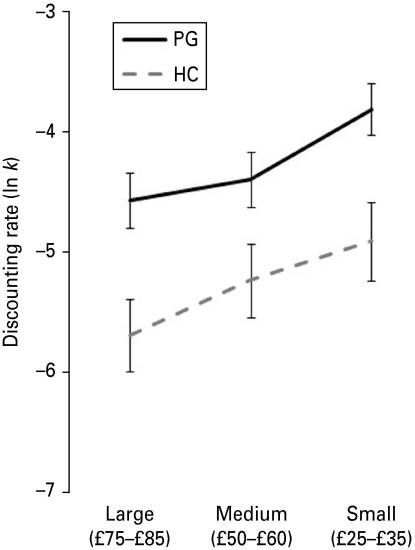
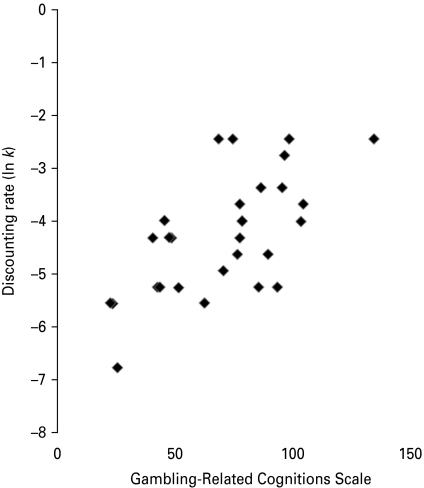
Background: Pathological gambling (PG) is a form of behavioural addiction that has been associated with elevated impulsivity and also cognitive distortions in the processing of chance, probability and skill. We sought to assess the relationship between the level of cognitive distortions and state and trait measures of impulsivity in treatment-seeking pathological gamblers. Method: Thirty pathological gamblers attending the National Problem Gambling Clinic, the first National Health Service clinic for gambling problems in the UK, were compared with 30 healthy controls in a case-control design. Cognitive distortions were assessed using the Gambling-Related Cognitions Scale (GRCS). Trait impulsivity was assessed using the UPPS-P, which includes scales of urgency, the tendency to be impulsive in positive or negative mood states. Delay discounting rates were taken as a state measure of impulsive choice. Results: Pathological gamblers had elevated impulsivity on several UPPS-P subscales but effect sizes were largest (Cohen's d>1.4) for positive and negative urgency. The pathological gamblers also displayed higher levels of gambling distortions, and elevated preference for immediate rewards, compared to controls. Within the pathological gamblers, there was a strong relationship between the preference for immediate rewards and the level of cognitive distortions (R2=0.41). Conclusions: Impulsive choice in the gamblers was correlated with the level of gambling distortions, and we hypothesize that an impulsive decision-making style may increase the acceptance of erroneous beliefs during gambling play.
Overview
The claims and statistics of this paper haven’t been checked yet.
Free: it reads the open-access text and checks the first 5 claims that cite a source we can check. Create a free account to check every claim.
Integrity signals
Registry
Cites
Statistics
Figures
Verification
Claims the paper makes
The claims and statistics of this paper haven’t been checked yet.
Free: it reads the open-access text and checks the first 5 claims that cite a source we can check. Create a free account to check every claim.
Claims other papers make about this one
Each is checked against this paper’s own text: does it say what the citing paper says it does?
The source backs part of the claim, not all of it — or backs it for a different population, condition or comparison.
In the citing paper
“While typical individuals exhibit an increase in gambling motivation in response to near-misses, and overestimate the frequency of one of two equally probable outcomes after a run of the alternate outcome, these effects are increased in those with problematic gambling behaviour (Fortune and Goodie, 2012; Michalczuk et al., 2011).”
From Atypical interoception as a common risk factor for psychopathology: A review (2021) · cites this paper as Michalczuk et al., 2011
Experimental — accuracy not yet measured
Self-check
Percentages, sums and reported differences re-computed from the paper’s own numbers.
The self-check needs the paper’s full text.
Citations
Cites
(1998) · The Journal of Clinical Psychiatry · Cited by 19,139
(1998) · PubMed · Cited by 10,216
The mini international neuropsychiatric interview
Lecrubier, Y., Sheehan, D., Hergueta, T., & Weiller, E. (1998) · European Psychiatry · doi:10.1016/s0924-9338(99)80239-9 · Cited by 5,872
Whiteside, S. P., & Lynam, D. R. (2001) · Personality and Individual Differences · doi:10.1016/s0191-8869(00)00064-7 · Cited by 4,123 · cited 1×
“This construct was initially identified by Whiteside & Lynam (2001) using a composite of the Barratt and Eysenck scales and the Zuckerman Sensation Seeking Scale, and subsequent work by Cyders, Smith and colleagues (Cyders & Smith, 2008 b ) has distinguished positive and negative aspects of urgency.”
Separate neural systems value immediate and delayed monetary rewards
McClure, S. M., Laibson, D. I., Loewenstein, G., & Cohen, J. D. (2004) · Science · doi:10.1126/science.1100907 · Cited by 3,089 · cited 1×
“The resolution of these inter-temporal decisions recruits neural regions, including the ventral striatum and ventromedial prefrontal cortex (McClure et al. 2004 ; Hariri et al. 2006 ; Sellitto et al. 2010), that are implicated in the pathophysiology of problem gambling (Potenza et al.”
(1987) · American Journal of Psychiatry · doi:10.1176/ajp.144.9.1184 · Cited by 2,948
Heroin addicts have higher discount rates for delayed rewards than non-drug-using controls.
Kirby, K. N., Petry, N. M., & Bickel, W. K. (1999) · Journal of Experimental Psychology: General · doi:10.1037/0096-3445.128.1.78 · Cited by 2,171 · cited 5×
“This is in keeping with past personality studies in the general population, which primarily find an association with the Barratt non-planning subscale (Kirby et al. 1999 ; Mobini et al. 2007 ; Koff & Lucas, 2011).”
InfluentialEvenden, J. L. (1999) · Psychopharmacology · doi:10.1007/pl00005481 · Cited by 2,044 · cited 2×
“Rather than being a unidimensional construct, impulsivity is being increasingly viewed as a constellation of traits, including a lack of planning or forethought, reduced perseverance and the seeking of novel or intense sensory experiences (Evenden, 1999; Verdejo-Garcia et al. 2008).”
A pathways model of problem and pathological gambling
Blaszczynski, A., & Nower, L. (2002) · Addiction · doi:10.1046/j.1360-0443.2002.00015.x · Cited by 2,013 · cited 3×
“PG is thought to arise through a combination of biological, social and psychological risk factors (Blaszczynski & Nower, 2002; Sharpe, 2002).”
A Discounting Framework for Choice With Delayed and Probabilistic Rewards.
Green, L., & Myerson, J. (2004) · Psychological Bulletin · doi:10.1037/0033-2909.130.5.769 · Cited by 1,676 · cited 2×
“This is a consistent finding in the behavioural economics literature (Chapman, 1996; Green & Myerson, 2004), and, as in the original study using this measure in heroin addicts (Kirby et al .”
Research works printed but not linked: 1
- Nelson HE Willison J 1991 National Adult Reading Test (NART) Test Manual NFER-Nelson Windsor, UK
Cited by
Items 101–200 of 269
Cognitive distortions among older adult gamblers in an Asian context
Subramaniam, M., Chong, S. A., Browning, C. J., & Thomas, S. A. (2017) · PLoS ONE · doi:10.1371/journal.pone.0178036 · Cited by 31
Jara-Rizzo, M. F., Navas, J. F., Steward, T., López-Gómez, M., Jiménez‐Múrcia, S., Fernández‐Aranda, F., & Perales, J. C. (2018) · Adicciones · doi:10.20882/adicciones.1041 · Cited by 36
Causal Learning in Gambling Disorder: Beyond the Illusion of Control
Perales, J. C., Navas, J. F., de Lara, C. M. R., Maldonado, A., & Catena, A. (2016) · Journal of Gambling Studies · doi:10.1007/s10899-016-9634-6 · Cited by 33
Evaluating the accuracy of alcohol expectancies relative to subjective response to alcohol
Morean, M. E., Corbin, W. R., & Treat, T. A. (2015) · Addictive Behaviors · doi:10.1016/j.addbeh.2015.07.027 · Cited by 31
Lottery ticket and instant win ticket gambling: exploring the distinctions
Short, M. M., Penney, A. M., Mazmanian, D. S., & Jamieson, J. (2015) · Journal of Gambling Issues · doi:10.4309/jgi.2015.30.4 · Cited by 27
Betting on Illusory Patterns: Probability Matching in Habitual Gamblers
Gaissmaier, W., Wilke, A., Scheibehenne, B., McCanney, P., & Barrett, H. C. (2015) · Journal of Gambling Studies · doi:10.1007/s10899-015-9539-9 · Cited by 33
“This precondition also seems to be fulfilled in habitual gamblers: There are many studies showing that they are more prone to act impulsively (e.g., MacLaren et al. 2012; Marmurek et al. 2015; Michalczuk et al. 2011; Miedl et al. 2014).”
BackgroundResultInfluentialMegías‐Robles, A., Navas, J. F., Perandrés‐Gómez, A., Maldonado, A., Catena, A., & Perales, J. C. (2017) · Journal of Gambling Studies · doi:10.1007/s10899-017-9693-3 · Cited by 30
Impulsivity influences betting under stress in laboratory gambling
Canale, N., Rubaltelli, E., Vieno, A., Pittarello, A., & Billieux, J. (2017) · Scientific Reports · doi:10.1038/s41598-017-10745-9 · Cited by 26
Induced sadness increases persistence in a simulated slot machine task among recreational gamblers.
Devos, G., Clark, L., Maurage, P., & Billieux, J. (2018) · Psychology of Addictive Behaviors · doi:10.1037/adb0000364 · Cited by 26
Self-citationCiccarelli, M., Nigro, G., Griffiths, M. D., D’Olimpio, F., & Cosenza, M. (2019) · Journal of Gambling Studies · doi:10.1007/s10899-019-09872-x · Cited by 28
A model-based analysis of impulsivity using a slot-machine gambling paradigm
Paliwal, S., Petzschner, F. H., Schmitz, A. K., Tittgemeyer, M., & Stephan, K. E. (2014) · Frontiers in Human Neuroscience · doi:10.3389/fnhum.2014.00428 · Cited by 33
“These deficits correlate mainly with cognitive distortions, suggesting that differences in the underlying belief structure of a gambler might contribute to the types of impulsivity we see in disordered gambling (Michalczuk et al., 2011).”
Backgroundde Lara, C. M. R., Navas, J. F., Soriano‐Mas, C., Sescousse, G., & Perales, J. C. (2018) · International Gambling Studies · doi:10.1080/14459795.2018.1448427 · Cited by 28
“…does support the decisive relevance of NU in GD, with PGD exhibiting particularly high scores in this aspect of impulsivity (Albein-Urios, Martinez-González, Lozano, Clark, & Verdejo-García, 2012; Billieux et al., 2012; MacLaren, Fugelsang, Harrigan, & Dixon, 2011; Michalczuk et al., 2011).”
BackgroundCocker, P. J., Tremblay, M., Kaur, S., & Winstanley, C. A. (2016) · Psychopharmacology · doi:10.1007/s00213-016-4447-y · Cited by 28
Effects of a high-fat diet on impulsive choice in rats
Garman, T. S., Setlow, B., & Orsini, C. A. (2020) · Physiology & Behavior · doi:10.1016/j.physbeh.2020.113260 · Cited by 25
“Although these two aspects of impulsivity are considered to be largely independent of one another, with distinct although overlapping neural substrates [8-12], there is some evidence that in clinical populations, such as those diagnosed with gambling disorder, these two facets of impulsivity not only correlate with th…”
BackgroundImpulsivity and loot box engagement
Garrett, E. P., Drummond, A., Lowe-Calverley, E., de Salas, K., Lewis, I., & Sauer, J. D. (2023) · Telematics and Informatics · doi:10.1016/j.tele.2023.101952 · Cited by 26
Impulsivity and Gambling Type Among Treatment-Seeking Disordered Gamblers: An Explorative Study
Lutri, V., Soldini, E., Ronzitti, S., Smith, N. T., Clerici, M., Blaszczynski, A. P., & Bowden‐Jones, H. (2018) · Journal of Gambling Studies · doi:10.1007/s10899-018-9764-0 · Cited by 28
Self-citationFlórez, G., Sáiz, P. A., Martínez-Santamaría, E., Álvarez, S., Nogueiras, L., & Arrojo, M. (2016) · Psychiatry Research · doi:10.1016/j.psychres.2016.08.039 · Cited by 27
“Another important issue is that, in patients treated for pathological gambling, impulsivity is related to cognitive distortions so that an impulsive decision-making style might increase the chance of unquestioning acceptance of erroneous beliefs (Michalczuk et al., 2011).”
InfluentialDelay Discounting in Gambling Disorder: Implications in Treatment Outcome
Mena-Moreno, T., Testa, G., Mestre‐Bach, G., Miranda‐Olivos, R., Granero, R., Fernández‐Aranda, F., Menchón, J. M., & Jiménez‐Múrcia, S. (2022) · Journal of Clinical Medicine · doi:10.3390/jcm11061611 · Cited by 27
Cognitive distortions and gambling near-misses in Internet Gaming Disorder: A preliminary study
Wu, Y., Sescousse, G., Yu, H., Clark, L., & Li, H. (2018) · PLoS ONE · doi:10.1371/journal.pone.0191110 · Cited by 24
Self-citationSuperstitious beliefs and the associative mind
Daprati, E., Sirigu, A., Desmurget, M., & Nico, D. (2019) · Consciousness and Cognition · doi:10.1016/j.concog.2019.102822 · Cited by 23
Inactivation of the orbitofrontal cortex reduces irrational choice on a rodent Betting Task
Barrus, M. M., Hosking, J. G., Cocker, P. J., & Winstanley, C. A. (2016) · Neuroscience · doi:10.1016/j.neuroscience.2016.02.028 · Cited by 25
Living in the Now: Decision-Making and Delay Discounting in Adolescent Gamblers
Nigro, G., & Cosenza, M. (2016) · Journal of Gambling Studies · doi:10.1007/s10899-016-9595-9 · Cited by 22
Weidacker, K., Johnston, S. J., Mullins, P. G., Boy, F., & Dymond, S. (2019) · European Neuropsychopharmacology · doi:10.1016/j.euroneuro.2019.12.110 · Cited by 22
Nonmonetary Decision-Making Indices Discriminate Between Different Behavioral Components of Gambling
Navas, J. F., Torres, A., Vilar‐López, R., Verdejo‐García, A., Catena, A., & Perales, J. C. (2014) · Journal of Gambling Studies · doi:10.1007/s10899-014-9482-1 · Cited by 22
Impulsivity profiles in pathological slot machine gamblers
Aragay, N., Barrios, M., Ramírez-Gendrau, I., Garcia-Caballero, A., Garrido, G., Ramos-Grille, I., Galindo, Y., Martin-Dombrowski, J., & Vallès, V. (2018) · Comprehensive Psychiatry · doi:10.1016/j.comppsych.2018.03.008 · Cited by 24
Sharman, S., Clark, L., Roberts, A. D. L., Michalczuk, R., Cocks, R., & Bowden‐Jones, H. (2019) · Frontiers in Psychiatry · doi:10.3389/fpsyt.2019.00588 · Cited by 21
Self-citationBonnaire, C., Devos, G., Barrault, S., Grall‐Bronnec, M., Luminet, O., & Billieux, J. (2022) · Journal of Behavioral Addictions · doi:10.1556/2006.2022.00055 · Cited by 20
Limbrick‐Oldfield, E. H., Mick, I., Cocks, R., Flechais, R., Turton, S., Lingford-Hughes, A. R., Bowden‐Jones, H., & Clark, L. (2019) · Neuropsychopharmacology · doi:10.1038/s41386-019-0534-1 · Cited by 21
Self-citationTo Play or Not to Play? An Analysis of Dispositions, Gambling, and Daily Fantasy Sport
Dwyer, B., Drayer, J., & Shapiro, S. L. (2019) · Journal of Sport Management · doi:10.1123/jsm.2018-0115 · Cited by 27
“It is important to note that the impulsivity scale is a single scale but it is made up of four distinct dimensions, which may connect uniquely to cognitive distortions and problem behavior (Michalczuk et al., 2011).”
BackgroundEffect of a Brief Meditation Intervention on Gambling Cravings and Rates of Delay Discounting
Shead, N. W., Champod, A. S., & MacDonald, A. (2019) · International Journal of Mental Health and Addiction · doi:10.1007/s11469-019-00133-x · Cited by 21
An exploratory study of the role played by hedonic dysregulation in gambling disorder
Velotti, P., & Rogier, G. (2020) · International Gambling Studies · doi:10.1080/14459795.2020.1784977 · Cited by 19
“Along the same lines, past studies showed that, compared to Negative Urgency, Positive Urgency correlated more strongly with GD’s severity (Blain et al., 2015) and cognitive biases (Michalczuk et al., 2011).”
ResultGranero, R., Fernández‐Aranda, F., Valero-Solís, S., del Pino‐Gutiérrez, A., Mestre‐Bach, G., Baenas, I., Contaldo, S. F., Gómez‐Peña, M., Aymamí, N., Moragas, L., et al. (2020) · Journal of Behavioral Addictions · doi:10.1556/2006.2020.00028 · Cited by 19
Jara-Rizzo, M. F., Navas, J. F., Rodas, J. A., & Perales, J. C. (2020) · BMC Psychology · doi:10.1186/s40359-020-00482-6 · Cited by 19
Brain networks alterations in cocaine use and gambling disorders during emotion regulation
Picó‐Pérez, M., Costumero, V., Verdejo‐Román, J., Albein‐Urios, N., Martínez-González, J. M., Soriano‐Mas, C., Barrós‐Loscertales, A., & Verdejo‐García, A. (2022) · Journal of Behavioral Addictions · doi:10.1556/2006.2022.00018 · Cited by 19
Reactive and proactive control mechanisms of response inhibition in gambling disorder
Sharif-Razi, M., Hodgins, D. C., & Goghari, V. M. (2018) · Psychiatry Research · doi:10.1016/j.psychres.2018.12.049 · Cited by 17
Merkouris, S., Greenwood, C. J., Manning, V., Oakes, J., Rodda, S. N., Lubman, D. I., & Dowling, N. (2019) · Addictive Behaviors · doi:10.1016/j.addbeh.2019.106257 · Cited by 16
Interoception and respiratory sinus arrhythmia in gambling disorder
Kennedy, D., Goshko, C., Murch, W. S., Limbrick‐Oldfield, E. H., Dunn, B. D., & Clark, L. (2019) · Psychophysiology · doi:10.1111/psyp.13333 · Cited by 17
Self-citationGambling and Homelessness: Prevalence and Pathways
Sharman, S. (2019) · Current Addiction Reports · doi:10.1007/s40429-019-00242-6 · Cited by 16
A Comparison of Self-Reported Impulsivity in Gambling Disorder and Bipolar Disorder
Shakeel, M. K., Hodgins, D. C., & Goghari, V. M. (2018) · Journal of Gambling Studies · doi:10.1007/s10899-018-9808-5 · Cited by 18
Impulsivity and Cognitive Distortions in Problem Gambling
Lindberg, A., Clark, L., & Bowden‐Jones, H. (2014) · Palgrave Macmillan UK eBooks · doi:10.1057/9781137272423.0018 · Cited by 18
Self-citationCognitive factors in gambling disorder, a behavioral addiction
Brooks, G. A., Ferrari, M. A., & Clark, L. (2019) · Elsevier eBooks · doi:10.1016/b978-0-12-815298-0.00015-0 · Cited by 16
Self-citationBellés, L., Arrondeau, C., Urueña‐Méndez, G., & Ginovart, N. (2022) · Pharmacology Biochemistry and Behavior · doi:10.1016/j.pbb.2022.173508 · Cited by 14
Sancho, M., Bonnaire, C., Costa, S., Casalé-Salayet, G., Igual, J. V., Rodríguez, R. C., Duran‐Sindreu, S., & Trujols, J. (2021) · International Journal of Environmental Research and Public Health · doi:10.3390/ijerph18094869 · Cited by 16
“[42], gamblers’ impulsive choice correlates with gambling distortions’ level.”
BackgroundResultWhen Humans and Other Animals Behave Irrationally
Zentall, T. R. (2016) · Comparative Cognition & Behavior Reviews · doi:10.3819/ccbr.2016.110002 · Cited by 13
Mastropietro, S., Favieri, F., Forte, G., Locuratolo, N., Mannarelli, D., Pauletti, C., Fattapposta, F., & Casagrande, M. (2022) · International Journal of Mental Health and Addiction · doi:10.1007/s11469-022-00906-x · Cited by 15
“Subcomponents of impulsivity, including low inhibitory control, play a role in gambling, food addiction, and other potentially addictive behaviors (Billieux et al., 2012; Canale et al., 2016; Fischer et al., 2008; Grall-Bronnec et al., 2012; Michalczuk et al., 2011; Savvidou et al., 2017; Kelly et al., 2014; Mikheeva…”
Muela, I., Ventura-Lucena, J. M., Navas, J. F., & Perales, J. C. (2023) · Journal of Behavioral Addictions · doi:10.1556/2006.2023.00009 · Cited by 14
“, 2020; Navas et al., 2019), the transdiagnostic nature of negative urgency would make people with disordered gambling more vulnerable to other conditions (especially in the high end of the externalizing continuum), increasing the risk of clinical complications not necessarily caused by gambling itself. That said, the…”
MethodResultDunsmuir, P., Smith, D., Fairweather‐Schmidt, A. K., Riley, B. J., & Battersby, M. (2018) · Psychiatry Research · doi:10.1016/j.psychres.2018.02.028 · Cited by 14
“Thus, urge is postulated to associate with poor emotion regulation and deficient coping strategies (Michalczuk et al., 2011; Moccia et al., 2017; Williams et al., 2012).”
Martínez-Fernández, V., Irles, D. L., & Segura, J. (2018) · Revista de Psicología Clínica con Niños y Adolescentes · doi:10.21134/rpcna.2018.05.3.1 · Cited by 18
Intuition in Mathematical and Probabilistic Reasoning
Morsanyi, K., & Szűcs, D. (2014) · Oxford University Press eBooks · doi:10.1093/oxfordhb/9780199642342.013.016 · Cited by 15
Smith, D., Woodman, R. J., Drummond, A., & Battersby, M. (2016) · Psychiatry Research · doi:10.1016/j.psychres.2016.02.002 · Cited by 13
“The instrument has been used in a range of gambling help settings for both treatment screening and outcome assessment, for example, (Michalczuk et al., 2011; Oei and Gordon, 2008; Oei and Raylu, 2015; Smith et al., 2010; Smith et al., 2015).”
MethodAssessing the role of impulsivity in smoking & non-smoking disordered gamblers
Boothby, C. A., Kim, H. S. A., Romanow, N. K., Hodgins, D. C., & McGrath, D. S. (2017) · Addictive Behaviors · doi:10.1016/j.addbeh.2017.02.002 · Cited by 16
Cocker, P. J., Lin, M.-Y., Tremblay, M., Kaur, S., & Winstanley, C. A. (2018) · European Journal of Neuroscience · doi:10.1111/ejn.14070 · Cited by 13
“The therapeutic benefit of Li for the treatment of GD may therefore arise via suppression of behaviours such as impulsivity that confer vulnerability towards the development of some types of GD (Michalczuk et al., 2011).”
BackgroundFarstad, S. M., & von Ranson, K. M. (2021) · Canadian Journal of Behavioural Science/Revue canadienne des sciences du comportement · doi:10.1037/cbs0000239 · Cited by 13
Durao, M., Etchezahar, E. D., Ungaretti, J., & Calligaro, C. (2021) · Actualidades en Psicología · doi:10.15517/ap.v35i130.41963 · Cited by 17
“Es decir, la impulsividad precederá y se encontraría en la base de un comportamiento impulsivo que llevaría a falta de control de la conducta (Verdejo-García et al., 2008; Belin et al., 2011; Papachristou et al., 2012; Everitt et al., 2008; Hogarth, 2011; Michalczuk et al., 2011).”
BackgroundDiscrete Roles for Impulsivity and Compulsivity in Gambling Disorder
Mestre‐Bach, G., Steward, T., Balodis, I. M., DeVito, E. E., Yip, S. W., George, T. P., Reynolds, B. A., Granero, R., Fernández‐Aranda, F., Jiménez‐Múrcia, S., et al. (2021) · Frontiers in Psychiatry · doi:10.3389/fpsyt.2021.789940 · Cited by 14
Impulse and reason? Justifications in problem gambling
Wu, R., & Clark, L. (2024) · Addictive Behaviors · doi:10.1016/j.addbeh.2024.108072 · Cited by 11
Self-citationImpulsividad y adicción a los videojuegos
Irles, D. L., & Morell-Gomis, R. (2016) · African journal of rhetoric · doi:10.21134/haaj.v16i1.255 · Cited by 15
High Rollers: Correlates of Problematic Cocaine Use Among a Community Sample of Gamblers
Ethier, A. R., Kim, H. S. A., Hodgins, D. C., & McGrath, D. S. (2020) · Journal of Gambling Studies · doi:10.1007/s10899-020-09943-4 · Cited by 11
Bonnaire, C., & Billieux, J. (2022) · International Gambling Studies · doi:10.1080/14459795.2022.2102203 · Cited by 12
“(e.g. Challet-Bouju et al., 2017; Cunningham et al., 2014; Devos et al., 2020; Labrador et al., 2020; Michalczuk et al., 2011; Navas et al., 2017; Raylu & Oei, 2004).”
BackgroundTedford, S. E., Holtz, N. A., Persons, A. L., & Napier, T. C. (2014) · Frontiers in Behavioral Neuroscience · doi:10.3389/fnbeh.2014.00215 · Cited by 12
Impulsiveness and Inhibitory Mechanisms
Bari, A., Kellermann, T. S., & Studer, B. (2016) · Elsevier eBooks · doi:10.1016/b978-0-12-800935-2.00006-3 · Cited by 13
Yang, Y., Zhong, X. B., Wu, D., Li, H., & Li, M. (2016) · Psychiatry Research · doi:10.1016/j.psychres.2016.04.110 · Cited by 14
The Role of Aging, Time Perspective, and Gambling-Related Cognitions in Affective Decision-Making
Cosenza, M., Ciccarelli, M., Matarazzo, O., Griffiths, M. D., & Nigro, G. (2023) · International Journal of Mental Health and Addiction · doi:10.1007/s11469-023-01046-6 · Cited by 10
“However, considering that disordered gamblers have been found to report more gambling-related cognitive distortions than non-gamblers (e.g., Michalczuk et al., 2011), gambling involvement could be a potential confounder.”
An Animal Model of Human Gambling
Zentall, T. R. (2016) · International journal of psychological research · doi:10.21500/20112084.2284 · Cited by 10
“It has been proposed that the mechanism responsible for the suboptimal choice involved in gambling is likely to be impulsivity (Michalczuk et al., 2011; Nower and Blaszczynski, 2006).”
BackgroundDonati, M. A., Derevensky, J. L., Cipollini, B., Leonardo, L. D., Sareri, G. I., & Primi, C. (2021) · Journal of Gambling Studies · doi:10.1007/s10899-021-10053-y · Cited by 10
Rivero, F. J., Muela, I., Navas, J. F., Blanco, I., Martín-Pérez, C., Rodas, J. A., Jara-Rizzo, M. F., Brevers, D., & Perales, J. C. (2023) · Cyberpsychology Journal of Psychosocial Research on Cyberspace · doi:10.5817/cp2023-3-4 · Cited by 14
“Actually, several studies have pitched negative urgency against positive urgency as predictors of severity of potentially problematic or addictive behaviors (see, for example, Michalczuk et al., 2011; Navas, Contreras‐ Rodríguez et al., 2017; for a short review see Muela et al., 2023).”
Gambling Disorder and Substance-Related Disorders: Similarities and Differences
Goudriaan, A. E., van den Brink, W., & van Holst, R. J. (2019) · Springer eBooks · doi:10.1007/978-3-030-03060-5_12 · Cited by 15
Shi, W., & Li, N. (2023) · Frontiers in Psychology · doi:10.3389/fpsyg.2023.1089608 · Cited by 10
Hungry Ghosts Eat Casino Chips: Associations Between Dispositional Greed and Gambling
Weller, J. A., Zeelenberg, M., & Summers, B. A. (2025) · Personality and Social Psychology Bulletin · doi:10.1177/01461672251315200 · Cited by 10
“…largely focused on higher-order trait dimensions, such as the Big Five (Dudfield et al., 2023; Strømme et al., 2021), or on narrower traits related to risk-taking, such as those related to sensation-seeking and self-control (e.g., Canale et al., 2015; Cyders & Smith, 2008; Michalczuk et al., 2011).”
Association between endocrine and neuropsychological endophenotypes and gambling disorder severity
Mora‐Maltas, B., Baenas, I., Etxandi, M., Lucas, I., Granero, R., Fernández‐Aranda, F., Tovar, S. A., Solé‐Morata, N., Gómez‐Peña, M., Moragas, L., et al. (2024) · Addictive Behaviors · doi:10.1016/j.addbeh.2024.107968 · Cited by 9
“An amount of literature supports that positive and negative urgencies are linked with gambling-related cognitive distortions (Del Prete et al., 2017; Michalczuk et al., 2011) and with DSM-5 criteria (Vintr ´ o-Alcaraz et al., 2022).”
BackgroundThe gambler’s fallacy in problem and non-problem gamblers
Matarazzo, O., Carpentieri, M., Greco, C., & Pizzini, B. (2019) · Journal of Behavioral Addictions · doi:10.1556/2006.8.2019.66 · Cited by 12
Muela, I., Navas, J. F., & Perales, J. C. (2021) · Frontiers in Psychology · doi:10.3389/fpsyg.2020.611784 · Cited by 11
“A detailed review of the role of executive functions related to cognitive control in gambling problems, and its neurobiological correlates, can be found at Moccia et al. (2017).”
BackgroundValenciano‐Mendoza, E., Fernández‐Aranda, F., Granero, R., Vintró‐Alcaraz, C., Mora‐Maltas, B., Valero-Solís, S., Sánchez, I., Toro, J. J., Gómez‐Peña, M., Moragas, L., et al. (2022) · Journal of Behavioral Addictions · doi:10.1556/2006.2022.00072 · Cited by 12
Decision-Making in Gambling Disorder
Clark, L. (2016) · Elsevier eBooks · doi:10.1016/b978-0-12-805308-9.00027-0 · Cited by 13
Self-citationTreatment of problem gambling: development, status, and future
Wynn, J., Hudyma, A., Hauptman, E., Houston, T. N., & Faragher, J. M. (2014) · Drugs and Alcohol Today · doi:10.1108/dat-10-2013-0044 · Cited by 12
Neurophysiological Correlates of Near-Wins in Gambling: A Systematic Literature Review
Dores, A. R., Peixoto, M., Fernandes, C., Geraldo, A., Griffiths, M. D., & Barbosa, F. (2024) · Journal of Gambling Studies · doi:10.1007/s10899-024-10327-1 · Cited by 9
“Besides the risk posed, dysfunctional cognitions can also lead to a higher need of immediate rewards, to more impulsive gambling behavior (MacLaren et al., 2015; Michalczuk et al., 2011), and to increased gambling motivation (Mathieu et al., 2018).”
Mahdavi, A., Mansureh, H.-H., Lavasani, M. G., Elaheh, H., Nili, M.-H. H. K., Yamin, B. D., & Vahabie, A. (2023) · Journal of Attention Disorders · doi:10.1177/10870547231155436 · Cited by 8
“Thus, an impulsive decision-making style increases the probability of accepting incorrect beliefs without any questioning (Ciobotaru & Clinciu, 2022; Michalczuk et al., 2011).”
BackgroundPathways to understanding problem gambling among adolescents
Lee, H. J., & Lee, G. (2025) · BMC Public Health · doi:10.1186/s12889-025-23213-1 · Cited by 10
“However, many studies have identified impulsivity as a predictor variable for problem gambling [25, 43, 41].”
Mehdipour, F., Rafiepoor, A., & Alizadeh, K. H. (2017) · Zahedan Journal of Research in Medical Sciences · doi:10.5812/zjrms.10609 · Cited by 10
“[44], all patients especially those afflicted with refractory diseases have many dysfunctional attitudes and destructive thought patterns.”
BackgroundBrooks, G. A., & Clark, L. (2022) · Journal of Behavioral Addictions · doi:10.1556/2006.2022.00021 · Cited by 10
Self-citation“Should’ve known better”: Counterfactual processing in disordered gambling
Wu, Y., Kennedy, D., Goshko, C., & Clark, L. (2020) · Addictive Behaviors · doi:10.1016/j.addbeh.2020.106622 · Cited by 10
Self-citationImpulsivity, Consciousness and Defense Mechanisms of the Ego Among Pathological Gamblers
Ciobotaru, C. M., & Clinciu, A. I. (2021) · Journal of Gambling Studies · doi:10.1007/s10899-021-10035-0 · Cited by 8
“Impulsivity is related to cognitive distortions, so an impulsive decision-making style increases the chance of accepting erroneous beliefs without any further questions (Michalczuk et al., 2011).”
BackgroundGambling and Impulsivity: An Exploratory Study in a French Adolescent Population
Romo, L., Kotbagi, G., Platey, S., Coëffec, A., Boz, F., & Kern, L. (2014) · Open Journal of Medical Psychology · doi:10.4236/ojmp.2014.34032 · Cited by 8
“Resulting in difficulty in self-regulation, it has on numerous occasions been scientifically correlated with pathological gambling [8] [23] [24] and has been recognized as a predictor of severity of pathological gambling [25]-[28].”
BackgroundProblematic gaming use and psychological distress among Spanish young adults: A comprehensive study
Suárez-Soto, E., la Hoz, A. P.-D., Sánchez-Fernández-Quejo, A., Rodríguez-Toscano, E., Lagunas, N., Reneses, B., & de la Torre‐Luque, A. (2024) · The European Journal of Psychiatry · doi:10.1016/j.ejpsy.2024.100279 · Cited by 7
“In this regard, a study conducted by Michalczuk et al. 65 indicated that urgency dimensions (i.e., negative and positive urgency) were strongly linked to gambling behaviors.”
Pathological Gambling among Italian Nursing Students
Cicolini, G., Pelle, C. D., Simonetti, V., Comparcini, D., Sepede, G., & Cipollone, F. (2017) · Archives of Psychiatric Nursing · doi:10.1016/j.apnu.2017.11.020 · Cited by 8
Turek, A., Machalska, K., Chrobak, A. A., Siwek, M., & Dudek, D. (2020) · Psychiatria Polska · doi:10.12740/pp/onlinefirst/110472 · Cited by 8
“The presented results are consistent with the previously described research on bipolar disorder spectrum and pathological gambling, and indicate the possibility of including affective temperamental traits and bipolarity spectrum in pathological gambling research [7, 8, 16, 20, 21].”
BackgroundResultZaher, A., Mourad, G. M., & Ibrahim, F. M. (2025) · BMC Psychology · doi:10.1186/s40359-025-03560-9 · Cited by 6
“Similarly, Michalczuk et al. [27], who reported that diminished frustration tolerance predicted impulsive behavior and relapse in SUD patients.”
Bresin, K., & Mekawi, Y. (2022) · Substance Use & Misuse · doi:10.1080/10826084.2022.2026966 · Cited by 6
“It should be noted that gambling has been shown to be significantly positively related to negative urgency in prior studies (e.g., Michalczuk et al., 2011).”
ResultPilatti, A., Cupani, M., Tuzinkievich, F. B., & Winfree, W. R. (2016) · Addictive Behaviors Reports · doi:10.1016/j.abrep.2016.09.001 · Cited by 7
“A greater level of these cognitive distortions is related to greater severity of gambling, not only among clinical disordered gamblers (Michalczuk et al., 2011;Winfree et al., 2015), but also among non-clinical adolescents (Donati et al.”
BackgroundImpulsiveness in Alcohol Addiction and Pathological Gambling
Bodor, D., Tomić, A., Ricijaš, N., & Filipčić, I. (2016) · Alcoholism and psychiatry research Journal on psychiatric research and addictions · doi:10.20471/apr.2016.52.02.05 · Cited by 7
“The significant difference between the afore-mentioned two groups was in the lack of planning and lack of persistence while the part related to sensation seeking did not differ [41].”
BackgroundDisordered Gambling: The Effects of a Brief, Online Cognitive Intervention in an Australian Sample
Ellison, L. J., Vale, K., & Ladouceur, R. (2017) · OALib · doi:10.4236/oalib.1103288 · Cited by 7
“Previous results have identified specific unhelpful cognitions and thought processes which underlie dysfunctional gambling behaviours, particularly those relating to luck, chance and skill [10] [13].”
BackgroundResultComprensión y tratamiento del juego patológico: aportaciones desde la Neurociencia del Aprendizaje
Navas, J. F., & Perales, J. C. (2014) · Clínica y Salud · doi:10.1016/j.clysa.2014.10.001 · Cited by 14
Betting on Your Feelings: The Interplay between Emotion and Cognition in Gambling Affective Task
Mari, E., Cricenti, C., Boccia, M., Zucchelli, M. M., Nori, R., Piccardi, L., Giannini, A. M., & Quaglieri, A. (2024) · Journal of Clinical Medicine · doi:10.3390/jcm13102990 · Cited by 6
The “Problem Gambler” and Socio-Spatial Vulnerability
Welsh, M., Jones, R. A., Pykett, J., & Whitehead, M. (2014) · Palgrave Macmillan UK eBooks · doi:10.1057/9781137272423_8 · Cited by 7
Pilatti, A., Michelini, Y., & Pautassi, R. M. (2020) · CES Psicología · doi:10.21615/cesp.13.2.4 · Cited by 6
Illusion of Control and Problem Gambling Among Chinese Lottery Gamblers
Hu, Y., & Zhao, D. (2024) · International Journal of Mental Health and Addiction · doi:10.1007/s11469-024-01325-w · Cited by 5
Gambling and Personality Dimensions
Odlaug, B. L., & Chamberlain, S. R. (2013) · Current Behavioral Neuroscience Reports · doi:10.1007/s40473-013-0002-x · Cited by 7
Animal Models of Gambling-Related Behaviour
Cocker, P. J., & Winstanley, C. A. (2019) · Springer eBooks · doi:10.1007/978-3-030-03060-5_6 · Cited by 5
Haag, D., Meyer, A., Boumparis, N., Wenger, A., Baumgartner, C., Malischnig, D., Keough, M. T., Hodgins, D. C., Khazaal, Y., Haug, S., et al. (2025) · Journal of Gambling Studies · doi:10.1007/s10899-025-10458-z · Cited by 4
“…cross-sectional studies that gamblers exhibit greater impulsivity in temporal decision making and discount future rewards more steeply (Albein-Urios et al., 2014; Amlung et al., 2017; Dixon et al., 2003; Krmpotich et al., 2015; Michalczuk et al., 2011; Petry & Casarella, 1999; Ring et al., 2022).”
Classification of response inhibition measures: a proposal for a two-dimensional taxonomy
Colautti, L., Iannello, P., Antonietti, A., & Cancer, A. (2025) · Current Psychology · doi:10.1007/s12144-025-07486-8 · Cited by 7
Metadata
- Authors
- Michalczuk, R., Bowden-Jones, H., Verdejo-Garcia, A., & Clark, L.
- Affiliations
- University of Cambridge (GB)
- Corresponding author
- Clark, L.
- ORCID
- Clark, L.
- Venue
- Psychological Medicine
- Publisher
- Cambridge University Press (CUP)
- Published
- 2011-06-29
- Volume
- 41
- Issue
- 12
- Pages
- 2625-2635
- ISSN
- 0033-2917 (ISSN-L)
- 1469-8978
- PMC
- PMC3206226
- OpenAlex
- W1973481178
- Cited by
- 248
- References
- 83
- Citations by year
- 2026: 4 · 2025: 8 · 2024: 7 · 2023: 13 · 2022: 12 · 2021: 15 · 2020: 17 · 2019: 28 · 2018: 25 · 2017: 18 · 2016: 32 · 2015: 21 · 2014: 23 · 2013: 12 · 2012: 11
- FWCI
- 16.53
- Type
- journal article
- Language
- en
- Open access
- hybrid
- doi.org
- Licence
- cc-by-nc-sa
- www.cambridge.org/core/terms (unspecified)
- Locations
- Psychological Medicine (publishedVersion, cc-by-nc-sa)
- Europe PMC (PubMed Central) (publishedVersion, cc-by-nc-sa)
- PubMed Central (publishedVersion, cc-by-nc-sa)
- PubMed (publishedVersion)
- UCL Discovery (University College London) (submittedVersion)
- Funders
- Wellcome Trust (093875)
- Society for the Study of Addiction
- Medical Research Council (G0802725)
- Topics
- Social Sciences › Psychology › Clinical Psychology › Gambling Behavior and Treatments
- Social Sciences › Decision Sciences › General Decision Sciences › Decision-Making and Behavioral Economics
- Health Sciences › Medicine › Epidemiology › Substance Abuse Treatment and Outcomes
- Keywords
- gambling addiction, impulsivity, cognitive distortions, delay discounting, impulsive choice, urgency, positive urgency, negative urgency, UPPS-P, treatment-seeking gamblers, behavioral addiction
- MeSH terms
- Adult, Cognition Disorders, Female, Gambling, United Kingdom, Humans, Impulsive Behavior, Male, Middle Aged, Psychiatric Status Rating Scales, Psychological Tests, Psychotherapy, Reward, Case-Control Studies, Young Adult
About these checks
Registry, retraction, Cites and statistics results are computed, not judged, with one exception: a printed reference that no index lists is read once by a model before it counts as a citation error. Claims are extracted by a model and kept only when their quote appears verbatim in the text; each cited source is then checked, with a model’s help, for whether it says what the claim relies on. Those verdicts can be wrong — read the claim’s quote and the cited source before relying on one.
Statistics and arithmetic are recomputed, not judged.
Confidence bands are shown only for fields calibrated on our annotated test set. None is calibrated yet, so no band is shown.
What counts as a claim ›How we measure confidence ›How we check this ›
Are you an author, or do you see a problem with this page? Request a review
Data sources
Bibliographic data: Semantic Scholar, OpenAlex, Crossref.
Contains information from the Semantic Scholar Academic Graph Datasets, made available under the ODC Attribution License (ODC-BY 1.0).
Semantic Scholar’s data is described in: Kinney, R., et al. (2023). The Semantic Scholar Open Data Platform. arXiv:2301.10140.
