

Impulsivity and cognitive distortions in pathological gamblers attending the UK National Problem Gambling Clinic: a preliminary report
Open accessThe DOI matches its Crossref record; 82 of the 83 references it cites were found in a registry or an index.
Abstract
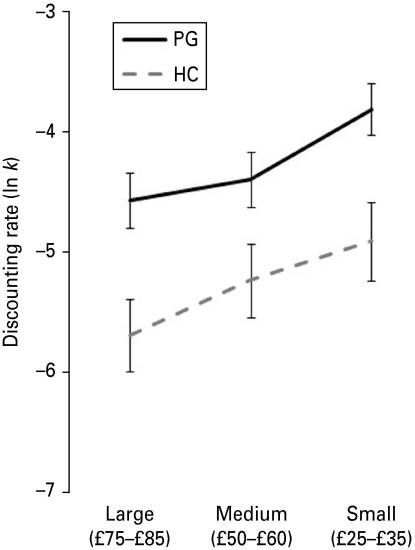
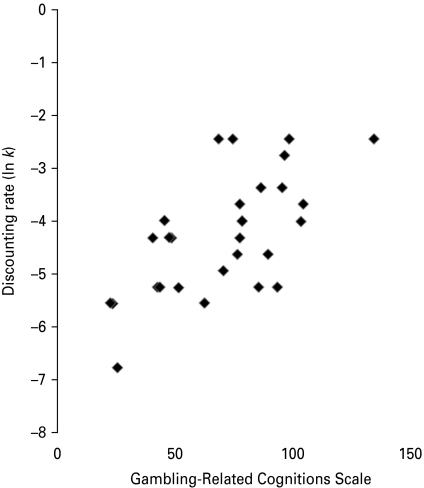
Background: Pathological gambling (PG) is a form of behavioural addiction that has been associated with elevated impulsivity and also cognitive distortions in the processing of chance, probability and skill. We sought to assess the relationship between the level of cognitive distortions and state and trait measures of impulsivity in treatment-seeking pathological gamblers. Method: Thirty pathological gamblers attending the National Problem Gambling Clinic, the first National Health Service clinic for gambling problems in the UK, were compared with 30 healthy controls in a case-control design. Cognitive distortions were assessed using the Gambling-Related Cognitions Scale (GRCS). Trait impulsivity was assessed using the UPPS-P, which includes scales of urgency, the tendency to be impulsive in positive or negative mood states. Delay discounting rates were taken as a state measure of impulsive choice. Results: Pathological gamblers had elevated impulsivity on several UPPS-P subscales but effect sizes were largest (Cohen's d>1.4) for positive and negative urgency. The pathological gamblers also displayed higher levels of gambling distortions, and elevated preference for immediate rewards, compared to controls. Within the pathological gamblers, there was a strong relationship between the preference for immediate rewards and the level of cognitive distortions (R2=0.41). Conclusions: Impulsive choice in the gamblers was correlated with the level of gambling distortions, and we hypothesize that an impulsive decision-making style may increase the acceptance of erroneous beliefs during gambling play.
Overview
The claims and statistics of this paper haven’t been checked yet.
Free: it reads the open-access text and checks the first 5 claims that cite a source we can check. Create a free account to check every claim.
Integrity signals
Registry
Cites
Statistics
Figures
Verification
Claims the paper makes
The claims and statistics of this paper haven’t been checked yet.
Free: it reads the open-access text and checks the first 5 claims that cite a source we can check. Create a free account to check every claim.
Claims other papers make about this one
Each is checked against this paper’s own text: does it say what the citing paper says it does?
The source backs part of the claim, not all of it — or backs it for a different population, condition or comparison.
In the citing paper
“While typical individuals exhibit an increase in gambling motivation in response to near-misses, and overestimate the frequency of one of two equally probable outcomes after a run of the alternate outcome, these effects are increased in those with problematic gambling behaviour (Fortune and Goodie, 2012; Michalczuk et al., 2011).”
From Atypical interoception as a common risk factor for psychopathology: A review (2021) · cites this paper as Michalczuk et al., 2011
Experimental — accuracy not yet measured
Self-check
Percentages, sums and reported differences re-computed from the paper’s own numbers.
The self-check needs the paper’s full text.
Citations
Cites
(1998) · The Journal of Clinical Psychiatry · Cited by 19,139
(1998) · PubMed · Cited by 10,216
The mini international neuropsychiatric interview
Lecrubier, Y., Sheehan, D., Hergueta, T., & Weiller, E. (1998) · European Psychiatry · doi:10.1016/s0924-9338(99)80239-9 · Cited by 5,872
Whiteside, S. P., & Lynam, D. R. (2001) · Personality and Individual Differences · doi:10.1016/s0191-8869(00)00064-7 · Cited by 4,123 · cited 1×
“This construct was initially identified by Whiteside & Lynam (2001) using a composite of the Barratt and Eysenck scales and the Zuckerman Sensation Seeking Scale, and subsequent work by Cyders, Smith and colleagues (Cyders & Smith, 2008 b ) has distinguished positive and negative aspects of urgency.”
Separate neural systems value immediate and delayed monetary rewards
McClure, S. M., Laibson, D. I., Loewenstein, G., & Cohen, J. D. (2004) · Science · doi:10.1126/science.1100907 · Cited by 3,089 · cited 1×
“The resolution of these inter-temporal decisions recruits neural regions, including the ventral striatum and ventromedial prefrontal cortex (McClure et al. 2004 ; Hariri et al. 2006 ; Sellitto et al. 2010), that are implicated in the pathophysiology of problem gambling (Potenza et al.”
(1987) · American Journal of Psychiatry · doi:10.1176/ajp.144.9.1184 · Cited by 2,948
Heroin addicts have higher discount rates for delayed rewards than non-drug-using controls.
Kirby, K. N., Petry, N. M., & Bickel, W. K. (1999) · Journal of Experimental Psychology: General · doi:10.1037/0096-3445.128.1.78 · Cited by 2,171 · cited 5×
“This is in keeping with past personality studies in the general population, which primarily find an association with the Barratt non-planning subscale (Kirby et al. 1999 ; Mobini et al. 2007 ; Koff & Lucas, 2011).”
InfluentialEvenden, J. L. (1999) · Psychopharmacology · doi:10.1007/pl00005481 · Cited by 2,044 · cited 2×
“Rather than being a unidimensional construct, impulsivity is being increasingly viewed as a constellation of traits, including a lack of planning or forethought, reduced perseverance and the seeking of novel or intense sensory experiences (Evenden, 1999; Verdejo-Garcia et al. 2008).”
A pathways model of problem and pathological gambling
Blaszczynski, A., & Nower, L. (2002) · Addiction · doi:10.1046/j.1360-0443.2002.00015.x · Cited by 2,013 · cited 3×
“PG is thought to arise through a combination of biological, social and psychological risk factors (Blaszczynski & Nower, 2002; Sharpe, 2002).”
A Discounting Framework for Choice With Delayed and Probabilistic Rewards.
Green, L., & Myerson, J. (2004) · Psychological Bulletin · doi:10.1037/0033-2909.130.5.769 · Cited by 1,676 · cited 2×
“This is a consistent finding in the behavioural economics literature (Chapman, 1996; Green & Myerson, 2004), and, as in the original study using this measure in heroin addicts (Kirby et al .”
Research works printed but not linked: 1
- Nelson HE Willison J 1991 National Adult Reading Test (NART) Test Manual NFER-Nelson Windsor, UK
Cited by
Items 201–269 of 269
Non-invasive Neuromodulation in Problem Gambling: What Are the Odds?
Goudriaan, A. E., & Schluter, R. S. (2019) · Current Addiction Reports · doi:10.1007/s40429-019-00266-y · Cited by 4
A Family Study of Executive Function in Gambling Disorder
Aidelbaum, R., Hodgins, D. C., & Goghari, V. M. (2023) · International Journal of Mental Health and Addiction · doi:10.1007/s11469-022-00963-2 · Cited by 4
“This explanation has been supported by evidence suggesting motor impulsivity is more consistently disrupted in severe cases of GD (Chowdhury et al., 2017; Michalczuk et al., 2011).”
Étude de faisabilité d’une exposition thérapeutique en réalité virtuelle pour joueurs pathologiques
Rémond, J.-J., Hernández-Mora, M., Marseille, C., Mesure, G., & Romo, L. (2019) · L Encéphale · doi:10.1016/j.encep.2019.09.002 · Cited by 6
Clark, L., & Sharman, S. (2014) · Addiction · doi:10.1111/add.12697 · Cited by 4
Self-citationLewi, A., & Bonnaire, C. (2024) · Journal of Gambling Studies · doi:10.1007/s10899-024-10360-0 · Cited by 3
“…in the development and severity of problem gambling (Bonnaire et al., 2022; Cunningham et al., 2014; Devos et al., 2020; Goodie & Fortune, 2013; Labrador et al., 2020; Michalczuk et al., 2011; Myrseth et al., 2010; Orlowski et al., 2020; Raylu & Oei, 2004; Raylu et al., 2016; Xian et al., 2008).”
Harmonious and obsessive gambling passion: a comparative analysis of non-problem to problem gamblers
Serafim, C. J. (2026) · Addiction Research & Theory · doi:10.1080/16066359.2026.2638744 · Cited by 3
“While problem gamblers often struggle with impulsivity and poor emotion regulation, these traits are significantly less pronounced in non-prob-lem and low-risk groups (Michalczuk et al. 2011; Yan et al. 2016; Jara-Rizzo et al. 2019; Marchica et al. 2020).”
Luknar, I. (2025) · Socioloski pregled · doi:10.5937/socpreg59-55492 · Cited by 6
Cognitive Models of Gambling and Problem Gambling
Schiller, M. R. G., & Gobet, F. R. (2014) · Palgrave Macmillan UK eBooks · doi:10.1057/9781137272423_4 · Cited by 6
Neuronal and Psychological Underpinnings of Pathological Gambling
Robinson, M. J. F., Anselme, P., Singer, B. F., & Vezina, P. (2014) · Frontiers research topics · doi:10.3389/978-2-88919-320-2 · Cited by 3
Impulsive behavior in drug addiction: Clinical, cognitive, and neural correlates
Richard, Y., & Moustafa, A. A. (2020) · Elsevier eBooks · doi:10.1016/b978-0-12-816979-7.00002-9 · Cited by 3
Cooper, D. M. (2023) · arXiv (Cornell University) · doi:10.48550/arxiv.2307.04549 · Cited by 4
“…and problem gaming (Bonnaire et al., 2016; Botterill et al., 2016; Edgren et al., 2016; Hardoon et al., 2004; Hing et al., 2017; Kotov et al., 2010; Michalczuk et al., 2011; Mills & Allen, 2020; Nower et al., 2004; Nower & Blaszczynski, 2017; Petry et al., 2008; Tabri et al., 2017; Vachon & Bagby,…”
BackgroundInfluentialDevelopment and Validation of a Near Miss Scale for Assessing Gambling Tendency
Çakıcı, M., Sancar, N., Buran, A., Çakır, G., & Yılmaz, B. (2021) · Journal of Gambling Studies · doi:10.1007/s10899-021-10087-2 · Cited by 2
“It remains unclear from the gambling psychometric scales whether increased scores reflect the tendency to use beliefs of cognitive distortions to justify excessive gambling (Michalczuk et al., 2011).”
BackgroundThe Financial Literacy Paradox in Gambling Disorder: Why Knowing Isn’t Doing
Hamurcu, Ç., Mutlu, E. A., Hamurcu, H. D., Öz, T., & Ataşlar, E. Y. (2025) · Society · doi:10.1007/s12115-025-01123-7 · Cited by 2
“Research indicates that while people with GD may retain core financial knowledge, they often show impairments in attitudes and behaviors related to planning, control, and risk assessment (Michalczuk et al., 2011; Ciccarelli et al., 2017; Starcke & Brand, 2012).”
Juegos de azar y distorsiones cognitivas
Labrador, F. J., & Labrador, M. (2021) · Anuario Internacional de Revisiones en Psicología · doi:10.14635/revpsy.0.3 · Cited by 3
Problem Gambling and Cognitive Distortions among Macao VIP Hosts: A Brief Report
Xu, T., Abarbanel, B., Erdem, M., Bernhard, B. J., & Kraus, S. W. (2023) · UNLV Gaming Research & Review Journal · doi:10.9741/2327-8455.1478 · Cited by 2
Gambling: Pathological Decision‐Making
Tobias‐Webb, J., & Clark, L. (2015) · Wiley eBooks · doi:10.1002/9780470015902.a0025788 · Cited by 2
Self-citationJara-Rizzo, M. F., Navas, J. F., Rodas, J. A., & Perales, J. C. (2019) · PsyArXiv (OSF Preprints) · doi:10.31234/osf.io/m2nav · Cited by 3
IMPULSIVENESS AND VIDEO GAME ADDICTION IMPULSIVIDAD Y ADICCIÓN A LOS VIDEOJUEGOS
Irles, D. L., & Morell-Gomis, R. (2015) · Cited by 1
Casino legalization and gambling disorder: A comprehensive review and recommendations
Murase, H. (2017) · Journal of Health Psychology Research · doi:10.11560/jhpr.170601075 · Cited by 1
Testing a Model to Predict Problem Gambling in Speculative Game Users
Park, H., & Kim, S. (2018) · Journal of Korean Academy of Nursing · doi:10.4040/jkan.2018.48.2.195 · Cited by 1
“이는 도박자의 우울, 불안, 충동성이 높고 인지오 류가 높을 때 문제도박이 증가하였다고 한 선행 연구결과[21,42]와 유사하다.”
Predictors of problem gambling and other addictive behaviors
Goudriaan, A. E. (2019) · Elsevier eBooks · doi:10.1016/b978-0-12-815298-0.00014-9 · Cited by 2
Linking the neural correlates of addiction and negative urgency
Halcomb, M., Yoder, K. K., & Cyders, M. A. (2022) · Springer eBooks · doi:10.1007/978-3-030-67928-6_30-1 · Cited by 1
Linking the Neural Correlates of Addiction and Negative Urgency
Halcomb, M., Yoder, K. K., & Cyders, M. A. (2022) · Springer eBooks · doi:10.1007/978-3-030-92392-1_30 · Cited by 1
Farstad, S. M. (2017) · Libraries and Cultural Resources (University of Calgary) · doi:10.11575/prism/26031 · Cited by 2
Cadre Conceptuel du Jeu Préjudiciable, Troisième Édition
Abbott, M., Binde, P., Clark, L., Hodgins, D. C., Johnson, M., Manitowabi, D., Quilty, L. C., Spångberg, J., Volberg, R. A., Walker, D., et al. (2018) · doi:10.33684/cfhg3.fr · Cited by 1
Self-citationDisparities in Career Attitudes among Postgraduate Students
Karavdic, S., Odero, A., Karathanasi, C., & Baumann, M. (2016) · Open Repository and Bibliography (University of Luxembourg)
Full number / Número Completo: Volumen 13, Número 2
del Castillo, J. A. G. (2013) · African journal of rhetoric · doi:10.21134/haaj.v13i2.212
Reprint of “Suboptimal choice by pigeons: An analog of human gambling behavior”
Zentall, T. R. (2014) · Behavioural Processes · doi:10.1016/j.beproc.2014.03.001 · Cited by 1
Albein‐Urios, N. (2013) · Institutional Repository of the University of Granada (University of Granada) · Cited by 1
Inception of an Instrument on Health Capability of Family Caregivers
Bucki, B., & Baumann, M. (2016) · Open Repository and Bibliography (University of Luxembourg)
Integration of beliefs and affective values in human decision-making
Rouault, M. (2015) · theses.fr (ABES) · doi:10.70675/8f0be33fzebccz4894zb2eaz8508fbd683af · Cited by 1
The relationship of self-reported executive functioning to suicidal ideation and suicide attempts
Saffer, B. Y. (2015) · cIRcle (University of British Columbia) · doi:10.14288/1.0166510
Conductes de risc associades en jugadors patològics i professionals de pòquer i escacs
Àngels, C. M., & Estévez, A. (2016) · Anuari de Psicologia de la Societat Valenciana de Psicologia · doi:10.7203/anuari.psicologia.16.2.53
The role of cognitive bias distortions in pathological gambling
Tani, F., Gori, A., & Ponti, L. (2016) · Florence Research (University of Florence) · Cited by 1
Overfeed the Bold, Starve the Cowardly: A Legend or Reality?
Bi, Y., Xiang, Z., Li, S., & Zhang, B. (2017) · Journal of Gambling Studies · doi:10.1007/s10899-017-9739-6
Étude des motivations, des cognitions et des émotions chez les joueurs de jeu de hasard et d'argent
Mathieu, S. (2018) · theses.fr (ABES) · doi:10.70675/cc2ab283z82e9z4497zbe09z387efa1990eb
Cognitions des parieurs sportifs
Mercier, J. (2019) · Corpus Université Laval (Université Laval) · Cited by 1
Impulsivity and compulsivity as transdiagnostic clinical features in gambling and eating disorders
Mestre‐Bach, G. (2019) · Dipòsit Digital de la Universitat de Barcelona (Universitat de Barcelona)
Problem Gambling Among Post-Secondary Students and Student-Athletes
Marcinkevics, D. (2020) · ERA: Education and Research Archive (University of Alberta) · doi:10.7939/r3-0wk3-ec15
Nieto, S. C. (2021) · e_Buah
Schiller, M. R. G., & Gobet, F. R. (2014) · Palgrave Macmillan UK eBooks · doi:10.1057/9781137272423_1
Gambling Harms: A Dominance Analysis of Cognitions, Motivation and Impulsivity
(2020) · Journal of Addiction Research · doi:10.33140/jar.04.02.01
سمات الشخصیة والتشوهات المعرفیة بكونها منبئات بإضطراب القمار لدی مدمنی الكحول
خطاب, د. د. (2022) · المجلة المصرية للدراسات النفسية · doi:10.21608/ejcj.2022.247906
Beyond substance use disorders
Yates, J. R. (2023) · Elsevier eBooks · doi:10.1016/b978-0-323-90578-7.00010-4
Gerardin, A. (2021) · theses.fr (ABES) · doi:10.70675/d444e75bza2fcz49e1zac35zcf04c0fe01d7
Yukang, X., & Zhu, L. (2023) · Cambridge University Press eBooks · doi:10.1017/9781107165250.034
De-Sola, J., Talledo, H., Rubio, G., & de Fonseca, F. R. (2023) · Cambridge University Press eBooks · doi:10.1017/9781107165250.038
Gomis-Vicent, E., Turner, J. J., Nitsche, M. A., Rivolta, D., & Thoma, V. (2025) · Addictive Behaviors · doi:10.1016/j.addbeh.2025.108358 · Cited by 1
Jara-Rizzo, M. F., Navas, J. F., Rodas, J. A., & Perales, J. C. (2020) · Figshare · doi:10.6084/m9.figshare.13212640
Delay Discounting as a Biomarker for the Treatment of Gambling Disorder: a systematic review
Martins, J. C. (2025) · Portuguese National Funding Agency for Science, Research and Technology (RCAAP Project by FCT)
Muela, I. (2024) · Institutional Repository of the University of Granada (University of Granada) · Cited by 2
Perfiles clínicos en las adicciones comportamentales y trayectorias de curso terapéutico
Valero-Solís, S. (2022) · Tesis Doctorals en Xarxa (Consorci de Serveis Universitaris de Catalunya)
Group Cognitive Behavioural Therapy for Gambling Disorder: A Case Series
Dalby, R. L. (2023) · White Rose eTheses Online (University of Leeds, The University of Sheffield, University of York)
Acute psychosocial stress responses in problem gambling and associations with features of addiction
Pangborn, N. (2024) · MacSphere (McMaster University) · doi:10.71548/19699
Disturbo da gioco d'azzardo e disregolazione emotiva
Rogier, G. (2019) · IRIS Research product catalog (Sapienza University of Rome)
Vintró‐Alcaraz, C. (2022) · Tesis Doctorals en Xarxa (Consorci de Serveis Universitaris de Catalunya)
Gulamani, T. (2024) · TSpace (University of Toronto)
Problèmes liés aux jeux d’argent et usages excessifs liés aux écrans
Rémond, J.-J. (2021) · theses.fr (ABES) · doi:10.70675/2c180510zde5fz4b4az8bcaz631d1c92d177
Boussac, M. (2021) · theses.fr (ABES) · doi:10.70675/f0a1096dze299z4436zb794zc2a019a7b46a
Суюндыкова, Н. М., Tapalova, O., Zhiyenbayeva, N., & Кудушева, Н. А. (2026) · The Journal of Psychology and Sociology · doi:10.26577/jpss20269726
Poursabouri, A. (2025) · The Atrium (University of Guelph)
Serafim, C. J., Sans, E., & Gunnoo, A. (2026) · Australian Journal of Psychology · doi:10.1080/00049530.2026.2726226
“…passion are often more pronounced among individuals experiencing greater gambling problems (Ciccarelli et al., 2016; Leonard et al., 2021; Michalczuk et al., 2011; Morvannou et al., 2017, 2018; Nicholson et al., 2016; Philander & Gainsbury, 2023; Serafim, 2026), the observed structural…”
Franco, B., Belmas, É., Noyet, B., Bonnaire, C., Nicolas, B., Chartofylaka, L., Costes, J., Delcroix, A., Dernat, S., Freundlich, H., et al. (2026) · Éditions Orbis Tertius eBooks · doi:10.66263/978-2-36783-504-4
Weihrauch, P., & Manske, J. (2026) · SSRN Electronic Journal · doi:10.2139/ssrn.7544813
Stanković, M., Teovanović, P., Filipović, S. R., & Bjekić, J. (2026) · Journal of Gambling Studies · doi:10.1007/s10899-026-10557-5
Cocker, P. J., & Winstanley, C. A. (2015) · Current Addiction Reports · doi:10.1007/s40429-015-0065-8 · Cited by 2
Metadata
- Authors
- Michalczuk, R., Bowden-Jones, H., Verdejo-Garcia, A., & Clark, L.
- Affiliations
- University of Cambridge (GB)
- Corresponding author
- Clark, L.
- ORCID
- Clark, L.
- Venue
- Psychological Medicine
- Publisher
- Cambridge University Press (CUP)
- Published
- 2011-06-29
- Volume
- 41
- Issue
- 12
- Pages
- 2625-2635
- ISSN
- 0033-2917 (ISSN-L)
- 1469-8978
- PMC
- PMC3206226
- OpenAlex
- W1973481178
- Cited by
- 248
- References
- 83
- Citations by year
- 2026: 4 · 2025: 8 · 2024: 7 · 2023: 13 · 2022: 12 · 2021: 15 · 2020: 17 · 2019: 28 · 2018: 25 · 2017: 18 · 2016: 32 · 2015: 21 · 2014: 23 · 2013: 12 · 2012: 11
- FWCI
- 16.53
- Type
- journal article
- Language
- en
- Open access
- hybrid
- doi.org
- Licence
- cc-by-nc-sa
- www.cambridge.org/core/terms (unspecified)
- Locations
- Psychological Medicine (publishedVersion, cc-by-nc-sa)
- Europe PMC (PubMed Central) (publishedVersion, cc-by-nc-sa)
- PubMed Central (publishedVersion, cc-by-nc-sa)
- PubMed (publishedVersion)
- UCL Discovery (University College London) (submittedVersion)
- Funders
- Wellcome Trust (093875)
- Society for the Study of Addiction
- Medical Research Council (G0802725)
- Topics
- Social Sciences › Psychology › Clinical Psychology › Gambling Behavior and Treatments
- Social Sciences › Decision Sciences › General Decision Sciences › Decision-Making and Behavioral Economics
- Health Sciences › Medicine › Epidemiology › Substance Abuse Treatment and Outcomes
- Keywords
- gambling addiction, impulsivity, cognitive distortions, delay discounting, impulsive choice, urgency, positive urgency, negative urgency, UPPS-P, treatment-seeking gamblers, behavioral addiction
- MeSH terms
- Adult, Cognition Disorders, Female, Gambling, United Kingdom, Humans, Impulsive Behavior, Male, Middle Aged, Psychiatric Status Rating Scales, Psychological Tests, Psychotherapy, Reward, Case-Control Studies, Young Adult
About these checks
Registry, retraction, Cites and statistics results are computed, not judged, with one exception: a printed reference that no index lists is read once by a model before it counts as a citation error. Claims are extracted by a model and kept only when their quote appears verbatim in the text; each cited source is then checked, with a model’s help, for whether it says what the claim relies on. Those verdicts can be wrong — read the claim’s quote and the cited source before relying on one.
Statistics and arithmetic are recomputed, not judged.
Confidence bands are shown only for fields calibrated on our annotated test set. None is calibrated yet, so no band is shown.
What counts as a claim ›How we measure confidence ›How we check this ›
Are you an author, or do you see a problem with this page? Request a review
Data sources
Bibliographic data: Semantic Scholar, OpenAlex, Crossref.
Contains information from the Semantic Scholar Academic Graph Datasets, made available under the ODC Attribution License (ODC-BY 1.0).
Semantic Scholar’s data is described in: Kinney, R., et al. (2023). The Semantic Scholar Open Data Platform. arXiv:2301.10140.
