

Impulsivity and cognitive distortions in pathological gamblers attending the UK National Problem Gambling Clinic: a preliminary report
Open accessThe DOI matches its Crossref record; 82 of the 83 references it cites were found in a registry or an index.
Abstract
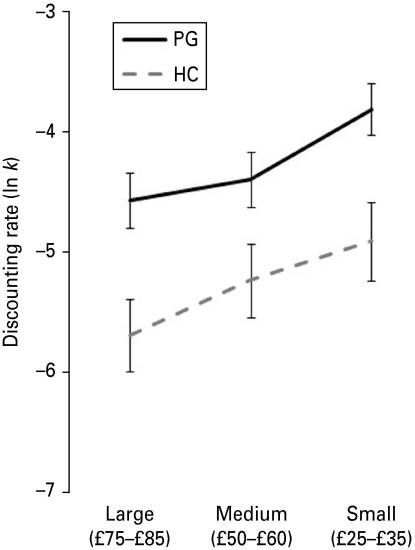
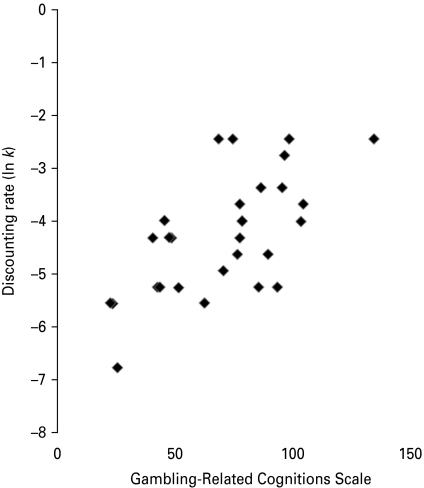
Background: Pathological gambling (PG) is a form of behavioural addiction that has been associated with elevated impulsivity and also cognitive distortions in the processing of chance, probability and skill. We sought to assess the relationship between the level of cognitive distortions and state and trait measures of impulsivity in treatment-seeking pathological gamblers. Method: Thirty pathological gamblers attending the National Problem Gambling Clinic, the first National Health Service clinic for gambling problems in the UK, were compared with 30 healthy controls in a case-control design. Cognitive distortions were assessed using the Gambling-Related Cognitions Scale (GRCS). Trait impulsivity was assessed using the UPPS-P, which includes scales of urgency, the tendency to be impulsive in positive or negative mood states. Delay discounting rates were taken as a state measure of impulsive choice. Results: Pathological gamblers had elevated impulsivity on several UPPS-P subscales but effect sizes were largest (Cohen's d>1.4) for positive and negative urgency. The pathological gamblers also displayed higher levels of gambling distortions, and elevated preference for immediate rewards, compared to controls. Within the pathological gamblers, there was a strong relationship between the preference for immediate rewards and the level of cognitive distortions (R2=0.41). Conclusions: Impulsive choice in the gamblers was correlated with the level of gambling distortions, and we hypothesize that an impulsive decision-making style may increase the acceptance of erroneous beliefs during gambling play.
Overview
The claims and statistics of this paper haven’t been checked yet.
Free: it reads the open-access text and checks the first 5 claims that cite a source we can check. Create a free account to check every claim.
Integrity signals
Registry
Cites
Statistics
Figures
Verification
Claims the paper makes
The claims and statistics of this paper haven’t been checked yet.
Free: it reads the open-access text and checks the first 5 claims that cite a source we can check. Create a free account to check every claim.
Claims other papers make about this one
Each is checked against this paper’s own text: does it say what the citing paper says it does?
The source backs part of the claim, not all of it — or backs it for a different population, condition or comparison.
In the citing paper
“While typical individuals exhibit an increase in gambling motivation in response to near-misses, and overestimate the frequency of one of two equally probable outcomes after a run of the alternate outcome, these effects are increased in those with problematic gambling behaviour (Fortune and Goodie, 2012; Michalczuk et al., 2011).”
From Atypical interoception as a common risk factor for psychopathology: A review (2021) · cites this paper as Michalczuk et al., 2011
Experimental — accuracy not yet measured
Self-check
Percentages, sums and reported differences re-computed from the paper’s own numbers.
The self-check needs the paper’s full text.
Citations
Cites
(1998) · The Journal of Clinical Psychiatry · Cited by 19,139
(1998) · PubMed · Cited by 10,216
The mini international neuropsychiatric interview
Lecrubier, Y., Sheehan, D., Hergueta, T., & Weiller, E. (1998) · European Psychiatry · doi:10.1016/s0924-9338(99)80239-9 · Cited by 5,872
Whiteside, S. P., & Lynam, D. R. (2001) · Personality and Individual Differences · doi:10.1016/s0191-8869(00)00064-7 · Cited by 4,123 · cited 1×
“This construct was initially identified by Whiteside & Lynam (2001) using a composite of the Barratt and Eysenck scales and the Zuckerman Sensation Seeking Scale, and subsequent work by Cyders, Smith and colleagues (Cyders & Smith, 2008 b ) has distinguished positive and negative aspects of urgency.”
Separate neural systems value immediate and delayed monetary rewards
McClure, S. M., Laibson, D. I., Loewenstein, G., & Cohen, J. D. (2004) · Science · doi:10.1126/science.1100907 · Cited by 3,089 · cited 1×
“The resolution of these inter-temporal decisions recruits neural regions, including the ventral striatum and ventromedial prefrontal cortex (McClure et al. 2004 ; Hariri et al. 2006 ; Sellitto et al. 2010), that are implicated in the pathophysiology of problem gambling (Potenza et al.”
(1987) · American Journal of Psychiatry · doi:10.1176/ajp.144.9.1184 · Cited by 2,948
Heroin addicts have higher discount rates for delayed rewards than non-drug-using controls.
Kirby, K. N., Petry, N. M., & Bickel, W. K. (1999) · Journal of Experimental Psychology: General · doi:10.1037/0096-3445.128.1.78 · Cited by 2,171 · cited 5×
“This is in keeping with past personality studies in the general population, which primarily find an association with the Barratt non-planning subscale (Kirby et al. 1999 ; Mobini et al. 2007 ; Koff & Lucas, 2011).”
InfluentialEvenden, J. L. (1999) · Psychopharmacology · doi:10.1007/pl00005481 · Cited by 2,044 · cited 2×
“Rather than being a unidimensional construct, impulsivity is being increasingly viewed as a constellation of traits, including a lack of planning or forethought, reduced perseverance and the seeking of novel or intense sensory experiences (Evenden, 1999; Verdejo-Garcia et al. 2008).”
A pathways model of problem and pathological gambling
Blaszczynski, A., & Nower, L. (2002) · Addiction · doi:10.1046/j.1360-0443.2002.00015.x · Cited by 2,013 · cited 3×
“PG is thought to arise through a combination of biological, social and psychological risk factors (Blaszczynski & Nower, 2002; Sharpe, 2002).”
A Discounting Framework for Choice With Delayed and Probabilistic Rewards.
Green, L., & Myerson, J. (2004) · Psychological Bulletin · doi:10.1037/0033-2909.130.5.769 · Cited by 1,676 · cited 2×
“This is a consistent finding in the behavioural economics literature (Chapman, 1996; Green & Myerson, 2004), and, as in the original study using this measure in heroin addicts (Kirby et al .”
AREA UNDER THE CURVE AS A MEASURE OF DISCOUNTING
Myerson, J., Green, L., & Warusawitharana, M. (2001) · Journal of the Experimental Analysis of Behavior · doi:10.1901/jeab.2001.76-235 · Cited by 1,505 · cited 1×
“Given that the k parameter assumes an underlying hyperbolic discounting curve, an area under the curve (AUC) value was also extracted for each participant, as a parameter that is neutral to the underlying discounting function (Myerson et al. 2001).”
Verdejo-García, A., Lawrence, A. J., & Clark, L. (2008) · Neuroscience & Biobehavioral Reviews · doi:10.1016/j.neubiorev.2007.11.003 · Cited by 1,422 · cited 1×
“Rather than being a unidimensional construct, impulsivity is being increasingly viewed as a constellation of traits, including a lack of planning or forethought, reduced perseverance and the seeking of novel or intense sensory experiences (Evenden, 1999; Verdejo-Garcia et al. 2008).”
Self-citationCyders, M. A., Smith, G. T., Spillane, N. S., Fischer, S., Annus, A. M., & Peterson, C. (2007) · Psychological Assessment · doi:10.1037/1040-3590.19.1.107 · Cited by 1,193 · cited 1×
“( Cyders et al. 2007 ) This is a 59-item self-report questionnaire using a Likert scale from 1 (I agree strongly) to 4 (I disagree strongly) to assess five impulsivity subscales: Negative Urgency (e.g. ‘Sometimes when I feel bad, I can’t seem to stop what I am doing even though it is making me feel…”
Emotion-based dispositions to rash action: positive and negative urgency
Cyders, M. A., & Smith, G. T. (2008) · Psychological Bulletin · doi:10.1037/a0013341 · Cited by 1,136 · cited 3×
“This construct was initially identified by Whiteside & Lynam (2001) using a composite of the Barratt and Eysenck scales and the Zuckerman Sensation Seeking Scale, and subsequent work by Cyders, Smith and colleagues (Cyders & Smith, 2008 b ) has distinguished positive and negative aspects of urgency.”
Toward a behavioral economic understanding of drug dependence: delay discounting processes
Bickel, W. K., & Marsch, L. A. (2001) · Addiction · doi:10.1046/j.1360-0443.2001.961736.x · Cited by 1,117 · cited 1×
“The delay discounting paradigm assesses impulsive choice by presenting a series of decisions between a smaller reward available soon (or immediately), and larger re-wards available after a longer delay (Bickel & Marsch, 2001; Reynolds, 2006).”
Pathological gambling is linked to reduced activation of the mesolimbic reward system
Reuter, J., Raedler, T., Rose, M., Hand, I., Gläscher, J., & Büchel, C. (2005) · Nature Neuroscience · doi:10.1038/nn1378 · Cited by 734 · cited 1×
“2010), that are implicated in the pathophysiology of problem gambling (Potenza et al. 2003 ; Reuter et al. 2005; Lawrence et al. 2009b).”
A review of delay-discounting research with humans: relations to drug use and gambling
Reynolds, B. (2006) · Behavioural Pharmacology · doi:10.1097/fbp.0b013e3280115f99 · Cited by 711 · cited 3×
“The delay discounting paradigm assesses impulsive choice by presenting a series of decisions between a smaller reward available soon (or immediately), and larger re-wards available after a longer delay (Bickel & Marsch, 2001; Reynolds, 2006).”
Should addictive disorders include non-substance-related conditions?
Potenza, M. N. (2006) · Addiction · doi:10.1111/j.1360-0443.2006.01591.x · Cited by 663 · cited 1×
“There is extensive clinical and pathophysiological overlap be-tween pathological gambling (PG) and the substance use disorders (Potenza, 2006; Frascella et al .”
A general theory of addictions: A new theoretical model
Jacobs, D. F. (1986) · Journal of Gambling Behavior · doi:10.1007/bf01019931 · Cited by 597 · cited 2×
“…relevant to gambling behaviour, as it is known that many gam-blers are motivated to gamble to alleviate states of depression, stress or boredom (Jacobs, 1986), but simultaneously, positive mood (perhaps associated with hypomania or dramatic wins) may also prompt gambling sprees (Cummins et al .”
British Gambling Prevalence Survey 2007
Griffiths, M. D., Orford, J., Sproston, K., & Wardle, H. (2007) · Nottingham Trent University's Institutional Repository (Nottingham Trent Repository) · Cited by 594
Hariri, A. R., Brown, S. M., Williamson, D. E., Flory, J. D., de Wit, H., & Manuck, S. B. (2006) · The Journal of Neuroscience · doi:10.1523/jneurosci.3446-06.2006 · Cited by 557 · cited 1×
“The resolution of these inter-temporal decisions recruits neural regions, including the ventral striatum and ventromedial prefrontal cortex (McClure et al. 2004 ; Hariri et al. 2006 ; Sellitto et al. 2010), that are implicated in the pathophysiology of problem gambling (Potenza et al.”
Temporal discounting and utility for health and money.
Chapman, G. B. (1996) · Journal of Experimental Psychology: Learning, Memory, and Cognition · doi:10.1037//0278-7393.22.3.771 · Cited by 537 · cited 3×
“This is a consistent finding in the behavioural economics literature (Chapman, 1996 ; Green & Myerson, 2004), and, as in the original study using this measure in heroin addicts (Kirby et al.”
Pathological gambling severity is associated with impulsivity in a delay discounting procedure
Alessi, S. M., & Petry, N. M. (2003) · Behavioural Processes · doi:10.1016/s0376-6357(03)00150-5 · Cited by 526 · cited 7×
“2006), and a similar relationship was reported between Barratt scores and a measure of cognitive distortions that apply across many forms of psychopathology, such as personalization of negative events and all-or-none thinking (Mobini et al .”
InfluentialRaylu, N., & Oei, T. P. S. (2004) · Addiction · doi:10.1111/j.1360-0443.2004.00753.x · Cited by 504 · cited 6×
“…data available on the clinical characteristics and preferred forms of gambling of treatment-seeking gamblers in the UK, and it is vital to study gambling at a national level given the pronounced cultural and legislative heterogeneity in gambling practices across countries (Raylu & Oei, 2004 b ).”
InfluentialCanadian Problem Gambling Index
Ferris, J., Wynne, H., & Single, E. (2011) · PsycTESTS Dataset · doi:10.1037/t00772-000 · Cited by 490
Role of culture in gambling and problem gambling
Raylu, N., & Oei, T. P. (2004) · Clinical Psychology Review · doi:10.1016/j.cpr.2003.09.005 · Cited by 466 · cited 6×
“…data available on the clinical characteristics and preferred forms of gambling of treatment-seeking gamblers in the UK, and it is vital to study gambling at a national level given the pronounced cultural and legislative heterogeneity in gambling practices across countries (Raylu & Oei, 2004 b ).”
InfluentialSubstance abuse, pathological gambling, and impulsiveness
Petry, N. M. (2001) · Drug and Alcohol Dependence · doi:10.1016/s0376-8716(00)00188-5 · Cited by 462 · cited 5×
“…show enhanced preference for the smaller immediate rewards and steeper discounting of delayed outcomes (i.e. higher k values), and several studies have described such a tendency in treatment-seeking and community groups with disordered gambling (Petry, 2001 a ; Alessi & Petry, 2003; Dixon et al .”
InfluentialDelay discounting by pathological gamblers
Dixon, M. R., Marley, J., & Jacobs, E. A. (2003) · Journal of Applied Behavior Analysis · doi:10.1901/jaba.2003.36-449 · Cited by 442 · cited 2×
“Studies using personality measures and neuro-cognitive tests have also highlighted changes in impulsivity in PG. Scores on the Barratt Impulsivity Scale and the Eysenck Impulsivity Venturesomeness Empathy (IVE) scale reliably increased in case-control studies (Blaszczynski et al .”
Real and laboratory gambling, sensation‐seeking and arousal
Anderson, G., & Brown, R. I. F. (1984) · British Journal of Psychology · doi:10.1111/j.2044-8295.1984.tb01910.x · Cited by 437 · cited 2×
“…used to assess univariate relationships between the UPPS-P, GRCS and Kirby MCQ variables, and a stepwise multiple linear regression assessed possible additive contributions of the UPPS-P and Kirby MCQ variables to predicting the level of cognitive distortions (with GRCS as the dependent variable).”
Petry, N. M. (2001) · Journal of Abnormal Psychology · doi:10.1037//0021-843x.110.3.482 · Cited by 425 · cited 6×
“Steeper discounting on the KirbyMCQ procedure replicates previous work in PG using other variants of the delay discounting paradigm (Petry, 2001a ; Alessi & Petry, 2003 ; Dixon et al. 2003 ; MacKillop et al. 2006 ; Ledgerwood et al. 2009), and patients with Parkinson’s disease with medication-induced PG also show stee…”
InfluentialGambling near-misses enhance motivation to gamble and recruit win-related brain circuitry
Clark, L., Lawrence, A. J., Astley-Jones, F., & Gray, N. (2009) · Neuron · doi:10.1016/j.neuron.2008.12.031 · Cited by 410 · cited 1×
“We have reported previously that individual differences on the GRCS predicted neural responses to gambling ‘near-misses ’ in healthy non-gamblers (Clark et al. 2009).”
Self-citationA reformulated cognitive–behavioral model of problem gambling
Sharpe, L. (2002) · Clinical Psychology Review · doi:10.1016/s0272-7358(00)00087-8 · Cited by 402
An fMRI Stroop Task Study of Ventromedial Prefrontal Cortical Function in Pathological Gamblers
Potenza, M. N., Leung, H.-C., Blumberg, H. P., Peterson, B. S., Fulbright, R. K., Lacadie, C. M., Skudlarski, P., & Gore, J. C. (2003) · American Journal of Psychiatry · doi:10.1176/appi.ajp.160.11.1990 · Cited by 400
Impulsivity in pathological gambling: The antisocial impulsivist
BLASZCZYNSKI, A., STEEL, Z., & McCONAGHY, N. (1997) · Addiction · doi:10.1111/j.1360-0443.1997.tb03639.x · Cited by 367 · cited 1×
“Scores on the Barratt Impulsivity Scale and the Eysenck Impulsivity Venturesomeness Empathy (IVE) scale reliably increased in case-control studies (Blaszczynski et al. 1997 ; Petry, 2001b ; Nower et al. 2004 ; Lawrence et al. 2009a), and prospective studies have confirmed that high impulsivity during adolescence predi…”
Clinical Features and Psychiatric Comorbidity of Subjects With Pathological Gambling Behavior
Black, D. W., & Moyer, T. (1998) · Psychiatric Services · doi:10.1176/ps.49.11.1434 · Cited by 351 · cited 2×
“…used to assess univariate relationships between the UPPS-P, GRCS and Kirby MCQ variables, and a stepwise multiple linear regression assessed possible additive contributions of the UPPS-P and Kirby MCQ variables to predicting the level of cognitive distortions (with GRCS as the dependent variable).”
Cognitive Distortions in Heavy Gambling
Toneatto, T., Blitz-Miller, T., Calderwood, K., Dragonetti, R., & Tsanos, A. (1997) · Journal of Gambling Studies · doi:10.1023/a:1024983300428 · Cited by 348 · cited 3×
“This close linkage illustrates that gamblers with more ‘myopic’ (i.e. focused on the present) decision making and a reduced capacity to defer gratification are more susceptible to the diverse range of complex distortions that occur during play, such as beliefs in superstitions and rituals (GRCS Illusion of Control), th…”
InfluentialImpulsivity and response inhibition in alcohol dependence and problem gambling
Lawrence, A. J., Luty, J., Bogdan, N. A., Sahakian, B. J., & Clark, L. (2009) · Psychopharmacology · doi:10.1007/s00213-009-1645-x · Cited by 329 · cited 1×
“Scores on the Barratt Impulsivity Scale and the Eysenck Impulsivity Venturesomeness Empathy (IVE) scale reliably increased in case-control studies (Blaszczynski et al. 1997 ; Petry, 2001b ; Nower et al. 2004 ; Lawrence et al. 2009a), and prospective studies have confirmed that high impulsivity during adolescence predi…”
Self-citationThe relationship of impulsivity, sensation seeking, coping, and substance use in youth gamblers
Nower, L., Derevensky, J. L., & Gupta, R. (2004) · Psychology of Addictive Behaviors · doi:10.1037/0893-164x.18.1.49 · Cited by 315 · cited 2×
“This may reflect the exclusively male sample (Nower et al. 2004), or it is possible that sensation seeking can be decomposed further into subfactors, such as boredom proneness, some of which may be associated with PG (Fortune & Goodie, 2010).”
Impulsivity, personality disorders and pathological gambling severity
Steel, Z., & Blaszczynski, A. (1998) · Addiction · doi:10.1046/j.1360-0443.1998.93689511.x · Cited by 304 · cited 2×
“Previous studies have described associations be-tween facets of impulsivity and gambling severity (Steel & Blaszczynski, 1998; Krueger et al .”
Impulsivity predicts problem gambling in low SES adolescent males
Vitaro, F., Arseneault, L., & Tremblay, R. E. (1999) · Addiction · doi:10.1046/j.1360-0443.1999.94456511.x · Cited by 297 · cited 1×
“2009a), and prospective studies have confirmed that high impulsivity during adolescence predicts later gambling problems (Vitaro et al. 1999 ; Slutske et al. 2005).”
Development and validation of the Gamblers' Beliefs Questionnaire.
Steenbergh, T. A., Meyers, A. W., May, R. K., & Whelan, J. (2002) · Psychology of Addictive Behaviors · doi:10.1037//0893-164x.16.2.143 · Cited by 290 · cited 2×
“Using psychometric measures of gambling distortions, such as the Gambling-Related Cognitions Scale (GRCS; Raylu & Oei, 2004a) or the Gambling Beliefs Questionnaire (GBQ; Steenbergh et al. 2002), several studies have reported elevated levels of distorted cognitions in individuals with disordered gambling compared to th…”
Problem gamblers share deficits in impulsive decision-making with alcohol-dependent individuals.
Lawrence, A. J., Luty, J., Bogdan, N. A., Sahakian, B. J., & Clark, L. (2009) · Addiction · doi:10.1111/j.1360-0443.2009.02533.x · Cited by 287
Self-citationDecision-making during gambling: an integration of cognitive and psychobiological approaches
Clark, L. (2010) · Philosophical Transactions of the Royal Society B: Biological Sciences · doi:10.1098/rstb.2009.0147 · Cited by 283 · cited 3×
“One of the defining features of gamblers’ cognition is the tendency to overestimate the chances of winning, due to variety of cognitive distortions in the processing of chance, skill and probability (Ladouceur & Walker, 1996 ; Clark, 2010).”
Self-citationThe multifaceted role of distress tolerance in dysregulated eating behaviors
Anestis, M. D., Selby, E. A., Fink, E. L., & Joiner, T. E. (2007) · International Journal of Eating Disorders · doi:10.1002/eat.20471 · Cited by 278 · cited 1×
“2010), whereas negative urgency is associated with bulimic symptoms (Anestis et al. 2007) and tobacco cravings (Billieux et al.”
The role of urgency and its underlying psychological mechanisms in problematic behaviours
Billieux, J., Gay, P., Rochat, L., & Van der Linden, M. (2010) · Behaviour Research and Therapy · doi:10.1016/j.brat.2010.07.008 · Cited by 264 · cited 1×
“By inference, impulsive acts in problem gamblers may predominantly arise through an interaction with current affective state, perhaps through impaired emotion regulation mechanisms (Billieux et al. 2010 ; Cyders et al. 2010).”
Pathological gambling among adolescents: Massachusetts Gambling Screen (MAGS)
Shaffer, H. J., LaBrie, R., Scanlan, K. M., & Cummings, T. N. (1994) · Journal of Gambling Studies · doi:10.1007/bf02104901 · Cited by 240 · cited 1×
“PG was confirmed using the Massachusetts Gambling Screen (MAGS; Shaffer et al .”
Personality and Problem Gambling: A Prospective Study of a Birth Cohort of Young Adults
Slutske, W. S., Caspi, A., Moffitt, T. E., & Poulton, R. (2005) · Archives of General Psychiatry · doi:10.1001/archpsyc.62.7.769 · Cited by 235 · cited 1×
“2009a), and prospective studies have confirmed that high impulsivity during adolescence predicts later gambling problems (Vitaro et al. 1999 ; Slutske et al. 2005).”
Myopic Discounting of Future Rewards after Medial Orbitofrontal Damage in Humans
Sellitto, M., Ciaramelli, E., & di Pellegrino, G. (2010) · The Journal of Neuroscience · doi:10.1523/jneurosci.2516-10.2010 · Cited by 232 · cited 1×
“The resolution of these inter-temporal decisions recruits neural regions, including the ventral striatum and ventromedial prefrontal cortex (McClure et al. 2004 ; Hariri et al. 2006 ; Sellitto et al. 2010), that are implicated in the pathophysiology of problem gambling (Potenza et al.”
Patterns of substance abuse in pathological gamblers undergoing treatment
Ramirez, L. F., McCormick, R. A., Russo, A. M., & Taber, J. I. (1983) · Addictive Behaviors · doi:10.1016/0306-4603(83)90044-8 · Cited by 215 · cited 1×
“We note that the rate of substance use disorder co-morbidity was relatively low compared to international data in treatment-seeking PG (Ramirez et al. 1983 ; Black & Moyer, 1998), and we did not examine the additive impact of these comorbidities on psychological functioning (e.”
The Stubborn Logic of Regular Gamblers: Obstacles and Dilemmas in Cognitive Gambling Research
Delfabbro, P. (2004) · Journal of Gambling Studies · doi:10.1023/b:jogs.0000016701.17146.d0 · Cited by 201 · cited 4×
“However, it remains unclear from the psychometric scales whether increased scores reflect the frequency of these cognitions, the conviction with which the beliefs are held, or the tendency to use these beliefs to justify excessive gambling (Ladouceur & Walker, 1996 ; Delfabbro, 2004).”
InfluentialDombrovski, A. Y., Szanto, K., Siegle, G. J., Wallace, M. L., Forman, S. D., Sahakian, B., Reynolds, C. F., & Clark, L. (2011) · Biological Psychiatry · doi:10.1016/j.biopsych.2010.12.025 · Cited by 198
Self-citationFrascella, J., Potenza, M. N., Brown, L. L., & Childress, A. R. (2010) · Annals of the New York Academy of Sciences · doi:10.1111/j.1749-6632.2009.05420.x · Cited by 191
Sensation Seeking and Pathological Gambling
BLASZCZYNSKI, A. P., WILSON, A. C., & MCCONAGHY, N. (1986) · British Journal of Addiction · doi:10.1111/j.1360-0443.1986.tb00301.x · Cited by 190 · cited 1×
“We observed no group differences in sensation seeking, consistent with some (Blaszczynski et al. 1986 ; Parke et al. 2004 ; Ledgerwood et al. 2009) but not all (CunninghamWilliams et al.”
Clarifying the role of personality dispositions in risk for increased gambling behavior
Cyders, M. A., & Smith, G. T. (2008) · Personality and Individual Differences · doi:10.1016/j.paid.2008.06.002 · Cited by 185 · cited 3×
“This construct was initially identified by Whiteside & Lynam (2001) using a composite of the Barratt and Eysenck scales and the Zuckerman Sensation Seeking Scale, and subsequent work by Cyders, Smith and colleagues (Cyders & Smith, 2008 b ) has distinguished positive and negative aspects of urgency.”
Goudriaan, A. E., Oosterlaan, J., De Beurs, E., & Van Den Brink, W. (2008) · Psychological Medicine · doi:10.1017/s0033291707000694 · Cited by 185 · cited 1×
“2003; Goudriaan et al .”
Housden, C. R., O'Sullivan, S. S., Joyce, E. M., Lees, A. J., & Roiser, J. P. (2010) · Neuropsychopharmacology · doi:10.1038/npp.2010.84 · Cited by 175 · cited 1×
“…used to assess univariate relationships between the UPPS-P, GRCS and Kirby MCQ variables, and a stepwise multiple linear regression assessed possible additive contributions of the UPPS-P and Kirby MCQ variables to predicting the level of cognitive distortions (with GRCS as the dependent variable).”
Myrseth, H., Brunborg, G. S., & Eidem, M. (2010) · Journal of Gambling Studies · doi:10.1007/s10899-010-9180-6 · Cited by 173
Trends in cognitive and behavioural therapies
Silva, P. D. (1996) · Behaviour Research and Therapy · doi:10.1016/s0005-7967(96)80346-9 · Cited by 170
Which dimensions of impulsivity are related to cigarette craving?
Billieux, J., der Linden, M. V., & Ceschi, G. (2006) · Addictive Behaviors · doi:10.1016/j.addbeh.2006.08.007 · Cited by 169 · cited 1×
“2007) and tobacco cravings (Billieux et al .”
Psychosocial Factors Related to Gambling Abstinence and Relapse in Members of Gamblers Anonymous
Oei, T. P. S., & Gordon, L. M. (2007) · Journal of Gambling Studies · doi:10.1007/s10899-007-9071-7 · Cited by 165 · cited 1×
“2001), and higher baseline scores predicted poorer outcome in a Gambler’s Anonymous programme (Oei & Gordon, 2008).”
Cunningham‐Williams, R. M., Grucza, R. A., Cottler, L. B., Womack, S. B., Books, S. J., Przybeck, T. R., Spitznagel, E. L., & Cloninger, C. R. (2004) · Journal of Psychiatric Research · doi:10.1016/j.jpsychires.2004.09.002 · Cited by 141
Cyders, M. A., Zapolski, T. C. B., Combs, J. L., Settles, R. F., Fillmore, M. T., & Smith, G. T. (2010) · Psychology of Addictive Behaviors · doi:10.1037/a0019494 · Cited by 139 · cited 2×
“2010; Cyders et al .”
InfluentialLloyd, J., Doll, H., Hawton, K. E., Dutton, W. H., Geddes, J. R., Goodwin, G. M., & Rogers, R. D. (2010) · Biological Psychiatry · doi:10.1016/j.biopsych.2010.03.038 · Cited by 139
Ledgerwood, D. M., Alessi, S. M., Phoenix, N., & Petry, N. M. (2009) · Drug and Alcohol Dependence · doi:10.1016/j.drugalcdep.2009.06.011 · Cited by 123 · cited 3×
“Steeper discounting on the KirbyMCQ procedure replicates previous work in PG using other variants of the delay discounting paradigm (Petry, 2001a ; Alessi & Petry, 2003 ; Dixon et al. 2003 ; MacKillop et al. 2006 ; Ledgerwood et al. 2009), and patients with Parkinson’s disease with medication-induced PG also show stee…”
Which pathological gamblers will complete treatment?
Leblond, J., Ladouceur, R., & Blaszczynski, A. (2003) · British Journal of Clinical Psychology · doi:10.1348/014466503321903607 · Cited by 123 · cited 1×
“2005), and short-term treatment outcomes (Leblond et al. 2003 ; Goudriaan et al. 2008).”
Trends in Cognitive and Behavioural Therapies.
Salkovskis, P. M. (1996) · Behaviour Research and Therapy · Cited by 119
Miller, N. V., & Currie, S. R. (2008) · Journal of Gambling Studies · doi:10.1007/s10899-008-9089-5 · Cited by 108 · cited 1×
“2002), several studies have reported elevated levels of distorted cognitions in individuals with disordered gambling compared to those without gambling problems (Miller & Currie, 2008; Emond & Marmurek, 2010; Myrseth et al .”
Mobini, S., Pearce, M., Grant, A. J., Mills, J., & Yeomans, M. R. (2005) · Personality and Individual Differences · doi:10.1016/j.paid.2005.11.006 · Cited by 100
Parke, A., Griffiths, M., & Irwing, P. (2004) · Addiction Research & Theory · doi:10.1080/1606635310001634500 · Cited by 96 · cited 1×
“1986; Parke et al .”
Cortisol and Heart Rate Measures during Casino Gambling in Relation to Impulsivity
Krueger, T. H. C., Schedlowski, M., & Meyer, G. (2005) · Neuropsychobiology · doi:10.1159/000089004 · Cited by 95 · cited 2×
“2005), physiological arousal during gambling (Anderson & Brown, 1984; Krueger et al. 2005), and short-term treatment outcomes (Leblond et al.”
MacKillop, J., Anderson, E. J., Castelda, B. A., Mattson, R. E., & Donovick, P. J. (2006) · Psychology of Addictive Behaviors · doi:10.1037/0893-164x.20.1.75 · Cited by 94 · cited 7×
“In an undergraduate sample comprising a range of gambling problems, the Eysenck Impulsivity score predicted higher scores on the GBQ (MacKillop et al .”
InfluentialEmond, M. S., & Marmurek, H. H. C. (2009) · Journal of Gambling Studies · doi:10.1007/s10899-009-9164-6 · Cited by 88 · cited 4×
“…even in non-problem-atic regular players (Ladouceur & Walker, 1996; Delfabbro, 2004), and it was not until psychometric measures such as the GRCS and GBQ were developed that the elevated level of distortions in PG became evident (Raylu & Oei, 2004 a ; Emond & Marmurek, 2010; Myrseth et al .”
InfluentialTakahashi, T., Oono, H., Inoue, T., Boku, S., Kako, Y., Kitaichi, Y., Kusumi, I., Masui, T., Nakagawa, S., Suzuki, K., et al. (2011) · arXiv · doi:10.48550/arxiv.1111.6493 · Cited by 75
The Relationship Between Pathological Gambling and Sensation Seeking: The Role of Subscale Scores
Fortune, E. E., & Goodie, A. S. (2009) · Journal of Gambling Studies · doi:10.1007/s10899-009-9162-8 · Cited by 73 · cited 2×
“…used to assess univariate relationships between the UPPS-P, GRCS and Kirby MCQ variables, and a stepwise multiple linear regression assessed possible additive contributions of the UPPS-P and Kirby MCQ variables to predicting the level of cognitive distortions (with GRCS as the dependent variable).”
Mobini, S., Grant, A., Kass, A. E., & Yeomans, M. R. (2007) · Personality and Individual Differences · doi:10.1016/j.paid.2007.04.009 · Cited by 71 · cited 4×
“21), were comparable to the strength of relationships observed in previous studies (Kirby et al. 1999 ; Mobini et al. 2007 ; Koff & Lucas, 2011).”
InfluentialWinning and positive affect can lead to reckless gambling.
Cummins, L. F., Nadorff, M. R., & Kelly, A. E. (2009) · Psychology of Addictive Behaviors · doi:10.1037/a0014783 · Cited by 71 · cited 1×
“…relevant to gambling behaviour, as it is known that many gam-blers are motivated to gamble to alleviate states of depression, stress or boredom (Jacobs, 1986), but simultaneously, positive mood (perhaps associated with hypomania or dramatic wins) may also prompt gambling sprees (Cummins et al .”
Association of cognitive distortions with problem and pathological gambling in adult male twins
Xian, H., Shah, K. R., Phillips, S. M., Scherrer, J. F., Volberg, R. A., & Eisen, S. A. (2008) · Psychiatry Research · doi:10.1016/j.psychres.2007.08.007 · Cited by 67 · cited 1×
“Indeed, it is unclear whether these distortions have an obvious parallel in substance use disorders (Xian et al. 2008).”
Cognitive changes in pathological gamblers following a 28-day inpatient program.
Breen, R. B., Kruedelbach, N. G., & Walker, H. I. (2001) · Psychology of Addictive Behaviors · doi:10.1037//0893-164x.15.3.246 · Cited by 64 · cited 3×
“…going overboard’); (lack of) Planning (e.g. ‘I usually make up my mind through careful reasoning’ – negative loading); (lack of) Perseverance (e.g. ‘I finish what I start’ – negative loading); and Sensation Seeking (e.g. ‘I would enjoy the sensation of skiing very fast down a high mountain slope’).”
Mood moderates the relationship between impulsiveness and delay discounting
Koff, E., & Lucas, M. (2011) · Personality and Individual Differences · doi:10.1016/j.paid.2011.01.016 · Cited by 52 · cited 2×
“2007; Koff & Lucas, 2011).”
Influentialvan Leeuwen, A. P., Creemers, H. E., Verhulst, F. C., Ormel, J., & Huizink, A. C. (2011) · Journal of Studies on Alcohol and Drugs · doi:10.15288/jsad.2011.72.70 · Cited by 42
Pathological gambling: a neurobiological and clinical update
Bowden-Jones, H., & Clark, L. (2011) · British Journal of Psychiatry · doi:10.1192/bjp.bp.110.088146 · Cited by 29
Self-citationComments from the Trenches: Proposed Changes to the DSM-V Classification of Pathological Gambling
Mitzner, G. B., Whelan, J. P., & Meyers, A. W. (2010) · Journal of Gambling Studies · doi:10.1007/s10899-010-9225-x · Cited by 28 · cited 1×
“2010), prompting a probable reclassification of PG among the addictions in the forthcoming DSM-V (Mitzner et al .”
Research works printed but not linked: 1
- Nelson HE Willison J 1991 National Adult Reading Test (NART) Test Manual NFER-Nelson Windsor, UK
Cited by
Problematic use of the mobile phone: A literature review and a pathways model
Billieux, J. (2012) · Current Psychiatry Reviews · doi:10.2174/157340012803520522 · Cited by 794
“For example, research on gambling pointed out that cognitive distortions are highly prevalent in problem gamblers [60] and influence gambling behaviors (e.g., persistence in playing despite losses) [61].”
BackgroundValidation of a short French version of the UPPS-P Impulsive Behavior Scale
Billieux, J., Rochat, L., Ceschi, G., Carré, A., Offerlin-Meyer, I., Defeldre, A.-C., Khazaal, Y., Besche-Richard, C., & Van der Linden, M. (2012) · Comprehensive Psychiatry · doi:10.1016/j.comppsych.2011.09.001 · Cited by 430
Robbins, T., & Clark, L. (2015) · Current Opinion in Neurobiology · doi:10.1016/j.conb.2014.09.005 · Cited by 296
Self-citationClark, L., Stokes, P. R., Wu, K., Michalczuk, R., Benecke, A., Watson, B. J., Egerton, A., Piccini, P., Nutt, D. J., Bowden-Jones, H., et al. (2012) · NeuroImage · doi:10.1016/j.neuroimage.2012.06.067 · Cited by 193
“Case–control comparisons on the Urgency facet yielded stronger effect sizes than 'narrow' impulsivity (i.e. lack of planning, lack of perseverance), which was also seen in a larger group recruited from the same clinical setting (Michalczuk et al., 2011).”
InfluentialSelf-citationAtypical interoception as a common risk factor for psychopathology: A review
Brewer, R., Murphy, J., & Bird, G. (2021) · Neuroscience & Biobehavioral Reviews · doi:10.1016/j.neubiorev.2021.07.036 · Cited by 180
Metadata
- Authors
- Michalczuk, R., Bowden-Jones, H., Verdejo-Garcia, A., & Clark, L.
- Affiliations
- University of Cambridge (GB)
- Corresponding author
- Clark, L.
- ORCID
- Clark, L.
- Venue
- Psychological Medicine
- Publisher
- Cambridge University Press (CUP)
- Published
- 2011-06-29
- Volume
- 41
- Issue
- 12
- Pages
- 2625-2635
- ISSN
- 0033-2917 (ISSN-L)
- 1469-8978
- PMC
- PMC3206226
- OpenAlex
- W1973481178
- Cited by
- 248
- References
- 83
- Citations by year
- 2026: 4 · 2025: 8 · 2024: 7 · 2023: 13 · 2022: 12 · 2021: 15 · 2020: 17 · 2019: 28 · 2018: 25 · 2017: 18 · 2016: 32 · 2015: 21 · 2014: 23 · 2013: 12 · 2012: 11
- FWCI
- 16.53
- Type
- journal article
- Language
- en
- Open access
- hybrid
- doi.org
- Licence
- cc-by-nc-sa
- www.cambridge.org/core/terms (unspecified)
- Locations
- Psychological Medicine (publishedVersion, cc-by-nc-sa)
- Europe PMC (PubMed Central) (publishedVersion, cc-by-nc-sa)
- PubMed Central (publishedVersion, cc-by-nc-sa)
- PubMed (publishedVersion)
- UCL Discovery (University College London) (submittedVersion)
- Funders
- Wellcome Trust (093875)
- Society for the Study of Addiction
- Medical Research Council (G0802725)
- Topics
- Social Sciences › Psychology › Clinical Psychology › Gambling Behavior and Treatments
- Social Sciences › Decision Sciences › General Decision Sciences › Decision-Making and Behavioral Economics
- Health Sciences › Medicine › Epidemiology › Substance Abuse Treatment and Outcomes
- Keywords
- gambling addiction, impulsivity, cognitive distortions, delay discounting, impulsive choice, urgency, positive urgency, negative urgency, UPPS-P, treatment-seeking gamblers, behavioral addiction
- MeSH terms
- Adult, Cognition Disorders, Female, Gambling, United Kingdom, Humans, Impulsive Behavior, Male, Middle Aged, Psychiatric Status Rating Scales, Psychological Tests, Psychotherapy, Reward, Case-Control Studies, Young Adult
About these checks
Registry, retraction, Cites and statistics results are computed, not judged, with one exception: a printed reference that no index lists is read once by a model before it counts as a citation error. Claims are extracted by a model and kept only when their quote appears verbatim in the text; each cited source is then checked, with a model’s help, for whether it says what the claim relies on. Those verdicts can be wrong — read the claim’s quote and the cited source before relying on one.
Statistics and arithmetic are recomputed, not judged.
Confidence bands are shown only for fields calibrated on our annotated test set. None is calibrated yet, so no band is shown.
What counts as a claim ›How we measure confidence ›How we check this ›
Are you an author, or do you see a problem with this page? Request a review
Data sources
Bibliographic data: Semantic Scholar, OpenAlex, Crossref.
Contains information from the Semantic Scholar Academic Graph Datasets, made available under the ODC Attribution License (ODC-BY 1.0).
Semantic Scholar’s data is described in: Kinney, R., et al. (2023). The Semantic Scholar Open Data Platform. arXiv:2301.10140.
