

The methods and outcomes of cultural adaptations of psychological treatments for depressive disorders: a systematic review
Open accessThe DOI matches its Crossref record; 54 of the 54 references it cites were found in a registry or an index.
Abstract
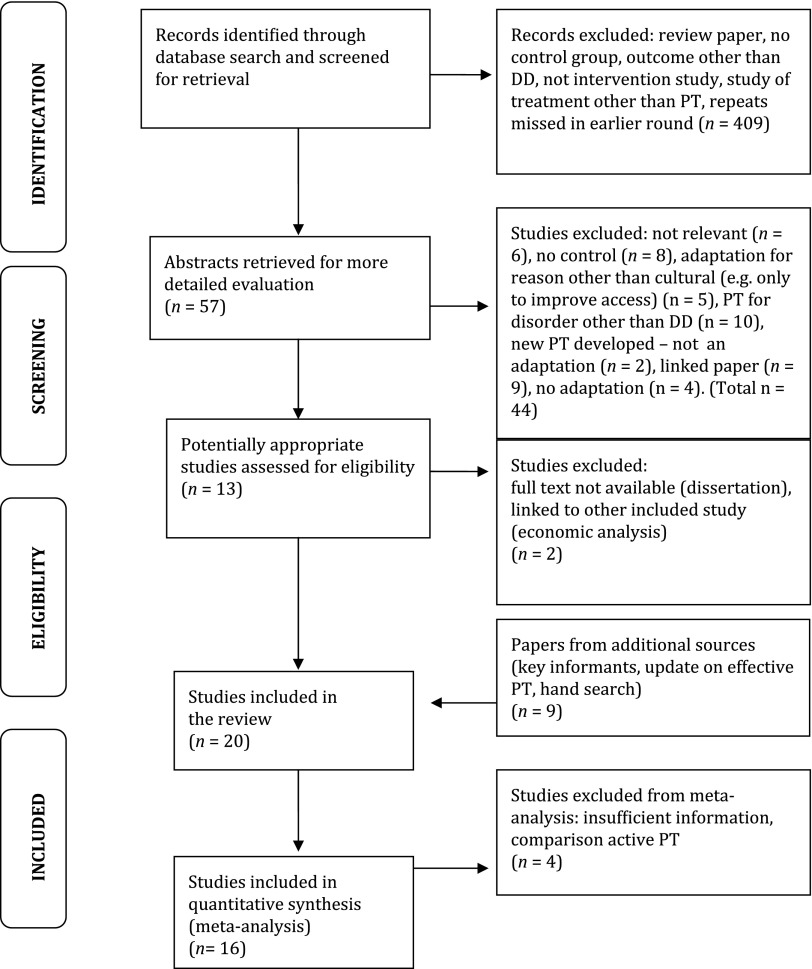
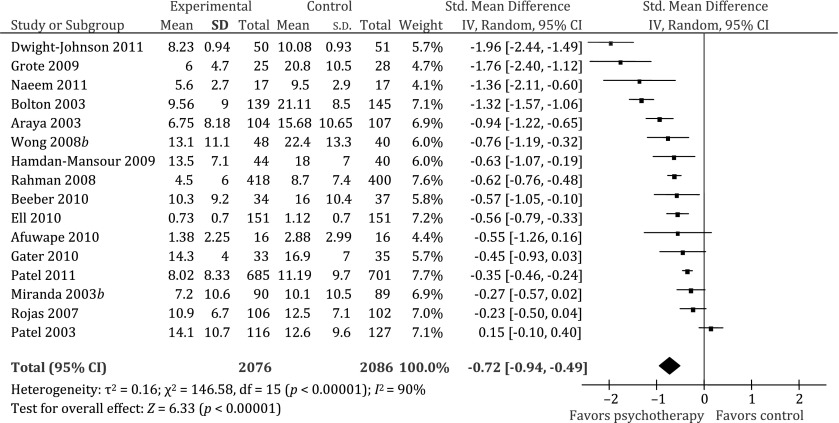
Background: Cultural adaptations of evidence-based psychological treatments (PTs) are important to enhance their universal applicability. The aim of this study was to review systematically the literature on adaptations of PTs for depressive disorders for ethnic minorities in Western countries and for any population in non-Western countries to describe the process, extent and nature of the adaptations and the effectiveness of the adapted treatments. Method: Controlled trials were identified using database searches, key informants, previous reviews and reference lists. Data on the process and details of the adaptations were analyzed using qualitative methods and meta-analysis was used to assess treatment effectiveness. Results: Twenty studies were included in this review, of which 16 were included in the meta-analysis. The process of adaptation was reported in two-thirds of the studies. Most adaptations were found in the dimensions of language, context and therapist delivering the treatment. The meta-analysis revealed a statistically significant benefit in favor of the adapted treatment [standardized mean difference (SMD) −0.72, 95% confidence interval (CI) −0.94 to −0.49]. Conclusions: Cultural adaptations of PTs follow a systematic procedure and lead primarily to adaptations in the implementation of the treatments rather than their content. Such PTs are effective in the treatment of depressive disorders in populations other than those for whom they were originally developed.
Overview
The claims and statistics of this paper haven’t been checked yet.
Free: it reads the open-access text and checks the first 5 claims that cite a source we can check. Create a free account to check every claim.
Integrity signals
Registry
Cites
Statistics
Figures
Verification
Claims the paper makes
The claims and statistics of this paper haven’t been checked yet.
Free: it reads the open-access text and checks the first 5 claims that cite a source we can check. Create a free account to check every claim.
Claims other papers make about this one
Each is checked against this paper’s own text: does it say what the citing paper says it does?
The source backs part of the claim, not all of it — or backs it for a different population, condition or comparison.
In the citing paper
“Cultural adaptation is important for psychosocial interventions for various mental health conditions, and meta-analyses have shown that such interventions are more effective than non-culturally adapted interventions. (474-476)”
From Dementia prevention, intervention, and care: 2024 report of the Lancet standing Commission (2024) · cites this paper as [476]
Experimental — accuracy not yet measuredThe source backs part of the claim, not all of it — or backs it for a different population, condition or comparison.
In the citing paper
“Research consistently shows that culturally adapted treatments are more effective, acceptable, and satisfying for patients [58-60].”
From Effectiveness of an Internet-Based Self-Help Acceptance and Commitment Therapy Program on Medical Students’ Mental Well-Being: Follow-Up Randomized Controlled Trial (2024) · cites this paper as [58]
Experimental — accuracy not yet measuredThe source backs part of the claim, not all of it — or backs it for a different population, condition or comparison.
In the citing paper
“Studies have also demonstrated that participants find culturally adapted ACT enjoyable and acceptable [58,61,62].”
From Effectiveness of an Internet-Based Self-Help Acceptance and Commitment Therapy Program on Medical Students’ Mental Well-Being: Follow-Up Randomized Controlled Trial (2024) · cites this paper as [58]
Experimental — accuracy not yet measuredThe source backs part of the claim, not all of it — or backs it for a different population, condition or comparison.
In the citing paper
“There is evidence that adapted, culturally-relevant mental health programming is an effective tool for addressing poor mental health in humanitarian contexts [8,9,10,11]”
From Psychological Interventions for Survivors of Intimate Partner Violence in Humanitarian Settings: An Overview of the Evidence and Implementation Considerations (2022) · cites this paper as [10]
Experimental — accuracy not yet measuredThe cited source says what the claim attributes to it.
In the citing paper
“The emerging evidence-base accordingly emphasises delivery adaptations (practitioner skills, characteristics and flexible patient centred approaches) over cultural adaptation of underlying principles of therapies [10-12].”
From Development and evaluation of culturally sensitive psychosocial interventions for under-served people in primary care (2014) · cites this paper as [10]
1 more claim about this paper
Create a free account to see every claim other papers make about this one.
Self-check
Percentages, sums and reported differences re-computed from the paper’s own numbers.
The self-check needs the paper’s full text.
Citations
Cites
Preferred Reporting Items for Systematic Reviews and Meta-Analyses: the PRISMA statement
Moher, D., Liberati, A., Tetzlaff, J., Altman, D. G., & for the PRISMA Group (2009) · BMJ · doi:10.1136/bmj.b2535 · Cited by 83,823
Measuring inconsistency in meta-analyses
Higgins, J. P. T., Thompson, S. G., Deeks, J. J., & Altman, D. G. (2003) · BMJ · doi:10.1136/bmj.327.7414.557 · Cited by 63,139 · cited 3×
“A random-effects model was used for the meta-analyses because substantial heterogeneity was observed (I(2)=90%) (Higgins et al. 2003).”
InfluentialBias in meta-analysis detected by a simple, graphical test
Egger, M., Smith, G. D., Schneider, M., & Minder, C. (1997) · BMJ · doi:10.1136/bmj.315.7109.629 · Cited by 56,722 · cited 1×
“check for publication bias (Egger et al. 1997); the plot was asymmetrical suggesting publication bias.”
Preferred reporting items for systematic reviews and meta-analyses: the PRISMA Statement.
(2009) · PubMed Central · Cited by 44,859
Preferred Reporting Items for Systematic Reviews and Meta-Analyses: The PRISMA Statement
Moher, D., Liberati, A., Tetzlaff, J., & Altman, D. G. (2009) · Journal of Clinical Epidemiology · doi:10.1016/j.jclinepi.2009.06.005 · Cited by 19,575
Developing and evaluating complex interventions: the new Medical Research Council guidance
Craig, P., Dieppe, P., Macintyre, S., Michie, S., Nazareth, I., & Petticrew, M. (2008) · BMJ · doi:10.1136/bmj.a1655 · Cited by 10,995 · cited 2×
“These themes were based on two frameworks: (1) The Medical Research Council (MRC) framework for the development and evaluation of complex interventions was used to draw out common elements in the process of cultural adaptation (Craig et al. 2008).”
Culturally adapted mental health intervention: a meta-analytic review
Griner, D., & Smith, T. B. (2006) · Psychotherapy: Theory, Research, Practice, Training · doi:10.1037/0033-3204.43.4.531 · Cited by 1,236 · cited 3×
“Although there have been previous systematic reviews of adaptations of mental health interventions (Griner & Smith, 2006; Huey & Polo, 2008; Benish et al. 2011; Smith et al .”
Psychotherapy for depression in adults: A meta-analysis of comparative outcome studies.
Cuijpers, P., van Straten, A., Andersson, G., & van Oppen, P. (2008) · Journal of Consulting and Clinical Psychology · doi:10.1037/a0013075 · Cited by 1,050 · cited 1×
“Although there is extensive evidence of the effectiveness of psychological treatments (PTs) for depressive disorders (Cuijpers et al. 2008; Hollon & Ponniah, 2010), it has been argued that PTs are developed in particular cultural contexts and that this may limit their universal applicability.”
Rahman, A., Malik, A., Sikander, S., Roberts, C., & Creed, F. (2008) · The Lancet · doi:10.1016/s0140-6736(08)61400-2 · Cited by 993 · cited 25×
“Non-RCTs were included as they too would provide information on all the research questions including effectiveness.”
InfluentialSelf-citationIssues and challenges in the design of culturally adapted evidence-based interventions
Castro, F. G., Barrera, M., & Holleran Steiker, L. K. (2010) · Annual Review of Clinical Psychology · doi:10.1146/annurev-clinpsy-033109-132032 · Cited by 796
Research works printed but not linked: 2
- 2. Andrew G, Dias-Saxena F, Patel V (2000). The development of a counselling treatment for common mental disorders in general health care settings. Indian Journal of Clinical Psychology 27, 72– 79
- 17. Crespo MM (2006). Effects of culturally specific dynamically oriented group art therapy with immigrant Latinas. Doctoral dissertation, California Institute of Integral Studies, San Francisco, CA
Cited by
Items 201–300 of 349
India needs rigorously tested, culturally adapted cognitive behavioural therapy
Sinha, D., & Chatterji, B. P. (2021) · The Lancet Psychiatry · doi:10.1016/s2215-0366(21)00092-4 · Cited by 5
A Culturally Adapted Cognitive Behavioral Therapy Group: A Randomized Controlled Trial
Young, D. K. W., & Petrus, Y. N. N. G. (2021) · Research on Social Work Practice · doi:10.1177/10497315211063627 · Cited by 8
“…of depression are common in Chinese societies (Ryder et al., 2008), depression has not been described in medical terms to avoid psychiatric labels and stigma but was expressed as mood disturbance with somatic complaints to help participants normalize these experiences (Chowdhary et al., 2014).”
BackgroundInfluentialAl-Hendawi, M. (2022) · Emotional and Behavioural Difficulties · doi:10.1080/13632752.2023.2171349 · Cited by 5
Qushua, N., Smith‐Appelson, J., Sarraf, D., Stark, L., & Seff, I. (2023) · Children and Youth Services Review · doi:10.1016/j.childyouth.2023.107262 · Cited by 8
Pössel, P., Seely, H. D., & Marchetti, I. (2024) · Research on Child and Adolescent Psychopathology · doi:10.1007/s10802-024-01218-5 · Cited by 6
“For example, 70% ( n = 270) of the adolescents participating in one of the most influential and much of our most influential psychotherapeutic approaches based on these theories can be effective when applied to other populations (Chowdhary et al., 2014; Wilson & Cot - tone, 2013 ).”
Curtin, L., Moss, S. E., & Keefe, S. E. (2020) · Springer eBooks · doi:10.1007/978-981-10-5012-1_34-1 · Cited by 5
Psychological therapy to improve HIV care and reduce stigma
Katz, I. T., & Tsai, A. C. (2015) · The Lancet HIV · doi:10.1016/s2352-3018(15)00044-2 · Cited by 5
Child and adolescent psychiatry: challenges, solutions, opportunities, and future directions
Cortese, S., Arango, C., Aymerich, C., Catalan, A., Chetouani, M., Cohen, D., Coghill, D., Gabellone, A., Iniesta, R., Kadan, A., et al. (2026) · World Psychiatry · doi:10.1002/wps.70044 · Cited by 4
Sit, H. F., Li, G., Chen, W. L., Sou, E. K. L., Wong, M., Burchert, S., Hong, I. W., Sit, H. Y., Lam, A. I. F., & Hall, B. J. (2022) · Internet Interventions · doi:10.1016/j.invent.2022.100579 · Cited by 6
Hassan, E., Prakash, B. K., Magar, J., Luitel, N. P., Kohrt, B. A., Jordans, M. J. D., & Rose‐Clarke, K. (2022) · Frontiers in Psychiatry · doi:10.3389/fpsyt.2022.949251 · Cited by 4
Self-citationBah, A. J., Wurie, H. R., Samai, M. H., Horn, R., & Ager, A. (2025) · Frontiers in Psychiatry · doi:10.3389/fpsyt.2025.1441936 · Cited by 8
Suemith-Fajardo, A., Taylor, A. M., & Roberts, R. (2025) · The Journal of Positive Psychology · doi:10.1080/17439760.2025.2542224 · Cited by 4
“Affordable techniques (e.g. bibliotherapy and reflective journaling) are more widely acceptable due to their minimal resource requirements and ease in implementation (Chowdhary et al., 2013; Geerling et al., 2020).”
TAYLOR, K. F., & Burgess, G. H. (2019) · International Journal of Mental Health · doi:10.1080/00207411.2019.1708633 · Cited by 5
Bercean, A.-V., Breen, L. J., McEvoy, P. M., Yeak, S., & Rooney, R. M. (2020) · Professional Psychology Research and Practice · doi:10.1037/pro0000326 · Cited by 6
Cultural Diversity and Family-Based Interventions
Hechanova, M. R. M., Tabo-Corpuz, C. E. S., & Bunagan, K. (2021) · Cambridge University Press eBooks · doi:10.1017/9781108682053.007 · Cited by 5
Zemestani, M., Davoudi, F., Farhadi, A., & Gallagher, M. W. (2021) · Anxiety Stress & Coping · doi:10.1080/10615806.2021.1990269 · Cited by 5
Costas-Muñíz, R., Blasco, N. T., Castro, E., Claros, M., Narang, B., Vazquez, O., Montaña, F., Sanchez, J. C., & Gany, F. M. (2022) · Implementation Research and Practice · doi:10.1177/26334895221096291 · Cited by 5
“Culturally adapted interventions are far more effective than non-adapted interventions for ethnic minority patients (Benish et al., 2011; Chowdhary et al., 2014; Griner & Smith, 2006; Hall et al., 2016).”
BackgroundComputerised health interventions targeting Australian veterans and their families: A scoping review
McMahon, B., Guindalini, C., & Mellor, R. (2023) · Health Promotion Journal of Australia · doi:10.1002/hpja.832 · Cited by 4
Examining the Eye Movement Desensitization Reprocessing Flash Technique on Racial Trauma
Hung, Y., Chang, K., Soloski, K. L., & Linville, D. C. (2025) · Journal of Marital and Family Therapy · doi:10.1111/jmft.70032 · Cited by 3
Fau, S., Ramli, M., Hidayah, N., Chusniyah, T., & Akkakanjanasupar, P. (2025) · Journal of Behavioral and Cognitive Therapy · doi:10.1016/j.jbct.2025.100557 · Cited by 5
Sawaya, R. T., Zalzale, H., & Ghossoub, E. (2023) · Forensic Science International Mind and Law · doi:10.1016/j.fsiml.2023.100126 · Cited by 4
Inclusion of cross-cultural care training in humanitarian aid: A scoping review
Gómez, M. D. M. M., Pimentel, J., & Delgado, R. C. (2025) · Public Health · doi:10.1016/j.puhe.2024.12.026 · Cited by 3
Guided self-help to reduce psychological distress: what's the potential for scaling up?
Hanlon, C., & Jordans, M. J. D. (2020) · The Lancet Global Health · doi:10.1016/s2214-109x(19)30539-x · Cited by 5
Self-citationHess, J. M., Magan, I. M., & Goodkind, J. R. (2024) · American Journal of Community Psychology · doi:10.1002/ajcp.12763 · Cited by 7
Fenta, T. B., Keynejad, R. C., Sorsdahl, K. R., MYERS, B. J., Honikman, S., Medhin, G., Fekadu, E., Mulushoa, A., Howard, L. M., Girma, F., et al. (2025) · Pilot and Feasibility Studies · doi:10.1186/s40814-025-01672-y · Cited by 2
“The World Health Organization Mental Health Gap Action Programme intervention guide (mhGAP-IG) for PHC workers recommends several brief, manual-ised psychological therapies for people with depression, highlighting the need to adapt interventions to the cultural context [31].”
Redefining menopausal care: a randomized trial of group CBT for vasomotor symptoms in Korean women
Jung, D., Park, J. Y., Chung, K., & Kim, M.-R. (2026) · Climacteric · doi:10.1080/13697137.2026.2661353 · Cited by 2
“CBT is grounded in universal cognitive and emotional processing mechanisms, focusing on modifying the interactions among automatic thoughts, cognitive distortions and emotional responses [21,51].”
Ramírez-Cruz, J. C., Santana-Cárdenas, S., Franco‐Paredes, K., & Javier-Juárez, S. P. (2023) · Revista Brasileira de Terapia Comportamental e Cognitiva · doi:10.31505/rbtcc.v25i1.1811 · Cited by 3
Implementation of the digital format of psychological first aid in war stress conditions
Lahutina, S., & Frankova, I. (2023) · Ukrains kyi Visnyk Psykhonevrolohii · doi:10.36927/2079-0325-v31-is4-2023-8 · Cited by 5
Interpersonal Psychotherapy in Ethiopia (IPT-E)
Wondimagegn, D., Hailu, H., Ravitz, P., & Pain, C. (2024) · Oxford University Press eBooks · doi:10.1093/oso/9780197652084.003.0017 · Cited by 2
Alözkan, C., Cuijpers, P. J., Dawson, K. S., Mittendorfer‐Rutz, E., Akhtar, A., Bryant, R. A., & Sijbrandij, M. (2024) · Cambridge Prisms Global Mental Health · doi:10.1017/gmh.2024.93 · Cited by 3
“Despite these limitations, there is evidence that adapted interventions have larger effect sizes (Chowdhary et al., 2014) and to ensure the acceptability, feasibility and effectiveness of the interventions, carrying out cultural adaptations while maintaining the fidelity and core components of the…”
Bedi, R. P., Ahn, J. Y., Choubisa, R., & Ruparel, N. (2024) · International Perspectives in Psychology · doi:10.1027/2157-3891/a000109 · Cited by 2
Adaptive empathic response selection is sensitive to multiple dimensions of social interaction
Arbel, E. K., Shamay‐Tsoory, S., & Hertz, U. (2024) · Communications Psychology · doi:10.1038/s44271-024-00164-8 · Cited by 5
“Some research has examined the cultural context of the dyad or target 68,76 – 78 .”
Aeschlimann, A., Heim, E., Killikelly, C., Mahmoud, N., Haji, F., Stoeckli, R. T., Aebersold, M., Thoma, M. V., & Maercker, A. (2025) · Internet Interventions · doi:10.1016/j.invent.2025.100800 · Cited by 2
“…indicating that adapted approaches are generally more effective, acceptable, and may increase adherence compared to non-adapted ones (Arundell et al., 2021; Benish et al., 2011; Chowdhary et al., 2014; Griner and Smith, 2006; Hall et al., 2016; Harper Shehadeh et al., 2016; Naeem et al., 2019).”
Addressing Latinx mental healthcare disparities with community engagement
Prandoni, J. I., Jolles, M. P., & Stein, G. L. (2020) · Elsevier eBooks · doi:10.1016/b978-0-12-818012-9.00002-2 · Cited by 2
Rodríguez-Cuevas, F. G., Hartman, S. J., Aguerrebere, M., & Palazuelos, D. (2021) · Springer eBooks · doi:10.1007/978-3-030-57296-9_101 · Cited by 2
Curtin, L., Moss, S. E., & Keefe, S. E. (2021) · Springer eBooks · doi:10.1007/978-981-15-6631-8_34 · Cited by 2
Lal, S., Gleeson, J., D’Alfonso, S., Lepage, M., Joober, R., Lee, H., Abdel‐Baki, A., Lecomte, T., & Álvarez‐Jiménez, M. (2024) · Digital Health · doi:10.1177/20552076241282231 · Cited by 4
Sangraula, M., Kohrt, B. A., Ghimire, R., Shrestha, P., Luitel, N. P., Hof, E. V., Dawson, K. S., & Jord, M. J. (2020) · Research Square · doi:10.21203/rs.3.rs-40265/v1 · Cited by 2
“Literature has shown that translating interventions directly from one culture to another without any other changes may reduce the effectiveness of the intervention and could even cause harm (5, 6).”
BackgroundKhalsa, G. S., Softas‐Nall, B. C., & Razo, J. T. (2023) · Studies in Social Science Research · doi:10.22158/sssr.v4n3p59 · Cited by 2
Delgado, A. K., Holliday, R. P., Maguen, S., & Holder, N. D. (2025) · Healthcare · doi:10.3390/healthcare13050469 · Cited by 5
“Considering cultural factors in mental health treatment is critical to enhance effectiveness and accessibility in interventions across diverse populations as well as reducing mental health disparities [6,7].”
Holmes, S. R., Santiago, R. T., Liu, C. L., Shaoli, S. S., Welland, J. B., Mitchell, A., & Owens, S. (2025) · School Mental Health · doi:10.1007/s12310-025-09792-9 · Cited by 1
“Several meta-analyses have demonstrated that culturally adapted mental health interventions outperform non-adapted interventions for minoritized and marginalized groups (Ben-ish et al., 2011; Chowdhary et al., 2014; Griner & Smith, 2006).”
Smith, M., Jones, A., Zormati, P., Brady, L., Clark, A., Kamal, A., Karawalli, F., Khan, S., Mengoni, S. E., Mir, G., et al. (2025) · Pilot and Feasibility Studies · doi:10.1186/s40814-025-01691-9 · Cited by 5
“…(see Table 1 for key characteristics) is CBT-based and adapted with Islamic faith messages using cognitive and behavioural underpinnings including insights from GM’s (co-applicant) therapeutic approach with Muslim populations [18, 28] and CBT models used in cultural adaptations [50–52].”
Cultural Adaptation of Mindfulness from a Japanese Perspective
Hamamura, T., Maung, M., Baminiwatta, A., Chan, C. S., Chih, H., Kanetsuki, M., Gumulya, M. M., Gilbey, S. E., & Mazzucchelli, T. G. (2025) · Mindfulness · doi:10.1007/s12671-025-02714-5 · Cited by 1
“…they echo debates in global mental health, where systematic attention to cultural adaptations has been critical (Oman, 2025; Patel et al., 2018), and parallel long-standing questions in psychology about how psychotherapy programs are received in new cultural contexts (Chowdhary et al., 2014).”
Chen, P., Jia, S., Deng, Y., Cheng, J., Tang, T., Li, H., Li, H., Ma, H., & Zhang, T. (2026) · BMC Psychology · doi:10.1186/s40359-026-04224-y · Cited by 3
“…symptoms, and exploring their long-term impact and sustainability; (3) applying machine learning to optimize intervention selection based on individual characteristics (e.g., sensory processing preferences, emotional sensitivity), advancing personalized mental health care [105]; (4) [106, 107].”
Major Depression in Postconflict Northern Uganda: A Case Report
Nakimuli‐Mpungu, E., Odokonyero, R. F., Laker, J., & Alderman, S. (2014) · American Journal of Psychiatry · doi:10.1176/appi.ajp.2014.14020261 · Cited by 1
Frisby, C. L., & O’Donohue, W. (2018) · Springer eBooks · doi:10.1007/978-3-319-78997-2_28 · Cited by 1
Plessas, A., Billot, M., Tamatea, A. J., Medvedev, O. N., McCormack, J. C., & Anderson, A. (2021) · Frontiers in Psychiatry · doi:10.3389/fpsyt.2021.747054 · Cited by 1
Karimi‐Shahanjarini, A., Afshari, M., & Besharati, F. (2022) · International Archives of Occupational and Environmental Health · doi:10.1007/s00420-022-01880-6 · Cited by 2
“There are a variety of methods to assess cultural adaptation in studies (Griner and Smith 2006; Chowdhary et al. 2014; Bernal and Sáez‐Santiago 2006; Bender and Clark 2011).”
MethodChapter 4. Integrating Culture and Psychotherapy Through the DSM-5 Cultural Formulation Interview
Aggarwal, N. K., & Lewis‐Fernández, R. (2017) · American Psychiatric Association Publishing eBooks · doi:10.1176/appi.books.9781615372072.md04 · Cited by 1
Kulturološka prilagodba kognitivno-bihevioralne terapije – doprinos učinkovitosti
Centar za osobni razvoj Apsiha, Z., Mrgan, I., Jokić‐Begić, N., & Sveučilište u Zagrebu, F. F. (2023) · Socijalna psihijatrija · doi:10.24869/spsih.2022.417 · Cited by 2
“Although the findings of review papers focusing on the effectiveness of culturally adapted psychological treatments are considered to be promising (34,37) in general, it is a common complaint that they are not based on the active control.”
BackgroundCulturally Adapted CBT for Psychosis
Naeem, F., Naz, S., & Phiri, P. (2023) · Springer eBooks · doi:10.1007/978-3-031-27003-1_7 · Cited by 1
Bakhti, R., Mareschal, I., Kharouf, A. E., Dajani, R., Qtaishat, L., von Stumm, S., & Hadfield, K. (2024) · Journal of Immigrant & Refugee Studies · doi:10.1080/15562948.2024.2428305 · Cited by 1
Young, D. K. W., Carlbring, P., Ng, S., Cheng, D., Petrus Yat-nam, N. G., Chen, Q.-R. J., Tam, H.-L., & Yeung, J. W. K. (2025) · Clinical Social Work Journal · doi:10.1007/s10615-025-00990-1 · Cited by 1
“Furthermore, there is evidence that culturally adapted psychological interventions achieve better treatment effects than non-adapted psychological interventions for people with mental disorders (Chowdhary et al., 2014; Ng & Wong, 2018; Young & Ng, 2022).”
Papke, V., Hayee, S., Hodges, H. R., Simenec, T. S., Reigstad, K. M., Gunlicks‐Stoessel, M., & Klimes‐Dougan, B. (2025) · American Journal of Psychotherapy · doi:10.1176/appi.psychotherapy.20240017 · Cited by 2
The Use of qPsychological Testsq for Early Childhood
Daharnis, D., & Ardi, Z. (2018) · International Conference of Early Childhood Education (ICECE) · doi:10.2991/icece-17.2018.31 · Cited by 2
Yusuf, H. (2019) · TSpace (University of Toronto) · Cited by 2
Analysis of brief Cognitive Behavioral Therapy for panic discorder
Chicaiza, N. A. (2018) · Revista Iberoamericana de Psicología · doi:10.33881/2027-1786.rip.11206
Sullivan, M., & Aggarwal, N. K. (2019) · American Psychiatric Association Publishing eBooks · doi:10.1176/appi.books.9781615371501.lr44
Rodríguez-Cuevas, F. G., Hartman, S. J., Aguerrebere, M., & Palazuelos, D. (2020) · Springer eBooks · doi:10.1007/978-3-319-70134-9_101-1 · Cited by 1
Yirdaw, B. A. (2021) · Open University of Cape Town (University of Cape Town) · Cited by 1
WARMI (Woman in Quechua-Aymara)
Arteaga, P. M., Gaviria, S. L., Saavedra, A. M., Ruiz, P., & Castilla‐Puentes, R. (2021) · Springer eBooks · doi:10.1007/978-3-030-57296-9_150
The Personal Relevance of Psychotherapy for Asian Americans
Huang, E. R. (2021) · Scholars' Bank (University of Oregon)
Beck, A. W., & Brooks, M. (2021) · Cambridge University Press eBooks · doi:10.1017/9781108355605.035 · Cited by 1
Specialist Applications of Cognitive Behavioral Therapy for Anxiety Disorders and Depression
Todd, G., & Branch, R. (2021) · Cambridge University Press eBooks · doi:10.1017/9781108355605.029
Chapter 44. Culturally Diverse Patients
Sullivan, M., & Aggarwal, N. K. (2019) · American Psychiatric Association Publishing eBooks · doi:10.1176/appi.books.9781615372980.lr44
Singh, A., Nemiro, A., Malik, A., Guimond, M.-F., Nduwimana, E., Likindikoki, S. L., Annan, J. R., & Tol, W. A. (2021) · Research Square · doi:10.21203/rs.3.rs-295574/v1
Ethno-cognitive behavioral therapy and ethnopsychotherapy: A new narrative
Naeem, F. (2023) · Elsevier eBooks · doi:10.1016/b978-0-323-85726-0.00018-1 · Cited by 1
Adaptations culturelles du protocole EMDR standard dans cinq pays d’Afrique
Mbazzi, F. B., Dewailly, A., Admasu, K., Masika, Y. D., Wamala, K., Vera, A., Bwesigye, D., & Roth, G. (2023) · Journal of EMDR Practice and Research · doi:10.1891/emdr-2022-0062
Cultural Adaptations of Mental Health Care
Emmelkamp, P. M. G. (2023) · Springer eBooks · doi:10.1007/978-3-031-34078-9_4
(2023) · Cambridge Prisms Global Mental Health · doi:10.1017/gmh.2023.66.pr10
(2023) · Cambridge Prisms Global Mental Health · doi:10.1017/gmh.2023.66.pr9
(2023) · Cambridge Prisms Global Mental Health · doi:10.1017/gmh.2023.66.pr8
(2023) · Cambridge Prisms Global Mental Health · doi:10.1017/gmh.2023.66.pr7
Tran, T. D. (2023) · Cambridge Prisms Global Mental Health · doi:10.1017/gmh.2023.66.pr6
(2023) · Cambridge Prisms Global Mental Health · doi:10.1017/gmh.2023.66.pr4
(2023) · Cambridge Prisms Global Mental Health · doi:10.1017/gmh.2023.66.pr5
(2023) · Cambridge Prisms Global Mental Health · doi:10.1017/gmh.2023.66.pr2
(2023) · Cambridge Prisms Global Mental Health · doi:10.1017/gmh.2023.66.pr3
Tran, T. D. (2023) · Cambridge Prisms Global Mental Health · doi:10.1017/gmh.2023.66.pr1
Intervenções para tratamento da depressão perinatal
Charles, C. M. (2020) · doi:10.47749/t/unicamp.2020.1162228
Psychological Approaches to Fostering Positive Emotions in Cultural Context
Tripathi, R., Nath, P. S., & Rawat, V. S. (2024) · International and cultural psychology/International and cultural psychology series · doi:10.1007/978-3-031-46349-5_13
Khan, A., Madihie, A., Khan, S. U., Haider, S., & Haider, M. (2024) · doi:10.2196/preprints.65098
Lacsa, J. E. M. (2024) · Journal of Public Health · doi:10.1093/pubmed/fdae214
Aeschlimann, A., Heim, E., Killikelly, C., Mahmoud, N., Haji, F., Stoeckli, R. T., Aebersold, M., Thoma, M. V., & Maercker, A. (2024) · SSRN Electronic Journal · doi:10.2139/ssrn.4995408
Nonspecialists providing perinatal depression services in China: a qualitative study †
Zhu, Y., Xuan, Z.-Y., Xu, M., Tang, X.-M., Li, Q., & Xu, G. (2024) · Frontiers of Nursing · doi:10.2478/fon-2024-0044
McQuaid, J. R., & Breland‐Noble, A. M. (2025) · Cambridge University Press eBooks · doi:10.1017/9781009086264.003
Woods, D. W., Piacentini, J. C., Peterson, A. L., Scahill, L. D., & Walkup, J. T. (2025) · doi:10.1093/med-psych/9780199363346.001.0001
Woods, D. W., Piacentini, J. C., Peterson, A. L., Scahill, L. D., & Walkup, J. T. (2025) · Oxford University Press eBooks · doi:10.1093/med-psych/9780199363346.002.0005
(2025) · Oxford University Press eBooks · doi:10.1093/med-psych/9780199363346.002.0007
Woods, D. W., Piacentini, J. C., Peterson, A. L., Scahill, L. D., & Walkup, J. T. (2025) · Oxford University Press eBooks · doi:10.1093/med-psych/9780199363346.002.0004
Introductory Information for Therapists
Woods, D. W., Piacentini, J. C., Peterson, A. L., Scahill, L. D., & Walkup, J. T. (2025) · Oxford University Press eBooks · doi:10.1093/med-psych/9780199363346.003.0001
Behavioral Model of Tic Disorders and Mechanisms of Change
Woods, D. W., Piacentini, J. C., Peterson, A. L., Scahill, L. D., & Walkup, J. T. (2025) · Oxford University Press eBooks · doi:10.1093/med-psych/9780199363346.003.0003
Woods, D. W., Piacentini, J. C., Peterson, A. L., Scahill, L. D., & Walkup, J. T. (2025) · Oxford University Press eBooks · doi:10.1093/med-psych/9780199363346.003.0002
Woods, D. W., Piacentini, J. C., Peterson, A. L., Scahill, L. D., & Walkup, J. T. (2025) · Oxford University Press eBooks · doi:10.1093/med-psych/9780199363346.005.0001
Woods, D. W., Piacentini, J. C., Peterson, A. L., Scahill, L. D., & Walkup, J. T. (2025) · Oxford University Press eBooks · doi:10.1093/med-psych/9780199363346.003.0006
Comorbidity Management: It’s Not Just Tics
Lewin, A. B. (2025) · Oxford University Press eBooks · doi:10.1093/med-psych/9780199363346.003.0017
Bootes, K. R., Blount, T. H., Kudryk, K., & Himle, M. B. (2025) · Oxford University Press eBooks · doi:10.1093/med-psych/9780199363346.003.0015
Occupational Therapy, Tourette Disorder, and CBIT
Rowe, J., & Martin, H. S. (2025) · Oxford University Press eBooks · doi:10.1093/med-psych/9780199363346.003.0013
Assessment of Tourette Disorder
Woods, D. W., Piacentini, J. C., Peterson, A. L., Scahill, L. D., & Walkup, J. T. (2025) · Oxford University Press eBooks · doi:10.1093/med-psych/9780199363346.003.0004
Metadata
- Authors
- Chowdhary, N., Jotheeswaran, A. T., Nadkarni, A., Hollon, S. D., King, M., Jordans, M. J. D., Rahman, A., Verdeli, H., Araya, R., & Patel, V.
- Affiliations
- London School of Hygiene & Tropical Medicine (GB)
- Vanderbilt University (US)
- University College London (GB)
- HealthNet TPO (NL)
- University of Liverpool (GB)
- Columbia University (US)
- University of Bristol (GB)
- Corresponding author
- Patel, V.
- ORCID
- Venue
- Psychological Medicine
- Publisher
- Cambridge University Press (CUP)
- Published
- 2013-07-19
- Volume
- 44
- Issue
- 6
- Pages
- 1131-1146
- ISSN
- 0033-2917 (ISSN-L)
- 1469-8978
- PMC
- PMC3943384
- OpenAlex
- W2117132662
- Cited by
- 349
- References
- 53
- Citations by year
- 2026: 26 · 2025: 54 · 2024: 26 · 2023: 38 · 2022: 19 · 2021: 43 · 2020: 37 · 2019: 23 · 2018: 28 · 2017: 9 · 2016: 12 · 2015: 23 · 2014: 11
- FWCI
- 2.03
- Type
- journal article
- Language
- en
- Open access
- hybrid
- doi.org
- Locations
- Psychological Medicine (publishedVersion, cc-by)
- Europe PMC (PubMed Central) (publishedVersion, cc-by)
- PubMed Central (publishedVersion, cc-by)
- PubMed (publishedVersion)
- LSHTM Research Online (London School of Hygiene and Tropical Medicine) (acceptedVersion)
- UCL Discovery (University College London) (submittedVersion)
- Research Portal (King's College London) (submittedVersion, cc-by)
- Greater South Information System
- Funders
- Wellcome Trust (091834)
- Topics
- Health Sciences › Medicine › Psychiatry and Mental health › Mental Health Treatment and Access
- Health Sciences › Medicine › Public Health, Environmental and Occupational Health › Cultural Competency in Health Care
- Social Sciences › Psychology › Clinical Psychology › Psychotherapy Techniques and Applications
- Keywords
- cultural adaptation, psychological intervention, depressive disorders, ethnic minorities, cross-cultural adaptation, treatment effectiveness, language adaptation, implementation adaptation, non-Western populations
- MeSH terms
- Depressive Disorder, Humans, Minority Groups, Psychotherapy, Culturally Competent Care
About these checks
Registry, retraction, Cites and statistics results are computed, not judged, with one exception: a printed reference that no index lists is read once by a model before it counts as a citation error. Claims are extracted by a model and kept only when their quote appears verbatim in the text; each cited source is then checked, with a model’s help, for whether it says what the claim relies on. Those verdicts can be wrong — read the claim’s quote and the cited source before relying on one.
Statistics and arithmetic are recomputed, not judged.
Confidence bands are shown only for fields calibrated on our annotated test set. None is calibrated yet, so no band is shown.
What counts as a claim ›How we measure confidence ›How we check this ›
Are you an author, or do you see a problem with this page? Request a review
Data sources
Bibliographic data: Semantic Scholar, OpenAlex, Crossref.
Contains information from the Semantic Scholar Academic Graph Datasets, made available under the ODC Attribution License (ODC-BY 1.0).
Semantic Scholar’s data is described in: Kinney, R., et al. (2023). The Semantic Scholar Open Data Platform. arXiv:2301.10140.
