

The DOI matches its Crossref record; 64 of the 64 references it cites were found in a registry or an index.
Psychotherapeutic benefits of compassion-focused therapy: an early systematic review
Open accessAbstract
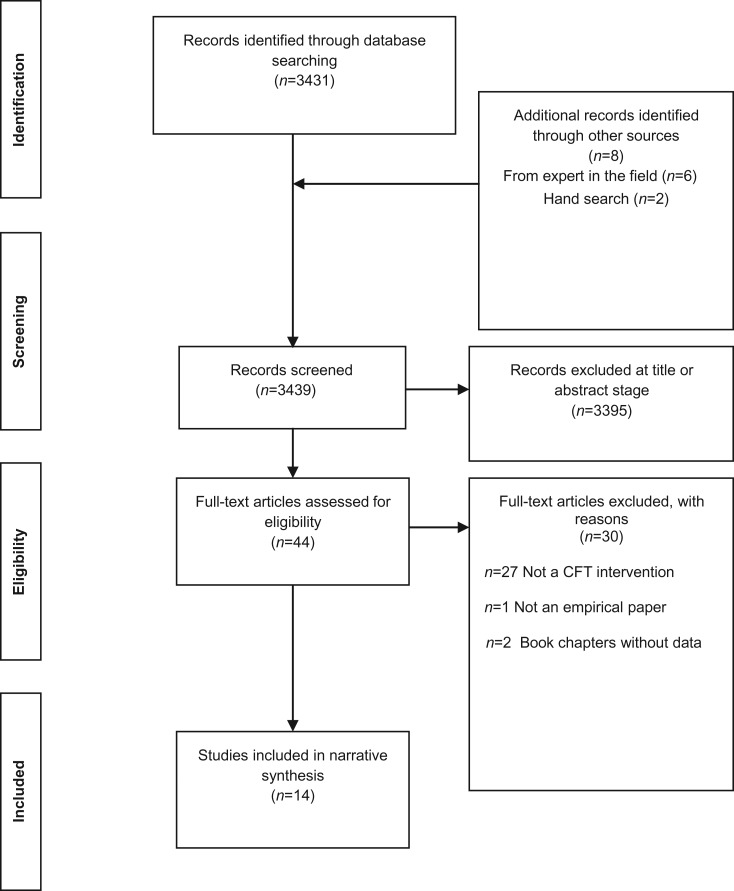
BACKGROUND: Compassion-focused therapy (CFT) is a relatively novel form of psychotherapy that was developed for people who have mental health problems primarily linked to high shame and self-criticism. The aim of this early systematic review was to draw together the current research evidence of the effectiveness of CFT as a psychotherapeutic intervention, and to provide recommendations that may inform the development of further trials. METHOD: A comprehensive search of electronic databases was undertaken to systematically identify literature relating to the effectiveness of CFT as a psychotherapeutic intervention. Reference lists of key journals were hand searched and contact with experts in the field was made to identify unpublished data. RESULTS: Fourteen studies were included in the review, including three randomized controlled studies. The findings from the included studies were, in the most part, favourable to CFT, and in particular seemed to be effective for people who were high in self-criticism. CONCLUSIONS: CFT shows promise as an intervention for mood disorders, particularly those high in self-criticism. However, more large-scale, high-quality trials are needed before it can be considered evidence-based practice. The review highlights issues from the current evidence that may be used to inform such trials.
Overview
The claims and statistics of this paper haven’t been checked yet.
Run the check — free, no account needed. It reads the open-access text and checks the sources it cites.
Integrity signals
Registry
Cites
Statistics
Figures
Verification
Claims the paper makes
The claims and statistics of this paper haven’t been checked yet.
Run the check — free, no account needed. It reads the open-access text and checks the sources it cites.
Claims other papers make about this one
Each is checked against this paper’s own text: does it say what the citing paper says it does?
The source backs part of the claim, not all of it — or backs it for a different population, condition or comparison.
In the citing paper
“A number of studies have provided empirical evidence for CFT’s effectiveness in treating a range of conditions, including mood and anxiety disorders (Leaviss and Uttley, 2015; Wilson et al., 2018), substance use disorders (Held et al., 2018), and OCD (Petrocchi et al., 2021).”
From Feasibility and preliminary outcomes of compassion-focused acceptance and commitment therapy delivered via telehealth in a community behavioral health clinic (2025) · cites this paper as Leaviss and Uttley, 2015
Experimental — accuracy not yet measuredThe source backs part of the claim, not all of it — or backs it for a different population, condition or comparison.
In the citing paper
“Pre-treatment shame proneness, which has been demonstrated to be correlated with self-compassion/self-criticism and has also been shown to be a predictor of response to compassion-focused interventions (Leaviss and Uttley, 2015), was not as consistently connected to treatment effect in this study.”
From Feasibility and preliminary outcomes of compassion-focused acceptance and commitment therapy delivered via telehealth in a community behavioral health clinic (2025) · cites this paper as Leaviss and Uttley, 2015
Experimental — accuracy not yet measuredThe source backs part of the claim, not all of it — or backs it for a different population, condition or comparison.
In the citing paper
“Notably, Leaviss and Uttley [72] demonstrated that CFT yields multiple therapeutic advantages, especially for individuals characterized by high self-criticism, such as maladaptive perfectionists.”
From The Influence of Positive and Negative Aspects of Perfectionism on Psychological Distress in Emerging Adulthood: Exploring the Mediating Role of Self-Compassion (2023) · cites this paper as [72]
Experimental — accuracy not yet measuredThe source backs part of the claim, not all of it — or backs it for a different population, condition or comparison.
In the citing paper
“CFT and CMT have been shown to reduce suffering and improve QoL in a range of health problems such as anxiety/depression, eating disorders, phobias and pain management30–33”
From SafeSpace: what is the feasibility and acceptability of a codesigned virtual reality intervention, incorporating compassionate mind training, to support people undergoing cancer treatment in a clinical setting? (2022) · cites this paper as [31]
Experimental — accuracy not yet measuredThe cited source says what the claim attributes to it.
In the citing paper
“While the earliest review of selfcompassion-related therapies concluded that treatment effectiveness was difficult to evaluate given methodological weaknesses in the field (Leaviss and Uttley 2015)”
From Effectiveness of Self-Compassion Related Therapies: a Systematic Review and Meta-analysis (2019) · cites this paper as Leaviss and Uttley 2015
The cited source says what the claim attributes to it.
In the citing paper
“Treatment effect, as measured by quantitative outcome and process measures, may be related to pre-treatment levels of psychological inflexibility, and self-criticism/self-compassion, consistent with Leaviss and Uttley’s (2015) finding that those exhibiting higher self-criticism benefit most from compassion-focused interventions”
From Feasibility and preliminary outcomes of compassion-focused acceptance and commitment therapy delivered via telehealth in a community behavioral health clinic (2025) · cites this paper as Leaviss and Uttley’s (2015)
The cited source says what the claim attributes to it.
In the citing paper
“There is empirical evidence of CFT and other compassion-based interventions in reducing psychopathology, shame, and self-criticism, and improving well-being (Kirby, 2017; Leaviss & Uttley, 2015), particularly with adolescents (Bluth et al., 2016; Figueiredo et al., 2021)”
From THE EFFICACY OF A COMPASSION, ACCEPTANCE AND MINDFULNESS-BASED PILOT INTERVENTION FOR ADOLESCENTS’ TEST ANXIETY: A CASE STUDY USING THE ACADEMIC PROGRAM (2023) · cites this paper as Leaviss & Uttley, 2015
The cited source says what the claim attributes to it.
In the citing paper
“This growing body of literature has been synthesized in several systematic reviews, which generally conclude that CFT appears efficacious in treating a range of clinical populations, although the existing studies vary considerably in terms of study quality and content of the therapeutic intervention and -format (Beaumont and Martin, 2015; Craig et al., 2020; Leaviss and Uttley, 2015).”
From Group-based compassion-focused therapy for prolonged grief symptoms in adults – Results from a randomized controlled trial (2022) · cites this paper as Leaviss and Uttley, 2015
The cited source says what the claim attributes to it.
In the citing paper
“CFT aims to facilitate compassion in order to increase psychological well-being (Leaviss and Uttley, 2015).”
From Group-based compassion-focused therapy for prolonged grief symptoms in adults – Results from a randomized controlled trial (2022) · cites this paper as Leaviss and Uttley, 2015
The cited source says what the claim attributes to it.
In the citing paper
“As the evidence base of using CFT in groups emerges, researchers have trialled a number of different durations of groups and follow-up periods.16”
In the citing paper
“Cultivating compassion for self and others has also become a central focus for the development of psychotherapies [35, 37, 40, 61, 67, 69, 77, 96].”
From The development of compassionate engagement and action scales for self and others (2017) · cites this paper as [77]
In the citing paper
“it is likely that most compassion focused therapies, for which there a few now [69] work in both direct and indirect ways on mental health problems [67, 69, 77].”
From The development of compassionate engagement and action scales for self and others (2017) · cites this paper as [77]
Self-check
Percentages, sums and reported differences re-computed from the paper’s own numbers.
The self-check needs the paper’s full text.
Citations
Cites
Preferred reporting items for systematic reviews and meta-analyses: the PRISMA Statement.
(2009) · PubMed Central · Cited by 44,859
Preferred reporting items for systematic reviews and meta-analyses: The PRISMA statement
Moher, D., Liberati, A., Tetzlaff, J., Altman, D. G., & the PRISMA Group* (2009) · Annals of Internal Medicine · doi:10.7326/0003-4819-151-4-200908180-00135 · Cited by 37,554
The Cochrane Collaboration's tool for assessing risk of bias in randomised trials
Higgins, J. P. T., Altman, D. G., Gotzsche, P. C., Juni, P., Moher, D., Oxman, A. D., Savovic, J., Schulz, K. F., Weeks, L., Sterne, J. A. C., et al. (2011) · BMJ · doi:10.1136/bmj.d5928 · Cited by 33,817
Preferred Reporting Items for Systematic Reviews and Meta-Analyses: The PRISMA Statement
Moher, D., Liberati, A., Tetzlaff, J., & Altman, D. G. (2009) · Journal of Clinical Epidemiology · doi:10.1016/j.jclinepi.2009.06.005 · Cited by 19,575
Grading quality of evidence and strength of recommendations
(2004) · BMJ · doi:10.1136/bmj.328.7454.1490 · Cited by 8,477
(1996) · Cited by 3,692
A conceptual framework for implementation fidelity
Carroll, C., Patterson, M., Wood, S., Booth, A., Rick, J., & Balain, S. (2007) · Implementation Science · doi:10.1186/1748-5908-2-40 · Cited by 2,559
Fredrickson, B. L., Cohn, M. A., Coffey, K. A., Pek, J., & Finkel, S. M. (2008) · Journal of Personality and Social Psychology · doi:10.1037/a0013262 · Cited by 2,365 · cited 3×
“Similarly, the practice of ‘loving kindness’-based meditation has been shown to increase positive emotions, mindfulness, feelings of purpose in life and social support, and to decrease illness symptoms (Fredrickson et al. 2008). From a biological perspective, the practice of CM has been shown to reduce stress-linked i…”
BackgroundThe Handbook of evolutionary psychology
(2006) · Choice Reviews Online · doi:10.5860/choice.44-0622 · Cited by 2,128
Exploring compassion: A meta-analysis of the association between self-compassion and psychopathology
MacBeth, A., & Gumley, A. (2012) · Clinical Psychology Review · doi:10.1016/j.cpr.2012.06.003 · Cited by 1,838 · cited 2×
“The meta-analysis by Macbeth & Gumley (2012) supports this relationship.”
BackgroundMethod
Research works printed but not linked: 2
- 2001, An Open Heart: Practicing Compassion in Everyday Life
- 2004, Guideline Development Methods. Information for National Collaborating Centres and Guideline Developers
Cited by
Sorted by citations
Items 401–500 of 545
Melchert, T. P. (2020) · Cambridge University Press eBooks · doi:10.1017/9781108650182.004 · Cited by 1
Riches, S., Brownell, T., Schrank, B., Lawrence, V. C., Rashid, T., & Slade, M. (2020) · Clinical Psychology Forum · doi:10.53841/bpscpf.2020.1.336.41 · Cited by 1
Efficacy of Compassion Focused Therapy for Managing Skin Shaming of Acne in Young Women
Khan, A., & Bilal, A. (2023) · THE THERAPIST (Journal of Therapies & Rehabilitation Sciences) · doi:10.54393/tt.v4i1.99
Gilbert, P. (2017) · The SAGE Encyclopedia of Abnormal and Clinical Psychology · doi:10.4135/9781483365817.n304 · Cited by 1
IsHak, W. W. (2020) · Cambridge University Press eBooks · doi:10.1017/9781108650182.052 · Cited by 2
Bolton, M. J., Ault, L. K., Burton, K. W., & Lazzaro, A. (2022) · doi:10.31234/osf.io/2czxh · Cited by 2
Leboeuf, I. (2021) · theses.fr (ABES) · doi:10.70675/88602588z101cz4c13zb58ezc5a04c3c7f99 · Cited by 1
Sodimu, S., Bird, R., Bailey, A., & O'hAnrachtaigh, E. (2026) · Counselling and Psychotherapy Research · doi:10.1002/capr.70150
“Moreover, these improvements may be limited to the mental health of clients and not be as helpful in supporting their holistic well-being and practical difficulties they may face (Leaviss and Uttley 2014).”
Kämpe, C., & Rosendahl-Santillo, A. (2015) · Lund University Publications Student Papers (Lund University)
What’s UP – Unified Protocol med unga vuxna
Müller, K., & Persson, M. (2015) · KTH Publication Database DiVA (KTH Royal Institute of Technology)
Hardiman, M. (2015) · UEL Research Repository (University of East London) · doi:10.15123/pub.4623 · Cited by 1
Relationen mellan mindfulness, självmedkänsla och upplevd stress bland universitetsstudenter
Sandberg, V., & Modig, S. (2016) · KTH Publication Database DiVA (KTH Royal Institute of Technology)
Cwinn, E. (2018) · The Atrium (University of Guelph)
The relationship between self-compassion and chronic depression: a cross-sectional clinical study
da Silva, J. E., & Simões, S. C. C. (2019) · The Psychologist Practice & Research Journal · doi:10.33525/pprj.v1i2.26
The Case of Jerome Ocean: A Student’s Classic Conundrum
Green, C. R., & Gordon-Elliott, J. S. (2019) · Springer eBooks · doi:10.1007/978-3-030-10952-3_20
Cognitive Behavioral Stress Management Training for Nursing Students
Terp, U. (2019) · Diva portal (Dalarna University Library)
Mental health and behaviour in childhood dystonia
Bates, L. (2018)
Author, U. (2019) · Lincoln Repository (University of Lincoln) · doi:10.24385/lincoln.24326158
Fernandes, M., Galhardo, A. B., & Massano‐Cardoso, I. (2020) · Revista Portuguesa de Investigação Comportamental e Social · doi:10.31211/rpics.2020.6.1.162 · Cited by 2
Mindfulness, Meditation, and Yoga
Budd, K. (2020) · Cambridge University Press eBooks · doi:10.1017/9781108650182.028
Work, Love, Play, and Joie de Vivre
Groningen, N. V., IsHak, W. W., Ganjian, S., Ong, M. K., & Slusser, W. M. (2020) · Cambridge University Press eBooks · doi:10.1017/9781108650182.045
Acupuncture, Herbs, and Ayurvedic Medicine
Postolov, L., & Gilberg-Lenz, S. (2020) · Cambridge University Press eBooks · doi:10.1017/9781108650182.031
Circadian Rhythm in the Digital Age
Ezzat-Velinov, M., & Guarneri, M. (2020) · Cambridge University Press eBooks · doi:10.1017/9781108650182.035
Chaudhry, M., Gordon, A., Tadros, E., Sun, C., Tobia, G., & IsHak, W. W. (2020) · Cambridge University Press eBooks · doi:10.1017/9781108650182.019
The Personalized Wellness Life Plan
IsHak, W. W., Bart, R., Gohar, Y., Lorea, N., Eskander, L., Chang, T., Cohen, S., Furman, K., Nayyar, P. P., & DeBonis, K. (2020) · Cambridge University Press eBooks · doi:10.1017/9781108650182.050
Exercise, Dance, Tai Chi, Pilates, and Alexander Technique
Altug, Z. (2020) · Cambridge University Press eBooks · doi:10.1017/9781108650182.025
Louy, C., Sweet, C., Pollock, G. A., de Zagon, C., Louy, Z., Weiss, J. M., & Maher, D. P. (2020) · Cambridge University Press eBooks · doi:10.1017/9781108650182.017
Pharmaceuticals and Alternatives for Wellness
Parisi, T., Heath, B., Wen, R. Y., & IsHak, W. W. (2020) · Cambridge University Press eBooks · doi:10.1017/9781108650182.024
Bucciarelli, A., Ellison, G. K., Sommer, E. K., & Spooner, H. (2020) · Cambridge University Press eBooks · doi:10.1017/9781108650182.036
Screening and Assessment Methods for Wellness
Greenberg, J. M., Castillo, E. G., IsHak, W. W., & Wells, K. B. (2020) · Cambridge University Press eBooks · doi:10.1017/9781108650182.002
The Role of Leisure, Recreation, and Play in Health and Well-Being
Payne, L. L., & An, J. (2020) · Cambridge University Press eBooks · doi:10.1017/9781108650182.048
Positive Neuropsychology, Cognitive Rehabilitation, and Neuroenhancement
Pimental, P. A., O'Hara, J. B., Christopher, J., & Ciampanelli, A. (2020) · Cambridge University Press eBooks · doi:10.1017/9781108650182.030
Wellness in Children and Adolescents
Zanko, C., & Stuber, M. L. (2020) · Cambridge University Press eBooks · doi:10.1017/9781108650182.016
Connection, Compassion, and Community
Hedrick, R., & Jones, K. (2020) · Cambridge University Press eBooks · doi:10.1017/9781108650182.043
Wellness Interventions for Chronicity and Disability
Klimowicz, A., Schussel, L., & IsHak, W. W. (2020) · Cambridge University Press eBooks · doi:10.1017/9781108650182.044
Mays, A. M., Whiteman, E., & Rosen, S. L. (2020) · Cambridge University Press eBooks · doi:10.1017/9781108650182.015
Developing Purpose, Meaning, and Achievements
Vilhauer, J. S. (2020) · Cambridge University Press eBooks · doi:10.1017/9781108650182.041
Sleep, Rest, and Relaxation in Improving Wellness
Ngor, A., & IsHak, W. W. (2020) · Cambridge University Press eBooks · doi:10.1017/9781108650182.026
The Biopsychosocial Assessment
Somjee, L., & Esbitt, S. A. (2020) · Cambridge University Press eBooks · doi:10.1017/9781108650182.003 · Cited by 1
Wellness and the Genito-Urinary System
EILBER, K. S., & Lee, U. J. (2020) · Cambridge University Press eBooks · doi:10.1017/9781108650182.010
Marin, K., Tobia, G., Bakhoum, A., Naghdechi, L., Korouri, S., & IsHak, W. W. (2020) · Cambridge University Press eBooks · doi:10.1017/9781108650182.027
Cardiovascular and Pulmonary Wellness
IsHak, W. W., & Herrera, N. (2020) · Cambridge University Press eBooks · doi:10.1017/9781108650182.008
Wellness in Endocrine and Metabolic Disorders
Clevenger, S., Eskander, L., Lin, T. Y., & IsHak, W. W. (2020) · Cambridge University Press eBooks · doi:10.1017/9781108650182.013
The Concept of Wellness in Psychiatric and Substance-Use Disorders
Awad, A. G. (2020) · Cambridge University Press eBooks · doi:10.1017/9781108650182.006
Wellness and Whole-Person Care
Hutchinson, T. A., & Hutchinson, N. (2020) · Cambridge University Press eBooks · doi:10.1017/9781108650182.049
Herrera, N., & IsHak, W. W. (2020) · Cambridge University Press eBooks · doi:10.1017/9781108650182.040
Wellness in Cancer and Neoplastic Diseases
Bashmi, L., & IsHak, W. W. (2020) · Cambridge University Press eBooks · doi:10.1017/9781108650182.018
Wellness Interventions for Physicians and Healthcare Professionals
Goldenberg, M., & Danovitch, I. (2020) · Cambridge University Press eBooks · doi:10.1017/9781108650182.021
Neurological and Neurosurgical Disorders and Wellness
Ding, K., & Yang, I. (2020) · Cambridge University Press eBooks · doi:10.1017/9781108650182.007
Gastrointestinal System and Wellness
Robbins, L., & Feldman, E. J. (2020) · Cambridge University Press eBooks · doi:10.1017/9781108650182.009
Outcome of First-admission Depression Treated in a Specialized Mood Disorders Service
Thekiso, T. B., McLoughlin, D. M., Hartnett, Y., Casey, S. J., Orji, A. M. O. A. U. F., Heron, E. A., Rush, G., & Kennedy, N. (2020) · Journal of Psychiatric Practice · doi:10.1097/pra.0000000000000509
Sayar, H., & Hjeltnes, A. (2021) · Journal of Contemporary Psychotherapy · doi:10.1007/s10879-020-09482-4
Bowins, B. E. (2021) · Elsevier eBooks · doi:10.1016/b978-0-323-85049-0.00014-3
Seo, J., & Chang, H. (2021) · THE KOREAN JOURNAL OF DEVELOPMENTAL PSYCHOLOGY · doi:10.35574/kjdp.2021.3.34.1.1
van den Brink, E., & Koster, F. (2021) · Springer eBooks · doi:10.1007/978-3-030-57733-9_7
Shams, G., Pashang, S., & Sedaghat, M. (2021) · Journal of Preventive Medicine · doi:10.52547/jpm.8.1.80
Vimalakanthan, K. (2021) · UWSpace (University of Waterloo)
大地, 菅., 楓, 福., Kojiro, T., & 拓実, 林. (2021) · Journal of Health Psychology Research · doi:10.11560/jhpr.200208147
IsHak, W. W. (2020) · Cambridge University Press eBooks · doi:10.1017/9781108650182.051
Lundy, J. (2020) · Cambridge University Press eBooks · doi:10.1017/9781108650182.022
IsHak, W. W., Mann, A., Manoukian, V., Pakhdikian, S., Chaudhry, M., Liu, A., & Bart, R. (2020) · Cambridge University Press eBooks · doi:10.1017/9781108650182.001 · Cited by 2
Depression, Self-Criticism, and Nonsuicidal Self-Injury: A Prospective Investigation in Young AdultsPreprint
Victor, S. E., Mitchell, S. M., & Ingram, P. B. (2021) · doi:10.31234/osf.io/g7x6k
Compassion apps for better mental health, a qualitative review. (Preprint)Preprint
de Krijger, E., Bohlmeijer, E. T., Geuze, E., & Kelders, S. M. (2019) · doi:10.2196/preprints.14409
(2020) · Vandenhoeck & Ruprecht eBooks · doi:10.13109/9783666404986.233
IsHak, W. W. (2020) · Cambridge University Press eBooks · doi:10.1017/9781108650182.053
الخوف من السعادة وعلاقته بنقد الذات لدى طلبة جامعة اليرموك
(2022) · Jordan Journal of Educational Sciences · doi:10.47015/18.3.4
Laute, V. (2020) · FPID Bulletin The Bulletin of the Faculty for People with Intellectual Disabilities · doi:10.53841/bpsfpid.2020.18.3.23
Wood, F. (2020) · Clinical Psychology Forum · doi:10.53841/bpscpf.2020.1.333.61
Analysis of the Novel of My Sweet Orange Tree in the Context of Self-Compassion
Keleş, F. B., Ak, M., & Kesici, Ş. (2023) · Research on education and psychology · doi:10.54535/rep.1282261
Shamsnajafi, Z. S., Hasanzadeh, R., & Emadian, S. O. (2023) · journal of Adolescent and Youth Psychological Studies · doi:10.61186/jayps.4.5.76
Scham und Psychotherapie: Theorie, Methoden und Praxis
Sinha, M. (2023) · Springer eBooks · doi:10.1007/978-3-031-36229-3_11
Didehban, E., Ayoubi, S., Tabesh, H., Mohammad‐Zadeh, M., Saleh, L. A., & Asgharipour, N. (2024) · Iranian Journal of Psychiatry and Behavioral Sciences · doi:10.5812/ijpbs-138912
Translation of Eastern Meditative Disciplines into Western Psychotherapy
Semple, R. J., & Hatt, S. P. (2024) · Oxford University Press eBooks · doi:10.1093/oxfordhb/9780190905538.013.20
الله, م. خ. م. ع., & بكر, أ. س. ص. أ. (2023) · مجلة الإرشاد النفسی · doi:10.21608/cpc.2024.263038.1052
Introduction to the EMBARK Approach
Brennan, B., & Belser, A. (2024) · Oxford University Press eBooks · doi:10.1093/9780197762622.003.0003
Brennan, B., & Belser, A. (2024) · Oxford University Press eBooks · doi:10.1093/9780197762622.003.0006
Bringing It Home and Carrying It Forward
Brennan, B., & Belser, A. (2024) · Oxford University Press eBooks · doi:10.1093/9780197762622.003.0009
Considerations Prior to Meeting With a Participant
Brennan, B., & Belser, A. (2024) · Oxford University Press eBooks · doi:10.1093/9780197762622.003.0005
INTRODUCTION: A New Approach for the Whole Person
Brennan, B., & Belser, A. (2024) · Oxford University Press eBooks · doi:10.1093/9780197762622.003.0001
Choosing Suggested Integration Goals
Brennan, B., & Belser, A. (2024) · Oxford University Press eBooks · doi:10.1093/9780197762622.005.0004
Working Within the EMBARK Domains Cheat Sheet
Brennan, B., & Belser, A. (2024) · Oxford University Press eBooks · doi:10.1093/9780197762622.005.0003
Brennan, B., & Belser, A. (2024) · Oxford University Press eBooks · doi:10.1093/9780197762622.003.0007
Brennan, B., & Belser, A. (2024) · Oxford University Press eBooks · doi:10.1093/9780197762622.005.0002
An Overview of Psychedelic-Assisted Therapy
Brennan, B., & Belser, A. (2024) · Oxford University Press eBooks · doi:10.1093/9780197762622.003.0002
Personal Care for the Therapist
Brennan, B., & Belser, A. (2024) · Oxford University Press eBooks · doi:10.1093/9780197762622.005.0001
Brennan, B., & Belser, A. (2024) · Oxford University Press eBooks · doi:10.1093/9780197762622.003.0008
Brennan, B., & Belser, A. (2024) · Oxford University Press eBooks · doi:10.1093/9780197762622.002.0004
EMBARK Mechanisms of Change in the Treatment of Depression
Brennan, B., & Belser, A. (2024) · Oxford University Press eBooks · doi:10.1093/9780197762622.003.0004
Hackley, J., Dixon, A., Royle, C., Moss, C., Brown, R. J., & Bell, T. (2024) · OBM Integrative and Complementary Medicine · doi:10.21926/obm.icm.2401021
Scham überwinden: Perspektiven der Positiven Psychologie
Alex, A., & Farisha, A. T. P. (2024) · Springer eBooks · doi:10.1007/978-3-031-52011-2_10
Alkhathami, S. S., Abbady, A. S., Ahmed, E., Teleb, A. A., & Marashdh, M. (2024) · International Journal of Interactive Mobile Technologies (iJIM) · doi:10.3991/ijim.v18i09.48871
Yavari, Y., Khoshakhlagh, H., & zadeh, M. S. (2023) · Journal of Health and Care · doi:10.61186/jhc.25.2.121
Bovero, A., Tos, C., Pesce, S., Pidinchedda, A. V., Botto, R., Ostacoli, L., & Malandrone, F. (2024) · Journal of Health Psychology · doi:10.1177/13591053241273577
GRACE ‐4 letter to the editor “Opening invisible wounds” response
Borgundvaag, B., Sheikh, H., & Authors, T. G. (2024) · Academic Emergency Medicine · doi:10.1111/acem.15071
From Dharma to Dialogue: A Scoping Review of Couple Interventions Based on Buddhist Wisdom
Mary, T., & Gopal, B. (2025) · Contemporary Family Therapy · doi:10.1007/s10591-024-09726-8 · Cited by 1
Compassion-Focused Therapy und Metta-basierte Therapie: Ein systematisches Review
Kreis, M., Arens, E. A., Hofmann, S. G., & Stangier, U. (2025) · Verhaltenstherapie · doi:10.1159/000542737 · Cited by 1
Ünsal, C., & Mavi, M. K. (2025) · Archives of Current Medical Research · doi:10.47482/acmr.1599602
Metadata
- Authors
- Leaviss, J., & Uttley, L.
- Affiliations
- University of Sheffield (GB)
- Corresponding author
- Leaviss, J.
- Venue
- Psychological Medicine
- Publisher
- Cambridge University Press (CUP)
- Published
- 2014-09-12
- Volume
- 45
- Issue
- 5
- Pages
- 927-945
- ISSN
- 0033-2917 (ISSN-L)
- 1469-8978
- PMC
- PMC4413786
- OpenAlex
- W2150285866
- Cited by
- 546
- References
- 64
- Citations by year
- 2026: 34 · 2025: 48 · 2024: 55 · 2023: 50 · 2022: 50 · 2021: 56 · 2020: 104 · 2019: 41 · 2018: 28 · 2017: 41 · 2016: 19 · 2015: 17 · 2014: 1
- FWCI
- 3.93
- Type
- journal article
- Language
- en
- Open access
- hybrid
- doi.org
- Locations
- Psychological Medicine (publishedVersion, cc-by)
- Europe PMC (PubMed Central) (publishedVersion, cc-by)
- PubMed Central (publishedVersion, cc-by)
- PubMed (publishedVersion)
- White Rose Research Online (University of Leeds, The University of Sheffield, University of York) (acceptedVersion)
- Funders
- University of Sheffield
- Topics
- Social Sciences › Psychology › Clinical Psychology › Mindfulness and Compassion Interventions
- Social Sciences › Psychology › Clinical Psychology › Psychotherapy Techniques and Applications
- Social Sciences › Psychology › Experimental and Cognitive Psychology › Anxiety, Depression, Psychometrics, Treatment, Cognitive Processes
- Keywords
- compassion-focused therapy, shame, self-criticism, mood disorders, treatment efficacy, evidence-based practice
- MeSH terms
- Mental Disorders, Empathy, Humans, Psychotherapy, Self Concept, Shame, Treatment Outcome
About these checks
Registry, retraction, Cites and statistics results are computed, not judged, with one exception: a printed reference that no index lists is read once by a model before it counts as a citation error. Claims are extracted by a model and kept only when their quote appears verbatim in the text; each cited source is then checked, with a model’s help, for whether it says what the claim relies on. Those verdicts can be wrong — read the claim’s quote and the cited source before relying on one.
Statistics and arithmetic are recomputed, not judged.
Confidence bands are shown only for fields calibrated on our annotated test set. None is calibrated yet, so no band is shown.
What counts as a claim ›How we measure confidence ›How we check this ›
Are you an author, or do you see a problem with this page? Request a review
